REVIEW 3 major objections 4 minor 28 references
Two Decades of Network Science as seen through the co-authorship network of network scientists
T0 review · 3 major / 4 minor · reviewed 2026-08-14 · deepseek-v4-flash
Pith's one-line read A co-authorship network built from papers citing three landmark studies shows network science becoming a single, connected community over two decades.
desk verdict A solid, well-documented descriptive map of the network-science community that needs a name-disambiguation robustness check before the connectivity claims are fully convincing. read the letter →
The pith
A machine-rendered reading of the paper's core claim, the machinery that carries it, and where it could break.
The reading
What carries the argument
The load-bearing construction is the co-authorship network of network scientists. A node is any author of a paper citing at least one of three seminal works, and an edge joins two authors who co-authored at least one such citing paper. This single definition supplies the corpus, the vertex set, and the edge set, so the entire analysis depends on it. On top of this network the paper uses Clauset–Newman–Moore greedy modularity maximization for communities, betweenness and harmonic centrality for author importance, and a country-level collaboration graph for international patterns.
What would settle it
Recompute the giant component ratio and the centrality–citation correlation using a different definition of network science, for instance papers published in network-science-specific journals or papers citing a broader set of landmark works. If the giant component drops far below 62.8% or the centrality–citation correlation weakens substantially, the paper's portrait of a single, connected community is an artifact of the citation proxy.
Extended reading notes
Core claim
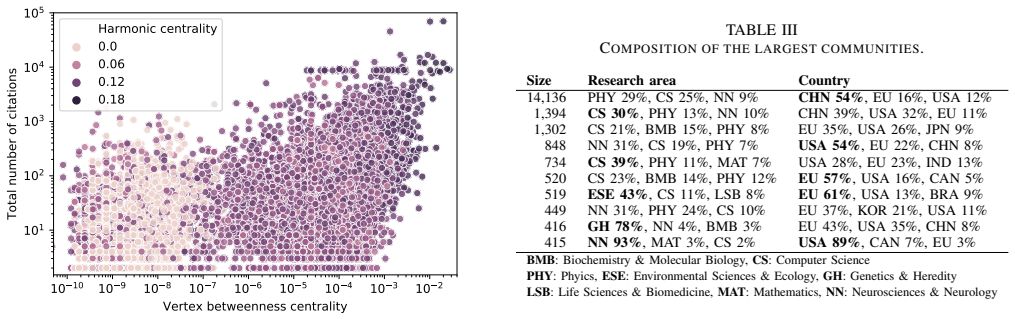
The central discovery is a structural portrait: network science, as delimited by citing one of three milestone papers, is not a fragmented collection of sub-disciplines but a single growing component. The largest connected component of the co-authorship network comprises 32,904 of 52,406 authors (62.8%), a fraction that increased over time. Community detection reveals ten large communities, with the largest (14,136 authors) dominated by Chinese physicists, and smaller communities that are more homogeneous in discipline and country. Centrality in the co-authorship network correlates strongly with citation counts, so position in the collaboration graph tracks scientific impact.
Load-bearing premise
The whole analysis assumes that 'network science paper' can be defined as any paper citing at least one of the three selected milestone papers, even though the authors admit this is arbitrary and will both miss real network science and include unrelated citing papers.
Editorial extensions
If this is right
- If the proxy is faithful, the field's cohesion has been increasing over time, and the 62.8% giant component ratio is the quantitative signature of that cohesion.
- Centrality in the co-authorship network can serve as a proxy for scientific impact where citation data are unavailable or unreliable.
- The community structure implies that network science is held together by a few interdisciplinary bridges rather than by uniformly dense collaboration, since the largest community is a Chinese physics-heavy cluster.
- The spatiotemporal data imply that China and the US dominate production, and that international collaborations are concentrated among European countries and the US.
Reading between the lines
- A testable extension would be to treat the three landmark papers as a fixed seed set and vary the citation distance (direct citers only versus two-hop citers) to see whether the giant component ratio is stable; if it collapses, the boundary of the field is much fuzzier than the paper suggests.
- The same construction could be applied to other fields with identifiable founding papers, turning 'a community that cites X' into a general tool for mapping disciplinary emergence.
- The centrality–citation correlation could be compared against a null model of random rewiring, which would separate genuine structural advantage from the mere fact that highly cited authors appear in many papers and therefore have high degree.
Signed reviews
Editorial analysis
A structured set of objections, weighed in public.
Referee Report
Summary. This paper constructs and analyzes the co-authorship network of 52,406 researchers who have at least one paper citing at least one of three seminal network science papers (Watts & Strogatz 1998, Barabási & Albert 1999, Girvan & Newman 2002). The authors characterize the papers themselves (research areas, journals, keywords, countries), then study the topology and dynamics of the co-authorship network: degree distribution, clustering, centralities, community structure, and the growth of the largest connected component over time. They find that the largest component has grown to 62.8% of the network, interpret this as evidence of a 'diverse but not divided' community, and report a correlation between centrality and citation counts. The anonymized data are made available in a GitHub repository.
Significance. If the data-construction choices hold up, this is a useful descriptive and reference contribution: it provides a large, openly available co-authorship dataset for a field-defining citation-based population, and it quantifies the community's evolution over 20 years. The authors are appropriately careful in places—they explicitly acknowledge that the citation-based definition of 'network science' is arbitrary, they share their data, and they rely on standard graph metrics. The central claims about growing connectivity and community diversity are falsifiable and important for the science-of-science literature. However, the validity of the headline connectivity results depends on author name disambiguation, and the paper's treatment of that issue is inadequate for this specific dataset.
major comments (3)
- [Section III, Data collection and preparation] The claim that the error from conflating distinct authors with identical full names is 'negligible, as also pointed out by Newman [22] and by Barabasi et al. [20]' is not supported for this dataset. Table III shows the largest community is 54% Chinese, and Web of Science full-name strings for Chinese authors are typically short pinyin with high collision rates. The cited prior works examined smaller or different datasets, so they cannot justify this conclusion here. Since the growth of the giant component (Fig. 10) is the central evidence for the 'diverse but not divided' claim, the authors should quantify the collision rate in their dataset or demonstrate sensitivity of the main results to name-merging choices (e.g., by re-running the analysis with conservative splitting heuristics or by validating against ORCID data). Without such a check, the headline connectivity numbers rest on an unvalidated assumption.
- [Section V, Analysis of the co-authorship network] The reported global clustering coefficient of 0.98 is surprisingly high and is presented without explanation or a clear definition. The paper also reports an average local clustering coefficient of 0.77 and an average degree of 12.56; a transitivity of 0.98 in a network with that density is extreme and not self-evidently plausible. The authors should state whether 'global clustering coefficient' means the fraction of closed triples among all triples, the average local clustering, or some other quantity, and they should verify the computation. If the value is correct, a brief discussion of why co-authorship networks achieve such high transitivity (e.g., due to large-author papers) would help; if it is an artifact of the definition, the text currently overstates the clustering.
- [Section II and Section V] The authors acknowledge that the definition of a network science paper (citing at least one of three selected papers) is arbitrary, but they do not test how robust their conclusions are to this choice. In particular, the growth of the giant component, the high clustering, and the centrality–citation correlation could in principle depend on the set of root papers or the citation-threshold. I ask for at least a limited sensitivity analysis—for example, varying the set of seminal papers (e.g., dropping one of the three) or using a stricter citation requirement—to show that the main findings are not artifacts of the specific definition. This would materially strengthen the paper's claim to describe 'the network science community' rather than merely the selected citing population.
minor comments (4)
- [Table II] The column headers for Table II are ambiguous: the text lists 'betweenness' and 'harmonic' centralities, but the table layout is unclear about which column corresponds to which measure. Please add explicit headers or break the table into separate columns with clear labels.
- [Section V, Fig. 9] The text states there is 'a strong correlation' between centrality and citation count, but no correlation coefficient or statistical test is reported. Please provide the Pearson and/or Spearman correlation values, or otherwise quantify the strength of the association.
- [Section III] The sentence 'the error introduced by this problem is negligible, as also pointed out by Newman [22] and by Barab'asi et al. [20]' should be rephrased: the cited works do not establish that the error is negligible in a dataset with the demographic composition of the present one; at minimum, the statement should be presented as an assumption rather than a conclusion.
- [Throughout] There are minor typographical errors: 'world clouds' should be 'word clouds' (Section IV), 'measurues' should be 'measures' (Fig. 9 caption), and 'Phyics' appears in the Table III legend. Also, the phrase 'the authors of this article emerge as a maximal clique' (Section V) refers to the 388-author consortium paper; consider clarifying that the consortium members form a clique, not the six listed authors only.
Circularity Check
No significant circularity: the paper is an observational network analysis with an admittedly arbitrary but non-circular definition of the network science community.
full rationale
The paper makes no derived predictions and fits no parameters; it only measures structural properties of a co-authorship network that it constructs from Web of Science records. The definition of a network scientist as a scholar with at least one paper citing one of the three seminal papers is explicitly acknowledged as arbitrary ('The previous definitions of network science paper and network scientist are of course quite arbitrary'), but this definition does not presuppose any of the paper's conclusions about giant-component growth, degree distribution, community composition, or centrality-citation correlation. The main connectivity claim, that the largest component has grown to 62.8% of the network, is a direct empirical measurement, not a consequence of the definition. The handling of name ambiguity is a data-quality limitation, not a circular step: the paper states that identical names cannot be distinguished, calls the issue 'mainly relevant for Asian authors,' and dismisses it as negligible by citing Newman [22] and Barabási et al. [20], both external to the present authors. The only self-citation is [19] (Barabás, Fülöp, Molontay, and Pályi), which is cited merely as an example of a previous co-authorship study of a citing community and is not load-bearing for any argument. Community detection uses the standard Clauset-Newman-Moore algorithm, and the centrality-versus-citations comparison is a measured correlation. No equation or definition is used both as input and output, and no result is forced by a self-citation chain. Therefore the appropriate score is 0.
Assumptions & free parameters
free parameters (2)
- citation threshold for network science paper =
1 (minimum number of citations to any of the three selected papers)
- number of seminal papers used for definition =
3
assumptions (4)
- domain assumption A paper's citation of one of three selected papers identifies it as a network science paper.
- domain assumption Web of Science data (retrieved May 16, 2019) is sufficiently complete and accurate for constructing the network.
- domain assumption Author name disambiguation via dictionary and ignoring same-name collisions for Asian authors introduces negligible error.
- standard math Greedy modularity maximization (Clauset-Newman-Moore) produces meaningful communities in this network.
Cite this review
Pith. "Pith review of Two Decades of Network Science as seen through the co-authorship network of network scientists." pith.science (2026). https://pith.science/paper/TTOHQWM6
@misc{pith2026190808478,
  author       = {Pith},
  title        = {Pith review of: Two Decades of Network Science as seen through the co-authorship network of network scientists},
  year         = {2026},
  howpublished = {\url{https://pith.science/paper/TTOHQWM6}},
  note         = {Machine review of arXiv:1908.08478}
}
read the original abstract
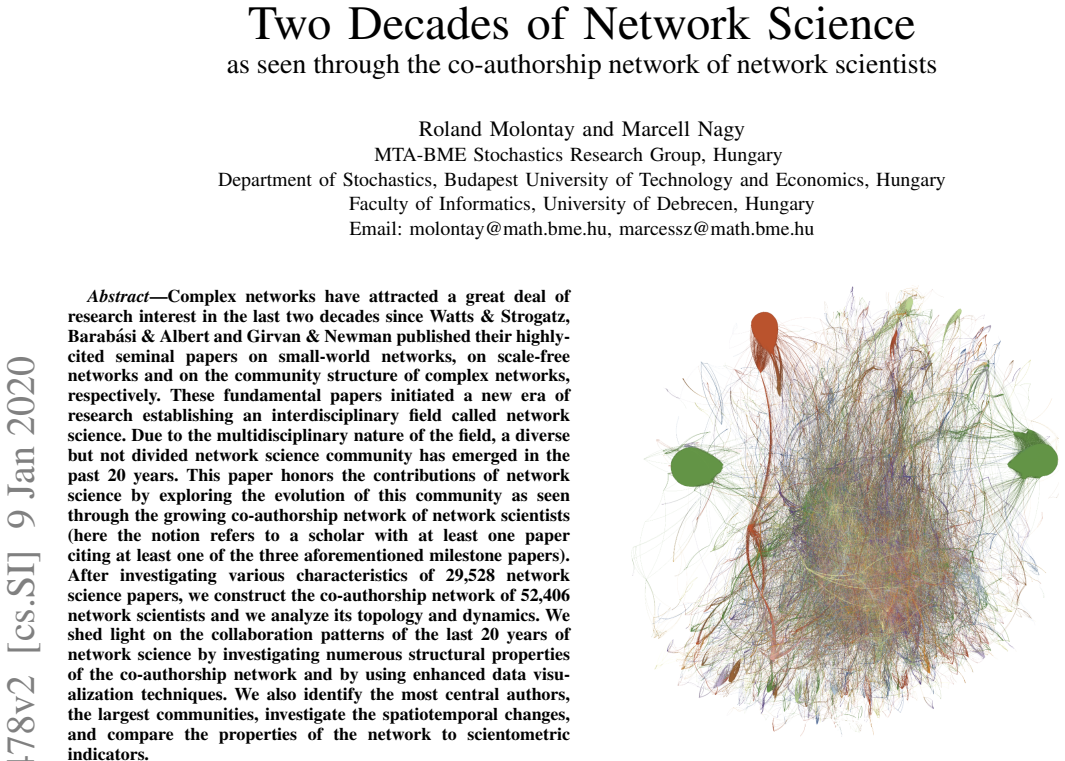
Complex networks have attracted a great deal of research interest in the last two decades since Watts & Strogatz, Barab\'asi & Albert and Girvan & Newman published their highly-cited seminal papers on small-world networks, on scale-free networks and on the community structure of complex networks, respectively. These fundamental papers initiated a new era of research establishing an interdisciplinary field called network science. Due to the multidisciplinary nature of the field, a diverse but not divided network science community has emerged in the past 20 years. This paper honors the contributions of network science by exploring the evolution of this community as seen through the growing co-authorship network of network scientists (here the notion refers to a scholar with at least one paper citing at least one of the three aforementioned milestone papers). After investigating various characteristics of 29,528 network science papers, we construct the co-authorship network of 52,406 network scientists and we analyze its topology and dynamics. We shed light on the collaboration patterns of the last 20 years of network science by investigating numerous structural properties of the co-authorship network and by using enhanced data visualization techniques. We also identify the most central authors, the largest communities, investigate the spatiotemporal changes, and compare the properties of the network to scientometric indicators.
Figures


Figures from the paper (6 more)



Reference graph
Works this paper leans on
-
[22]
The structure of scientific collaboration networks,
M. E. Newman, “The structure of scientific collaboration networks,” Proceedings of the National Academy of Sciences , vol. 98, no. 2, pp. 404–409, 2001
work page 2001
-
[20]
Evolution of the social network of scientific collaborations,
A.-L. Barab ´asi, H. Jeong, Z. N ´eda, E. Ravasz, A. Schubert, and T. Vicsek, “Evolution of the social network of scientific collaborations,” Physica A: Statistical Mechanics and its Applications , vol. 311, no. 3-4, pp. 590–614, 2002
work page 2002
-
[1]
Network science committee on network science for future army applications,
N. R. Council et al. , “Network science committee on network science for future army applications,” 2005
work page 2005
-
[2]
Emergence of scaling in random net- works,
A.-L. Barab ´asi and R. Albert, “Emergence of scaling in random net- works,” Science, vol. 286, no. 5439, pp. 509–512, 1999
1999
-
[3]
Collective dynamics of small-world networks,
D. J. Watts and S. H. Strogatz, “Collective dynamics of small-world networks,” Nature, vol. 393, no. 6684, p. 440, 1998
work page 1998
-
[4]
Community structure in social and biological networks,
M. Girvan and M. E. Newman, “Community structure in social and biological networks,” Proceedings of the National Academy of Sciences , vol. 99, no. 12, pp. 7821–7826, 2002
work page 2002
-
[5]
Network science: A new paradigm shift,
L. Kocarev and V . In, “Network science: A new paradigm shift,” IEEE Network, vol. 24, no. 6, 2010
work page 2010
-
[6]
A.-L. Barab ´asi et al. , Network science . Cambridge Univ. Press, 2016
work page 2016
Show all 28 references
-
[7]
Newman, Networks
M. Newman, Networks. Oxford University Press, 2018
2018
-
[8]
Linked: The new science of networks,
A.-L. Barab ´asi, “Linked: The new science of networks,” 2003
2003
-
[9]
D. J. Watts, Six degrees: The science of a connected age . WW Norton & Company, 2004
2004
-
[10]
Connected: The power of six degrees,
A. T ´alas, “Connected: The power of six degrees,” 2008
2008
-
[11]
Twenty years of network science,
A. Vespignani, “Twenty years of network science,” Nature, vol. 558, pp. 528–529, 2018
2018
-
[12]
Twenty years of network science: From structure to control,
A. Barabasi, “Twenty years of network science: From structure to control,” Bulletin of the American Physical Society , 2019
2019
-
[13]
Scale-free networks are rare,
A. D. Broido and A. Clauset, “Scale-free networks are rare,” Nature communications, vol. 10, no. 1, p. 1017, 2019
2019
-
[14]
The powerful law of the power law and other myths in network biology,
G. Lima-Mendez and J. van Helden, “The powerful law of the power law and other myths in network biology,” Molecular BioSystems, vol. 5, no. 12, pp. 1482–1493, 2009
2009
-
[15]
Scale-rich metabolic networks,
R. Tanaka, “Scale-rich metabolic networks,” Physical Review Letters , vol. 94, no. 16, p. 168101, 2005
2005
-
[16]
Mathematics and the internet: A source of enormous confusion and great potential,
W. Willinger, D. Alderson, and J. C. Doyle, “Mathematics and the internet: A source of enormous confusion and great potential,” Notices of the American Mathematical Society , vol. 56, no. 5, pp. 586–599, 2009
2009
-
[17]
Critical truths about power laws,
M. P. Stumpf and M. A. Porter, “Critical truths about power laws,” Science, vol. 335, no. 6069, pp. 665–666, 2012
2012
-
[18]
Power-law distributions in empirical data,
A. Clauset, C. R. Shalizi, and M. E. Newman, “Power-law distributions in empirical data,” SIAM Review, vol. 51, no. 4, pp. 661–703, 2009
2009
-
[19]
Impact of the discovery of fluorous biphasic systems on chemistry: A statistical and network analysis,
B. Barab ´as, O. F ¨ulop, R. Molontay, and G. P ´alyi, “Impact of the discovery of fluorous biphasic systems on chemistry: A statistical and network analysis,” ACS Sustainable Chemistry & Engineering , vol. 5, no. 9, pp. 8108–8118, 2017
2017
-
[21]
Co-authorship networks: a review of the literature,
S. Kumar, “Co-authorship networks: a review of the literature,” Aslib Journal of Information Management , vol. 67, no. 1, pp. 55–73, 2015
2015
-
[23]
Coauthorship networks and patterns of scientific collaboration,
——, “Coauthorship networks and patterns of scientific collaboration,” Proceedings of the National Academy of Sciences , vol. 101, no. suppl 1, pp. 5200–5205, 2004
2004
-
[24]
Finding community structure in networks using the eigenvectors of matrices,
——, “Finding community structure in networks using the eigenvectors of matrices,” Physical Rev. E , vol. 74, no. 3, p. 036104, 2006
2006
-
[25]
Finding and evaluating community structure in networks,
M. E. Newman and M. Girvan, “Finding and evaluating community structure in networks,” Physical Rev. E, vol. 69, no. 2, p. 026113, 2004
2004
-
[26]
Two Decades of Network Science - Supplemnentary Material,
R. Molontay and M. Nagy, “Two Decades of Network Science - Supplemnentary Material,” 2019. [Online]. Available: https://github. com/marcessz/Two-Decades-of-Network-Science
2019
-
[27]
Communicability disruption in Alzheimers disease connectivity networks,
E. Lella, N. Amoroso, A. Lombardi, T. Maggipinto, S. Tangaro, R. Bel- lotti, and A. D. N. Initiative, “Communicability disruption in Alzheimers disease connectivity networks,” Journal of Complex Networks , vol. 7, no. 1, pp. 83–100, 2018
2018
-
[28]
Finding community structure in very large networks,
A. Clauset, M. E. Newman, and C. Moore, “Finding community structure in very large networks,” Physical Review E , vol. 70, no. 6, p. 066111, 2004
2004
Reviewed August 14, 2026 · model on record in the stance chip above.
Discussion (0). Continue with ORCID to comment.