REVIEW 4 major objections 3 minor 27 references
A Hybrid Method for Online Trajectory Planning of Mobile Robots in Cluttered Environments
T0 review · 4 major / 3 minor · reviewed 2026-08-14 · deepseek-v4-flash
Pith's one-line read This paper shows that a sampling-based path can be turned into a dynamically feasible, collision-free trajectory by a single convex quadratic program, with a worst-case deviation bound that makes iterative optimization unnecessary.
desk verdict The paper's core promise of a guaranteed-feasible single-shot QP is undercut by an algebraic error in the kinematics that breaks the central theorem, though the idea and experiments are worth a serious revision. read the letter →
The pith
A machine-rendered reading of the paper's core claim, the machinery that carries it, and where it could break.
The reading
What carries the argument
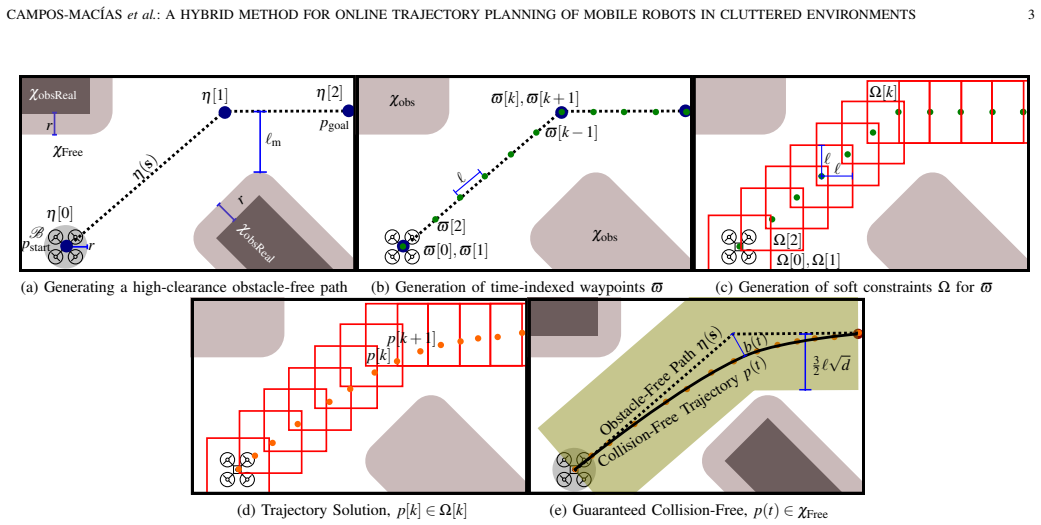
The load-bearing construction is the sequence of time-indexed waypoints $\varpi[k]$ with hypercube soft constraints $\Omega[k]$. Each waypoint sits on the sampled path, consecutive waypoints are separated by $\ell$, and two identical waypoints are placed at every path vertex. The dynamical constants $V_{\max}=\sqrt{\ell A_{\max}}$ and $h=2\sqrt{\ell/A_{\max}}$ are chosen so that crossing one hypercube in one time step is always possible with bounded acceleration; the duplicated vertex waypoints provide the extra time step needed to reverse direction safely. These choices make the QP's constraint set nonempty by construction, and the separation argument in Lemma 7 turns that into a continuous-time collision-free guarantee.
What would settle it
Run the planner in an environment where the true minimum clearance of the sampled path is measured, set $\ell$ so that $\ell_m < \frac{3}{2}\ell\sqrt{d}$, solve the QP, and check whether the executed continuous trajectory enters the inflated obstacle region. If it does in any such case, the unconditional collision-free claim is false; if it never does for $\ell=0.05$ with nominal clearance $0.05$ m in 3D, the bound is conservative or the realized clearance exceeds the nominal one.
Extended reading notes
Core claim
The paper's core discovery is a constructive choice of waypoint spacing and time step that makes the feasibility problem trivial to satisfy. Along the sampled path it places waypoints $\varpi[k]$ at Euclidean spacing $\ell$, with duplicate waypoints at every vertex to handle sharp turns, and associates each with a hypercube $\Omega[k]=\{\rho : \|\rho-\varpi[k]\|_\infty\le \ell\}$. Choosing $V_{\max}^2=\ell A_{\max}$ and $h^2=4\ell/A_{\max}$, the authors prove through Lemmas 5-7 that a piecewise-constant acceleration exists moving the robot from any state in one hypercube to the next while respecting velocity and acceleration bounds, and that between samples the trajectory cannot depart more than $\frac{3}{2}\ell\sqrt{d}$ from the guiding path. The QP then only has to minimize a cost such as jerk subject to these hypercube and bound constraints, and by Theorem 3 it is guaranteed feasible. This converts trajectory planning from a search over time durations and waypoint counts into a one-shot convex solve.
Load-bearing premise
The collision-free guarantee assumes the sampled path truly keeps a minimum distance from obstacles of at least $\frac{3}{2}\ell\sqrt{d}$, an inequality the paper never writes out; its benchmarks use $\ell=0.05$ in 3D, which allows about $0.13$ m of deviation against a nominal clearance of $0.05$ m.
Editorial extensions
If this is right
- A trajectory for a robot with bounded acceleration can be computed by solving one convex QP, so planning can run at the few-hundred-millisecond scale even in environments with hundreds of obstacles.
- Because the QP is guaranteed feasible whenever the sampling planner finds a path with the required clearance, the overall success rate is essentially inherited from the sampling planner and is not degraded by the optimization stage.
- The continuous trajectory, not just the discrete samples, is collision-free, so no post-hoc interpolation check or iterative time adjustment is needed.
- The design parameter $\ell$ controls a clear trade-off: smaller $\ell$ gives shorter trajectories but longer solve times, while larger $\ell$ produces faster solves and larger clearance margins.
- Replanning can be triggered online while the robot executes a committed segment, supporting goal changes in obstacle-dense environments without restarting the whole pipeline.
Reading between the lines
- An implied tuning rule, not written in the paper, is to cap the deviation budget at about $0.38$ times the path's minimum clearance in three dimensions; this follows directly from the stated separation bound and gives a concrete safety-margin recipe for users.
- Because the QP constraints only involve velocity and acceleration bounds, the same waypoint-hypercube construction should transfer to other differentially flat vehicles, not just quadcopters, by substituting the vehicle's acceleration limit.
- The paper's table showing solve time decreasing as $\ell$ grows suggests an online planner could adapt $\ell$ during replanning, starting with a large margin for a fast initial solve and shrinking it later to shorten the trajectory.
Signed reviews
Editorial analysis
A structured set of objections, weighed in public.
Referee Report
Summary. The paper proposes a hybrid online trajectory planning method: an IRRT* sampling-based planner generates an obstacle-free path, and a single convex QP computes a time-parameterized trajectory that is claimed to be guaranteed feasible and collision-free. The QP uses waypoints placed along the path with associated hypercube regions, and the time step and velocity bound are derived from a design parameter 𝓁 and the maximum acceleration. The central theoretical claims are that the QP is always feasible and that the continuous trajectory remains within (3/2)𝓁√d of the path, hence collision-free given sufficient path clearance. The method is compared with iSCP and CHOMP in simulation and demonstrated on a Crazyflie quadcopter in cluttered environments with up to 200 obstacles.
Significance. If the theoretical claims were correct, the paper would make a valuable contribution: replacing iterative or sequential convex programs with a single QP that has formal feasibility and collision-avoidance guarantees is an important step for online planning. The experimental work is substantial, including 500-trial benchmarks across varying obstacle densities and real quadcopter flights, and the algorithm is clearly described with parameter choices. However, the correctness of the central guarantees is not established by the manuscript. The algebraic error in the discrete kinematics of Problem 4 and the invalid coordinate-wise arguments in the Appendix undermine the proof of the main theorem. The empirical results, while promising, cannot compensate for these theoretical gaps.
major comments (4)
- [Section IV, Problem 4] The discrete-time kinematics used in Problem 4 are algebraically incorrect. Under the stated constant-acceleration model, where a[i] is held constant on (ih,(i+1)h], the exact recurrence p[k+1]=p[k]+h v[k]+(h^2/2)a[k], v[k+1]=v[k]+h a[k] yields p[k] = p[0] + h k v[0] + h^2 Σ_{i=0}^{k-1} (k-i-1/2) a[i]. The paper instead defines the coefficient as (2(k-i)+3)/2 = k-i+3/2, which is larger by 2 for every term. Consequently, the constraints ‖ϖ[k]-p[k]‖∞ ≤ 𝓁 in Problem 4 are evaluated at positions that do not equal the actual positions produced by the acceleration sequence under the stated dynamics. A QP solution can therefore satisfy all constraints as written while the executed trajectory violates the waypoint constraints and the separation bound of Theorem 3. This error is load-bearing because the paper's central claim is that the posed QP is guaranteed feasible and that its solution is collision-free; the appendix lemmas construct accelerations using the correct recurrence, so the QP as stated is not the problem those lemmas solve.
- [Appendix, Lemma 5] The proof of Lemma 5, and similarly Lemma 6, uses a rotation of coordinates so that the path segment lies on the x-axis, and then performs the construction coordinate-wise under assumptions such as vx[k] ∈ [0,Vmax], vy[k] ∈ [-Vmax,Vmax], and Ω[k+1] = Ω[k] + [𝓁,0,...]^T. These assertions are not valid for the ∞-norm constraints used in the paper. The ∞-norm is not invariant under rotation: for v with ‖v‖∞ ≤ Vmax, a rotated component can be as large as √d Vmax. Moreover, the rotation of an axis-aligned hypercube Ω[k] is generally not an axis-aligned hypercube in the rotated frame, so the coordinate-wise bounds on p[k] and the shifted-cube relation do not hold. Thus the constructed acceleration may violate the original acceleration bound and may not drive p[k+1] into Ω[k+1]. This invalidates the derivation of the feasibility conditions in Problem 2 and the proof of Theorem 3.
- [Section IV-A and Lemma 5] The feasibility proof assumes that consecutive waypoints are exactly 𝓁 apart (Problem 2, condition (i)), but the construction in Section IV-A sets κ_s = ceil(‖η[s+1]-η[s]‖/𝓁), giving spacing δ ≤ 𝓁, and adds duplicate waypoints at path nodes. The control designed in Lemma 5 produces a displacement of exactly 𝓁 along the path direction; when δ < 𝓁, a robot starting at the maximal allowable position in Ω[k] can be sent beyond Ω[k+1], so the proof does not cover the actual waypoint sequence generated by the algorithm. The paper does not explain how Problem 2's conditions are satisfied by the construction with non-uniform spacing and duplicate waypoints; Lemma 6 addresses duplicate waypoints but inherits the same rotation issues.
- [Section IV, Theorem 3] The claim that the bound |b(t)| ≤ (3/2)𝓁√d implies p(t) ∈ χFree requires a quantitative relationship between the path clearance 𝓁_m and the design parameter 𝓁. The paper asserts that 'Since there is a minimum clearance of 𝓁_m, this property guarantees a collision-free trajectory,' but it never states the required inequality 𝓁_m ≥ (3/2)𝓁√d. In the simulation benchmarks, 𝓁 = 0.05 is used in three dimensions, giving a deviation bound of approximately 0.13 m, while the reported clearance values are not shown to satisfy this inequality. In the experiments, 𝓁 = 0.02 yields a deviation bound of approximately 0.052 m, yet the stated maximum allowable 𝓁 derived from the robot radius, string diameter, and tracking error is 0.035 m, which would not satisfy the inequality if 𝓁_m = 0.035 m. Without this condition, Theorem 3 does not establish collision avoidance.
minor comments (3)
- [Section IV, Problem 2 and Problem 4] There are several minor typographical issues: 'assumme' appears in Problem 2; the subscripts in the waypoint definition are inconsistently typeset (ϖs versus ϖ_s); and the dimension of the optimization variable in Problem 4 is written as R^{dK} although there are K+1 acceleration vectors, so the dimension should be d(K+1).
- [Figure 4 caption] The caption of Figure 4 states that the separation is 'bounded by 2/3 𝓁√d', while the text and Theorem 3 give the bound as (3/2)𝓁√d. The fraction appears inverted in the caption.
- [Section II and Lemma 7] The definition of b(t) as a minimum of distances is nonnegative by construction, so the notation |b(t)| used in Lemma 7 and Theorem 3 is inconsistent; if b(t) is intended to be signed, its definition and the bound should be clarified.
Circularity Check
No circularity: central guarantees are analytic constructions, not fits or self-citations.
full rationale
No circular step is present. The feasibility guarantee (Theorem 3) is supported by Lemmas 5–7, which supply explicit constant-acceleration constructions from the stated inputs (, Amax, path waypoints); the proof does not assume the QP solution exists and does not fit any parameter to a target outcome. The collision-free bound |b(t)|≤(3/2)√d is derived analytically from the waypoint-box constraints, not renamed from them, and the extra requirement that this bound fit within the obstacle clearance _m is a design condition even though the inequality _m ≥ (3/2)√d is not written out explicitly. The QP in Problem 4 uses the same waypoint regions as constraints, but feasibility is established by an independent existence argument, so the formulation does not reduce to its inputs by construction. The performance and success-rate claims are empirical comparisons against iSCP and CHOMP, not outputs derived from fitted parameters. The paper contains no load-bearing self-citations: IRRT*, RRT*, CHOMP, iSCP, and the differential-flatness result are external standard references. The apparent algebraic discrepancy between the closed-form p[k] in Problem 4 and the constant-acceleration recurrence used in the lemmas, if real, is a correctness bug rather than a circularity; likewise, the unstated clearance inequality is an assumption or robustness gap, not a circular reduction.
Assumptions & free parameters
free parameters (3)
- 𝓁 (design clearance parameter) =
0.05 m in benchmark, 0.02 m in experiments
- Amax (maximum acceleration) =
20 m/s^2
- IRRT* planning budget =
At most 4 rounds, early stop if no cost improvement
assumptions (5)
- domain assumption The robot centroid obeys double-integrator dynamics pdot = v, vdot = a with per-axis acceleration bounds.
- domain assumption The obstacle region is known and static, and obstacles can be inflated before path planning.
- domain assumption The sampling-based planner returns a piecewise-linear obstacle-free path with a known positive minimum clearance 𝓁_m.
- ad hoc to paper Consecutive waypoints in the feasibility proof are exactly 𝓁 apart.
- ad hoc to paper Initial and intermediate velocities are aligned with the path direction, v[k]ᵀ(ϖ[k+1]−ϖ[k]) ≥ 0.
Cite this review
Pith. "Pith review of A Hybrid Method for Online Trajectory Planning of Mobile Robots in Cluttered Environments." pith.science (2026). https://pith.science/paper/PP7UU2OV
@misc{pith2026190808493,
  author       = {Pith},
  title        = {Pith review of: A Hybrid Method for Online Trajectory Planning of Mobile Robots in Cluttered Environments},
  year         = {2026},
  howpublished = {\url{https://pith.science/paper/PP7UU2OV}},
  note         = {Machine review of arXiv:1908.08493}
}
read the original abstract
This paper presents a method for online trajectory planning in known environments. The proposed algorithm is a fusion of sampling-based techniques and model-based optimization via quadratic programming. The former is used to efficiently generate an obstacle-free path while the latter takes into account the robot dynamical constraints to generate a time-dependent trajectory. The main contribution of this work lies on the formulation of a convex optimization problem over the generated obstacle-free path that is guaranteed to be feasible. Thus, in contrast with previously proposed methods, iterative formulations are not required. The proposed method has been compared with state-of-the-art approaches showing a significant improvement in success rate and computation time. To illustrate the effectiveness of this approach for online planning, the proposed method was applied to the fluid autonomous navigation of a quadcopter in multiple environments consisting of up to two hundred obstacles. The scenarios hereinafter presented are some of the most densely cluttered experiments for online planning and navigation reported to date. See video at https://youtu.be/DJ1IZRL5t1Q
Figures


Figures from the paper (3 more)


Reference graph
Works this paper leans on
-
[1]
C. Katrakazas, M. Quddus, W.-H. Chen, and L. Deka, “Real-time motion planning methods for autonomous on-road driving: State-of-the-art and future research directions,” Transportation Research Part C: Emerging Technologies, vol. 60, pp. 416 – 442, November 2015
work page 2015
-
[2]
A survey of motion planning and control techniques for self-driving urban vehicles,
B. Paden, M. Cap, S. Z. Yong, D. Yershov, and E. Frazzoli, “A survey of motion planning and control techniques for self-driving urban vehicles,” IEEE Trans. Intell. Veh., vol. 1, no. 1, pp. 33–55, March 2016
work page 2016
-
[3]
Sampling-based algorithms for optimal motion planning,
S. Karaman and E. Frazzoli, “Sampling-based algorithms for optimal motion planning,” Int. J. Robot. Res. , vol. 30, no. 7, pp. 846–894, June 2011
work page 2011
-
[4]
Sampling-based robot motion planning: A review,
M. Elbanhawi and M. Simic, “Sampling-based robot motion planning: A review,” IEEE Access, vol. 2, pp. 56–77, February 2014
work page 2014
-
[5]
J. D. Gammell, S. S. Srinivasa, and T. D. Barfoot, “Batch informed trees (BIT*): Sampling-based optimal planning via the heuristically guided search of implicit random geometric graphs,” in IEEE Int. Conf. Robot. Autom., June 2015, pp. 3067–3074
work page 2015
-
[6]
S. Choudhury, J. D. Gammell, T. D. Barfoot, S. S. Srinivasa, and S. Scherer, “Regionally accelerated batch informed trees (RABIT*): A framework to integrate local information into optimal path planning,” in IEEE Int. Conf. Robot. Autom. IEEE, May 2016, pp. 4207–4214
work page 2016
-
[7]
Computing large convex regions of obstacle- free space through semidefinite programming,
R. Deits and R. Tedrake, “Computing large convex regions of obstacle- free space through semidefinite programming,” in Algorithmic Founda- tions of Robotics XI . Springer, August 2015, pp. 109–124
work page 2015
-
[8]
Aggressive quadrotor flight through cluttered environments using mixed integer programming,
B. Landry, R. Deits, P. R. Florence, and R. Tedrake, “Aggressive quadrotor flight through cluttered environments using mixed integer programming,” in IEEE Int. Conf. Robot. Autom. , May 2016, pp. 1469– 1475
work page 2016
Show all 27 references
-
[9]
Kinodynamic RRT*: Asymptotically optimal motion planning for robots with linear dynamics,
D. J. Webb and J. van den Berg, “Kinodynamic RRT*: Asymptotically optimal motion planning for robots with linear dynamics,” in IEEE Int. Conf. Robot. Autom. IEEE, May 2013, pp. 5054–5061
2013
-
[10]
Toward asymptotically optimal motion planning for kinodynamic systems using a two-point boundary value problem solver,
C. Xie, J. van den Berg, S. Patil, and P. Abbeel, “Toward asymptotically optimal motion planning for kinodynamic systems using a two-point boundary value problem solver,” in IEEE Int. Conf. Robot. Autom. IEEE, May 2015, pp. 4187–4194
2015
-
[11]
Polynomial trajectory planning for aggressive quadrotor flight in dense indoor environments,
C. Richter, A. Bry, and N. Roy, “Polynomial trajectory planning for aggressive quadrotor flight in dense indoor environments,” in Robotics Research. Springer, April 2016, pp. 649–666
2016
-
[12]
Generation of collision-free trajectories for a quadrocopter fleet: A sequential convex programming approach,
F. Augugliaro, A. P. Schoellig, and R. D’Andrea, “Generation of collision-free trajectories for a quadrocopter fleet: A sequential convex programming approach,” in IEEE/RSJ Int. Conf. Intell. Robots Syst. , October 2012, pp. 1917–1922
2012
-
[13]
Decoupled multiagent path planning via incremental sequential convex programming,
Y . Chen, M. Cutler, and J. P. How, “Decoupled multiagent path planning via incremental sequential convex programming,” in IEEE Int. Conf. Robot. Autom., May 2015, pp. 5954–5961
2015
-
[14]
Motion planning with sequential convex optimization and convex collision checking,
J. Schulman, Y . Duan, J. Ho, A. Lee, I. Awwal, H. Bradlow, J. Pan, S. Patil, K. Goldberg, and P. Abbeel, “Motion planning with sequential convex optimization and convex collision checking,” Int. J. Robot. Res. , vol. 33, no. 9, pp. 1251–1270, June 2014
2014
-
[15]
Online generation of collision-free trajectories for quadrotor flight in unknown cluttered environments,
J. Chen, T. Liu, and S. Shen, “Online generation of collision-free trajectories for quadrotor flight in unknown cluttered environments,” in IEEE Int. Conf. Robot. Autom. , May 2016, pp. 1476–1483
2016
-
[16]
CHOMP: Covariant hamiltonian optimization for motion planning,
M. Zucker, N. Ratliff, A. D. Dragan, M. Pivtoraiko, M. Klingensmith, C. M. Dellin, J. A. Bagnell, and S. S. Srinivasa, “CHOMP: Covariant hamiltonian optimization for motion planning,” Int. J. Robot. Res. , vol. 32, no. 9-10, pp. 1164–1193, September 2013
2013
-
[17]
STOMP: Stochastic trajectory optimization for motion planning,
M. Kalakrishnan, S. Chitta, E. Theodorou, P. Pastor, and S. Schaal, “STOMP: Stochastic trajectory optimization for motion planning,” in IEEE Int. Conf. Robot. Autom. IEEE, May 2011, pp. 4569–4574
2011
-
[18]
Continuous-time trajectory optimization for online UA V replan- ning,
H. Oleynikova, M. Burri, Z. Taylor, J. Nieto, R. Siegwart, and E. Gal- ceran, “Continuous-time trajectory optimization for online UA V replan- ning,” in IEEE/RSJ Int. Conf. Intell. Robots Syst. , October 2016, pp. 5332–5339
2016
-
[19]
Estimation, control, and planning for aggressive flight with a small quadrotor with a single camera and IMU,
G. Loianno, C. Brunner, G. McGrath, and V . Kumar, “Estimation, control, and planning for aggressive flight with a small quadrotor with a single camera and IMU,” IEEE Robot Autom. Lett. , vol. 2, no. 2, pp. 404–411, November 2017
2017
-
[20]
Sampling-based path planning on configuration-space costmaps,
L. Jaillet, J. Cort ´es, and T. Sim ´eon, “Sampling-based path planning on configuration-space costmaps,” IEEE Trans. Robot , vol. 26, no. 4, pp. 635–646, August 2010
2010
-
[21]
Optimal path planning in complex cost spaces with sampling-based algorithms,
D. Devaurs, T. Sim ´eon, and J. Cort ´es, “Optimal path planning in complex cost spaces with sampling-based algorithms,” IEEE Trans. Autom. Sci. Eng. , vol. 13, no. 2, pp. 415–424, April 2016
2016
-
[22]
Informed RRT*: Optimal sampling-based path planning focused via direct sampling of an admissible ellipsoidal heuristic,
J. D. Gammell, S. S. Srinivasa, and T. D. Barfoot, “Informed RRT*: Optimal sampling-based path planning focused via direct sampling of an admissible ellipsoidal heuristic,” in IEEE/RSJ Int. Conf. Intell. Robots Syst., September 2014, pp. 2997–3004
2014
-
[23]
Anytime motion planning using the RRT*,
S. Karaman, M. R. Walter, A. Perez, E. Frazzoli, and S. Teller, “Anytime motion planning using the RRT*,” in IEEE Int. Conf. Robot. Autom. IEEE, May 2011, pp. 1478–1483
2011
-
[24]
Neunert, C
M. Neunert, C. de Crousaz, F. Furrer, M. Kamel, F. Farshidian, R. Sieg- wart, and J. Buchli, “Fast nonlinear model predictive control for unified CAMPOS-MAC´IAS et al.: A HYBRID METHOD FOR ONLINE TRAJECTORY PLANNING OF MOBILE ROBOTS IN CLUTTERED ENVIRONMENTS 9 trajectory optimi...
2016
-
[25]
[Online]
Mosek ApS, The MOSEK optimization software , 2016. [Online]. Available: http://www.mosek.com/
2016
-
[26]
High-speed flight in an ergodic forest,
S. Karaman and E. Frazzoli, “High-speed flight in an ergodic forest,” in IEEE Int. Conf. Robot. Autom. , May 2012, pp. 2899–2906
2012
-
[27]
[Online]
Bitc raze AB, A quadcopter open platform , 2016. [Online]. Available: https://www.bitcraze.io/crazyflie-2/
2016
Reviewed August 14, 2026 · model on record in the stance chip above.
Discussion (0). Continue with ORCID to comment.