REVIEW 4 minor 27 references
A Pieri rule for Demazure characters of the general linear group
T0 review · 0 major / 4 minor · reviewed 2026-08-14 · deepseek-v4-flash
Pith's one-line read A signed Pieri rule for key polynomials, proved by box insertion into Kohnert diagrams.
desk verdict A substantial new bijective Pieri rule for key polynomials, with the main caveat being a load-bearing imported lemma that the authors do not reprove. read the letter →
The pith
A machine-rendered reading of the paper's core claim, the machinery that carries it, and where it could break.
The reading
What carries the argument
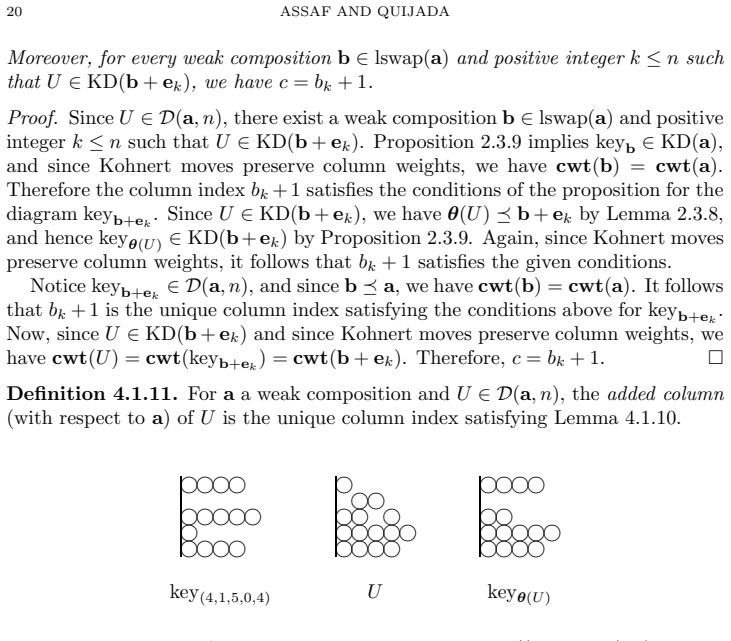
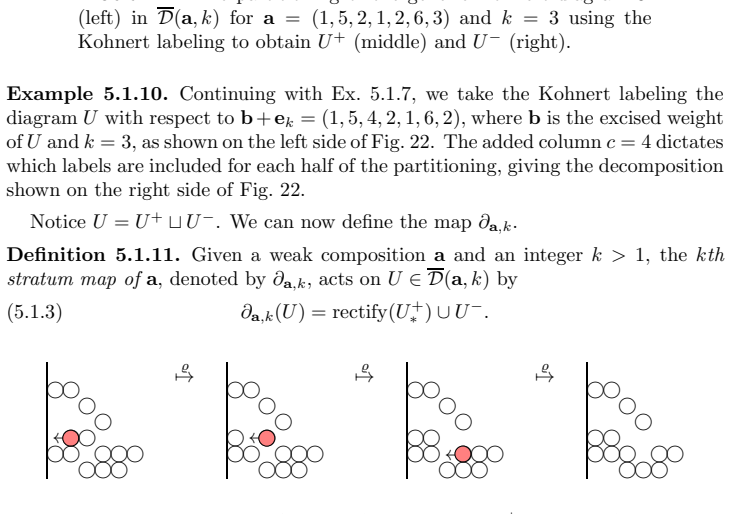
The machinery is Kohnert diagrams together with the left swap order and thread decomposition. A Kohnert diagram is a finite set of unit cells obtained from the key diagram of a weak composition by repeatedly moving the rightmost cell of a row down to the first available position in its column, and key polynomials are the generating polynomials of these diagrams. The left swap order $b\preceq a$ is the transitive closure of swapping a smaller part of $a$ with a larger part to its right; it controls containment, since $\mathrm{key}_b\in KD(a)$ exactly when $b\preceq a$, and more generally a diagram $T$ lies in $KD(a)$ exactly when its thread weight $\theta(T)$ lies below $a$ in this order. The paper's new insertion maps---bottom insertion, rectification, top insertion, and stratum maps---play the role of RSK insertion on tableaux and prove the bijection of Theorem 3.1.4. The drop composition $\mathrm{drop}(c,R)_a$ is the weak composition obtained by lowering supporting cells from above the added cell down to the rows of $R$; it is the object that records the inclusion-exclusion data in the final formula.
What would settle it
Search for a generic Kohnert diagram $T$ and a weak composition $a$ with $\theta(T)\preceq a$ but $T\notin KD(a)$; one such pair refutes the imported thread-weight criterion and, with it, Theorem 3.3.6. Because all objects are finite and algorithmically enumerable, this is a concrete brute-force check.
Extended reading notes
Core claim
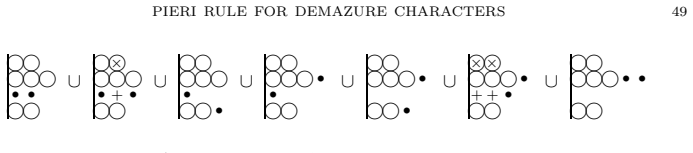
The central claim is Theorem 3.3.6: for a weak composition $a$ and positive integer $k$, $\kappa_a s_{(1)}(x_1,\ldots,x_k)$ equals the signed sum over $k$-addable columns $c$ of $a$ and nonempty subsets $R$ of the $k$-addable row set $\mathrm{Row}^c_{a,k}$ of $(-1)^{|R|-1}\kappa_{\mathrm{drop}(c,R)_a+e_{\min(R)}}$, and the terms are pairwise distinct. The indexing data are read directly from the key diagram of $a$: a $k$-addable cell is a position in a row at most $k$ to which a box can be added after supporting cells above row $k$ are dropped down through left swaps, and the drop composition records how far those supporting cells fall. The theorem is proved through the weight-preserving bijection of Theorem 3.1.4, $KD(a)\times KD(e_k)\leftrightarrow\bigcup_{b\preceq a,\,1\le j\le k} KD(b+e_j)$, constructed by an insertion algorithm on Kohnert diagrams. The negative signs are not cancellations inside a single disjoint union; they come from genuine overlaps of the sets $KD(b+e_j)$, and the inclusion-exclusion in the formula removes exactly that redundancy.
Load-bearing premise
The load-bearing premise is the imported criterion, used without proof, that a generic Kohnert diagram lies in $KD(a)$ exactly when its thread weight lies below $a$ in the left swap order; if that criterion has hidden restrictions, the bijection and the signed formula collapse.
Editorial extensions
If this is right
- The product of any key polynomial with $x_1+\cdots+x_k$ has a cancellation-free expansion in the key basis, with at most one positive term per $k$-addable column and signs recorded by subsets of rows.
- For weakly increasing $a$ and $k=n$, the formula specializes to the classical Schur Pieri rule $s_\lambda s_{(1)}=\sum_{\mu\supset\lambda,\,|\mu/\lambda|=1} s_\mu$.
- For $k\ge \ell(a)$, the expansion is nonnegative and is indexed by choosing columns $c_1<\cdots<c_m$ with each $c_i-1$ among the parts of the current composition, as stated in Corollary 6.3.3.
- For weak compositions satisfying condition (2) of Macdonald's vexillary definition, the key expansion of $\kappa_a s_{(m)}(x_1,\ldots,x_k)$ is nonnegative for every $k$, giving an explicit formula for the Schubert polynomial product $S_wS_{v((m),k)}$ in Theorem 6.3.8.
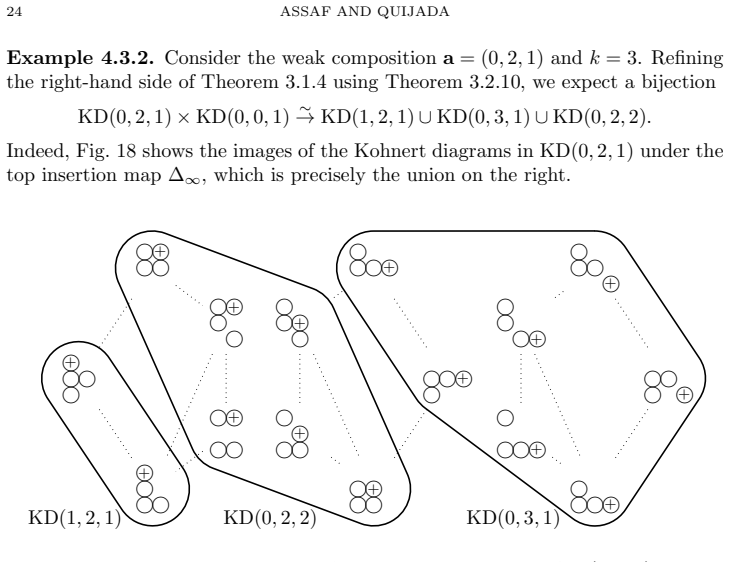
- Iterating the insertion gives a horizontal-strip bijection $KD(a)\times KD(m e_k)\leftrightarrow D^{(m)}(a,k)$, expanding the product $\kappa_a\kappa_{m e_k}$ by $k$-addable horizontal $m$-strips, as in Theorem 6.1.5 and Corollary 6.1.8.
Reading between the lines
- The signs, which arise from overlaps of diagram sets rather than from a sign-reversing involution, suggest that the formula could be lifted to a K-theoretic or Euler-characteristic Pieri rule for Demazure characters; this is a testable extension, not a claim of the paper.
- The same stratum machinery might yield a direct rule for products of a key polynomial with an arbitrary Schur polynomial in a fixed number of variables, with explicit sign data refining the earlier formula; the paper only treats the single-row case.
- A brute-force verification on all weak compositions of a small fixed length would test both the formula and the imported thread-weight criterion, since the two are logically tied.
Signed reviews
Editorial analysis
A structured set of objections, weighed in public.
Referee Report
Summary. The paper proves a nonsymmetric generalization of the Pieri rule for key polynomials (Demazure characters of GL_n). The main bijective statement, Theorem 3.1.4, asserts a weight-preserving bijection between KD(a) × KD(e_k) and the union of KD(b + e_j) over b weakly below a in left swap order and 1 ≤ j ≤ k. From this, Theorem 3.3.6 derives a cancellation-free, multiplicity-free signed formula for κ_a · s_(1)(x_1, ..., x_k) as a sum over k-addable columns and nonempty subsets R of the corresponding row sets. Sections 4 and 5 prove the bijection through bottom insertion, top insertion via rectification, and a stratification by stratum maps; Section 6 extends the construction to horizontal strips and characterizes when the key expansion is nonnegative, with applications to Schubert polynomials.
Significance. If the result stands, it is a substantial contribution: it gives the first explicit nonsymmetric Pieri rule for key polynomials, generalizes the classical RSK-based proof of Pieri's rule, and provides a signed but cancellation-free expansion whose signs are fully understood. The paper is also notable for its detailed, example-rich combinatorial proof and for the clean reduction to classical Schur Pieri in the weakly increasing case. The positivity characterization in Section 6.3, including the vexillary case, is a further valuable dividend. The main caveat is that the proof leans on the imported thread-decomposition criterion of Lemma 2.3.8; this is a cited result rather than an internal error, but its exact statement should be made fully explicit given how many later statements depend on it.
minor comments (4)
- [Section 2.3, Lemma 2.3.8] Lemma 2.3.8, stated as implicit in [5, Theorem 3.7], is the load-bearing criterion that T ∈ KD(a) if and only if θ(T) ≼ a. It is used repeatedly—for example in Proposition 2.3.9, Corollary 3.1.5, Lemma 3.2.5, Theorem 3.2.10, Lemma 3.3.4, and Theorem 4.1.8—and therefore underpins Theorem 3.3.6. Since the paper does not reproduce or prove this criterion, I ask the authors to provide either a self-contained proof or a precise quotation of [5, Theorem 3.7] together with an explanation of why the stated 'if and only if' follows for generic Kohnert diagrams. This is a completeness issue rather than an apparent error, but it should be resolved before publication.
- [Section 6.3, Corollary 6.3.1] In the displayed formula, the condition 'c_i−1 ∈ {a_1,...,a_n, c_i−1}' is tautological as written. Based on Example 6.3.2 and the surrounding text, it should read 'c_i−1 ∈ {a_1,...,a_n, c_{i−1}}' (with the second term being the previously chosen value, not the current value). Please correct this notation.
- [Section 4.3, Theorem 4.3.15 and text before it] The notation 'ℓ = max_i{a_i > 0}' is ambiguous; it should be 'ℓ = max{i : a_i > 0}' or 'ℓ(a) = max{i : a_i > 0}', matching the use earlier in the paper. As written, the expression resembles a maximum over a set of inequalities rather than the largest index with a positive part.
- [Section 5.2, proof of Theorem 5.1.13] In the paragraph after Lemma 5.2.8, the sentence 'By Lemma 5.1.8, we have wt(M_{b+e_k}|_{U^-}) = wt(M_{b+e_k}|_{U^-})' is tautological and appears to contain a typo. Please check whether the intended equality involves θ(U^-) or the restriction of the Kohnert labeling, and revise accordingly.
Circularity Check
No circularity: the Pieri formula is derived from an independently constructed Kohnert-diagram bijection, with only a non-load-bearing external thread-criterion citation.
full rationale
The derivation of Theorem 3.3.6 does not assume the Pieri-type expansion it proves. The target bijection in Theorem 3.1.4 is constructed independently: bottom insertion is proved directly in Theorem 4.1.13, top insertion via rectification in Theorem 4.3.15, and the general case through the injective stratum maps of Theorems 5.1.13 and 5.1.14. None of these arguments presuppose the coefficient formula or reduce it to a definition. The addable-cell reductions and intersection computations, such as Lemmas 3.2.5, 3.2.8, 3.3.4, and Theorem 3.2.10, are containment statements in the left-swap order, and these rely on the imported Lemma 2.3.8 from Assaf-Searles [5]. That lemma is a parameter-free criterion characterizing membership in Kohnert diagram sets in terms of thread weights; its statement does not involve products of key polynomials, the Pieri coefficients, or the desired expansion. Although the present paper cites prior work with overlapping authorship and does not reprove the lemma, the cited result is independent evidence rather than a restatement of the goal, so it does not make the argument circular. No fitted parameter is renamed as a prediction, no uniqueness theorem is imported to forbid alternatives, and the final signed expansion is obtained by generating functions and inclusion-exclusion from a genuinely constructed bijection. Hence the derivation chain is self-contained in the relevant sense: the theorem is not equivalent to its inputs by construction.
Assumptions & free parameters
assumptions (6)
- domain assumption Key polynomials are the generating polynomials of Kohnert diagrams (Kohnert's theorem, taken as Definition 2.2.3).
- domain assumption A diagram T is a generic Kohnert diagram iff the column inequality (2.3.1) holds (Proposition 2.3.2, from Assaf-Searles).
- domain assumption For T generic, T is in KD(a) iff theta(T) is at most a in the left swap order (Lemma 2.3.8, cited to Assaf-Searles).
- domain assumption The injective map from Kohnert diagrams to semistandard Young tableaux of sorted shape is a bijection exactly for weakly increasing compositions (Assaf-Searles, Proposition 2.2.4).
- standard math RSK insertion yields the Pieri bijection for semistandard Young tableaux (Theorem 3.1.1 and Theorem 6.1.1).
- standard math Hall's Marriage Theorem implies the matching sequence characterization of Kohnert diagrams.
Cite this review
Pith. "Pith review of A Pieri rule for Demazure characters of the general linear group." pith.science (2026). https://pith.science/paper/XO7TJTWA
@misc{pith2026190808502,
  author       = {Pith},
  title        = {Pith review of: A Pieri rule for Demazure characters of the general linear group},
  year         = {2026},
  howpublished = {\url{https://pith.science/paper/XO7TJTWA}},
  note         = {Machine review of arXiv:1908.08502}
}
read the original abstract
The Pieri rule is a nonnegative, multiplicity-free formula for the Schur function expansion of the product of an arbitrary Schur function with a single row Schur function. Key polynomials are characters of Demazure modules for the general linear group that generalize the Schur function basis of symmetric functions to a basis of the full polynomial ring. We prove a nonsymmetric generalization of the Pieri rule by giving a cancellation-free, multiplicity-free formula for the key polynomial expansion of the product of an arbitrary key polynomial with a single part key polynomial. Our proof is combinatorial, generalizing the Robinson--Schensted--Knuth insertion algorithm on tableaux to an insertion algorithm on Kohnert diagrams.
Figures


Figures from the paper (25 more)









Reference graph
Works this paper leans on
-
[1]
Demazure crystals for Kohnert polynomials
Sami Assaf. Demazure crystals for Kohnert polynomials. preprint
-
[2]
Weak dual equivalence for polynomials
Sami Assaf. W eak dual equivalence for polynomials. arXi v:1702.04051
-
[3]
Nonsymmetric Macdonald polynomials and a re finement of Kostka–Foulkes poly- nomials
Sami Assaf. Nonsymmetric Macdonald polynomials and a re finement of Kostka–Foulkes poly- nomials. Trans. Amer. Math. Soc. , 370(12):8777–8796, 2018
work page 2018
-
[4]
Demazure crystals for specialized nonsymmetric Macdonald polynomials
Sami Assaf and Nicolle Gonz´ alez. Demazure crystals for specialized nonsymmetric Macdonald polynomials. arXiv:1901.07520, 2019
work page Pith review arXiv 1901
-
[5]
Kohnert tableaux and a li fting of quasi-Schur functions
Sami Assaf and Dominic Searles. Kohnert tableaux and a li fting of quasi-Schur functions. J. Combin. Theory Ser. A , 156:85–118, 2018
work page 2018
-
[6]
Sami H. Assaf and Peter R. W. McNamara. A Pieri rule for ske w shapes. J. Combin. Theory Ser. A , 118(1):277–290, 2011
work page 2011
-
[7]
Armand Borel. Sur la cohomologie des espaces fibr´ es prin cipaux et des espaces homog` enes de groupes de Lie compacts. Ann. of Math. (2) , 57:115–207, 1953
work page 1953
-
[8]
D´ esingularisation des vari´ et´ es deSchubert g´ en´ eralis´ ees.Ann
Michel Demazure. D´ esingularisation des vari´ et´ es deSchubert g´ en´ eralis´ ees.Ann. Sci. ´Ecole Norm. Sup. (4) , 7:53–88, 1974. Collection of articles dedicated to Henri C artan on the occa- sion of his 70th birthday, I
work page 1974
Show all 27 references
-
[9]
Une nouvelle formule des caract` eres
Michel Demazure. Une nouvelle formule des caract` eres. Bull. Sci. Math. (2) , 98(3):163–172, 1974
1974
-
[10]
Haglund, K
J. Haglund, K. Luoto, S. Mason, and S. van Willigenburg. Refinements of the Littlewood- Richardson rule. Trans. Amer. Math. Soc. , 363(3):1665–1686, 2011
2011
-
[11]
Nonsymmetric Macdonald polynomials and De mazure characters
Bogdan Ion. Nonsymmetric Macdonald polynomials and De mazure characters. Duke Math. J., 116(2):299–318, 2003
2003
-
[12]
Donald E. Knuth. Permutations, matrices, and generali zed Young tableaux. Pacific J. Math. , 34:709–727, 1970. PIERI RULE FOR DEMAZURE CHARACTERS 65
1970
-
[13]
W eintrauben, Polynome, Tableaux
Axel Kohnert. W eintrauben, Polynome, Tableaux. Bayreuth. Math. Schr. , (38):1–97, 1991. Dissertation, Universit¨ at Bayreuth, Bayreuth, 1990
1991
-
[14]
Polyn ˆ omes de Schubert
Alain Lascoux and Marcel-Paul Sch¨ utzenberger. Polyn ˆ omes de Schubert. C. R. Acad. Sci. Paris S´ er. I Math., 294(13):447–450, 1982
1982
-
[15]
Keys & standard bases
Alain Lascoux and Marcel-Paul Sch¨ utzenberger. Keys & standard bases. In Invariant theory and tableaux (Minneapolis, MN, 1988) , volume 19 of IMA Vol. Math. Appl. , pages 125–144. Springer, New York, 1990
1988
-
[16]
I. G. Macdonald. Notes on Schubert polynomials. LACIM, Univ. Quebec a Montreal, Mon- treal, PQ, 1991
1991
-
[17]
An explicit construction of type A Demazur e atoms
Sarah Mason. An explicit construction of type A Demazur e atoms. J. Algebraic Combin. , 29(3):295–313, 2009
2009
-
[18]
D. Monk. The geometry of flag manifolds. Proc. London Math. Soc. (3) , 9:253–286, 1959
1959
-
[19]
Sul problema degli spazi secanti
Mario Pieri. Sul problema degli spazi secanti. Rend. Ist. Lombardo (2) , 26:534–546, 1893
-
[20]
Key polynomials and a flagged Littlewood-Richardson rule
Victor Reiner and Mark Shimozono. Key polynomials and a flagged Littlewood-Richardson rule. J. Combin. Theory Ser. A , 70(1):107–143, 1995
1995
-
[21]
G. de B. Robinson. On the Representations of the Symmetr ic Group. Amer. J. Math. , 60(3):745–760, 1938
1938
-
[22]
Sanderson
Yasmine B. Sanderson. On the connection between Macdon ald polynomials and Demazure characters. J. Algebraic Combin. , 11(3):269–275, 2000
2000
-
[23]
Schensted
C. Schensted. Longest increasing and decreasing subse quences. Canad. J. Math. , 13:179–191, 1961
1961
-
[24]
Kalk¨ ul der abz¨ ahlenden Geometrie
Hermann Schubert. Kalk¨ ul der abz¨ ahlenden Geometrie. Springer-Verlag, Berlin-New York,
-
[25]
Pieri’s formula for flag manifolds and Sc hubert polynomials
Frank Sottile. Pieri’s formula for flag manifolds and Sc hubert polynomials. Ann. Inst. Fourier (Grenoble), 46(1):89–110, 1996
1996
-
[26]
Richard P. Stanley. Enumerative combinatorics. Vol. 2 , volume 62 of Cambridge Studies in Advanced Mathematics. Cambridge University Press, Cambridge, 1999. With a forew ord by Gian-Carlo Rota and appendix 1 by Sergey Fomin. Department of Mathematics, University of Southern Ca...
1999
-
[1979]
Reprint of the 1879 original, With an introduction by S teven L. Kleiman
Reviewed August 14, 2026 · model on record in the stance chip above.
Discussion (0). Continue with ORCID to comment.