REVIEW 4 major objections 5 minor 57 references
Entropy-cooled nonequilibrium states of the Hubbard model
T0 review · 4 major / 5 minor · reviewed 2026-08-14 · deepseek-v4-flash
Pith's one-line read Transiently coupling a Hubbard model to narrow full and empty bands removes enough entropy to create cold photo-doped Mott states, a negative-temperature s-wave superconductor, and an eta-paired state.
desk verdict Solid proof-of-principle paper: three new nonequilibrium states prepared by cooling-by-doping in DMFT, but the NCA-only impurity solver leaves the quantitative results without a cross-check. read the letter →
The pith
A machine-rendered reading of the paper's core claim, the machinery that carries it, and where it could break.
The reading
What carries the argument
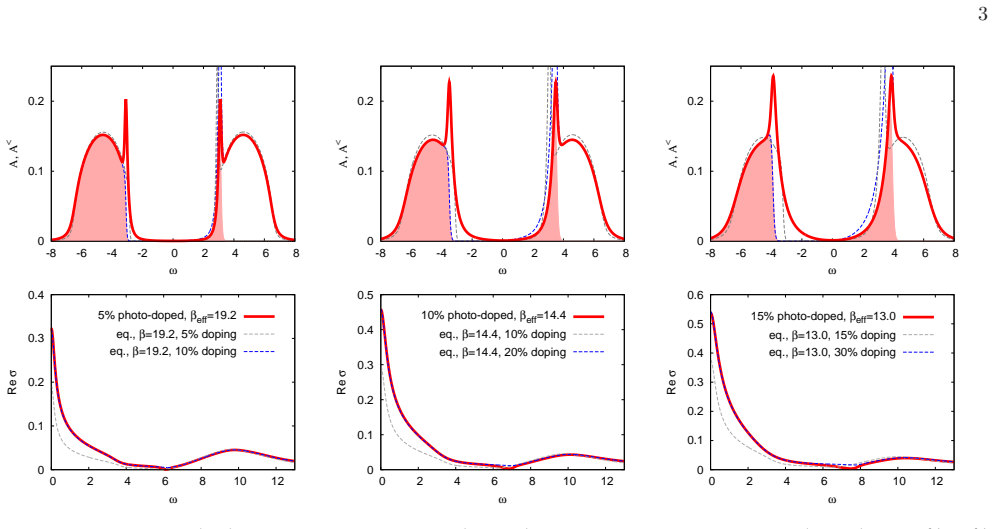
The load-bearing mechanism is the cooling-by-doping protocol: a chirped hopping pulse of the form $v_{\mathrm{system\text{-}bath}}(t)=a_{\max} f_{\mathrm{envelope}}(t)\sin(\Omega(t)t)$ couples the system to a narrow full band and a narrow empty band, transferring electrons into the upper Hubbard band and out of the lower Hubbard band while the narrow bands carry away entropy. The particle-hole symmetric arrangement of the two bands keeps the chemical potential fixed, which the paper argues is important for superconductivity. The quantitative engine is nonequilibrium dynamical mean-field theory on the infinite-connected Bethe lattice, solved with the non-crossing approximation; Nambu matrix self-consistency equations detect s-wave pairing, and a sign-flipped version detects $\eta$-pairing, defined as staggered s-wave pairing with opposite phase on the two sublattices. The paper's central quantitative identity is the equivalence between a photo-doped state with $x\%$ doublons and $x\%$ holons and an equilibrium chemical doping of $2x\%$ at the same effective inverse temperature $\beta_{\mathrm{eff}}$, with $\beta_{\mathrm{eff}}$ extracted from Fermi-function fits to the occupation ratio $A^<(\omega)/A(\omega)$.
What would settle it
Rerun the two decisive simulations, the negative-temperature s-wave superconductor at $U=2.52$ and the eta-paired state at $U=9$, with an impurity solver that does not use the non-crossing approximation, for example a continuous-time quantum Monte Carlo solver or exact diagonalization on a finite cluster, and check whether the order parameters still grow to the reported magnitudes and whether the extracted $\beta_{\mathrm{eff}}$ values remain below the thresholds for symmetry breaking. If they do not, the demonstrations are artifacts of the approximate solver.
Extended reading notes
Core claim
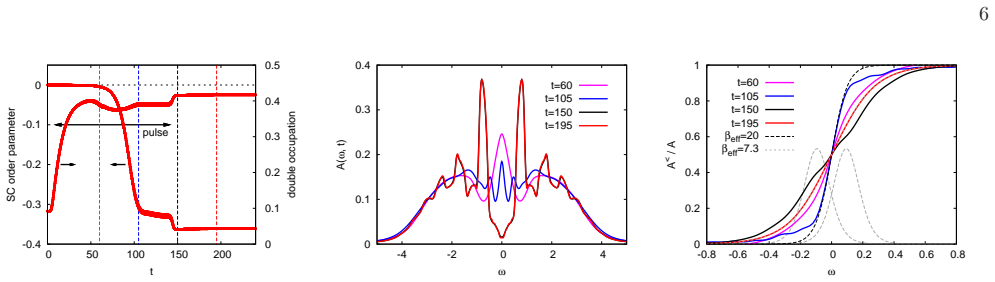
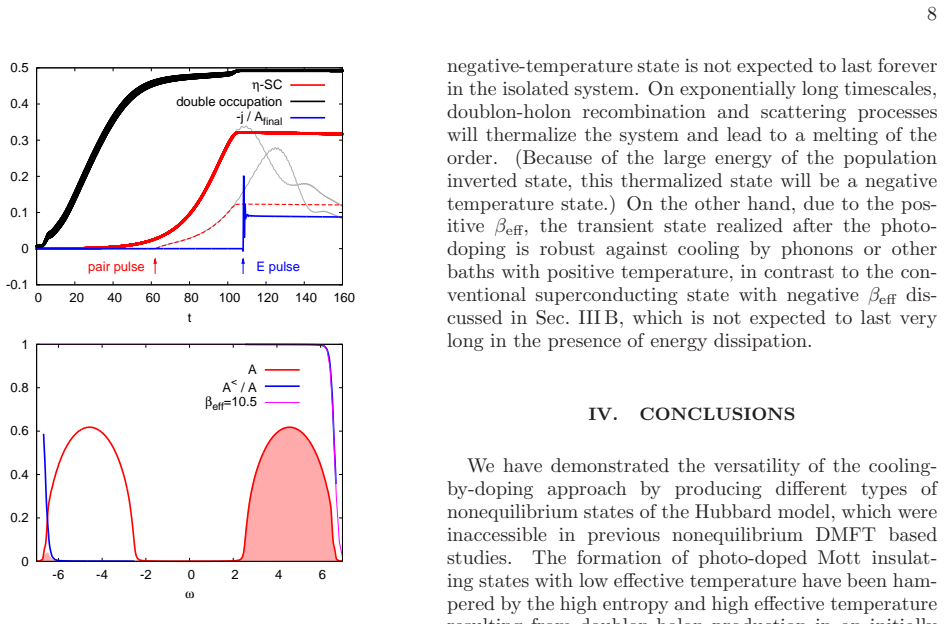
On the paper's own terms, the central discovery is that entropy can be reshuffled out of a Hubbard system into narrow full and empty bands faster than the system heats itself, so the remaining population of doublons and holons is characterized by a low effective temperature. In the Mott regime ($U=9$) the resulting photo-doped states have inverse effective temperatures $\beta_{\mathrm{eff}}\approx 13$-$20$ and sharp quasiparticle peaks, and their low-frequency conductivity is, within DMFT, identical to that of a chemically doped equilibrium state with the same $\beta_{\mathrm{eff}}$ and $2x\%$ doping when the photo-doped state has $x\%$ doublons and $x\%$ holons. In the metallic regime ($U=2.52$) the same protocol generates a population-inverted negative-temperature state; after the narrow bands are decoupled it thermalizes to $\beta=-7.3$ and develops an s-wave superconducting order parameter of magnitude about 0.36, which the paper identifies with the equilibrium superconducting state of the attractive Hubbard model. In the strongly interacting regime ($U=9$) with large doublon and holon density, the protocol induces an $\eta$-paired staggered superconducting state with a nonzero order parameter and a persistent current, stable well beyond the simulation window. The paper presents all three as proofs of principle that cooling-by-doping can reach states that direct photodoping or boson-bath cooling could not.
Load-bearing premise
The approximate impurity solver used in every dynamical mean-field simulation is quantitatively trustworthy for the broken-symmetry and negative-temperature states, so the reported order parameters and effective temperatures are not solver artifacts.
Editorial extensions
If this is right
- Photo-doped Mott insulators should show a sharp Drude peak and quasiparticle features when the doping is done through narrow bands, in contrast to the broad bad-metal response seen after ordinary photodoping.
- For a photo-doped state with $x\%$ doublons and $x\%$ holons, comparisons with equilibrium should use $2x\%$ chemical doping at the same $\beta_{\mathrm{eff}}$, not $x\%$.
- A repulsively interacting Hubbard model can host conventional s-wave superconductivity in a cold negative-temperature state, with the same properties as the attractive-Hubbard superconductor at positive temperature.
- Eta-paired superconducting states can be realized in large-gap Mott insulators with high doublon and holon densities and are long-lived because the recombination time grows exponentially with the gap; their positive effective temperature makes them robust against phonon or positive-temperature bath coupling.
- Cooling-by-doping bypasses the thermalization bottleneck observed in boson-bath cooling protocols by moving the system along the filling axis instead of waiting for quasiparticle formation.
Reading between the lines
- The paper's open-system setup treats the narrow bands as equilibrium entropy sinks that never heat up; a closed-system version would presumably cool less, so a natural extension is to quantify how much entropy a finite-width narrow band can absorb before its own temperature rises.
- Because the low-frequency equivalence with chemical doping is stated to hold within DMFT, an immediate test is whether the same conductivity matching survives in non-DMFT methods such as cluster or diagrammatic approaches; if it does, the effective-doping correspondence may be a general property of photo-doped Mott insulators.
- The same entropy-reshuffling idea could be applied to magnetic order: coupling to narrow bands that selectively accept entropy from one spin species or one sublattice might prepare cold antiferromagnetic states, which the current paper does not simulate.
- A practical diagnostic suggested by the paper's logic is that a sharp Drude peak appearing after resonant excitation into a narrow band is a signature of effective temperatures far below the nominal lattice temperature; pump-probe experiments could look for this crossover as the chirp frequency is tuned.
Signed reviews
Editorial analysis
A structured set of objections, weighed in public.
Referee Report
Summary. This paper uses nonequilibrium dynamical mean-field theory (DMFT) with the non-crossing approximation (NCA) as the impurity solver to study the cooling-by-doping mechanism in the single-band Hubbard model. Three demonstrations are presented: (i) photo-doped Mott insulating states with effective inverse temperatures beta_eff ≈ 19, 14, and 13 that show a sharp Drude peak in the optical conductivity, matching that of chemically doped equilibrium systems at the same beta_eff and twice the doping (Fig. 2); (ii) a negative-temperature state in the repulsive Hubbard model that develops a large s-wave superconducting order parameter under a weak applied pair field (Fig. 5); and (iii) a strongly photo-doped Mott insulator that enters an eta-paired state with a large staggered order parameter and a non-decaying induced current (Figs. 6 and 7). The paper is explicitly framed as a proof of principles.
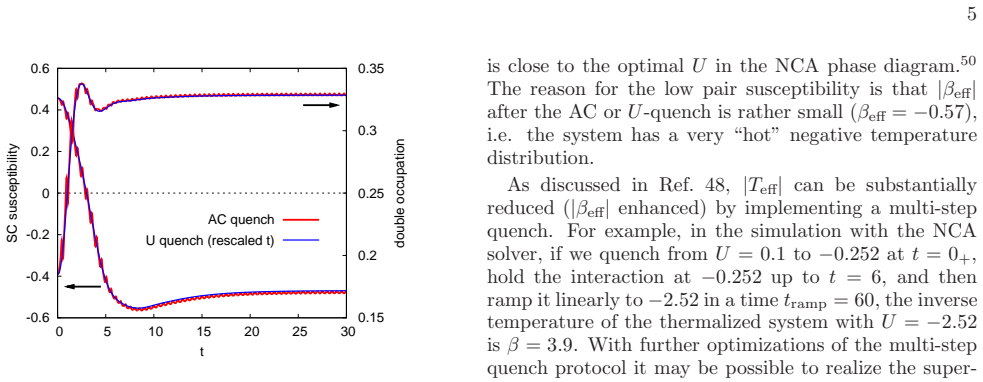
Significance. If the results hold, they are significant for the nonequilibrium DMFT community and for pump-probe and cold-atom experiments: cooling-by-doping is proposed as a way to avoid thermalization bottlenecks and to access cold photo-doped metals, negative-temperature superconductivity, and eta-paired states without coupling to boson baths. The paper is generally well parameterized and contains valuable internal checks, including the AC-quench versus U-quench comparison (Fig. 3), the weak pair-field pulse and persistent-current diagnostics for eta-pairing (Fig. 6), and the use of three doping levels in the conductivity comparison. However, all numerical evidence is generated with a single approximate impurity solver, and several definitional and protocol-level issues need to be resolved before the central claims can be considered established.
major comments (4)
- [Sec. II, Figs. 2, 5-7] The impurity model is solved exclusively with NCA (Sec. II), and all three headline results—the conductivity matching in Fig. 2, the s-wave order parameter in Fig. 5, and the eta-pairing order parameters in Figs. 6 and 7—are produced with this single approximate solver. The only internal cross-check (Sec. III B, Fig. 3) compares an AC-field quench with a U-quench; both calculations use NCA, so it validates the Bessel-function mapping within NCA but not the accuracy of NCA in the low-temperature, symmetry-broken, or negative-temperature regimes that are central here. NCA is uncontrolled in precisely those regimes, and the paper itself relies on an NCA phase diagram (Ref. 50) to locate beta_c. I request a benchmark of at least one of the three protocols against a numerically exact or independent impurity solver in the relevant parameter regime, together with a statement of the expected NCA error. Without such a check, the reported effective temperatures and order parameters could be solver artifacts.
- [Sec. II vs. Secs. III A-C] The method section states that the narrow bands have the same temperature as the initial equilibrium system, but in all simulations the band edges are specified as Fermi-function cutoffs with temperature 0.01–0.05, whereas the initial system is at beta = 5 (T = 0.2). The reservoirs used in the calculations are therefore substantially colder than the initial system, which could provide a trivial cooling channel. Please clarify whether the cutoff temperature is a physical temperature or a numerical broadening; if it is physical, reconcile it with the 'same temperature' statement and test the cooling effect with bands at the same temperature as the initial state (or in the closed setup of Ref. 40). Otherwise the claim that the bandwidth, rather than the temperature, drives the cooling is not supported by the presented simulations.
- [Sec. III A, Fig. 2] The effective temperature beta_eff is extracted from a Fermi-function fit to A</A in the energy range of the upper Hubbard band, but the headline comparison is the low-frequency Drude conductivity, which is controlled by states near the chemical potential. Because the distribution functions are not exactly Fermi-like (see Fig. 5, right panel), the value of beta_eff may depend on the chosen fit window. Please show the robustness of beta_eff to the fit range (e.g., fitting the lower Hubbard band or both bands), report the fit residuals, and, if the two bands give different beta_eff, qualify the equivalence statement in the abstract. This point is load-bearing because the central 'same low-frequency conductivity as a chemically doped system with 2x% doping and beta=beta_eff' claim depends on beta_eff being well-defined.
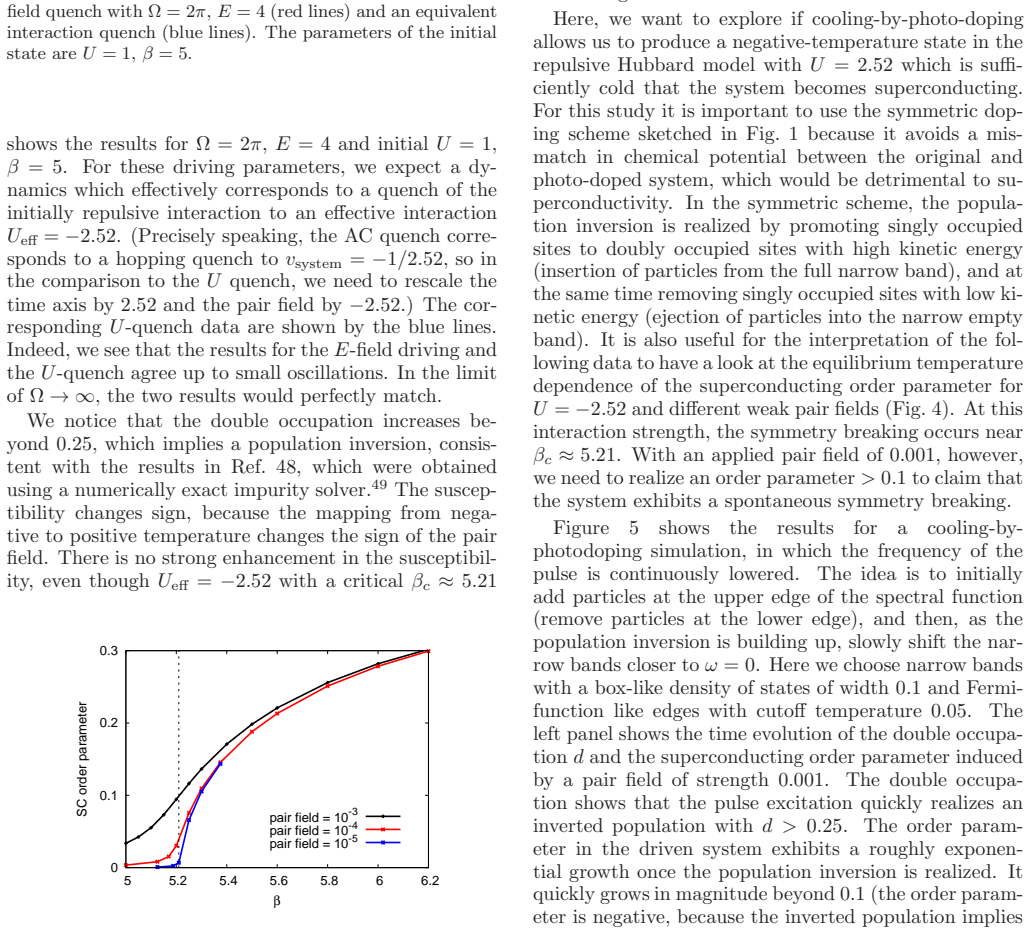
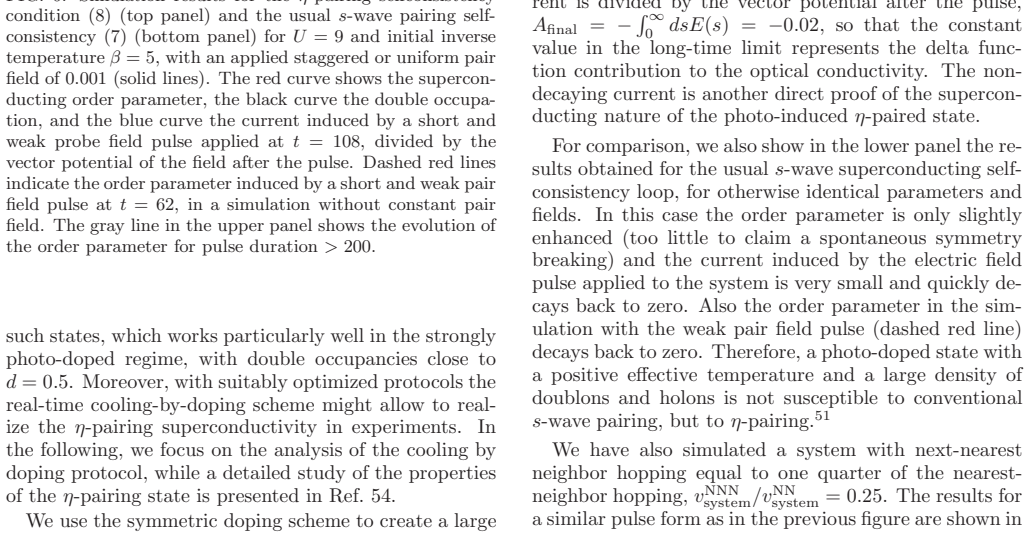
- [Sec. III B, Fig. 5] The superconducting demonstration in Fig. 5 is performed with a constant applied pair field of strength 0.001, and the paper uses the heuristic criterion that an order parameter larger than 0.1 indicates spontaneous symmetry breaking. This criterion is reasonable, but it does not by itself exclude a large nonlinear induced response; the equilibrium comparison in Fig. 4 uses the same NCA solver and pair-field values, so it cannot serve as an independent calibration. Unlike the eta-pairing case in Sec. III C (dashed line in Fig. 6), no simulation is shown in which the pair field is switched off after the order has formed and the order parameter persists. Please add such a zero-field persistence check (or a divergent zero-field pair susceptibility) to support the claim of spontaneous s-wave superconductivity in the negative-temperature state.
minor comments (5)
- [Sec. III B; Fig. 7 caption] There are two typos: 'superconductvity' in Sec. III B and 'oder parameter' in the Fig. 7 caption.
- [Sec. III B] The full pulse protocol for the superconducting simulation is not specified: the text says the frequency is 'continuously lowered' but does not give Omega(t) or fenvelope(t), unlike the eta-pairing section which provides Eq. (14). Please provide the complete pulse parameters for reproducibility.
- [Fig. 2] The caption says 'grey (blue) dashed lines' but the text distinguishes gray and blue equilibrium curves; please clarify which color corresponds to x% and 2x% doping in both the spectral and conductivity panels.
- [Sec. II] The statement that 'the noninteracting narrow bands have the same temperature as the initial equilibrium system' should be corrected or qualified in view of the cutoff temperatures used in the simulations.
- [References] Ref. 54 is cited as 'in preparation'; if a published version exists, please update the reference.
Circularity Check
No significant circularity: effective temperatures and order parameters are measured outputs, not fitted inputs; only minor non-load-bearing self-citations to prior cooling-by-doping work appear.
full rationale
The paper's derivation chain is not circular. The effective inverse temperatures β_eff are obtained from Fermi-function fits to the measured distribution A</A in the Hubbard bands (Sec. III A, Fig. 2; Sec. III C, Fig. 7), and are then used as labels for comparison with equilibrium calculations; they are not adjusted to force the target conductivities or order parameters. The s-wave superconducting order parameter is induced by a weak applied pair field and then measured as a dynamical response, growing and persisting after decoupling (Sec. III B, Fig. 5), so it is not imposed by construction. Similarly, the η-pairing order parameter is demonstrated both with a constant pair field and with a short weak pair-field pulse, and is corroborated by a nondecaying current (Sec. III C, Figs. 6–7). The cooling-by-doping mechanism is imported from Ref. 40, and the η-pairing phase diagram from the in-preparation Ref. 54, both involving the same group, but these citations are not load-bearing in a circular sense: the present paper's central claims are supported by its own nonequilibrium DMFT simulations and by comparisons to equilibrium benchmarks. The cited U_eff = U/J0 AC-quench mapping (Ref. 48) is used only as motivation; the superconducting demonstration itself relies on the cooling-by-doping protocol, and the negative-temperature-to-attractive-equivalence is an exact mapping. The NCA impurity solver's quantitative reliability is a legitimate correctness concern, but it is not a circularity issue.
Assumptions & free parameters
free parameters (8)
- Hubbard interaction U =
9 (Mott regime) and 2.52 (negative-temperature superconducting regime)
- Initial inverse temperature beta =
5
- Pulse amplitude a_max and envelope =
0.15 or 0.25 with envelope f_envelope(t), duration Delta t=50
- Narrow band parameters =
width 0.05 or 0.1; cutoff temperature 0.01 or 0.05
- Chirp protocol Omega(t) =
Omega_min=8, Omega_max=12.5, t_ramp=170 for eta-pairing; continuously lowered frequency for the superconducting run
- Effective temperatures beta_eff =
19.2, 14.4, 13.0, 10.5, -7.3 (for different runs)
- Pair field strength and probe fields =
constant pair field 0.001; short pair-field pulses; weak electric-field probe
- Next-nearest-neighbor hopping ratio =
v_NNN/v_NN = 0.25
assumptions (6)
- domain assumption DMFT mapping to a single-site impurity model is exact in the limit of infinite lattice coordination; the Bethe lattice self-consistency Delta = v G v* is used.
- domain assumption The non-crossing approximation (NCA) yields quantitatively accurate impurity spectra and order parameters for the strongly correlated nonequilibrium states studied.
- domain assumption The narrow full and empty bands remain in equilibrium during the protocol and act as an entropy sink that does not feed entropy back into the system.
- ad hoc to paper A Fermi-function fit to A</A in the upper Hubbard band defines a meaningful effective temperature that also characterizes the low-frequency conductivity.
- ad hoc to paper An applied pair field of strength 0.001 is a sufficiently weak probe that order parameters larger than 0.1 indicate spontaneous symmetry breaking.
- domain assumption Doublon-holon recombination and other heating processes are negligible on the simulation timescale because of the large Mott gap U=9.
Cite this review
Pith. "Pith review of Entropy-cooled nonequilibrium states of the Hubbard model." pith.science (2026). https://pith.science/paper/DZ5CF66T
@misc{pith2026190808515,
  author       = {Pith},
  title        = {Pith review of: Entropy-cooled nonequilibrium states of the Hubbard model},
  year         = {2026},
  howpublished = {\url{https://pith.science/paper/DZ5CF66T}},
  note         = {Machine review of arXiv:1908.08515}
}
abstract
We show that the recently proposed cooling-by-doping mechanism allows to efficiently prepare interesting nonequilibrium states of the Hubbard model. Using nonequilibrium dynamical mean field theory and a particle-hole symmetric setup with dipolar excitations to full and empty bands we produce cold photo-doped Mott insulating states with a sharp Drude peak in the optical conductivity, a superconducting state in the repulsive Hubbard model with an inverted population, and $\eta$-paired states in systems with a large density of doublons and holons. The reshuffling of entropy into full and empty bands not only provides an efficient cooling mechanism, it also allows to overcome thermalization bottlenecks and slow dynamics that have been observed in systems cooled by the coupling to boson baths.
Figures

Figures from the paper (5 more)

Reference graph
Works this paper leans on
-
[1]
L. Stojchevska, I. Vaskivskyi, T. Mertelj, P. Kusar, D. Svetin, S. Brazovskii, and D. Mihailovic, Science 344 , 177 (2014)
work page 2014
- [2]
-
[3]
S. Mor, M. Herzog, D. Golez, P. Werner, M. Eckstein, N. Katayama, M. Nohara, H. Takagi, T. Mizokawa, C. Monney and J. St\"ahler, Phys. Rev. Lett. 119 , 086401 (2017)
work page 2017
- [4]
-
[5]
S.Kaiser, C. R. Hunt, D. Nicoletti, W. Hu, I. Gierz, H. Y. Liu, M. Le Tacon, T. Loew, D. Haug, B. Keimer, and A. Cavalleri, Phys. Rev. B 89 , 184516 (2014)
work page 2014
-
[6]
W. Hu, S. Kaiser, D. Nicoletti, C. R. Hunt, I. Gierz, M. C. Hoffmann, M. Le Tacon, T. Loew, B. Keimer, and A. Cavalleri, Nat. Mater. 13 , 705 (2014)
work page 2014
-
[7]
M. Mitrano, A. Cantaluppi, D. Nicoletti, S. Kaiser, A. Perucchi, S. Lupi, P. Di Pietro, D. Pontiroli, M. Ricco, S. R. Clark, D. Jaksch, and A. Cavalleri, Nature 530 , 461 (2016)
work page 2016
-
[8]
S. J. Denny, S. R. Clark, Y. Laplace, A. Cavalleri, and D. Jaksch, Phys. Rev. Lett 114 , 137001 (2015)
work page 2015
Show all 57 references
-
[9]
Okamoto, A
J.-i. Okamoto, A. Cavalleri, and L. Mathey, Phys. Rev. Lett. 117 , 227001 (2016)
2016
-
[10]
D. M. Kennes, E. Y. Wilner, D. R. Reichman, and A. J. Millis, Nat. Phys. 13 , 479 (2017)
2017
-
[11]
Babadi, M
M. Babadi, M. Knap, I. Martin, G. Refael, and E. Demler, Phys. Rev. B 96 , 014512 (2017)
2017
-
[12]
Murakami, N
Y. Murakami, N. Tsuji, M. Eckstein, and P. Werner, Phys. Rev. B 96 , 045125 (2017)
2017
-
[13]
Tanaka, M
Y. Tanaka, M. Daira, K. Yonemitsu, Phys. Rev. B 97 , 115105 (2018)
2018
-
[14]
A. Nava, C. Giannetti, A. Georges, E. Tosatti, and M. Fabrizio, Nature Physics 14 , 154 (2018)
2018
-
[15]
Eckstein and P
M. Eckstein and P. Werner, Phys. Rev. B 84 , 035122 (2011)
2011
-
[16]
Golez, J
D. Golez, J. Bonca, L. Vidmar, and S. A. Trugman, Phys. Rev. Lett. 109 , 236402 (2012)
2012
-
[17]
Sentef, A
M. Sentef, A. F. Kemper, B. Moritz, J. K. Freericks, Z.-X. Shen, and T. P. Devereaux, Phys. Rev. X 3 , 041033 (2013)
2013
-
[18]
Lenarcic and P
Z. Lenarcic and P. Prelovsek, Phys. Rev. Lett. 111 , 016401 (2013)
2013
-
[19]
Golez, J
D. Golez, J. Bonca, M. Mierzejewski, and L. Vidmar, Phys. Rev. B 89 , 165118 (2014)
2014
-
[20]
Murakami, P
Y. Murakami, P. Werner, N. Tsuji, and H. Aoki, Phys. Rev. B 91 , 045128 (2015)
2015
-
[21]
Eckstein, P
M. Eckstein, P. Werner, Scientific Reports 6 , 21235 (2016)
2016
-
[22]
Murakami, D
Y. Murakami, D. Golez, M. Eckstein, P. Werner, Phys. Rev. Lett. 119 , 247601 (2017)
2017
-
[23]
Golez, L
D. Golez, L. Boehnke, H. Strand, M. Eckstein, and P. Werner, Phys. Rev. Lett. 118 , 246402 (2017)
2017
-
[24]
K. Ido, T. Ohgoe, and M. Imada, Sci. Adv. 3 , e1700718 (2017)
2017
-
[25]
Oka and H
T. Oka and H. Aoki, Phys. Rev. B 79 , 081406 (2009)
2009
-
[26]
N. H. Lindner, G. Refael, and V. Galitski, Nature Physics 7 , 490 (2011)
2011
-
[27]
J. H. Mentink, K. Balzer, and M. Eckstein, Nat. Commun. 6 , 6708 (2015)
2015
-
[28]
Werner and M
P. Werner and M. Eckstein, Europhys. Lett. 109 , 37002 (2015)
2015
-
[29]
Ono and S
A. Ono and S. Ishihara, Phys. Rev. Lett. 119 , 207202 (2017)
2017
-
[30]
Ono and S
A. Ono and S. Ishihara, Phys. Rev. B 98 , 214408 (2018)
2018
-
[31]
J. Li, H. Strand, P. Werner, and M. Eckstein, Nature Commun. 9 , 4581 (2018)
2018
-
[32]
Strand, D
H. Strand, D. Golez, M. Eckstein and P. Werner, Phys. Rev. B 96 , 165104 (2017)
2017
-
[33]
Werner, H
P. Werner, H. Strand, S. Hoshino, Y. Murakami, and M. Eckstein, Phys. Rev. B 97 , 165119 (2018)
2018
-
[34]
Eckstein and P
M. Eckstein and P. Werner, Phys. Rev. Lett. 110, 126401 (2013)
2013
-
[35]
M. A. Sentef, A. F. Kemper, A. Georges, C. Kollath, Phys. Rev. B 93 , 144506 (2016)
2016
- [36]
-
[37]
Dal Conte, L
S. Dal Conte, L. Vidmar, D. Golez, M. Mierzejewski, G. Soavi, S. Peli, F. Banfi, G. Ferrini, R. Comin, B. M. Ludbrook, L. Chauviere, N. D. Zhigadlo, H. Eisaki, M. Greven, S. Lupi, A. Damascelli, D. Brida, M. Capone, J. Bon?a, G. Cerullo, C. Giannetti, Nature Physics 11 , 421 (2015)
2015
-
[38]
J. D. Rameau, S. Freutel, M. A. Sentef, A. F. Kemper, J. K. Freericks, I. Avigo, M. Ligges, L. Rettig, Y. Yoshida, H. Eisaki, J. Schneeloch, R. D. Zhong, Z. J. Xu, G. D. Gu, P. D. Johnson, U. Bovensiepen, Nature Comm. 7 , 13761 (2016)
2016
-
[39]
Sayyad and M
S. Sayyad and M. Eckstein, Phys. Rev. Lett. 117 , 096403 (2016)
2016
- [40]
-
[41]
H. Aoki, N. Tsuji, M. Eckstein, M. Kollar, T. Oka, and P. Werner, Rev. Mod. Phys. 86 , 779 (2014)
2014
-
[42]
Georges, G
A. Georges, G. Kotliar, W. Krauth, and M. J. Rozenberg, Rev. Mod. Phys. 68 , 13 (1996)
1996
-
[43]
Metzner and D
M. Metzner and D. Vollhard, Phys. Rev. Lett. 62 , 324 (1989)
1989
-
[44]
Keiter and J
H. Keiter and J. C. Kimball, Intern. J. Magnetism 1 , 233 (1971)
1971
-
[45]
Eckstein and P
M. Eckstein and P. Werner, Phys. Rev. B 82 , 115115 (2010)
2010
-
[46]
Werner, S
P. Werner, S. Hoshino, H. Strand, and M. Eckstein, Phys. Rev. B 95 , 195405 (2017)
2017
-
[47]
C. N. Yang, Phys. Rev. Lett. 63 , 2144 (1989)
1989
-
[48]
Tsuji, T
N. Tsuji, T. Oka, P. Werner, and H. Aoki, Phys. Rev. Lett. 106, 236401 (2011)
2011
-
[49]
Werner, T
P. Werner, T. Oka, and A. J. Millis, Phys. Rev. B 79 035320 (2009)
2009
-
[50]
Werner, N
P. Werner, N. Tsuji, and M. Eckstein, Phys. Rev. B 86, 205101 (2012)
2012
-
[51]
Rosch, D
A. Rosch, D. Rasch, B. Binz and M. Vojta, Phys. Rev. Lett. 101 , 265301 (2008)
2008
-
[52]
Sensarma, D
R. Sensarma, D. Pekker, E. Altman, E. Demler, N. Strohmaier, D. Greif, R. J?ordens, L. Tarruell, H. Moritz, and T. Esslinger, Phys. Rev. B 82 , 224302 (2010)
2010
-
[53]
Kaneko, T
T. Kaneko, T. Shirakawa, S. Sorella, and S. Yunoki, Phys. Rev. Lett. 122 , 077002 (2019)
2019
-
[54]
J. Li, D. Golez, P. Werner, and M. Eckstein, in preparation
-
[55]
Mazurenko, C
A. Mazurenko, C. S. Chiu, G. Ji, M. F. Parsons, M. Kanasz-Nagy, R. Schmidt, F. Grusdt, E. Demler, D. Greif and M. Greiner, Nature 545 , 462 (2017)
2017
-
[56]
Tarruell, D
L. Tarruell, D. Greif, T. Uehlinger, G. Jotzu, and T. Esslinger, Nature 483 , 302 (2012)
2012
-
[57]
Sandholzer, Y
K. Sandholzer, Y. Murakami, F. Goerg, J. Minguzzi, M. Messer, R. Desbuquois, M. Eckstein, P. Werner, and T. Esslinger, arxiv:1811.12826 (2018)
2018 arXiv
Reviewed August 14, 2026 · model on record in the stance chip above.
Discussion (0). Continue with ORCID to comment.