REVIEW 2 major objections 6 minor 2 cited by
Search for Neutrinos from Populations of Optical Transients
T0 review · 2 major / 6 minor · reviewed 2026-08-14 · deepseek-v4-flash
Pith's one-line read Tidal disruption events make under 26% of cosmic neutrinos
desk verdict First stacking limits on TDE neutrino emission, clean nulls, but the 26% population cap rests on an unquantified standard-candle assumption that the abstract states too crisply. read the letter →
The pith
A machine-rendered reading of the paper's core claim, the machinery that carries it, and where it could break.
The reading
What carries the argument
The machinery that carries the argument is an unbinned likelihood stacking analysis over pre-defined source catalogues. For each TDE the search window covers roughly 30 days before optical peak to 100 days after, extended for sources without a resolved peak and widened further for obscured TDEs to accommodate infrared reprocessing delays; the likelihood combines spatial coincidence, reconstructed energy, and time. The second load-bearing step is the conversion of the stacked per-source upper limit into a population fraction: the golden TDEs are treated as standard candles and the population flux is obtained by multiplying the per-source limit by the assumed local TDE rate, which is why the final caps scale linearly with the rate and carry a shaded uncertainty band.
What would settle it
A volume-limited optical survey that measures the local TDE rate with selection bias under control would settle the rate leg of the argument: if the measured rate falls well outside the shaded band used here, the claimed caps must be rescaled proportionally. The representativeness leg could be tested by repeating the stack with a larger, spectroscopically clean TDE sample and checking whether the per-source neutrino limit changes when the 13 golden objects are removed or reweighted.
Extended reading notes
Core claim
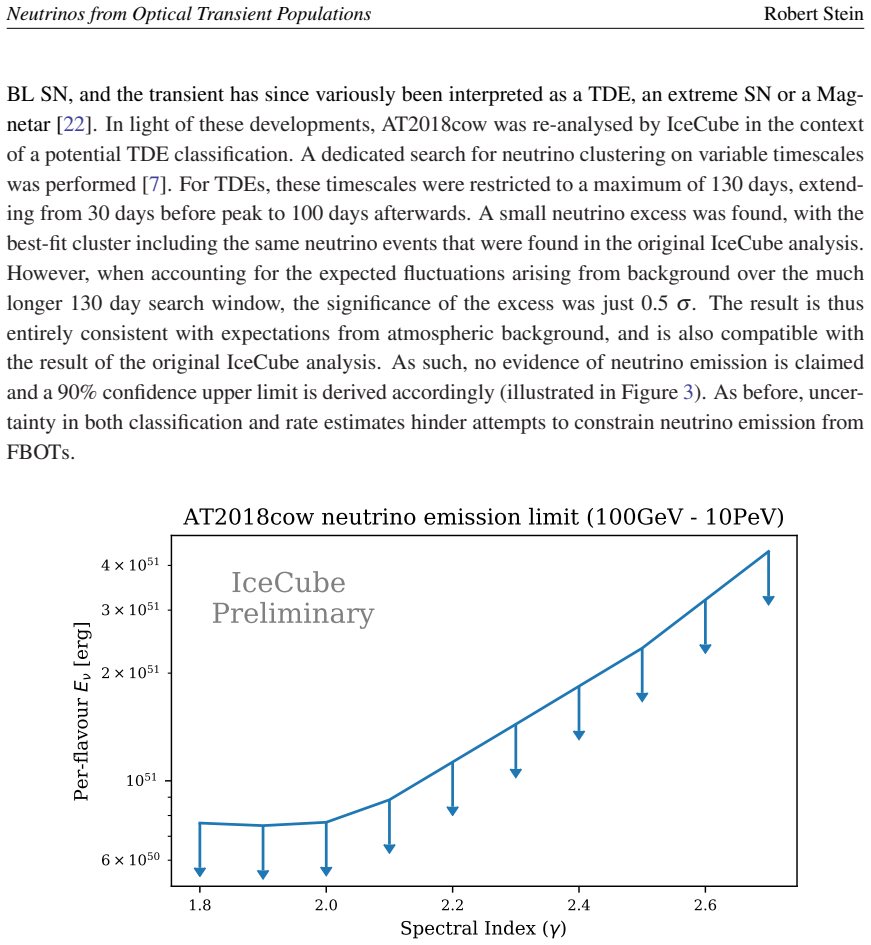
The central claim is that tidal disruption events are not a dominant source of the astrophysical neutrino flux. In a source-driven stacking analysis of four TDE catalogues — 3 on-axis jetted, 13 'golden' non-jetted, 24 'silver' non-jetted, and 13 obscured TDEs — the observed neutrino counts are consistent with background in every category. After assuming standard-candle behaviour for the golden non-jetted sample and using the central values of published local TDE rates, the authors derive 90% confidence upper limits of 26% for non-jetted TDEs and 1.3% for jetted TDEs on their share of the diffuse astrophysical neutrino flux, for an $E^{-2.5}$ spectrum. If jetted TDE neutrino luminosity instead scales with black hole mass, the jetted contribution is capped at 0.4% for a mean host black hole mass of $10^{6.5}\,M_\odot$. In a separate search, AT2018cow shows at most a $0.5\sigma$ excess over the 130-day TDE window, so the paper claims no neutrino emission and instead reports an upper limit on the integrated per-flavour energy release across spectral indices.
Load-bearing premise
The load-bearing premise is that the 13 'golden' TDEs are a representative, standard-candle sample of all non-jetted TDEs and that the published local TDE rates used to scale from per-source limits to population fractions are correct; if either is wrong, the 26% and 1.3% caps shift linearly.
Editorial extensions
If this is right
- If the caps are correct, TDEs cannot be the main explanation for the diffuse astrophysical neutrino flux, so the dominant sources must lie elsewhere — blazars, star-forming galaxies, or classes not yet searched.
- Neutrino-emission models for TDEs that predict a non-jetted population contribution above 26% or a jetted contribution above 1.3% are ruled out at 90% confidence.
- The AT2018cow result means the two neutrinos seen near the explosion were consistent with background over the full 130-day TDE window, so a bright optical transient of this kind does not guarantee detectable high-energy neutrino emission.
- Any improvement in the measured local TDE rate can be plugged directly into the published limits without re-running the neutrino analysis, so better optical surveys will immediately tighten or loosen these caps.
- Larger and cleaner TDE samples from upcoming time-domain surveys will improve both the stacking sensitivity and the rate estimates, strengthening these population constraints.
Reading between the lines
- One consequence the paper leaves implicit is that the 26% and 1.3% caps constrain the neutrino efficiency of TDE jets: a model that still wants TDEs to produce ultra-high-energy cosmic rays must keep the neutrino yield per jet below these bounds.
- Because the caps scale linearly with the assumed local TDE rate, a future unbiased rate measurement could shift the headline numbers considerably; for example, a rate three times the central value would push the non-jetted cap toward 78%, making the 'less than a quarter' statement contingent on today's rate estimates.
- The representativeness of the 13 golden TDEs is testable: once larger spectroscopically confirmed samples exist, one could split the sample by black-hole mass or optical luminosity and check whether the standard-candle assumption changes the stacked limit.
- The same analysis template could be transferred to other rare optical transients, such as superluminous supernovae or fast blue optical transients, as soon as optical surveys provide clean, rate-known samples.
Signed reviews
Editorial analysis
A structured set of objections, weighed in public.
Referee Report
Summary. This ICRC proceedings paper reports a search by the IceCube Collaboration for high-energy neutrino emission from populations of tidal disruption events (TDEs) using 9.5 years of muon-neutrino data. Four source catalogues are stacked independently: on-axis jetted TDEs, a 'golden' sample of unambiguously classified non-jetted TDEs, a 'silver' sample of candidate TDEs, and obscured TDEs in dusty galaxies. No significant neutrino excess is found, and 90% confidence upper limits are converted, under a standard-candle assumption and using external TDE rate estimates, into caps on the TDE contribution to the diffuse astrophysical neutrino flux of less than 1.3% for jetted TDEs and 26% for non-jetted TDEs. The paper also reanalyzes AT2018cow in a 130-day TDE-motivated window, finding only a 0.5 sigma excess (compared with the 1.8 sigma reported in the original 3-day Fast Response Analysis) and deriving 90% upper limits on its integrated neutrino emission as a function of spectral index. The outlook section discusses expected improvements from ZTF and LSST.
Significance. If the results hold, this is the first constraint on TDE populations as contributors to the IceCube diffuse neutrino flux, directly addressing a leading candidate class for the unresolved astrophysical neutrino background. The AT2018cow reanalysis is a useful, internally consistent correction of the earlier 1.8 sigma hint, properly accounting for the larger search window. The use of an agnostic stacking method that does not assume relative source weights is a methodological strength, as is the transparent dependence of the population limits on the local TDE rate, which is shown as an uncertainty band. The main scientific value lies in the null result and in the clearly stated conditional nature of the population caps, although that conditionality is not carried through to the abstract.
major comments (2)
- [Section 4, Figure 1] The conversion from the golden-sample stacking limit to a population-wide cap of 26% for non-jetted TDEs relies on the assumption, stated in Section 4, that the 13 golden TDEs are representative standard candles for the entire non-jetted TDE population. The paper does not quantify how selection on optical classification quality could bias the sample with respect to neutrino luminosity. If a rare subpopulation of non-jetted TDEs, absent from or under-represented in the golden sample, produced substantially more neutrinos per source, the golden-sample stacking limit would not constrain that subpopulation and the true population contribution could exceed 26%. This is a load-bearing assumption for the headline result, so I recommend either a sensitivity study that varies the fraction and luminosity of a hidden bright subpopulation, or at minimum a prominent caveat in the abstract and conclusions that the <26% limit applies only under the standard-candle/representativeness assumption.
- [Section 4, Figures 1 and 2] The population flux caps also depend on the assumed redshift evolution of the TDE rate, which appears only in the figure captions as 'With evolution from Sun et al.' and is never defined in the text. The local rate values from [13] and [17] are given, but the reader cannot assess how the 26% and 1.3% numbers depend on the chosen evolution prescription or on the normalization of the IceCube diffuse flux [16]. The authors should explicitly state the evolution model and the diffuse flux reference value, and ideally show how the caps would shift under a reasonable alternative evolution model.
minor comments (6)
- [Section 3] The unbinned likelihood analysis, test statistic, and event selection are not described in the manuscript; they are only cited to references [7] and [9]. For a proceedings paper this is acceptable, but a brief sentence stating the test statistic and pointing to the specific sections of [7] and [9] would greatly improve usability.
- [Section 5] The heading 'A T2018cow' contains a typo and should be 'AT2018cow'; in the abstract and introduction, 'AT2018cow are presented' should be 'AT2018cow is presented'.
- [Figure 3] The y-axis label in Figure 3 appears truncated or ambiguous; please clarify whether the integrated limit is per flavour or summed over flavours, and state the exact units (for example, erg cm^-2 or E^2 dN/dE in GeV cm^-2 s^-1).
- [Section 4] For each of the four catalogues, the paper says the results are consistent with background but does not quote the observed number of events, the expected background, or the resulting p-value. A small table with these quantities would make the null result more concrete.
- [Section 4] The text states the limits assume 'an E−2.5 astrophysical neutrino flux' but does not explain how the spectral index enters the stacking search or the limit calculation; a brief clarification of the spectral weighting would help, especially since Figure 3 shows a spectral-index dependence only for AT2018cow.
- [Section 6] The sentence 'Higher cadence observations can greatly reduce background by constraining search windows, for example the estimated CCSN explosion time' would be clearer if 'background' were specified as the temporal trial factor or atmospheric background, rather than leaving it ambiguous.
Circularity Check
No circularity: the TDE neutrino-flux limits are produced by an unblinded stacking analysis and normalized to external TDE rates and a previously published diffuse-flux measurement.
full rationale
The paper's derivation chain is a stacking search over neutrino events correlated with TDE catalogues, yielding null results and 90% confidence upper limits. These limits are then converted into population flux fractions by assuming standard-candle behavior, assuming the 'Golden TDEs' are representative of non-jetted TDEs, and multiplying by external TDE rate estimates from van Velzen (2018) and Sun et al. (2015), then dividing by IceCube's published diffuse astrophysical neutrino flux. No parameter fitted in this analysis is recycled as a prediction; the 26% and 1.3% values are upper limits, not best-fit claims. The diffuse-flux reference is a self-citation only in the sense that it is an already-published measurement by the same collaboration, and it is independent of the present search's fitted values; the TDE rates are external. The representativeness and standard-candle assumptions are explicitly stated assumptions, not derived equivalences, so limitations in those assumptions are a correctness or applicability concern rather than circularity. Accordingly, no specific circular step can be identified and the appropriate score is 0.
Assumptions & free parameters
free parameters (5)
- Non-jetted TDE local rate =
8 (+4/-4) x 10^-7 Mpc^-3 yr^-1
- Jetted TDE local rate =
3 (+4/-2) x 10^-11 Mpc^-3 yr^-1
- Mean SMBH mass for jetted TDEs =
10^6.5 solar masses
- TDE neutrino spectral index =
-2.5
- TDE search window =
30 days before to 100 days after optical peak
assumptions (5)
- domain assumption TDEs emit neutrinos as standard candles for the population limits
- domain assumption Golden TDEs represent the non-jetted TDE population
- domain assumption External TDE rates from [13] and [17] are accurate
- standard math The unbinned likelihood machinery from [7] and the Stasik thesis is correctly applied
- domain assumption Neutrino emission from TDEs occurs near optical peak, within -30 to +100 days
Cite this review
Pith. "Pith review of Search for Neutrinos from Populations of Optical Transients." pith.science (2026). https://pith.science/paper/NPXE3HXG
@misc{pith2026190808547,
  author       = {Pith},
  title        = {Pith review of: Search for Neutrinos from Populations of Optical Transients},
  year         = {2026},
  howpublished = {\url{https://pith.science/paper/NPXE3HXG}},
  note         = {Machine review of arXiv:1908.08547}
}
read the original abstract
Since the detection of high-energy cosmic neutrinos at the IceCube Neutrino Observatory in 2013, there has been an on-going search to find the origins of this flux. Despite recent evidence identifying a flaring blazar as a possible neutrino source, the vast majority of the diffuse neutrino flux measured by IceCube remains unexplained. Here, the latest IceCube results testing time-dependent correlation between neutrinos and Tidal Disruption Events (TDEs) are presented, limiting the contribution of jetted and non-jetted TDEs to the diffuse astrophysical neutrino flux to be less than 1.3% and 26% respectively at 90% confidence level. In addition, a dedicated search for neutrinos from the extraordinary transient AT2018cow are presented, and upper limits on the integrated neutrino emission are derived. Expected improvements from new and upcoming time domain optical surveys (such as ZTF and LSST) are also introduced.
Figures


Forward citations
Cited by 2 Pith papers
-
SN 2023uqf: An Interacting Supernova Coincident with a High-Energy Neutrino
SN 2023uqf, a rare interacting Type Ibn supernova found coincident with neutrino IC231004A, is the first observational evidence that interacting supernovae are hadronic accelerators.
-
Neutrinos from explosive transients at the dawn of multi-messenger astronomy
This review summarizes the state of neutrino emission from supernovae and neutron-star mergers, covering thermal and high-energy signals, flavor conversion, and multi-messenger detection strategies.
Reference graph
Works this paper leans on
- [13]
-
[17]
H. Sun, B. Zhang, and Z. Li, Astrophys. J. 812 (2015) 33
work page 2015
-
[16]
IceCube Collaboration, M. G. Aartsen et al., Astrophys. J. 809 (2015) 98
2015
-
[1]
IceCube Collaboration, M. G. Aartsen et al., JINST 12 (2017) P03012
2017
-
[2]
IceCube Collaboration, M. G. Aartsen et al., Science 342 (2013) 1242856
2013
-
[3]
IceCube Collaboration, M. G. Aartsen et al., Astropart. Phys. 92 (2017) 30–41
work page 2017
-
[4]
Kankare et al., Submitted to: Astron
Pan-STARRS, IceCube Collaboration, E. Kankare et al., Submitted to: Astron. Astrophys. (2019)
work page 2019
-
[5]
IceCube Collaboration, M. G. Aartsen et al., Astrophys. J. 835 (2017) 151
work page 2017
Show all 23 references
-
[6]
IceCube, Fermi-LA T, MAGIC, AGILE, ASAS-SN, HA WC, H.E.S.S., INTEGRAL, Kanata, Kiso, Kapteyn, Liverpool Telescope, Subaru, Swift NuSTAR, VERITAS, VLA/17B-403 Collaboration, M. G. Aartsen et al., Science 361 (2018) eaat1378
2018
-
[7]
IceCube Collaboration, M. G. Aartsen et al., Science 361 (2018) 147–151
2018
-
[8]
IceCube Collaboration, M. G. Aartsen et al., Astrophys. J. 835 (2017) 45
2017
-
[9]
A. J. Stasik. PhD thesis, Humboldt-Universitaet zu Berlin, Mathematisch-Naturwissenschaftliche Fakultaet, 2018
2018
-
[10]
Komossa, JHEAp 7 (2015) 148–157
S. Komossa, JHEAp 7 (2015) 148–157
2015
-
[11]
Lunardini and W
C. Lunardini and W. Winter, Phys. Rev. D95 (2017) 123001
2017
-
[12]
Biehl, D
D. Biehl, D. Boncioli, C. Lunardini, and W. Winter, Sci. Rep. 8 (2018) 10828
2018
-
[14]
Auchettl, J
K. Auchettl, J. Guillochon, and E. Ramirez-Ruiz, Astrophys. J. 838 (2017) 149
2017
-
[15]
T. Wang, L. Yan, L. Dou, N. Jiang, Z. Sheng, and C. Yang, Mon. Not. Roy. Astron. Soc. 477 (2018) 2943–2965
2018
-
[18]
Wevers, N
T. Wevers, N. C. Stone, S. van Velzen, P. G. Jonker, T. Hung, K. Auchettl, S. Gezari, F. Onori, D. M. Sánchez, and Z. Kostrzewa-Rutkowska, Mon. Not. Roy. Astron. Soc. (Jun, 2019) 1534
2019
-
[19]
Margutti et al., Astrophys
R. Margutti et al., Astrophys. J. 872 (2019) 18
2019
-
[20]
IceCube Collaboration, PoS(ICRC2019)1026 (these proceedings)
-
[21]
Blaufuss, The Astronomer’s Telegram11785 (June, 2018)
E. Blaufuss, The Astronomer’s Telegram11785 (June, 2018)
2018
-
[22]
D. A. Perley et al., Mon. Not. Roy. Astron. Soc. 484 (2019) 1031–1049
2019
-
[23]
E. C. Bellm et al., PASP 131 (Jan, 2019) 018002. 8
2019
Reviewed August 14, 2026 · model on record in the stance chip above.
Discussion (0). Continue with ORCID to comment.