REVIEW 3 major objections 5 minor 80 references
Evolution of Neutral Oxygen During the Epoch of Reionization and its Use in Estimating the Neutral Hydrogen Fraction
T0 review · 3 major / 5 minor · reviewed 2026-08-14 · deepseek-v4-flash
Pith's one-line read In simulations, the ratio of neutral oxygen to silicon in quasar spectra gauges the neutral hydrogen fraction during reionization.
desk verdict A capable simulation paper with a plausible qualitative story about OI absorbers during reionization, but the advertised 10% accuracy of the OI/Si x_HI estimator is an in-sample curve fit, not a validated measurement. read the letter →
The pith
A machine-rendered reading of the paper's core claim, the machinery that carries it, and where it could break.
The reading
What carries the argument
The machinery is the $\Omega_{\rm OI}/\Omega_{\rm Si}$ ratio, defined from summed column densities of OI, SiII, and SiIV absorbers along a synthetic sightline, converted to comoving mass densities via a line-of-sight pathlength normalization. Because neutral oxygen and neutral hydrogen have nearly the same ionization energy, OI is destroyed by the same photons that reionize hydrogen; the denominator $\Omega_{\rm Si}$ stands in for the total oxygen column, avoiding the need for full ionization modeling of oxygen. The ratio removes most of the redshift-dependent enrichment and density evolution, leaving an observable quantity that responds chiefly to the ionizing background, and its scatter is controlled by restricting the sums to detected absorption systems with column-density cutoffs.
What would settle it
Take quasar spectra at $5.5 \lesssim z \lesssim 7$, measure the OI, SiII, and SiIV column-density ratios from unsaturated lines, convert them to $\Omega_{\rm OI}/\Omega_{\rm Si}$, and compare the inferred neutral hydrogen fraction against independent constraints from Ly-$\alpha$ damping wings, LAE clustering, or 21-cm limits; a disagreement systematically larger than the claimed roughly 10 per cent scatter at $x_{\rm HI} > 0.1$ would falsify the proxy.
Extended reading notes
Core claim
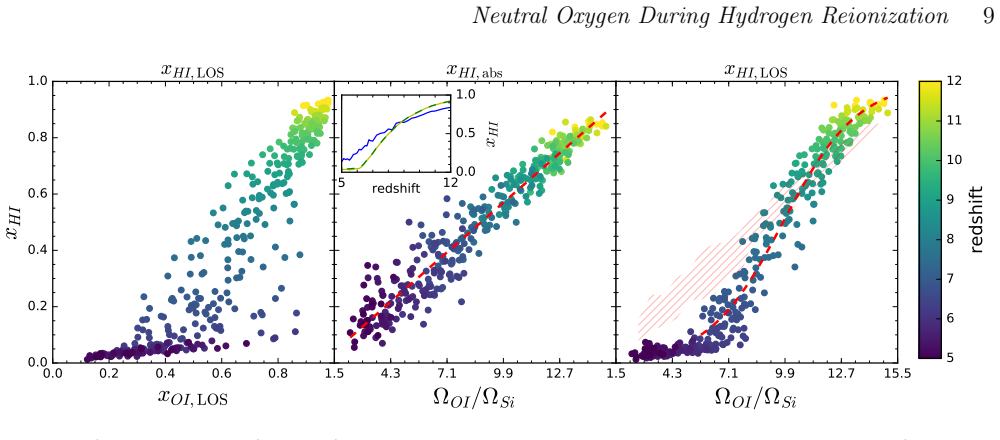
The central discovery is that the comoving mass-density ratio $\Omega_{\rm OI}/\Omega_{\rm Si}$, with $\Omega_{\rm Si} = \Omega_{\rm SiII} + \Omega_{\rm SiIV}$, is a tight observational proxy for the neutral hydrogen fraction along a quasar sightline. When only gas belonging to detected metal absorption systems is included, the relation is linear, $x_{\rm HI,abs} = 0.06\,(\Omega_{\rm OI}/\Omega_{\rm Si}) - 0.05$. When all gas along the sightline is included, the relation is sigmoidal and is fitted by $x_{\rm HI} = [1+\exp(-0.51(\Omega_{\rm OI}/\Omega_{\rm Si}-9.73))]^{-1}$ for $\Omega_{\rm OI}/\Omega_{\rm Si} > 5.42$, with more than 90 per cent of sightline segments within 10 per cent of the predicted value. The authors conclude that this ratio can estimate the mass-weighted neutral hydrogen fraction, and thus track the progress of reionization, particularly where $x_{\rm HI} > 10$ per cent.
Load-bearing premise
The whole calibration rests on the assumption that the simulated gas ionization states, particularly that SiII and SiIV carry essentially all the silicon and that the ionizing background is realistic, match the real reionization-era universe; if they do not, the fitted relation will not transfer from simulation to observation.
Editorial extensions
If this is right
- A measurement of OI and SiII+SiIV column densities in a $z>6$ quasar spectrum can directly estimate the mass-weighted neutral hydrogen fraction, covering the regime $x_{\rm HI} > 0.1$ where Ly-alpha forest transmission saturates.
- The predicted abrupt decline in OI absorber incidence at the overlap epoch gives a new redshift marker for the completion of reionization; the observed jump near $z=5.7$ would then mean the true neutral fraction dropped below about one per cent at that epoch.
- Weak, low-equivalent-width OI systems respond to reionization before strong systems, so the equivalent width distribution itself encodes the outside-in progression of reionization.
- The calibration applies only above a neutral fraction of about 10 per cent; at lower $x_{\rm HI}$ the relation flattens, so the proxy is intended for the early and middle stages of reionization, not its tail.
Reading between the lines
- If the ratio is as tight in real spectra as in the simulation, a single quasar sightline could provide a crude reionization redshift without 21-cm tomography or Ly-alpha damping-wing modeling; many sightlines could map patchiness.
- The paper's own test with only SiII (dropping SiIV) shows a less linear, noisier relation, so whether SiIV is observable at $z>6$ is a decisive practical question; upcoming near-infrared spectra may settle it.
- Because the simulation completes reionization earlier than current observational inferences ($z\sim6.3$ versus $z\sim5.7$), a direct test is to compare the OI/Si-inferred $x_{\rm HI}$ at $z\sim6$-$7$ against independent damping-wing and LAE clustering constraints; agreement would validate the calibration, disagreement would locate the bias.
Signed reviews
Editorial analysis
A structured set of objections, weighed in public.
Referee Report
Summary. The paper uses synthetic sightlines through the Technicolor Dawn radiation-hydrodynamic simulation to study neutral oxygen absorbers from z=8 to z=5. It reports that OI covering fractions shrink around halos as reionization proceeds, that weak absorbers are affected more than strong ones, and that the OI incidence rate drops abruptly near the overlap epoch, in qualitative agreement with the Becker et al. (2019) observations, while the simulated EW distribution overproduces weak systems and underproduces strong ones. Motivated by the similar ionization energies of OI and HI, the paper calibrates a relation between the ratio of OI to SiII+SiIV comoving mass densities, Omega_OiSi, and the neutral hydrogen fraction. For absorber-restricted quantities a linear relation (Eq. 5) describes x_HI,abs; for the full line-of-sight neutral fraction x_HI,LOS a sigmoid (Eq. 6) is fitted, with the statement that more than 90 percent of sightline-segment values lie within 10 percent of the prediction. The paper argues that the median x_HI,LOS across segments tracks the global mass-weighted x_HI,m, and therefore that Omega_OiSi is a useful reionization probe in the regime x_HI > 10 percent.
Significance. If the central calibration survived external validation, an OI/Si ratio probe would be a valuable complement to Ly-alpha and 21 cm observations, particularly in the partially neutral regime where the Ly-alpha forest saturates and the OI lines are not saturated. The paper's strengths are its realistic simulation setup, including on-the-fly multifrequency radiative transfer, self-consistent metal enrichment, synthetic spectra with realistic noise and Voigt-profile fitting, explicit completeness corrections, and a generally honest confrontation with observations, including the known early reionization and weak-UVB problems. The qualitative outside-in reionization picture is well supported by the covering-fraction and absorber-distance trends. However, the quantitative accuracy claim for estimating the global mass-weighted hydrogen neutral fraction is not yet demonstrated, and the calibration is entirely internal to one simulation, so the significance of the central quantitative result is currently conditional.
major comments (3)
- [Section 3.6, Eq. (6) and inset of Figure 8] The central accuracy claim is not established by the analysis as presented. Equation (6) is fitted to x_HI,LOS, the neutral fraction of all gas along a sightline segment, and the statement that 'more than 90 percent of the sightline segment x_HI,LOS values fall within 10 percent of the predicted value' measures scatter around that fit to x_HI,LOS. The only connection to the global mass-weighted neutral fraction x_HI,m is the inset of Figure 8, which shows that the median x_HI,LOS across segments tracks x_HI,m. Because reionization is patchy, an individual quasar sightline can have an x_HI,LOS substantially different from the cosmic mean, and the right panel of Figure 8 reports a maximum scatter of roughly +/-0.2. The paper never computes the bias or rms scatter between predictions from Eq. (6) and the true global x_HI,m for individual segments. This is the load-bearing step for the abstract's claim that the probe can estimate the neutral hydrogen fraction, so it should be quantified directly, for example as a function of redshift and x_HI,m, both for single segments and for stacked samples.
- [Section 3.6, Eqs. (5)-(6); Section 4.4] The calibration is entirely in-sample. Equations (5) and (6) are best-fit relations evaluated on the same simulation outputs from which x_HI and Omega_OiSi are computed, so the quoted '10 percent' accuracy is a measure of internal scatter, not predictive accuracy against the real universe. The paper itself notes that the simulation completes reionization earlier than current observational inferences (z~6.3 versus z~5.7), that the simulated UVB is too weak at z<6, and that the observable silicon ionization states may not be representative at z>6. A systematic shift in the ionization balance or in the silicon ionization fractions would change the fitted coefficients in Eqs. (5) and (6). To support transferability, the paper should either propagate these stated systematic uncertainties into an error budget for the coefficients or validate the relation against an independent simulation or post-processing ionization model; otherwise the accuracy claim should be explicitly framed as conditional on the simulation's ionization balance.
- [Section 4.4, Figure 10] The observational utility of Omega_OiSi depends on simultaneous detection of SiII and SiIV, and the paper itself notes that SiIV may be difficult to observe at z>6 and that Becker et al. (2011) only obtained upper limits on SiIV. The SiII-only variant shown in Figure 10 loses the tight high-x_HI branch and has increased scatter, so the paper's own test indicates that the method is not as sensitive if SiIV is unavailable. The abstract states without qualification that the probe 'may prove particularly useful' for x_HI>10 percent. The conditions under which Eq. (6) can be applied to real spectra should be stated explicitly, and the claimed useful regime should be tied to a demonstrably observable set of silicon transitions.
minor comments (5)
- [Section 3.6, Eq. (6)] The text says the fit is optimized for x_HI > 0.1, but Equation (6) is restricted by Omega_OiSi > 5.42. Please clarify whether the selection is on the predictor or the target, and whether all snapshots contribute equally to the fit.
- [Section 3.6] The phrase 'more than 90 percent of the sightline segment x_HI,LOS values fall within 10 percent of the predicted value' should state whether the 10 percent is relative to the predicted value or an absolute offset, and how this coexists with the reported maximum scatter of roughly +/-0.2.
- [Section 3.6 and Figure 8 caption] Please state explicitly that Omega_OiSi in the right panel is computed from absorber systems via Eq. (4), while x_HI,LOS is computed from all particles along the line of sight. The mixed definition is important for interpreting the claimed relation.
- [Section 2.2] In the sentence beginning 'Testing the sensitivity of the chosen velocity cutoff, we find that there is an insignificant adjustment...', the phrase 'up to 200 km/' is missing the unit; it should read 'up to 200 km/s'.
- [Section 4.4] The notation 'zO i >= 4.9' is not defined and is confusing; it should presumably be written as z >= 4.9 or z ~ 4.9.
Circularity Check
No significant circularity: the OI/Si–x_HI relation is an openly fitted simulation calibration with independent emergent content.
full rationale
Equations 5 and 6 are explicitly labeled as fit lines obtained by optimization; the paper never claims they are first-principles derivations. The correlation between Omega_OI/Omega_Si and x_HI,LOS is not definitional: the two axes of Figure 8 use different particle selections (all gas along the sightline segment versus detected metal absorber systems) and different elements/ions, connected by the physical assumption of similar OI and HI ionization energies. The OI absorber abundance and EW statistics are emergent predictions of the Technicolor Dawn simulation rather than tuning targets, and the paper tests them against Becker et al. (2019) as external observational benchmarks. Citations to Finlator et al. (2018) are standard references to the simulation code and its calibration, not a self-citation chain that forces the conclusion. The main weakness is that the stated 10% accuracy is the scatter around the fitted x_HI,LOS curve, and the bridge to global x_HI,m is via the median of segments rather than per-sightline validation; that is an internal validation gap or overclaim, not a reduction of the claim to its own inputs by construction.
Assumptions & free parameters
free parameters (4)
- Equation 5 slope and intercept =
0.06, -0.05
- Equation 6 sigmoid parameters =
k=-0.51, midpoint=9.73, cutoff=5.42
- Completeness sigmoid parameters =
z<5.7: L=0.96, k=4.81, x0=-1.17; z>5.7: L=0.97, k=4.20, x0=-1.07
- Subgrid outflow and enrichment parameters =
Outflow mass-loading scaling from Muratov et al. 2015; wind velocity from Dave et al.
assumptions (6)
- domain assumption Planck 2016 LCDM cosmology with (Omega_M, Omega_Lambda, Omega_b, h, X_H) = (0.3089, 0.6911, 0.0486, 0.6774, 0.751).
- domain assumption OI traces HI because their ionization energies are similar and charge exchange couples them.
- domain assumption SiII and SiIV dominate the total silicon column in the simulation and in real absorbers.
- domain assumption The simulated reionization history and UVB are representative enough for absorber statistics to match reality.
- domain assumption Simulated synthetic sightline absorber detection mimics observational selection.
- domain assumption The mass-weighted neutral fraction can be estimated from line-of-sight neutral fraction medians.
Cite this review
Pith. "Pith review of Evolution of Neutral Oxygen During the Epoch of Reionization and its Use in Estimating the Neutral Hydrogen Fraction." pith.science (2026). https://pith.science/paper/66VWOQ3F
@misc{pith2026190808549,
  author       = {Pith},
  title        = {Pith review of: Evolution of Neutral Oxygen During the Epoch of Reionization and its Use in Estimating the Neutral Hydrogen Fraction},
  year         = {2026},
  howpublished = {\url{https://pith.science/paper/66VWOQ3F}},
  note         = {Machine review of arXiv:1908.08549}
}
abstract
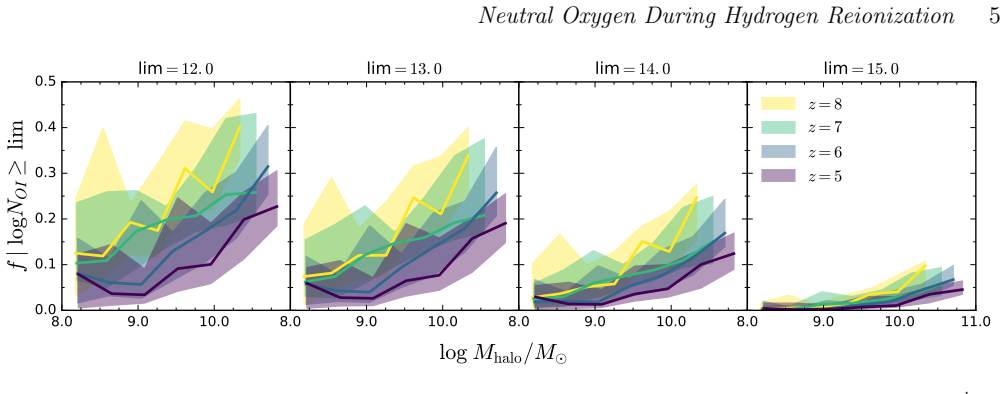
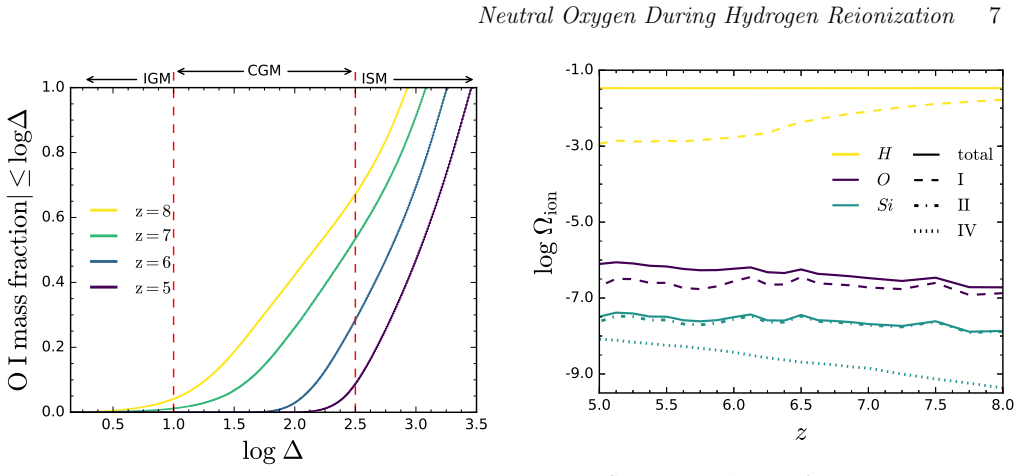
We use synthetic sightlines drawn through snapshots of the Technicolor Dawn simulations to explore how the statistics of neutral oxygen OI absorbers respond to hydrogen reionization. The ionization state of the circumgalactic medium (CGM) initially roughly tracks that of the intergalactic medium, but beginning at $z=8$ the CGM grows systematically more neutral owing to self-shielding. Weak absorbers trace diffuse gas that lies farther from halos, hence they are ionized first, whereas stronger systems are less sensitive to reionization. The overall OI covering fraction decreases slowly with time owing to competition between ongoing enrichment and gradual encroachment of ionization fronts into increasingly overdense gas. While the declining covering fraction is partially offset by continued formation of new halos, the ionization of the diffuse gas causes the predicted line-of-sight incidence rate of OI absorbers to decline abruptly at the overlap epoch, in qualitative agreement with observations. In comparison to the recently-observed equivalent width (EW) distribution at $z\approx6$, the simulations underproduce systems with $EW \geq 0.1 \unicode{x212B}$, although they reproduce weaker systems with $EW \geq 0.05 \unicode{x212B}$. By $z\approx5$, the incidence of $EW < 0.1 \unicode{x212B}$ systems are overproduced, consistent with previous indications that the simulated ionizing background is too weak at $z<6$. The summed column densities of SiII and SiIV trace the total oxygen column, and hence the ratio of the OI and SiII + SiIV comoving mass densities traces the progress of reionization. This probe may prove particularly useful in the regime where $x_{HI} > 10\%$
Figures


Figures from the paper (5 more)



Reference graph
Works this paper leans on
-
[1]
Ba \ n ados E., et al., 2016, @doi [ ] 10.3847/0067-0049/227/1/11 , http://adsabs.harvard.edu/abs/2016ApJS..227...11B 227, 11
-
[2]
Bahcall J. N., Peebles P. J. E., 1969, @doi [ ] 10.1086/180337 , http://adsabs.harvard.edu/abs/1969ApJ...156L...7B 156, L7
doi:10.1086/180337 1969
-
[3]
Becker G. D., Sargent W. L. W., Rauch M., Calverley A. P., 2011, @doi [ ] 10.1088/0004-637X/735/2/93 , http://adsabs.harvard.edu/abs/2011ApJ...735...93B 735, 93
-
[4]
Becker G. D., Bolton J. S., Madau P., Pettini M., Ryan-Weber E. V., Venemans B. P., 2015, @doi [ ] 10.1093/mnras/stu2646 , http://adsabs.harvard.edu/abs/2015MNRAS.447.3402B 447, 3402
-
[5]
D., et al., 2019, arXiv e-prints, https://ui.adsabs.harvard.edu/abs/2019arXiv190702983B p
Becker G. D., et al., 2019, arXiv e-prints, https://ui.adsabs.harvard.edu/abs/2019arXiv190702983B p. arXiv:1907.02983
arXiv 2019
-
[6]
Bolton J. S., Haehnelt M. G., 2013, @doi [ ] 10.1093/mnras/sts455 , http://adsabs.harvard.edu/abs/2013MNRAS.429.1695B 429, 1695
-
[7]
Bosman S. E. I., Fan X., Jiang L., Reed S., Matsuoka Y., Becker G., Haehnelt M., 2018, @doi [ ] 10.1093/mnras/sty1344 , https://ui.adsabs.harvard.edu/abs/2018MNRAS.479.1055B 479, 1055
-
[8]
Bowman J. D., Rogers A. E. E., Monsalve R. A., Mozdzen T. J., Mahesh N., 2018, @doi [ ] 10.1038/nature25792 , http://adsabs.harvard.edu/abs/2018Natur.555...67B 555, 67
Show all 80 references
-
[9]
Cai Z., Fan X., Dave R., Finlator K., Oppenheimer B., 2017, @doi [ ] 10.3847/2041-8213/aa8fc6 , http://adsabs.harvard.edu/abs/2017ApJ...849L..18C 849, L18
2017 doi
-
[10]
G., Aubert D., Puchwein E., 2015, @doi [ ] 10.1093/mnras/stv1786 , http://adsabs.harvard.edu/abs/2015MNRAS.453.2943C 453, 2943
Chardin J., Haehnelt M. G., Aubert D., Puchwein E., 2015, @doi [ ] 10.1093/mnras/stv1786 , http://adsabs.harvard.edu/abs/2015MNRAS.453.2943C 453, 2943
2015 doi
-
[11]
G., 2017, @doi [ ] 10.1093/mnras/stw2943 , http://adsabs.harvard.edu/abs/2017MNRAS.465.3429C 465, 3429
Chardin J., Puchwein E., Haehnelt M. G., 2017, @doi [ ] 10.1093/mnras/stw2943 , http://adsabs.harvard.edu/abs/2017MNRAS.465.3429C 465, 3429
2017 doi
-
[12]
V., Garc \' a L
Codoreanu A., Ryan-Weber E. V., Garc \' a L. \'A ., Crighton N. H. M., Becker G., Pettini M., Madau P., Venemans B., 2018, @doi [ ] 10.1093/mnras/sty2576 , http://adsabs.harvard.edu/abs/2018MNRAS.481.4940C 481, 4940
2018 doi
-
[13]
J., Simcoe R
Cooper T. J., Simcoe R. A., Cooksey K. L., Bordoloi R., Miller D. R., Furezs G., Turner M. L., Ba \ n ados E., 2019, arXiv e-prints, http://adsabs.harvard.edu/abs/2019arXiv190105980C
2019
-
[14]
Couchman H. M. P., Rees M. J., 1986, @doi [ ] 10.1093/mnras/221.1.53 , http://adsabs.harvard.edu/abs/1986MNRAS.221...53C 221, 53
1986 doi
-
[15]
R., McQuinn M., Trac H., Shapiro P
D'Aloisio A., Upton Sanderbeck P. R., McQuinn M., Trac H., Shapiro P. R., 2017, @doi [ ] 10.1093/mnras/stx711 , http://adsabs.harvard.edu/abs/2017MNRAS.468.4691D 468, 4691
2017 doi
-
[16]
F., 2016, @doi [ ] 10.1093/mnras/stw1862 , http://adsabs.harvard.edu/abs/2016MNRAS.462.3265D 462, 3265
Dav \'e R., Thompson R., Hopkins P. F., 2016, @doi [ ] 10.1093/mnras/stw1862 , http://adsabs.harvard.edu/abs/2016MNRAS.462.3265D 462, 3265
2016 doi
-
[17]
R., 2016, in Electromagnetics in Advanced Applications (ICEAA), 2016 International Conference on, article id
DeBoer D. R., 2016, in Electromagnetics in Advanced Applications (ICEAA), 2016 International Conference on, article id. 7731446. p. 7731446, @doi 10.1109/ICEAA.2016.7731446
2016
-
[18]
D., Dav \'e R., Zackrisson E., 2018, @doi [ ] 10.1093/mnras/sty156 , http://adsabs.harvard.edu/abs/2018MNRAS.tmp..152D
Doughty C., Finlator K., Oppenheimer B. D., Dav \'e R., Zackrisson E., 2018, @doi [ ] 10.1093/mnras/sty156 , http://adsabs.harvard.edu/abs/2018MNRAS.tmp..152D
2018 doi
-
[19]
Einasto M., Einasto J., 1987, @doi [ ] 10.1093/mnras/226.3.543 , http://adsabs.harvard.edu/abs/1987MNRAS.226..543E 226, 543
1987 doi
-
[20]
K., Strauss M
Fan X., Narayanan V. K., Strauss M. A., White R. L., Becker R. H., Pentericci L., Rix H.-W., 2002, @doi [ ] 10.1086/339030 , http://adsabs.harvard.edu/abs/2002AJ....123.1247F 123, 1247
2002 doi
-
[21]
L., Keating B., 2006, @doi [ ] 10.1146/annurev.astro.44.051905.092514 , http://adsabs.harvard.edu/abs/2006ARA
Fan X., Carilli C. L., Keating B., 2006, @doi [ ] 10.1146/annurev.astro.44.051905.092514 , http://adsabs.harvard.edu/abs/2006ARA
2006 arXiv
-
[22]
J., Korista K
Ferland G. J., Korista K. T., Verner D. A., Ferguson J. W., Kingdon J. B., Verner E. M., 1998, @doi [ ] 10.1086/316190 , http://adsabs.harvard.edu/abs/1998PASP..110..761F 110, 761
1998 doi
-
[24]
A., Oppenheimer B
Finlator K., Mu \ n oz J. A., Oppenheimer B. D., Oh S. P., \"O zel F., Dav \'e R., 2013, @doi [ ] 10.1093/mnras/stt1697 , http://adsabs.harvard.edu/abs/2013MNRAS.436.1818F 436, 1818
2013 doi
-
[25]
D., 2015, @doi [ ] 10.1093/mnras/stu2668 , http://adsabs.harvard.edu/abs/2015MNRAS.447.2526F 447, 2526
Finlator K., Thompson R., Huang S., Dav \'e R., Zackrisson E., Oppenheimer B. D., 2015, @doi [ ] 10.1093/mnras/stu2668 , http://adsabs.harvard.edu/abs/2015MNRAS.447.2526F 447, 2526
2015 doi
-
[26]
D., Dav \'e R., Zackrisson E., 2018, @doi [ ] 10.1093/mnras/sty1949 , http://adsabs.harvard.edu/abs/2018MNRAS.480.2628F 480, 2628
Finlator K., Keating L., Oppenheimer B. D., Dav \'e R., Zackrisson E., 2018, @doi [ ] 10.1093/mnras/sty1949 , http://adsabs.harvard.edu/abs/2018MNRAS.480.2628F 480, 2628
2018 doi
-
[27]
M., Prochaska J
Fumagalli M., O'Meara J. M., Prochaska J. X., Worseck G., 2013, @doi [ ] 10.1088/0004-637X/775/1/78 , http://adsabs.harvard.edu/abs/2013ApJ...775...78F 775, 78
2013 doi
-
[28]
A., Tescari E., Ryan-Weber E
Garc \' a L. A., Tescari E., Ryan-Weber E. V., Wyithe J. S. B., 2017, @doi [ ] 10.1093/mnrasl/slx053 , http://adsabs.harvard.edu/abs/2017MNRAS.469L..53G 469, L53
2017 doi
-
[29]
M., Trac H., 2018, @doi [Research Notes of the American Astronomical Society] 10.3847/2515-5172/aad68a , http://adsabs.harvard.edu/abs/2018RNAAS...2c.135G 2, 135
Glazer D., Rau M. M., Trac H., 2018, @doi [Research Notes of the American Astronomical Society] 10.3847/2515-5172/aad68a , http://adsabs.harvard.edu/abs/2018RNAAS...2c.135G 2, 135
2018 doi
-
[30]
Y., 2000, @doi [ ] 10.1086/308876 , https://ui.adsabs.harvard.edu/abs/2000ApJ...535..530G 535, 530
Gnedin N. Y., 2000, @doi [ ] 10.1086/308876 , https://ui.adsabs.harvard.edu/abs/2000ApJ...535..530G 535, 530
2000 doi
-
[31]
E., Peterson B
Gunn J. E., Peterson B. A., 1965, @doi [ ] 10.1086/148444 , http://adsabs.harvard.edu/abs/1965ApJ...142.1633G 142, 1633
1965 doi
-
[32]
Haardt F., Madau P., 2012, @doi [ ] 10.1088/0004-637X/746/2/125 , http://adsabs.harvard.edu/abs/2012ApJ...746..125H 746, 125
2012 doi
-
[33]
Hahn O., Abel T., 2011, @doi [ ] 10.1111/j.1365-2966.2011.18820.x , http://adsabs.harvard.edu/abs/2011MNRAS.415.2101H 415, 2101
2011
-
[34]
Haiman Z., Loeb A., 1997, @doi [ ] 10.1086/304238 , http://adsabs.harvard.edu/abs/1997ApJ...483...21H 483, 21
1997 doi
-
[35]
L., Sand D., Bildfell C., 2017, @doi [ ] 10.3847/1538-4357/834/1/15 , http://adsabs.harvard.edu/abs/2017ApJ...834...15H 834, 15
Heringer E., Pritchet C., Kezwer J., Graham M. L., Sand D., Bildfell C., 2017, @doi [ ] 10.3847/1538-4357/834/1/15 , http://adsabs.harvard.edu/abs/2017ApJ...834...15H 834, 15
2017 doi
-
[36]
Hoag A., et al., 2019, arXiv e-prints, http://adsabs.harvard.edu/abs/2019arXiv190109001H
2019
-
[37]
Huml \' cek J., 1979, @doi [ ] 10.1016/0022-4073(79)90062-1 , http://adsabs.harvard.edu/abs/1979JQSRT..21..309H 21, 309
1979 doi
-
[38]
B., et al., 2018, arXiv e-prints, https://ui.adsabs.harvard.edu/abs/2018arXiv181112410H p
Hummels C. B., et al., 2018, arXiv e-prints, https://ui.adsabs.harvard.edu/abs/2018arXiv181112410H p. arXiv:1811.12410
2018 arXiv
-
[39]
K., et al., 2018, @doi [ ] 10.1093/pasj/psy048 , http://adsabs.harvard.edu/abs/2018PASJ...70...55I 70, 55
Inoue A. K., et al., 2018, @doi [ ] 10.1093/pasj/psy048 , http://adsabs.harvard.edu/abs/2018PASJ...70...55I 70, 55
2018 doi
-
[40]
G., et al., 2019, @doi [ ] 10.3847/1538-4357/aaf1a6 , http://adsabs.harvard.edu/abs/2019ApJ...870..137K 870, 137
Kacprzak G. G., et al., 2019, @doi [ ] 10.3847/1538-4357/aaf1a6 , http://adsabs.harvard.edu/abs/2019ApJ...870..137K 870, 137
2019 doi
-
[41]
C., Haehnelt M
Keating L. C., Haehnelt M. G., Becker G. D., Bolton J. S., 2014, @doi [ ] 10.1093/mnras/stt2324 , http://adsabs.harvard.edu/abs/2014MNRAS.438.1820K 438, 1820
2014 doi
-
[42]
C., Puchwein E., Haehnelt M
Keating L. C., Puchwein E., Haehnelt M. G., Bird S., Bolton J. S., 2016, @doi [ ] 10.1093/mnras/stw1306 , http://adsabs.harvard.edu/abs/2016MNRAS.461..606K 461, 606
2016 doi
-
[43]
Konno A., et al., 2018, @doi [ ] 10.1093/pasj/psx131 , http://adsabs.harvard.edu/abs/2018PASJ...70S..16K 70, S16
2018 doi
-
[44]
Kroupa P., 2001, @doi [ ] 10.1046/j.1365-8711.2001.04022.x , http://adsabs.harvard.edu/abs/2001MNRAS.322..231K 322, 231
2001
-
[45]
J., 2000, @doi [ ] 10.1086/312934 , http://adsabs.harvard.edu/abs/2000ApJ...542L..69M 542, L69
Madau P., Rees M. J., 2000, @doi [ ] 10.1086/312934 , http://adsabs.harvard.edu/abs/2000ApJ...542L..69M 542, L69
2000 doi
-
[46]
Mason C. A., Treu T., Dijkstra M., Mesinger A., Trenti M., Pentericci L., de Barros S., Vanzella E., 2018, @doi [ ] 10.3847/1538-4357/aab0a7 , http://adsabs.harvard.edu/abs/2018ApJ...856....2M 856, 2
2018 doi
-
[47]
D., Fan X., Jiang L., Cai Z., 2018, @doi [ ] 10.3847/1538-3881/aaaab4 , http://adsabs.harvard.edu/abs/2018AJ....155..131M 155, 131
McGreer I. D., Fan X., Jiang L., Cai Z., 2018, @doi [ ] 10.3847/1538-3881/aaaab4 , http://adsabs.harvard.edu/abs/2018AJ....155..131M 155, 131
2018 doi
-
[48]
McQuinn M., Lidz A., Zahn O., Dutta S., Hernquist L., Zaldarriaga M., 2007, @doi [ ] 10.1111/j.1365-2966.2007.11489.x , http://adsabs.harvard.edu/abs/2007MNRAS.377.1043M 377, 1043
2007
-
[49]
Mellema G., et al., 2013, @doi [Experimental Astronomy] 10.1007/s10686-013-9334-5 , http://adsabs.harvard.edu/abs/2013ExA....36..235M 36, 235
2013 doi
-
[50]
Miralda-Escud \'e J., 1998, @doi [ ] 10.1086/305799 , http://adsabs.harvard.edu/abs/1998ApJ...501...15M 501, 15
1998 doi
-
[51]
J., 2000, @doi [ ] 10.1086/308330 , http://adsabs.harvard.edu/abs/2000ApJ...530....1M 530, 1
Miralda-Escud \'e J., Haehnelt M., Rees M. J., 2000, @doi [ ] 10.1086/308330 , http://adsabs.harvard.edu/abs/2000ApJ...530....1M 530, 1
2000 doi
-
[52]
F., Wyithe J
Morales M. F., Wyithe J. S. B., 2010, @doi [ ] 10.1146/annurev-astro-081309-130936 , http://adsabs.harvard.edu/abs/2010ARA
2010 doi
-
[53]
423, Understanding the Epoch of Cosmic Reionization: Challenges and Progress
Mortlock D., 2016, in Mesinger A., ed., Astrophysics and Space Science Library Vol. 423, Understanding the Epoch of Cosmic Reionization: Challenges and Progress. p. 187 ( @eprint arXiv 1511.01107 ), @doi 10.1007/978-3-319-21957-8_7
2016 arXiv
-
[54]
L., Kere s D., Faucher-Gigu \`e re C.-A., Hopkins P
Muratov A. L., Kere s D., Faucher-Gigu \`e re C.-A., Hopkins P. F., Quataert E., Murray N., 2015, @doi [ ] 10.1093/mnras/stv2126 , http://adsabs.harvard.edu/abs/2015MNRAS.454.2691M 454, 2691
2015 doi
-
[55]
M., Kacprzak G
Nielsen N. M., Kacprzak G. G., Muzahid S., Churchill C. W., Murphy M. T., Charlton J. C., 2017, @doi [ ] 10.3847/1538-4357/834/2/148 , http://adsabs.harvard.edu/abs/2017ApJ...834..148N 834, 148
2017 doi
-
[56]
Nomoto K., Tominaga N., Umeda H., Kobayashi C., Maeda K., 2006, @doi [Nuclear Physics A] 10.1016/j.nuclphysa.2006.05.008 , http://adsabs.harvard.edu/abs/2006NuPhA.777..424N 777, 424
2006 doi
-
[57]
P., 2002, @doi [ ] 10.1046/j.1365-8711.2002.05859.x , http://adsabs.harvard.edu/abs/2002MNRAS.336.1021O 336, 1021
Oh S. P., 2002, @doi [ ] 10.1046/j.1365-8711.2002.05859.x , http://adsabs.harvard.edu/abs/2002MNRAS.336.1021O 336, 1021
2002
-
[58]
Onoue M., et al., 2017, @doi [ ] 10.3847/2041-8213/aa8cc6 , http://adsabs.harvard.edu/abs/2017ApJ...847L..15O 847, L15
2017 doi
-
[59]
D., Dav \'e R., 2008, @doi [ ] 10.1111/j.1365-2966.2008.13280.x , https://ui.adsabs.harvard.edu/abs/2008MNRAS.387..577O 387, 577
Oppenheimer B. D., Dav \'e R., 2008, @doi [ ] 10.1111/j.1365-2966.2008.13280.x , https://ui.adsabs.harvard.edu/abs/2008MNRAS.387..577O 387, 577
2008
-
[61]
D., et al., 2016, @doi [ ] 10.1093/mnras/stw1066 , http://adsabs.harvard.edu/abs/2016MNRAS.460.2157O 460, 2157
Oppenheimer B. D., et al., 2016, @doi [ ] 10.1093/mnras/stw1066 , http://adsabs.harvard.edu/abs/2016MNRAS.460.2157O 460, 2157
2016 doi
-
[62]
D., Schaye J., Crain R
Oppenheimer B. D., Schaye J., Crain R. A., Werk J. K., Richings A. J., 2018, @doi [ ] 10.1093/mnras/sty2281 , http://adsabs.harvard.edu/abs/2018MNRAS.481..835O 481, 835
2018 doi
-
[63]
P., Gnedin N
Ostriker J. P., Gnedin N. Y., 1996, @doi [ ] 10.1086/310375 , http://adsabs.harvard.edu/abs/1996ApJ...472L..63O 472, L63
1996 doi
-
[64]
Ouchi M., et al., 2018, @doi [ ] 10.1093/pasj/psx074 , http://adsabs.harvard.edu/abs/2018PASJ...70S..13O 70, S13
2018 doi
-
[65]
Pallottini A., Gallerani S., Ferrara A., 2014, @doi [ ] 10.1093/mnrasl/slu126 , http://adsabs.harvard.edu/abs/2014MNRAS.444L.105P 444, L105
2014 doi
-
[66]
H., et al., 2017, @doi [ ] 10.3847/1538-4357/aa63e7 , http://adsabs.harvard.edu/abs/2017ApJ...838...65P 838, 65
Patil A. H., et al., 2017, @doi [ ] 10.3847/1538-4357/aa63e7 , http://adsabs.harvard.edu/abs/2017ApJ...838...65P 838, 65
2017 doi
-
[67]
S., et al., 2019, @doi [ ] 10.3847/1538-4357/ab0654 , https://ui.adsabs.harvard.edu/abs/2019ApJ...873..129P 873, 129
Peeples M. S., et al., 2019, @doi [ ] 10.3847/1538-4357/ab0654 , https://ui.adsabs.harvard.edu/abs/2019ApJ...873..129P 873, 129
2019 doi
-
[68]
H., Agertz O., Christensen L., Renaud F., Uldall Fynbo J
Pehlivan Rhodin N. H., Agertz O., Christensen L., Renaud F., Uldall Fynbo J. P., 2019, arXiv e-prints, http://adsabs.harvard.edu/abs/2019arXiv190110777P
2019
-
[69]
Planck Collaboration et al., 2016, @doi [ ] 10.1051/0004-6361/201525830 , http://adsabs.harvard.edu/abs/2016A
2016 doi
-
[70]
Planck Collaboration et al., 2018, preprint, http://adsabs.harvard.edu/abs/2018arXiv180706209P ( @eprint arXiv 1807.06209 )
2018 arXiv
-
[71]
E., Prochaska J
Prochter G. E., Prochaska J. X., Burles S. M., 2006, @doi [ ] 10.1086/499341 , http://adsabs.harvard.edu/abs/2006ApJ...639..766P 639, 766
2006 doi
-
[72]
M., Prochaska J
Rafelski M., Wolfe A. M., Prochaska J. X., Neeleman M., Mendez A. J., 2012, @doi [ ] 10.1088/0004-637X/755/2/89 , http://adsabs.harvard.edu/abs/2012ApJ...755...89R 755, 89
2012 doi
-
[73]
V., Pettini M., Madau P., Zych B
Ryan-Weber E. V., Pettini M., Madau P., Zych B. J., 2009, @doi [ ] 10.1111/j.1365-2966.2009.14618.x , http://adsabs.harvard.edu/abs/2009MNRAS.395.1476R 395, 1476
2009
-
[74]
N., Cooksey K
Seyffert E. N., Cooksey K. L., Simcoe R. A., O'Meara J. M., Kao M. M., Prochaska J. X., 2013, @doi [ ] 10.1088/0004-637X/779/2/161 , http://adsabs.harvard.edu/abs/2013ApJ...779..161S 779, 161
2013 doi
-
[75]
A., Sullivan P
Simcoe R. A., Sullivan P. W., Cooksey K. L., Kao M. M., Matejek M. S., Burgasser A. J., 2012, @doi [ ] 10.1038/nature11612 , http://adsabs.harvard.edu/abs/2012Natur.492...79S 492, 79
2012 doi
-
[76]
Songaila A., 2001, @doi [ ] 10.1086/324761 , http://adsabs.harvard.edu/abs/2001ApJ...561L.153S 561, L153
2001 doi
-
[77]
L., 2010, @doi [ ] 10.1088/0004-637X/721/2/1448 , http://adsabs.harvard.edu/abs/2010ApJ...721.1448S 721, 1448
Songaila A., Cowie L. L., 2010, @doi [ ] 10.1088/0004-637X/721/2/1448 , http://adsabs.harvard.edu/abs/2010ApJ...721.1448S 721, 1448
2010 doi
-
[78]
Springel V., Hernquist L., 2003, @doi [ ] 10.1046/j.1365-8711.2003.06207.x , https://ui.adsabs.harvard.edu/abs/2003MNRAS.339..312S 339, 312
2003
-
[79]
P., 2016, @doi [ ] 10.1146/annurev-astro-081915-023417 , http://adsabs.harvard.edu/abs/2016ARA
Stark D. P., 2016, @doi [ ] 10.1146/annurev-astro-081915-023417 , http://adsabs.harvard.edu/abs/2016ARA
2016 doi
-
[80]
B., Trenti M., Bradley L
Treu T., Schmidt K. B., Trenti M., Bradley L. D., Stiavelli M., 2013, @doi [ ] 10.1088/2041-8205/775/1/L29 , http://adsabs.harvard.edu/abs/2013ApJ...775L..29T 775, L29
2013 doi
-
[81]
S., Werk J
Tumlinson J., Peeples M. S., Werk J. K., 2017, @doi [ ] 10.1146/annurev-astro-091916-055240 , http://adsabs.harvard.edu/abs/2017ARA
2017 doi
-
[82]
C., Pakmor R., 2019, @doi [ ] 10.1093/mnrasl/sly190 , https://ui.adsabs.harvard.edu/abs/2019MNRAS.482L..85V 482, L85
van de Voort F., Springel V., Mandelker N., van den Bosch F. C., Pakmor R., 2019, @doi [ ] 10.1093/mnrasl/sly190 , https://ui.adsabs.harvard.edu/abs/2019MNRAS.482L..85V 482, L85
2019 doi
Reviewed August 14, 2026 · model on record in the stance chip above.
Discussion (0). Continue with ORCID to comment.