REVIEW 3 major objections 5 minor 71 references
Exploring the multiphase medium in MKW 08: from the central active galaxy up to cluster scales
T0 review · 3 major / 5 minor · reviewed 2026-08-14 · deepseek-v4-flash
Pith's one-line read MKW 08 hides a 64-Myr mini cool core inside its brightest cluster galaxy.
desk verdict Solid mini cool core and AGN detection in a non-cool-core cluster, but the pressure-equilibrium interface claim rests on a spherical deprojection of an asymmetric system and a self-admittedly degenerate beta model. read the letter →
The pith
A machine-rendered reading of the paper's core claim, the machinery that carries it, and where it could break.
The reading
What carries the argument
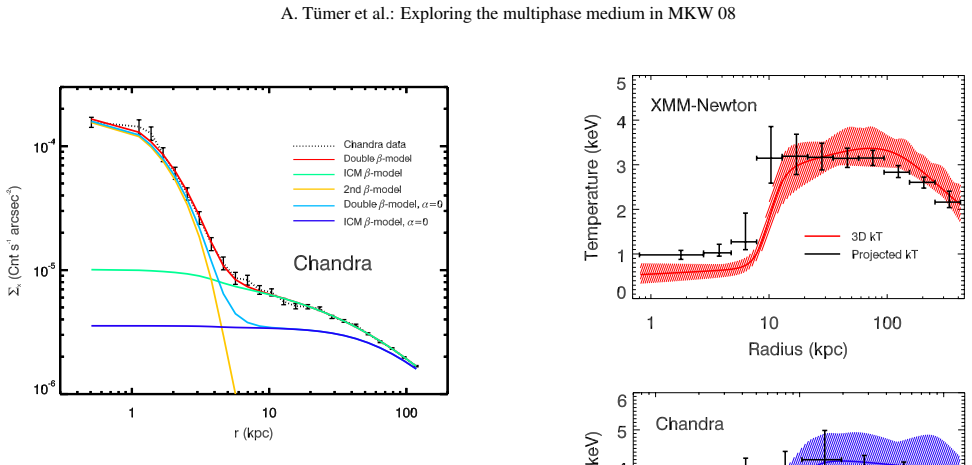
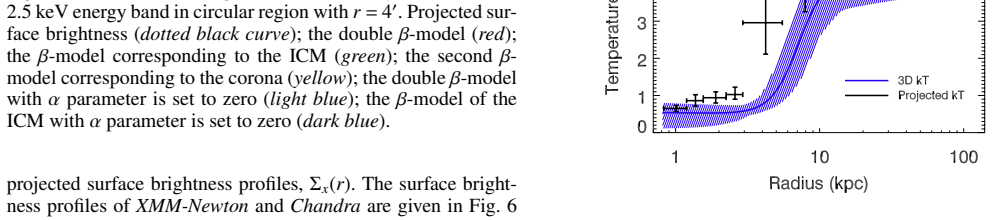
The load-bearing tool is the double $\beta$-model deprojection: an analytic electron-density profile with one $\beta$-model term for the ICM, a second $\beta$-model term for the coronal gas, and a power-law cusp index, projected and fitted to the Chandra and XMM-Newton surface brightness profiles. Combined with a five-parameter broken-power-law temperature parameterization and spectroscopic-like projection, it yields 3D temperature and pressure profiles. This decomposition is what locates the corona ($r\le4$ kpc), the constant-pressure interface (4-10 kpc), and the ICM, and it feeds the cooling-time estimate $t_{\rm cool}=U/L_{\rm hot}$. The central AGN signature comes from spectral fits with absorbed apec plus powerlaw models, evaluated with Poisson-based C-statistics.
What would settle it
Take the Chandra spectra in four azimuthal sectors of the 4-10 kpc annulus and compute the deprojected pressure in each; if the pressures differ by more than the measurement errors, or if a non-spherical (e.g., prolate) deprojection removes the flat pressure plateau, the corona-ICM pressure equilibrium and the interface radii would not be real. A shorter version: measure the pressure jump directly across the interface by comparing the brightest tail sector with the opposite sector.
Extended reading notes
Core claim
The paper establishes that the BCG corona in MKW 08 is a small-scale cool core embedded in a non-cool-core cluster. Using Chandra surface brightness and temperature profiles deprojected with a double $\beta$ model, the authors isolate three zones: an isothermal corona ($kT\simeq1$ keV) inside $r\sim4$ kpc, an interface of nearly constant pressure between 4 and 10 kpc, and the cluster ICM beyond. From the Chandra spectrum of the central 3 kpc they derive a cooling time of $\sim64$ Myr, implying the gas would collapse without a heating source; since the corona is isothermal, heat conduction is ruled out and the central AGN (power-law photon index $\simeq1.8$) is proposed as the main heater. The 40 kpc metal-rich tail ($Z\sim0.5$-$0.9$ solar) is interpreted as stripped coronal material. In the authors' view, fast-cooling coronae and AGN feedback can coexist even where the cluster as a whole shows no cool core.
Load-bearing premise
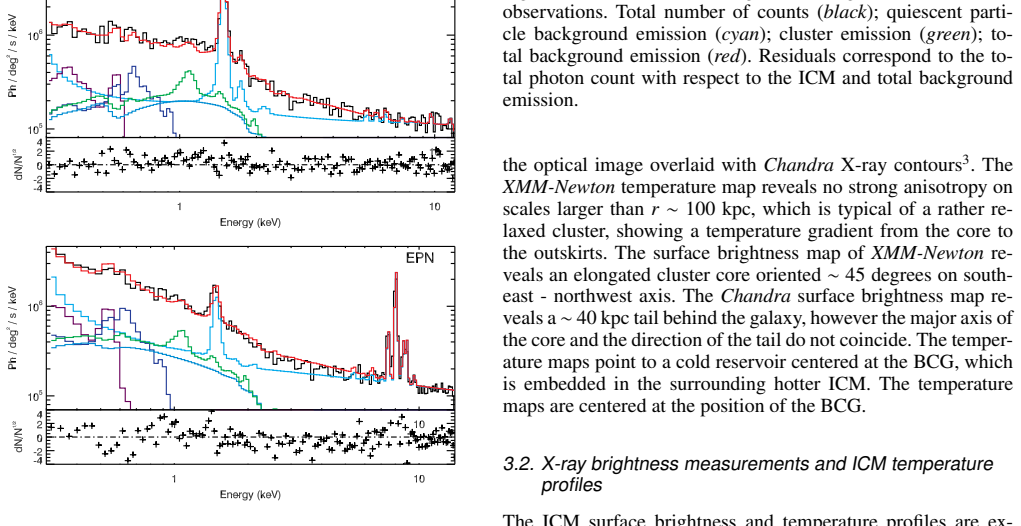
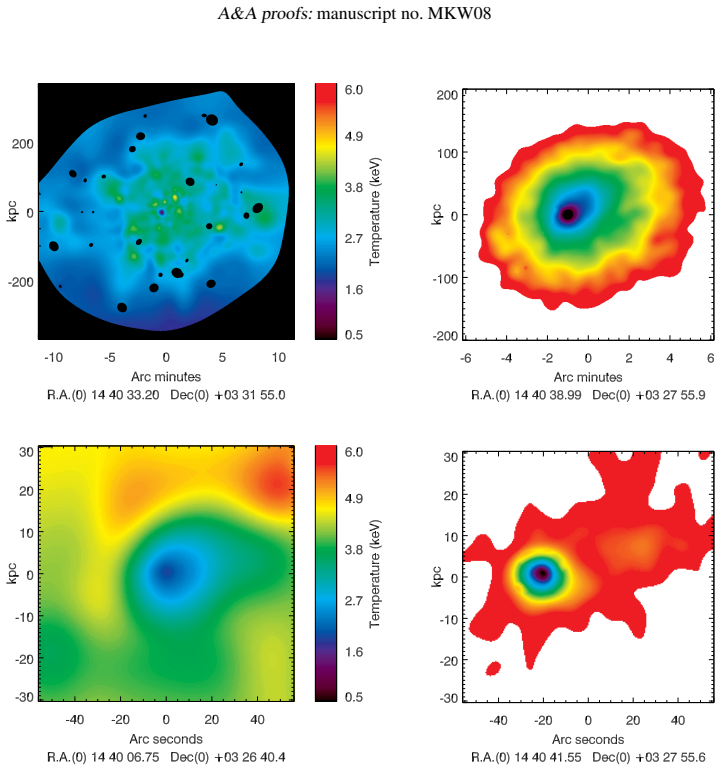
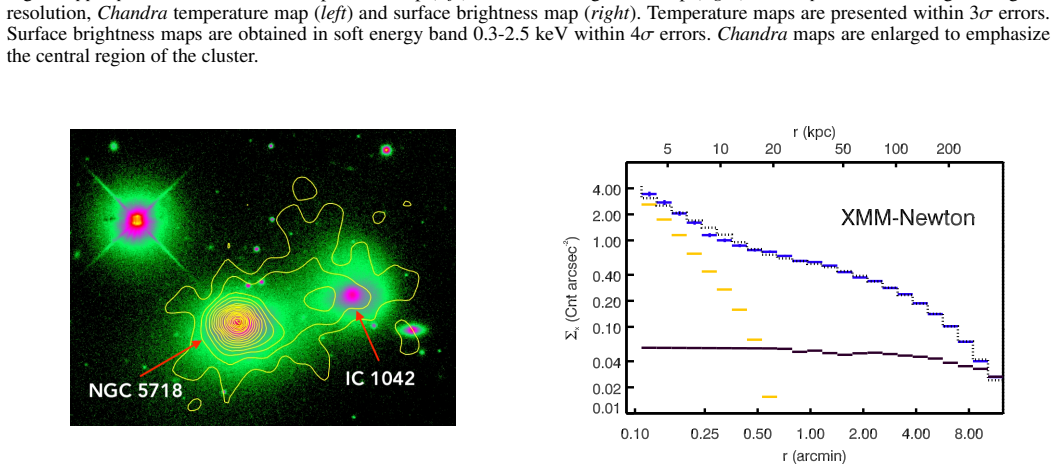
The load-bearing premise is that the gas around NGC 5718 is spherically symmetric and hydrostatic when projected surface brightness and temperature maps are converted into 3D density, temperature, and pressure profiles; images showing a 40 kpc tail and an elongated core mean a non-spherical geometry could change the inferred interface and equilibrium.
Editorial extensions
If this is right
- MKW 08's central gas should have collapsed long ago without a heat source; since the corona is isothermal, the paper concludes mechanical AGN feedback, not conduction or star formation, is the main heating channel.
- Cluster cool-core classifications that rely only on the central cooling time at a large radius can miss genuine small-scale cool cores inside BCGs.
- The corona exists in pressure equilibrium with the hot ICM, so it is confined and can survive in a non-cool-core cluster rather than being immediately destroyed.
- The metal-rich 40 kpc tail implies the corona is losing mass through ram-pressure stripping or an interaction with IC 1042, linking BCG evolution to its cluster environment.
Reading between the lines
- If the deprojection's spherical-symmetry assumption is relaxed, the inferred interface at 4-10 kpc and the pressure plateau might instead be the boundary of an elongated or clumpy stripped structure; a non-spherical deprojection of the same data would test this.
- The 64 Myr cooling time and deep Chandra exposure suggest a targeted search for faint X-ray cavities or bubbles around NGC 5718 could directly test mechanical feedback without waiting for a future large mission.
- Comparing the metallicity of the tail with the corona's abundance could distinguish stripping of ISM from mixing with ICM; the paper's two-sector spectral fits already set up this test.
- If other NCC clusters with deep Chandra pointings show similar mini cool cores, the CC/NCC dichotomy may be partly an artefact of resolution, with many 'NCC' clusters really hosting coronae whose feedback duty cycle is tied to their short local cooling time.
Signed reviews
Editorial analysis
A structured set of objections, weighed in public.
Referee Report
Summary. The paper analyzes deep archival XMM-Newton and Chandra observations of the non-cool-core cluster MKW 08, focusing on its BCG NGC 5718. It reports a central AGN with photon index Gamma ~ 1.8, a mini cool core in the BCG with cooling time ~64 Myr at r = 3 kpc, an interface region at 4 <= r <= 10 kpc where the coronal gas is claimed to reach pressure equilibrium with the ICM, and a metal-rich ~40 kpc tail. The analysis combines surface brightness and temperature mapping, a double beta-model deprojection under assumptions of spherical symmetry and hydrostatic equilibrium, C-stat-based spectral fitting of XMM-Newton and Chandra data, cooling time estimates, and sector spectroscopy of the tail.
Significance. If the results hold, the paper is a valuable case study of a BCG corona embedded in a non-cool-core cluster, showing that a fast-cooling corona and an active nucleus can coexist in the absence of a cluster-scale cool core. The AGN detection is robust (Delta C / Delta nu ~ 508/2 in the XMM-Newton 10 kpc spectrum, and the Chandra 3 kpc spectrum independently requires a power law), and the short cooling time follows directly from the spectral normalization within r = 3 kpc rather than from the deprojected model. The tail results add to the sparse sample of X-ray tails associated with BCG coronae. However, the interface and pressure-equilibrium claim is the least secure element: it depends on the decomposition of the surface brightness profile into two beta-model components whose parameters the authors themselves describe as degenerate in Appendix A, and on a spherical deprojection that is in tension with the observed elongated core and tail. The paper is publishable after the central claim is either robustly tested or appropriately downgraded.
major comments (3)
- [Sect. 3.2, Fig. 7, Eq. (1), Appendix A] The identification of the corona/ICM interface at 4 <= r <= 10 kpc and the associated pressure profile in Fig. 9 depend on decomposing the Chandra surface brightness profile into the two beta-model components shown in Fig. 7. Appendix A states that the double beta-model parameters are degenerate and that 'the given beta values by themselves should not be used to estimate physical properties.' Since the interface position is inferred from the intersection of the two components, this degeneracy directly affects the paper's central claim of pressure equilibrium. The authors should demonstrate that the interface radius and the pressure plateau are robust to the degeneracy (for example, by exploring the full parameter covariance in Monte Carlo fits, testing different functional forms for the central cusp, or fitting the two components separately with independent data) or they should downgrade the interface/pressure-equilibrium claim from a reported result to a tentative interpretation.
- [Sect. 3.2, Figs. 4-5, Fig. 9] The deprojection assumes spherical symmetry and hydrostatic equilibrium, but the Chandra maps show an elongated core and a ~40 kpc tail. Azimuthally averaged 1D profiles therefore mix physically different sectors, and the nearly constant pressure plateau at 4-10 kpc seen in Fig. 9 could be an artifact of the assumed symmetric model. The authors should test the sensitivity of the 3D pressure profile to asymmetry, for instance by extracting sector-resolved profiles in the tail and counter-tail directions, or by quantifying the systematic uncertainty introduced by the assumed geometry before claiming that the coronal gas reaches pressure equilibrium with the ICM.
- [Sect. 6] The argument that AGN mechanical feedback is the major heating mechanism rests on the deprojected temperature being isothermal, on excluding heat conduction because of isothermality, and on dismissing star formation using a luminosity-based SFR estimate of ~40 M_sun/yr. No direct measurement of the star formation rate in NGC 5718 is presented, and the comparison to 'typical radio galaxies' is not a measurement for this object. This makes the heating-mechanism conclusion weaker than the abstract's phrasing suggests. The authors should soften this claim to 'consistent with mechanical feedback' or obtain an independent SFR constraint for NGC 5718.
minor comments (5)
- [Sec. 4.2, Table 3] The fixed-Gamma fit described in Sec. 4.2 (Gamma = 1.81 from XMM-Newton, kT = 0.93 +/- 0.04 keV, C/nu = 47.99/43) is discussed in the text but is not listed in Table 3; including it would make the Chandra analysis fully reproducible.
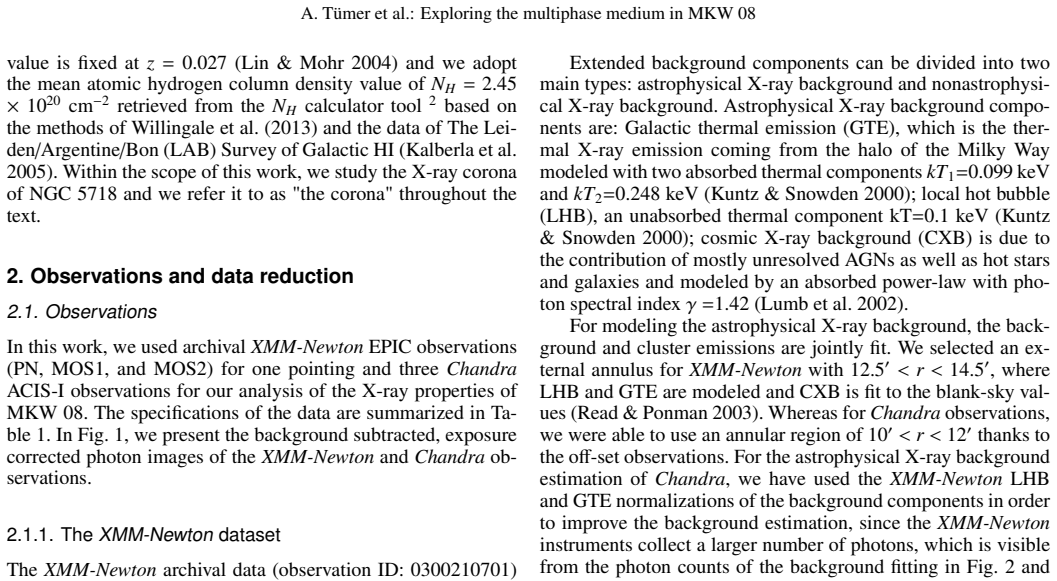
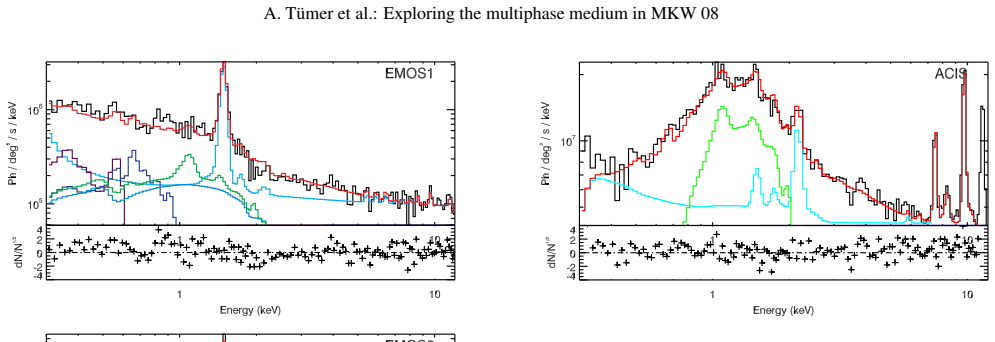
- [Fig. 7] The yellow and green curves representing the corona and ICM components are not labeled in the printed figure; the caption should identify the color scheme explicitly.
- [Eq. (1)] Equation (1) and the surrounding text use 'nenp' where the product n_e n_p is intended; please correct the notation.
- [Sec. 5] The statement that Sector 1 and Sector 2 are 'symmetric along the true NE-SW axis' is ambiguous because the sectors have 45-degree opening angles; clarify whether the symmetry refers to the sector boundaries or to the underlying galaxy structure.
- [Sec. 4.1] The reported abundance range 0.20 <= Z <= 1.0 Z_sun within 90% confidence is given in the text but not tabulated; adding it to Table 2 would be helpful.
Circularity Check
No significant circularity: the AGN detection, cooling time, and tail properties are direct spectral/imaging measurements, and the interface/pressure-equilibrium claim is model-dependent but not a self-referential derivation.
full rationale
The central claims are empirical measurements, not derivations that take their conclusions as inputs. The AGN power-law with photon index Gamma ~ 1.8 is required by C-stat improvements in the XMM-Newton and Chandra spectral fits (Sect. 4.1-4.2), with the photon index directly constrained by the data. The mini cool core cooling time of ~64 Myr at r = 3 kpc is computed in Sect. 4.4 from the apec normalization, volume, and luminosity of the same region (t_cool = U/L_hot); this is a standard self-consistent estimate, not a fitted parameter renamed as a prediction. The 40 kpc metal-enriched tail is identified from surface brightness maps and sector spectroscopy (Sect. 5), again directly from data. The pressure-equilibrium/interface claim (Sect. 3.2, Fig. 9) is the least independent element: the 3D pressure profile is derived from the analytic double-beta density model (Eq. 1) whose two components were already used to define the corona/ICM interface at r ~ 4-10 kpc, so the pressure profile 'revealing' the same interface is a re-expression of the same fitted model rather than an independent confirmation. However, this is model dependence, not a circular reduction: the density model was fit to the observed surface brightness, and the temperature profile (Eq. 2) was fit to spectroscopically measured projected temperatures, so the pressure profile carries data content. Appendix A explicitly warns that the beta-model parameters are degenerate and 'should not be used to estimate physical properties,' which is a genuine limitation on the interface/pressure interpretation, and the spherical-symmetry/hydrostatic-equilibrium assumption (Sect. 3.2) is in tension with the observed asymmetric tail and elongated core; these are correctness risks, not circularity. Self-citations to Bourdin & Mazzotta (2008) and Tombesi et al. (2017) supply methods or procedures, but the results are reproduced against the archival data and external benchmarks (e.g., Sun et al. 2007), so the citations are not load-bearing in a circular way. Overall, no step reduces to its own input by construction, and the main claims remain data-driven.
Assumptions & free parameters
free parameters (5)
- apec normalization in Chandra 3 kpc region =
1.51e-5 (1 sigma: +0.20/-0.21e-5)
- power-law photon index Gamma =
1.81 (XMM), 2.49 (Chandra)
- double beta model parameters (n0, n02, rc, rc2, alpha, beta, gamma, epsilon) =
Table A.1 (e.g., Chandra n02 about 7.41, rc2 about 0.964 kpc)
- deprojected temperature profile parameters (T0, rt, a, b, c) =
Table A.1
- abundance Z in central spectral fits =
1 Z_sun (fixed)
assumptions (5)
- domain assumption Spherical symmetry and hydrostatic equilibrium hold for deprojection
- domain assumption The X-ray emitting gas follows APEC thermal plasma emission
- domain assumption The coronal gas within r=3 kpc is a fully ionized sphere with constant density
- domain assumption The power-law component is dominated by the AGN rather than X-ray binaries
- domain assumption Fixed redshift z=0.027 and Galactic column NH=2.45e20 cm^-2
Cite this review
Pith. "Pith review of Exploring the multiphase medium in MKW 08: from the central active galaxy up to cluster scales." pith.science (2026). https://pith.science/paper/X2JPPBBC
@misc{pith2026190808560,
  author       = {Pith},
  title        = {Pith review of: Exploring the multiphase medium in MKW 08: from the central active galaxy up to cluster scales},
  year         = {2026},
  howpublished = {\url{https://pith.science/paper/X2JPPBBC}},
  note         = {Machine review of arXiv:1908.08560}
}
abstract
The study of the brightest cluster galaxy (BCG) coronae embedded in noncool core (NCC) galaxy clusters is crucial to understand the BCG's role in galaxy cluster evolution as well as the activation of the self-regulated cooling and heating mechanism in the central regions of galaxy clusters. We explore the X-ray properties of the intracluster medium (ICM) of the NCC galaxy cluster MKW 08 and the BCG corona, along with their interface region. With recent and deep archival Chandra observations, we study the BCG corona in detail, and with archival XMM-Newton observations, we investigate the implications of the central active galactic nuclei (AGN) on the BCG. We carry out imaging and spectral analyses of MKW 08 with archival XMM-Newton and Chandra X-ray observations. Our spectral analysis suggests the presence of a central AGN by a power-law with a photon index of $\Gamma$ ~ 1.8 at the core of its BCG. Although the ICM does not exhibit a cluster scale cool core, the BCG manifests itself as a mini cool core characterized by a cooling time as short as 64 Myr at r = 3 kpc centered at the galaxy. The isothermality of the BCG corona seems to favor mechanical feedback from the central AGN as the major source of gas heating. The gas pressure profile of this mini cool core suggests that the BCG coronal gas reaches pressure equilibrium with the hotter and less dense ICM inside an interface of nearly constant pressure, delimited by radii 4 < r < 10 kpc at the galactic center. As revealed by the presence of a metal enriched tail (Z ~ 0.5 - 0.9 Solar) extending up to 40 kpc, the BCG corona seems to be experiencing ram-pressure stripping by the surrounding ICM and/or interacting with a nearby galaxy, IC 1042.}
Figures

Figures from the paper (10 more)


Reference graph
Works this paper leans on
-
[1]
, " * write output.state after.block = add.period write newline
ENTRY address archiveprefix author booktitle chapter edition editor howpublished institution eprint journal key month note number organization pages publisher school series title type volume year label extra.label sort.label short.list INTEGERS output.state before.all mid.sentence after.sentence after.block FUNCTION init.state.consts #0 'before.all := #1 ...
-
[2]
write newline
" write newline "" before.all 'output.state := FUNCTION n.dashify 't := "" t empty not t #1 #1 substring "-" = t #1 #2 substring "--" = not "--" * t #2 global.max substring 't := t #1 #1 substring "-" = "-" * t #2 global.max substring 't := while if t #1 #1 substring * t #2 global.max substring 't := if while FUNCTION word.in bbl.in " " * FUNCTION format....
-
[3]
2017, Astronomische Nachrichten, 338, 153
Barcons , X., Barret , D., Decourchelle , A., et al. 2017, Astronomische Nachrichten, 338, 153
work page 2017
-
[4]
Bartalucci, I., Mazzotta, P., Bourdin, H., & Vikhlinin, A. 2014, A&A , 566, 25
work page 2014
-
[5]
C., Chiba, M., Yoshii, Y., et al
Beers, T. C., Chiba, M., Yoshii, Y., et al. 1995, ApJS , 96, 175
work page 1995
-
[6]
N., von der Linden, A., Kauffmann, G., Heckman, T
Best, P. N., von der Linden, A., Kauffmann, G., Heckman, T. M., & Kaiser, C. R. 2017, , 349, 894
work page 2017
-
[7]
Bharadwaj, V., Reiprich, T. H., Schellenberger, G., et al. 2014, A&A , 572, 46
work page 2014
-
[8]
Birzan, L., Rafferty, D. A., McNamara, B. R., Wise, M. W., & Nulsen, P. E. J. 2004, , 607, 800
work page 2004
Show all 71 references
-
[9]
& Mazzotta, P
Bourdin, H. & Mazzotta, P. 2008, , 479, 307
2008
-
[10]
2013, , 764, 82
Bourdin, H., Mazzotta, P., Markevitch, M., Giacintucci, S., & Brunetti, G. 2013, , 764, 82
2013
-
[11]
Bourne, M. A. & Nayakshin, S. 2013, , 436, 2346
2013
-
[12]
1979, , 228, 939
Cash , W. 1979, , 228, 939
1979
-
[13]
& Fusco-Femiano, R
Cavaliere, A. & Fusco-Femiano, R. 1978, , 70, 677
1978
-
[14]
R., et al
Cicone, C., Brusa, M., Almeida, C. R., et al. 2018, Nature Astronomy, 2, 176
2018
-
[15]
Y., Bautz, M
Elkholy, T. Y., Bautz, M. W., & Canizares, C. R. 2015, , 805, 3
2015
-
[16]
2009, A&A , 501, 61
Ettori, S., Morandi, A., Tozzi, P., et al. 2009, A&A , 501, 61
2009
-
[17]
C., Sanders, J
Fabian, A. C., Sanders, J. S., Allen, S. W., et al. 2003, , 344, 43
2003
-
[18]
C., Walker, S
Fabian, A. C., Walker, S. A., Pinto, C., Russell, H. R., & Edge, A. C. 2015, , 451
2015
-
[19]
A., Dominguez , A., Gelmis , K., et al
Gaskin , J. A., Dominguez , A., Gelmis , K., et al. 2018, in Space Telescopes and Instrumentation 2018: Ultraviolet to Gamma Ray
2018
-
[20]
2014, , 783, L10
Gaspari, M., Brighenti, F., Temi, P., & Ettori, S. 2014, , 783, L10
2014
-
[21]
L., et al
Gaspari, M., McDonald, M., Hamer, S. L., et al. 2018, , 854, 167
2018
-
[22]
2012, , 746, 94
Gaspari, M., Ruszkowski, M., & Sharma, P. 2012, , 746, 94
2012
-
[23]
& Sadowski, A
Gaspari, M. & Sadowski, A. 2017, , 837, 149
2017
-
[24]
2016, , 337, 117
Hitomi Collaboration . 2016, , 337, 117
2016
-
[25]
T., Edge, A
Hogan, M. T., Edge, A. C., Hlavacek-Larrondo, J., et al. 2015, , 453, 1201
2015
-
[26]
S., Mittal, R., Reiprich, T
Hudson, D. S., Mittal, R., Reiprich, T. H., et al. 2010, , 513, 37
2010
-
[27]
Kaaret, P., Feng, H., & Roberts, T. P. 2017, Annual Review of Astronomy and Astrophysics , 55, 303
2017
-
[28]
Kalberla, P. M. W., Burton, W. B., Hartmann, D., et al. 2005, A&A , 440, 775
2005
-
[29]
& Pellegrini , S., eds
Kim , D.-W. & Pellegrini , S., eds. 2012, Hot Interstellar Matter in Elliptical Galaxies, Vol. 378 (Springer)
2012
-
[30]
Kuntz, K. D. & Snowden, S. L. 2000, , 543, 195
2000
-
[31]
Kuntz , K. D. & Snowden , S. L. 2008, , 478, 575
2008
-
[32]
& Molendi, S
Leccardi, A. & Molendi, S. 2008, A&A , 486, 359
2008
-
[33]
& Mohr, J
Lin, Y.-T. & Mohr, J. J. 2004, , 617, 879
2004
-
[34]
& Mohr, J
Lin, Y.-T. & Mohr, J. J. 2007, ApJS , 170, 71
2007
-
[35]
H., Warwick, R
Lumb, D. H., Warwick, R. S., Page, M., & Luca, A. D. 2002, , 389, 93
2002
-
[36]
2004, , 354, 10
Mazzotta, P., Rasia, E., Moscardini, L., & Tormen, G. 2004, , 354, 10
2004
-
[37]
R., & Tremblay, G
McDonald, M., Gaspari, M., McNamara, B. R., & Tremblay, G. R. 2018, , 858, 45
2018
-
[38]
R., Nulsen, P
McNamara, B. R., Nulsen, P. E. J., Wise, M. W., et al. 2005, , 433, 45
2005
-
[39]
D., Morrison, G
Mineo, S., Gilfanov, M., Lehmer, B. D., Morrison, G. E., & Sunyaev, R. 2014, , 437, 1698
2014
-
[40]
S., Reiprich, T
Mittal, R., Hudson, D. S., Reiprich, T. H., & Clarke, T. 2009, , 501, 835
2009
-
[41]
& Pizzolato, F
Molendi, S. & Pizzolato, F. 2001, , 560, 194
2001
-
[42]
2018, in Society of Photo-Optical Instrumentation Engineers (SPIE) Conference Series , Vol
Mushotzky , R. 2018, in Society of Photo-Optical Instrumentation Engineers (SPIE) Conference Series , Vol. 10699, Space Telescopes and Instrumentation 2018: Ultraviolet to Gamma Ray , 29
2018
-
[43]
2015, , 447, 3612
Nims, J., Quataert, E., & Faucher-Giguere, C.-A. 2015, , 447, 3612
2015
-
[44]
Nulsen, P. E. J., McNamara, B. R., Wise, M. W., & David, L. P. 2005, , 628, 629
2005
-
[45]
& Rephaeli, Y
Persic, M. & Rephaeli, Y. 2002, A&A , 382, 843
2002
-
[46]
Peterson, J. R. & Fabian, A. C. 2006, Phys.Rept., 427, 1
2006
-
[47]
2004, A&A , 423, 33
Pointecouteau, E., Arnaud, M., Kaastra, J., & de Plaa, J. 2004, A&A , 423, 33
2004
-
[48]
Read, A. M. & Ponman, T. J. 2003, , 409, 395
2003
-
[49]
Reiprich, T. H. & B\" o hringer, H. 2002, , 567, 716
2002
-
[50]
& Gaspari, M
Sadowski, A. & Gaspari, M. 2017, , 468, 1398
2017
-
[51]
Sarazin, C. L. 1986, Reviews of Modern Physics , 58, 1
1986
-
[52]
& Reiprich, T
Schellenberger, G. & Reiprich, T. H. 2017, , 471, 1370
2017
-
[53]
2019, A&A , 627, 121
Serafinelli, R., Tombesi, F., Vagnetti, F., et al. 2019, A&A , 627, 121
2019
-
[54]
K., Brickhouse, N
Smith, R. K., Brickhouse, N. S., Liedahl, D. A., & Raymond, J. C. 2001, , 556, L91
2001
-
[55]
M., Digel, S., Zhang, B., & Chiang, J
Starck, J.-L., Fadili, J. M., Digel, S., Zhang, B., & Chiang, J. 2009, , 504, 641
2009
-
[56]
2009, , 704, 1586
Sun, M. 2009, , 704, 1586
2009
-
[57]
2007, , 657, 197
Sun, M., Jones, C., Forman, W., et al. 2007, , 657, 197
2007
-
[58]
2018, in Society of Photo-Optical Instrumentation Engineers (SPIE) Conference Series, Vol
Tashiro , M., Maejima , H., Toda , K., et al. 2018, in Society of Photo-Optical Instrumentation Engineers (SPIE) Conference Series, Vol. 10699, Space Telescopes and Instrumentation 2018: Ultraviolet to Gamma Ray, 1069922
2018
-
[59]
2015, , 519, 436
Tombesi, F., Melendez, M., Veilleux, S., et al. 2015, , 519, 436
2015
-
[60]
F., Reynolds, C
Tombesi, F., Mushotzky, R. F., Reynolds, C. S., et al. 2017, , 838, 16
2017
-
[61]
N., Kallman, T., et al
Tombesi, F., Reeves, J. N., Kallman, T., et al. 2016, , 830, 98
2016
-
[62]
2006, , 451, 457
Tozzi , P., Gilli , R., Mainieri , V., et al. 2006, , 451, 457
2006
-
[63]
2006, , 640, 691
Vikhlinin, A., Kravtsov, A., Forman, W., et al. 2006, , 640, 691
2006
-
[64]
2001, , 555, 87
Vikhlinin, A., Markevitch, M., Forman, W., & Jones, C. 2001, , 555, 87
2001
-
[65]
Y., Bicknell, G
Wagner, A. Y., Bicknell, G. V., & Umemura, M. 2012, , 757, 136
2012
-
[66]
Y., Umemura, M., & Bicknell, G
Wagner, A. Y., Umemura, M., & Bicknell, G. V. 2013, , 763, 18
2013
-
[67]
2009, , 398, 23
Werner, N., Zhuravleva, I., Churazov, E., et al. 2009, , 398, 23
2009
-
[68]
2016, , 151, 120
Westhues, C., Haas, M., Barthel, P., et al. 2016, , 151, 120
2016
-
[69]
Willingale, R., Starling, R. L. C., Beardmore, A. P., Tanvir, N. R., & O'Brien, P. T. 2013, , 431, 394
2013
-
[70]
M., Peterson, J
Xu, H., Kahn, S. M., Peterson, J. R., et al. 2002, , 579, 600
2002
-
[71]
& Nayakshin, S
Zubovas, K. & Nayakshin, S. 2014, , 440, 2625
2014
Reviewed August 14, 2026 · model on record in the stance chip above.
Discussion (0). Continue with ORCID to comment.