REVIEW 4 major objections 6 minor 25 references
Extensive Online Shock Model Database
T0 review · 4 major / 6 minor · reviewed 2026-08-14 · deepseek-v4-flash
Pith's one-line read 3MdBs is a public SQL-queryable database of fully radiative MAPPINGS V shock models: an exact replica of the Allen et al. (2008) grids, a low-metallicity extension, and grids of young, age-truncated shocks.
desk verdict A genuinely useful shock-model resource with honest caveats; the unvalidated 100–200 km/s preionization regime and the lack of a versioned snapshot are the real conditions on acceptance. read the letter →
The pith
A machine-rendered reading of the paper's core claim, the machinery that carries it, and where it could break.
The reading
What carries the argument
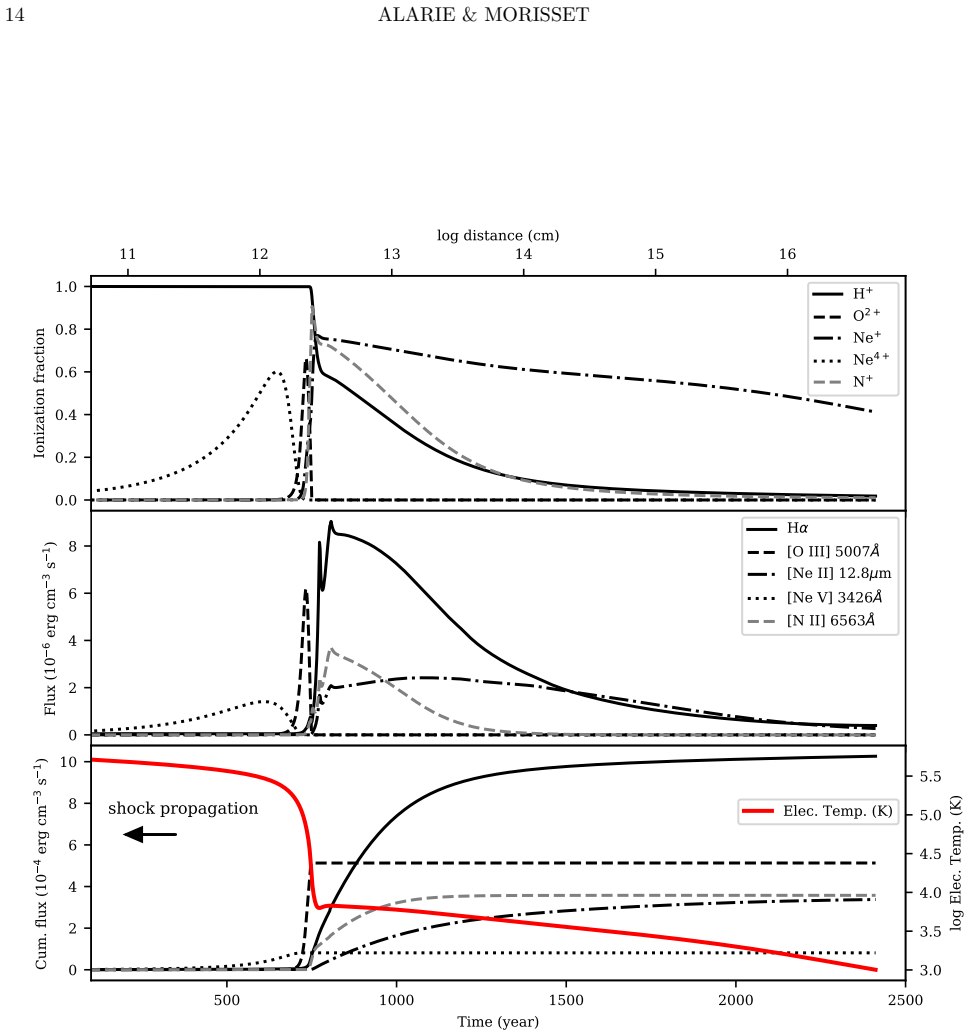
The carrying mechanism is the database architecture itself: a modular set of twelve MySQL tables, including shock parameters, abundances, five emission-line tables split by wavelength interval (660–938 Å, 939–1527 Å, 1528–2999 Å, 3000–7499 Å, and 7500 Å–609 µm), and tables for ionic fractions, ionic temperatures, and ionic column densities, linked by model and abundance identifiers so that any parameter combination or line ratio can be retrieved with a single SQL query. The scientific content is produced by the MAPPINGS V shock and photoionization code (version 5.1.13), and in particular by its iterated, fully time-dependent treatment of preionization: the code solves the photoionization, recombination, photoelectric heating, and line cooling of the gas as it approaches the shock front and repeats until the precursor state converges, replacing the older iterative method that assumed ionization equilibrium and is valid only above about 200 km s$^{-1}$.
What would settle it
Run an independent MAPPINGS V calculation of a stored model, for example a 400 km s$^{-1}$ shock with $n_0 = 1$ cm$^{-3}$, $B = 3.23\,\mu$G and solar abundances, and compare every stored line intensity; then compare the stored precursor line fluxes against UV/optical spectra of a well-studied radiative shock such as a Cygnus Loop filament, since a systematic mismatch with observed precursor spectra or an irreproducible stored intensity would show the database values are biased.
Extended reading notes
Core claim
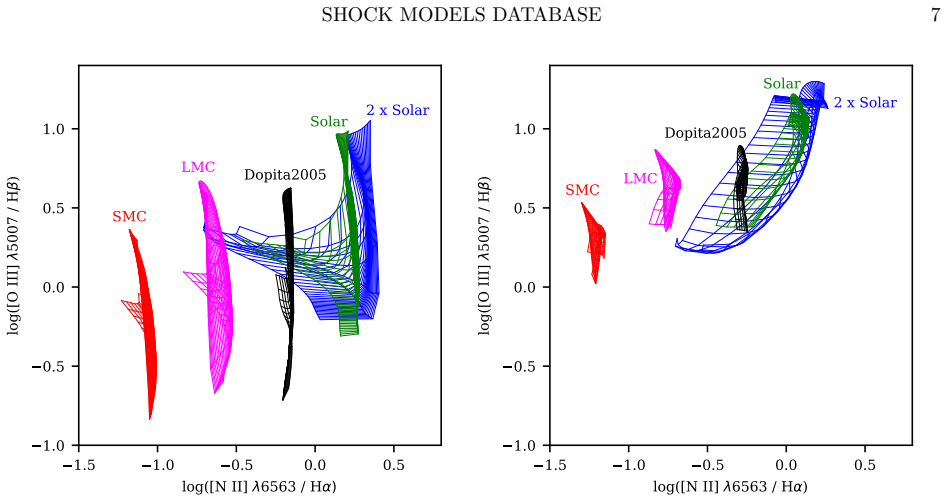
On the authors' terms, the central claim is the creation of a shared resource: a live MySQL database, named 3MdBs, that delivers fully radiative shock models in which each model is identified by shock velocity, preshock density, transverse magnetic field, abundance set, and (for the young grid) shock age, with line intensities stored for the shocked gas, the precursor, and their sum. The flagship grid reproduces Allen et al. (2008) exactly in parameter space, with five abundance sets, velocities from 100 to 1,000 km s$^{-1}$, magnetic fields from $10^{-4}$ to 10 $\mu$G, and densities from 0.01 to 1,000 cm$^{-3}$, recomputed with MAPPINGS V, whose new time-dependent treatment of preshock ionization replaces the iterative equilibrium method that fails below about 200 km s$^{-1}$. Recomputing changes the diagnostics: [O III] 5007 Å/Hβ comes out up to about 0.3 dex stronger than in the MAPPINGS III models in parts of the BPT diagram, while [C II] 2327 Å and [Ne III] 15.5 µm come out weaker. The extension grids add two cautionary results: at very low metallicity the metal lines almost vanish while hydrogen and helium lines persist, and young, age-truncated shocks at low metallicity can fall below the Kewley et al. (2001) shock classification curve.
Load-bearing premise
The database's scientific value rests on one untested premise: that the new time-dependent preionization treatment in MAPPINGS V correctly computes the ionization and thermal state of the gas entering the shock, since the paper states this treatment is new, notes that the older method fails below about 200 km/s, and does not compare the predicted line intensities with observations.
Editorial extensions
If this is right
- Anyone with a SQL client can reproduce the Allen et al. (2008) shock grids and build diagnostic diagrams such as BPT or LINER plots in seconds, instead of reading model tables out of published papers.
- The MAPPINGS V recomputation shifts some line ratios relative to the MAPPINGS III grid, with [O III] 5007 Å/Hβ up to about 0.3 dex stronger in parts of the diagram, so shock classifications and parameter estimates based on the older grid carry a systematic offset.
- At very low metallicity the metal collisionally excited lines become negligible while hydrogen and helium lines remain, so a shock component superimposed on a photoionized region could make standard abundance methods underestimate quantities such as O/H.
- Young, age-truncated shocks at low metallicity can fall below the Kewley et al. (2001) classification curve, so low [S II]/Hα or [N II]/Hα ratios do not by themselves exclude a shock origin.
- Because the database is live, new grids, including future MAPPINGS V versions or community-requested parameter sets, become immediately accessible to every user the moment they are added.
Reading between the lines
- Editorial inference: the age-truncated grid stores cumulative line fluxes as a function of time, so the same data could be used to estimate the age of a young supernova remnant or Herbig-Haro object by matching observed line ratios against the stored time series, a use the paper does not develop.
- Editorial inference: all stored models exclude dust, so the optical line intensities represent a dust-free case; a dust-inclusive extension of the same schema would test how much the diagnostic diagrams shift in dusty environments.
- Editorial inference: the reported shift of up to 0.3 dex in [O III]/Hβ between code versions implies that published AGN and LINER classification boundaries calibrated on the older MAPPINGS III grid may need recalibration, a conclusion the authors do not draw.
- Editorial inference: the time-dependent preionization treatment makes a specific, testable prediction, that below roughly 200 km/s equilibrium preionization fails and the precursor ionization structure should differ systematically, which could be checked against UV spectra of slow radiative shocks.
Signed reviews
Editorial analysis
A structured set of objections, weighed in public.
Referee Report
Summary. The paper presents 3MdBs, a MySQL-accessible database of radiative shock models computed with MAPPINGS V. Three grids are described: a re-computation of the Allen et al. (2008) shock grids with MAPPINGS V, a low-metallicity extension using Gutkin et al. (2016) abundances, and grids of age-truncated (young) shocks. The database stores line intensities from 660 Å to 609 µm for the shock, precursor, and combined regions, together with ionic fractions, temperatures, column densities, and other plasma properties. The paper includes BPT-type comparisons with Allen et al. (2008), documents differences of up to ~0.3 dex in some line ratios, and gives SQL and Python examples for querying the database.
Significance. If the stored models are correct, this is a valuable community resource for interpreting shock excitation in H II regions, LINERs, and high-redshift galaxies. The paper has clear strengths: the grids are precisely parameterized, the absence of dust is explicitly disclosed, the comparison to the previous Allen et al. (2008) grids is shown, and the SQL/MySQL distribution with a web interface is a practical step beyond scattered flat files. The forward-model nature of the work makes circularity a non-issue. However, the scientific value depends critically on the new time-dependent preionization treatment introduced in Section 2.1, and that treatment is not validated against independent calculations or observations; the 100-200 km/s regime and all precursor spectra above 100 km/s therefore carry the main correctness risk. The low-metallicity and truncated grids are likewise introduced without external benchmarks.
major comments (4)
- [Section 2.1 (and Section 2.2)] The new time-dependent preionization treatment is the physical basis for every model at 100-200 km/s and for every precursor spectrum above 100 km/s, yet the paper provides no convergence test, no comparison with an independent time-dependent photoionization calculation, and no observational validation in this regime. Since the paper states that the earlier iterative method used by Allen et al. (2008) fails below about 200 km/s, there is no external benchmark for these models. The database documentation should carry an explicit caveat, and the authors should add at least one convergence test and one independent comparison for the low-velocity and precursor models.
- [Section 4.2, Figures 3-5] The paper reports differences of up to ~0.3 dex in [O III]/Hβ and other line ratios relative to Allen et al. (2008) and then states that it is beyond its scope to determine whether these arise from code improvements, atomic data updates, or the new preionization treatment. Because the grid is presented as an exact replica and potential replacement of the Allen et al. (2008) grid, users cannot tell whether the stored intensities are more correct or merely different. This is a load-bearing gap: without identifying the origin of the offset, the claim that the database supersedes Allen et al. (2008) is not supported. Please analyze the origin of the main differences or explicitly present the grid as a candidate update pending validation.
- [Section 4.1, Tables 2-3] The grid definition is internally inconsistent. The text says '36 individual shock velocities (from 100 up to 1000 km s−1 in steps of 25 km s−1)', but this range contains 37 values; the stated total of 1440 models in the first sub-grid implies 5 abundances × 8 magnetic fields × 36 velocities, not 37. The authors should correct the count, state the exact velocity list, give total model counts for all grids, and provide a checksum or export so that the 'exact replica' claim is independently verifiable.
- [Section 4.4] The truncated/young shock grids are a central new contribution, but the paper does not state precisely how each model was terminated beyond the field 'cut off temp', and it offers no comparison with the published young-shock models cited in the text (Raymond et al. 1980; Contini & Shaviv 1982; Binette et al. 1985). The 'cut' distinction is therefore not well enough defined for users to interpret the stored spectra. Please specify the stopping criterion (temperature threshold, age, or column density) and provide at least one comparison to existing young-shock calculations.
minor comments (6)
- [Abstract and general text] The abstract and body contain several typos and unclear phrases: 'in other to explore', 'publicized', 'visualized', 'the data in distributed', and 'book case' should be corrected.
- [Table 3 caption] The caption states 'GRID SAMPLE OF THE LOW METALLICITY GRID DESCRIBED IN SECTION 3.2', but the low-metallicity grid is actually described in Section 4.3; also, the caption should clarify whether all combinations of the listed parameter values were computed.
- [Table 7] The description for the ZINC field says 'Abundance of helium in log(Zn/H)'; it should say 'Abundance of zinc in log(Zn/H)'.
- [Figure 2 caption] The caption says the figure is 'identical' to Fig. 20 of Allen et al. (2008) even though the models were computed with a different code; please use a phrase such as 'comparable' or 'equivalent' instead.
- [Section 3.1] The paper states that 4132 emission lines are stored but does not provide the line list in the text; a link, appendix, or sample line list would help readers assess the wavelength and species coverage.
- [Section 3.2] The database is referenced only by a URL; a persistent identifier or DOI would make the resource more robust for long-term citation and archival access.
Circularity Check
No circularity: the paper presents forward-modeled shock grids from an external code with no inferred parameters, and its self-citations are infrastructural only.
full rationale
The paper's central product is a database of shock models computed with the external code MAPPINGS V. There is no step in which a derived quantity is defined in terms of its own output, no parameter is fitted to a subset of data and then presented as an independent prediction, and no uniqueness theorem or ansatz is imported from the authors' prior work to force a conclusion. The self-citations present in the paper are infrastructural: Morisset et al. (2015) established the 3MdB database architecture, and the present work extends that architecture to shock models. That citation is not load-bearing for the physical content of the shock models; it merely describes the storage and access framework. The models themselves rest on the cited MAPPINGS V code (Sutherland & Dopita 2017), which is external to this paper and not invoked as a circular justification of any result derived here. The comparison with Allen et al. (2008) is an honest forward-model comparison, and the paper explicitly declines to attribute the differences to any single cause, which is a limitation rather than a circular move. No quantity in the paper is fitted, renamed, or assumed into existence by the authors' own prior claims. The honest finding is therefore no significant circularity.
Assumptions & free parameters
assumptions (3)
- domain assumption MAPPINGS V correctly solves the radiative shock structure including the time-dependent preionization treatment (Section 2.1)
- domain assumption The abundance sets from Gutkin et al. (2016) are correctly mapped to the listed Z values using their stated methodology (Section 4.3)
- domain assumption Neglecting dust does not materially alter the stored line intensities (Section 4)
Cite this review
Pith. "Pith review of Extensive Online Shock Model Database." pith.science (2026). https://pith.science/paper/UJVKJ3BA
@misc{pith2026190808579,
  author       = {Pith},
  title        = {Pith review of: Extensive Online Shock Model Database},
  year         = {2026},
  howpublished = {\url{https://pith.science/paper/UJVKJ3BA}},
  note         = {Machine review of arXiv:1908.08579}
}
read the original abstract
We present a new database of fully radiative shock models calculated with the shock and photoionization code MAPPINGS V. The database architecture is built to contain diverse shock grids comprising of multiple shock parameters. It can be easily accessible through the MySQL protocol. Intensities of spectral lines from infrared to X-rays are stored along with other useful outputs such as the ionic fractions/temperature, integrated densities, etc. A web page was created in other to explore interactively the database as it evolves with time. Examples of its usage is given using the Python language.
Figures


Figures from the paper (6 more)




Reference graph
Works this paper leans on
-
[1]
G., Groves , B
Allen , M. G., Groves , B. A., Dopita , M. A., Sutherland , R. S., & Kewley , L. J. 2008, , 178, 20
2008
-
[2]
Asplund , M., Grevesse , N., & Sauval , A. J. in , Astronomical Society of the Pacific Conference Series, Vol. 336, Cosmic Abundances as Records of Stellar Evolution and Nucleosynthesis, ed. T. G. Barnes , IIIF. N. Bash , 25
-
[3]
A., Phillips , M
Baldwin , J. A., Phillips , M. M., & Terlevich , R. 1981, , 93, 5
1981
- [4]
-
[5]
Boch , T. & Fernique , P. in , Astronomical Society of the Pacific Conference Series, Vol. 485, Astronomical Data Analysis Software and Systems XXIII, ed. N. Manset P. Forshay , 277
-
[6]
Bonnarel , F., Fernique , P., Bienaym \'e , O., Egret , D., Genova , F., Louys , M., Ochsenbein , F., Wenger , M., & Bartlett , J. G. 2000, , 143, 33
work page 2000
- [7]
-
[8]
Dopita , M. A., Groves , B. A., Fischera , J., Sutherland , R. S., Tuffs , R. J., Popescu , C. C., Kewley , L. J., Reuland , M., & Leitherer , C. 2005, , 619, 755
work page 2005
Show all 25 references
-
[9]
Dopita , M. A. & Sutherland , R. S. 1995, , 455, 468
1995
-
[10]
1996, , 102, 161
---. 1996, , 102, 161
1996
-
[11]
J., Chatzikos , M., Guzm \'a n , F., Lykins , M
Ferland , G. J., Chatzikos , M., Guzm \'a n , F., Lykins , M. L., van Hoof , P. A. M., Williams , R. J. R., Abel , N. P., Badnell , N. R., Keenan , F. P., Porter , R. L., & Stancil , P. C. 2017, rmxaa, 53, 385
2017
-
[12]
2016, , 462, 1757
Gutkin , J., Charlot , S., & Bruzual , G. 2016, , 462, 1757
2016
-
[13]
M., Guerrero , M
Kehrig , C., V \' lchez , J. M., Guerrero , M. A., Iglesias-P \'a ramo , J., Hunt , L. K., Duarte-Puertas , S., & Ramos-Larios , G. 2018, , 480, 1081
2018
-
[14]
J., Dopita , M
Kewley , L. J., Dopita , M. A., Sutherland , R. S., Heisler , C. A., & Trevena , J. 2001, , 556, 121
2001
-
[15]
2001, Library Hi Tech News, 18, null
McKiernan, G. 2001, Library Hi Tech News, 18, null
2001
-
[16]
J., Maoz , D., Runnoe , J
Molina , M., Eracleous , M., Barth , A. J., Maoz , D., Runnoe , J. C., Ho , L. C., Shields , J. C., & Walsh , J. L. 2018, , 864, 90
2018
-
[17]
2015, rmxaa, 51, 103
Morisset , C., Delgado-Inglada , G., & Flores-Fajardo , N. 2015, rmxaa, 51, 103
2015
-
[18]
2000, , 143, 23
Ochsenbein , F., Bauer , P., & Marcout , J. 2000, , 143, 23
2000
-
[19]
C., Hartmann , L., Black , J
Raymond , J. C., Hartmann , L., Black , J. H., Dupree , A. K., & Wolff , R. S. 1980, , 238, 881
1980
-
[20]
C., Hester , J
Raymond , J. C., Hester , J. J., Cox , D., Blair , W. P., Fesen , R. A., & Gull , T. R. 1988, , 324, 869
1988
-
[21]
Russell , S. C. & Dopita , M. A. 1992, , 384, 508
1992
-
[22]
2018, MAPPINGS V: Astrophysical plasma modeling code , Astrophysics Source Code Library
Sutherland , R., Dopita , M., Binette , L., & Groves , B. 2018, MAPPINGS V: Astrophysical plasma modeling code , Astrophysics Source Code Library
2018
-
[23]
Sutherland , R. S. & Dopita , M. A. 2017, , 229, 34
2017
-
[24]
, " * write output.state after.block = add.period write newline
ENTRY address author booktitle chapter edition editor howpublished institution journal key month note number organization pages publisher school series title type volume year url adsnote label extra.label sort.label short.list INTEGERS output.state before.all mid.sentence afte...
-
[25]
write newline
" write newline "" before.all 'output.state := FUNCTION n.dashify 't := "" t empty not t #1 #1 substring "-" = t #1 #2 substring "--" = not "--" * t #2 global.max substring 't := t #1 #1 substring "-" = "-" * t #2 global.max substring 't := while if t #1 #1 substring * t #2 gl...
Reviewed August 14, 2026 · model on record in the stance chip above.
Discussion (0). Continue with ORCID to comment.