REVIEW 4 major objections 5 minor 99 references
PHEMTO : Polarimetric High Energy Modular Telescope Observatory
T0 review · 4 major / 5 minor · reviewed 2026-08-14 · deepseek-v4-flash
Pith's one-line read PHEMTO: a proposed mission that would resolve 70% of the cosmic X-ray background's 30 keV peak using 1 arcsecond optics and 1% polarimetry.
desk verdict A solid, ambitious mission concept white paper whose headline CXB-resolved fraction is asserted, not derived, and which conflicts with its own high-energy PSF estimate. read the letter →
The pith
A machine-rendered reading of the paper's core claim, the machinery that carries it, and where it could break.
The reading
What carries the argument
The load-bearing design is a two-branch telescope: a low-energy branch using reflecting mirror stacks (Silicon Pore Optics or slumped glass) covering about 1–30 keV, and a high-energy branch using a Laue lens that concentrates photons by crystal diffraction in transmission up to 600 keV, both focused onto a single compact focal plane. The focal plane is a double-layer detector, a silicon low-energy detector stacked over a CdTe high-energy detector, which also functions as a Compton polarimeter through coincidence events, with an active/passive antishield to keep the background at or below $10^{-4}$ cts s$^{-1}$ cm$^{-2}$ keV$^{-1}$. This combination is what lets the mission claim arcsecond resolution and high sensitivity across the whole 1–600 keV band, and it is the mechanism that produces the stated resolving power and polarization capability.
What would settle it
A source-population simulation that convolves a realistic 30 keV log N–log S distribution with the proposed 1 arcsecond point-spread function at the 200 ks sensitivity limit would show whether 70% of the cosmic X-ray background peak is actually resolved into individual sources.
Extended reading notes
Core claim
The paper's central discovery claim is that an observatory combining a 1–30 keV focusing mirror (Silicon Pore Optics or glass) with a Laue lens focusing from roughly 30 to 600 keV, placed at a 100-meter focal length in formation flight, can reach a continuum sensitivity of about $10^{-16}$ erg cm$^{-2}$ s$^{-1}$ at 10 keV and a 1% minimum detectable polarization. With these figures, PHEMTO would detect more than 25 sources per 200 ks field in the 10–40 keV band, and simulations show it would recover intrinsic absorption with less than 20% uncertainty for Compton-thin AGN, tell apart unabsorbed, Compton-thin, and Compton-thick objects up to $z\simeq 3$, and resolve 70% of the cosmic X-ray background at its peak around 30 keV.
Load-bearing premise
The entire scientific program depends on technology that has not yet been built: never-flown Silicon Pore Optics would have to reach 1 arcsecond resolution, a 100 m focal-length Laue lens would have to achieve 10 arcsec resolution, and the detectors would have to reach an ultra-low background of $10^{-4}$ cts s$^{-1}$ cm$^{-2}$ keV$^{-1}$, all within the next 20 to 30 years.
Editorial extensions
If this is right
- In a 200 ks exposure, PHEMTO would resolve 70% of the cosmic X-ray background at its ~30 keV peak, quantitatively linking the resolved sources to the known SMBH mass density.
- A 1 Ms deep field would measure column densities of Compton-thin AGN with <20% uncertainty and identify Compton-thick objects up to $z\simeq 3$, giving the first census of the most obscured accretion.
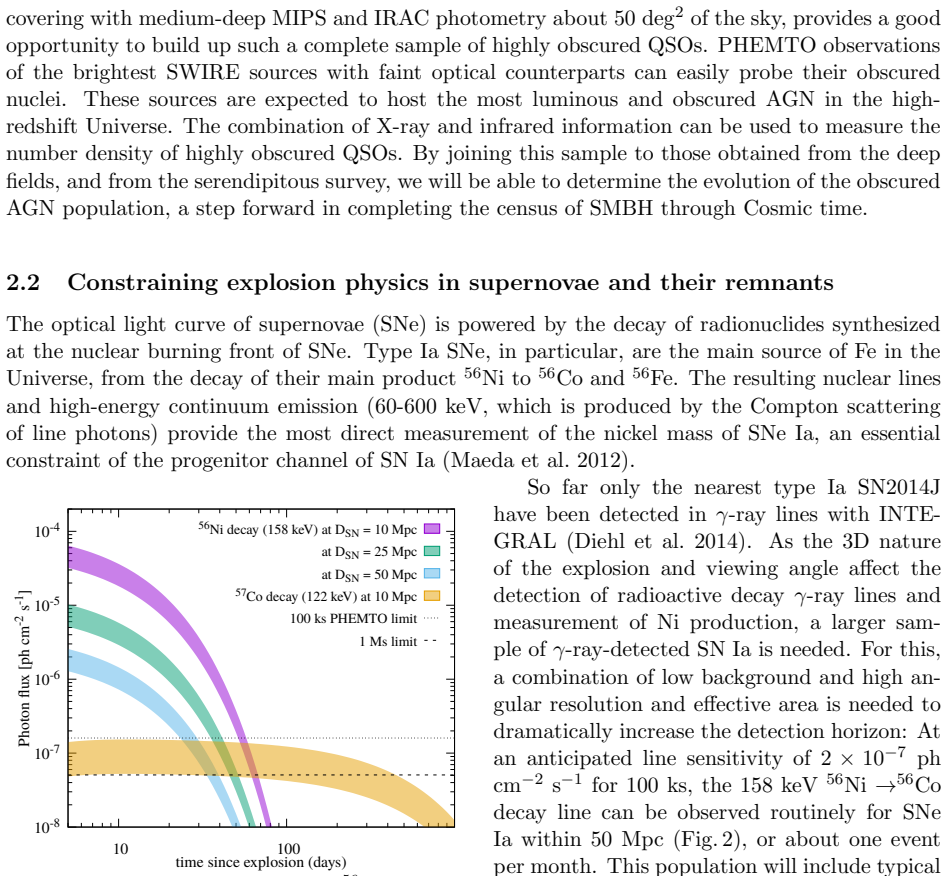
- The combination of angular resolution and low background would make the 158 keV $^{56}$Ni decay line detectable from type Ia supernovae out to ~50 Mpc, about one event per month, and allow $^{57}$Ni/$^{56}$Ni and $^{44}$Ti mapping in nearby remnants.
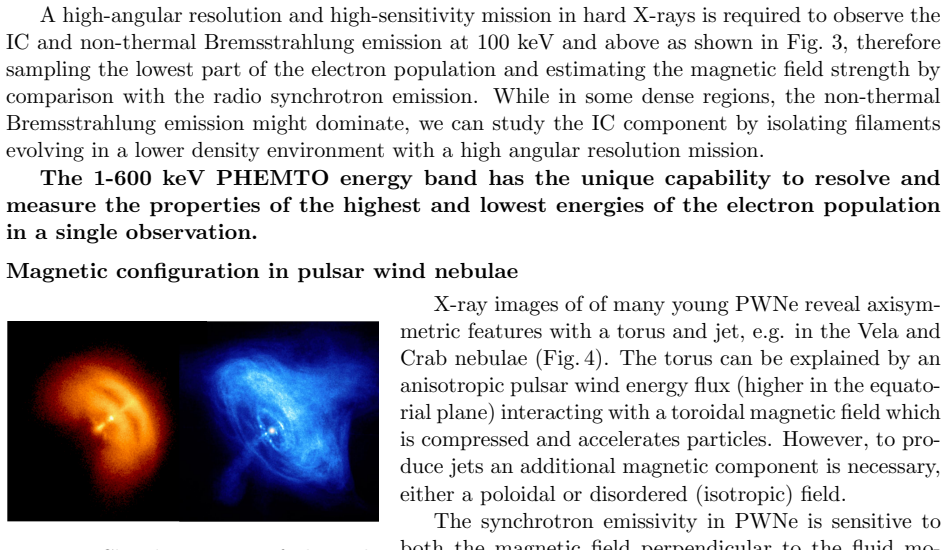
- Polarimetry at the 1% level across 1–600 keV would measure magnetic field geometry in SNRs, PWNe, magnetars, and accreting black holes, breaking degeneracies that spectroscopy alone cannot.
- If the mission flies in the 2050 era, its observations of inverse-Compton and non-thermal Bremsstrahlung in cluster atmospheres can settle the magnetic-field strength in radio halos.
Reading between the lines
- Resolving 70% of the CXB peak tightly connects the unresolved fraction to the missing SMBH accretion; a plausible consequence is that the 'hidden' AGN population has a different luminosity function than currently assumed, which would alter models of black-hole growth feedback.
- The double-layer Compton polarimeter could be exploited as a gamma-ray burst polarimeter in its own right; mapping the polarization angle swing across the neutron-star cyclotron line would give a direct, model-independent measurement of the accretion column geometry.
- If the Laue lens reaches the stated 10 arcsec at 100 m, the same technology could focus nuclear lines from galactic novae and perhaps constrain the $e^+e^-$ annihilation line morphology, a testable extension the paper does not develop.
- The requirements are substantially driven by the assumption that both optics technologies advance in parallel; a mission that flew with only one branch (say, only the mirror up to 30 keV) would still resolve a large part of the CXB peak, though it would lose the 44Ti and nuclear-line program.
Signed reviews
Editorial analysis
A structured set of objections, weighed in public.
Referee Report
Summary. PHEMTO is a Voyage 2050 white paper proposing an observatory-class hard X-ray mission with a broad 1–600 keV band, arcsecond-class angular resolution, high effective area (2000 cm² at 10 keV, 500 cm² at 600 keV), sensitivity of 10^-16 erg cm^-2 s^-1 at 10 keV, and 1% minimum detectable polarization. The concept combines a low-energy mirror (Silicon Pore Optics or glass optics) with a Laue lens at higher energies, focusing onto a common focal plane with Si and CdTe detectors, in a formation-flying configuration with up to 100 m focal length. The paper develops five science themes: resolving the cosmic X-ray background (CXB) peak and the obscured AGN census, SN Ia and 44Ti nucleosynthesis, particle acceleration and magnetic fields in SNRs and PWNe, magnetar physics and accretion/ejection in X-ray binaries, and non-thermal emission in galaxy clusters. The central quantitative claim is that PHEMTO will resolve 70% of the CXB at about 30 keV at the confusion limit (Section 2.1, Figure 1).
Significance. If the stated performance could be delivered, PHEMTO would be a transformative facility: it would be the first instrument to image the 30 keV CXB peak at arcsecond resolution, make routine hard X-ray polarization measurements, detect SN Ia gamma-ray lines to 50 Mpc, and map non-thermal cluster emission. The paper's strength is the breadth and coherence of the science case, and the explicit requirement table (Table 1) provides a useful framework for mission design. It also builds on a credible technology heritage, including ATHENA SPO, NuSTAR GOp, the ASTENA Laue lens, and CdTe strip detectors. However, the manuscript is a concept study: it does not present the simulations, background models, source-count calculations, or technology demonstrations needed to substantiate the headline performance numbers. Because the central claims are not yet backed by quantitative analysis traceable to the stated requirements, the scientific promise is not yet demonstrated.
major comments (4)
- [Section 2.1, Figure 1] The claim that at the confusion limit PHEMTO will resolve 70% of the CXB at about 30 keV is not supported by the required calculation. The text says 'taken at face value' and 'our simulations show', but no source-count model, point-spread function (PSF), confusion-noise estimate, or conversion from flux limit to resolved fraction is presented. Moreover, the only high-energy focusing system explicitly described, the Laue lens in Section 4.4.5, is credited with 10 arcsec HEW at a 100 m focal length, not the 1 arcsec in SR-5; a 10 arcsec PSF has 100 times the solid angle of a 1 arcsec PSF and correspondingly degrades the confusion limit. The 70% number is internally inconsistent with the stated optics unless a separate 1-arcsec hard X-ray telescope is described, which the paper does not do. This claim should either be removed or replaced with a confusion-limit calculation that uses the actual PSF and source counts.
- [Table 1, SR-2 and SR-8] The continuum sensitivity and detector background are load-bearing requirements, but no derivation or simulation is shown. To obtain 10^-16 erg cm^-2 s^-1 at 10 keV and 10^-14 erg cm^-2 s^-1 at 100 keV from the effective areas in SR-6, one needs an assumed source spectrum, exposure time, PSF, and background model; none is given. The background requirement of 10^-4 cts s^-1 cm^-2 keV^-1 is more than an order of magnitude below the measured levels of current space hard X-ray detectors, and no physical background model, shielding concept, or graded-z analysis is provided. The science cases in Sections 2.1–2.5 consequently rest on numbers that are asserted rather than demonstrated.
- [Sections 4.4.4 and 4.4.5] The technology-readiness argument is a series of extrapolations without quantified milestones. SPO is said to 'reasonably' reach 1 arcsec below about 10 keV, GOp is 'anticipated' to reach the required resolution up to a few hundred keV, and the Laue lens is expected to reach 10 arcsec at 100 m, which still misses SR-5. There is no error budget for the 1 arcsec HEW, no tolerance analysis for the 100 m formation flying, and no development roadmap or prototype results. Because the scientific goals, including filament spectroscopy, CXB resolution, and polarimetry, depend directly on the PSF, this gap must be quantified or the requirements must be revised.
- [Sections 4.3.2 and 4.4.2] The focal-plane design, with two 2048×2048, 100-µm-pixel Si and CdTe arrays, read out in rolling-shutter mode with fast trigger and 50 µs timing, and used as a Compton polarimeter, is presented as a conceptual design but no simulation or prototype evidence is given that such arrays can simultaneously deliver the required spectral resolution, timing, and Compton event efficiency. The 100 µm pitch CdTe imaging spectrometer with good spectroscopy is explicitly acknowledged to require 'developments in rupture'. The 1% minimum detectable polarization in SR-3 depends on the polarimetric modulation factor and background, neither of which is quantified. This is a central feasibility issue for the polarimetry claims in Sections 2.3 and 2.4.
minor comments (5)
- [Abstract] The first sentence contains a duplicated preposition: 'thanks to to sounding rockets' should read 'thanks to sounding rockets'.
- [Section 2.1.2] The statement that PHEMTO will detect more than 25 sources per field in 200 ks is not defined with field size, energy band, detection significance, or assumed source spectrum; please specify these assumptions.
- [Section 2.2] The stated 100 ks line sensitivity of 2×10^-7 ph cm^-2 s^-1 should be derived from or cross-referenced to Table 1 and the assumed background level.
- [Section 4.4.5] The reference 'Frontera et al. 2019 in preparation' and the ASTENA mission description are not publicly available; please supply a citable reference or technical report.
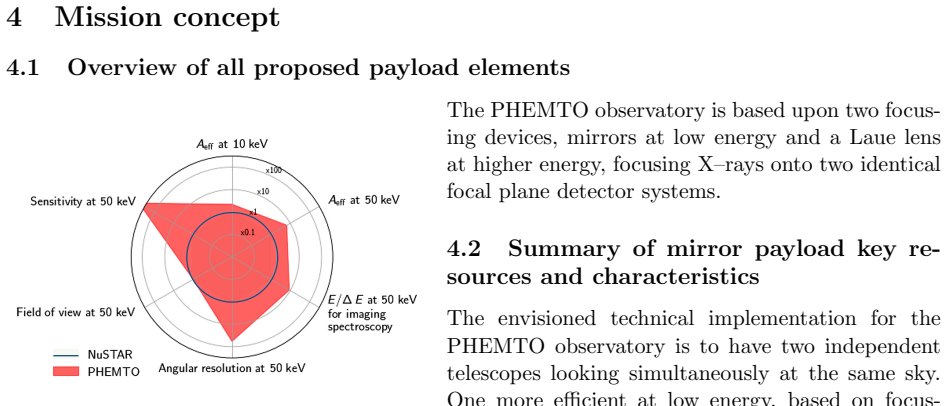
- [Figure 7] The comparison with NuSTAR lacks axis labels and a legend; please specify what quantities are compared and under what assumptions.
Circularity Check
No circularity found: PHEMTO's science goals are not derived from fitted parameters or definitional identities, and its self-citations are independent observational/technical references.
full rationale
The paper is a Voyage 2050 mission white paper. Its central claims are prospective: that a 1–600 keV observatory with ~1 arcsec optics and 1% polarimetry would resolve the CXB peak and address accretion, SNR, cluster, and magnetar science. None of these claims is obtained by fitting a parameter to a subset of data and then predicting a closely related quantity. The 70% CXB resolved fraction in Sec. 2.1 is 'taken at face value' from a literature plot of source counts; this is an unsupported extrapolation given the assumed PSF and flux limit, but it is not circular because the number is not constructed from the PHEMTO parameters, nor is the mission design fitted to it. The paper explicitly labels the key technology steps (1 arcsec SPO below ~10 keV; 10 arcsec Laue lens at 100 m; 10^-4 cts/s/cm2/keV background) as 'reasonable to estimate' and 'anticipated' rather than as derived results. Those are feasibility risks, not circular reductions. The self-citations (Laurent et al. 2011; Goetz et al. 2013; Rodriguez et al. 2015 for INTEGRAL polarimetry; Frontera et al. 2013 and Virgilli et al. 2018 for Laue lens development) are prior independent measurements or hardware-development references; they are not invoked as a uniqueness theorem or as the source of a predicted quantity. No equation in the paper is equivalent to its input by construction. The main weakness is lack of a confusion-limit calculation connecting SR-5/SR-2 to the 70% resolved fraction, but absence of support is a correctness/feasibility concern, not circularity.
Assumptions & free parameters
assumptions (3)
- ad hoc to paper The required technologies (1 arcsecond SPO/GOp optics, Laue lens with 10 arcsecond resolution, 100 micrometer pixel CdTe arrays, 100 m formation flying) will be available by 2050.
- domain assumption The instrument background can be reduced to 10^-4 cts/s/cm2/keV.
- domain assumption The AGN population models used to predict resolved CXB fractions are correct.
Cite this review
Pith. "Pith review of PHEMTO : Polarimetric High Energy Modular Telescope Observatory." pith.science (2026). https://pith.science/paper/24SXLUWY
@misc{pith2026190808586,
  author       = {Pith},
  title        = {Pith review of: PHEMTO : Polarimetric High Energy Modular Telescope Observatory},
  year         = {2026},
  howpublished = {\url{https://pith.science/paper/24SXLUWY}},
  note         = {Machine review of arXiv:1908.08586}
}
read the original abstract
With the opening of the X and gamma--ray windows in the sixties, thanks to to sounding rockets and satellite-borne instruments, extremely energetic and violent phenomena were discovered and subsequently found to be ubiquitous in the Universe. Observations in the high energy domain are fundamental for understanding how matter is organized and behaves around black holes; unravelling how these extreme objects influence their environments on a very large scale; and finding the still elusive obscured massive objects in the centre of galaxies. Other major problems in contemporary astrophysics, such as the understanding of acceleration processes at shocks of all sizes (those of pulsar wind nebulae, supernova remnants, but also at larger scales those of Active Galactic Nuclei radio lobes) in relation to the origin of cosmic-rays, or the definitive characterization of the debated non-thermal X-ray energy content of clusters of galaxies, also requires observations at very high energies. An observatory type medium mission operating from around 1 keV to about 600 keV can provide direct insights into these major questions. The essential characteristics will be coverage of the full energy range by telescopes featuring a large throughput and arc-second resolution optics, coupled to a compact focal plane assembly, with excellent imaging resolution and spectroscopy. In addition, the mission will provide unique polarimetry measurements in the hard X-ray domain, an important new diagnostic tool at energies for which the non-thermal processes dominate. The Polarimetric High-Energy Modular Telescope Observatory (PHEMTO) is designed to have performance several orders of magnitude better than the present hard X-ray instruments. This gives to PHEMTO the improvements in scientific performance needed for a mission in the 2050 era.
Figures


Figures from the paper (4 more)


Reference graph
Works this paper leans on
-
[1]
G., Ackermann, M., Adams, J., et al
Aartsen, M. G., Ackermann, M., Adams, J., et al. 2018, Science, 361, eaat1378
2018
-
[2]
2010, ApJ, 725, 1688
Ajello, M., Rebusco, P., Cappelluti, N., et al. 2010, ApJ, 725, 1688
2010
-
[3]
V., Lyutikov, M., & Khangulyan, D
Barkov, M. V., Lyutikov, M., & Khangulyan, D. 2019, MNRAS, 484, 4760
2019
-
[4]
A., Klochkov, D., Sch¨ onherr, G., et al
Becker, P. A., Klochkov, D., Sch¨ onherr, G., et al. 2012, A&A, 544, A123
2012
-
[5]
Becker, P. A. & Wolff, M. T. 2007, ApJ, 654, 435
2007
-
[6]
& Shrader, C
Beckmann, V. & Shrader, C. R. 2012, Active Galactic Nuclei
2012
-
[7]
2009, A&A, 505, 417
Beckmann, V., Soldi, S., Ricci, C., et al. 2009, A&A, 505, 417
2009
-
[8]
E., Harrison, F
Boggs, S. E., Harrison, F. A., Miyasaka, H., et al. 2015, Science, 348, 670
2015
Show all 99 references
-
[9]
2014, MNRAS, 443, 1999
Brightman, M., Nandra, K., Salvato, M., et al. 2014, MNRAS, 443, 1999
2014
-
[10]
& Jones, T
Brunetti, G. & Jones, T. W. 2014, International Journal of Modern Physics D, 23, 1430007
2014
-
[11]
2017, MNRAS, 470, 4066
Bucciantini, N., Bandiera, R., Olmi, B., & Del Zanna, L. 2017, MNRAS, 470, 4066
2017
-
[12]
Buote, D. A. 2001, ApJ, 553, L15
2001
-
[13]
M., Uvarov, Y
Bykov, A. M., Uvarov, Y. A., Bloemen, J. B. G. M., den Herder, J. W., & Kaastra, J. S. 2009, MNRAS, 399, 1119
2009
-
[14]
2019, arXiv e-prints, arXiv:1904.09112
Cangemi, F., Beuchert, T., Siegert, T., et al. 2019, arXiv e-prints, arXiv:1904.09112
2019 arXiv
-
[15]
& Spitkovsky, A
Caprioli, D. & Spitkovsky, A. 2014, ApJ, 794, 46
2014
-
[16]
2013, ApJ, 777, 141
Cassano, R., Ettori, S., Brunetti, G., et al. 2013, ApJ, 777, 141
2013
-
[17]
2010, ApJ, 721, L82
Cassano, R., Ettori, S., Giacintucci, S., et al. 2010, ApJ, 721, L82
2010
-
[18]
J., & M´ arka, S
Chassande-Mottin, E., Hendry, M., Sutton, P. J., & M´ arka, S. 2011, General Relativity and Grav- itation, 43, 437 Chieffi, A. & Limongi, M. 2017, ApJ, 836, 79
2011
-
[19]
A., Piran, T., & Stark, R
Connors, P. A., Piran, T., & Stark, R. F. 1980, ApJ, 235, 224
1980
-
[20]
2014, Science, 345, 1162
Diehl, R., Siegert, T., Hillebrandt, W., et al. 2014, Science, 345, 1162
2014
-
[21]
2017, ApJS, 231, 8
Enoto, T., Shibata, S., Kitaguchi, T., et al. 2017, ApJS, 231, 8
2017
-
[22]
Fabian, A. C. & Iwasawa, K. 1999, MNRAS, 303, L34
1999
-
[23]
Farinelli, R., Ferrigno, C., Bozzo, E., & Becker, P. A. 2016, A&A, 591, A29
2016
-
[24]
2012, A&A Rev., 20, 54
Feretti, L., Giovannini, G., Govoni, F., & Murgia, M. 2012, A&A Rev., 20, 54
2012
-
[25]
K., Hillebrandt, W., et al
Fink, M., R¨ opke, F. K., Hillebrandt, W., et al. 2010, A&A, 514, A53
2010
-
[26]
2008, ApJ, 672, 94
Fiore, F., Grazian, A., Santini, P., et al. 2008, ApJ, 672, 94
2008
-
[27]
A., Gouiff` es, C., & Lebrun, F
Forot, M., Laurent, P., Grenier, I. A., Gouiff` es, C., & Lebrun, F. 2008, ApJ, 688, L29 21
2008
-
[28]
2013, in Society of Photo-Optical Instrumentation Engineers (SPIE) Conference Series, Vol
Frontera, F., Virgilli, E., Valsan, V., et al. 2013, in Society of Photo-Optical Instrumentation Engineers (SPIE) Conference Series, Vol. 8861, Proc. SPIE, 886106
2013
-
[29]
C., Vievering, J., et al
Furukawa, K., Buitrago-Casas, J. C., Vievering, J., et al. 2019, Nuclear Instruments and Methods in Physics Research A, 924, 321
2019
-
[30]
R., Molendi, S., et al
Gastaldello, F., Wik, D. R., Molendi, S., et al. 2015, ApJ, 800, 139
2015
-
[31]
2007, A&A, 463, 79
Gilli, R., Comastri, A., & Hasinger, G. 2007, A&A, 463, 79
2007
-
[32]
2009, A&A, 507, 1257
Giovannini, G., Bonafede, A., Feretti, L., et al. 2009, A&A, 507, 1257
2009
-
[33]
2011, A&A, 536, A89 G´ omez-Gomar, J., Isern, J., & Jean, P
Girardi, M., Bardelli, S., Barrena, R., et al. 2011, A&A, 536, A89 G´ omez-Gomar, J., Isern, J., & Jean, P. 1998, MNRAS, 295, 1 G¨ otz, D., Covino, S., Fern´ andez-Soto, A., Laurent, P., & Boˇ snjak,ˇZ. 2013, MNRAS, 431, 3550 G¨ otz, D., Mereghetti, S., Tiengo, A., & Esposito,...
2011
-
[34]
2004, ApJ, 605, 695
Govoni, F., Markevitch, M., Vikhlinin, A., et al. 2004, ApJ, 605, 695
2004
-
[35]
W., Harrison, F
Grefenstette, B. W., Harrison, F. A., Boggs, S. E., et al. 2014, Nature, 506, 339
2014
-
[36]
E., Johnson, W
Grove, J. E., Johnson, W. N., Kroeger, R. A., et al. 1998, ApJ, 500, 899
1998
-
[37]
A., Aird, J., Civano, F., et al
Harrison, F. A., Aird, J., Civano, F., et al. 2016, ApJ, 831, 185
2016
-
[38]
A., Craig, W
Harrison, F. A., Craig, W. W., Christensen, F. E., et al. 2013, ApJ, 770, 103
2013
-
[39]
Hester, J. J. 2008, ARA&A, 46, 127
2008
-
[40]
2013, ApJ, 771, 14
Holcomb, C., Guillochon, J., De Colle, F., & Ramirez-Ruiz, E. 2013, ApJ, 771, 14
2013
-
[41]
B., Pottschmidt, K., Falkner, S., et al
Iwakiri, W. B., Pottschmidt, K., Falkner, S., et al. 2019, ApJ, 878, 121
2019
-
[42]
P., & Malzac, J
Jourdain, E., Roques, J. P., & Malzac, J. 2012, ApJ, 744, 64
2012
-
[43]
2013, A&A, 557, A99
Kale, R., Venturi, T., Giacintucci, S., et al. 2013, A&A, 557, A99
2013
-
[44]
& Pavlov, G
Kargaltsev, O. & Pavlov, G. G. 2008, in American Institute of Physics Conference Series, Vol. 983, 40 Years of Pulsars: Millisecond Pulsars, Magnetars and More, ed. C. Bassa, Z. Wang, A. Cumming, & V. M. Kaspi, 171–185
2008
-
[45]
2018, MNRAS, 480, 2578
Lanzuisi, G., Civano, F., Marchesi, S., et al. 2018, MNRAS, 480, 2578
2018
-
[46]
2011, Science, 332, 438
Laurent, P., Rodriguez, J., Wilms, J., et al. 2011, Science, 332, 438
2011
-
[47]
P., Lavocat, P., et al
Lebrun, F., Leray, J. P., Lavocat, P., et al. 2003, A&A, 411, L141
2003
-
[48]
& Nomoto, K
Leung, S.-C. & Nomoto, K. 2018, ApJ, 861, 143
2018
-
[49]
2012, ApJ, 760, 54
Maeda, K., Terada, Y., Kasen, D., et al. 2012, ApJ, 760, 54
2012
-
[50]
X., Hungerford, A
Magkotsios, G., Timmes, F. X., Hungerford, A. L., et al. 2010, ApJS, 191, 66 22
2010
-
[51]
2006, in ESA Special Publication, Vol
Markevitch, M. 2006, in ESA Special Publication, Vol. 604, The X-ray Universe 2005, ed. A. Wilson, 723
2006
-
[52]
2003, ApJ, 586, L19
Markevitch, M., Mazzotta, P., Vikhlinin, A., et al. 2003, ApJ, 586, L19
2003
-
[53]
2018, ApJ, 867, 162
Masini, A., Comastri, A., Civano, F., et al. 2018, ApJ, 867, 162
2018
-
[54]
L., Ryan, J
McConnell, M. L., Ryan, J. M., Collmar, W., et al. 2000, ApJ, 543, 928
2000
-
[55]
L., Kuncic, Z., & Wu, K
McNamara, A. L., Kuncic, Z., & Wu, K. 2009, MNRAS, 395, 1507
2009
-
[56]
2017, in Society of Photo-Optical Instrumentation Engineers (SPIE) Conference Series, Vol
Meidinger, N., Barbera, M., Emberger, V., et al. 2017, in Society of Photo-Optical Instrumentation Engineers (SPIE) Conference Series, Vol. 10397, Proc. SPIE, 103970V
2017
-
[57]
A., & Weisskopf, M
Meszaros, P., Novick, R., Szentgyorgyi, A., Chanan, G. A., & Weisskopf, M. C. 1988, ApJ, 324, 1056
1988
-
[58]
J., Ives, J
Mitchell, R. J., Ives, J. C., & Culhane, J. L. 1976, in BAAS, Vol. 8, Bulletin of the American Astronomical Society, 553
1976
-
[59]
2013, MNRAS, 433, 1687
Molina, M., Bassani, L., Malizia, A., et al. 2013, MNRAS, 433, 1687
2013
-
[60]
A., Kajino, T., et al
Mori, K., Famiano, M. A., Kajino, T., et al. 2018, ApJ, 863, 176
2018
-
[61]
& Lee, J
Neilsen, J. & Lee, J. C. 2009, Nature, 458, 481
2009
-
[62]
2008, MNRAS, 389, 989
Nobili, L., Turolla, R., & Zane, S. 2008, MNRAS, 389, 989
2008
-
[63]
2016, International Journal of Modern Physics D, 25, 1630025
Nomoto, K. 2016, International Journal of Modern Physics D, 25, 1630025
2016
-
[64]
A., Hanke, M., Trowbridge, S
Nowak, M. A., Hanke, M., Trowbridge, S. N., et al. 2011, ApJ, 728, 13
2011
-
[65]
& Bucciantini, N
Olmi, B. & Bucciantini, N. 2019, MNRAS, 484, 5755
2019
-
[66]
2014, in Suzaku-MAXI 2014: Expanding the Frontiers of the X-ray Universe, ed
Ota, N. 2014, in Suzaku-MAXI 2014: Expanding the Frontiers of the X-ray Universe, ed. M. Ishida, R. Petre, & K. Mitsuda, 378
2014
-
[67]
N., White, N
Parmar, A. N., White, N. E., & Stella, L. 1989, ApJ, 338, 373
1989
-
[68]
G., Teter, M
Pavlov, G. G., Teter, M. A., Kargaltsev, O., & Sanwal, D. 2003, ApJ, 591, 1157
2003
-
[69]
& Mastichiadis, A
Petropoulou, M. & Mastichiadis, A. 2014, Monthly Notices of the Royal Astronomical Society, 447, 36
2014
-
[70]
2014, Journal of Instrumentation, 9, C05013
Poikela, T., Plosila, J., Westerlund, T., et al. 2014, Journal of Instrumentation, 9, C05013
2014
-
[71]
A., Suleimanov, V
Poutanen, J., Mushtukov, A. A., Suleimanov, V. F., et al. 2013, ApJ, 777, 115
2013
-
[72]
& Gruber, D
Rephaeli, Y. & Gruber, D. E. 1988, ApJ, 333, 133
1988
-
[73]
Rephaeli, Y., Nevalainen, J., Ohashi, T., & Bykov, A. M. 2008, Space Sci. Rev., 134, 71
2008
-
[74]
2015, ApJ, 807, 17
Rodriguez, J., Grinberg, V., Laurent, P., et al. 2015, ApJ, 807, 17
2015
-
[75]
& Ponchut, C
Ruat, M. & Ponchut, C. 2012, IEEE Transactions on Nuclear Science, 59, 2392
2012
-
[76]
R., McNamara, B
Russell, H. R., McNamara, B. R., Sanders, J. S., et al. 2012, MNRAS, 423, 236 23
2012
-
[77]
Schnittman, J. D. & Krolik, J. H. 2010, ApJ, 712, 908
2010
-
[78]
R., Summa, A., Krauß, F., et al
Seitenzahl, I. R., Summa, A., Krauß, F., et al. 2015, MNRAS, 447, 1484
2015
-
[79]
J., Kasen, D., Miles, B
Shen, K. J., Kasen, D., Miles, B. J., & Townsley, D. M. 2018, ApJ, 854, 52
2018
-
[80]
2019, A&A, 622, A61
Staubert, R., Tr¨ umper, J., Kendziorra, E., et al. 2019, A&A, 622, A61
2019
-
[81]
G., Dall’Osso, S., Hernandez, X., & De Cesare, G
Stratta, G., Dainotti, M. G., Dall’Osso, S., Hernandez, X., & De Cesare, G. 2018, ApJ, 869, 155
2018
-
[82]
Sunyaev, R. A. & Titarchuk, L. G. 1985, A&A, 143, 374
1985
-
[83]
2017, The Extremes of Thermonuclear Supernovae, ed
Taubenberger, S. 2017, The Extremes of Thermonuclear Supernovae, ed. A. W. Alsabti & P. Mur- din, 317
2017
-
[84]
2006, A&A, 451, 457
Tozzi, P., Gilli, R., Mainieri, V., et al. 2006, A&A, 451, 457
2006
-
[85]
2019, Journal of Instru- mentation, 14, P03019
Treberspurg, W., Hauser, G., Meidinger, N., M¨ uller-Seidlitz, J., & Ott, S. 2019, Journal of Instru- mentation, 14, P03019
2019
-
[86]
S., Krivonos, R
Tsygankov, S. S., Krivonos, R. A., Lutovinov, A. A., et al. 2016, MNRAS, 458, 3411 T¨ urler, M., Chernyakova, M., Courvoisier, T. J. L., et al. 2010, A&A, 512, A49
2016
-
[87]
A., Tanaka, T., Takahashi, T., & Maeda, Y
Uchiyama, Y., Aharonian, F. A., Tanaka, T., Takahashi, T., & Maeda, Y. 2007, Nature, 449, 576
2007
-
[88]
1998, ApJ, 492, 782 van Weeren, R
Ueda, Y., Inoue, H., Tanaka, Y., et al. 1998, ApJ, 492, 782 van Weeren, R. J., de Gasperin, F., Akamatsu, H., et al. 2019, Space Sci. Rev., 215, 16
1998
-
[89]
2018, in Fifteenth Marcel Grossmann Meeting - MG15, 3289–3294
Virgilli, E., Frontera, F., Rosati, P., et al. 2018, in Fifteenth Marcel Grossmann Meeting - MG15, 3289–3294
2018
-
[90]
R., Hornstrup, A., Molendi, S., et al
Wik, D. R., Hornstrup, A., Molendi, S., et al. 2014, ApJ, 792, 48
2014
-
[91]
R., Sarazin, C
Wik, D. R., Sarazin, C. L., Zhang, Y.-Y., et al. 2012, ApJ, 748, 67
2012
-
[92]
J., Auchettl, K., Badenes, C., et al
Williams, B. J., Auchettl, K., Badenes, C., et al. 2019, arXiv e-prints arXiv:1904.05857
2019 arXiv
-
[93]
D., Dummott, L., Duarte, D
Wilson, M. D., Dummott, L., Duarte, D. D., et al. 2015, Journal of Instrumentation, 10, P10011
2015
-
[94]
2017, ApJ, 842, 13
Wongwathanarat, A., Janka, H.-T., M¨ uller, E., Pllumbi, E., & Wanajo, S. 2017, ApJ, 842, 13
2017
-
[95]
S., Han, J
Yuan, Z. S., Han, J. L., & Wen, Z. L. 2015, ApJ, 813, 77
2015
-
[96]
& Lemoine, M
Zakine, R. & Lemoine, M. 2017, A&A, 601, A64
2017
-
[97]
A., Malyshev, D., Chernyakova, M., & Pooley, G
Zdziarski, A. A., Malyshev, D., Chernyakova, M., & Pooley, G. G. 2017, MNRAS, 471, 3657
2017
-
[98]
& B¨ ottcher, M
Zhang, H. & B¨ ottcher, M. 2013, The Astrophysical Journal, 774, 18
2013
-
[99]
Zirakashvili, V. N. & Aharonian, F. 2007, A&A, 465, 695 24
2007
Reviewed August 14, 2026 · model on record in the stance chip above.
Discussion (0). Continue with ORCID to comment.