REVIEW 3 major objections 7 minor 53 references
Network-Accelerated Non-Contiguous Memory Transfers
T0 review · 3 major / 7 minor · reviewed 2026-08-14 · deepseek-v4-flash
Pith's one-line read The paper claims that a programmable NIC executing per-packet handlers can transparently unpack MPI derived datatypes at or near line rate, achieving true zero-copy non-contiguous transfers.
desk verdict A clever and honest SmartNIC offload paper whose headline speedups rest on an optimistic NIC memory model; the RW-CP idea is real and worth building on, but the numbers for small-block layouts need a more realistic memory simulation or hardware validation. read the letter →
The pith
A machine-rendered reading of the paper's core claim, the machinery that carries it, and where it could break.
The reading
What carries the argument
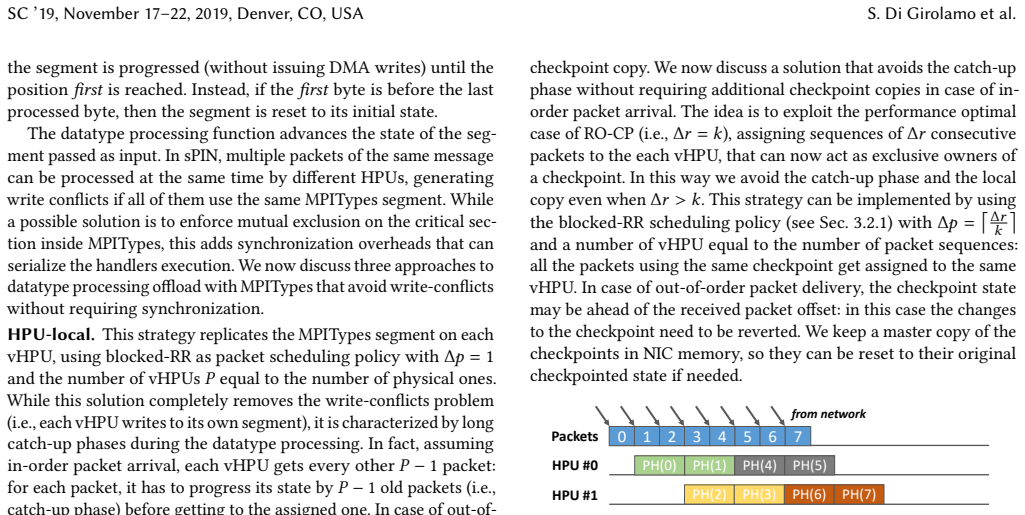
The load-bearing mechanism is the pairing of sPIN, a packet-streaming processing model in which a NIC executes a handler on every packet of a message, with a checkpointed representation of MPI datatype processing state. The general handlers use the dataloops representation of MPI datatypes: a datatype is a tree of descriptors (contig, vector, blockindexed, indexed, struct), and partial progress through that tree is captured in a segment, a stack of dataloop states. To let many handler processing units work on different packets in parallel without write conflicts, the paper introduces checkpoints, snapshots of the segment taken every $\Delta r$ bytes, and three state strategies: HPU-local replicates the segment per virtual handler unit, RO-CP copies the nearest checkpoint in each handler, and RW-CP gives each virtual handler unit exclusive ownership of a checkpoint, avoiding both catch-up phases and copies for in-order delivery. A blocked round-robin scheduler with virtual handler units enforces the packet-to-checkpoint assignment. The same machinery is extended to the sender side with streaming puts and outbound sPIN (PtlProcessPut), which let sender-side handlers generate packets and DMA the right contiguous regions out.
What would settle it
Run the progressing-checkpoint and specialized payload handlers on a cycle-accurate register-transfer-level model of a banked NIC SRAM, or on a prototype SmartNIC, with a 4 MiB vector-datatype message of 128-byte blocks at 200 Gbit/s, and compare throughput against host unpacking; if offload throughput falls below the host for blocks above 256 bytes, or if main-memory traffic counters show DMA writes incur read-for-ownership traffic that erases the 3.8x reduction, the central claim would fail.
Extended reading notes
Core claim
The paper's central claim is that non-contiguous memory transfers can be transparently network-accelerated, truly achieving zero-copy communications. Concretely, it shows that a NIC running sPIN-style handlers can take each incoming packet of a message described by an MPI derived datatype, compute which scattered addresses in the receive buffer the payload belongs to, and issue DMA writes directly there, so the CPU never copies or touches the data. The authors implement this in a packet-level model of a Portals 4 NIC with cycle-accurate handler cores, compare four offload strategies (specialized handlers, HPU-local, read-only checkpoints, and progressing checkpoints), and report up to 12x speedup of the progressing-checkpoint and specialized handlers over host-based unpacking, plus a 3.8x reduction in data volume moved to and from main memory. They also state the limits: very small blocks (4 bytes) still lose to the host, single-packet messages gain nothing, and unexpected messages must fall back to CPU unpacking.
Load-bearing premise
The speedup numbers assume the NIC's on-card memory has one-cycle access latency, very high bandwidth, and no bank contention, and the paper itself concedes the simulator may not model memory contention accurately; if real NIC memory is slower or banked, the block size where offload wins moves up and the reported speedups shrink.
Editorial extensions
If this is right
- MPI libraries could offload datatype unpacking automatically at type-commit and receive-post time, falling back to the host only for unexpected messages or very small blocks.
- Datatypes reused across multiple receives amortize the checkpoint-creation cost: in 75% of the application cases studied, the speedup pays off in fewer than four reuses.
- Because the NIC writes each byte of the message exactly once into its final location, main-memory traffic for a received message drops by a geometric-mean factor of 3.8 relative to host unpacking.
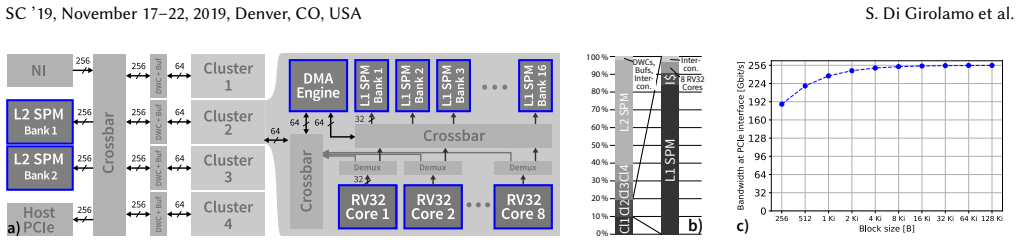
- A co-integrated accelerator built from 32 RISC-V cores and 12 MiB of on-NIC memory (about 23.5 mm² in 22 nm) is estimated to sustain 192 Gbit/s for block sizes of 256 B and above, suggesting offload fits within a NIC power and area budget.
- At scale, offloading the transpose in FFT2D shortens application runtime by up to 26% relative to host-based unpacking at 64 nodes.
Reading between the lines
- Extension: the checkpoint-interval heuristic treats $\Delta r$ as a static per-message choice, so a natural next step is adaptive checkpoint placement driven by observed packet arrival order, since out-of-order delivery is exactly the case where RW-CP must reset checkpoints.
- Extension: the same per-packet handler machinery could carry other data-centric transformations, such as filtering, reduction, or on-the-fly compression, while data is in flight; the paper's hardware estimates cover only datatype handlers, so these uses are untested.
- Extension: if a physical NIC's on-card memory has bank conflicts or higher latency than the single-cycle model used in the simulation, the crossover block size moves upward; the paper's own cycle-accurate hardware results already show lower throughput than the processor simulation for blocks under 256 bytes.
- Extension: the comparison baseline assumes a NIC refilling small scatter-gather lists over PCIe with about 500 ns latency, so a NIC with a larger or prefetched iovec table would narrow the gap; the reported 12x speedup is best read as an upper bound against that particular baseline.
Signed reviews
Editorial analysis
A structured set of objections, weighed in public.
Referee Report
Summary. The manuscript proposes and evaluates offloading MPI derived-datatype (DDT) processing to a programmable NIC using the sPIN model. It introduces several mechanisms: streaming puts and outbound sPIN for sender-side offload, specialized per-datatype handlers, and general-purpose receiver-side strategies including HPU-local segments, read-only checkpoints (RO-CP), and progressing checkpoints (RW-CP) under a blocked round-robin vHPU scheduler. The evaluation combines an SST+gem5 model of a Cray Slingshot NIC with 32 ARM cores, a cycle-accurate PULP RTL prototype with synthesis-based area and power estimates, and a LogGOPSim-based FFT2D scaling study. The paper reports up to 12x speedup over host-based unpacking, a 3.8x reduction in main-memory traffic, and identifies cases where offload does not help.
Significance. If the performance claims hold, this is a substantial step toward transparent zero-copy non-contiguous transfers: the RW-CP checkpointing scheme is an elegant solution to the packet-handler state-sharing problem, and the combination of an analytic scheduling model, SST+gem5 evaluation, and a synthesizable RTL prototype with concrete area and power numbers is stronger evidence than typical NIC-offload proposals. The paper also honestly discloses regimes where offload does not help, such as very small messages, very small blocks, and unexpected messages. The main weakness is that the headline speedups rest on an optimistic NIC-memory model that the paper itself questions, as detailed in the major comments.
major comments (3)
- [Sec. 5.1 and Sec. 4.3.2] The central speedup claims in Figs. 8 and 16 are produced with the gem5 SimpleMemory NIC-memory model configured with 1-cycle latency, 50 GiB/s bandwidth, and channels equal to twice the HPU count. The paper's own PULP cycle-accurate results in Fig. 10 show lower throughput for block sizes below 256 B due to L2 SPM contention, and Sec. 4.3.2 explicitly concedes that 'the gem5-based simulation may not model memory contention properly.' Because RW-CP and specialized handlers access checkpoints and dataloops on every packet, this optimistic memory model shifts the crossover point where offload beats host unpacking and inflates the reported 10-12x speedups for small-block application layouts. Please add a sensitivity analysis over NIC-memory latency, bandwidth, and channel count, or re-run the application-level benchmarks with PULP-derived handler costs.
- [Sec. 5.1 (host baseline)] The host-based unpack baseline is profiled on a single-threaded Intel i7-4770, while the sPIN NIC is modeled with 32 Cortex-A15 HPUs. The 'up to 12x speedup over host-based unpacking' headline therefore compares a single-core host implementation against a 32-core NIC model, which may overstate the benefit of offload. Please justify the single-threaded baseline, or include a stronger host baseline such as a multi-core optimized unpack or a contemporary server CPU, to demonstrate that the speedups are not an artifact of this asymmetry.
- [Sec. 5.3 (Fig. 16)] The Portals 4 iovec comparison is modeled rather than measured: it assumes v=32 scatter-gather entries per fetch and a 500 ns PCIe read latency to load the next iovec batch, and the paper states that no Portals 4 implementation is publicly available. Because Fig. 16 presents this as a competing network-accelerated solution, the relative claims against iovec offload depend on these unvalidated parameters. Please label the Portals 4 curve as a model and provide sensitivity to v and the PCIe read latency.
minor comments (7)
- [Abstract vs. Sec. 5.3] The abstract reports 'up to 10x speedup' while Sec. 5.3 states 'RW-CP and native can reach up to 12x speedup'; please make these numbers consistent.
- [Fig. 16] Figure 16 is extremely dense and the per-bar annotations are unreadable at normal print size; consider splitting it into multiple figures or providing a table of the underlying values.
- [Sec. 3.2.4] In the RW-CP message-processing-time model, the symbols Tpkt, k, P, and npkt are not all defined at first use, and the expression 'npkt/P' should be clearly specified as a ceiling division; please revise for clarity.
- [Sec. 5.2] The statement 'We observe similar results for other MPI derived datatypes but omit them due to space limitations' is an unsupported claim; please either include a representative additional datatype result or explicitly mark this as future work.
- [Sec. 4.3.2] The y-axis label in Fig. 10 contains the typo 'Througput'; it should read 'Throughput'.
- [Sec. 5.1] The phrase 'x32 PCIe Gen4' should be written as '32-lane PCIe Gen4' for clarity.
- [References] Reference [2] contains a duplicated URL prefix 'http://http://'; please fix it.
Circularity Check
No significant circularity: the speedup claims emerge from SST/gem5 and PULP simulations against an external host baseline, not from a self-referential derivation.
full rationale
The central claim that sPIN can transparently accelerate non-contiguous MPI datatype transfers is supported by simulation results (Fig. 8, Fig. 16, Fig. 19) that compare offload strategies against host-based unpacking with MPITypes on an Intel i7. The speedups are computed as ratios of simulated times; no fitted constant or derived equation reproduces the headline result by construction. The RW-CP checkpoint interval is selected using the analytic model TC = Tpkt + (Δr/k)(P−1)Tpkt + (npkt/P)TPH(γ), but this model only chooses a scheduling parameter; it does not encode the measured speedup, and the actual throughput is obtained from the SST/gem5 and PULP simulations. The paper builds on the authors' own sPIN concept [14] and gem5 integration approach [38], but these self-citations are not load-bearing for the quantitative results: the paper implements its own NIC model in SST and validates with a cycle-accurate PULP RTL prototype. The acknowledged limitation that 'the gem5-based simulation may not model memory contention properly' (Sec. 4.3.2) is a modeling validity concern, not a circular dependency. No equation or benchmark in the paper reduces to its own inputs, and no prediction is equivalent to a fitted parameter by construction. Accordingly, no circular step is identified.
Assumptions & free parameters
free parameters (3)
- epsilon for RW-CP checkpoint interval =
0.2
- Checkpoint interval delta_r =
per experiment
- Portals 4 baseline iovec entries v =
32
assumptions (4)
- domain assumption Portals 4 matching semantics and sPIN execution model as defined in prior work [14]
- domain assumption Network delivers header and completion packets as first and last packets of a message
- domain assumption In-order payload arrival for the RW-CP performance model
- domain assumption Host unpack baseline is single-threaded MPITypes with cold caches
invented entities (3)
-
Streaming puts (PtlSPutStart/PtlSPutStream)
-
PtlProcessPut and outbound sPIN
-
Virtual HPUs (vHPUs) with blocked-RR scheduling
Cite this review
Pith. "Pith review of Network-Accelerated Non-Contiguous Memory Transfers." pith.science (2026). https://pith.science/paper/57SJ6QSK
@misc{pith2026190808590,
  author       = {Pith},
  title        = {Pith review of: Network-Accelerated Non-Contiguous Memory Transfers},
  year         = {2026},
  howpublished = {\url{https://pith.science/paper/57SJ6QSK}},
  note         = {Machine review of arXiv:1908.08590}
}
read the original abstract
Applications often communicate data that is non-contiguous in the send- or the receive-buffer, e.g., when exchanging a column of a matrix stored in row-major order. While non-contiguous transfers are well supported in HPC (e.g., MPI derived datatypes), they can still be up to 5x slower than contiguous transfers of the same size. As we enter the era of network acceleration, we need to investigate which tasks to offload to the NIC: In this work we argue that non-contiguous memory transfers can be transparently networkaccelerated, truly achieving zero-copy communications. We implement and extend sPIN, a packet streaming processor, within a Portals 4 NIC SST model, and evaluate strategies for NIC-offloaded processing of MPI datatypes, ranging from datatype-specific handlers to general solutions for any MPI datatype. We demonstrate up to 10x speedup in the unpack throughput of real applications, demonstrating that non-contiguous memory transfers are a first-class candidate for network acceleration.
Figures


Figures from the paper (15 more)






Reference graph
Works this paper leans on
-
[1]
T. Shanley. 2003. Infiniband Network Architecture. Addison-Wesley Professional
work page 2003
-
[2]
2019. Mellanox Technologies. http://http://www.mellanox.com/. (2019)
work page 2019
-
[3]
B. Alverson, et al . 2012. Cray XC series network. Cray Inc., White Paper WP- Aries01-1112 (2012)
work page 2012
-
[4]
B. W Barrett, et al. 2018. The Portals 4.2 Network Programming Interface. Sandia National Laboratories, November 2012, Technical Report SAND2012-10087 (2018)
work page 2018
-
[5]
T. Schneider, et al. 2013. Protocols for Fully Offloaded Collective Operations on Accelerated Network Adapters. InParallel Processing (ICPP), 2013 42nd International Conference on. 593–602
work page 2013
-
[6]
S. Di Girolamo, et al. 2016. Exploiting Offload Enabled Network Interfaces. IEEE MICRO 36, 4 (Jul. 2016). 12 Network-Accelerated Non-Contiguous Memory Transfers SC ’19, November 17–22, 2019, Denver, CO, USA
work page 2016
-
[7]
T. Schneider, R. Gerstenberger, and T. Hoefler. 2012. Micro-Applications for Communication Data Access Patterns and MPI Datatypes. In Recent Advances in the Message Passing Interface - Proceedings of the 19th European MPI Users’ Group Meeting, EuroMPI 2012, 2012. , Vol. 7490. Springer, 121–131
work page 2012
-
[8]
T. Schneider, R. Gerstenberger, and T. Hoefler. 2014. Application-oriented ping- pong benchmarking: how to assess the real communication overheads. Journal of Computing 96, 4 (Apr. 2014), 279–292
work page 2014
Show all 53 references
-
[9]
Hoefler and S
T. Hoefler and S. Gottlieb. 2010. Parallel Zero-Copy Algorithms for Fast Fourier Transform and Conjugate Gradient using MPI Datatypes. In Recent Advances in the Message Passing Interface (EuroMPI’10) , Vol. LNCS 6305. Springer, 132–141
2010
-
[10]
Gropp, et al
W. Gropp, et al. 2011. Performance Expectations and Guidelines for MPI De- rived Datatypes. In Recent Advances in the Message Passing Interface (EuroMPI’11) , Vol. 6960. Springer, 150–159
2011
-
[11]
Schneider, F
T. Schneider, F. Kjolstad, and T. Hoefler. 2013. MPI Datatype Processing using Runtime Compilation. InProceedings of the 20th European MPI Users’ Group Meeting. ACM, 19–24
2013
-
[12]
Santhanaraman, J
G. Santhanaraman, J. Wu, and D. K Panda. 2004. Zero-copy MPI derived datatype communication over InfiniBand. In European Parallel Virtual Machine/Message Passing Interface Users’ Group Meeting . Springer, 47–56
2004
-
[13]
Wang, et al
H. Wang, et al. 2011. Optimized non-contiguous MPI datatype communication for GPU clusters: Design, implementation and evaluation with MVAPICH2. In 2011 IEEE International Conference on Cluster Computing . IEEE, 308–316
2011
-
[14]
Hoefler, et al
T. Hoefler, et al . 2017. sPIN: High-performance streaming Processing in the Network. In Proceedings of the International Conference for High Performance Computing, Networking, Storage and Analysis (SC17)
2017
-
[15]
F Van der Wijngaart and P
R. F Van der Wijngaart and P. Wong. 2002. NAS parallel benchmarks version 2.4. (2002)
2002
-
[16]
Nieplocha, et al
J. Nieplocha, et al. 2006. High performance remote memory access communication: The ARMCI approach. The International Journal of High Performance Computing Applications 20, 2 (2006), 233–253
2006
-
[17]
Chapman, et al
B. Chapman, et al. 2010. Introducing OpenSHMEM: SHMEM for the PGAS com- munity. In Proceedings of the Fourth Conference on Partitioned Global Address Space Programming Model. ACM, 2
2010
-
[18]
Mellor-Crummey, et al
J. Mellor-Crummey, et al. 2009. A new vision for Coarray Fortran. In Proceedings of the Third Conference on Partitioned Global Address Space Programing Models . ACM, 5
2009
-
[19]
El-Ghazawi and L
T. El-Ghazawi and L. Smith. 2006. UPC: unified parallel C. In Proceedings of the 2006 ACM/IEEE conference on Supercomputing . ACM, 27
2006
-
[20]
Message Passing Interface Forum. 2012. MPI: A Message-Passing Interface Stan- dard Version 3.0. (09 2012). Chapter author for Collective Communication, Process Topologies, and One Sided Communications
2012
-
[21]
Gropp, E
W. Gropp, E. Lusk, and D. Swider. 1999. Improving the performance of MPI derived datatypes. In Proceedings of the Third MPI Developer’s and User’s Conference . MPI Software Technology Press, 25–30
1999
-
[22]
Byna, et al
S. Byna, et al . 2006. Automatic memory optimizations for improving MPI de- rived datatype performance. In European Parallel Virtual Machine/Message Passing Interface Users’ Group Meeting . Springer, 238–246
2006
-
[23]
Tanabe and H
N. Tanabe and H. Nakajo. 2008. Introduction to acceleration for MPI derived datatypes using an enhancer of memory and network. In European Parallel Virtual Machine/Message Passing Interface Users’ Group Meeting . Springer, 324–325
2008
-
[24]
J. L. Träff. 2014. Optimal MPI Datatype Normalization for Vector and Index-block Types. In Proceedings of the 21st European MPI Users’ Group Meeting (EuroMPI/ASIA ’14). ACM, New York, NY, USA, Article 33, 6 pages. DOI:http://dx.doi.org/10.1145/ 2642769.2642771
2014
-
[25]
Ross, et al
R. Ross, et al. 2009. Processing MPI datatypes outside MPI. In European Parallel Virtual Machine/Message Passing Interface Users’ Group Meeting . Springer, 42–53
2009
-
[26]
R. Ross, N. Miller, and W. D Gropp. 2003. Implementing fast and reusable datatype processing. In European Parallel Virtual Machine/Message Passing Interface Users’ Group Meeting. Springer, 404–413
2003
-
[27]
Kurth, et al
A. Kurth, et al . 2017. HERO: Heterogeneous embedded research platform for exploring RISC-V manycore accelerators on FPGA.arXiv preprint arXiv:1712.06497 (2017)
2017 arXiv
-
[28]
Rossi, et al
D. Rossi, et al. 2017. Energy-Efficient Near-Threshold Parallel Computing: The PULPv2 Cluster. IEEE Micro 37, 5 (Sep. 2017), 20–31
2017
-
[29]
Gautschi, et al
M. Gautschi, et al. 2017. Near-Threshold RISC-V Core With DSP Extensions for Scalable IoT Endpoint Devices. IEEE Transactions on Very Large Scale Integration (VLSI) Systems 25, 10 (Oct 2017), 2700–2713. DOI:http://dx.doi.org/10.1109/TVLSI. 2017.2654506
2017
-
[30]
Mellanox Technologies. 2019. Mellanox BlueField SmartNIC. http://www.mellanox. com/related-docs/prod_adapter_cards/PB_BlueField_Smart_NIC.pdf. (2019). On- line; accessed 05. April 2019
2019
-
[31]
H. T. Mair, et al . 2016. 4.3 A 20nm 2.5GHz ultra-low-power tri-cluster CPU subsystem with adaptive power allocation for optimal mobile SoC performance. In IEEE International Solid-State Circuits Conference (ISSCC) . 76–77
2016
-
[32]
Pyo, et al
J. Pyo, et al. 2015. 23.1 20nm high-K metal-gate heterogeneous 64b quad-core CPUs and hexa-core GPU for high-performance and energy-efficient mobile application processor. In 2015 IEEE International Solid-State Circuits Conference - (ISSCC) Digest of Technical Papers. 1–3
2015
-
[33]
Sohan, et al
R. Sohan, et al. 2010. Characterizing 10 Gbps network interface energy consump- tion. In IEEE Local Computer Network Conference . 268–271
2010
-
[34]
L Janssen, et al
C. L Janssen, et al. 2010. A simulator for large-scale parallel computer architectures. International Journal of Distributed Systems and Technologies (IJDST) 1, 2 (2010), 57–73
2010
-
[35]
Nathan Binkert, et al . 2011. The gem5 simulator. ACM SIGARCH Computer Architecture News 39, 2 (2011), 1–7
2011
-
[36]
A Endo, D
F. A Endo, D. Couroussé, and H. Charles. 2014. Micro-architectural simulation of in-order and out-of-order arm microprocessors with gem5. In 2014 International Conference on Embedded Computer Systems: Architectures, Modeling, and Simulation (SAMOS XIV). IEEE, 266–273
2014
-
[37]
Tousi and C
A. Tousi and C. Zhu. 2017. Arm Research Starter Kit: System Modeling using gem5. (2017)
2017
-
[38]
Hoefler, T
T. Hoefler, T. Schneider, and A. Lumsdaine. 2010. LogGOPSim - Simulating Large- Scale Applications in the LogGOPS Model. In Proceedings of the 19th ACM Interna- tional Symposium on High Performance Distributed Computing . ACM, 597–604
2010
-
[39]
Lawrence Livermore National Laboratory. 2018. Comb is a communication per- formance benchmarking tool. (2018). https://github.com/LLNL/Comb
2018
-
[40]
Plimpton
S. Plimpton. 1995. Fast Parallel Algorithms for Short-range Molecular Dynamics. J. Comput. Phys. 117, 1 (March 1995), 1–19. DOI:http://dx.doi.org/10.1006/jcph. 1995.1039
1995
-
[41]
Bernard, et al
C. Bernard, et al. 1991. Studying quarks and gluons on MIMD parallel computers. The International Journal of Supercomputing Applications 5, 4 (1991), 61–70
1991
-
[42]
Carrington, et al
L. Carrington, et al. 2008. High-frequency Simulations of Global Seismic Wave Propagation Using SPECFEM3D GLOBE on 62K Processors. In Proceedings of the 2008 ACM/IEEE Conference on Supercomputing (SC ’08) . IEEE Press, Piscataway, NJ, USA, Article 60, 11 pages. http://dl.acm.o...
2008
-
[43]
B Sjogreen. 2018. SW4 final report for iCOE. Technical Report. Lawrence Livermore National Lab.(LLNL), Livermore, CA (United States)
2018
-
[44]
W. C. Skamarock and J. B. Klemp. 2008. A Time-split Nonhydrostatic Atmospheric Model for Weather Research and Forecasting Applications. J. Comput. Phys. 227, 7 (March 2008), 3465–3485. DOI:http://dx.doi.org/10.1016/j.jcp.2007.01.037
2008 doi
-
[45]
Neugebauer, et al
R. Neugebauer, et al. 2018. Understanding PCIe performance for end host net- working. In Proceedings of the 2018 Conference of the ACM Special Interest Group on Data Communication. ACM, 327–341
2018
-
[46]
Martinasso, et al
M. Martinasso, et al . 2016. A PCIe Congestion-Aware Performance Model for Densely Populated Accelerator Servers. In Proceedings of the International Confer- ence for High Performance Computing, Networking, Storage and Analysis (SC16) . IEEE Press, 63:1–63:11
2016
-
[47]
Hoefler, C
T. Hoefler, C. Siebert, and A. Lumsdaine. 2009. Group Operation Assembly Lan- guage - A Flexible Way to Express Collective Communication, In ICPP-2009 - The 38th International Conference on Parallel Processing. (Sep. 2009)
2009
-
[48]
J. L. Träff, et al . 1999. Flattening on the Fly: efficient handling of MPI derived datatypes. In Recent Advances in Parallel Virtual Machine and Message Passing Interface, Jack Dongarra, Emilio Luque, and Tomàs Margalef (Eds.). Springer Berlin Heidelberg, Berlin, Heidelberg, 109–116
1999
-
[49]
Prabhu and W
T. Prabhu and W. Gropp. 2015. DAME: A runtime-compiled engine for derived datatypes. In Proceedings of the 22nd European MPI Users’ Group Meeting . ACM, 4
2015
-
[50]
Schneider, R
T. Schneider, R. Gerstenberger, and T. Hoefler. 2013. Compiler optimizations for non-contiguous remote data movement. In International Workshop on Languages and Compilers for Parallel Computing . Springer, 307–321
2013
-
[51]
TV Eicken, et al . 1992. Active messages: a mechanism for integrated commu- nication and computation. In [1992] Proceedings the 19th Annual International Symposium on Computer Architecture. IEEE, 256–266
1992
-
[52]
Besta and T
M. Besta and T. Hoefler. 2015. Accelerating Irregular Computations with Hardware Transactional Memory and Active Messages. In Proceedings of the 24th Symposium on High-Performance Parallel and Distributed Computing (HPDC’15) . ACM, 161– 172
2015
-
[53]
Besta and T
M. Besta and T. Hoefler. 2015. Active Access: A Mechanism for High-Performance Distributed Data-Centric Computations. In Proceedings of the 29th International Conference on Supercomputing (ICS’15) . ACM, 155–164. 13
2015
Reviewed August 14, 2026 · model on record in the stance chip above.
Discussion (0). Continue with ORCID to comment.