REVIEW 6 minor 22 references
Noise sensitivity and exceptional times of transience for a simple symmetric random walk in one dimension
T0 review · 0 major / 6 minor · reviewed 2026-08-14 · deepseek-v4-flash
Pith's one-line read For a switch random walk, times at which the walk escapes to infinity exist almost surely and form a set of Hausdorff dimension 1/2.
desk verdict A rigorous and genuinely new proof that the switch walk has exceptional times of transience of Hausdorff dimension 1/2 and is maximally noise sensitive; deserves a serious referee. read the letter →
The pith
A machine-rendered reading of the paper's core claim, the machinery that carries it, and where it could break.
The reading
What carries the argument
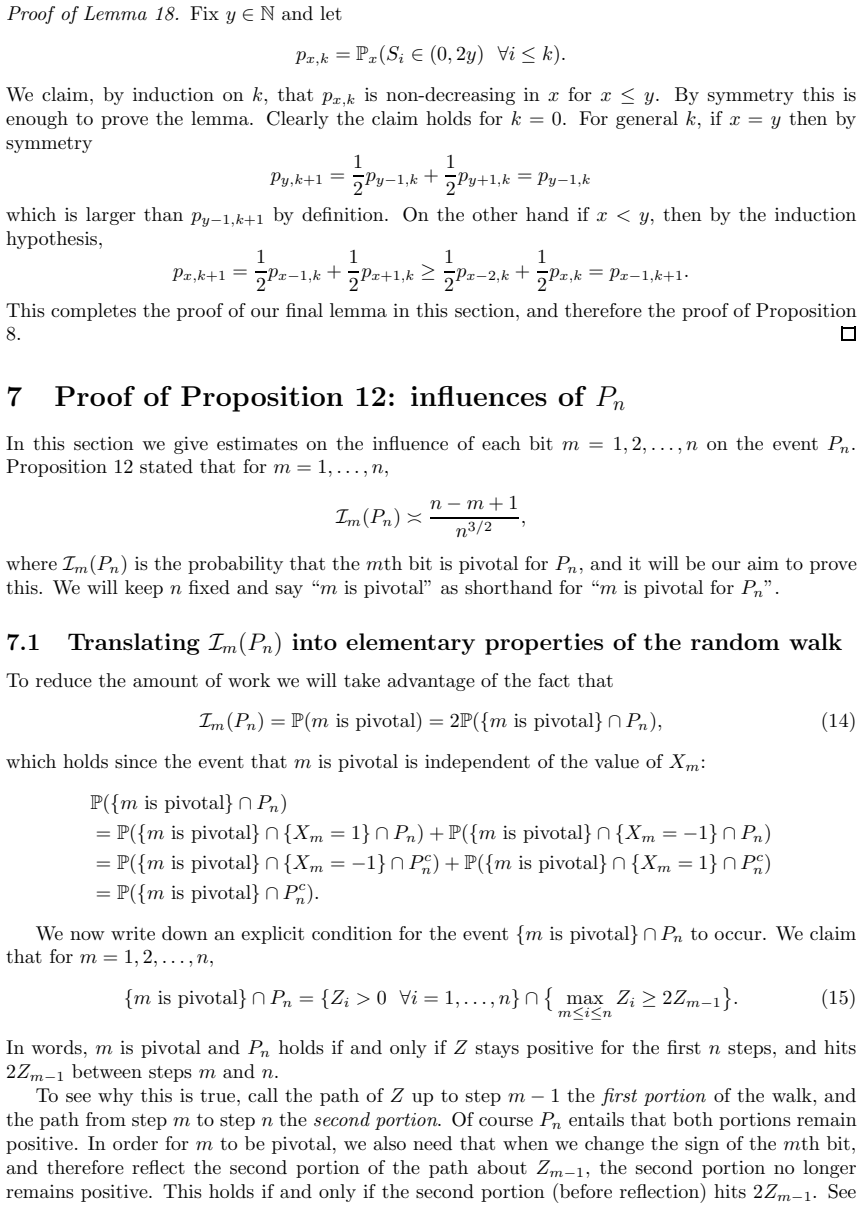
The load-bearing object is the period decomposition of the two coupled walks relative to the change times $I_k(t)=\min\{i>I_{k-1}(t):X_i(t)\ne X_i(0)\}$. On odd periods the increments of $Z(0)$ and $Z(t)$ coincide; on even periods they are mirror images, so writing $U_n$ and $V_n$ for the sums over odd and even periods gives $Z_n(0)=U_n+V_n$ and $Z_n(t)=U_n-V_n$. Joint positivity of the two walks becomes the event $U_n>|V_n|$, whose probability tends to $1/4$ once there are many periods by step $n$. For the Hausdorff dimension lower bound the same decomposition is combined with the FKG inequality and the half-sum process $W_i(t)=(Z_i(0)+Z_i(t))/2$, which is constant on even periods, to obtain $P(P_n(0)\cap P_n(t))\lesssim 1/(nt^{1/2})$; the upper bound is carried by the influence estimate $I_m(P_n)\asymp (n-m+1)n^{-3/2}$ for the positivity event $P_n$, converted to a dimension bound through a standard energy criterion for exceptional times.
What would settle it
Simulate or compute the coupled switch walk with noise level $\varepsilon_n=n^{-1/2}$; Theorem 2 predicts $P(Z_n(0)>0\text{ and }Z_n(\varepsilon_n)>0)\to1/4$. If the joint-positivity frequency instead stays near $1/2$ for large $n$, the maximal noise-sensitivity claim is false; similarly, an estimate of the Hausdorff dimension of $E_\alpha$ different from $1/2$ would falsify Theorem 1.
Extended reading notes
Core claim
For the dynamical switch walk $Z_n(t)=\sum_{k=1}^n\prod_{j=1}^k X_j(t)$, with each bit $X_j$ rerandomised by an independent rate-1 Poisson clock, the paper establishes three claims. First, the set $E=\{t\in[0,1]:Z_n(t)\to\infty\}$ is almost surely non-empty, and for every $\alpha\in[0,1/2)$ the set $E_\alpha=\{t:\liminf_n Z_n(t)/n^\alpha>0\}$ has Hausdorff dimension $1/2$ almost surely, while $E_\alpha$ is empty for $\alpha>1/2$. Second, the events $\{\{Z_n>0\},n\ge1\}$ are maximally noise sensitive: for every $\varepsilon_n\in(0,1)$ with $n\varepsilon_n\to\infty$, $P(Z_n(0)>0\text{ and }Z_n(\varepsilon_n)>0)-P(Z_n(0)>0)^2\to0$. Third, these statements are in direct contrast to the compass walk $Y_n(t)$, for which recurrence is dynamically stable and the positivity events are noise stable.
Load-bearing premise
The proof assumes that each bit $X_j$ rerandomises according to an independent rate-1 Poisson clock, so the times at which bits change are independent of the walk's values and of one another; if updates were synchronised or depended on the walk's position, the mirroring of even periods, and with it both main theorems, would fail.
Editorial extensions
If this is right
- Recurrence of the switch walk is dynamically sensitive: with probability one there are times $t$ at which $Z_n(t)\to\infty$, so one-dimensional recurrence is not automatically dynamically stable.
- The exceptional times form a genuine fractal: for every $\alpha<1/2$, the times with $\liminf_n Z_n(t)/n^\alpha>0$ have Hausdorff dimension exactly $1/2$, while no such times exist for $\alpha>1/2$.
- The positivity events are maximally noise sensitive: any noise level $\varepsilon_n$ with $n\varepsilon_n\to\infty$ destroys the correlation between $\{Z_n(0)>0\}$ and $\{Z_n(\varepsilon_n)>0\}$, and the condition on $\varepsilon_n$ is optimal.
- The law of the iterated logarithm is dynamically sensitive for the switch walk: there almost surely exist times at which $Z_n(t)$ is negative for all large $n$, a phenomenon that cannot occur for the compass walk.
Reading between the lines
- Because the compass and switch walks have identical laws as sequences of random variables, the paper implies that noise sensitivity is representation-dependent: the same Boolean-function distribution can be encoded so that positivity is noise stable or maximally noise sensitive.
- The optimality of $n\varepsilon_n\to\infty$ suggests a quantitative crossover: when $n\varepsilon_n$ is bounded, some of the first $n$ bits never rerandomise, so the correlation should remain bounded away from zero; quantifying this crossover could connect to Fourier-weight or influence calculations for the switch walk.
- The period-decomposition method is not tied to positivity: the same odd/even mirroring gives explicit covariance asymptotics for other additive functionals such as the maximum or the range of the walk, and those would be testable extensions.
- Whether $E_{1/2}$ is empty remains open; the natural next step is the same second-moment argument with sharper estimates near the $t^{-1/2}$ singularity, which is exactly the borderline separating the $\alpha<1/2$ and $\alpha>1/2$ regimes.
Signed reviews
Editorial analysis
A structured set of objections, weighed in public.
Referee Report
Summary. The paper introduces a dynamical version of the 'switch random walk' in one dimension, in which the increments are products of independent fair bits, and each bit is rerandomized by its own rate-1 Poisson clock. It proves two contrast results relative to the usual 'compass' dynamical random walk. Theorem 1 states that almost surely there exist times t in [0,1] at which the switch walk tends to infinity, that the set E_alpha of times with liminf Z_n(t)/n^alpha > 0 has Hausdorff dimension 1/2 almost surely for alpha in [0,1/2), and that E_alpha is empty almost surely for alpha > 1/2. Theorem 2 states that the events {Z_n > 0} are maximally noise sensitive: for any sequence epsilon_n with n epsilon_n -> infinity, the events {Z_n(0) > 0} and {Z_n(epsilon_n) > 0} decorrelate. The proof of Theorem 2 uses a period decomposition into odd and even blocks, on which the two walks agree or mirror each other. Theorem 1 is reduced to a lower-bound estimate (Proposition 8) proved through the same period decomposition together with FKG-type arguments, and an upper-bound influence estimate (Proposition 12) proved by ballot and random-walk estimates.
Significance. If correct, the paper establishes a clean one-dimensional example where recurrence is dynamically sensitive, contrasting with the dynamical stability of recurrence for the compass walk proved by Benjamini, Haggstrom, Peres and Steif, and with the noise stability of the positivity event for the compass walk. The lower-bound argument in Section 6 is genuinely different from the spectral-sample and randomized-algorithm methods used in related dynamical percolation results, and it is elementary and self-contained. The paper also proves a sharp maximal noise sensitivity statement, explicitly noting that the condition n epsilon_n -> infinity is best possible. The results are pure theorems with no fitted parameters, and the proof infrastructure is well organized; the use of external tools such as the local central limit theorem, the reflection principle, the FKG inequality, and the Schramm-Steif results is clearly identified.
minor comments (6)
- [Section 4, definition of U_n] The final term X_{I_K(epsilon_n)} in the definition of U_n is not self-explanatory; a short sentence explaining that only the first increment of the next odd period is included because the comparison stops at I_K(epsilon_n) would improve readability.
- [Section 6, definition of A'_j(t) and proof of Proposition 15] There is a notational inconsistency: A'_j(t) is defined using a walk B^{(j)}(t) started from W_{I_{j-1}(t)-1}(t), but in the proof of Proposition 15 the event A'_{2j}(t) is written as {W_{I_{2j-1}(t)-1}(t) + B^{(2j)}_i(t) in (0,2W_{...})}, which suggests that B^{(2j)} is started at 0. The authors should unify the two spellings, for example by stating explicitly that in the second form B^{(2j)} is a walk started at 0 and W + B is the walk started from W.
- [Section 7, equation (16)] In the displayed formula for I_m(P_n), the second maximum is written as max_{i <= m-n+1} Z_i >= 2z; the index should be i <= n-m+1, as in the definition of U in equation (17).
- [Section 5.3, equation (7)] The displayed inequality involving P(L^alpha_n(1)>0) is correct but unnecessarily confusing because the same probability appears on both sides; rewriting it as P(A) <= E[L^alpha_n(2)] / E[L^alpha_n(2) | A] with A = {L^alpha_n(1)>0} would make the argument easier to follow.
- [Section 6, proof of Lemma 14] The Chernoff bound in the proof of Lemma 14 is applied to show decay of P(E^odd_n(t)^c), and the sentence 'P(E^even_n(t)) = P(E^odd_n(t))' should read 'P(E^even_n(t)^c) = P(E^odd_n(t)^c)'; as written, the equality is between probabilities of different events.
- [Section 5.3] The proof that E_alpha is empty for alpha > 1/2 first treats alpha in (1/2,1) and then extends to alpha >= 1 by monotonicity; it may be worth stating explicitly that the event E_alpha is decreasing in alpha, even though this is immediate from the definition.
Circularity Check
No significant circularity identified
full rationale
The paper is a self-contained mathematical derivation: the switch random walk is defined explicitly from independent fair bits and rate-1 Poisson clocks, and the theorems are proven from those definitions using standard external results (local central limit theorem, reflection principle, FKG inequality, and Schramm–Steif as black boxes). No parameter is fitted to data and then renamed as a prediction; the noise-sensitivity statement is obtained by direct asymptotic computation of P(Zn(0)>0 and Zn(epsilon_n)>0), not by assuming the conclusion. The period decomposition is derived from the Poisson-clock structure, and the mirroring of increments on even periods follows from the definitions. Citations to earlier works are external published theorems or standard facts, and the few borrowed lemmas, such as Schramm–Steif's Lemma 6.2 and Theorem 8.1, are used as independent mathematical tools with stated assumptions, not as an unverified self-referential premise. The paper's main results therefore do not reduce by construction to their inputs; there is no circular step to report.
Assumptions & free parameters
assumptions (7)
- standard math Local central limit theorem (Lemma 3, from Lawler-Limic [17])
- standard math Reflection principle (Lemma 5)
- standard math FKG inequality on {−1,1}^N (Eq. (1)-(2))
- standard math Schramm-Steif quantitative noise sensitivity and Frostman-type lemmas ([19, Lemma 6.2, Theorem 8.1])
- standard math Ritter's theorem on growth of random walks conditioned to stay positive ([18, Theorem 2])
- standard math Ballot theorem (ref [2])
- standard math Strong Markov property, Borel-Cantelli lemma, and ergodic theorem
Cite this review
Pith. "Pith review of Noise sensitivity and exceptional times of transience for a simple symmetric random walk in one dimension." pith.science (2026). https://pith.science/paper/JPHCU6T3
@misc{pith2026190808606,
  author       = {Pith},
  title        = {Pith review of: Noise sensitivity and exceptional times of transience for a simple symmetric random walk in one dimension},
  year         = {2026},
  howpublished = {\url{https://pith.science/paper/JPHCU6T3}},
  note         = {Machine review of arXiv:1908.08606}
}
abstract
We define a dynamical simple symmetric random walk in one dimension, and show that there almost surely exist exceptional times at which the walk tends to infinity. This is in contrast to the usual dynamical simple symmetric random walk in one dimension, for which such exceptional times are known not to exist. In fact we show that the set of exceptional times has Hausdorff dimension $1/2$ almost surely, and give bounds on the rate at which the walk diverges at such times. We also show noise sensitivity of the event that our random walk is positive after $n$ steps. In fact this event is maximally noise sensitive, in the sense that it is quantitatively noise sensitive for any sequence $\varepsilon_n$ such that $n\varepsilon_n\to\infty$. This is again in contrast to the usual random walk, for which the corresponding event is known to be noise stable.
Figures


Figures from the paper (1 more)

Reference graph
Works this paper leans on
-
[1]
L. Addario-Berry and B.A. Reed. Ballot theorems, old and new. In Horizons of Combinatorics , pages 9–35. Springer, 2008
work page 2008
-
[2]
Solution directe du probleme r´ esolu par M
D´ esir´ e Andr´ e. Solution directe du probleme r´ esolu par M. Bertrand. CR Acad. Sci. Paris , 105(436):7, 1887
-
[3]
Itai Benjamini, Olle H¨ aggstr¨ om, Yuval Peres, and Jeffrey E. S teif. Which properties of a random sequence are dynamically sensitive? The Annals of Probability , 31(1):1–34, 2003
work page 2003
-
[4]
Noise sensitivity of Bo olean functions and applications to percolation
Itai Benjamini, Gil Kalai, and Oded Schramm. Noise sensitivity of Bo olean functions and applications to percolation. Publications Math´ ematiques de l’Institut des Hautes ´Etudes Sci- entifiques, 90(1):5–43, 1999
work page 1999
-
[5]
Patrick Billingsley. Probability and measure . John Wiley & Sons, 2008
work page 2008
-
[6]
Invariance pr inciple for biased bootstrap random walks
Andrea Collevecchio, Kais Hamza, and Yunxuan Liu. Invariance pr inciple for biased bootstrap random walks. Stochastic Processes and their Applications , 129(3):860–877, 2019
work page 2019
-
[7]
Andrea Collevecchio, Kais Hamza, and Meng Shi. Bootstrap rando m walks. Stochastic Pro- cesses and their Applications , 126(6):1744–1760, 2016
work page 2016
-
[8]
Turning a coin over inste ad of tossing it
J´ anos Engl¨ ander and Stanislav Volkov. Turning a coin over inste ad of tossing it. Journal of Theoretical Probability, 31(2):1097–1118, 2018
work page 2018
Show all 22 references
-
[9]
The coin- turning walk and its scaling limit
Janos Englander, Stanislav Volkov, and Zhenhua Wang. The coin- turning walk and its scaling limit. arXiv preprint arXiv:1904.10953 , 2019. 28
1904 arXiv
-
[10]
Fortuin, P.W
C.M. Fortuin, P.W. Kasteleyn, and J. Ginibre. Correlation inequalit ies on some partially ordered sets. Communications in Mathematical Physics , 22(2):89–103, 1971
1971
-
[11]
The Fou rier spectrum of critical per- colation
Christophe Garban, G´ abor Pete, and Oded Schramm. The Fou rier spectrum of critical per- colation. Acta Mathematica, 205(1):19–104, 2010
2010
-
[12]
Christophe Garban and Jeffrey E. Steif. Noise sensitivity of Boolean functions and percolation . Cambridge University Press, 2014
2014
-
[13]
Olle H¨ aggstr¨ om, Yuval Peres, and Jeffrey E. Steif. Dynamical percolation. Annales de l’Institut Henri Poincare (B) Probability and Statistics , 33(4):497–528, 1997
1997
-
[14]
Recurrence of simple random walk on Z2 is dynamically sensitive
Christopher Hoffman. Recurrence of simple random walk on Z2 is dynamically sensitive. arXiv preprint math/0503065 , 2005
2005 arXiv
-
[15]
Levin, and Pedro J
Davar Khoshnevisan, David A. Levin, and Pedro J. M´ endez-He rn´ andez. On dynamical Gaus- sian random walks. The Annals of Probability , 33(4):1452–1478, 2005
2005
-
[16]
Levin, and Pedro J
Davar Khoshnevisan, David A. Levin, and Pedro J. M´ endez-Hern´ andez. Exceptional times and invariance for dynamical random walks. Probability theory and related fields , 134(3):383–416, 2006
2006
-
[17]
Random walk: a modern introduction , volume 123
Gregory F Lawler and Vlada Limic. Random walk: a modern introduction , volume 123. Cambridge University Press, 2010
2010
-
[18]
Grant A. Ritter. Growth of random walks conditioned to stay po sitive. The Annals of Probability, 9(4):699–704, 1981
1981
-
[19]
Schramm and J.E
O. Schramm and J.E. Steif. Quantitative noise sensitivity and exc eptional times for percola- tion. Ann. of Math. (2) , 171(2):619–672, 2010
2010
-
[20]
J.E. Steif. A survey of dynamical percolation. Fractal Geometry and Stochastics IV , pages 145–174, 2009
2009
-
[21]
Triple points: from non-Brownian filtrations to h armonic measures
Boris Tsirelson. Triple points: from non-Brownian filtrations to h armonic measures. Geometric and Functional Analysis , 7(6):1096–1142, 1997
1997
-
[22]
J. Warren. Splitting: Tanaka’s SDE revisited. arXiv preprint math.PR/9911115 , 1999. 29
1999
Reviewed August 14, 2026 · model on record in the stance chip above.
Discussion (0). Continue with ORCID to comment.