REVIEW 2 major objections 5 minor 45 references
Lattice simulations with G-parity Boundary Conditions
T0 review · 2 major / 5 minor · reviewed 2026-08-14 · deepseek-v4-flash
Pith's one-line read G-parity boundary conditions put a moving momentum on the pion ground state without breaking isospin symmetry, and the derived lattice action reproduces pion, kaon, and $B_K$ physics of the periodic ensemble.
desk verdict Sound methods paper for GPBC with a solid action derivation and honest numerics; the rooted strange determinant is the one place I want more control. read the letter →
The pith
A machine-rendered reading of the paper's core claim, the machinery that carries it, and where it could break.
The reading
What carries the argument
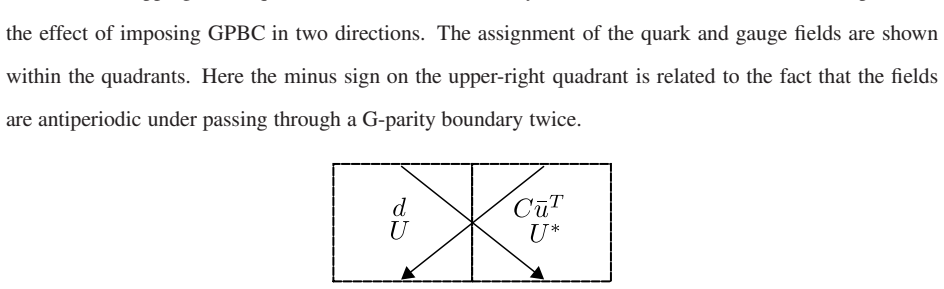
The load-bearing objects are: the two-component flavor doublet $\psi=(d, C\bar u^T)$, which turns G-parity into the simple rotation $\hat G\psi\hat G^{-1}=i\sigma_2\psi$ and makes the boundary condition a flavor rotation rather than a flavor flip; the unitary boundary twist matrices $B^\pm_\mu(x_\mu)=\exp(\pm i\,G_\mu\pi\sigma_2/2)$ at the boundary, which enter the covariant derivative and encode the flavor mixing; the discretized fermion action of Eq. (41) built from those ingredients together with complex-conjugate (charge-conjugation) boundary conditions on the gauge links; the $\sigma_2$-eigenstate projectors $\tfrac12(1\pm\sigma_2)$ that restore translational covariance to quark fields, with allowed quark momenta that are odd multiples of $\pi/(2L)$ and with the constraint that momentum components in different G-parity directions must be equal modulo $2\pi/L$; and, for the strange quark, the fictional degenerate partner $s'$ with a rooted $(s,s')$ sea determinant and a $\sqrt{2}$ state-normalization factor. The mechanism that carries the argument is that meson states built from these projected fields automatically inherit antiperiodic boundary conditions, so the pion ground state has momentum $\pi/L$ while isospin symmetry is exact, and physical kaon matrix elements survive the mixing with the unphysical partner up to $O(e^{-m_K L})$ corrections.
What would settle it
Compute the finite-volume difference between the rooted $(s,s')$ determinant and the Pfaffian of the charge-conjugation-boundary theory on a sequence of box sizes and verify that it decays with the claimed exponential rate; if the difference instead decays as a power of $1/L$ or fails to vanish, the rooting equivalence fails. A complementary lattice test is to generate two ensembles differing only in the strange-sea treatment, one with the rooted $(s,s')$ determinant and one with a single strange quark via the exact one-flavor action, and require the kaon mass and $B_K$ to agree at much better than the current 1–2% precision.
Extended reading notes
Core claim
The central claim is that G-parity boundary conditions provide a practical way to simulate QCD in a finite box in which the pion ground state is a moving pion, with momentum components that are odd-integer multiples of $\pi/L$, while the full isospin symmetry of the two-flavor theory is retained. The paper establishes this by rewriting the quark fields as a two-component doublet $\psi=(d, C\bar u^T)$ on which G-parity acts as the simple rotation $\hat G\psi\hat G^{-1}=i\sigma_2\psi$, inserting boundary twist matrices $B^\pm_\mu$ into the covariant derivative, and deriving the complete discretized fermion action (Eq. 41) together with the complex-conjugate boundary conditions that gauge invariance forces onto the gauge links. The same formalism yields translationally covariant quark fields by projecting onto the $\sigma_2$ eigenstates, so meson operators of definite momentum can be constructed; it also supplies a consistent treatment of a single strange quark via a fictional degenerate partner $s'$, with a $\sqrt{2}$ normalization factor relating finite-volume matrix elements to their physical values up to $O(e^{-m_K L})$ corrections. Numerically, on three $16^3\times32$ domain wall ensembles with G-parity imposed in zero, one, and two directions, the measured pion energies match the continuum dispersion relation within 1.8%, and $m_K$, $f_K$, and $B_K$ agree with the periodic ensemble, so physical $K\to(\pi\pi)_{I=0}$ matrix elements can be computed from these moving-pion states without excited-state subtraction.
Load-bearing premise
The argument rests on the claim that taking the numerical square root of the two-flavor strange/strange-prime sea determinant returns exactly one strange quark, with all errors decaying exponentially as the box grows; this is supported by a diagram-level comparison with a charge-conjugation Pfaffian theory, not a proof, and the ensemble comparisons do not isolate this step from other finite-volume effects.
Editorial extensions
If this is right
- The $I=0$ $K\to\pi\pi$ amplitude at physical kinematics can be measured without isolating a moving pion as an excited state, removing the multi-exponential fits whose disconnected-diagram noise was the main obstacle.
- Because isospin remains exact, charged and neutral pions are treated on equal footing, so the $\Delta I=1/2$ amplitude needs no Wigner-Eckart detour through unphysical charge states.
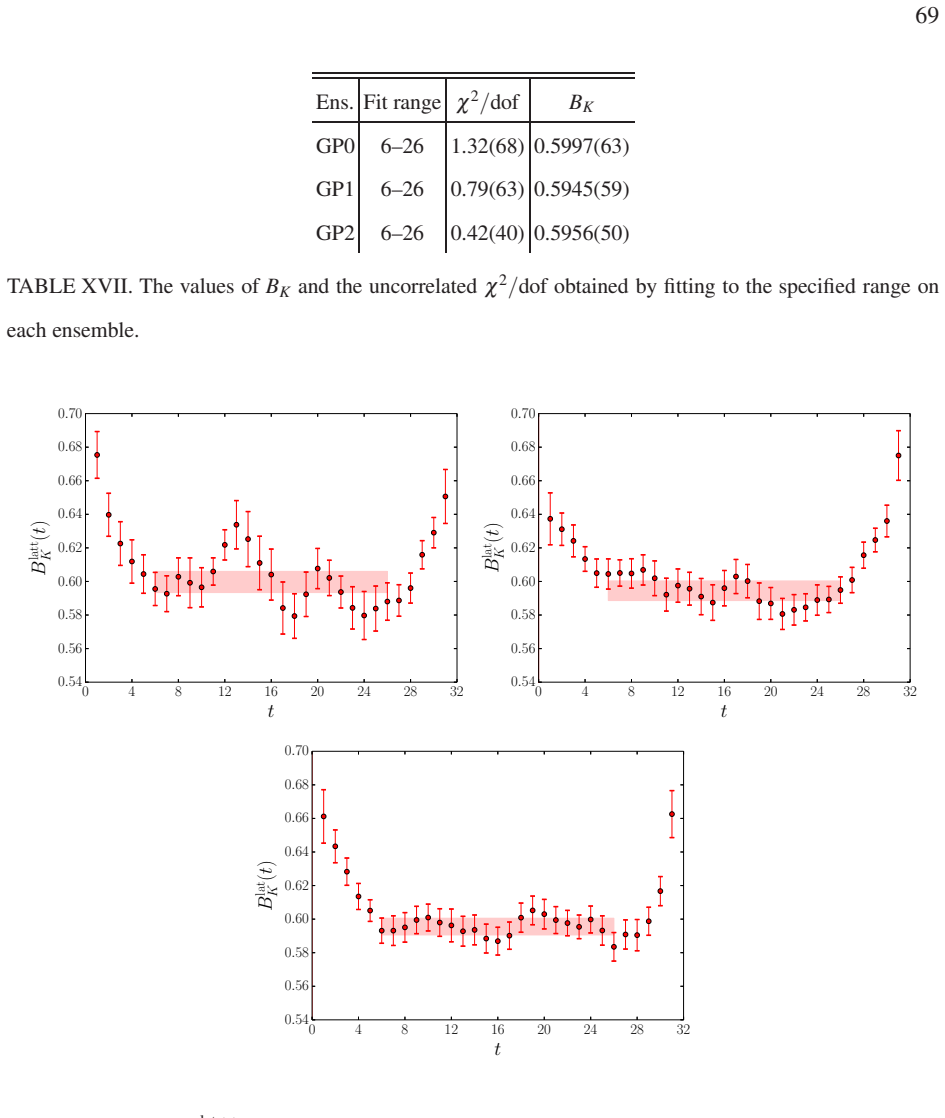
- Physical kaon observables read off from the mixed $|\tilde K^0_+\rangle$ state, namely its mass, $f_K$, and $B_K$, reproduce the periodic-boundary values up to $O(e^{-m_K L})$ corrections, as the three ensembles confirm.
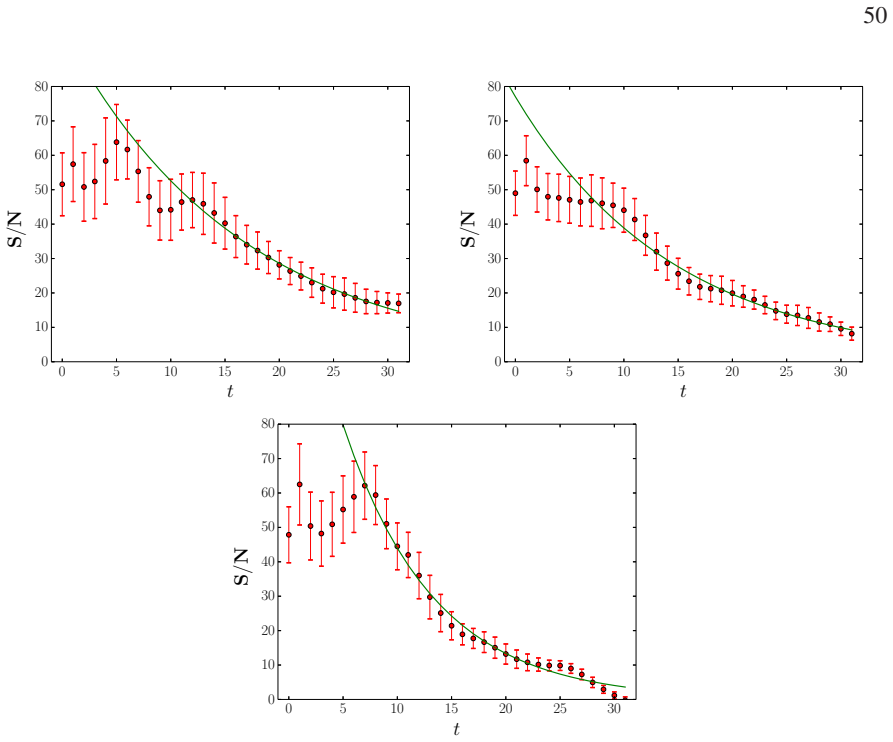
- Pion two-point functions on G-parity ensembles lose signal-to-noise exponentially in time because a G-parity-even flavor-singlet state at the stationary-pion energy enters the noise; matching this to the measured singlet energy confirms the mechanism and sets the cost of production-scale runs.
- The quark-level breaking of cubic rotational symmetry leaves pion energies intact, and averaging the $O^-_\pi$ and $O^+_\pi$ operator forms restores the rotational behavior of two-point amplitudes within statistics, enabling approximately symmetric $\pi\pi$ operators.
Reading between the lines
- The rooting equivalence of Section VI C is the one step of the construction that would benefit from a dedicated numerical check: generate a matched pair of ensembles, one with the rooted $(s,s')$ determinant and one with a genuinely single strange quark via the exact one-flavor action, and require a strange-sea-sensitive quantity to agree at the level of the claimed $e^{-m_K L}$ corrections rather
- Because the flavor-singlet pseudoscalar state at the stationary-pion energy enters the noise of every pion correlator, variance-reduction methods targeted at that state, such as low-mode subtraction, multi-level integration, or a sink that suppresses the singlet, are a natural extension that could restore a flat signal-to-noise ratio on production ensembles.
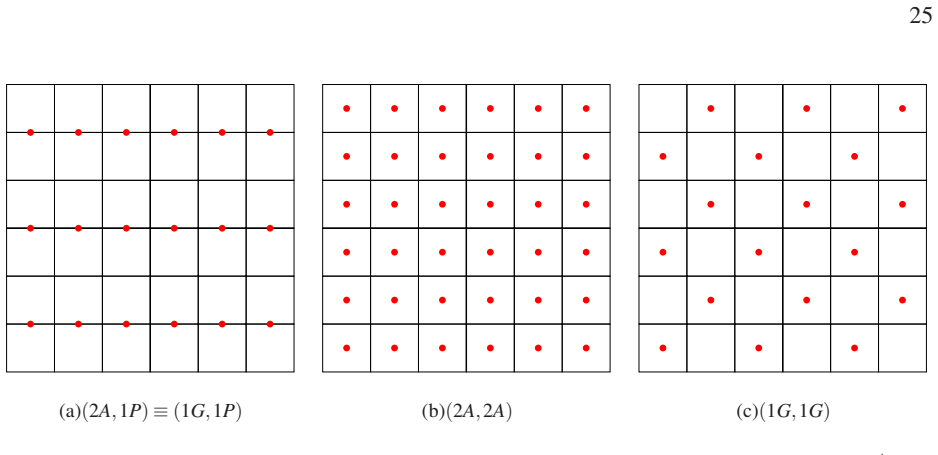
- The same construction should transfer to other moving-meson observables, such as $\pi\pi$ phase shifts in moving frames, with the caveat that the constraint linking quark momentum components in different G-parity directions selects a coarser momentum grid; mapping that grid's interplay with box size is a quantitative question this paper leaves open.
- Since the boundary converts quarks into antiquarks, baryon number is violated and the method is confined to mesonic channels; finding a variant that imprints momentum while sparing baryon number would open the technique to nucleon and multi-baryon observables, but no such construction is attempted here.
Signed reviews
Editorial analysis
A structured set of objections, weighed in public.
Referee Report
Summary. The paper develops G-parity boundary conditions (GPBC) for lattice QCD as a way to give the pion ground state non-zero momentum while preserving isospin symmetry. It derives the discretized fermion action in a two-flavor notation (Eq. 41), studies the symmetries of the action—including translations, parity, isospin, and the breaking of rotational symmetry at the quark level—and discusses how to introduce a single strange quark via a fictitious s' partner and a rooted determinant. The authors describe a two-flavor numerical implementation and present results from three 16^3×32 dynamical domain-wall ensembles with GPBC in 0, 1, and 2 spatial directions. They compare pion energies against the continuum dispersion relation, extract kaon masses, decay constants, the residual mass, Z_A/Z_A, and B_K, and find consistency among the three ensembles. The paper argues that the method is suitable for K→(ππ)_{I=0} calculations with physical kinematics.
Significance. If the method is sound, it provides an important tool for lattice QCD calculations of ΔI=1/2 K→ππ amplitudes, where moving pions are required and isospin must be preserved. The paper's strengths include careful, self-consistent derivations of the action and symmetries; explicit treatment of the one-flavor/2L equivalence; identification of the quark-level rotational symmetry breaking with a practical averaging strategy to reduce its effects; and numerical checks across three ensembles. The authors are transparent about difficulties, such as the baryon-number violation, the boundary-induced axial symmetry breaking, and the signal-to-noise degradation. The numerical results support the central claim that the pion ground state has the expected moving-pion energy and that kaon observables are stable across ensembles.
major comments (2)
- [Sec. VI C, Eq. (134)] The rooting of the s/s' determinant is the least secure part of the formalism. The paper correctly states that the finite-volume determinant does not factorize and that the rooted effective action is non-local, with 'no guarantee' of being in the correct universality class. The subsequent defense, comparing the rooted determinant with the Pfaffian of a local charge-conjugation theory via a boundary-term expansion (Fig. 4), samples only leading graphs with propagators connecting the same side of the volume; it does not control the full determinant, possible phase choices of the root, or non-perturbative contributions. The numerical checks in Tables XVI and XVII are reassuring but valence-dominated: mK, fK, and BK are mainly sensitive to valence quark masses and are common to all ensembles, so they do not isolate the non-local O(e^{-m_K L}) sea-quark effect introduced by the root. The conclusion 'we therefore expect no subtle difficulties' is stronger than the evidence. The authors should either provide a rigorous equivalence (which appears difficult) or, at minimum, explicitly identify the rooting as an uncontrolled systematic, estimate its size, and propose a targeted numerical test—for example, comparing a rooted GPBC ensemble with an unrooted (s/s')-doublet ensemble at identical parameters, or measuring a quantity deeply sensitive to the strange sea action.
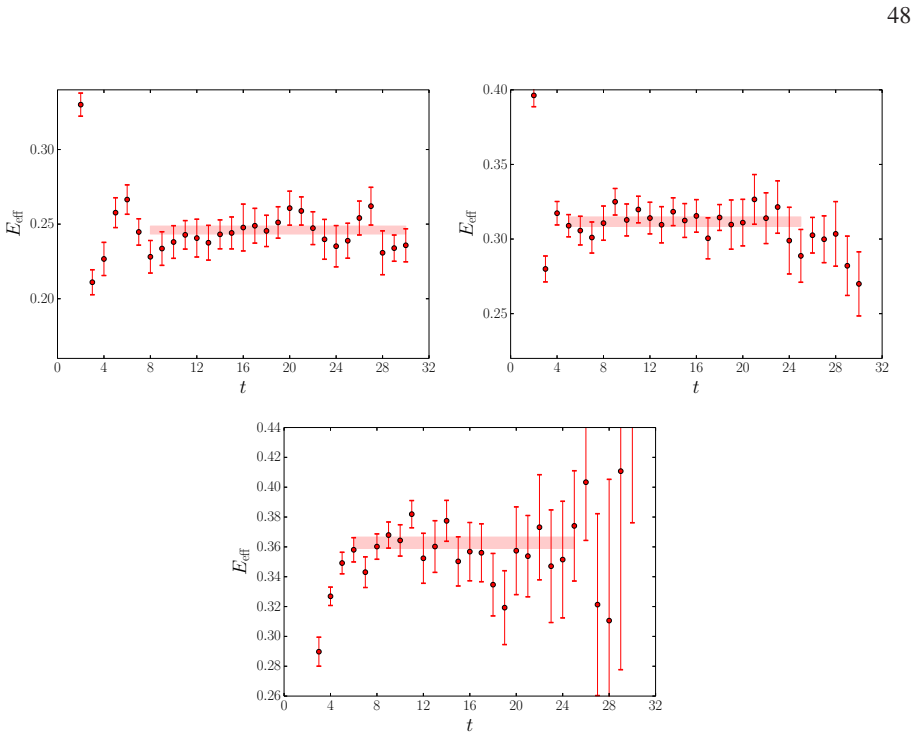
- [Sec. VIII A, Table IV] The GP2 pion energy is 1.8(1.0)% below the continuum dispersion prediction, while the GP1 result agrees well. The paper discusses possible explanations (chiral condensate shift, lattice dispersion relation, statistics) but does not resolve the discrepancy. Because the central validation claim is that the pion ground state energy follows E_pi = sqrt(m_pi^2 + n(pi/L)^2), this borderline effect should be better understood. The authors should verify the result with alternative fit ranges, include the lattice dispersion relation consistently (noting that the naive lattice momentum for the relevant p = pi/L is 2 sin(pi/(2L))), or place the discrepancy within a quantified systematic uncertainty. If the effect is real, it may indicate a boundary-induced shift relevant for precision K→pi pi calculations; if it is statistical, the analysis should demonstrate that more convincingly.
minor comments (5)
- [Sec. IV F, after Eq. (88)] There is a typo: 'is not an not an eigenstate' should read 'is not an eigenstate'.
- [Sec. VIII A, Eq. (148)] The lattice dispersion relation expression used to check the GP2 energy is written as E_pi = sqrt(m_pi^2 + n sin^2(pi/L)), which is dimensionally inconsistent as written. Please specify the correct lattice momentum, e.g., E_pi = sqrt(m_pi^2 + n [2 sin(pi/(2L))]^2), or clarify the convention.
- [Sec. VIII E, Table XIII] The Z_A/Z_A values on GP1 and GP2 are about 2% higher than on GP0, yet a single periodic-ensemble value (0.7162(2)) is used for all ensembles in subsequent decay constant computations. This choice should be justified, or ensemble-specific values should be used with the difference propagated as a systematic uncertainty.
- [Sec. VII C] The chiral condensate on GP2 differs from GP0 by 1.9(7)%, which the authors call 'likely statistical' but without quantitative support. Since this is correlated with the pion energy discrepancy, the authors should either perform a more careful statistical analysis (e.g., comparing autocorrelation times or splitting the data) or discuss the possibility of a real boundary-induced effect in more detail.
- [Sec. VIII B] The unexplained exponential falloff in the GP0 signal-to-noise ratio (Table V and Fig. 8) is a loose end. The authors state the discrepancy has not been understood; a brief discussion of possible sources (e.g., contributions from heavier states or disconnected diagrams) would be helpful, since the predictive power of the LePage argument is otherwise weakened.
Circularity Check
No circular derivation: the G-parity action is derived from gauge invariance and explicit boundary operators; the numerical checks use independent periodic-ensemble inputs, and the rooted strange determinant is a stated systematic risk rather than a fitted prediction.
full rationale
The central action, Eq. (41), is derived self-containedly from the G-parity transformation, translation operators, and gauge invariance, without presupposing the pion-energy result. The one-flavor/2L equivalence of Section III C is an exact rewriting of the same degrees of freedom, not a fitted output. The numerical comparisons are not circular: the 'predicted' pion energies in Table IV use m_pi from an independent periodic ensemble (Ref. [24]) together with the continuum dispersion relation, while the GP1/GP2 energies come from separate fits to G-parity correlation functions. The agreement of mK, fK, and BK among GP0/GP1/GP2 is a comparison against an independently generated periodic baseline, not a consequence of parameters fitted to those G-parity observables. The weakest link is the rooted s/s' sea-quark determinant in Section VI C, where the paper explicitly states that at finite volume the Dirac matrix cannot be factored and the non-local rooted determinant 'leaves no guarantee' of being in the correct universality class. That is a correctness and systematic-risk concern, not a circularity: nothing in the rooting procedure is fitted to the quantities later compared, and the diagrammatic comparison with the charge-conjugation Pfaffian is an independent argument rather than a renaming of the target result. Self-citations, including Ref. [8] for the Pfaffian and Ref. [24] for the periodic pion mass, are used as context or as independent baseline data; no load-bearing claim reduces to an unverified self-citation. Therefore no circular step is identified.
Assumptions & free parameters
free parameters (3)
- light quark mass ml =
0.01
- strange quark mass ms =
0.032
- smearing radius r =
2
assumptions (3)
- domain assumption The square root of the non-factorizable s/s' determinant is equivalent to a local single-strange-quark action up to terms exponentially suppressed in the box size.
- domain assumption Boundary-induced explicit chiral symmetry breaking is exponentially suppressed in m_pi L and can be neglected for the studied m_pi L around 4.
- domain assumption The fictitious strange partner s' mixes with the physical kaon only through exponentially suppressed finite-volume corrections, and the sqrt(2) factor in Eq. (132) is the only finite-volume modification needed.
invented entities (1)
-
Fictitious strange partner quark s'
Cite this review
Pith. "Pith review of Lattice simulations with G-parity Boundary Conditions." pith.science (2026). https://pith.science/paper/SSLQP4W7
@misc{pith2026190808640,
  author       = {Pith},
  title        = {Pith review of: Lattice simulations with G-parity Boundary Conditions},
  year         = {2026},
  howpublished = {\url{https://pith.science/paper/SSLQP4W7}},
  note         = {Machine review of arXiv:1908.08640}
}
abstract
We discuss G-parity lattice boundary conditions as a means to impose momentum on the pion ground state without breaking isospin symmetry. This technique is expected to be critical for the precision measurement of $K\rightarrow(\pi\pi)_{I=0}$ matrix elements where physical kinematics demands moving pions in the final state and the statistical noise caused by disconnected contributions will make it difficult to use multi-exponential fits to isolate this as an excited state. We present a formalism for computing hadronic Green's functions with G-parity boundary conditions, derive the discretized action and its symmetries, discuss how the strange quark can be introduced and detail techniques for the numerical implementation of these boundary conditions. We demonstrate and test these methods using several $16^3\times 32$ dynamical domain wall ensembles with a $420$ MeV pion mass and G-parity boundary conditions in one and two spatial directions.
Figures

Figures from the paper (9 more)




Reference graph
Works this paper leans on
-
[3]
5895 ⟨P ⟩ 0 200 400 600 800 1000 1200 1400 1600 configuration
-
[5]
0026 ⟨¯ψψ ⟩ 0 200 400 600 800 1000 1200 1400 1600 configuration
-
[6]
0026 ⟨¯ψψ ⟩ 0 200 400 600 800 1000 1200 1400 1600 configuration −0. 0015 −0. 0010 −0. 0005
-
[8]
0015 ⟨¯ψγ 5ψ ⟩ 0 200 400 600 800 1000 1200 1400 1600 configuration −0. 0015 −0. 0010 −0. 0005
-
[9]
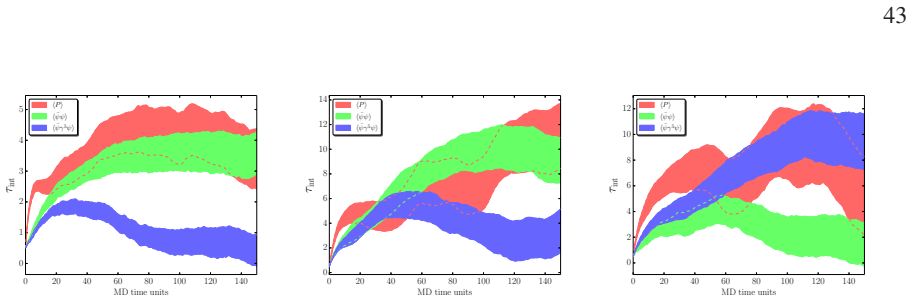
0015 ⟨¯ψγ 5ψ ⟩ 0 200 400 600 800 1000 1200 1400 1600 configuration −20 −15 −10 −5 0 5 10 15 20 Qtop 0 200 400 600 800 1000 1200 1400 1600 configuration −20 −15 −10 −5 0 5 10 15 20 Qtop 0 200 400 600 800 1000 1200 1400 1600 configuration −20 −15 −10 −5 0 5 10 15 20 Qtop FIG. 5. The evolution of the average plaquette (first line), c hiral condensate (second lin...
-
[10]
30 Eeff 0 4 8 12 16 20 24 28 32 t
-
[11]
40 Eeff 0 4 8 12 16 20 24 28 32 t
-
[12]
44 Eeff FIG. 7. The pion effective energy in the PP channel overlaid by the fitted value on the GP0 (upper-left), GP1 (upper-right) and GP2 (lower) ensembles. For the two-point functions in the previous section, the Gre en’s function OO † describes the propagation of two quarks and two antiquarks. On the GP0 ense mble, the ground state of this system is jus...
Show all 45 references
-
[13]
point-split
0040 m′ res GP0 GP1 FIG. 9. m′ res on the GP0 and GP1 ensembles, overlaid by the fit to the GP0 data . Given that we measure with only a single valence quark mass, w e cannot extrapolate to the massless limit. However, the result measured on the GP0 ense mble agrees very well w...
-
[15]
38 meff 0 4 8 12 16 20 24 28 32 t
-
[16]
38 meff FIG. 10. The kaon effective mass in the PP channel overlaid by the fitted value on the GP0 (upper-left), GP1 (upper-right) and GP2 (lower) ensembles. Coulomb gauge fixed wall sources and sinks for the light and st range quarks introducing explicit position-dependent phase...
-
[17]
70 Blatt K (t) 0 4 8 12 16 20 24 28 32 t
-
[18]
70 Blat K (t) 0 4 8 12 16 20 24 28 32 t
-
[19]
70 Blat K (t) FIG. 11. Results for Blat K (t) from Eq. (188) overlaid by the fitted value on the GP0 (upper-l eft), GP1 (upper- right) and GP2 (lower) ensembles. In Table XVII we list the hand-chosen fit ranges, the fitted val ues of BK and the associated χ 2/dof. Plots of Blat K...
-
[20]
Luscher, Commun
M. Luscher, Commun. Math. Phys. 105, 153 (1986). 75
1986
-
[21]
Lellouch and M
L. Lellouch and M. Luscher, Commun.Math.Phys. 219, 31 (2001), hep-lat/0003023
2001 arXiv
-
[22]
T. Blum, P . Boyle, N. Christ, N. Garron, E. Goode, et al. , Phys.Rev.Lett. 108, 141601 (2012), 1111.1699
2012 arXiv
- [23]
-
[24]
Bai et al
Z. Bai et al. (RBC, UKQCD), Phys. Rev. Lett. 115(21), 212001 (2015), 1505.07863
2015 arXiv
-
[25]
Wiese, Nucl.Phys
U. Wiese, Nucl.Phys. B375, 45 (1992)
1992
- [26]
- [27]
-
[28]
Lucini, A
B. Lucini, A. Patella, A. Ramos, and N. Tantalo, JHEP 02, 076 (2016), 1509.01636
2016 arXiv
-
[29]
M. E. Peskin and D. V . Schroeder, An Introduction to quantum field theory (Addison-Wesley, Reading, USA, 1995), ISBN 9780201503975 , 0201503972, URL http://www.slac.stanford.edu/~mpeskin/QFT.html
1995
-
[30]
Luscher, Commun.Math.Phys
M. Luscher, Commun.Math.Phys. 104, 177 (1986)
1986
-
[31]
Luscher, Nucl
M. Luscher, Nucl. Phys. B354, 531 (1991)
1991
-
[32]
C. D. Lin, G. Martinelli, C. T. Sachrajda, and M. Testa, N ucl.Phys. B619, 467 (2001), hep-lat/0104006
2001 arXiv
-
[33]
T. Blum, P . Boyle, N. Christ, N. Garron, E. Goode, et al., Phys.Rev. D86, 074513 (2012), 1206.5142
2012 arXiv
-
[34]
P . A. Boyle, Comput.Phys.Commun. 180, 2739 (2009)
2009
-
[35]
P . A. Boyle, PoS LATTICE2012, 020 (2012)
2012
- [36]
-
[37]
Allton et al
C. Allton et al. (RBC-UKQCD Collaboration), Phys.Rev. D78, 114509 (2008), 0804.0473
2008 arXiv
-
[38]
Allton et al
C. Allton et al. (RBC, UKQCD), Phys.Rev. D76, 014504 (2007), hep-lat/0701013
2007 arXiv
-
[39]
Ogawa, T.-W
K. Ogawa, T.-W. Chiu, and T.-H. Hsieh (TWQCD), PoS LAT2009, 033 (2009), 0911.5532
2009 arXiv
- [40]
-
[41]
C. Jung, C. Kelly, R. D. Mawhinney, and D. J. Murphy, Phys . Rev. D97(5), 054503 (2018), 1706.05843
2018 arXiv
- [42]
-
[43]
Liu, Kaon to two pions decays from lattice QCD: ∆ I=1/2 rule and CP violation , Ph.D
Q. Liu, Kaon to two pions decays from lattice QCD: ∆ I=1/2 rule and CP violation , Ph.D. thesis, Columbia University (2012)
2012
-
[44]
G. P . Lepage, in Boulder ASI 1989:97-120 (1989), pp. 97–120, URL http://alice.cern.ch/format/showfull?sysnb=0117836
1989
-
[45]
Foley, K
J. Foley, K. Jimmy Juge, A. O’Cais, M. Peardon, S. M. Ryan , and J.-I. Skullerud, Comput. Phys. 76 Commun. 172, 145 (2005), hep-lat/0505023
2005 arXiv
- [46]
- [47]
- [48]
-
[49]
D. J. Antonio et al. (RBC, UKQCD), Phys. Rev. D75, 114501 (2007), hep-lat/0612005
2007 arXiv
- [50]
Reviewed August 14, 2026 · model on record in the stance chip above.
Discussion (0). Continue with ORCID to comment.