REVIEW 3 major objections 6 minor 10 references
Tree-metrizable HGT networks
T0 review · 3 major / 6 minor · reviewed 2026-08-14 · deepseek-v4-flash
Pith's one-line read Every tree metric can also come from an HGT network with h−1 reticulation arcs.
desk verdict Bold and interesting, but the main theorem's proof has a real gap and the headline result is not yet established. read the letter →
The pith
A machine-rendered reading of the paper's core claim, the machinery that carries it, and where it could break.
The reading
What carries the argument
The load-bearing object is the caterpillar network: a network whose underlying tree is a caterpillar tree (a tree with one cherry, leaves ordered $x_1,\dots,x_n$), with an HGT arc from each leaf $x_i$ ($1\le i\le n-2$) to the last leaf $x_n$. It has exactly $n-1$ display trees $T_1,\dots,T_{n-1}$, which makes the four-point condition manageable. Lemma 3.2 turns tree-metrizability of a four-leaf network into an inequality between probability-weighted sums of internal-arc lengths of the three quartet splits; Lemma 5.3 computes those sums for caterpillar networks; Theorem 5.4 chooses the edge lengths $\ell_j$ so that the required inequalities hold, making the network tree-metrizable on every displayed tree. The Replacement Theorem 4.3, which says that grafting a tree onto a leaf preserves tree-metrizability, then lifts the caterpillar result to arbitrary trees in Corollary 5.5. A second construction, the enhanced caterpillar network, is shown to remain tree-metrizable when grafted onto any tree (Theorem 6.7).
What would settle it
Run the Theorem 5.4 construction on a five-leaf caterpillar network: fix positive values for the internal arc lengths $m_2,m_3$ and for the probabilities $\beta_1,\dots,\beta_4$, then solve the displayed linear equations for $\ell_1,\ell_2,\ell_3$ (including the extra equality connecting $\ell_{i+1}$ and $\ell_{i-1}$). If any choice of positive parameters forces a nonpositive $\ell_j$, the asserted positivity claim fails for those parameters; a computer search over the parameter range would settle whether the proof's claim is universally true.
Extended reading notes
Core claim
The central claim is that tree-likeness of a distance matrix does not limit the number of reticulation events that could have generated it. For any rooted binary phylogenetic tree $T$ of height $h>2$, Corollary 5.5 constructs a non-trivial HGT network with underlying tree $T$ and exactly $h-1$ non-trivial reticulation arcs that is $T$-metrizable: the network's convex combination of display-tree metrics equals the metric of $T$. The proof goes through caterpillar networks $C$ on $n$ leaves, in which each of the first $n-2$ leaves sends an HGT arc to the last leaf. Theorem 5.4 shows such a network is tree-metrizable on every tree it displays by choosing the edge lengths $\ell_j$ to satisfy a linear system built from Lemma 5.3's formulas for internal-arc sums; Corollary 5.5 then grafts pendant subtrees onto the caterpillar leaves via the Replacement Theorem 4.3 to realize an arbitrary tree $T$ of height $h$.
Load-bearing premise
The construction's load-bearing premise is that, for each display tree $T_i$, the linear system in Theorem 5.4 has a strictly positive solution for the edge lengths $\ell_j$ (the $\gamma_\pm$ equations plus the extra equality); the paper asserts this is a simple exercise in linear algebra without exhibiting the solution or proving positivity. If some parameter choices force a nonpositive $\ell_j$, the caterpillar construction—and with it Corollary 5.5—fails.
Editorial extensions
If this is right
- Every rooted binary tree of height $h>2$ admits a non-trivial HGT network with the same metric and $h-1$ reticulation arcs (Corollary 5.5).
- Tree-metrizability is preserved when a tree is grafted onto any leaf of a tree-metrizable network, so the class of tree-metrizable networks is closed under adding arbitrary pendant subtrees (Theorem 4.3).
- Caterpillar networks are tree-metrizable on every tree they display, so the metric alone cannot single out the underlying tree among a network's display trees (Theorem 5.4).
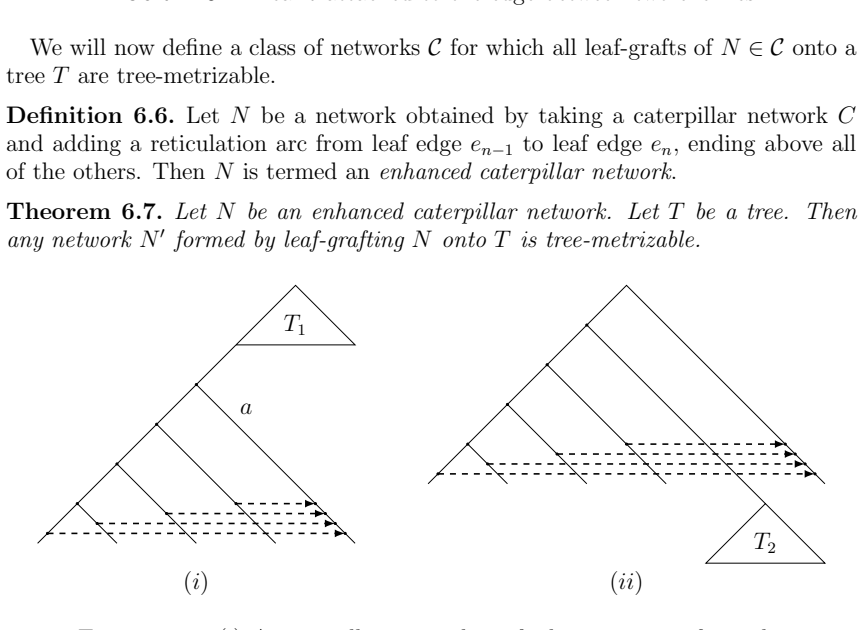
- Networks formed by leaf-grafting an enhanced caterpillar network onto a tree are tree-metrizable, giving a broad positive class for the network-onto-tree grafting question (Theorem 6.7).
- Single-reticulation restrictions from earlier work do not extend: tree metrics are compatible with arbitrarily many HGT events.
Reading between the lines
- If Corollary 5.5 is right, then the four-point condition cannot be used as evidence against HGT: every tree-like distance is also explained by a network with up to $h-1$ transfers, so detecting reticulation from distances alone is impossible in principle.
- The explicit caterpillar construction suggests an algorithm for building such networks: for a given tree $T$, embed a caterpillar of the same height into it, solve the linear system of Theorem 5.4 for edge lengths, and leaf-graft the pendant subtrees; a natural test is to run this on random trees and check that positive solutions exist.
- The root-relocation observation in Theorem 6.7 hints that the class of tree-metrizable networks may be invariant under moving the root along an arc when all pairwise distances are preserved; if so, the tree-versus-network distinction in distance data depends only on unrooted quartet structure.
- Since the network distance is a convex combination of display-tree metrics, the construction also implies that the set of tree metrics is contained in the convex hull of display-tree metric sets for suitably chosen HGT networks; this convex-geometric view might connect to reconstruction algorithms based on convex mixture models.
Signed reviews
Editorial analysis
A structured set of objections, weighed in public.
Referee Report
Summary. The paper studies horizontal gene transfer (HGT) networks whose distance metric, defined as a convex combination of distances on displayed trees, satisfies the four-point condition and is therefore a tree metric. Such networks are called tree-metrizable. The authors extend earlier work on single-reticulation networks by constructing tree-metrizable HGT networks with many non-trivial reticulation arcs. The main tools are a quartet-based characterization (Lemma 3.2), a replacement lemma for deleting an HGT arc between siblings (Lemma 3.4), a leaf-grafting theorem (Theorem 4.3), and a construction of 'caterpillar networks' claimed to be tree-metrizable on every displayed tree (Theorem 5.4). The headline consequence is Corollary 5.5: every rooted tree of height h > 2 admits a T-metrizable HGT network with h-1 non-trivial reticulation arcs. A final section studies leaf grafts with network scions and gives a partial classification result for level-2 networks.
Significance. If the main construction is correct, the paper gives a strong and somewhat surprising answer to a natural question: a tree metric alone cannot certify the absence of complex reticulate histories, because every tree metric of height h can be realized by a network with many independent HGT arcs. This substantially extends the single-reticulation examples of Francis and Steel. The paper also introduces useful conceptual tools, especially the leaf-grafting replacement theorem and the caterpillar network family. A clear strength is that Lemmas 3.2 and 3.4 have detailed appendix proofs. However, the central theorem currently rests on unproven algebraic existence assertions and on displayed formulas that do not match the accompanying case analysis; the significance is therefore conditional on a successful repair of the proof of Theorem 5.4.
major comments (3)
- [Section 5, Lemma 5.3] The formulas for int(C,xaxb|xcxn) and int(C,xaxn|xbxc) are not consequences of the case analysis in the proof and are incorrect as displayed. For example, for n=6 and q={x2,x4,x5,x6} (a=2, b=4, c=5), the proof's description of internal arcs gives int(C,x2x6|x4x5) = βΣ(T2)ℓ2 + (βΣ(T1)+βΣ(T2))m2 + (βΣ(T1)+βΣ(T2)+βΣ(T3))m3, while the displayed formula gives βΣ(T2)ℓ2 + (Σ_{t=1}^{3}βΣ(Tt))m3 + (Σ_{t=1}^{4}βΣ(Tt))m4 -- a spurious m4 term and no m2 term. Similarly, for n=7, b=4, c=6, the correct coefficient of m4 is βΣ(T5)+βΣ(T6) and that of m5 is βΣ(T6), but the displayed formula gives βΣ(T5) for m4 and 2βΣ(T6) for m5. Since Theorem 5.4 explicitly invokes Lemma 5.3 to verify the hypotheses of Lemma 3.2, the main construction is not supported as written.
- [Section 5, proof of Theorem 5.4] The proof asserts 'It is a simple exercise in linear algebra that there exist strictly positive values of ℓ_j for all j ≠ i that satisfy these equations' without supplying the argument. The system is not triangular: γ+(j) depends on ℓ_{j−1}, γ−(j) depends on ℓ_{j+1}, the boundary conditions set ℓ_{n−3}=ℓ_{n−2} and ℓ_2=ℓ_1, and the extra equality couples the two chains through ℓ_{i−1} and ℓ_{i+1}. Because the affine expressions have negative constant terms, positivity is a genuine constraint rather than an automatic consequence. The proof also does not address how the chosen ℓ_i is accommodated by pendant arc lengths. A constructive feasibility argument, or an explicit solution, is required before Theorem 5.4 can be accepted.
- [Section 5, proof of Theorem 5.4] The proof treats the probabilities βΣ(T_j) as free positive parameters, but in the HGT network model they are not free. For a caterpillar network with independent reticulation probabilities α_i, one has βΣ(T_i)=α_i∏_{j≠i}(1−α_j) for i=1,...,n−2 and βΣ(T_{n−1})=∏_{j=1}^{n−2}(1−α_j). These relations do not fill the whole probability simplex: for n=4, the uniform distribution (1/3,1/3,1/3) is not attainable, since the formulas force α1=β1/(β1+β3), α2=β2/(β2+β3), and the resulting β1 is not 1/3. The proof never constructs the α_i or verifies that the βΣ values used in the linear system and inequalities are realizable by independent reticulation probabilities. Without this, the claimed existence of reticulation probabilities satisfying Lemma 3.2 is not established.
minor comments (6)
- [Section 5, proof of Theorem 5.4] The sentence 'Fix all aj to be some arbitrary non-zero lengths' uses an undefined symbol aj; it should refer to the m_j defined just before, and the lengths should be strictly positive, not merely non-zero.
- [Section 6, proof of Theorem 6.5] The proof refers to 'Lemma 6.2', but no such lemma exists; the intended reference is Theorem 6.2.
- [Section 5, Corollary 5.5] The phrase 'the subtree of T induced by δ(y_i)' is not defined when δ(y_i) is a leaf; the intended construction appears to be to graft, at each vertex of the chosen length-h path, the rooted subtree attached to the off-path child, and to handle the terminal leaf separately.
- [Section 3, Example 3.3] The displayed condition uses '≥' while Lemma 3.2 requires a strict inequality '>' for T1-metrizability; please correct the example to match the lemma.
- [Section 4, proof of Theorem 4.3] In Case (3), the statement 'It is immediate that the inequality holds' is terse; writing the three quartet sums explicitly would make the proof easier to verify.
- [General] The paper alternates between 'tree-metrized' (title and abstract) and 'tree-metrizable' (body); please standardize the terminology.
Circularity Check
No significant circularity: the existence constructions are self-contained; the only concern is an unproved linear-algebra positivity step, which is a gap rather than circularity.
full rationale
The paper's main results are existence theorems: Theorem 5.4 constructs edge lengths and uses reticulation probabilities as free parameters, then verifies the four-point condition through the internal-arc criterion Lemma 3.2 (proved in Appendix A). The inequalities in the proof are checked from the recurrence equations and Lemma 5.3, not imported from the statement being proved. Corollary 5.5 combines Theorem 5.4 with the in-paper leaf-grafting Theorem 4.3. The cited work [5] provides background lemmas and the n=4 base example (Theorem 2.8), but the central construction does not reduce to that citation; no displayed equation or fitted parameter is renamed as a prediction. The proof's assertion that strictly positive l_j solving the displayed linear system exist by 'a simple exercise in linear algebra' is an omitted justification and a potential correctness gap, but it is not circular because the existence of the solution is not assumed as the conclusion. Therefore no significant circularity.
Assumptions & free parameters
free parameters (4)
- ℓ_i (HGT arc start distances) =
chosen via linear system in Theorem 5.4
- m_i (internal edge lengths) =
arbitrary positive
- reticulation probabilities α_j (or βΣ) =
arbitrary positive, summing to 1
- Adjusted weights A1, A2, A3 in Lemma 3.4 =
a1+αa2, a3+(1−α)a2, a5+(1−α)a4
assumptions (4)
- standard math A convex combination of metrics on X is a metric
- standard math The four-point condition characterizes tree metrics
- domain assumption Any tree of height h contains a caterpillar subtree on h+1 leaves as a graph embedding
- ad hoc to paper Existence of strictly positive ℓ_j solving the linear system in Theorem 5.4
Cite this review
Pith. "Pith review of Tree-metrizable HGT networks." pith.science (2026). https://pith.science/paper/OFUPZTUB
@misc{pith2026190808647,
  author       = {Pith},
  title        = {Pith review of: Tree-metrizable HGT networks},
  year         = {2026},
  howpublished = {\url{https://pith.science/paper/OFUPZTUB}},
  note         = {Machine review of arXiv:1908.08647}
}
read the original abstract
Phylogenetic trees are often constructed by using a metric on the set of taxa that label the leaves of the tree. While there are a number of methods for constructing a tree using a given metric, such trees will only display the metric if it satisfies the so-called "four point condition", established by Buneman in 1971. While this condition guarantees that a unique tree will display the metric, meaning that the distance between any two leaves can be found by adding the distances on arcs in the path between the leaves, it doesn't exclude the possibility that a phylogenetic network might also display the metric. This possibility was recently pointed out and "tree-metrized" networks --- that display a tree metric --- with a single reticulation were characterized. In this paper, we show that in the case of HGT (horizontal gene transfer) networks, in fact there are tree-metrized networks containing many reticulations.
Figures


Figures from the paper (10 more)






Reference graph
Works this paper leans on
-
[1]
Peter Buneman, The recovery of trees from measures of dissimilarity , Mathematics in the Archaeological and Historical Sciences (1971)
work page 1971
-
[2]
Joseph Felsenstein, Inferring phylogenies, Sinauer Press, 2004
work page 2004
-
[3]
Johannes Fischer and Daniel H. Huson, New common ancestor problems in trees and directed acyclic graphs, Information Processing Letters 110 (2010), no. 8-9, 331–335. TREE-METRIZABLE HGT NETWORKS 23
work page 2010
-
[4]
Andrew Francis, Katherina T. Huber, and Vincent Moulton, Tree-based unrooted phylogenetic networks, Bulletin of Mathematical Biology 80 (2018), no. 2, 404
work page 2018
-
[5]
Andrew Francis and Mike Steel, Tree-like reticulation networks: When do tree-like distan ces also support reticulate evolution? , Mathematical Biosciences 259 (2015), 12–19
work page 2015
-
[6]
Andrew Francis and Mike Steel, Which phylogenetic networks are merely trees with addition al arcs?, Systematic Biology 64 (2015), no. 5, 768–777
work page 2015
-
[7]
Daniel H. Huson and David Bryant, Application of phylogenetic networks in evolutionary studies, Molecular Biology and Evolution 23 (2005), no. 2, 254–267
work page 2005
-
[8]
Daniel H. Huson, Regula Rupp, and Celine Scornavacca, Phylogenetic networks: concepts, algorithms and applications , Cambridge University Press, 2010
work page 2010
Show all 10 references
-
[9]
Hyeonsoo Jeong, Bushra Arif, Gustavo Caetano-Anoll´ es, Ky ung Mo Kim, and Arshan Nasir, Horizontal gene transfer in human-associated microorgani sms inferred by phylogenetic recon- struction and reconciliation , Scientific Reports 9 (2019), no. 1
2019
-
[10]
Woese, On the evolution of cells , Proceedings of the National Academy of Sciences 99 (2002), no
Carl R. Woese, On the evolution of cells , Proceedings of the National Academy of Sciences 99 (2002), no. 13, 8742–8747. Appendix A. Proofs of Lemma 3.2 and Lemma 3.4 Lemma A.1 (Lemma 3.2). Let N be a four-leaf network with leaves {x1, x2, x3, x4}. Suppose |TN | = 3,, so TN = ...
2002
Reviewed August 14, 2026 · model on record in the stance chip above.
Discussion (0). Continue with ORCID to comment.