REVIEW 3 major objections 5 minor 55 references
Jeffery orbits in shear-thinning fluids
T0 review · 3 major / 5 minor · reviewed 2026-08-14 · deepseek-v4-flash
Pith's one-line read Shear-thinning fluids change how rod-like particles rotate but do not break the infinite family of Jeffery orbits.
desk verdict A solid first calculation of shear-thinning corrections to Jeffery orbits, but the 'degeneracy survives' claim is argued from symmetry rather than proven, and the numerics shown can't rule out slow drift. read the letter →
The pith
A machine-rendered reading of the paper's core claim, the machinery that carries it, and where it could break.
The reading
What carries the argument
The load-bearing object is a regular perturbation expansion in $\mathrm{Cu}^2 = (\dot{\gamma}_c\lambda_t)^2$, the square of the Carreau number, which measures the characteristic shear rate against the fluid's crossover rate. For weak shear thinning the extra deviatoric stress is $\tau_{NN} \approx -\tfrac{1}{2}\mathrm{Cu}^2(1-\beta)(1-n)|\dot{\gamma}_0|^2\dot{\gamma}_0$, so the leading correction to the particle angular velocity is computed as a volume integral of this stress against the rigid-body strain-rate operator $\hat{E}_\Omega$, using the Newtonian field $\dot{\gamma}_0$ from a spheroidal multipole solution of the Stokes equations. Evaluating that integral—numerically in spheroidal coordinates, with singular terms handled analytically—converts a small viscosity reduction into orbit-specific changes in rotation rate and period. In the Newtonian limit the same setup returns $\Omega_0 = \Omega_\infty + \Lambda\, p\times E_\infty\cdot p$ with $\Lambda=(\lambda^2-1)/(\lambda^2+1)$, whose integration gives the Jeffery orbits.
What would settle it
Measure the rotation period of a single prolate spheroid of known aspect ratio in a shear-thinning fluid with measured Carreau parameters, launching it from several initial orientations at small but finite Carreau number. If all orbits share one period, or if the particle instead drifts to a single preferred orbit, the central claim is wrong; if the periods fan out with the Carreau number while the orbits remain closed, the claim is supported. A direct numerical simulation of the full Carreau problem at the same $\beta$ and $n$ would settle it in a more controlled way, because the perturbative integral could then be compared with the full nonlinear stress.
Extended reading notes
Core claim
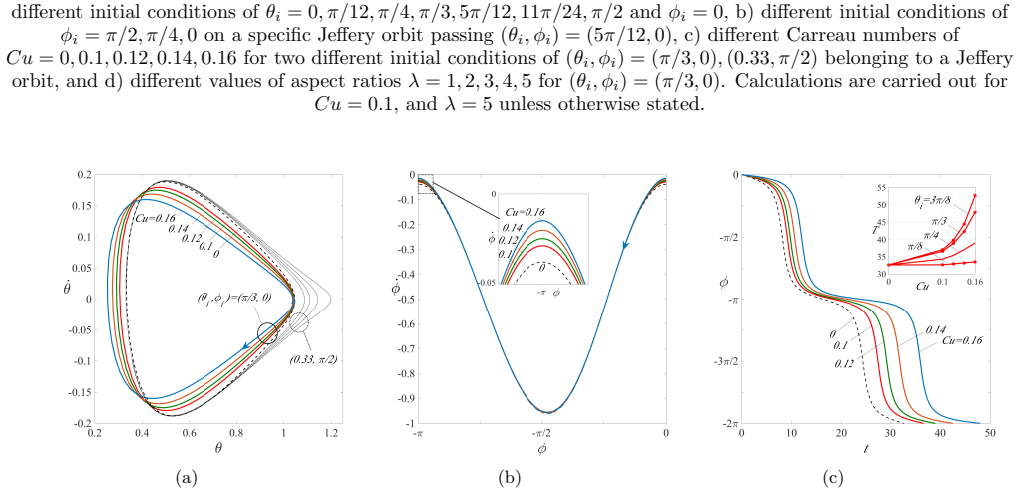
In a Newtonian fluid, a prolate spheroid in simple shear rotates along Jeffery orbits: closed curves on the orientation sphere labelled by a constant $C$, all with the same period $T_0 = 2\pi(\lambda^2+1)/\lambda$ for a fixed aspect ratio $\lambda$. The paper's central result is that weak shear thinning does not destroy this structure. The angular velocity acquires a first-order correction $\Omega_1 = \tfrac{1}{2}(1-\beta)(1-n)\hat{R}_{L\Omega}^{-1}\cdot \int_V |\dot{\gamma}_0|^2 \dot{\gamma}_0 : \hat{E}_\Omega \, dV$, built entirely from the Newtonian strain-rate field, and the director equation $\dot{p} = (\Omega_0 + \mathrm{Cu}^2\Omega_1)\times p$ still closes into a periodic orbit for every initial orientation. What changes is the shape of each orbit and its rotation rate: orbits narrow toward the flow-shear plane, the spin $\dot{\phi}$ drops mainly when the particle is aligned with the flow, and the period becomes orbit-dependent. The degeneracy persists because the generalized Newtonian constitutive equation inherits the symmetries of the Stokes equations, so nothing in the rheology breaks the continuous family the way inertia or viscoelasticity does.
Load-bearing premise
The calculation assumes that a regular perturbation in $\mathrm{Cu}^2$ stays uniformly accurate over many rotation periods—specifically that the non-Newtonian stress is generated by the Newtonian velocity field and that the tiny first-order angular-velocity correction remains reliable near orientations where the Newtonian rotation rate nearly vanishes.
Editorial extensions
If this is right
- In a weakly shear-thinning Carreau fluid, a prolate spheroid still rotates on closed periodic orbits for every initial orientation, so shear thinning alone produces no slow drift toward log-rolling or tumbling.
- Because the period now depends on the trajectory, computing orientation-averaged suspension properties from a single Jeffery period is no longer accurate; the distribution of initial orientations matters.
- Shear thinning behaves like an effective increase in particle aspect ratio, so measurements or models of anisotropic-particle suspensions may be interpretable through an effective $\lambda$ that grows with the Carreau number.
- A sphere ($\lambda=1$) is untouched by shear thinning at this order, while slender particles show the largest period increases, most sharply when aligned with the flow—so period shifts are a probe of both rheology and particle shape.
Reading between the lines
- A testable extension is to measure the spread of rotation periods across initial orientations in a single shear-thinning fluid: the spread should grow with the Carreau number while orbits remain closed, and any collapse to one preferred orbit would signal that elasticity or inertia, not shear thinning, is the active mechanism.
- If the effective-elongation picture holds beyond the perturbative regime, dilute suspensions of rods in shear-thinning fluids should develop stronger flow alignment and slower tumbling, which would feed back into the suspension's own viscosity and amplify its shear thinning.
- The symmetry argument suggests the degeneracy-persistence result is generic for any purely viscous, inelastic generalized Newtonian model whose weak-shear expansion has the same leading-order form, so orbit-dependent periods may be a general shear-thinning signature rather than a Carreau-specific quirk.
- A natural next calculation is to include weak elasticity alongside shear thinning; since elasticity alone drifts particles toward log-rolling, the competing effects of the two rheologies could be mapped onto the same effective-aspect-ratio language.
Signed reviews
Editorial analysis
A structured set of objections, weighed in public.
Referee Report
Summary. The paper studies the orientational dynamics of a neutrally buoyant prolate spheroid in a simple shear flow of a weakly shear-thinning Carreau fluid. Using a regular perturbation expansion in the square of the Carreau number, the authors derive a leading-order correction to the angular velocity that depends on the Newtonian velocity field, evaluate the required volume integral numerically with spheroidal multipoles, and integrate the resulting orientation dynamics. The central claims are that shear thinning modifies the Jeffery orbits and their instantaneous rotation rates, that the continuous degeneracy of Jeffery orbits is not lifted, and that, unlike in a Newtonian fluid, the rotation period now depends on the initial orientation of the particle.
Significance. If the central degeneracy claim is correct, the paper would establish an interesting distinction between inelastic shear-thinning rheology, which preserves the continuum of Jeffery orbits, and inertia or viscoelasticity, which are known to break it. The analytical framework, built on the general force/torque decomposition of Elfring and the spheroidal multipole solution of Einarsson et al., is parameter-free in the sense that the O(Cu^2) correction contains no fitted coefficients: it is computed from the known Newtonian resistance and flow fields. The sphere limit correctly recovers the earlier result of Datt and Elfring that shear thinning does not alter the rotation rate of a sphere. These are genuine strengths. However, the decisive claim about preservation of the degenerate family of periodic orbits is not supported by the evidence presented: the numerical orbits are shown over a single period, and the symmetry-based justification in Section III.B does not by itself rule out a slow drift across the unperturbed Jeffery orbits.
major comments (3)
- [Section III.B, Eq. (22), Figs. 3-5] The central claim that shear thinning does not lift the degeneracy of Jeffery orbits is not established. The modified orbits are integrated for only a single period, and the authors state in the text that the orbits 'repeat periodically for all time' without any long-time diagnostic. A slow drift of O(Cu^2) per period would be invisible on the plotted timescale but would overturn the headline conclusion on a timescale of order Cu^{-2}. The symmetry argument given near Fig. 3, namely that the generalized Newtonian constitutive equation 'maintains the symmetries of the Stokes equations and so one should not expect a symmetry-breaking drift,' is not sufficient: the Jeffery family of closed orbits is a dynamical degeneracy of the unperturbed phase portrait, not a consequence of a continuous symmetry of the fluid. A generic O(Cu^2) perturbation of the vector field in Eq. (22) will destroy the continuous family. To support the claim, the authors should either provide a first integral or Melnikov-type calculation for the perturbed system, or present a numerical closure diagnostic tracking, say, the deviation from the initial Jeffery orbit constant over hundreds of periods for several orbits and several values of Cu.
- [Section II.D and Section III.B, near Fig. 4(c)] The regular perturbation expansion in Cu^2 is used to integrate the orientation over O(1) periods, but the paper itself notes that changes in the period 'can be dramatic if the angular velocity is close to zero.' Near orientations where the Newtonian angular velocity nearly vanishes, an O(Cu^2) angular-velocity correction can produce an O(1) change in the local time spent in that region, so the expansion in the orbital phase is not uniformly valid over the full period. The paper does not address this nonuniformity, and it is precisely the regime in which a small drift could accumulate. The authors should quantify the region of validity of the asymptotic approximation and check whether their numerical orbit integration remains consistent when the local angular velocity is small.
- [Section III.B, Eq. (21)] The volume integral in Eq. (21) is evaluated numerically with a trapezoidal rule, and the orientation dynamics are integrated with an RK4 scheme, but no convergence study, grid-resolution test, or error estimate is reported. Since the quantitative predictions for the period shift and for the modification of the orbits rest entirely on this integral and on the subsequent time integration, the absence of any numerical validation makes the reported values unverified. The authors should report, at minimum, a convergence test in the number of spheroidal-coordinate grid points and the time-step size, preferably with a table showing that the computed period is converged.
minor comments (5)
- [Section I, reference [34]] The reference to Datt and Elfring [34] should include the full article title and volume/page range; the entry as printed ('J. Non-Newtonian Fluid Mech., 107 (2018)') omits the article title and appears incomplete.
- [Section II.D] The phrase 'non-dimensionlize' in the first sentence of Section II.D appears to be a typo; it should be 'nondimensionalize'.
- [Figure 1] Figure 1 does not label the coordinate axes or the vorticity direction; labeling the shear plane and the vorticity axis in the caption or in the figure itself would help the reader connect the geometry to the definitions in the text.
- [Section III.B, Fig. 3 caption] In the caption of Fig. 3, the phrase 'Jeffery orbit passing (θi,φi) = (5π/12, 0)' is ambiguous: it should be clear that the orbit is the Newtonian Jeffery orbit through that initial condition, and that the modified orbit is plotted for the same initial condition.
- [Appendix A] The notation I_n^m, J_n^m, and K_n^m is dense, and the definition of R in Eq. (A37) uses e (the eccentricity) while the text elsewhere uses λ; a short sentence noting the relation between e and λ would improve readability.
Circularity Check
No circularity: the modified orbits and period shifts are produced by a forward perturbation calculation from the Newtonian base state, not by fitting or by construction.
full rationale
After walking the derivation chain, I find no step in which a claimed prediction reduces to an input by construction, nor any load-bearing self-citation chain. The central objects are Eq. (16), where the leading-order correction Omega_1 is computed as a definite integral of the Newtonian strain-rate tensor |gamma_0|^2 gamma_0 : E_hat, and Eq. (22), the forward integration of pdot = (Omega_0 + Cu^2 Omega_1) x p. The modified orbits, the rate reduction near flow alignment, and the trajectory-dependent period are outputs of this integration, not fitted quantities. The cited items from Elfring's group ([34], [47]) supply a general reciprocal-theorem decomposition and the sphere check; they are published, parameter-free building blocks used before the present target and are not the conclusion of this paper. The only in-scope weakness is the assertion in Section III.B that the Carreau constitutive equation "maintains the symmetries of the Stokes equations and so one should not expect a symmetry-breaking drift of the orbits in time"; this is a support gap (a generic O(Cu^2) perturbation need not preserve the continuous family of closed orbits) and a possible correctness risk, but it is not circularity because the claim is not equivalent to an input, fitted parameter, or self-cited theorem.
Assumptions & free parameters
assumptions (6)
- domain assumption Inertial and Brownian effects are negligible (zero Reynolds number, no thermal fluctuations).
- domain assumption The Carreau generalized Newtonian model (Eqs. 5-6) captures the fluid's shear-thinning behavior; elasticity and normal stresses are absent.
- domain assumption The leading-order non-Newtonian stress is computed from the Newtonian velocity field u0 via a regular perturbation in Cu^2 (Eq. 15).
- standard math The Newtonian spheroid multipole solution of Einarsson et al. [26] (Appendix B) correctly gives the strain-rate tensor M and resistance operators.
- standard math The force/torque decomposition Eq. (12) from Elfring [47] applies to a generalized Newtonian fluid.
- domain assumption The constitutive symmetry of the generalized Newtonian fluid prevents drift between Jeffery orbits.
Cite this review
Pith. "Pith review of Jeffery orbits in shear-thinning fluids." pith.science (2026). https://pith.science/paper/XTDFYI5P
@misc{pith2026190808687,
  author       = {Pith},
  title        = {Pith review of: Jeffery orbits in shear-thinning fluids},
  year         = {2026},
  howpublished = {\url{https://pith.science/paper/XTDFYI5P}},
  note         = {Machine review of arXiv:1908.08687}
}
read the original abstract
We investigate the dynamics of a prolate spheroid in a shear flow of a shear-thinning Carreau fluid. The motion of a prolate particle is developed analytically for asymptotically weak shear thinning and then integrated numerically. We find that shear-thinning rheology does not lift the degeneracy of Jeffery orbits observed in Newtonian fluids but the instantaneous rate of rotation and trajectories of the orbits are modified. Qualitatively, shear thinning has a similar effect to elongating the particle in a Newtonian fluid. The period of rotation increases as the particle slows down more when aligned with the flow due to a reduction of shear stresses. Unlike Jeffery orbits in Newtonian fluids, in shear-thinning fluids the period of orbits depends on the specific trajectory (or initial orientation of the particle).
Figures


Figures from the paper (3 more)


Reference graph
Works this paper leans on
-
[1]
Coussot, Rheometry of Pastes, Suspensions, and Granular Materials (John Wiley & Sons, Inc., 2005)
P. Coussot, Rheometry of Pastes, Suspensions, and Granular Materials (John Wiley & Sons, Inc., 2005)
work page 2005
-
[2]
R. R. Eley, Rheol. Rev. , 173 (2005)
work page 2005
-
[3]
Clark, Pulp technology and treatment for paper , A Pulp & Paper Book (M
J. Clark, Pulp technology and treatment for paper , A Pulp & Paper Book (M. Freeman Publications, 1985)
work page 1985
-
[4]
A. Tsetsekou, C. Agrafiotis, and A. Milias, J. Eur. Ceramic Soc 21, 363 (2001)
work page 2001
-
[5]
A. E. Aust, P. M. Cook, and R. F. Dodson, J. Toxicol Environ. Health B Crit. Rev. 14, 40 (2011)
work page 2011
-
[6]
S. B. Hamed and M. Belhadri, J. Petrol. Sci. Eng. 67, 84 (2009)
work page 2009
-
[7]
A. C. Barbati, J. Desroches, A. Robisson, and G. H. McKinley, Annu. Rev. Chem. Biomol. Eng. 7, 415 (2016)
work page 2016
-
[8]
A. K. Hardacre, R. G. Lentle, S.-Y. Yap, and J. A. Monro, J. Royal Soc. Interface 15, 20180092 (2018)
work page 2018
Show all 55 references
-
[9]
S. M. Cutting, Food Microbiol. 28, 214 (2011)
2011
-
[10]
S. E. Spagnolie, ed., Complex Fluids in Biological Systems (Springer New York, 2015)
2015
-
[11]
Dasgupta, T
S. Dasgupta, T. Auth, and G. Gompper, J. Phys. Condens. Matterr 29, 373003 (2017)
2017
-
[12]
Einstein, Ann
A. Einstein, Ann. Phys. 324, 289 (1906)
1906
-
[13]
Einstein, Ann
A. Einstein, Ann. Phys. 339, 591 (1911)
1911
-
[14]
J. C. van der Werff and C. G. de Kruif, J. Rheol. 33, 421 (1989)
1989
-
[15]
N. J. Wagner and J. F. Brady, Phys. Today 62, 27 (2009)
2009
-
[16]
L. G. Leal and E. J. Hinch, J. Fluid Mech. 55, 745 (1972)
1972
-
[17]
Oberbeck, J
A. Oberbeck, J. Reine Angew. Math. 81, 62 (1876)
-
[18]
Edwardes, Q
D. Edwardes, Q. J. Pure Appl. Math. 26, 70 (1893)
-
[19]
G. B. Jeffery, Proc. Royal Soc. A 102, 161 (1922)
1922
-
[20]
A. T. Chwang and T. Y.-T. Wu, J. Fluid Mech. 63, 607 (1974)
1974
-
[21]
doubly periodic
experimentally showed that an ellipsoid of revolution in a simple shear flow drifts through the continuous family of Jeffery orbits until the ellipsoid is rotating in a final preferred orbit. A prolate spheroid, after approximately 180 complete revolutions, would settle into a lo...
1908 arXiv
-
[22]
E. Y. Harper and I.-D. Chang, J. Fluid Mech. 33, 209 (1968)
1968
-
[23]
G. I. Taylor, Proc. Royal Soc. A 103, 58 (1923)
1923
-
[24]
Einarsson, F
J. Einarsson, F. Candelier, F. Lundell, J. R. Angilella, and B. Mehlig, Phys. Rev. E 91, 041002 (2015)
2015
-
[25]
E. J. Ding and C. K. Aidun, J. Fluid Mech. 423, 317 (2000)
2000
-
[26]
Einarsson, F
J. Einarsson, F. Candelier, F. Lundell, J. R. Angilella, and B. Mehlig, Phys. Fluids 27, 063301 (2015)
2015
-
[27]
Candelier, J
F. Candelier, J. Einarsson, F. Lundell, B. Mehlig, and J.-R. Angilella, Phys. Rev. E 91, 053023 (2015)
2015
-
[28]
Einarsson, B
J. Einarsson, B. M. Mihiretie, A. Laas, S. Ankardal, J. R. Angilella, D. Hanstorp, and B. Mehlig, Phys. Fluids 28, 013302 (2016)
2016
-
[29]
Ros´ en, J
T. Ros´ en, J. Einarsson, A. Nordmark, C. K. Aidun, F. Lundell, and B. Mehlig, Phys. Rev. E 92, 063022 (2015)
2015
-
[30]
F. P. Bretherton, J. Fluid Mech. 14, 284 (1962)
1962
-
[31]
Byron, J
M. Byron, J. Einarsson, K. Gustavsson, G. Voth, B. Mehlig, and E. Variano, Phys. Fluids 27, 035101 (2015)
2015
-
[32]
Masoud, H
H. Masoud, H. A. Stone, and M. J. Shelley, J. Fluid Mech. 733, R6 (2013)
2013
-
[33]
E. J. Hinch and L. G. Leal, J. Fluid Mech. 92, 591 (1979). 10
1979
-
[34]
Datt and G
C. Datt and G. J. Elfring, J. Non-Newtonian Fluid Mech. , 107 (2018)
2018
-
[35]
Einarsson, M
J. Einarsson, M. Yang, and E. S. G. Shaqfeh, Phys. Rev. Fluids 3, 013301 (2018)
2018
-
[36]
P. G. Saffman, J. Fluid Mech. 1, 540 (1956)
1956
-
[37]
L. G. Leal, Annu. Rev. Fluid Mech. 12, 435 (1980)
1980
-
[38]
L. G. Leal, J. Fluid Mech. 69, 305 (1975)
1975
-
[39]
Bartram, H
E. Bartram, H. L. Goldsmith, and S. G. Mason, Rheol. Acta 14, 776 (1975)
1975
-
[40]
Gunes, R
D. Gunes, R. Scirocco, J. Mewis, and J. Vermant, J. Non-Newtonian Fluid Mech. 155, 39 (2008)
2008
-
[41]
Brunn, J
P. Brunn, J. Fluid Mech. 82, 529 (1977)
1977
-
[42]
E. S. G. Shaqfeh, AIChE J. 65, e16575 (2019)
2019
-
[43]
D’Avino, M
G. D’Avino, M. A. Hulsen, F. Greco, and P. L. Maffettone, Phys. Rev. E 89, 043006 (2014)
2014
-
[44]
The magnitude of strain-rate is defined | ˙γ| =√ ˙γ : ˙γ
for a generalized Newtonian fluid with deviatoric stress τ =η( ˙γ) ˙γ, (5) where the functional dependence of the viscosity on the strain-rate, η( ˙γ) =η∞ + (η0−η∞) [ 1 +λ2 t| ˙γ|2] (n−1) 2 , (6) is characterized by a zero-shear viscosity η0, an infinite-shear viscosity η∞, a ti...
-
[45]
Brunn, J
P. Brunn, J. Non-Newtonian Fluid Mech. 7, 271 (1980)
1980
-
[46]
R. B. Bird, C. F. Curtiss, R. C. Armstrong, and O. Hassager, Dynamics of Polymeric Liquids , volume 2 ed. (Wiley- Interscience, 1987)
1987
-
[47]
F´ erec, G
J. F´ erec, G. Ausias, and G. Natale, AIP Conf. Proc. 1960, 020006 (2018)
2018
-
[48]
S. M. J. Sobhani, S. Bazargan, and K. Sadeghy, Phys. Fluids 31, 081902 (2019)
2019
-
[49]
G. J. Elfring, J. Fluid Mech. 829, R3 (2017)
2017
-
[50]
Lauga, Europhys
E. Lauga, Europhys. Lett. 86, 64001 (2009)
2009
-
[51]
Natale, C
G. Natale, C. Datt, S. G. Hatzikiriakos, and G. J. Elfring, Phys. Fluids 29, 123102 (2017)
2017
-
[52]
C. Datt, L. Zhu, G. J. Elfring, and O. S. Pak, J. Fluid Mech. 784, R1 (2015)
2015
-
[53]
D’Avino and P
G. D’Avino and P. Maffettone, J. Non-Newtonian Fluid Mech. 215, 80 (2015)
2015
-
[54]
A. T. Chwang and T. Y.-T. Wu, J. Fluid Mech. 67, 787 (1975). 11 Appendix A: Spheroidal multipoles Here we give the solution to the Stokes equations for a spheroid with the aspect ratio of λ in a shear flow, following Einarsson et al. [26], in terms of a finite multipole expansio...
1975
-
[55]
(B14) Ultimately, because the torque on the body is zero then the rotlet strength must be zero and hence B = 0
Jeffery Orbits The torque on a spheroid can be calculated by linearly superposing the contributions from all the contained rotlets, ui =QR ijkϵjklBl, as L0 =−16π ∫ c −c (c2−ξ2)dξB =−64πc3 3 B, (B13) where from (B1) the rotlet strength is B =− { ARpp +BR(I− pp) } · Ω′ 0 +CRp× (E...
Reviewed August 14, 2026 · model on record in the stance chip above.
Discussion (0). Continue with ORCID to comment.