REVIEW 3 major objections 7 minor 37 references
Quasar emission lines as virial luminosity estimators
T0 review · 3 major / 7 minor · reviewed 2026-08-14 · deepseek-v4-flash
Pith's one-line read Extreme Population A quasars can act as Eddington standard candles: the FWHM of Hβ or AlIII 1860 yields a redshift-independent luminosity via L = L0 FWHM^4.
desk verdict Honest status report with one new line choice (AlIII 1860) and a circular orientation correction; read it as a pointer to prior papers, not as an independent test. read the letter →
The pith
A machine-rendered reading of the paper's core claim, the machinery that carries it, and where it could break.
The reading
What carries the argument
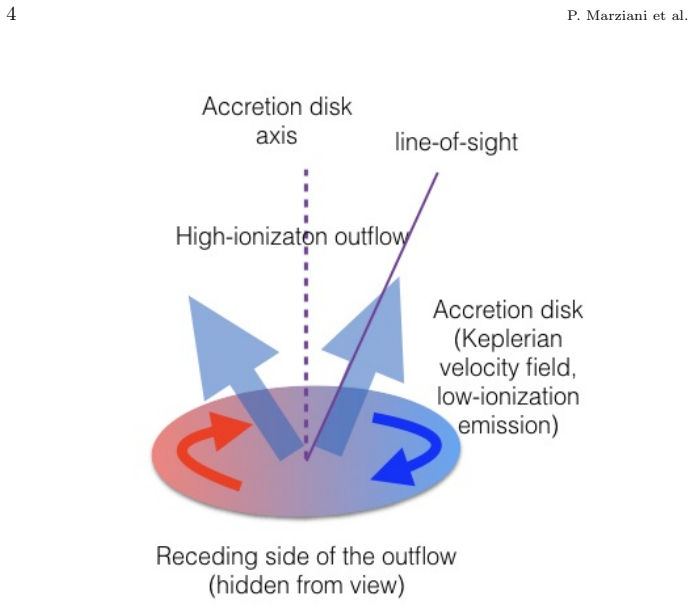
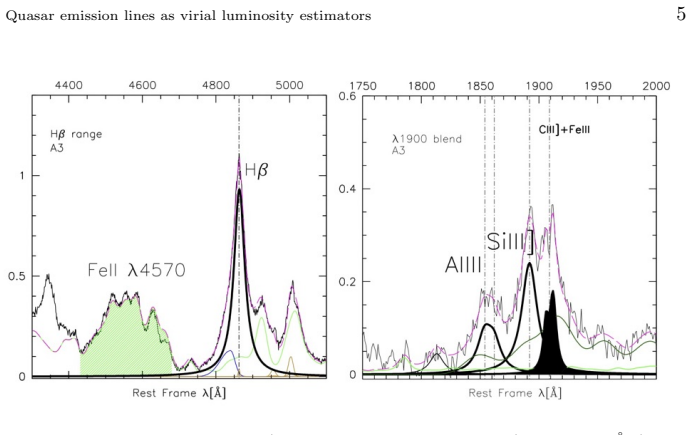
The central object is the virial luminosity identity $L = L_0\,\mathrm{FWHM}^4$, obtained by combining the virial mass estimate $M \propto R\,\mathrm{FWHM}^2$, the Eddington scaling $L \propto L_{\rm Edd} \propto M$, and the photoionization scaling $R_{\rm BLR} \propto L^{1/2}$. The constant $L_0$ absorbs the Eddington ratio, the ionizing photon fraction, the average ionizing frequency, and the geometry. The paper adds AlIII 1860 as a UV virial broadening estimator equivalent to H$\beta$, and uses a structure factor $f = \frac{1}{4}(\kappa^2 + \sin^2\theta)$ to model the projection of the virial velocity field, so that the FWHM can be converted into the virial broadening that enters the luminosity law.
What would settle it
Measure FWHM(H$\beta$) and an independent Eddington ratio for a sample of xA quasars with reverberation-mapped black-hole masses: if the scatter in $L/L_{\rm Edd}$ at fixed FWHM exceeds roughly 0.3 dex, the $L \propto \mathrm{FWHM}^4$ relation cannot work as a distance indicator. Alternatively, compare virial luminosities to distance moduli from type Ia supernovae or other standard candles in overlapping redshift ranges and check whether residuals grow systematically with redshift.
Extended reading notes
Core claim
The paper's central claim is that for extreme Population A quasars, the width of a low-ionization line is a virial broadening estimator and, together with a nearly constant Eddington ratio, it fixes the quasar's luminosity without any redshift information. Writing the virial luminosity as $L = L_0\,\mathrm{FWHM}^4$ makes the method a quasar analogue of the Tully-Fisher and Faber-Jackson relations for galaxies. The paper argues that the AlIII 1860 line is equivalent to H$\beta$ as a virial broadening estimator, which extends the method to $z \gtrsim 1.2$ where H$\beta$ is no longer easily observed, and that accounting for orientation with a form factor $f = \frac{1}{4}(\kappa^2 + \sin^2\theta)$ brings virial and redshift-based luminosity estimates into agreement.
Load-bearing premise
The load-bearing premise is that extreme Population A quasars have a nearly constant Eddington ratio with small scatter; if $L/L_{\rm Edd}$ varies substantially at fixed FWHM, the same line width would correspond to different luminosities and the $L \propto \mathrm{FWHM}^4$ distance method fails.
Editorial extensions
If this is right
- A single FWHM measurement of H$\beta$ or AlIII 1860 gives a luminosity that does not depend on redshift, so xA quasars can build a Hubble diagram from $z \approx 0$ to $z \gtrsim 6$.
- The same virial-luminosity logic could be applied to other quasars along the main sequence if their Eddington ratios were independently pinned down, extending the standard-candle idea beyond xA sources.
- If the Eddington ratio is nearly constant, the residual scatter between virial and redshift-based luminosities mostly measures viewing angle, making orientation a correctable systematic rather than an unknown.
- Using AlIII 1860 extends virial luminosity estimates to high-$z$ sources where H$\beta$ is redshifted beyond optical coverage, opening the epoch within 1 Gyr of the Big Bang.
- With larger samples and orientation corrections, the scatter can drop to roughly 0.3 dex, sufficient to constrain cosmological parameters at redshifts beyond supernova reach.
Reading between the lines
- Application across cosmic time could turn the method into a probe of accretion physics: if the $L \propto \mathrm{FWHM}^4$ relation is exact, any redshift-dependent residual would reveal evolution in the Eddington ratio rather than a failure of the distance indicator.
- A clean observational test would be to compare xA quasars with independent orientation indicators, such as radio core dominance or spectropolarimetric position angles, looking for a systematic correlation between those indicators and the residual of the virial luminosity relation.
- The same scaling law suggests a common virial-theorem origin for the luminosity-velocity relation across very different systems, including elliptical galaxies, galaxy clusters, and quasar broad-line regions, which could be tested by comparing the scatter of each class on the $L \propto \sigma^4$ plane.
Signed reviews
Editorial analysis
A structured set of objections, weighed in public.
Referee Report
Summary. This paper argues that extreme Population A (xA) quasars—selected by strong FeII emission and narrow Hβ—can serve as redshift-independent distance indicators through a 'virial luminosity' scaling L = L0 FWHM^4 (§4). The argument combines three assumptions: (i) xA quasars radiate at a nearly constant Eddington ratio with little scatter (§4, item 1); (ii) low-ionization line broadening (Hβ and AlIII 1860) is predominantly virial; and (iii) xA sources share similar BLR physical conditions. The paper compares virial luminosities with redshift-based concordance luminosities for the Negrete et al. (2018) sample, and after applying an orientation correction based on the structure factor f = 1/4(κ^2 + sin^2θ) (§5.1), claims consistency between the two luminosity estimates (§6). The abstract frames this as a possible new distance indicator usable from the local universe to less than 1 Gyr after the Big Bang.
Significance. If the central claim were established, xA quasars would provide a powerful new class of Eddington standard candles with applications in cosmology and black-hole accretion studies across a wide redshift range. The paper usefully identifies AlIII 1860 as a potential virial broadening estimator and draws an analogy with the Faber–Jackson and Tully–Fisher scaling relations. However, the empirical validation is circular: the orientation correction is implemented as a per-object fit that zeroes residuals, and the zero point L0 of the luminosity relation is not independently calibrated. As a result, the manuscript does not establish its central claim, and its scientific significance rests on assumptions that are not tested in the presented analysis.
major comments (3)
- [§5.1 and Fig. 5] The claimed consistency between virial and redshift-based luminosities is not an independent test because the orientation correction is a per-object fit rather than a prediction. The text states that 'residuals are zeroed if f1/2 FWHM is used as a VBE,' meaning the viewing angle θ is adjusted for each object to eliminate the residual between Lvir and L(z, H0, ΩM, ΩΛ). With θ as a free parameter per object, the post-correction scatter in Fig. 5 can be made arbitrarily small by construction, so the agreement cannot be used to support the conclusion in §6 that the consistency 'supports this basic interpretation' of a virialized, flattened BLR and constant Eddington ratio.
- [§4] The zero point L0 in the relation L = L0 FWHM^4 is not independently calibrated or derived in this work. The paper states only that L0 depends on the fraction of ionizing luminosity, the average frequency of ionizing photons, and the photon flux, but it provides no numerical values, no uncertainty budget, and no procedure for anchoring L0 from first principles or from an external sample. Without an independently determined L0, the comparison with redshift-based luminosities in §5.1 does not demonstrate that line widths yield absolute luminosities; any arbitrary multiplicative constant could make the two estimates agree on average.
- [§4, item 1] The central physical premise—that xA quasars have L/LEdd ≈ 1 with very little scatter—is stated but not tested in this paper. The citation to Marziani & Sulentic (2014) is not by itself a demonstration for the current sample, and the orientation-correction analysis in §5.1 cannot serve as a test because the per-object θ fitting can absorb arbitrary scatter in the FWHM–luminosity relation. The manuscript itself acknowledges that the method currently applies only to xA quasars where the Eddington ratio is assumed known with high precision; this limitation means the validity of the L ∝ FWHM^4 scaling for distance measurement remains unverified.
minor comments (7)
- [Abstract] The claim that xA quasars 'may provide a new class of distance indicators covering cosmic epochs from present day up to less than 1 Gyr from the Big Bang' is too strong given the method's dependence on unverified assumptions; consider softening to 'may eventually provide' or 'we outline the steps toward.'
- [§1] There is a typo in the definition of RFeII: 'defined asRFeII' should be 'defined as RFeII.'
- [§4] In item 1, 'Eddignton ratio' should be 'Eddington ratio.'
- [§3] The reference 'del Olmo et al. 2019, in preparation' is incomplete and should be updated or removed.
- [§5.1] The structure factor f = 1/4(κ^2 + sin^2θ) is introduced without derivation; a brief geometric justification of the assumed velocity-field projection would help the reader evaluate the model.
- [§5.1 and Fig. 5] The statement that 'all objects in the sample of Negrete et al. (2018) can be accounted for by the effect of the viewing angle within 0≲θ≲50 degrees' would be more informative if accompanied by the distribution of fitted θ values and a comparison with an expected random-orientation distribution; otherwise it is difficult to assess whether the model is over-fitting.
- [Acknowledgements] The word 'gtrateful' should be 'grateful.'
Circularity Check
Validation of the virial luminosity method is partly circular: the §5.1 orientation correction zeroes residuals by construction, so the claimed consistency does not independently test the constant-Eddington-ratio premise or the L∝FWHM^4 relation.
-
fitted input called prediction
[Section 5.1 and Fig. 5; invoked again in Section 6.]
"Assuming a structure factor f relating virial broadening δv_K and line FWHM (δv_K^2 = f FWHM^2) in the form f = 1/4(κ^2 + sin^2θ), ... we found that all objects in the sample of Negrete et al. (2018) can be accounted for by the effect of the viewing angle within 0 <∼ θ <∼ 50 degrees (in the right panel of Fig. 5 residuals are zeroed if f^{1/2}FWHM is used as a VBE)."
The structure factor f contains the viewing angle θ as a per-object free parameter. The paper's stated check is that residual scatter is 'zeroed' when f^{1/2}FWHM is used; with one adjustable θ per object, the residual can be absorbed without testing the underlying FWHM-luminosity relation. The right-panel agreement is therefore built by the correction rather than predicted. Consequently the Section 6 claim that 'the consistency between virial and redshift-based luminosity estimates supports this basic interpretation' is not independent support for the constant-Eddington-ratio premise or for L∝FWHM^4; it is a reconstruction from the same residuals.
full rationale
The derivation of L = L0 FWHM^4 in §4 is an algebraic consequence of stated physical assumptions: near-Eddington accretion, virialized low-ionization-line gas, and R_BLR ∝ L^{1/2}. Those premises are assumed rather than derived in this paper, and the paper cites earlier work for the small Eddington-ratio scatter; that is a legitimate appeal to prior empirical evidence rather than a circular derivation. The clearest circular step is in the validation, not in the formula: §5.1 introduces f(θ) and reports that the residual scatter between virial and redshift-based luminosities is 'zeroed' once the per-object viewing angle is used. With θ effectively fitted per object, the post-correction agreement cannot serve as a test of the method, and the conclusion that the consistency supports the interpretation is overstated. The central method may still be viable, but this paper's demonstration of consistency is, at this point, partly by construction.
Assumptions & free parameters
free parameters (4)
- L0 =
not given
- κ =
not given
- θ (per object) =
not tabulated, range 0 to about 50 degrees
- n_H U =
not given in this paper
assumptions (5)
- domain assumption xA quasars radiate at an extreme Eddington ratio with small scatter around a well-defined value.
- domain assumption Broadening of low-ionization lines (Hβ, AlIII 1860) is predominantly virial.
- domain assumption xA quasars have similar BLR physical parameters, so R_BLR scales rigorously as the square root of luminosity.
- ad hoc to paper Structure factor f = 1/4(κ^2 + sin^2θ) describes how orientation projects the virial velocity field.
- domain assumption RFeII traces Eddington ratio along the quasar main sequence.
Cite this review
Pith. "Pith review of Quasar emission lines as virial luminosity estimators." pith.science (2026). https://pith.science/paper/LRPEOHSI
@misc{pith2026190808700,
  author       = {Pith},
  title        = {Pith review of: Quasar emission lines as virial luminosity estimators},
  year         = {2026},
  howpublished = {\url{https://pith.science/paper/LRPEOHSI}},
  note         = {Machine review of arXiv:1908.08700}
}
abstract
Quasars accreting matter at very high rates (known as extreme Population A [xA]) may provide a new class of distance indicators covering cosmic epochs from present day up to less than 1 Gyr from the Big Bang. We report on the developments of a method that is based on "virial luminosity" estimates from measurements of emission line widths of xA quasars. The approach is conceptually equivalent to the virial estimates based on early and late type galaxies. The main issues related to the cosmological application of luminosity estimates from xA quasar line widths are the identification of proper emission lines whose broadening is predominantly virial over a wide range of luminosity, and the assessment of the effect of the emitting region orientation with respect to the line of sight. We report on recent developments concerning the use of the AlIII 1860 intermediate ionisation line and of the Hydrogen Balmer line H$\beta$ as "virial broadening estimators."
Figures

Figures from the paper (3 more)


Reference graph
Works this paper leans on
-
[1]
Abramowicz, M. A., Czerny, B., Lasota, J. P., & Szuszkiewicz, E., Slim accretion disks. 1988, Astrophys. J., 332, 646, DOI: 10.1086/166683
doi:10.1086/166683 1988
-
[2]
L., Popovi´ c, L.ˇC., & Shapovalova, A
Afanasiev, V. L., Popovi´ c, L.ˇC., & Shapovalova, A. I., Spectropolarimetry of Seyfert 1 galaxies with equatorial scattering: black hole masses and broad-line region charac- teristics. 2019, Mon. Not. R. Astron. Soc. , 482, 4985, DOI: 10.1093/mnras/sty2995
-
[3]
W., et al., Average Ultraviolet Quasar Spectra in 10 P
Bachev, R., Marziani, P., Sulentic, J. W., et al., Average Ultraviolet Quasar Spectra in 10 P. Marziani et al. the Context of Eigenvector 1: A Baldwin Effect Governed by the Eddington Ratio? 2004, ApJ, 617, 171, DOI: 10.1086/425210
doi:10.1086/425210 2004
-
[4]
Boroson, T. A. & Green, R. F., The emission-line properties of low-redshift quasi- stellar objects. 1992, ApJS, 80, 109, DOI: 10.1086/191661
doi:10.1086/191661 1992
-
[5]
Burbidge, G. R. & Burbidge, E. M. 1967, Quasi-stellar objects (San Francisco, Free- man)
work page 1967
-
[6]
C., Banerji, M., et al., Correcting C IV-based virial black hole masses
Coatman, L., Hewett, P. C., Banerji, M., et al., Correcting C IV-based virial black hole masses. 2017, Mon. Not. R. Astron. Soc. , 465, 2120, DOI: 10.1093/mnras/stw2797 Collin-Souffrin, S., Dyson, J. E., McDowell, J. C., & Perry, J. J., The environment of active galactic nuclei. I - A two-component broad emission line model. 1988, MNRAS, 232, 539
-
[7]
Corbin, M. R. & Boroson, T. A., Combined Ultraviolet and Optical Spectra of 48 Low- Redshift QSOs and the Relation of the Continuum and Emission-Line Properties. 1996, Astrophys. J., Suppl. , 107, 69, DOI: 10.1086/192355
-
[8]
Diamond-Stanic, A. M., Fan, X., Brandt, W. N., et al., High-redshift SDSS Quasars with Weak Emission Lines. 2009, Astrophys. J. , 699, 782, DOI: 10.1088/0004- 637X/699/1/782 D’Onofrio, M., Sciarratta, M., Cariddi, S., Marziani, P., & Chiosi, C., The Parallelism between Galaxy Clusters and Early-type Galaxies. I. The Light and Mass Profiles. 2019, Astrophys...
doi:10.1088/0004- 2009
Show all 37 references
-
[9]
2016, Astrophys
Du, P., Wang, J.-M., Hu, C., et al., The Fundamental Plane of the Broad-line Region in Active Galactic Nuclei. 2016, Astrophys. J., Lett., 818, L14, DOI: 10.3847/2041- 8205/818/1/L14
2016 doi
-
[10]
2000, Astrophys
Elvis, M., A Structure for Quasars. 2000, Astrophys. J., 545, 63, DOI: 10.1086/317778
2000 doi
-
[11]
Faber, S. M. & Jackson, R. E., Velocity dispersions and mass-to-light ratios for ellip- tical galaxies. 1976, Astrophys. J., 204, 668, DOI: 10.1086/154215
1976 doi
-
[12]
Fraix-Burnet, D., Marziani, P., D’Onofrio, M., & Dultzin, D., The Phylogeny of Quasars and the Ontogeny of Their Central Black Holes. 2017, Frontiers in As- tronomy and Space Sciences, 4, 1, DOI: 10.3389/fspas.2017.00001 La Franca, F., Bianchi, S., Ponti, G., Branchini, E., & ...
2017
-
[13]
Marinello, M., Rodr´ ıguez-Ardila, A., Garcia-Rissmann, A., Sigut, T. A. A., & Prad- han, A. K., The Fe II Emission in Active Galactic Nuclei: Excitation Mecha- nisms and Location of the Emitting Region. 2016, Astrophys. J., 820, 116, DOI: 10.3847/0004-637X/820/2/116 Mart´ ıne...
2016
-
[14]
A., et al., Black hole mass estimates in quasars
Marziani, P., del Olmo, A., Mart´ ınez-Carballo, M. A., et al., Black hole mass estimates in quasars. A comparative analysis of high- and low-ionization lines. 2019, Astron. Astrophys., 627, A88, DOI: 10.1051/0004-6361/201935265 Quasar emission lines as virial luminosity estimators 11
2019 doi
-
[15]
W., et al., A main sequence for quasars
Marziani, P., Dultzin, D., Sulentic, J. W., et al., A main sequence for quasars. 2018, Frontiers in Astronomy and Space Sciences , 5, 6
2018
-
[16]
A., Dultzin, D., et al., Highly accreting quasars: a tool for cosmology? 2017, in IAU Symposium, Vol
Marziani, P., Negrete, C. A., Dultzin, D., et al., Highly accreting quasars: a tool for cosmology? 2017, in IAU Symposium, Vol. 324, IAU Symposium, 245–246
2017
-
[17]
& Sulentic, J
Marziani, P. & Sulentic, J. W., Highly accreting quasars: sample definition and pos- sible cosmological implications. 2014, Mon. Not. R. Astron. Soc. , 442, 1211, DOI: 10.1093/mnras/stu951
2014 doi
-
[18]
W., Dultzin-Hacyan, D., Calvani, M., & Moles, M., Compar- ative Analysis of the High- and Low-Ionization Lines in the Broad-Line Region of Active Galactic Nuclei
Marziani, P., Sulentic, J. W., Dultzin-Hacyan, D., Calvani, M., & Moles, M., Compar- ative Analysis of the High- and Low-Ionization Lines in the Broad-Line Region of Active Galactic Nuclei. 1996, ApJS, 104, 37, DOI: 10.1086/192291
1996 doi
-
[19]
W., Plauchu-Frayn, I., & del Olmo, A., Low-Ionization Out- flows in High Eddington Ratio Quasars
Marziani, P., Sulentic, J. W., Plauchu-Frayn, I., & del Olmo, A., Low-Ionization Out- flows in High Eddington Ratio Quasars. 2013b, ApJ, 764 [e-print:[arXiv]1301.0520] Mej´ ıa-Restrepo, J. E., Lira, P., Netzer, H., Trakhtenbrot, B., & Capellupo, D. M., The effect of nuclear gas ...
2018 arXiv
-
[20]
2000, Publ
Mineshige, S., Kawaguchi, T., Takeuchi, M., & Hayashida, K., Slim-Disk Model for Soft X-Ray Excess and Variability of Narrow-Line Seyfert 1 Galaxies. 2000, Publ. Astron. Soc. Jap., 52, 499, DOI: 10.1093/pasj/52.3.499
-
[21]
2012, ApJ, 757, 62
Negrete, A., Dultzin, D., Marziani, P., & Sulentic, J., BLR Physical Conditions in Extreme Population A Quasars: a Method to Estimate Central Black Hole Mass at High Redshift. 2012, ApJ, 757, 62
2012
-
[22]
A., Dultzin, D., Marziani, P., et al., Highly accreting quasars: The SDSS low-redshift catalog
Negrete, C. A., Dultzin, D., Marziani, P., et al., Highly accreting quasars: The SDSS low-redshift catalog. 2018, Astron. Astrophys. , 620, A118, DOI: 10.1051/0004- 6361/201833285
2018 doi
-
[23]
A., Dultzin, D., Marziani, P., & Sulentic, J
Negrete, C. A., Dultzin, D., Marziani, P., & Sulentic, J. W., Reverberation and Pho- toionization Estimates of the Broad-line Region Radius in Low-z Quasars. 2013, Astrophys. J., 771, 31, DOI: 10.1088/0004-637X/771/1/31
2013 doi
-
[24]
2019, arXiv e-prints , arXiv:1905.01729
Panda, S., Marziani, P., & Czerny, B., The Quasar Main Sequence explained by the combination of Eddington ratio, metallicity and orientation. 2019, arXiv e-prints , arXiv:1905.01729
2019 arXiv
-
[25]
Peterson, B. M. & Wandel, A., Keplerian Motion of Broad-Line Region Gas as Evi- dence for Supermassive Black Holes in Active Galactic Nuclei. 1999, Astrophys. J., Lett., 521, L95, DOI: 10.1086/312190
1999 doi
-
[26]
& Lusso, E., A Hubble Diagram for Quasars
Risaliti, G. & Lusso, E., A Hubble Diagram for Quasars. 2015, Astrophys. J., 815, 33, DOI: 10.1088/0004-637X/815/1/33
2015 doi
-
[27]
2011, ArXiv e- prints [e-print:[arXiv]1108.0396]
Sadowski, A., Slim accretion disks around black holes, PhD Thesis. 2011, ArXiv e- prints [e-print:[arXiv]1108.0396]
2011 arXiv
-
[28]
Shen, Y. & Ho, L. C., The diversity of quasars unified by accretion and orientation. 2014, Nature, 513, 210, DOI: 10.1038/nature13712 12 P. Marziani et al
2014 doi
-
[29]
2011, Baltic Astronomy, 20, 427
Sulentic, J., Marziani, P., & Zamfir, S., The Case for Two Quasar Populations. 2011, Baltic Astronomy, 20, 427
2011
-
[30]
W., Bachev, R., Marziani, P., Negrete, C
Sulentic, J. W., Bachev, R., Marziani, P., Negrete, C. A., & Dultzin, D., C IVλ1549 as an Eigenvector 1 Parameter for Active Galactic Nuclei. 2007, ApJ, 666, 757, DOI: 10.1086/519916
2007 doi
-
[31]
W., del Olmo, A., Marziani, P., et al., What does CIV λ1549 tell us about the physical driver of the Eigenvector quasar sequence? 2017, Astron
Sulentic, J. W., del Olmo, A., Marziani, P., et al., What does CIV λ1549 tell us about the physical driver of the Eigenvector quasar sequence? 2017, Astron. Astrophys., 608, A122, DOI: 10.1051/0004-6361/201630309
2017 doi
-
[32]
W., Marziani, P., & Calvani, M., An H-R diagram for AGN? 2001, in AIP
Sulentic, J. W., Marziani, P., & Calvani, M., An H-R diagram for AGN? 2001, in AIP
2001
-
[33]
W., Marziani, P., & Dultzin-Hacyan, D., Phenomenology of Broad Emis- sion Lines in Active Galactic Nuclei
Sulentic, J. W., Marziani, P., & Dultzin-Hacyan, D., Phenomenology of Broad Emis- sion Lines in Active Galactic Nuclei. 2000, ARA&A, 38, 521, DOI: 10.1146/an- nurev.astro.38.1.521
-
[34]
W., Zamfir, S., Marziani, P., & Dultzin, D., Our Search for an H-R Diagram of Quasars
Sulentic, J. W., Zamfir, S., Marziani, P., & Dultzin, D., Our Search for an H-R Diagram of Quasars. 2008, Revista Mexicana de Astronomia y Astrofisica Conference Series , 32, 51
2008
-
[35]
Tully, R. B. & Fisher, J. R., A new method of determining distances to galaxies. 1977, Astron. Astrophys., 54, 661
1977
-
[36]
2017, in American Astronomical Society Meeting Abstracts, Vol
Vietri, G., The LBT/WISSH quasar survey: revealing powerful winds in the most luminous AGN. 2017, in American Astronomical Society Meeting Abstracts, Vol. 229, American Astronomical Society Meeting Abstracts, 302.06
2017
-
[37]
2013, Physical Review Letters, 110, 081301, DOI: 10.1103/PhysRevLett.110.081301
Wang, J.-M., Du, P., Valls-Gabaud, D., Hu, C., & Netzer, H., Super-Eddington Ac- creting Massive Black Holes as Long-Lived Cosmological Standards. 2013, Physical Review Letters, 110, 081301, DOI: 10.1103/PhysRevLett.110.081301
2013 doi
Reviewed August 14, 2026 · model on record in the stance chip above.
Discussion (0). Continue with ORCID to comment.