REVIEW 2 major objections 5 minor 1 cited by
Local Bubble contribution to the 353-GHz dust polarized emission
T0 review · 2 major / 5 minor · reviewed 2026-08-14 · deepseek-v4-flash
Pith's one-line read The Local Bubble dominates the polarized dust sky seen at 353 GHz.
desk verdict A well-executed distance diagnostic that makes a plausible but assumption-dependent case for Local Bubble dominance of high-latitude 353-GHz polarization; worth reviewing, with the 'dominated' claim softened. read the letter →
The pith
A machine-rendered reading of the paper's core claim, the machinery that carries it, and where it could break.
The reading
What carries the argument
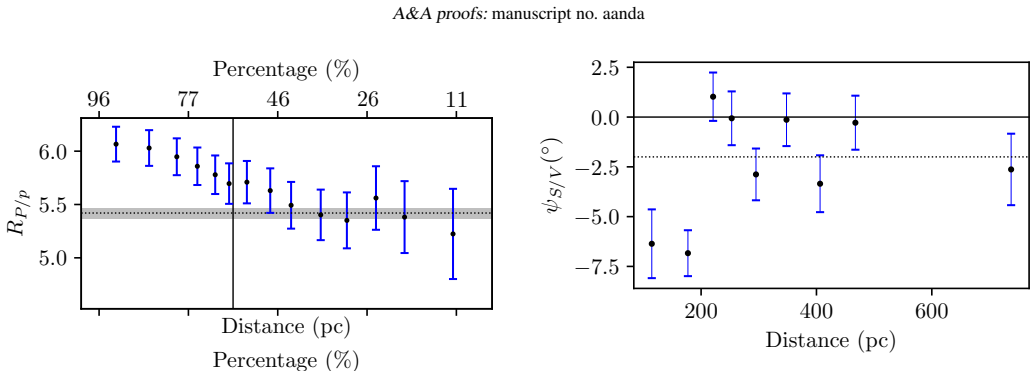
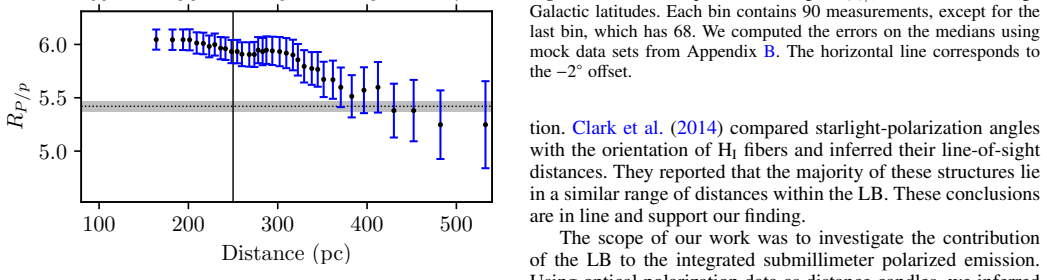
The load-bearing object is the emission-to-extinction polarization ratio $R_{P/p}=P_S/p_v$ (units MJy sr$^{-1}$), which compares submillimeter dust polarized emission integrated over the whole line of sight with optical starlight polarization that accumulates only out to the star's distance. Its 'universal' value, $5.42\pm0.05$ MJy sr$^{-1}$, characterizes a fully sampled column of aligned dust. Combining this ratio with star distances (mostly from a Bayesian inversion of parallaxes) and a truncation analysis—removing nearby stars step by step and watching the median—lets the authors locate where the column stops growing. A companion diagnostic is the angle difference $\psi_{S/V}$ between optical and submillimeter polarization, which should settle at a $-2^\circ$ systematic offset once both tracers see the same dust.
What would settle it
Find lines of sight at $|b|\geq 60^\circ$ where high signal-to-noise starlight polarization is measured for stars at many distances beyond 300 pc, ideally covering both hemispheres with dense optical polarization surveys. If the median $R_{P/p}$ continues to decline past 300 pc or shows a second convergence beyond 500 pc, then material behind the Local Bubble contributes significantly and the 250-pc wall is not the whole story. Alternatively, if direct measurements show the emission-to-extinction ratio of Local Bubble dust differs from the universal value, the distance inference based on convergence would be invalid.
Extended reading notes
Core claim
The central claim is that the dust polarized emission at high Galactic latitudes, the portion of the sky most used for CMB foreground studies, is dominated by a single, nearby magnetized structure—the shell of the Local Bubble—rather than by the large-scale Galactic magnetic field. The evidence is the convergence of the emission-to-extinction polarization ratio $R_{P/p}=P_S/p_v$ to the universal value $5.42\pm0.05$ MJy sr$^{-1}$ at $\sim 250$ pc, together with the concurrent locking of optical and submillimeter polarization angles to their expected perpendicular relation beyond that distance. In the authors' reading, the high-latitude lines of sight pass through essentially all of their polarizing dust within 200–300 pc, with little material behind the wall. As a corollary, the high-latitude dust-polarized signal can be modeled as local, and the Local Bubble magnetic field can be constrained directly from the same data used to characterize CMB foregrounds.
Load-bearing premise
The argument assumes that dust grain properties and the emission-to-extinction polarization ratio are the same everywhere in the Milky Way, so a single universal value of $5.42$ MJy sr$^{-1}$ applies; if the dust in the Local Bubble shell or behind it emits or extinguishes differently, the convergence at 250 pc would not prove that the full dust column has been reached.
Editorial extensions
If this is right
- At high Galactic latitudes, the dust-polarized signal used in CMB analyses can be treated as a local foreground produced within about 300 pc.
- The Local Bubble magnetic field model can be fitted directly to the high-latitude 353 GHz polarization data.
- Intermediate-latitude lines of sight contain several polarizing layers and cannot be assigned to a single structure.
- Modeling the Local Bubble is required for accurate characterization of high-frequency CMB Galactic foregrounds.
- Future all-sky optical polarization surveys should allow a tomographic decomposition of the dust-polarized emission by distance.
Reading between the lines
- If the near-field dominance holds, CMB foreground-subtraction pipelines could subtract a single local dust template instead of assuming a distributed Galactic screen.
- The same ratio method could be applied to other shells and superbubbles to map magnetic field structure in three dimensions, provided distance-resolved starlight polarization is available.
- The apparent chimney signature toward the northern cap suggests the Local Bubble wall is not uniform; testing whether the 250-pc convergence weakens in chimney directions would sharpen the model.
- A direct extension would be to combine parallax-based distances with high-latitude starlight polarization in the south, where the shell may be more continuous, to check hemisphere symmetry of the result.
Signed reviews
Editorial analysis
A structured set of objections, weighed in public.
Referee Report
Summary. This Letter uses a sample of high-latitude starlight polarization measurements with distance estimates (Gaia DR2 and Hipparcos) and Planck 353-GHz polarized emission maps to compute the emission-to-extinction polarization ratio RP/p = PS/pv as a function of distance. The authors find that for |b| > 60°, the median RP/p converges to the 'universal' value 5.42 MJy/sr at approximately 250 pc and remains flat beyond, and that the polarization-angle difference ψS/V approaches -2° at similar distances. They interpret this as evidence that the high-latitude 353-GHz polarized sky is dominated by a nearby magnetized structure extending between 200 and 300 pc, which they associate with the shell of the Local Bubble. The intermediate-latitude sample shows a more complex, distance-dependent behavior, supporting the interpretation that the high-latitude signal is locally dominated.
Significance. If the result holds, it would be an important step for CMB foreground characterization: the high-latitude dust polarization would be a local foreground, and Planck data could directly constrain the magnetic field of the Local Bubble shell. The paper's strengths are its careful handling of observational uncertainties (Monte Carlo propagation, debiasing), its use of permutation tests and truncation analysis, and its explicit checks of smoothing-radius and beam-depolarization effects (Appendix A). The statistical evidence for an RP/p-distance correlation in the high-latitude sample is genuinely strong (Spearman r = -0.21, p = 10^-7%). However, the central claim of Local Bubble dominance rests on an untested assumption about the dust emission-to-extinction ratio in the background ISM, which is load-bearing for the abstract's conclusion.
major comments (2)
- [Sec. 3.1 (Eq. 3); Abstract] The inference that convergence of the median RP/p to 5.42 MJy/sr at ~250 pc implies that the total polarized column has been reached (and hence that the Local Bubble dominates) is only valid if the dust beyond 250 pc has the same emission-to-extinction polarization ratio as the foreground material. The paper states this assumption ('dust properties are the same throughout the Milky Way') but does not test it. The degeneracy is concrete: writing the observed ratio as RP/p = R_f (1 + P_b/P_f), where R_f is the foreground ratio and P_b/P_f is the background-to-foreground polarized intensity ratio, convergence to 5.42 is consistent with a substantial background contribution. For R_f = 4 MJy/sr the background can carry 26% of the total polarized intensity, and for R_f = 3 it can carry 45%, without changing the predicted median. The angle analysis of Sec. 3.2 does not close this loophole, because a background layer whose polarization angle differs from the foreground by only a few degrees (well within the observed scatter about the -2° offset) can contribute a large fraction of P_S while leaving the median ψS/V near -2°. Consequently, the abstract's 'dominated' claim is conditional on an unmeasured microphysical property of the background ISM, not established by the distance data alone. The authors should either test this assumption (e.g., using the same analysis in different sky regions with independent dust tracers, or using 3D extinction maps) or soften the conclusion to 'consistent with' a local dominant contribution.
- [Sec. 2.1] The starlight sample is selected with pv/σpv ≥ 2, and no correction or quantitative discussion of the resulting selection bias is provided. This threshold can bias the median pv (and hence RP/p) as a function of distance; for example, if the fraction of stars passing the cut changes with distance, the median pv of the retained sample may not be representative of the underlying stellar population. Such a distance-dependent selection effect could in principle mimick the observed convergence of RP/p to a constant value. The authors should quantify the impact of the selection, for instance by repeating the analysis with a different S/N threshold (e.g., pv/σpv ≥ 3) or by modeling the selection function, to show that the location of the convergence at ~250 pc is not an artifact of the pv cut.
minor comments (5)
- [Sec. 2.2, Eq. (2)] The expression for σ_PS appears to have a typo: the second term in the numerator should be U_S^2 C_UU rather than Q_S^2 C_UU, and the denominator should be P_S^2 if this is the propagated variance. Please check the formula.
- [Fig. D.1] The colorbar for the P_S panel is labeled 'PS(%)' although P_S is expressed in MJy/sr; relabel the colorbar to avoid confusion.
- [Sec. 2.1] There are minor formatting issues with missing spaces in 'uncertaintyσpv' and 'angle,ψv'; these should be corrected in the final version.
- [Sec. 3.1] The phrase 'the medians could have taken any value at any distance' is vague; it would be clearer to state that under the null hypothesis of uniform dust distribution, the median RP/p would not be expected to converge to the universal value at a specific short distance.
- [Abstract and Sec. 3.1] The statement 'statistically robust evidence' refers to the RP/p-distance correlation, but the specific claim about Local Bubble dominance is not directly tested by the Spearman test; consider rephrasing to 'evidence consistent with' or explicitly noting the additional model assumption.
Circularity Check
No significant circularity: the distance inference rests on an externally calibrated polarization ratio and an explicitly stated uniformity assumption.
full rationale
The derivation chain is: compute RP/p = P_S/p_v per line of sight, bin by distance, observe median convergence to the externally published value 5.42 +/- 0.05 MJy/sr at roughly 250 pc, and interpret that convergence as reaching the total polarized column. The 5.42 value and the -2 degree angle offset are taken from Planck Collaboration Int. XXI (2015) and Planck Collaboration XII (2018), respectively; they are not fitted to the distance-binned data of this paper. The convergence is therefore a genuine comparison against an external benchmark, not a quantity defined by the conclusion. The same-dust-properties assumption stated in Sec. 3.1 creates a possible two-layer degeneracy if foreground and background dust have different emission-to-extinction ratios, but the paper states this assumption explicitly and does not hide it. An untested physical assumption is a correctness risk, not a circular reduction. The self-citations in the paper (Pelgrims 2019 for the truncation method and Pelgrims & Macias-Perez 2018 in the introduction) are methodological or contextual and are not load-bearing: the truncation analysis is described in the text, and no uniqueness claim is imported from those works. The acknowledged northern-sky bias and the stated inability to locate exact edges are sampling limitations, not circularity. No step in the derivation reduces by construction to its own input, so the circularity score is zero.
Assumptions & free parameters
free parameters (2)
- Universal RP/p value =
5.42 ± 0.05 MJy/sr
- Polarization angle offset ψS/V =
-2 degrees
assumptions (4)
- domain assumption Dust properties are the same throughout the Milky Way.
- domain assumption Optical and submillimeter polarization trace the same aligned dust grain population.
- domain assumption Star distances from Bailer-Jones et al. (2018) and Hipparcos are sufficiently accurate for the binned analysis.
- domain assumption The structure inferred at 200-300 pc is the shell of the Local Bubble.
Cite this review
Pith. "Pith review of Local Bubble contribution to the 353-GHz dust polarized emission." pith.science (2026). https://pith.science/paper/RGHKUQDE
@misc{pith2026190808706,
  author       = {Pith},
  title        = {Pith review of: Local Bubble contribution to the 353-GHz dust polarized emission},
  year         = {2026},
  howpublished = {\url{https://pith.science/paper/RGHKUQDE}},
  note         = {Machine review of arXiv:1908.08706}
}
abstract
It has not been shown so far whether the diffuse Galactic polarized emission at frequencies relevant for cosmic microwave background (CMB) studies originates from nearby or more distant regions of our Galaxy. This questions previous attempts that have been made to constrain magnetic field models at local and large scales. The scope of this work is to investigate and quantify the contribution of the dusty and magnetized local interstellar medium to the observed emission that is polarized by thermal dust. We used stars as distance candles and probed the line-of-sight submillimeter polarization properties by comparing the emission that is polarized by thermal dust at submillimeter wavelengths and the optical polarization caused by starlight. We provide statistically robust evidence that at high Galactic latitudes ($|b| \geq 60^\circ$), the $353$ GHz polarized sky as observed by \textit{Planck} is dominated by a close-by magnetized structure that extends between $200$ and $300$ pc and coincides with the shell of the Local Bubble. Our result will assist modeling the magnetic field of the Local Bubble and characterizing the CMB Galactic foregrounds.
Figures

Forward citations
Cited by 1 Pith paper
-
DHARA: Data Handling and Automated Reduction pipeline for AIMPOL
An automated Python pipeline for AIMPOL dual-beam polarimetry recovers literature polarization values within 2σ for standards and the Alessi 1 cluster and is adaptable to similar instruments.
Reference graph
Works this paper leans on
-
[1]
, " * write output.state after.block = add.period write newline
ENTRY address archiveprefix author booktitle chapter edition editor howpublished institution eprint journal key month note number organization pages publisher school series title type volume year label extra.label sort.label short.list INTEGERS output.state before.all mid.sentence after.sentence after.block FUNCTION init.state.consts #0 'before.all := #1 ...
-
[2]
write newline
" write newline "" before.all 'output.state := FUNCTION n.dashify 't := "" t empty not t #1 #1 substring "-" = t #1 #2 substring "--" = not "--" * t #2 global.max substring 't := t #1 #1 substring "-" = "-" * t #2 global.max substring 't := while if t #1 #1 substring * t #2 global.max substring 't := if while FUNCTION word.in bbl.in " " * FUNCTION format....
-
[3]
Alves , M. I. R., Boulanger , F., Ferri \`e re , K., & Montier , L. 2018, , 611, L5
work page 2018
-
[4]
G., Lazarian , A., & Vaillancourt , J
Andersson , B. G., Lazarian , A., & Vaillancourt , J. E. 2015, , 53, 501
work page 2015
-
[5]
Andersson , B. G. & Potter , S. B. 2006, , 640, L51
work page 2006
-
[6]
Bailer-Jones , C. A. L., Rybizki , J., Fouesneau , M., Mantelet , G., & Andrae , R. 2018, , 156, 58
2018
-
[7]
Bailey , M., van Loon , J. T., Farhang , A., et al. 2016, , 585, A12
work page 2016
- [8]
Show all 56 references
-
[9]
& Teerikorpi , P
Berdyugin , A. & Teerikorpi , P. 2001, , 368, 635
2001
-
[10]
& Teerikorpi , P
Berdyugin , A. & Teerikorpi , P. 2002, , 384, 1050
2002
-
[11]
2001, , 372, 276
Berdyugin , A., Teerikorpi , P., Haikala , L., et al. 2001, , 372, 276
2001
-
[12]
Bergh\"ofer, T. W. & Breitschwerdt, D. 2002, A&A, 390, 299
2002
-
[13]
E., Peek , J
Clark , S. E., Peek , J. E. G., & Putman , M. E. 2014, , 789, 82
2014
-
[14]
V., Marshall , J
Cotton , D. V., Marshall , J. P., Frisch , P. C., et al. 2019, , 483, 3636
2019
-
[15]
Cox , D. P. & Anderson , P. R. 1982, , 253, 268
1982
-
[16]
Cox , D. P. & Reynolds , R. J. 1987, , 25, 303
1987
-
[17]
T., Khosroshahi , H
Farhang , A., van Loon , J. T., Khosroshahi , H. G., Javadi , A., & Bailey , M. 2019, Nature Astronomy [ [arXiv] 1907.07429 ]
2019 arXiv
-
[18]
F., Aumont , J., et al
Fauvet , L., Mac \' as-P \'e rez , J. F., Aumont , J., et al. 2011, , 526, A145
2011
-
[19]
C., Andersson , B
Frisch , P. C., Andersson , B. G., Berdyugin , A., et al. 2012, , 760, 106
2012
-
[20]
C., Berdyugin , A., Piirola , V., et al
Frisch , P. C., Berdyugin , A., Piirola , V., et al. 2015, , 814, 112
2015
-
[21]
A., Dettbarn , C., & Flynn , C
Fuchs , B., Breitschwerdt , D., de Avillez , M. A., Dettbarn , C., & Flynn , C. 2006, , 373, 993
2006
-
[22]
Gaia Collaboration , Brown , A. G. A., Vallenari , A., et al. 2018, , 616, A1
2018
-
[23]
Gontcharov , G. A. & Mosenkov , A. V. 2019, , 483, 299
2019
-
[24]
M., Hivon , E., Banday , A
G \'o rski , K. M., Hivon , E., Banday , A. J., et al. 2005, , 622, 759
2005
-
[25]
R., Ferri \`e re , K
Jaffe , T. R., Ferri \`e re , K. M., Banday , A. J., et al. 2013, , 431, 683
2013
-
[26]
L., et al
Lallement , R., Babusiaux , C., Vergely , J. L., et al. 2019, , 625, A135
2019
-
[27]
L., Valette , B., et al
Lallement , R., Vergely , J. L., Valette , B., et al. 2014, , 561, A91
2014
-
[28]
Y., Vergely , J
Lallement , R., Welsh , B. Y., Vergely , J. L., Crifo , F., & Sfeir , D. 2003, , 411, 447
2003
-
[29]
Leike , R. H. & En lin , T. A. 2019, , 631, A32
2019
-
[30]
Leroy , J. L. 1999, , 346, 955
1999
-
[31]
R., et al
Liu , W., Chiao , M., Collier , M. R., et al. 2017, , 834, 33
2017
-
[32]
2001, , 560, L83
Ma \' z-Apell \'a niz , J. 2001, , 560, L83
2001
-
[33]
Martin , P. G. 2007, in EAS Publications Series, Vol. 23, EAS Publications Series, ed. M. A. Miville-Desch \^e nes & F. Boulanger , 165--188
2007
-
[34]
& Andersson , B
Medan , I. & Andersson , B. G. 2019, , 873, 87
2019
-
[35]
2015 a , , 574, A135
Montier , L., Plaszczynski , S., Levrier , F., et al. 2015 a , , 574, A135
2015
-
[36]
2015 b , , 574, A136
Montier , L., Plaszczynski , S., Levrier , F., et al. 2015 b , , 574, A136
2015
-
[37]
2007, , 170, 335
Page , L., Hinshaw , G., Komatsu , E., et al. 2007, , 170, 335
2007
-
[38]
2016, , 462, 2011
Panopoulou , G., Tassis , K., Blinov , D., et al. 2016, , 462, 2011
2016
-
[39]
2019, , 622, A145
Pelgrims , V. 2019, , 622, A145
2019
-
[40]
& Mac \' as-P \'e rez , J
Pelgrims , V. & Mac \' as-P \'e rez , J. F. 2018, arXiv e-prints, arXiv:1807.10516
2018 arXiv
-
[41]
Planck Collaboration Int. XIX . 2015, A&A, 576, A104
2015
-
[42]
Planck Collaboration Int. XXI . 2015, A&A, 576, A106
2015
-
[43]
2018, arXiv e-prints, arXiv:1807.06208
Planck Collaboration IV . 2018, arXiv e-prints, arXiv:1807.06208
2018 arXiv
-
[44]
2018, arXiv e-prints, arXiv:1807.06212
Planck Collaboration XII . 2018, arXiv e-prints, arXiv:1807.06212
2018 arXiv
-
[45]
2016, , 596, A103
Planck Collaboration XLII . 2016, , 596, A103
2016
-
[46]
2014, , 439, 4048
Plaszczynski , S., Montier , L., Levrier , F., & Tristram , M. 2014, , 439, 4048
2014
-
[47]
L., & Snowden , S
Puspitarini , L., Lallement , R., Vergely , J. L., & Snowden , S. L. 2014, , 566, A13
2014
-
[48]
A., & Battaner , E
Ruiz-Granados , B., Rubi \ n o-Mart \' n , J. A., & Battaner , E. 2010, , 522, A73
2010
-
[49]
P., Corradi , W., & Reis , W
Santos , F. P., Corradi , W., & Reis , W. 2011, , 728, 104
2011
-
[50]
M., Breitschwerdt , D., Feige , J., & Dettbarn , C
Schulreich , M. M., Breitschwerdt , D., Feige , J., & Dettbarn , C. 2017, , 604, A81
2017
-
[51]
1958, , 8, 135
Serkowski , K. 1958, , 8, 135
1958
-
[52]
Shelton , R. L. 1998, , 504, 785
1998
-
[53]
Smith , R. K. & Cox , D. P. 2001, , 134, 283
2001
-
[54]
N., Readhead , A
Tassis , K., Ramaprakash , A. N., Readhead , A. C. S., et al. 2018, arXiv e-prints, arXiv:1810.05652
2018 arXiv
-
[55]
Taylor , M. B. 2005, in Astronomical Society of the Pacific Conference Series, Vol. 347, Astronomical Data Analysis Software and Systems XIV, ed. P. Shopbell , M. Britton , & R. Ebert , 29
2005
-
[56]
T., Smith , K
van Loon , J. T., Smith , K. T., McDonald , I., et al. 2009, , 399, 195
2009
Reviewed August 14, 2026 · model on record in the stance chip above.
Discussion (0). Continue with ORCID to comment.