REVIEW 4 major objections 7 minor 72 references
Two's company, three's a crowd: SALT reveals the likely triple nature of the nucleus of the extreme abundance discrepancy factor planetary nebula Sp 3
T0 review · 4 major / 7 minor · reviewed 2026-08-14 · deepseek-v4-flash
Pith's one-line read The central star of the planetary nebula Sp 3 is a 4.81-day binary with a physically associated visual companion 0.31 arcseconds away, making the nucleus a likely triple system.
desk verdict Solid RV discovery of a 4.81 d binary in Sp 3 and a genuinely striking adf, but the 'likely triple' claim leans on an invalid negative-parallax distance and a partly circular comparison; still worth refereeing. read the letter →
The pith
A machine-rendered reading of the paper's core claim, the machinery that carries it, and where it could break.
The reading
What carries the argument
The load-bearing object is the visual companion: a G0V star at $0.31''$ separation, whose projected separation is about 740 au. The argument is a distance-concordance test: four independent distance indicators—nebular statistical distances, the companion's spectroscopic distance, the central star's inverse parallax, and a gravity distance from NLTE model atmospheres—all land within roughly 2–3 kpc. The orbital solution for the inner pair supplies the 4.81 d period and mass function, and the photospheric analysis supplies the $\log g$ and mass that anchor the gravity distance. A secondary mechanism is the abundance discrepancy factor (the ratio of oxygen abundances from optical recombination lines and collisionally excited lines), whose extreme value of $24.6^{+4.1}_{-3.4}$ is used to test population trends.
What would settle it
Measure the visual companion's own parallax and proper motion in a future Gaia data release, or take a high-resolution spectrum of it and derive its distance from its spectral type: a distance significantly greater than about 4 kpc, or a proper motion that disagrees with the central binary's motion by more than the measurement errors, would show the companion is a foreground interloper rather than a member of the triple.
Extended reading notes
Core claim
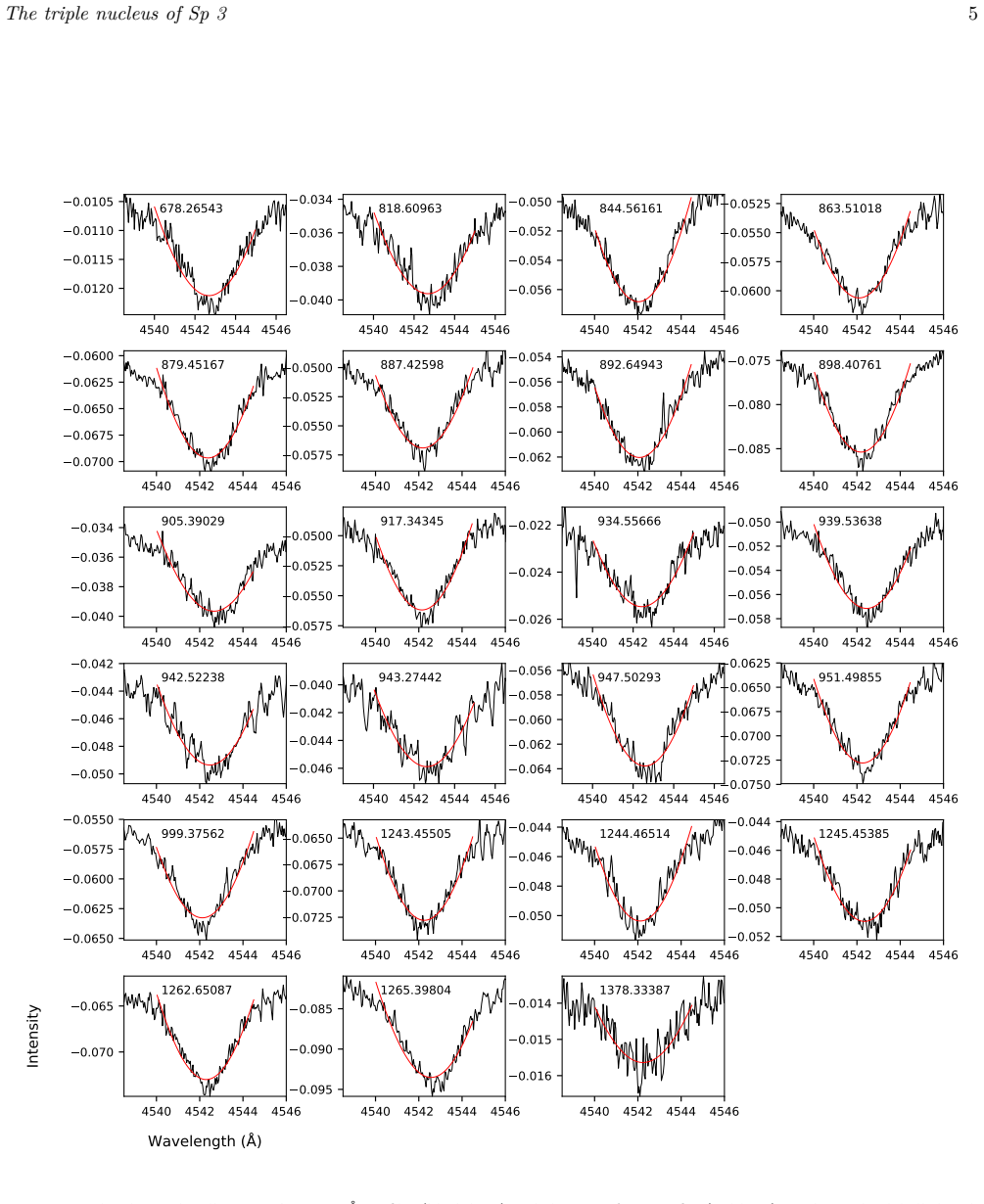
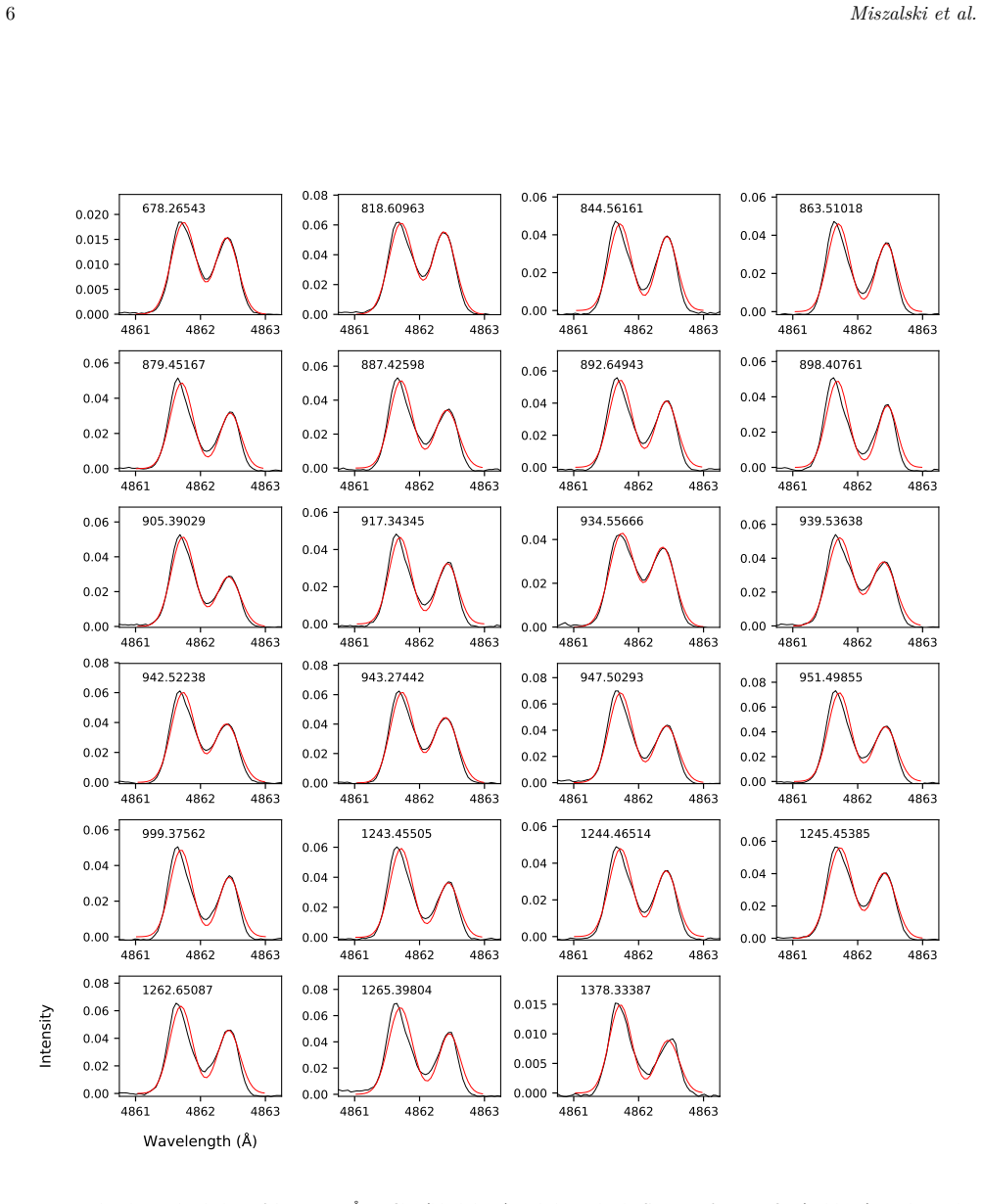
Using 23 radial-velocity measurements of the stellar He II line, the paper detects a circular orbit with period $4.815317 \pm 0.000664$ d, semi-amplitude $22.92 \pm 0.51$ km s$^{-1}$, and mass function $0.00598 \pm 0.00040\,M_\odot$. From NLTE model atmospheres the primary is hot and fast-rotating: $T_\mathrm{eff}=68^{+12}_{-6}$ kK, $\log g=4.6 \pm 0.2$, $v_\mathrm{rot}=80 \pm 20$ km s$^{-1}$, implying a mass of $0.60^{+0.27}_{-0.05}\,M_\odot$. The decisive evidence for the triple claim is distance concordance: the visual companion's spectroscopic distance of $2.22^{+0.61}_{-0.48}$ kpc agrees with nebular distances ($1.92\pm0.38$ and $2.11\pm0.60$ kpc), the inverse Gaia DR2 parallax of the central star ($2.32^{+0.79}_{-0.47}$ kpc), and the gravity distance from the stellar parameters ($2.8^{+0.8}_{-0.7}$ kpc). The paper concludes the companion is physically associated with the inner binary, yielding the strongest triple-nucleus candidate after NGC 246.
Load-bearing premise
The case rests on the distance to Sp 3 being about 2.3 kpc, obtained by taking the reciprocal of a negative Gaia parallax after rejecting the Bayesian distance of 11.2 kpc as implausible; if the true distance is much larger, the visual companion would be a foreground star instead of a bound tertiary.
Editorial extensions
If this is right
- Sp 3 becomes the strongest candidate for a triple planetary-nebula nucleus after NGC 246, giving a second system in which to study whether a tertiary companion can shape complex nebular morphology.
- The 4.81-day orbital period is among the longest found for a post-common-envelope central star, and it was found by radial-velocity monitoring rather than photometry, reinforcing the view that long-period binary nuclei are being missed.
- The extreme oxygen abundance discrepancy factor at this period contradicts the claim that post-common-envelope planetary nebulae with orbital periods above about 1 day have normal abundance discrepancy factors, pointing to selection effects in the current sample.
- The Type-I abundance pattern in a likely thick-disk object raises the possibility that fast rotation and binarity, not only progenitor mass, influence nucleosynthesis on the asymptotic giant branch.
- If the triple association is physical, the wide tertiary could have excited eccentricity in the inner binary's past through the Kozai-Lidov mechanism even though the present orbit is circular.
Reading between the lines
- If future astrometry confirms the association, Sp 3 would be the first known wide tertiary around a close post-common-envelope binary; because the 740 au separation is too large to shape the nebula directly, any morphological influence would have to act through secular dynamics before the common-envelope phase.
- The distance-concordance test used here is directly portable: any central star with a visual companion and a measured orbit can be checked the same way, and re-examining previously classified doubtful companions with new parallaxes is a natural next step.
- A sharper population test would compare the abundance discrepancy factor distribution of radial-velocity-selected binaries with photometrically selected ones; the paper's result predicts that RV-selected samples will show more elevated and extreme values.
- The extreme abundance discrepancy factor and the fast rotation of the primary suggest that rotation, not just binarity, may control the size of the discrepancy; this could be tested by measuring abundances in other rapidly rotating post-common-envelope nuclei.
Signed reviews
Editorial analysis
A structured set of objections, weighed in public.
Referee Report
Summary. The paper presents a multi-epoch radial-velocity study of the central star of the planetary nebula Sp 3 with SALT HRS (23 spectra, Table 1). A secure 4.81 d orbital period is derived (Section 3.3, Table 3, Fig. 13), with semi-amplitude K = 22.92 ± 0.51 km/s and residuals of 2.94 km/s, establishing the nucleus as a post-common-envelope binary while the nebular H-beta velocities remain constant at ~43.5 km/s. Combining this with the known V = 16.86 visual companion at 0.31 arcsec (Ciardullo et al. 1999), the authors argue that the companion's spectroscopic distance (2.22 kpc, Frew et al. 2016) agrees with the nebular distances (1.92 and 2.11 kpc), the reciprocal of the Gaia DR2 parallax (2.32 kpc), and a new gravity distance (2.8 kpc), and that the companion is therefore physically associated, making the nucleus a likely triple, the strongest candidate after NGC 246. Additional results include a TMAP NLTE analysis (Teff = 68+12/-6 kK, log g = 4.6 ± 0.2, vrot = 80 ± 20 km/s, M = 0.60+0.27/-0.05 Msun), new Fabry-Perot imaging revealing bipolar lobes, a broken ring, and jet-like knots, and nebular abundances with an extreme oxygen abundance discrepancy factor adf(O2+) = 24.6 that breaks the Wesson et al. (2018) period-adf trend for post-CE PNe.
Significance. If the triple interpretation is correct, Sp 3 would be a benchmark system: a post-CE 4.81 d binary with a candidate wide tertiary at ~740 AU, directly relevant to the proposed role of triple nuclei in shaping complex PNe morphologies. Independent of the triple question, the paper delivers two robust results: the secure orbital solution (a well-sampled Keplerian fit with stable nebular control velocities) and the extreme adf of 24.6, which is a legitimate challenge to the claimed period-adf correlation and strengthens the case that selection effects dominate the known post-CE PN sample. The paper is commendably transparent: it explicitly acknowledges the circularity of the Frew et al. (2016) calibrator distance, the caveats of the Gaia DR2 parallax, and the Teff-dependent gravity distance; the RV tables and line-flux tables are complete; and the model-atmosphere analysis is careful. However, the distance evidence for the triple claim mixes one statistically invalid estimate (1/negative parallax), one circular estimate, and one strongly parameter-dependent estimate, and the paper's rejection of the only fully independent Bayesian distance (11.2 kpc) is not quantitatively justified.
major comments (4)
- [4.1 / Table 6] The distance d = 2.32+0.79/-0.47 kpc is derived as 1/parallax from a negative Gaia DR2 parallax (ϖ = -0.431 ± 0.109 mas, a 4σ negative detection). The reciprocal of a negative parallax is not a valid distance, and the table's positive value amounts to inverting |ϖ| with error propagation 1/(|ϖ| ± σ), which has no statistical basis. The paper itself cites Luri et al. (2018) on exactly this hazard before performing the inversion. The appropriate Bayesian treatment is the Bailer-Jones et al. (2018) entry, r_est = 11.2 kpc, which the paper rejects; alternatively, the negative parallax may indicate that the astrometric solution is corrupted by the undetected 0.31 arcsec companion (astrometric_excess_noise = 0.68 mas is close to the 1 mas filter threshold). This estimate must be removed or replaced with a proper posterior distance, and the abstract and conclusions should not list the Gaia DR2 parallax as independent agreement supporting the triple claim.
- [4.1 / Table 7] The Frew et al. (2016) nebular distance of 2.11 ± 0.60 kpc is not an independent confirmation of the companion's spectroscopic distance: as the paper states, Sp 3 was included as a calibrator in Frew et al.'s method on the basis of the companion's spectroscopic distance (2.22 kpc). The agreement between these two entries is therefore partly by construction. This entry should be excluded from, or explicitly flagged in, the list of independent agreements in Table 7, and the abstract's phrase 'distance estimates to the nebula' should be narrowed to the Stanghellini & Haywood (2010) estimate (1.92 ± 0.38 kpc), which is the only genuinely independent nebular distance quoted.
- [4.1 / Table 7] The rejection of the Bailer-Jones et al. (2018) distance (r_est = 11.2 kpc, 8.1-15.4 kpc) rests on the claim that a 34 arcsec radius at 11.2 kpc (1.85 pc) is 'considerably larger than most PNe.' This is not quantified: the cited radius distribution in Frew et al. (2016) has a large tail above 1.5 pc, and the comparison with PFP1 is qualitative. If a distance near 11 kpc were correct, the visual companion would be a foreground star and the triple claim would fail, so this rejection is load-bearing for the paper's main result and needs a quantitative justification (e.g., a percentile from the physical-radius distribution of PNe of similar excitation, or an argument from surface brightness). The paper should also consider, and ideally test, the alternative that the Gaia astrometry is affected by the close companion. A concrete test (Gaia eDR3/DR3 astrometry, a proper-motion comparison, or a second-epoch measurement of the companion) would settle the question. Conversely, the strongest a priori evidence for association is the small angular separation itself: a chance projection of a V = 16.9 star within 0.31 arcsec at b = -14.3 deg has probability of order 1e-4. This argument is only cited through Ciardullo et al. (1999) and should be quantified and placed at the center of the association case.
- [4.1 / Section 3.2] The gravity distance d = 2.8+0.8/-0.7 kpc in Table 7 is computed for the adopted Teff = 68,000 K and M = 0.60 Msun. The paper notes that Teff = 80,000 K, which is favored by the He II 4686 line profile (Section 3.2) and is within the +12,000 K error bar, gives M = 0.83 Msun and d = 4.0+0.9/-1.2 kpc. The quoted uncertainty on d therefore does not include the dominant systematic, and the gravity distance is consistent with any distance between roughly 2 and 4 kpc. It should be presented with this systematic explicitly propagated, and the agreement with the ~2.3 kpc scale in Table 7 should be correspondingly weakened.
minor comments (7)
- [Abstract / Section 5] The conclusion that the distance agreement 'strongly suggests' physical association is stronger than the abstract's 'likely triple'; given the issues with the 1/parallax and calibrator distances (Major Comments 1 and 2), the concluding wording should be softened to match the abstract.
- [Section 3.3 / Table 3] Since the eccentricity is fixed to zero via the Lucy & Sweeney (1971) test, reporting the 3-sigma upper limit on e would be useful for the binary-population context and for future multi-epoch studies.
- [Section 3.4 / Table 5] The abstract refers to an 'oxygen abundance discrepancy factor (adf) of 24.6'; the value in Table 5 is specifically adf(O2+/H). The abstract and text should state 'adf(O2+)' to be precise, since O+/H is not part of the discrepancy measurement.
- [Section 3.4] The PG2300/PG900 joining uses a scale factor (0.9685) chosen to force consistent Balmer-decrement extinction; a sentence quantifying how the derived ORL O2+ abundance (and hence the adf) would change if the scale factor were varied within the plausible range would strengthen the extreme-adf claim.
- [Section 4.1] The phrase 'we have no other recourse but to estimate the distance as the reciprocal of the parallax' is not an adequate justification for an invalid statistic; see Major Comment 1.
- [Section 3.3] The systematic velocity of the binary (γ = 52.86 ± 0.36 km/s) differs from the nebular velocity (43.5 ± 0.1 km/s) by about 9 km/s; a brief comment on whether this offset is expected (e.g., from the CE ejection or shell kinematics) would preempt reader concerns.
- [Fig. 13 caption] Typographical errors: 'resdiuals' and 'respresents' should be 'residuals' and 'represents'.
Circularity Check
One distance 'agreement' is partly built-in because Sp 3 was a calibrator in Frew et al. (2016), though the triple claim retains independent support.
-
fitted input called prediction
[Section 4.1, first paragraph (distance and likelihood of visual companion physical association)]
"Frew et al. (2016) also estimated a distance based on the nebular properties of 2.11±0.60 kpc, where the spectroscopic distance to the visual companion was used as a basis for including Sp 3 as a calibrator for their distance estimation method."
The paper presents agreement among distance estimates as evidence that the visual companion is physically associated with the 4.81 d binary. One of the listed distances, d_nebula = 2.11 ± 0.60 kpc from Frew et al. (2016), was produced by a nebular distance method in which Sp 3 was included as a calibrator precisely because of the spectroscopic distance of the visual companion, d_spec,tertiary = 2.22+0.61/−0.48 kpc. Therefore the agreement between these two entries in Table 7 is not an independent confirmation; the nebular distance is partly constructed from the very quantity it is being compared with. The paper explicitly acknowledges this dependence, so the circularity is admitted, but it remains true that this particular 'agreement' is built in rather than independently measured.
full rationale
The paper's central claim is that the visual companion is physically associated with the 4.81 d binary, making Sp 3 a likely triple nucleus. The evidence is a concordance of distance estimates: the companion's spectroscopic distance, two nebular distances, a Gaia DR2 parallax reciprocal, and a gravity distance. One of those agreements is partially circular, as the paper itself states: the Frew et al. (2016) nebular distance of 2.11 kpc used Sp 3 as a calibrator based on the companion's spectroscopic distance of 2.22 kpc. Thus citing both as independent confirmations is not valid, and the headline 'agreement' is weakened by construction. However, the paper does not hide this dependence; it explicitly flags it in Section 4.1. The remaining distance estimates do not reduce to the companion's distance by construction. The Stanghellini & Haywood (2010) nebular distance is an independent method; the gravity distance depends on the stellar atmosphere parameters and evolutionary tracks but not on the companion; and the 1/parallax value comes from Gaia astrometry. The validity of the negative-parallax reciprocal is questionable, but that is a statistical/calibration concern rather than a circularity. No load-bearing self-citation chain or ansatz-smuggling is present. The paper's own acknowledgement makes the Frew calibrator issue a partial circularity rather than a hidden one, so a moderate score of 4 is appropriate.
Assumptions & free parameters
free parameters (4)
- PG2300/PG900 spectral scale factor =
0.9685
- Nebular extinction c(H beta) =
0.06 +0.05 -0.04
- NLTE model carbon abundance [C] =
-0.088
- NLTE model nitrogen abundance [N] =
0.39
assumptions (5)
- domain assumption Single-star post-AGB evolutionary tracks apply to the binary central star to derive mass and luminosity.
- domain assumption The nebula orientation matches the orbital inclination, so the apparent morphology gives an inclination of about 20 degrees.
- domain assumption The Gaia DR2 negative parallax, after zero-point correction, can be inverted (1/parallax) to give a usable distance of 2.32 kpc.
- domain assumption The visual companion's spectroscopic distance and G0V spectral classification from Frew et al. (2016) are correct.
- domain assumption Standard CEL and ORL nebular abundance analysis methods produce reliable abundances.
Cite this review
Pith. "Pith review of Two's company, three's a crowd: SALT reveals the likely triple nature of the nucleus of the extreme abundance discrepancy factor planetary nebula Sp 3." pith.science (2026). https://pith.science/paper/5D6IO3IZ
@misc{pith2026190808724,
  author       = {Pith},
  title        = {Pith review of: Two's company, three's a crowd: SALT reveals the likely triple nature of the nucleus of the extreme abundance discrepancy factor planetary nebula Sp 3},
  year         = {2026},
  howpublished = {\url{https://pith.science/paper/5D6IO3IZ}},
  note         = {Machine review of arXiv:1908.08724}
}
abstract
The substantial number of binary central stars of planetary nebulae (CSPNe) now known ($\sim$50) has revealed a strong connection between binarity and some morphological features including jets and low-ionisation structures. However, some features and asymmetries might be too complex or subtle to ascribe to binary interactions alone. A tertiary component, i.e. a triple nucleus, could be the missing ingredient required to produce these features. The only proven triple, NGC 246, is insufficient to investigate the shaping role of triple nuclei, but one straight-forward way to identify more triples is to search for binaries in nuclei with known visual companions. Here we report on the SALT HRS discovery of a 4.81 d orbital period in the CSPN of Sp 3 which has a visual companion 0.31" away. The spectroscopic distance of the visual companion agrees with distance estimates to the nebula, the GAIA DR2 parallax of the central star, and the gravity distance of the central star. This supports a physical association between the visual companion and the 4.81 d binary, making the nucleus of Sp 3 a likely triple. We determine $T_\mathrm{eff}=68^{+12}_{-6}$ kK, $\log g=4.6\pm0.2$ cm s$^{-2}$ and $v_\mathrm{rot}=80\pm20$ km s$^{-1}$ for the primary from NLTE model atmosphere analysis. The peculiar nebula presents an apparent bipolar morphology, jets and an unexpected `extreme' oxygen abundance discrepancy factor (adf) of 24.6$^{+4.1}_{-3.4}$. The adf is inconsistent with the purported trend for longer orbital period post-CE PNe to exhibit normal adfs, further highlighting selection effects in post-CE PNe. The Type-I nebular abundances of Sp 3, whose origin is often tied to more massive progenitors, are incongruous with the likely Galactic Thick Disk membership of Sp 3, possibly suggesting that rotation and binarity may play an important role in the AGB nucleosynthesis of PNe. (abridged)
Figures

Figures from the paper (11 more)


Reference graph
Works this paper leans on
-
[1]
2014, MNRAS, 444, 3459 Afšar, M., & Bond, H
Adam, C., & Mugrauer, M. 2014, MNRAS, 444, 3459 Afšar, M., & Bond, H. E. 2005, Mem. Soc. Astron. Ital- iana, 76, 608
work page 2014
-
[2]
Arenou, F., Luri, X., Babusiaux, C., et al. 2018, arXiv:1804.09375
arXiv 2018
-
[3]
Asplund, M., Grevesse, N., Sauval, A. J., & Scott, P. 2009, ARA&A, 47, 481 4http://www.astropy.org 18 Miszalski et al. Astropy Collaboration, Robitaille, T. P., Tollerud, E. J., et al. 2013, A&A, 558, A33 Astropy Collaboration, Price-Whelan, A. M., Sipőcz, B. M., et al. 2018, AJ, 156, 123
work page 2009
-
[4]
Bailer-Jones, C. A. L., Rybizki, J., Fouesneau, M., Man- telet, G., & Andrae, R. 2018, AJ, 156, 58
work page 2018
-
[5]
1992, European Southern Observatory Con- ference and Workshop Proceedings, 41, 177
Ballester, P. 1992, European Southern Observatory Con- ference and Workshop Proceedings, 41, 177
work page 1992
- [6]
-
[7]
Benetti, S., Cappellaro, E., Ragazzoni, R., Sabbadin, F., & Turatto, M. 2003, A&A, 400, 161
work page 2003
-
[8]
C., Parthasarathy, M., & García-Lario, P
Bobrowsky, M., Sahu, K. C., Parthasarathy, M., & García-Lario, P. 1998, Nature, 392, 469 Boffin, H. M. J., Miszalski, B., Rauch, T., et al. 2012, Science, 338, 773
work page 1998
Show all 72 references
-
[9]
Bond, H. E. 2000, Asymmetrical Planetary Nebulae II: From Origins to Microstructures, 199, 115
2000
-
[10]
E., & Ciardullo, R
Bond, H. E., & Ciardullo, R. 2018, Research Notes of the American Astronomical Society, 2, 143
2018
-
[11]
E., Liller, W., & Mannery, E
Bond, H. E., Liller, W., & Mannery, E. J. 1978, ApJ, 223, 252
1978
-
[12]
G., Sharples, R., Tyas, L., et al
Bramall, D. G., Sharples, R., Tyas, L., et al. 2010, Proc. SPIE, 7735, 77354F
2010
-
[13]
G., Schmoll, J., Tyas, L
Bramall, D. G., Schmoll, J., Tyas, L. M. G., et al. 2012, Proc. SPIE, 8446, 84460A
2012
-
[14]
Buckley, D. A. H., Swart, G. P., & Meiring, J. G. 2006, Proc. SPIE, 6267, 62670Z
2006
-
[15]
B., Nordsieck, K
Burgh, E. B., Nordsieck, K. H., Kobulnicky, H. A., et al. 2003, Proc. SPIE, 4841, 1463
2003
-
[16]
1985, ApJ, 291, 237
Cerruti-Sola, M., & Perinotto, M. 1985, ApJ, 291, 237
1985
-
[17]
E., Sipior, M
Ciardullo, R., Bond, H. E., Sipior, M. S., et al. 1999, AJ, 118, 488 Corradi R. L. M. & Schwarz H. E., 1995, A&A, 293, 871
1999
-
[18]
Corradi, R. L. M., Sabin, L., Miszalski, B., et al. 2011, MNRAS, 410, 1349
2011
-
[19]
Corradi, R. L. M., Rodríguez-Gil, P., Jones, D., et al. 2014, MNRAS, 441, 2799
2014
-
[20]
A., Sharples, R
Crause, L. A., Sharples, R. M., Bramall, D. G., et al. 2014, Proc. SPIE, 9147, 91476T
2014
-
[21]
M., Still, M., Schellart, P., et al
Crawford, S. M., Still, M., Schellart, P., et al. 2010, Proc. SPIE, 7737, 773725
2010
-
[22]
M., Skrutskie, M
Cutri, R. M., Skrutskie, M. F., van Dyk, S., et al. 2003, VizieR Online Data Catalog, 2246, De Marco, O. 2009, PASP, 121, 316
2003
-
[23]
1998, A&AS, 132, 13
Durand, S., Acker, A., & Zijlstra, A. 1998, A&AS, 132, 13
1998
-
[24]
E., Stassun, K
Exter, K., Bond, H. E., Stassun, K. G., et al. 2010, AJ, 140, 1414
2010
-
[25]
J., Parker, Q
Frew, D. J., Parker, Q. A., & Bojičić, I. S. 2016, MNRAS, 455, 1459 Gaia Collaboration, Prusti, T., de Bruijne, J. H. J., et al. 2016, A&A, 595, A1 Gaia Collaboration, Brown, A. G. A., Vallenari, A., et al. 2018a, A&A, 616, A1, arXiv:1804.09365 Gaia Collaboration, Babusiaux, C...
2016 arXiv
-
[26]
2001, A&A, 373, 572
Gauba, G., Parthasarathy, M., Nakada, Y., & Fujii, T. 2001, A&A, 373, 572
2001
-
[27]
J., Mikołajewska, J., & Różyczka, M
Gawryszczak, A. J., Mikołajewska, J., & Różyczka, M. 2002, A&A, 385, 205
2002
-
[28]
A., & De Marco, O
Guerrero, M. A., & De Marco, O. 2013, A&A, 553, A126
2013
-
[29]
A., & Gesicki, K
Hajduk, M., Zijlstra, A. A., & Gesicki, K. 2008, A&A, 490, L7
2008
-
[30]
Heber, U., Hunger, K., Jonas, G., & Kudritzki, R. P. 1984, A&A, 130, 119
1984
-
[31]
A., Templeton, M., Terrell, D., et al
Henden, A. A., Templeton, M., Terrell, D., et al. 2016, VizieR Online Data Catalog, 2336
2016
-
[32]
C., Jones, D., De Marco, O., et al
Hillwig, T. C., Jones, D., De Marco, O., et al. 2016, ApJ, 832, 125
2016
-
[33]
C., Frew, D
Hillwig, T. C., Frew, D. J., Reindl, N., et al. 2017, AJ, 153, 24
2017
-
[34]
Hunter, J. D. 2007, Computing in Science and Engineer- ing, 9, 90
2007
-
[35]
2013, A&ARv, 21, 59
Ivanova, N., Justham, S., Chen, X., et al. 2013, A&ARv, 21, 59
2013
-
[36]
Jones, D., & Boffin, H. M. J. 2017b, MNRAS, 466, 2034
-
[37]
I., & Lattanzio, J
Karakas, A. I., & Lattanzio, J. C. 2014, PASA, 31, e030
2014
-
[38]
Kim, H., & Taam, R. E. 2012, ApJ, 759, 59
2012
- [39]
-
[40]
L., & Barlow, M
Kingsburgh, R. L., & Barlow, M. J. 1994, MNRAS, 271, 257
1994
-
[41]
Y., Gvaramadze, V
Kniazev, A. Y., Gvaramadze, V. V., & Berdnikov, L. N. 2016, MNRAS, 459, 3068
2016
-
[42]
A., Nordsieck, K
Kobulnicky, H. A., Nordsieck, K. H., Burgh, E. B., et al. 2003, Proc. SPIE, 4841, 1634
2003
-
[43]
J., & Mink, D
Kurtz, M. J., & Mink, D. J. 1998, PASP, 110, 934
1998
-
[44]
E., Dufour, P., et al
Liebert, J., Bond, H. E., Dufour, P., et al. 2013, ApJ, 769, 32
2013
-
[45]
2018, A&A, 616, A2, arXiv:1804.09366
Lindegren, L., Hernandez, J., Bombrun, A., et al. 2018, A&A, 616, A2, arXiv:1804.09366
2018 arXiv
-
[46]
B., & Sweeney, M
Lucy, L. B., & Sweeney, M. A. 1971, AJ, 76, 544
1971
-
[47]
Luri, X., Brown, A. G. A., Sarro, L. M., et al. 2018, A&A, 616, A9, arXiv:1804.09376
2018 arXiv
-
[48]
2015, MNRAS, 448, 1789 Miller Bertolami, M
Manick, R., Miszalski, B., & McBride, V. 2015, MNRAS, 448, 1789 Miller Bertolami, M. M. 2016, A&A, 588, A25
2015
-
[49]
Miszalski, B., Boffin, H. M. J., Frew, D. J., et al. 2012, MNRAS, 419, 39
2012
-
[50]
Miszalski, B., Boffin, H. M. J., & Corradi, R. L. M. 2013, MNRAS, 428, L39
2013
-
[51]
& Mikoła- jewska, J
Miszalski, B., Manick, R., Van Winckel, H. & Mikoła- jewska, J. 2019b, MNRAS, 487, 1040 Nebot Gómez-Morán, A., Gänsicke, B. T., Schreiber, M. R., et al. 2011, A&A, 536, A43
2011
-
[52]
B., et al
Newville, M., Stensitzki, T., Allen, D. B., et al. 2016, Astrophysics Source Code Library, ascl:1606.014 O’Donoghue, D., Buckley, D. A. H., Balona, L. A., et al. 2006, MNRAS, 372, 151 Pierce M. J., Frew D. J., Parker Q. A., Köppen J., 2004, PASA, 21, 334
2016
-
[53]
Flannery, B. P. 1992, Cambridge: University Press, c1992, 2nd ed
1992
-
[54]
Joseph, C. L. 2008, AJ, 135, 1825
2008
-
[55]
1996, A&A, 310, 613
Rauch, T., Koeppen, J., & Werner, K. 1996, A&A, 310, 613
1996
-
[56]
2018, MNRAS, 475, 3896
Rauch, T., Demleitner, M., Hoyer, D., & Werner, K. 2018, MNRAS, 475, 3896
2018
-
[57]
Rauch, T., & Deetjen, J. L. 2003, Stellar Atmosphere Modeling, 288, 103
2003
-
[58]
C., Reylé, C., Fliri, J., et al
Robin, A. C., Reylé, C., Fliri, J., et al. 2014, A&A, 569, A13
2014
-
[59]
E., Corradi, R
Schwarz, H. E., Corradi, R. L. M., & Melnick, J. 1992, A&AS, 96, 23
1992
-
[60]
B., & Balick, B
Soker, N., Zucker, D. B., & Balick, B. 1992, AJ, 104, 2151
1992
-
[61]
1994, MNRAS, 270, 774
Soker, N. 1994, MNRAS, 270, 774
1994
-
[62]
2000, ApJ, 538, 241
Soker, N., & Rappaport, S. 2000, ApJ, 538, 241
2000
-
[63]
2016, MNRAS, 455, 1584
Soker, N. 2016, MNRAS, 455, 1584
2016
-
[64]
1999, Optical and Infrared Spectroscopy of Circumstellar Matter, 188, 331
Stahl, O., Kaufer, A., & Tubbesing, S. 1999, Optical and Infrared Spectroscopy of Circumstellar Matter, 188, 331
1999
-
[65]
2010, ApJ, 714, 1096 Stasińska, G., Morisset, C., Tovmassian, G., et al
Stanghellini, L., & Haywood, M. 2010, ApJ, 714, 1096 Stasińska, G., Morisset, C., Tovmassian, G., et al. 2010, A&A, 511, A44
2010
-
[66]
2014, MNRAS, 439, 2014
Tocknell, J., De Marco, O., & Wardle, M. 2014, MNRAS, 439, 2014
2014
-
[67]
2016, Computational Astrophysics and Cosmology, 3, 6 Tsamis Y
Toonen, S., Hamers, A., & Portegies Zwart, S. 2016, Computational Astrophysics and Cosmology, 3, 6 Tsamis Y. G., Barlow M. J., Liu X.-W., Storey P. J., Danziger I. J., 2004, MNRAS, 353, 953 van Dokkum, P. G. 2001, PASP, 113, 1420 Van Winckel, H., Jorissen, A., Exter, K., et al...
2016
-
[68]
L., Dreizler, S., et al
Werner, K., Deetjen, J. L., Dreizler, S., et al. 2003, Stellar Atmosphere Modeling, 288, 31
2003
-
[69]
2012, Astrophysics Source Code Library, ascl:1212.015 Wesson R., Stock D
Werner, K., Dreizler, S., & Rauch, T. 2012, Astrophysics Source Code Library, ascl:1212.015 Wesson R., Stock D. J., Scicluna P., 2012, MNRAS, 422, 3516 Wesson R., 2016, MNRAS, 456, 3774
2012
-
[70]
Wesson, R., Jones, D., García-Rojas, J., Boffin, H. M. J., & Corradi, R. L. M. 2018, MNRAS, 480, 4589
2018
-
[71]
T., Girard, T
Zacharias, N., Finch, C. T., Girard, T. M., et al. 2013, AJ, 145, 44
2013
-
[72]
2012, ApJ, 754, 28 20 Miszalski et al
Zhang, Y., Fang, X., Chau, W., et al. 2012, ApJ, 754, 28 20 Miszalski et al. T able 8 ObservedF (λ) and dereddenedI(λ) emission line fluxes for Sp 3. λ Ion F (λ) I (λ) Ion Multiplet Lower term Upper term g 1 g2 3697.75 3697.15 1.487 ± 0.133 1.389 +0.137 −0.152 H i H17 2p+ 2P* 1...
2012
Reviewed August 14, 2026 · model on record in the stance chip above.
Discussion (0). Continue with ORCID to comment.