REVIEW 2 major objections 4 minor 38 references
Number and location of pre-images under harmonic mappings in the plane
T0 review · 2 major / 4 minor · reviewed 2026-08-14 · deepseek-v4-flash
Pith's one-line read The paper proves that pre-image counts of harmonic mappings are determined by winding numbers of caustics, and that harmonic polynomials of degree $n$ achieve every zero count from $n$ to $n^2$.
desk verdict Solid extension of the caustic-winding formula to non-degenerate harmonic mappings, but two fixable gaps—one in the A∞ finiteness argument, one in the perturbation lemma—make the main theorem conditional as written. read the letter →
The pith
A machine-rendered reading of the paper's core claim, the machinery that carries it, and where it could break.
The reading
What carries the argument
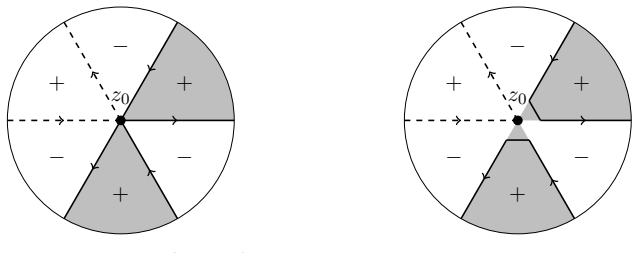
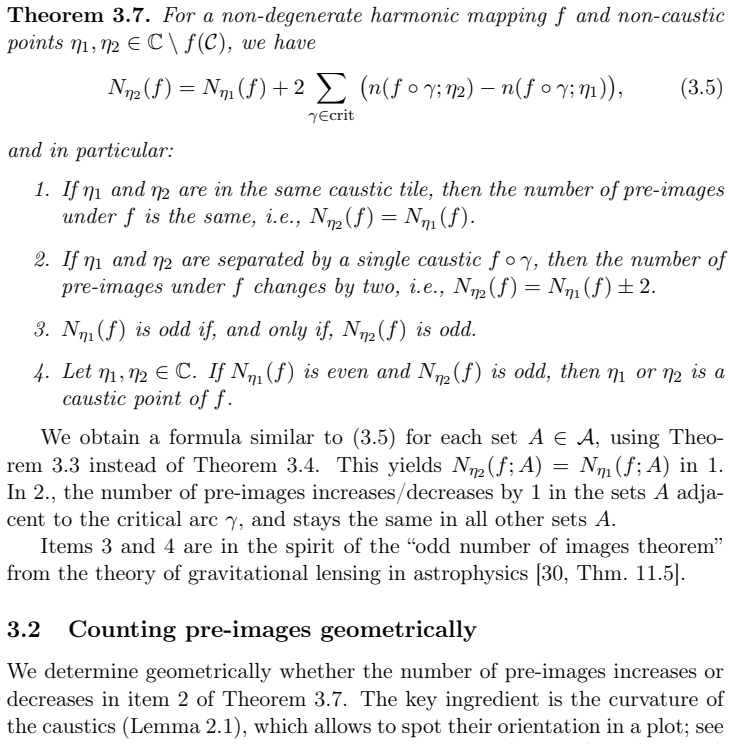
The load-bearing object is the critical curve: a closed parametrization $\gamma$ of a component of the critical set $C=\{z:J_f(z)=0\}$, oriented by the second complex dilatation through $\omega(\gamma(t))=e^{it}$, whose image $f\circ\gamma$ is a caustic. The identity $N_\eta(f)=P(f)+2\sum_{\gamma\in\mathrm{crit}} n(f\circ\gamma;\eta)$ carries the whole argument, converting pre-image counting into a winding-number sum; the factor $2$ is forced because every critical arc borders a sense-preserving region on one side and a sense-reversing region on the other. Around a fold caustic, the paper supplements the global formula with a local normal-form analysis and uses harmonic Newton iteration to show that the two pre-images that appear or disappear lie near $z_0\pm i\sqrt{t b_1/a_1}$.
What would settle it
For the map $f(z)=z^2+1/z+\overline{z}+1+2\log|z|$ from Example 3.10, compute the winding numbers of the critical curves about a point $\eta$ in each caustic tile and compare $N_\eta(f)=4+2\sum n(f\circ\gamma;\eta)$ with the actual number of pre-images obtained by solving. A mismatch in any tile, or an $\eta\notin f(C)$ with infinitely many pre-images accumulating at the pole, would falsify Theorem 3.4.
Extended reading notes
Core claim
The central claim, Theorem 3.4, is that for a non-degenerate harmonic mapping $f$ — defined on the Riemann sphere except for finitely many poles, with a bounded critical set and with local expansions at the poles whose leading coefficients are unequal in modulus — the identity $N_\eta(f)=P(f)+2\sum_{\gamma\in\mathrm{crit}} n(f\circ\gamma;\eta)$ holds for every $\eta\notin f(C)$. Here $\mathrm{crit}$ is the finite collection of closed curves obtained by parametrizing the components of the critical set $C=\{z:J_f(z)=0\}$ through $\omega(\gamma(t))=e^{it}$, and $P(f)$ is the sum of the absolute Poincaré indices of all poles. The proof partitions the sphere into the connected components of the complement of $C$, applies the argument principle on each component, and sums; each critical arc contributes twice because it separates a sense-preserving from a sense-reversing region. The paper then derives structural consequences: the number of pre-images is constant on caustic tiles, crossing a single caustic arc changes it by two, and for harmonic polynomials $f=p+\overline{q}$ with $\deg p=n>\deg q=m$, every zero count $k=n,n+1,\ldots,V_{n,m}$ occurs; with $m=n-1$, this gives every $k=n,n+1,\ldots,n^2$.
Load-bearing premise
The counting formula assumes that in the unbounded component of the complement of the critical set, the equation $f(z)=\eta$ has only finitely many solutions; the proof's inversion step $z\mapsto 1/z$ does not close off the possibility that zeros accumulate at the pole of the inverted map at $0$.
Editorial extensions
If this is right
- The number of pre-images is constant on each connected component of $C\setminus f(C)$, and crossing a single caustic arc changes the count by exactly two.
- For sufficiently large $|\eta|$, all pre-images lie near the poles, and the total number of pre-images equals $P(f)$.
- Every intermediate zero count between the minimum $n$ and the maximum $V_{n,m}$ is attained by some harmonic polynomial $p+\overline{q}$ with $\deg p=n$ and $\deg q=m$; in particular, all $k=n,n+1,\ldots,n^2$ occur for $m=n-1$.
- A zero count $k$ of parity opposite to $n$ forces the polynomial to have a singular zero, while the same-parity counts can be realized by non-singular polynomials.
- The formula is a geometric algorithm: from the caustic plot, winding numbers of the critical curves around $\eta$ give the image count without solving $f(z)=\eta$.
Reading between the lines
- The same argument-principle mechanism should extend to harmonic mappings on bounded domains and compact Riemann surfaces, since the local contributions are identical; the paper lists this as an outlook rather than a theorem.
- For gravitational-lensing models of the form $r(z)-\overline{z}$, the identity refines the odd-number-of-images theorem: image multiplicity is governed by caustic winding numbers, so caustic topology alone should determine which multiplicities are possible.
- Because the formula reduces valence to a winding-number sum, the open problem of computing $V_{n,m}$ becomes a computational topology question: find the caustic tile where the winding sum is maximal.
- The local fold analysis suggests an explicit numerical recipe for tracking image pairs in lensing applications: start harmonic Newton iteration at $z_0\pm i\sqrt{t b_1/a_1}$ to capture the two pre-images that bifurcate from a fold.
Signed reviews
Editorial analysis
A structured set of objections, weighed in public.
Referee Report
Summary. The paper derives a formula for the number of pre-images of a non-caustic point under a non-degenerate harmonic mapping in terms of the number of poles and the winding numbers of the critical curves. The main result, Theorem 3.4, states that N_eta(f) = P(f) + 2 * sum over critical curves of n(f composed with gamma; eta), and this is used to show that the pre-image count changes by +/-2 when crossing a caustic arc and to give a geometric method for determining valence. The authors also provide a local description of pre-images near fold caustics (Theorem 4.2) and apply the global formula to harmonic polynomials, proving in Theorem 5.4 that for every n > m >= 1 and every k between n and V_{n,m} there is a harmonic polynomial p(z)+q(z), with deg p = n and deg q = m, having exactly k zeros; Corollary 5.6 then gives the range k = n, n+1, ..., n^2 when m = n-1.
Significance. If the main assertions are correct, the paper gives an elegant geometric algorithm for computing the valence of non-degenerate harmonic maps and settles the intermediate-valence question for harmonic polynomials in the full degree range, generalizing the earlier result of Bleher et al. for rational harmonic functions. The argument-principle approach is natural, and the paper contains several well-chosen worked examples and figures. The central formula is derived from standard principles rather than from the authors' own results, and I see no circularity in the main counting argument. The presentation is generally clear, but the proof contains two repairable gaps that need attention before the paper is fully convincing.
major comments (2)
- [Section 3.1, proof of Theorem 3.3] The proof's claim that f_eta has only finitely many zeros in A_infinity is not established. The argument is that infinitely many zeros in {|z| >= R} would give infinitely many non-singular zeros of f_eta(1/z) in {|z| <= 1/R}, contradicting isolation of non-singular zeros. This ignores that f_eta(1/z) generally has a pole at 0 when f has a pole at infinity; zeros of a function may accumulate at a pole, so isolation of each zero does not give a contradiction. The statement is very likely true under the non-degeneracy condition |a_n| != |b_n| in Definition 3.1(2), because that condition implies |f(z) - eta| >= c |z|^n for sufficiently large |z|, which bounds all zeros; the proof should supply this or an equivalent argument.
- [Section 5, Theorem 5.4 and Lemma 5.3] The perturbation step in the proof of Theorem 5.4 has two unverified hypotheses. First, Lemma 5.3 is applied to a maximum-valence polynomial f, but Lemma 5.3 requires all zeros of f to be non-singular; the authors do not show that an extremal polynomial can be chosen with this property. Second, Lemma 5.2 only separates the images of two prescribed critical points, while the proof of Theorem 5.4 asserts that a degree-3 perturbation can resolve all multiple caustic arcs simultaneously 'such that no other multiple caustic arcs occur'; this global assertion is not proved. The subsequent claim that there is a path phi from eta_n to 0 intersecting the caustics only in single folds also depends on these unresolved points. These gaps are load-bearing for Corollary 5.6 and need to be repaired.
minor comments (4)
- [Example 3.11] The displayed formula for the harmonic polynomial is missing the conjugation on the q-part; as written, f(z) = z^n + (z-1)^n + i z^n - i(z-1)^n is an analytic polynomial of degree n and cannot have n^2 zeros. The intended expression should involve the conjugate of the second group of terms.
- [Section 2.1, after (2.7)] The statement 'By construction f is sense-preserving to the left of gamma, and sense-reversing to the right of gamma' is used later in the proof of Theorem 3.3, but it is not justified at this point; a short explanation of the orientation convention would improve readability.
- [Section 4, Theorem 4.2] The proof relies on [33, Lem. 5.1, Thm. 5.2] and 'their proofs' to obtain convergence of the harmonic Newton iteration in the two disks around z_+ and z_-; stating the hypotheses of those results explicitly would make the argument more self-contained.
- [Section 5, Lemma 5.2] In the proof of Lemma 5.2, the Hermite interpolation polynomial of degree 3 satisfying p(z_1)=epsilon, p(z_2)=-epsilon, p'(z_1)=p'(z_2)=0 exists uniquely when z_1 != z_2; the authors should mention that epsilon is taken sufficiently small so that later perturbation arguments remain valid.
Circularity Check
Minor self-citations appear, but the central counting formula and zero-count application are not circular.
full rationale
The derivation chain is not circular. Theorem 3.4's formula N_eta(f) = P(f) + 2 * sum over crit of n(f o gamma; eta) is obtained by applying the argument principle (Theorem 2.5) to the components of C\C, with zero indices supplied by Proposition 2.7 and pole indices by Proposition 2.10; the formula is not an input to those propositions. The geometric consequences in Theorems 3.6 and 3.7 are corollaries of the same argument, not restatements of the assumptions. The paper's self-citations do not carry the central claim: [21] is cited only as a source of a similar partition for rational harmonic mappings, [24] concerns the index of a special singular zero, and [33] supplies independent convergence results for the harmonic Newton iteration used in Theorem 4.2. None of these citations defines the counting formula or forces the valence conclusion by construction. There are genuine proof gaps, but they are correctness risks rather than circularity: the finiteness of zeros of f - eta in A_infinity is justified by an inversion argument that overlooks the pole of f_eta(1/z) at 0, and the perturbation argument in Lemma 5.3 assumes the maximal-valence polynomial has only non-singular zeros, which is not established. These gaps do not make any theorem equivalent to its inputs by definition, so the paper receives only a low score for the presence of minor, non-load-bearing self-citations.
Assumptions & free parameters
assumptions (5)
- standard math Argument principle for continuous functions with finitely many exceptional points (Theorem 2.5, after [3], [34]).
- standard math Poincare index formulas for poles and non-singular zeros of harmonic mappings (Propositions 2.7 and 2.10, after [35]).
- domain assumption Local standard forms and valence statements for light harmonic mappings (Lyzzaik [27, Thm. 5.1], Neumann [28, Thm. 6.7]).
- domain assumption Convergence of harmonic Newton iteration (Sete and Zur [33, Lem. 5.1, Thm. 5.2]).
- ad hoc to paper After a generic degree-3 perturbation, a maximum-valence harmonic polynomial can be taken with no multiple caustic arcs; an admissible path from eta_n to 0 crossing only folds exists.
Cite this review
Pith. "Pith review of Number and location of pre-images under harmonic mappings in the plane." pith.science (2026). https://pith.science/paper/NIM2LAZW
@misc{pith2026190808759,
  author       = {Pith},
  title        = {Pith review of: Number and location of pre-images under harmonic mappings in the plane},
  year         = {2026},
  howpublished = {\url{https://pith.science/paper/NIM2LAZW}},
  note         = {Machine review of arXiv:1908.08759}
}
abstract
We derive a formula for the number of pre-images under a non-degenerate harmonic mapping $f$, using the argument principle. This formula reveals a connection between the pre-images and the caustics. Our results allow to deduce the number of pre-images under $f$ geometrically for every non-caustic point. We approximately locate the pre-images of points near the caustics. Moreover, we apply our results to prove that for every $k = n, n+1, \ldots, n^2$ there exists a harmonic polynomial of degree $n$ with $k$ zeros.
Figures

Figures from the paper (5 more)


Reference graph
Works this paper leans on
-
[21]
J. Liesen and J. Zur, How constant shifts affect the zeros of certain rational har- monic functions, Comput. Methods Funct. Theory, 18 (2018), pp. 583–607
work page 2018
-
[1]
L. V. Ahlfors, Lectures on quasiconformal mappings, D. Van Nostrand Co., Inc., Toronto, Ont.-New York-London, 1966
work page 1966
-
[2]
J. H. An and N. W. Evans, The Chang–Refsdal lens revisited, Monthly Notices Roy. Astronom. Soc., 369 (2006), pp. 317–334
work page 2006
-
[3]
M. B. Balk, Polyanalytic Functions, vol. 63 of Mathematical Research, Akademie- Verlag, Berlin, 1991. 25
work page 1991
-
[4]
A. F. Beardon, Complex analysis. The argument principle in analysis and topology, John Wiley & Sons, Ltd., Chichester, 1979
work page 1979
-
[5]
C. Bénéteau and N. Hudson, A survey on the maximal number of solutions of equations related to gravitational lensing, inComplexanalysisanddynamicalsystems, Trends Math., Birkhäuser/Springer, Cham, 2018, pp. 23–38
work page 2018
-
[6]
W. Bergweiler and A. Eremenko, On the number of solutions of a transcenden- tal equation arising in the theory of gravitational lensing, Comput. Methods Funct. Theory, 10 (2010), pp. 303–324
work page 2010
-
[7]
P. M. Bleher, Y. Homma, L. L. Ji, and R. K. W. Roeder, Counting zeros of harmonic rational functions and its application to gravitational lensing, Int. Math. Res. Not. IMRN, (2014), pp. 2245–2264
work page 2014
Show all 38 references
-
[8]
Bollobás, Modern graph theory, vol
B. Bollobás, Modern graph theory, vol. 184 of Graduate Texts in Mathematics, Springer-Verlag, New York, 1998
1998
-
[9]
Bshouty and A
D. Bshouty and A. Lyzzaik, Problems and conjectures in planar harmonic map- pings, J. Anal., 18 (2010), pp. 69–81
2010
-
[10]
Clunie and T
J. Clunie and T. Sheil-Small, Harmonic univalent functions, Ann. Acad. Sci. Fenn. Ser. A I Math., 9 (1984), pp. 3–25
1984
-
[11]
Duren, Harmonic mappings in the plane, vol
P. Duren, Harmonic mappings in the plane, vol. 156 of Cambridge Tracts in Math- ematics, Cambridge University Press, Cambridge, 2004
2004
-
[12]
Duren, W
P. Duren, W. Hengartner, and R. S. Laugesen, The argument principle for harmonic functions, Amer. Math. Monthly, 103 (1996), pp. 411–415
1996
-
[13]
Geyer, Sharp bounds for the valence of certain harmonic polynomials, Proc
L. Geyer, Sharp bounds for the valence of certain harmonic polynomials, Proc. Amer. Math. Soc., 136 (2008), pp. 549–555
2008
-
[14]
Hengartner and G
W. Hengartner and G. Schober, Univalent harmonic functions, Trans. Amer. Math. Soc., 299 (1987), pp. 1–31
1987
-
[15]
Henrici, Applied and computational complex analysis
P. Henrici, Applied and computational complex analysis. Vol. 3, Pure and Applied Mathematics (New York), John Wiley & Sons, Inc., New York, 1986
1986
-
[16]
Khavinson, S.-Y
D. Khavinson, S.-Y. Lee, and A. Saez, Zeros of harmonic polynomials, critical lemniscates, and caustics, Complex Anal. Synerg., 4 (2018), p. 4:2
2018
-
[17]
Khavinson and G
D. Khavinson and G. Neumann, On the number of zeros of certain rational har- monic functions, Proc. Amer. Math. Soc., 134 (2006), pp. 1077–1085
2006
-
[18]
harmonious
D. Khavinson and G. Neumann, From the fundamental theorem of algebra to astrophysics: a “harmonious” path, Notices Amer. Math. Soc., 55 (2008), pp. 666– 675
2008
-
[19]
Khavinson and G
D. Khavinson and G. Świa ¸tek, On the number of zeros of certain harmonic poly- nomials, Proc. Amer. Math. Soc., 131 (2003), pp. 409–414
2003
-
[20]
S.-Y. Lee, A. Lerario, and E. Lundberg, Remarks on Wilmshurst’s theorem, Indiana Univ. Math. J., 64 (2015), pp. 1153–1167
2015
-
[22]
Liesen and J
J. Liesen and J. Zur, The maximum number of zeros ofr(z) − z revisited, Comput. Methods Funct. Theory, 18 (2018), pp. 463–472
2018
-
[23]
N. G. Lloyd, Degree theory, Cambridge University Press, Cambridge-New York- Melbourne, 1978. Cambridge Tracts in Mathematics, No. 73
1978
-
[24]
Luce and O
R. Luce and O. Sète, The index of singular zeros of harmonic mappings of anti- analytic degree one, Complex Var. Elliptic Equ., (2019), pp. 1–21. 26
2019
-
[25]
R. Luce, O. Sète, and J. Liesen, Sharp parameter bounds for certain maximal point lenses, Gen. Relativity Gravitation, 46 (2014), pp. 1–16
2014
-
[26]
R. Luce, O. Sète, and J. Liesen, A note on the maximum number of zeros of r(z) − z, Comput. Methods Funct. Theory, 15 (2015), pp. 439–448
2015
-
[27]
Lyzzaik, Local properties of light harmonic mappings, Canad
A. Lyzzaik, Local properties of light harmonic mappings, Canad. J. Math., 44 (1992), pp. 135–153
1992
-
[28]
Neumann, Valence of complex-valued planar harmonic functions, Trans
G. Neumann, Valence of complex-valued planar harmonic functions, Trans. Amer. Math. Soc., 357 (2005), pp. 3133–3167
2005
-
[29]
A. O. Petters, Gravity’s action on light, Notices Amer. Math. Soc., 57 (2010), pp. 1392–1409
2010
-
[30]
A. O. Petters, H. Levine, and J. Wambsganss, Singularity Theory and Grav- itational Lensing, vol. 21 of Progress in Mathematical Physics, Birkhäuser Boston, Inc., Boston, MA, 2001
2001
-
[31]
Roe, Winding around
J. Roe, Winding around. The winding number in topology, geometry, and analysis, vol. 76 of Student Mathematical Library, American Mathematical Society, Provi- dence, RI; Mathematics Advanced Study Semesters, University Park, PA, 2015
2015
-
[32]
O. Sète, R. Luce, and J. Liesen, Perturbing rational harmonic functions by poles, Comput. Methods Funct. Theory, 15 (2015), pp. 9–35
2015
-
[33]
Sète and J
O. Sète and J. Zur, A Newton method for harmonic mappings in the plane, IMA J. Numer. Anal., 40 (2020), pp. 2777–2801
2020
-
[34]
Sheil-Small, Complex Polynomials, vol
T. Sheil-Small, Complex Polynomials, vol. 75 of Cambridge Studies in Advanced Mathematics, Cambridge University Press, Cambridge, 2002
2002
-
[35]
T. J. Suffridge and J. W. Thompson, Local behavior of harmonic mappings, Complex Variables Theory Appl., 41 (2000), pp. 63–80
2000
-
[36]
J. L. Walsh, The Location of Critical Points of Analytic and Harmonic Functions, American Mathematical Society Colloquium Publications, Vol. 34, American Math- ematical Society, New York, N. Y., 1950
1950
-
[37]
Wegert, Visual complex functions
E. Wegert, Visual complex functions. An introduction with phase portraits. , Birkhäuser/Springer Basel AG, Basel, 2012
2012
-
[38]
A. S. Wilmshurst, The valence of harmonic polynomials, Proc. Amer. Math. Soc., 126 (1998), pp. 2077–2081. 27
1998
Reviewed August 14, 2026 · model on record in the stance chip above.
Discussion (0). Continue with ORCID to comment.