REVIEW 2 major objections 5 minor 31 references
Elasto-inertial Chains in a Two-dimensional Turbulent Flow
T0 review · 2 major / 5 minor · reviewed 2026-08-14 · deepseek-v4-flash
Pith's one-line read This paper shows that bead-spring chains with inertia sample a two-dimensional turbulent flow in a way controlled by the distribution of mass along the chain: heavy-headed chains orbit vortex edges while elastic tails pin the core, and…
desk verdict A useful numerical extension of the inertialess-chain mechanism, but the mass-distribution claim is confounded by total inertia; worth refereeing. read the letter →
The pith
A machine-rendered reading of the paper's core claim, the machinery that carries it, and where it could break.
The reading
What carries the argument
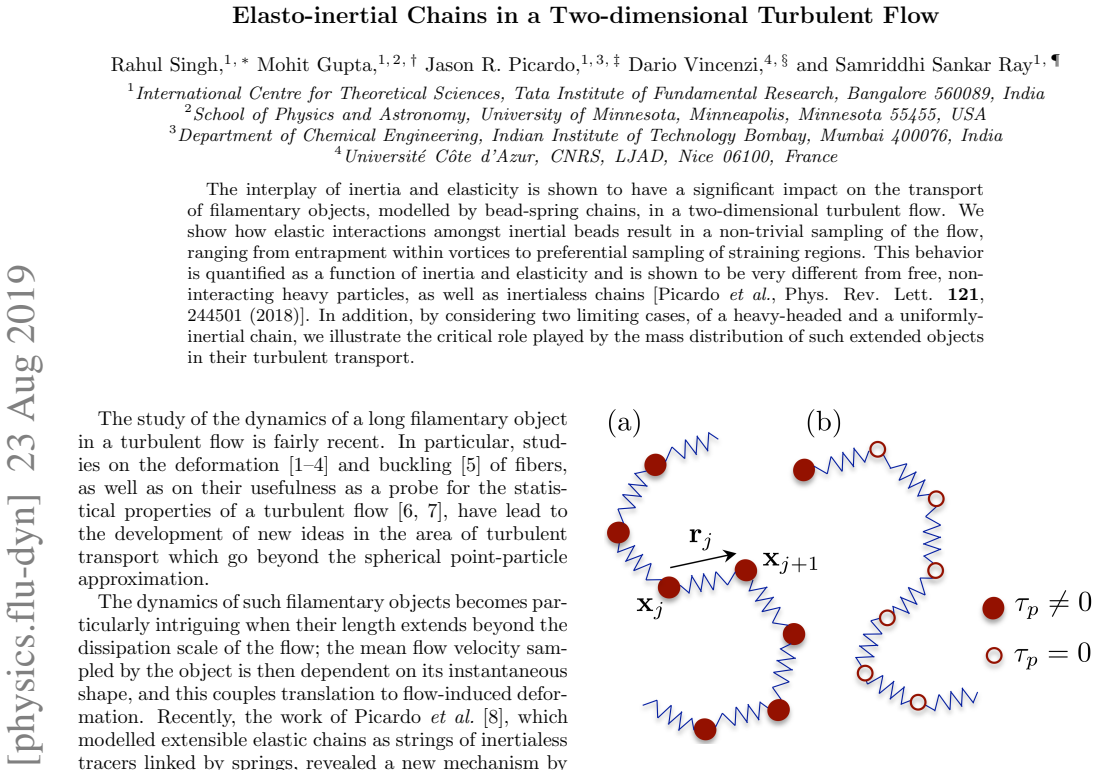
The central object is the elasto-inertial chain: $N_b$ spherical beads connected by finitely extensible nonlinear elastic (FENE) springs, each bead carrying a Stokes relaxation time $\tau_p$ and each link an elastic time $\tau_E$. The paper writes the dynamics in link-separation vectors and center-of-mass coordinates, and the governing dimensionless numbers are the Stokes number $St = \tau_p/\tau_\eta$ and the Weissenberg number $Wi = \tau_{\rm chain}/\tau_f$, with $\tau_{\rm chain} = 6\tau_E/(N_b(N_b+1))$. The diagnostic that carries the argument is the Lagrangian Okubo-Weiss parameter $\Lambda_c$ evaluated at the chain center of mass, whose sign distinguishes vortical ($\Lambda_c>0$) from straining ($\Lambda_c<0$) regions; the skewness $\gamma$ of its PDF is the single statistic that maps the transition across the $St$--$Wi$ plane, supplemented by measurements of mean chain length and the PDF of inter-bead separations.
What would settle it
Compare two identical bead-spring chains at the same $St$ and $Wi$, one with hydrodynamically interacting beads and one without, in the same two-dimensional turbulent flow; if the Ferris-wheel pattern and the evacuation of strong vortex cores vanish or shift their $St$--$Wi$ thresholds when bead-bead hydrodynamic coupling is switched on, those phenomena are artifacts of one-way coupling. A cleaner version: place a single heavy-headed chain in a laminar vortex and measure the head-bead orbit radius as the vortex strength and chain elasticity are varied; the paper's mechanism predicts a specific radius set by the balance between centrifugal expulsion and elastic pinning, not by initial conditions.
Extended reading notes
Core claim
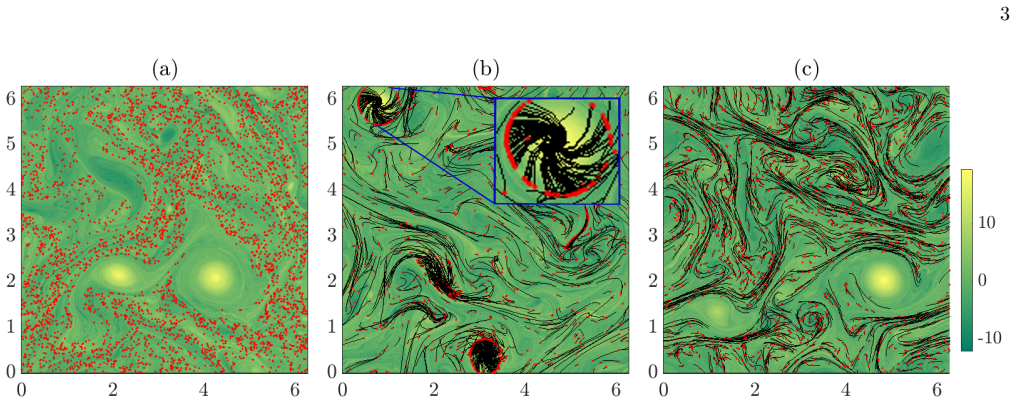
The paper's central claim is that in a two-dimensional turbulent flow, elasticity and inertia act as competing mechanisms that jointly decide how an extended chain samples the flow. For a chain with all inertia concentrated in one end bead, the elastic tail is drawn into vortex cores while the centrifugal force on the heavy head pushes it outward, so the chain traces a 'Ferris-wheel' pattern with the head circling the vortex edge. For a chain with uniform bead inertia, the same competition evacuates the cores of the strongest vortices while partially coiled chains keep weaker vortices occupied. The paper quantifies the transition with the Okubo-Weiss parameter $\Lambda_c = (\omega_c^2 - \sigma_c^2)/(4\langle\omega^2\rangle)$ at the chain's center of mass: its PDF skewness $\gamma$ changes sign and shape across the $St$--$Wi$ plane, showing that elasticity pulls the center of mass toward vortical regions at low $St$, while at large $St$ inertia decouples the chain from the flow and the dependence on $Wi$ disappears.
Load-bearing premise
The paper's picture rests on the assumption that each bead's inertia is fully described by a single linear-drag relaxation time and that the beads are small and dilute enough not to disturb the flow or interact hydrodynamically with one another.
Editorial extensions
If this is right
- At low Stokes numbers, increasing the Weissenberg number shifts the center of mass of a uniformly inertial chain toward vortical regions, as seen in the widening positive tail of the Okubo-Weiss PDF.
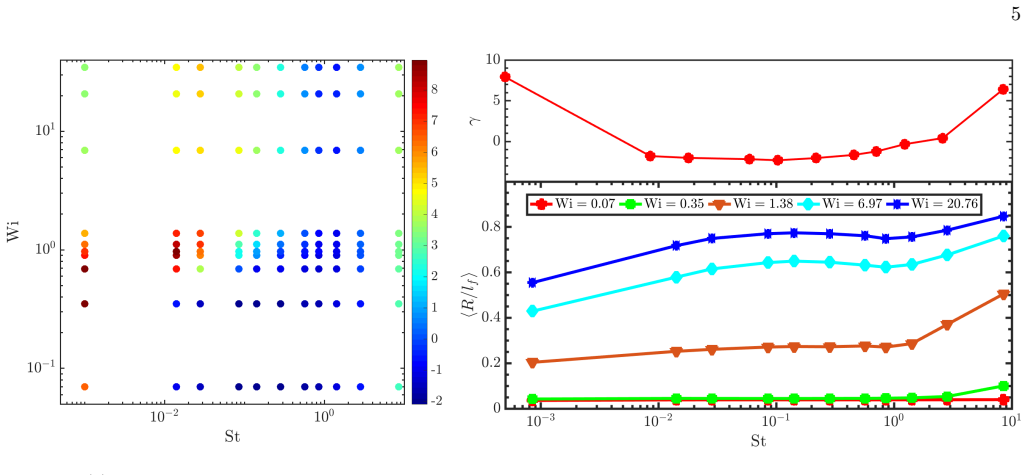
- The skewness $\gamma$ of $\Lambda_c$ is negative for free inertial particles at intermediate $St$, but becomes positive for chains with $Wi$ of order one, so elasticity reverses the sign of preferential sampling.
- At large Stokes numbers the Okubo-Weiss PDFs become nearly independent of $Wi$, so very heavy chains behave like free heavy particles.
- Heavy-headed chains have narrower Okubo-Weiss PDFs than free particles or uniformly inertial chains, because the inertial head is held at the vortex periphery and cannot sample intense vortical or straining regions.
- The mean chain length and the inter-bead separation PDF show that stretching at large $Wi$ is enhanced at small $St$ by preferential sampling of straining regions and at large $St$ by velocity decorrelation between beads.
Reading between the lines
- A natural testable extension is to vary the mass distribution continuously, from a single heavy head to uniform loading; the paper's two limits predict a family of sampling statistics, with intermediate distributions interpolating between the Ferris-wheel pattern and core evacuation.
- Because three-dimensional turbulence lacks the long-lived coherent vortices that sustain the Ferris-wheel pattern, repeating the simulation in 3D would show whether the mass-distribution effect survives or is replaced by a different signature, such as alignment with strain-rate eigenvectors.
- For applications such as towed sensors or seeded fibers, the Ferris-wheel mechanism suggests that attaching a heavy bead to one end of a flexible tether could be engineered to hold the object at vortex boundaries; this is an inference from the model, not a claim the paper tests.
- The model ignores hydrodynamic interactions and bending rigidity; if the chain's own drag modifies the local flow, the entrapment thresholds and Ferris-wheel radius would shift, which could be checked by fully resolved simulations of a settling fiber.
Signed reviews
Editorial analysis
A structured set of objections, weighed in public.
Referee Report
Summary. This paper investigates the transport of bead-spring chains with inertia in a two-dimensional turbulent flow, combining direct numerical simulations of the Navier–Stokes equations (with Ekman friction) and Lagrangian tracking of 5×10^4 chains. Two chain geometries are compared: (i) a uniformly-inertial chain, in which all Nb=10 beads share the same Stokes number St=τp/τη, and (ii) a heavy-headed chain, in which a single inertial head bead is attached to Nb−1 inertialess beads. Both use FENE springs, with elasticity characterized by the Weissenberg number Wi. The paper reports that elasto-inertial chains sample the flow differently from both free inertial particles and inertialess elastic chains. Heavy-headed chains display a 'Ferris-wheel' pattern with the inertial head orbiting the periphery of vortices while the elastic tail remains pinned to the core; uniformly-inertial chains evacuate the strongest vortex cores while weaker vortices remain occupied. These observations are quantified through PDFs of the Okubo–Weiss parameter at the chain center of mass, the skewness of this distribution in the St–Wi plane, and the statistics of chain and link lengths. The abstract and conclusions emphasize the critical role of mass distribution in the turbulent transport of extended objects.
Significance. The paper is a well-posed numerical study that extends the inertialess-chain mechanism of Picardo et al. (PRL 121, 244501) to inertial beads. Its strengths include a transparent model, explicit equations of motion, a reproducible numerical setup, direct baseline comparisons with non-interacting inertial particles, and clear qualitative illustration of the new phenomena via snapshots and movies. The central qualitative result—that adding inertia to elastic chains produces sampling behavior distinct from both free heavy particles and inertialess chains—is convincing from the evidence presented. If the mass-distribution claim is properly isolated, the paper would be a useful contribution to the turbulent transport of filamentary objects. However, the present comparison of heavy-headed and uniformly-inertial chains confounds mass distribution with total inertia, and the quantitative statistics lack uncertainty estimates; these issues affect the strongest conclusions.
major comments (2)
- [Abstract and the comparison in Fig. 2, Eqs. (2)–(5)] The assertion that the two limiting cases reveal the role of mass distribution is confounded by total inertia. In the simulations of Fig. 2 (and the PDFs of Fig. 3), the heavy-headed chain and the uniformly-inertial chain are run at the same per-bead Stokes number St=0.14; the uniformly-inertial chain therefore carries ten times the total bead mass of the heavy-headed chain. In addition, the center-of-mass dynamics are not of the same form: for the uniform chain, internal spring forces cancel in Eq. (2), leaving a heavy-particle-like equation with the bead-averaged fluid velocity, whereas for the heavy-headed chain Eq. (5) contains the head-local fluid velocity and an explicit elastic force. The observed contrast between Ferris-wheel periphery cycling and core evacuation could thus be due to the different total inertia and to the different center-of-mass advection law, rather than to the mass distribution per se. A control simulation at fixed total mass (for example, a uniform chain with per-bead St equal to one tenth of the head St), or an explicit argument for why total mass is irrelevant, is required to support the mass-distribution claim made in the abstract.
- [Figs. 3–5 and the St–Wi analysis] The quantitative results that support the central claims—particularly the PDFs of Λc, the skewness γ in the St–Wi plane, and the mean chain length ⟨R⟩—are presented without error bars, confidence intervals, or convergence checks. Skewness is a third-order moment and is especially sensitive to insufficient sampling of the PDF tails; with 5×10^4 chains the convergence of the tails is not self-evident. Please add error bars via block averaging or bootstrap, or otherwise report statistical uncertainty, and verify that the qualitative conclusions, such as the sign changes of γ in Fig. 4(a) and the local maximum of ⟨R⟩ near St≈0.1 in Fig. 4(c), are stable. Without this, the quantitative phase behavior in the St–Wi plane is not fully established.
minor comments (5)
- [Eq. (1)] Equation (1) defines the FENE interaction with '|r2j|' in the text; this should read |r_j|^2.
- [DNS setup section] The spelling 'Ekmann' appears in the DNS setup paragraphs; the correct spelling is 'Ekman'.
- [Discussion of Λc after Fig. 2] The statement that 'extremely small values correspond to regions with comparable amounts of vorticity and straining' is imprecise, because small |Λc| can also occur when both the vorticity and the strain are weak. Please rephrase.
- [Paragraph discussing Fig. 5] The statement that at large Wi 'the typical inter-bead separation is of the order of the vortex size' is inconsistent with the model parameters: the maximum inter-bead length is rm≈0.139, while the forcing scale is lf≈1.257; it is the total chain length, not the inter-bead separation, that is comparable to the vortex size.
- [Fig. 3 insets] The insets of Fig. 3 show only two Wi values, while the text says other values give similar results; a supplementary figure or a quantitative measure of the tail widths would make this claim checkable.
Circularity Check
No significant circularity: the paper is a direct numerical-experiment study whose observables are not fitted to or defined by the claimed outcomes.
full rationale
The elasto-inertial chain model (Eqs. 1–5) is stated ab initio; Stokes and Weissenberg numbers are independent control parameters defined from model timescales and the DNS flow, and no parameter is fitted to the measured Okubo–Weiss skewness, link-length PDFs, or chain-length statistics. The sampling results (vortex entrapment, Ferris-wheel pattern, straining-region sampling) are emergent outputs of the simulated bead-spring dynamics rather than identities imposed by the definitions. The comparison with inertialess chains cites the authors' earlier PRL (Ref. 8), but that prior work is a separate numerical study with its own stated model and is not fitted to the present data; it supplies an external baseline, not a logical premise of the present derivation. The skeptical concern about the heavy-headed versus uniformly-inertial comparison—that equal per-bead St implies unequal total bead mass—is a possible confound in the interpretation of the mass-distribution claim, but it is a limitation of the control in the numerical experiment, not a circular reduction of a prediction to its inputs. No equation-level circularity, fitted-input renaming, or author-imported uniqueness argument was found.
Assumptions & free parameters
free parameters (3)
- Stokes number St =
scanned: 0.14, 0.85, 2.84
- Weissenberg number Wi =
scanned: 0.07, 0.35, 1.38, 6.92
- Nb, r0, rm (chain geometry) =
Nb=10, r0=0.004, rm=1.25/(Nb-1)=0.139
assumptions (3)
- domain assumption Beads are small enough not to alter the fluid flow, and hydrodynamic interactions between beads are neglected.
- domain assumption Elastic links are phantom FENE springs with no bending resistance.
- domain assumption A statistically steady 2D flow with coherent vortices is a suitable testbed for the claimed transport mechanisms.
Cite this review
Pith. "Pith review of Elasto-inertial Chains in a Two-dimensional Turbulent Flow." pith.science (2026). https://pith.science/paper/KE7YDLNC
@misc{pith2026190808776,
  author       = {Pith},
  title        = {Pith review of: Elasto-inertial Chains in a Two-dimensional Turbulent Flow},
  year         = {2026},
  howpublished = {\url{https://pith.science/paper/KE7YDLNC}},
  note         = {Machine review of arXiv:1908.08776}
}
read the original abstract
The interplay of inertia and elasticity is shown to have a significant impact on the transport of filamentary objects, modelled by bead-spring chains, in a two-dimensional turbulent flow. We show how elastic interactions amongst inertial beads result in a non-trivial sampling of the flow, ranging from entrapment within vortices to preferential sampling of straining regions. This behavior is quantified as a function of inertia and elasticity and is shown to be very different from free, non-interacting heavy particles, as well as inertialess chains [Picardo et al., Phys. Rev. Lett. 121, 244501 (2018)]. In addition, by considering two limiting cases, of a heavy-headed and a uniformly-inertial chain, we illustrate the critical role played by the mass distribution of such extended objects in their turbulent transport.
Figures

Figures from the paper (2 more)

Reference graph
Works this paper leans on
-
[1]
Flexible fiber in a turbulent flow: A macroscopic polymer,
C. Brouzet, G. Verhille, and P. Le Gal, “Flexible fiber in a turbulent flow: A macroscopic polymer,” Phys. Rev. Lett. 112, 074501 (2014). 7
work page 2014
-
[2]
3d conformation of a flexible fiber in a turbulent flow,
G. Verhille and A. Bartoli, “3d conformation of a flexible fiber in a turbulent flow,” Exp. Fluids 57, 117 (2016)
work page 2016
-
[3]
Characterisation of flexible fibre deformations in turbulence,
A. Gay, B. Favier, and G. Verhille, “Characterisation of flexible fibre deformations in turbulence,” Europhys. Lett. 123, 24001 (2018)
work page 2018
-
[4]
Orientation, distribution, and deformation of inertial flexible fibers in turbulent channel flow,
D. Dotto and C. Marchioli, “Orientation, distribution, and deformation of inertial flexible fibers in turbulent channel flow,” Acta Mech. 230, 597 (2019)
work page 2019
-
[5]
Stretching and buck- ling of small elastic fibers in turbulence,
S. Allende, C. Henry, and J. Bec, “Stretching and buck- ling of small elastic fibers in turbulence,” Phys. Rev. Lett. 121, 154501 (2018)
work page 2018
-
[6]
Flexible fiber reveals the two-point statistical properties of turbulence,
M. E. Rosti, A. A. Banaei, L. Brandt, and A. Mazzino, “Flexible fiber reveals the two-point statistical properties of turbulence,” Phys. Rev. Lett. 121, 044501 (2018)
work page 2018
-
[7]
Flowing fibers as a proxy of turbulence statistics,
M. E. Rosti, S. Olivieri, A. A. Banaei, L. Brandt, and A. Mazzino, “Flowing fibers as a proxy of turbulence statistics,” Meccanica , in press (2019)
work page 2019
-
[8]
Pref- erential sampling of elastic chains in turbulent flows,
J. R. Picardo, D. Vincenzi, N. Pal, and S. S. Ray, “Pref- erential sampling of elastic chains in turbulent flows,” Phys. Rev. Lett. 121, 244501 (2018)
work page 2018
Show all 31 references
-
[9]
Fractal clustering of inertial particles in random flows,
J. Bec, “Fractal clustering of inertial particles in random flows,” Phys. Fluids 15, L81–L84 (2003)
2003
-
[10]
Clus- tering and collisions of heavy particles in random smooth flows,
J. Bec, A. Celani, M. Cencini, and S. Musacchio, “Clus- tering and collisions of heavy particles in random smooth flows,” Phys. Fluids 17, 073301 (2005)
2005
-
[11]
Clustering of aerosol particles in isotropic turbulence,
J. Chun, D. L. Koch, S. L. Rani, A. Ahluwalia, and L. R. Collins, “Clustering of aerosol particles in isotropic turbulence,” J. Fluid Mech. 536, 219–251 (2005)
2005
-
[12]
Heavy particle concentration in turbulence at dissipative and inertial scales,
J. Bec, L. Biferale, M. Cencini, A. Lanotte, S. Musac- chio, and F. Toschi, “Heavy particle concentration in turbulence at dissipative and inertial scales,” Phys. Rev. Lett. 98, 084502 (2007)
2007
-
[13]
Analyz- ing preferential concentration and clustering of inertial particles in turbulence,
R. Monchaux, M. Bourgoin, and A. Cartellier, “Analyz- ing preferential concentration and clustering of inertial particles in turbulence,” Int. J. Multiph. Flow 40, 1 – 18 (2012)
2012
-
[14]
Statistical models for spa- tial patterns of heavy particles in turbulence,
K. Gustavsson and B. Mehlig, “Statistical models for spa- tial patterns of heavy particles in turbulence,” Adv. in Phys. 65, 1–57 (2016)
2016
-
[15]
Gravity-driven en- hancement of heavy particle clustering in turbulent flow,
J. Bec, H. Homann, and S. S. Ray, “Gravity-driven en- hancement of heavy particle clustering in turbulent flow,” Phys. Rev. Lett. 112, 184501 (2014)
2014
-
[16]
Settling regimes of in- ertial particles in isotropic turbulence,
G. H. Good, P. J. Ireland, G. P. Bewley, E. Bodenschatz, L. R. Collins, and Z. Warhaft, “Settling regimes of in- ertial particles in isotropic turbulence,” J. Fluid Mech. 759, R3 (2014)
2014
-
[17]
Droplet–turbulence interaction in a confined polydis- persed spray: effect of turbulence on droplet dispersion,
S. Sahu, Y. Hardalupas, and A. M. K. P. Taylor, “Droplet–turbulence interaction in a confined polydis- persed spray: effect of turbulence on droplet dispersion,” J. Fluid Mech. 794, 267–309 (2016)
2016
-
[18]
Growth of cloud droplets in a turbulent environment,
W. W. Grabowski and L.-P. Wang, “Growth of cloud droplets in a turbulent environment,” Annu. Rev. Fluid Mech. 45, 293–324 (2013)
2013
-
[19]
Abrupt growth of large aggregates by correlated coalescences in turbulent flow,
J. Bec, S. S. Ray, E. W. Saw, and H. Homann, “Abrupt growth of large aggregates by correlated coalescences in turbulent flow,” Phys. Rev. E 93, 031102(R) (2016)
2016
-
[20]
R. B. Bird, C. F. Curtiss, R. C. Armstrong, and O. Has- sager, Dynamics of Polymeric Liquids (John Wiley and Sons, New York, 1977)
1977
-
[21]
Statistically steady turbu- lence in thin films: direct numerical simulations with Ekman friction,
P. Perlekar and R. Pandit, “Statistically steady turbu- lence in thin films: direct numerical simulations with Ekman friction,” New J. Phys. 11, 073003 (2011)
2011
-
[22]
Two-dimensional turbu- lence,
G. Boffetta and R. E. Ecke, “Two-dimensional turbu- lence,” Annu. Rev. Fluid Mech. 44, 427–451 (2012)
2012
-
[23]
Dynamics of dissolved poly- mer chains in isotropic turbulence,
S. Jin and L. R. Collins, “Dynamics of dissolved poly- mer chains in isotropic turbulence,” New J. Phys. 9, 360 (2007)
2007
-
[24]
Youtube movie showing the evolution of inertia-less elas- tic chains: https://youtu.be/etLuK6ovAqk,
-
[25]
Youtube movie showing the evolution of heavy- headed chains: https://www.youtube.com/watch?v= DG3TJTye2_8,
-
[26]
Youtube movie showing the evolution of uniformly- inertial chains: https://youtube.com/watch?v= g0T6JvVVI20,
-
[27]
Topology of two-dimensional turbulent flows of dust and gas,
D. Mitra and P. Perlekar, “Topology of two-dimensional turbulent flows of dust and gas,” Phys. Rev. Fluids 3, 044303 (2018)
2018
-
[28]
Two-dimensional homogeneous isotropic fluid turbulence with polymer ad- ditives,
A. Gupta, P. Perlekar, and R. Pandit, “Two-dimensional homogeneous isotropic fluid turbulence with polymer ad- ditives,” Phys. Rev. E 91, 033013 (2015)
2015
-
[29]
Emergence of phytoplankton patchiness at small scales in mild turbulence,
R. E. Breier, C. C. Lalescu, D. Waas, M. Wilczek, and M. G. Mazza, “Emergence of phytoplankton patchiness at small scales in mild turbulence,” Proc. Nat. Acad. Sci. USA 115, 12112–12117 (2018)
2018
-
[30]
Flocking of active particles in a turbulent flow,
A. Gupta, A. Roy, A. Saha, and S. S. Ray, “Flocking of active particles in a turbulent flow,” ArXiv e-prints (2018), arXiv:1812.10288
2018 arXiv
-
[31]
Effect of inertia on model flocks in a turbulent environment,
A. Choudhary, D. Venkataraman, and S. S. Ray, “Effect of inertia on model flocks in a turbulent environment,” Europhys. Lett. 112, 24005 (2015)
2015
Reviewed August 14, 2026 · model on record in the stance chip above.
Discussion (0). Continue with ORCID to comment.