REVIEW 3 major objections 7 minor 38 references
MHD supernova explosions -- Large-scale magnetic field effects
T0 review · 3 major / 7 minor · reviewed 2026-08-14 · deepseek-v4-flash
Pith's one-line read A uniform ambient magnetic field of a few microgauss changes how a supernova remnant expands and how much of the explosion energy it deposits in the surrounding gas.
desk verdict A credible qualitative mechanism and useful new numbers, but the 3D resistivity treatment needs testing before the quantitative claims should be relied on. read the letter →
The pith
A machine-rendered reading of the paper's core claim, the machinery that carries it, and where it could break.
The reading
What carries the argument
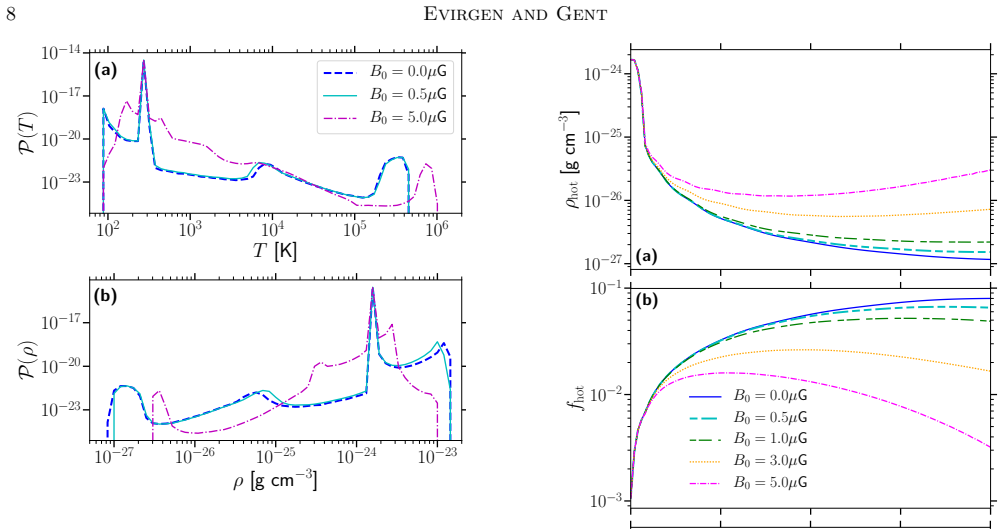
The engine of the effect is the magnetic pressure gradient that builds up in the remnant shell and its wake, perpendicular to the ambient field. Compression sweeps field lines into the shell and empties them from the core; just behind the shock the gradient $-\partial (|\mathbf{B}|^2/2\mu_0)/\partial R_\perp$ becomes comparable to, and later two to three times larger than, the thermal pressure gradient, driving an inward flow that carries mass and magnetic field back toward the core while magnetic tension stays subdominant. This produces a two-part remnant: a fast oblate shock front and a magnetically confined prolate hot core, with the inter-shock region heated by ultraviolet radiation more than it cools. The numerical model keeps the shell field intact by omitting shock-capturing resistivity from the induction equation, a choice the authors validate only in one-dimensional shock-tube comparisons.
What would settle it
Run the same B0 = 5 µG, n = 1 $cm^{-3}$ supernova simulation with shock-capturing resistivity or a different MHD solver and compare residual total energy at 1 Myr; if the retention ratio falls from 7.7% back toward the hydrodynamical 5.4% of E_SN, the reported energy enhancement depends on the numerical treatment of the shell field rather than the physics.
Extended reading notes
Core claim
The central claim is that a uniform ambient magnetic field of a few microgauss is not passive in supernova remnant evolution: compression stores blast-wave energy in the shell's magnetic field and releases it later as an inward magnetic pressure gradient. That inward force peels mass off the shell, creates a retrograde flow perpendicular to the field, confines the hot remnant core into a prolate spheroid, and leaves the shock front as an oblate spheroid. The shock advances faster perpendicular to the field but with reduced momentum, and the confined core plus an inter-shock region where UV heating exceeds radiative losses lose less energy to radiation. For B0 = 5 µG and n = 1 $cm^{-3}$, outward momentum injection falls by up to 10% relative to the hydrodynamical case, residual total energy retention at 1 Myr rises from 5.4% to 7.7% of E_SN, and by 4 Myr the magnetized remnant retains 4.2% of the explosion energy versus 1.3% without a field.
Load-bearing premise
The shell's compressed magnetic field must survive without being dissolved by numerical reconnection; the authors deliberately omit shock-capturing resistivity and test that choice only in one-dimensional shock tubes.
Editorial extensions
If this is right
- Galactic simulations that ignore large-scale magnetic fields likely overstate the momentum a supernova injects by up to 10% for B0 greater than or equal to 3 µG and understate the thermal energy left behind by as much as 40% at 1 Myr.
- In a magnetized interstellar medium, remnants should commonly show an oblate shell around a prolate hot core, so the relative orientation of radio and gamma-ray morphologies could trace the direction of the ambient field.
- The onset of magnetic effects is set by an ambient plasma beta of about 1, roughly 1 µG for n = 1 cm^-3, meaning most of the Milky Way's interstellar medium lies in the regime where these effects operate.
- Magnetic confinement makes the hot gas denser and reduces its fractional volume, so observations may see less diffuse X-ray-emitting gas in remnants than hydrodynamic models predict.
- The one-dimensional density scans indicate magnetic effects appear earlier and grow stronger in more diffuse gas, so the energy-retention enhancement should be larger in the warm diffuse interstellar medium than in dense cold gas.
Reading between the lines
- If subgrid models of supernova feedback in galaxy simulations do not include magnetic-field-dependent efficiencies, they may systematically misestimate both momentum-driven turbulence and thermal pressure support in magnetized disks.
- The magnitude of the effect probably depends on how long the compressed shell field survives; if future three-dimensional studies with shock-resolving resistivity reproduce a weaker version, the 10% and 40% numbers would shrink but the qualitative mechanism could stand.
- The predicted morphology, an oblate shell with a prolate core and a quadrupolar internal velocity field, could serve as a magnetometer for the ambient field direction and strength in resolved remnants, once projection and turbulent-field effects are separated.
- Because the onset is set by plasma beta, the critical field should scale roughly as sqrt(nT); testing this scaling in three dimensions across densities would extend the result beyond the n = 1 cm^-3 case studied here.
Signed reviews
Editorial analysis
A structured set of objections, weighed in public.
Referee Report
Summary. This manuscript presents 3D nonideal MHD simulations of supernova remnants expanding into a homogeneous, thermal-equilibrium ambient ISM threaded by a plane-parallel magnetic field of strength B0 = 0–5 µG. Using the Pencil Code, the authors find that for B0 ≳ 1 µG the remnant becomes biaxial: the blast wave expands faster perpendicular to the field, the hot core is magnetically confined into a prolate spheroid, and the compressed shell develops an inward magnetic pressure gradient that drives retrograde mass flow. They quantify a reduction in outward momentum injection of up to about 10% and an increase in residual total energy retention from 5.4% to 7.7% of E_SN at 1 Myr for B0 = 5 µG (a relative increase of up to about 40%). The paper derives a critical field strength Bcrit ~ sqrt(2 µ0 p) ~ 1 µG for the onset of these effects. Appendices provide 1D shock-tube tests, a 1D scan in ambient density, and an additional 3D run with ambient temperature 10^4 K to test sensitivity to the initial thermal state.
Significance. The qualitative picture—a magnetically confined core and a retrograde flow driven by the magnetic pressure gradient—is physically plausible and, if correct, would challenge the common assumption that ambient magnetic fields are unimportant for SN momentum injection (Kim & Ostriker 2015). This has implications for subgrid models of SN feedback in galaxy simulations. Strengths of the paper include the use of a well-documented code, direct simulation outputs rather than fitted parameters, a dimensionally motivated Bcrit criterion, and several validation runs (1D shock tubes, a resolution statement, and an alternative-temperature 3D run). However, the central quantitative claims rest on single realizations per field strength and on a 3D magnetic-diffusion treatment that is validated only in 1D; both points must be strengthened before the 10% momentum reduction and 40% energy-retention numbers can be regarded as robust.
major comments (3)
- [Section 2, Eq. (5); Section 4; Appendix A] The central mechanism—retrograde flow driven by the magnetic pressure gradient in the compressed shell—requires the shell magnetic field to remain coherent on Myr timescales. The deliberate omission of shock-capturing resistivity in the induction equation is justified only by 1D shock-tube tests (Appendix A, Figs. 12–15) in which the field is transverse to a planar shock. Those tests do not validate the 3D spherical setting, where field-line draping, oblique compression, and current sheets in the inter-shock region can lead to grid-scale numerical reconnection that either dissipates or, by suppressing diffusion, artificially enhances the shell field. I request a 3D demonstration that the radial profile of the Lorentz force (for example the magnetic-pressure-gradient and tension terms shown in Fig. 6 at 1 and 2 Myr) is numerically converged, or a companion run with an explicit shock-capturing resistivity, to show that the reported momentum and energy changes are not controlled by this numerical choice.
- [Section 4, Fig. 4; Table 1] Each field strength is represented by a single simulation with no error estimate, and the momentum evolution is non-monotonic: the claimed 'up to 10%' reduction is a transient maximum rather than a robust end-state difference. The only quantitative uncertainty statement in Section 2 ('results were convergent with resolution of 0.5 pc, other than a thinner more dense remnant shell') is not supported by a figure or table. To make the 10% momentum and 40% energy claims load-bearing, the authors should either provide a resolution study or small perturbation ensemble, or explicitly present the numbers as order-of-magnitude estimates rather than measured efficiencies.
- [Section 6, Fig. 11; Table 1] The reported residual total energy includes the magnetic energy of the compressed ambient field, as stated in the Figure 11 caption: ΔEtot(t) = Etot(t) − Etot(t=0), where Etot(t=0) includes the ambient magnetic energy. The increase in total retained energy at 1 Myr is therefore not purely newly injected SN thermal/kinetic energy; part of it is pre-existing ambient magnetic energy amplified by shock compression. The manuscript should state explicitly how much of the B0 = 5 µG versus HD difference at 1 Myr is magnetic energy, and should clarify whether the phrase 'residual energy injection by the SN into the ISM' is intended to include this ambient-field energy. Without this bookkeeping, the 40% figure risks being interpreted as an increase in new energy injection.
minor comments (7)
- [Section 1] In the last paragraph, 'n = 10−2 cm−2' should read 'cm−3'.
- [Section 5] The text contains an unfinished editorial note ('filling fraction → fractional volume, we went to some lengths in paper 1 ... Delete when OK') that must be removed before publication.
- [Figure 11] The legend in Figure 11 repeats 'B0 = 0.0 µG' for all five curves, making panels (b) and (c) impossible to interpret as printed.
- [Figure 9] The caption says 'HD (solid blue) and MHD models with B0 = 0.5 µG', but the panel shows at least five models; the caption should list all field strengths.
- [Section 6] The sentence beginning 'Beyond 3 Myr the strong MHD residual kinetic energy can persist more effectively than HD, would likely be subsumed...' is grammatically incomplete and should be rewritten.
- [Eq. (2)] The notation 'max5' is undefined; the stencil over which the maximum is taken should be stated explicitly.
- [Throughout] There are several typographical errors, including 'remamnts' (Section 3), 'momemtum' (Section 4), and 'notiecable' (Section 8), which should be corrected.
Circularity Check
No significant circularity: the central quantitative claims are direct simulation outputs checked against external analytic benchmarks, with no fitted parameter renamed as prediction.
full rationale
The paper's central results are measured outputs of 3D MHD simulations, not derived from a model fitted to those results. Momentum injection is integrated from simulation fields via Eq. (6) with an ellipsoidal normal (Eq. 7); residual energy retention percentages in Table 1 (e.g., 5.4% HD vs 7.7% at 5 microG at 1 Myr) are directly tabulated from evolved total, thermal, kinetic, and magnetic energies in Figure 11, and the 'up to 40%' claim is the ratio of those table entries, not a fitted parameter. The magnetic-pressure-gradient mechanism is diagnosed from force densities in Eq. (8) and Figure 6 after the fact. The critical-field estimate Bcrit ~ sqrt(2 mu0 p) (Section 7) is a dimensionally motivated plasma-beta < 1 criterion stated as a 'reasonable criteria' and checked against the B0=1 microG marginal case; it is not used as an input to construct the simulations. Self-citations (Evirgen et al. 2017, 2019; Gent et al. 2019) supply numerical recipes and consistency remarks about hot-gas density in larger simulations, but no cited result is the sole justification of the energy-retention or momentum-reduction claims. The HD runs reproduce the Cioffi et al. (1988) analytic solution (Figure 3), and the 1D shock-tube tests are compared with the exact Sod/Hawley analytic solution (Appendix A), providing external benchmarks. The omission of shock-capturing resistivity in Eq. (5) and its validation only in 1D shock tubes is a numerical-robustness caveat about the strength of the shell field, not a circular step: the claim still rests on the simulation output rather than on that output being an input. No step in the derivation chain was found to reduce, by construction or by self-citation, to its own inputs.
Assumptions & free parameters
free parameters (4)
- Uniform ambient magnetic field strength B0 =
0, 0.5, 1, 3, 5 µG
- Isotropic resistivity eta =
8e-4 kpc km/s
- Shear viscosity coefficient nu0 =
Delta x = 5e-4 kpc in nu = nu0 cs
- Shock-dependent mass diffusion zeta_D =
zeta_D proportional to f_shock, where f_shock defined in Eq. (2); 3D amplitude not specified numerically
assumptions (5)
- domain assumption The Wolfire et al. (1995) and Sarazin & White (1987) cooling curves with Wolfire UV heating describe the relevant ISM thermal balance.
- domain assumption The ambient ISM is homogeneous, non-stratified, non-turbulent, and in thermal equilibrium at T approximately 260 K.
- domain assumption The large-scale galactic magnetic field can be represented as a uniform plane-parallel field B=(0,B0,0) over the remnant scale.
- ad hoc to paper The Pencil Code's nonideal MHD formulation with artificial diffusivities, including the deliberate omission of shock-capturing resistivity, faithfully represents the shell magnetic field and Lorentz force.
- standard math Ideal gas equation of state with gamma = 5/3 and mean molecular weight 0.531 for solar-neighborhood abundances.
Cite this review
Pith. "Pith review of MHD supernova explosions -- Large-scale magnetic field effects." pith.science (2026). https://pith.science/paper/L4URUWSC
@misc{pith2026190808781,
  author       = {Pith},
  title        = {Pith review of: MHD supernova explosions -- Large-scale magnetic field effects},
  year         = {2026},
  howpublished = {\url{https://pith.science/paper/L4URUWSC}},
  note         = {Machine review of arXiv:1908.08781}
}
abstract
We examine the effect of uniform ambient magnetic fields on the evolution of supernova-driven blast waves into a homogeneous ambient ISM in thermal equilibrium. Using the Pencil Code we simulate high resolution nonideal magnetohydrodynamic simulations in 3D. We find that supernova blast waves are sensitive to plane-parallel magnetic fields of strength in excess of 1 $\mu$G for ambient gas number density 1 cm$^{-3}$ . Perpendicular to the field, the inward magnetic pressure gradient induces retrograde mass accretion in the wake of the primary shock front. Subsequently, we find that the primary shockwave expands faster perpendicular to the field, but with reduced momentum, while the remnant core is subject to magnetic confinement. This leads to a decrease in fractional volume of hot gas but also an increase in the density and temperature of hot gas in the magnetically confined remnant. The magnetic pressure gradient behind the shock front generates enhanced regions favourable to UV- heating and thus reduces net radiative losses. Although the presence of a strong uniform magnetic field can reduce momentum early on, and hence residual kinetic energy, it increases the efficiency of residual total energy injection by the SN into the ISM by up to 40% within 1 Myr.
Figures


Figures from the paper (14 more)




Reference graph
Works this paper leans on
-
[1]
, " * write output.state after.block = add.period write newline
ENTRY address archivePrefix author booktitle chapter doi edition editor eprint howpublished institution journal key month number organization pages publisher school series title misctitle type volume year version url label extra.label sort.label short.list INTEGERS output.state before.all mid.sentence after.sentence after.block FUNCTION init.state.consts ...
-
[2]
write newline
" write newline "" before.all 'output.state := FUNCTION format.url url empty "" new.block "" url * "" * if FUNCTION format.eprint eprint empty "" archivePrefix empty "" archivePrefix "arXiv" = new.block " " eprint * " " * new.block " " eprint * " " * if if if FUNCTION format.doi doi empty "" " " doi * " " * if FUNCTION format.pid doi empty eprint empty ""...
-
[3]
NbƐE.J+ GM.J 2 dnǥ 4FO1 D ӳT>&M R M K #7EPj B1<
thebibliography [1] 20pt to REFERENCES 6pt =0pt 10pt plus 3pt =0pt =0pt =1pt plus 1pt =0pt =0pt -12pt =13pt plus 1pt =20pt =13pt plus 1pt \@M =10000 =-1.0em =0pt =0pt 0pt =0pt =1.0em @enumiv\@empty 10000 10000 `\.\@m \@noitemerr \@latex@warning Empty `thebibliography' environment \@ifnextchar \@reference \@latexerr Missing key on reference command Each re...
arXiv 2017
-
[4]
Alves , M. I. R., Boulanger , F., Ferri \`e re , K., & Montier , L. 2018, , 611, L5, 10.1051/0004-6361/201832637
- [5]
-
[6]
2014, , 565, A74, 10.1051/0004-6361/201322685
Cardillo , M., Tavani , M., Giuliani , A., et al. 2014, , 565, A74, 10.1051/0004-6361/201322685
-
[7]
Caunt , S. E., & Korpi , M. J. 2001, , 369, 706, 10.1051/0004-6361:20010157
-
[8]
Chevalier , R. A. 1974, , 188, 501, 10.1086/152740
doi:10.1086/152740 1974
Show all 38 references
- [9]
-
[10]
F., McKee , C
Cioffi , D. F., McKee , C. F., & Bertschinger , E. 1988, , 334, 252, 10.1086/166834
1988 doi
-
[11]
2014, , 568, A107, 10.1051/0004-6361/201424191
de Gasperin , F., Evoli , C., Br \"u ggen , M., et al. 2014, , 568, A107, 10.1051/0004-6361/201424191
2014 doi
-
[12]
C., Gent , F
Evirgen , C. C., Gent , F. A., Shukurov , A., Fletcher , A., & Bushby , P. 2017, , 464, L105, 10.1093/mnrasl/slw196
2017 doi
-
[13]
C., Gent , F
Evirgen , C. C., Gent , F. A., Shukurov , A., Fletcher , A., & Bushby , P. J. 2019, in press, arXiv:1903.10263. 1903.10263
2019 arXiv
-
[14]
M., Mac Low , M.-M., & Zweibel , E
Ferriere , K. M., Mac Low , M.-M., & Zweibel , E. G. 1991, , 375, 239, 10.1086/170185
1991 doi
-
[15]
M., & Horellou , C
Fletcher , A., Beck , R., Shukurov , A., Berkhuijsen , E. M., & Horellou , C. 2011, , 412, 2396, 10.1111/j.1365-2966.2010.18065.x
2011
-
[16]
Gent, F. A. 2012, PhD thesis, Newcastle University School of Mathematics and Statistics
2012
-
[17]
A., Mac Low , M.-M., K \"a pyl \"a , M
Gent , F. A., Mac Low , M.-M., K \"a pyl \"a , M. J., Sarson , G. R., & Hollins , J. F. 2019, GAFD, in press, arXiv:1806.01570. 1806.01570
2019 arXiv
-
[18]
A., Shukurov , A., Fletcher , A., Sarson , G
Gent , F. A., Shukurov , A., Fletcher , A., Sarson , G. R., & Mantere , M. J. 2013, , 432, 1396, 10.1093/mnras/stt560
2013 doi
-
[19]
2016, , 456, 3432, 10.1093/mnras/stv2742
Girichidis , P., Walch , S., Naab , T., et al. 2016, , 456, 3432, 10.1093/mnras/stv2742
2016 doi
-
[20]
2006, , 641, 905, 10.1086/500527
Hanayama , H., & Tomisaka , K. 2006, , 641, 905, 10.1086/500527
2006 doi
-
[21]
F., Smarr , L
Hawley , J. F., Smarr , L. L., & Wilson , J. R. 1984, , 277, 296, 10.1086/161696
1984 doi
-
[22]
Jun, B.-I., & Norman, M. L. 1996, The Astrophysical Journal, 472, 245
1996
-
[23]
Kim , C.-G., & Ostriker , E. C. 2015, , 802, 99, 10.1088/0004-637X/802/2/99
2015 doi
-
[24]
Mac Low , M.-M., & Klessen , R. S. 2004, Reviews of Modern Physics, 76, 125, 10.1103/RevModPhys.76.125
2004 doi
- [25]
-
[26]
Murray , N., Quataert , E., & Thompson , T. A. 2005, , 618, 569, 10.1086/426067
2005 doi
- [27]
-
[28]
Sedov , L. I. 1959, Similarity and Dimensional Methods in Mechanics
1959
- [29]
-
[30]
Sod , G. A. 1978, Journal of Computational Physics, 27, 1, 10.1016/0021-9991(78)90023-2
1978 doi
-
[31]
1978, Physical processes in the interstellar medium , 10.1002/9783527617722
Spitzer , L. 1978, Physical processes in the interstellar medium , 10.1002/9783527617722
1978 doi
-
[32]
S., Krause , M., Fletcher , A., & Beck , R
Tabatabaei , F. S., Krause , M., Fletcher , A., & Beck , R. 2008, , 490, 1005, 10.1051/0004-6361:200810590
2008 doi
-
[33]
1950, Proceedings of the Royal Society of London Series A, 201, 159, 10.1098/rspa.1950.0049
Taylor , G. 1950, Proceedings of the Royal Society of London Series A, 201, 159, 10.1098/rspa.1950.0049
1950
-
[34]
1998, , 298, 797, 10.1046/j.1365-8711.1998.01654.x
Tomisaka , K. 1998, , 298, 797, 10.1046/j.1365-8711.1998.01654.x
1998
-
[35]
1981, , 78, 273, 10.1007/BF00648941
Tomisaka , K., Habe , A., & Ikeuchi , S. 1981, , 78, 273, 10.1007/BF00648941
1981 doi
-
[36]
G., Hollenbach , D., McKee , C
Wolfire , M. G., Hollenbach , D., McKee , C. F., Tielens , A. G. G. M., & Bakes , E. L. O. 1995, , 443, 152, 10.1086/175510
1995 doi
-
[37]
Yadav , N., Mukherjee , D., Sharma , P., & Nath , B. B. 2017, , 465, 1720, 10.1093/mnras/stw2522
2017 doi
-
[38]
N., & Ptuskin, V
Zirakashvili, V. N., & Ptuskin, V. S. 2008, The Astrophysical Journal, 678, 939
2008
Reviewed August 14, 2026 · model on record in the stance chip above.
Discussion (0). Continue with ORCID to comment.