REVIEW 4 major objections 6 minor 75 references
The parallelism between galaxy clusters and early-type galaxies: III. The Mass-Radius Relationship
T0 review · 4 major / 6 minor · reviewed 2026-08-14 · deepseek-v4-flash
Pith's one-line read The mass-radius relation of galaxies and star clusters is the intersection of constant-density collapse tracks with a cosmic maximum-halo-mass boundary, the 'Cosmic Galaxy Shepherd'.
desk verdict A plausible but partially tuned explanation for the universal mass-radius locus; worth refereeing if the authors clearly separate fitting from prediction. read the letter →
The pith
A machine-rendered reading of the paper's core claim, the machinery that carries it, and where it could break.
The reading
What carries the argument
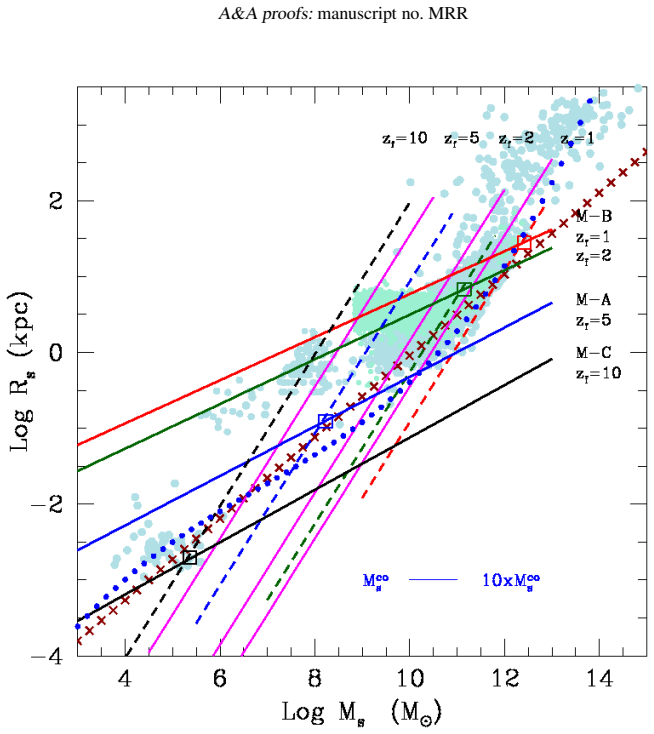
The central machinery is the Cosmic Galaxy Shepherd: the locus obtained by intersecting the halo growth function $n(M_D,z)$ at a fixed number density $N_s$ with the analytic collapse relation of eq. (10), which ties a stellar system's half-mass radius to its halo mass, stellar-to-halo mass ratio, Sersic profile and formation redshift. A second ingredient is the manifold of constant-initial-density tracks, the M-MRRs, summarized by eq. (31) as lines whose slope and zero point depend on the formation redshift. The observed mass-radius relation is the intersection of these two families of curves, and can also be reproduced by the Press-Schechter cut-off mass as a function of redshift; along the intersection, systems satisfy the virial condition and evolve passively.
What would settle it
Take a mass-complete, volume-limited sample of quiescent early-type galaxies and compare its high-mass edge on the mass-radius plane with the Cosmic Galaxy Shepherd calculated from the survey's own halo number density. If the edge falls inside the zone of avoidance at the expected number density, or if the edge does not move with redshift as the adopted cut-off mass changes, the proposed mechanism is wrong. A simpler check is to recompute $N_s$ using only early-type galaxies; if the resulting boundary no longer tracks the observed relation, the coincidence rests on the one-galaxy-per-halo assumption.
Extended reading notes
Core claim
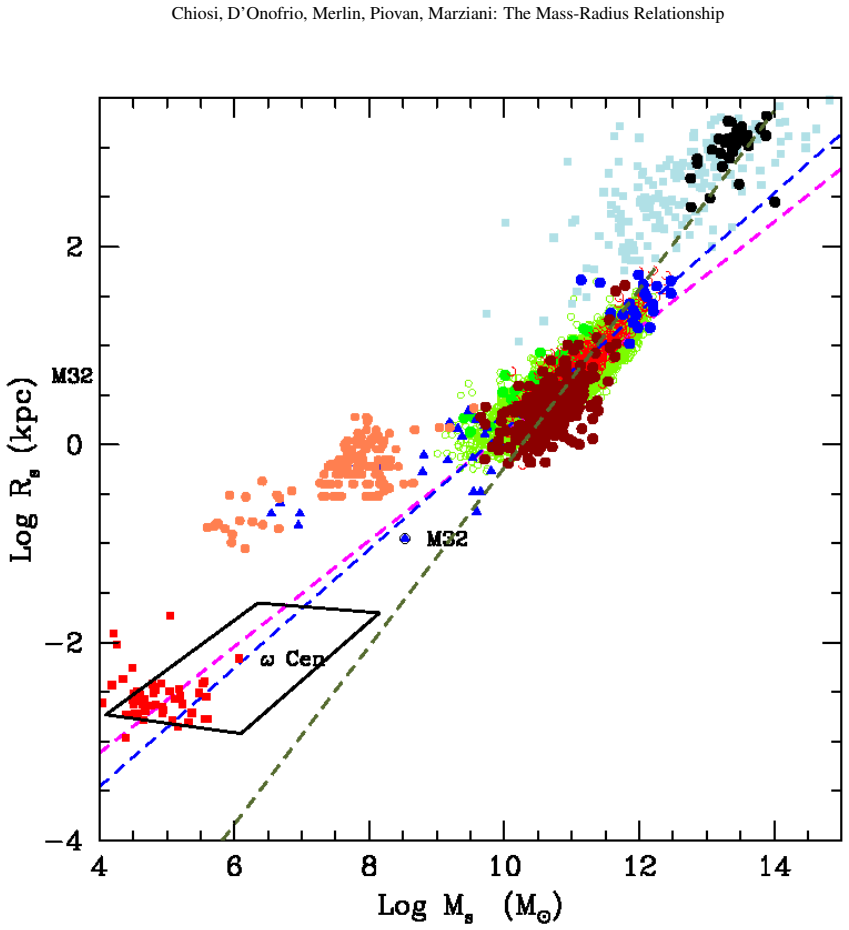
The paper claims that the observed mass-radius relation of stellar systems is not set by the virial theorem alone, nor by any single formation mechanism, but emerges where two ingredients cross. The first ingredient is a manifold of model mass-radius relations, each traced by objects of the same initial density (or formation redshift); the second is the redshift-dependent cut-off mass of the halo mass function, evaluated along a constant halo number density of $N_s = 10^{-2}$ halos per $(\mathrm{Mpc}/h)^3$. The cut-off line, named the Cosmic Galaxy Shepherd, runs close to the empirical mass-radius relation of the SDSS early-type galaxy sample and merges smoothly into the regions populated by globular clusters and galaxy clusters. Along this line objects are in virial equilibrium and passive evolution, and the slope of the line varies from about 0.5 to about 1 with increasing mass; galaxies with active star formation and strong winds, mainly dwarfs, lie above it.
Load-bearing premise
The construction assumes that every halo counted at the adopted number density $N_s=10^{-2}$ per $(\mathrm{Mpc}/h)^3$ hosts one and only one early-type galaxy of the kind in the comparison sample; because $N_s$ is taken from total SDSS galaxy counts rather than the early-type fraction alone, a lower true number density of early-type-hosting halos would move the Cosmic Galaxy Shepherd and could turn the agreement into a tuned coincidence.
Editorial extensions
If this is right
- The slope and curvature of the observed mass-radius relation, from roughly 0.5 for low-mass systems to about 1 for the most massive ones, are inherited from the shape of the halo growth function rather than from the virial theorem itself.
- The zone of avoidance below the relation is a cosmic-time statement: at each redshift, halos massive enough to populate that part of the plane are statistically too rare to be seen.
- Compact massive galaxies at high redshift should lie near the Cosmic Galaxy Shepherd for their epoch, above the present-day relation, rather than contradicting it; the paper indicates this will be examined in a companion study.
- Dwarf galaxies are expected to sit above the relation while star formation and galactic winds inflate them, and to settle onto it once they quench and reach mechanical and thermal equilibrium.
- The same construction spans stellar masses from globular clusters to galaxy clusters, about eleven orders of magnitude, with a single physical origin.
Reading between the lines
- If the Shepherd is recalibrated using only the number density of early-type galaxy hosts rather than all SDSS galaxies, its position will shift; this turns the paper's claimed coincidence into a quantitative, testable prediction rather than a posterior fit.
- The same boundary logic should apply to any population with a known collapse relation and a formation cutoff, such as globular cluster systems within a single galaxy or satellites within a cluster; checking whether their mass-radius envelopes show analogous shepherds would extend the idea beyond homogeneous galaxy samples.
- Surveys with different volumes or depths should see the high-mass edge of the mass-radius relation move: deeper volume coverage reaches rarer, more massive halos at fixed redshift and should push the envelope to larger masses and radii.
- A direct numerical convolution of the full halo mass function with the manifold of collapse tracks, rather than the linear intersection used in Section 5, would give a sharp test of the predicted slope and zero point across the whole mass range.
Signed reviews
Editorial analysis
A structured set of objections, weighed in public.
Referee Report
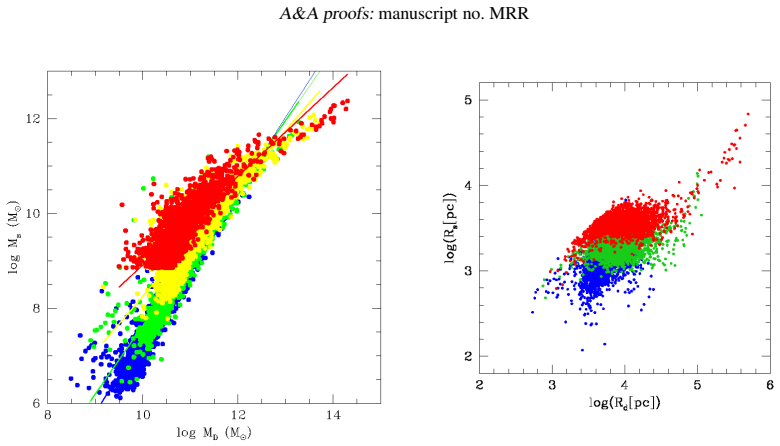
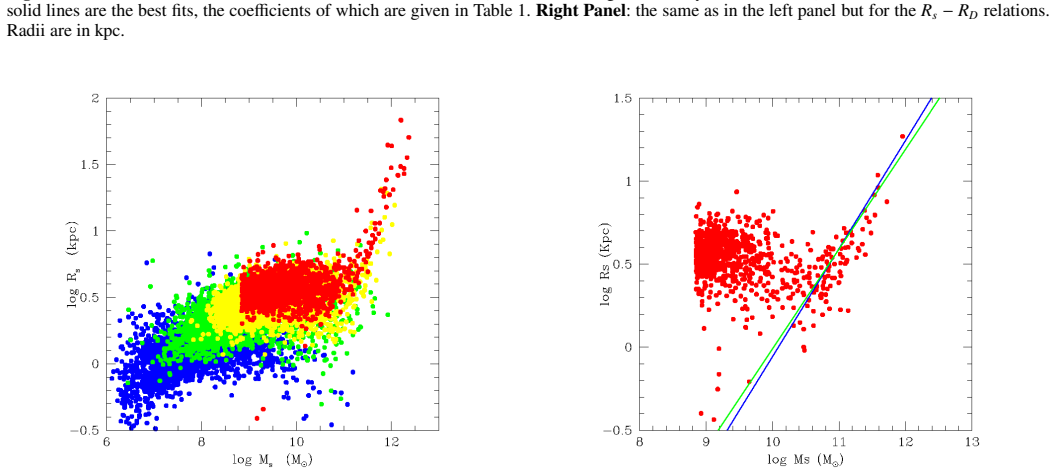
Summary. This paper (the third in a series) aims to explain the observed Mass-Radius Relation (MRR) spanned by globular clusters, early-type galaxies, and galaxy clusters/groups. The authors assemble literature data (Burstein et al. 1997; Bernardi et al. 2010; WINGS) and compare them with hydrodynamical models (Illustris, plus older monolithic and early-hierarchical simulations). They propose that the observed MRR is the envelope of two complementary effects: (i) lines of constant initial collapse density (M-MRRs, described by eqs. 10 and 31) that map halo mass and redshift to stellar mass and radius, and (ii) a redshift-dependent upper mass limit for halos, which they call the Cosmic Galaxy Shepherd (CGS), derived from the halo growth function via the condition n(MD,z)=Ns (eqs. 12-14). The intersections of the M-MRR manifold with the CGS boundary are claimed to reproduce the empirical ETG MRR (eq. 2), implying that objects along the MRR are in virial equilibrium and passive evolution. The paper is explicitly exploratory: several assumptions are labeled 'strong,' 'crude,' or 'provisional,' and the authors caution that the quantitative location of the CGS depends on uncertain ingredients.
Significance. If the proposed picture is correct, it provides a conceptually appealing and unifying explanation for why objects spanning ~11 orders of magnitude in stellar mass lie on a single, relatively narrow MRR: the relation emerges from the convolution of collapse physics (initial density) with cosmological halo growth (maximum halo mass at each epoch). The paper's qualitative argument that the MRR is a boundary rather than a fundamental scaling relation is interesting and worth testing. The authors deserve credit for using a wide range of observational data, comparing independent simulation schemes, and providing explicit analytical fits (e.g., eqs. 12-14, 31-33) that make the proposed mechanism falsifiable. However, the quantitative claims are not yet parameter-free: the CGS location depends on a number density Ns estimated from the total SDSS galaxy count rather than the ETG-hosting halo density, on a provisional z-independent stellar-to-halo mass relation, and on a free normalization in the Press-Schechter cut-off mass. These admitted uncertainties directly affect the central figures (Figs.
major comments (4)
- [Section 4.2, eqs. (12)-(14) and Fig. 8] The placement of the Cosmic Galaxy Shepherd uses Ns = 10^-2 halos per (Mpc/h)^3, derived from the total SDSS galaxy count (~10^6 galaxies over ~10^8 Mpc^3). The text itself calls the assumption that each halo hosts exactly one early-type galaxy 'a strong assumption.' Because the SDSS sample includes satellites and a large spiral/dwarf population, the number density of halo central galaxies that are early types is plausibly an order of magnitude or more lower. Since the condition n(MD,z)=Ns is steeply decreasing in MD, reducing Ns by a factor of 10-30 shifts the CGS to lower halo masses by roughly 0.5-1 dex, moving the predicted locus away from the Bernardi et al. (2010) points. Thus, the apparent coincidence between the CGS and the observed MRR in Fig. 8 is a tuning statement unless a separate, observationally motivated estimate of the ETG-hosting halo number density is provided.
- [Section 5, eqs. (32)-(33) and Fig. 9] Equation (32) defines the cut-off mass as MCO_T = MN × (1+z)^(-6/(n+3)), with MN described only as 'a suitable normalization mass scale.' In the Press-Schechter formalism the normalization is set by the power-spectrum amplitude (e.g., sigma_8) and the collapse threshold, so MN is not a free parameter; here it is left undetermined. Additionally, the text of Section 5 states that the curves are computed for gamma = 10 (MT = gamma * MCO_T), while the caption of Fig. 9 states that the dashed black lines correspond to 'total mass equal to 50 × MCO(z).' This discrepancy means that the maximum-mass boundary can be slid in the mass-radius plane by changing either MN or gamma. With two effective free normalizations in this step, the 'analytical demonstration' in Fig. 9 is not a parameter-free prediction; it is an exercise in matching the data with adjustable constants.
- [Appendix A, eq. (A.5), and Section 4.1] The stellar-to-halo mass ratio is a load-bearing ingredient because it converts the CGS halo masses into stellar masses via eq. (10). The adopted relation, log m = 0.062 log MD + 0.429, is fitted to Illustris galaxies at z = 0 and has no redshift dependence. The authors acknowledge this is provisional and note that other relations (e.g., Fan et al. 2010, Shankar et al. 2006, Girelli et al. 2020) disagree strongly at low halo masses and at high redshifts. Because the CGS is built from intersections over a wide redshift range, the z=0-only m(MD) may introduce a systematic bias in the predicted Ms and hence in the shape of the CGS in the MR-plane. The paper should quantify how the CGS changes when the redshift-dependent relations (A.1) or the Girelli et al. (2020) relations are used instead.
- [Section 5, eqs. (23)-(27)] The dissipation-less collapse derivation reproduces the slope of the observed MRR (eq. 23), but the zero-point constant k_gamma in eqs. (25)-(27) is explicitly left undetermined ('cannot be determined unless the constant k is specified by fixing the initial conditions'). Consequently, the agreement in slope between eq. (26) and the Bernardi et al. (2010) relation does not by itself constrain the MRR zero point; the latter is absorbed into k_gamma. This limits the strength of the claim that eq. (2) represents the locus of ideal dissipation-less collapse, because the zero-point remains a free parameter in the derivation.
minor comments (6)
- [Abstract] The abstract contains several typographical errors, including 'comsic' for 'cosmic' and 'evolution' in the final sentence where 'evolutions' or 'evolution processes' would be clearer. These should be corrected.
- [Introduction, Section 3 heading] The paper uses 'Section 3' twice: once for the description of simulations and once for 'The MRR of collapsing proto-galaxies.' The section numbering in the text should be made consistent.
- [Section 4.2, eq. (13)] Equations (13) and (14) are cubic polynomials in log Ms with many digits; it would be helpful to state the valid mass range for each fit and to give the fitting uncertainties, as is customary for empirical scaling relations.
- [Figure 9 caption] The caption states that the dashed black lines correspond to '50 × MCO(z),' while the body text says the calculation uses gamma = 10. This inconsistency should be resolved to avoid confusion about which parameter value was actually used.
- [Section 6, item (vi)] The conclusions section skips from item (iv) to item (vi); the numbering should be corrected or the missing item should be restored.
- [Appendix B.1] The description of the SCDM cosmology in Chiosi & Carraro (2002) could be confusing to readers because the rest of the paper adopts the Illustris Λ-CDM parameters; the distinction between the cosmological parameters used in the older models and those used in the present analysis should be clarified.
Circularity Check
The CGS boundary is partly calibrated: Ns is chosen so the curve sits at the ETG edge, and the Sec. 5 intersection proof contains an unspecified normalization and an inconsistent gamma; the slope/shape from the HGF is still independent.
-
fitted input called prediction
[Section 4.2, Eqs. (12)-(13), Fig. 8]
"It turns out that with the Ns corresponding to 10−2 halos per (Mpc/h)3 (that roughly corresponds to the volume surveyed by the SDSS), the curve is just at the edge of the observed distribution of ETGs on the MR-plane. Higher values of Ns would shift it to larger halos (baryonic galaxies), the opposite for lower values of Ns. ... Lower or higher values of the halo number density would predict loci in the MR-plane too far from the observational MRR."
Ns is the parameter that turns the Lukic halo growth function into the Cosmic Galaxy Shepherd on the MR-plane. The paper selects the value that places the curve 'just at the edge' of the Bernardi et al. ETG data and states that any other value moves it 'too far'; the CGS is then used to 'predict' the same observed MRR. The zero point of the prediction is therefore re-imported from the data, while only the slope/curvature is independently determined. The nominal SDSS count behind Ns = 10^-2 also counts all galaxies, not ETG central halos, an assumption the paper itself calls 'strong'.
-
other
[Section 5(vii)(b), Eqs. (32)-(33), and Fig. 9 caption]
"MCO_T = MN × (1+z)^−6/(n+3) (32) ... MN is a suitable normalization mass scale. ... limited to the case with MT = γ MCO_T for γ = 10 ... we get Rs = 16.9 × 10^12 × γ^−0.79 × (1+z)^3.96 × Ms (33). [Fig. 9 caption:] MRRs expected for galaxies with total mass equal to 50 × MCO(z)."
The 'analytical demonstration' that constant-density tracks intersect the cutoff-mass line on the observed MRR depends on two adjustable choices: the normalization MN, whose value is never specified, and the multiplicative factor γ, which is 10 in the text and 50 in the Fig. 9 caption. Since γ enters with exponent -0.79, changing it slides the boundary along the mass-radius plane, and with MN also free the intersection can be moved onto eq. (2). The statement 'This indeed is what we see in Fig. 9' is thus a consistency check made by the authors' choices, not a parameter-free first-principles prediction.
full rationale
The paper's qualitative claim, that the MR-plane distribution results from combining the collapse tracks of stellar systems with the redshift-dependent cutoff of the halo mass function, is a genuinely independent idea: the rising cutoff mass with time (Lukic et al. 2007; Press-Schechter) and the Fan et al. (2010) collapse relation are external inputs, and the curved slope change from ~0.5 to ~1 is not directly fitted to the Bernardi et al. (2010) fit. However, the quantitative CGS curve has a free normalization Ns that the authors effectively choose so that the curve is 'just at the edge' of the ETG data, and their Sec. 5 intersection proof leaves MN unspecified while using gamma=10 in the text and gamma=50 in the figure caption. Both degrees of freedom slide the predicted boundary along the MR-plane. The agreement in Figs. 8-9 is therefore partially a tuning statement, which is circular in the sense that a parameter selected after comparison with the target data is later presented as confirming the prediction. The heavy use of the authors' own earlier hydrodynamical models to build Eq. (31) is a self-citation, but those models are also compared with Illustris and with independent data, so I do not treat that as an independent circular step. Overall: the slope and shape derivation retains independent content, but the zero-point and the intersection demonstration are calibrated; score 6, not higher, because the central mechanism is not equivalent to the observed relation by definition.
Assumptions & free parameters
free parameters (6)
- Halo number density Ns =
10^-2 halos per (Mpc/h)^3
- Stellar-to-halo mass ratio m(MD) =
log m = 0.062 log MD + 0.429
- Velocity dispersion ratio f_sigma =
1
- Zero-point constant k_gamma in eq. (26) =
unspecified
- Gamma factor for maximum halo mass in eq. (33) =
10
- Primordial power spectrum slope n =
-1.8
assumptions (7)
- domain assumption Lambda-CDM cosmology with WMAP-7 parameters is the correct background for structure formation
- domain assumption The halo growth function n(MD,z) from Lukić et al. (2007) accurately describes the number density and cutoff of dark matter halos
- domain assumption The Fan et al. (2010) relation (eq. 10) gives the stellar half-mass radius from halo mass and collapse redshift
- ad hoc to paper Each dark matter halo hosts one and only one galaxy, and that galaxy is an early-type galaxy
- domain assumption The dissipationless spherical collapse model RT proportional to M_T^(5+n)/6 applies to galaxy formation
- ad hoc to paper The stellar-to-halo mass relation fitted to Illustris at z=0 (eq. A.5) is valid for all redshifts and masses used in the CGS calculation
- standard math The Press-Schechter cutoff mass M_CO(M) as a function of redshift (eq. 32) represents the maximum galaxy mass at each epoch
invented entities (1)
-
Cosmic Galaxy Shepherd (CGS)
Cite this review
Pith. "Pith review of The parallelism between galaxy clusters and early-type galaxies: III. The Mass-Radius Relationship." pith.science (2026). https://pith.science/paper/6O7D5ZB4
@misc{pith2026190808808,
  author       = {Pith},
  title        = {Pith review of: The parallelism between galaxy clusters and early-type galaxies: III. The Mass-Radius Relationship},
  year         = {2026},
  howpublished = {\url{https://pith.science/paper/6O7D5ZB4}},
  note         = {Machine review of arXiv:1908.08808}
}
read the original abstract
Context. This is the third study of a series dedicated to the observed parallelism of properties between Galaxy Clusters and Groups(GCGs) and early-type galaxies (ETGs). Aims. Here we investigate the physical origin of the Mass-Radius Relation (MRR). Methods. Having collected literature data on masses and radii for objects going from Globular Clusters (GCs) to ETGs and GCGs, we set up the MR-plane and compare the observed distribution with the MRR predicted by theoretical models both for the monolithic and hierarchical scenarios. Results. We argue that the distributions of stellar systems in the MR-plane is due to complementary mechanisms: (i) on one hand, as shown in paper II, the relation of the virial equilibrium does intersect with a relation that provides the total luminosity as a function of the star formation history; (ii) on the other hand, the locus predicted for the collapse of systems should be convolved with the statistical expectation for the maximum mass of the halos at each comsic epoch. This second aspect provides a natural boundary limit explaining either the curved distribution observed in the MR-plane and the existence of a zone of avoidance. Conclusions. The distribution of stellar systems in the MR-plane is the result of two combined evolution, that of the stellar component and that of the halo component.
Figures
Figures from the paper (5 more)


Reference graph
Works this paper leans on
- [1]
-
[2]
E., Springel , V., White , S
Angulo , R. E., Springel , V., White , S. D. M., et al. 2012, , 426, 2046
2012
-
[3]
Behroozi , P. S., Wechsler , R. H., Wu , H.-Y., et al. 2013, , 763, 18
work page 2013
- [4]
-
[5]
Bernardi , M., Roche , N., Shankar , F., & Sheth , R. K. 2011, , 412, L6
work page 2011
-
[6]
B., et al
Bernardi , M., Shankar , F., Hyde , J. B., et al. 2010, , 404, 2087
2010
-
[7]
R., Faber , S
Blumenthal , G. R., Faber , S. M., Primack , J. R., & Rees , M. J. 1984, , 311, 517
1984
-
[8]
Bryan , G. L. & Norman , M. L. 1998, , 495, 80
1998
Show all 75 references
-
[9]
2000, PhD thesis, Astronomy Department, Padova University, Vicolo Osservatorio 2, 35122 Padova, Italy
Buonomo , F. 2000, PhD thesis, Astronomy Department, Padova University, Vicolo Osservatorio 2, 35122 Padova, Italy
2000
-
[10]
1997, , 114, 1365
Burstein , D., Bender , R., Faber , S., & Nolthenius , R. 1997, , 114, 1365
1997
-
[11]
B., Grillo , C., Rosati , P., et al
Caminha , G. B., Grillo , C., Rosati , P., et al. 2017, , 607, A93
2017
-
[12]
2018, , 609, A133
Cariddi , S., D'Onofrio , M., Fasano , G., et al. 2018, , 609, A133
2018
-
[13]
M., et al
Cava , A., Bettoni , D., Poggianti , B. M., et al. 2009, , 495, 707
2009
-
[14]
& Carraro , G
Chiosi , C. & Carraro , G. 2002, , 335, 335
2002
-
[15]
2012, arXiv e-prints [ [arXiv] 1206.2532 ]
Chiosi , C., Merlin , E., & Piovan , L. 2012, arXiv e-prints [ [arXiv] 1206.2532 ]
2012 arXiv
-
[16]
G., Buta , R
Corwin , Jr., H. G., Buta , R. J., & de Vaucouleurs , G. 1994, , 108, 2128
1994
-
[17]
G., et al
de Vaucouleurs , G., de Vaucouleurs , A., Corwin , Jr., H. G., et al. 1991, Third Reference Catalogue of Bright Galaxies. Volume I: Explanations and references. Volume II: Data for galaxies between 0 ^ h and 12 ^ h . Volume III: Data for galaxies between 12 ^ h and 24 ^ h
1991
-
[18]
2014, , 572, A87
D'Onofrio , M., Bindoni , D., Fasano , G., et al. 2014, , 572, A87
2014
-
[19]
2019 a , , submitted
D'Onofrio , M., Chiosi , C., Sciarratta , M., & Marziani , P. 2019 a , , submitted
2019
-
[20]
2019 b , , 875, 103
D'Onofrio , M., Sciarratta , M., Cariddi , S., Marziani , P., & Chiosi , C. 2019 b , , 875, 103
2019
-
[21]
D., et al
Engler , C., Pillepich , A., Joshi , G. D., et al. 2020, arXiv e-prints, arXiv:2002.11119
2020 arXiv
-
[22]
Faber , S. M. 1984, in Large-Scale Structure of the Universe, ed. G. Setti & L. Van Hove , 187
1984
-
[23]
2010, , 718, 1460
Fan , L., Lapi , A., Bressan , A., et al. 2010, , 718, 1460
2010
-
[24]
2006, , 445, 805
Fasano , G., Marmo , C., Varela , J., et al. 2006, , 445, 805
2006
-
[25]
2012, , 420, 926
Fasano , G., Vanzella , E., Dressler , A., et al. 2012, , 420, 926
2012
-
[26]
M., Bettoni , D., et al
Fritz , J., Poggianti , B. M., Bettoni , D., et al. 2007, , 470, 137
2007
-
[27]
M., Cava , A., et al
Fritz , J., Poggianti , B. M., Cava , A., et al. 2011, , 526
2011
-
[28]
R., Masjedi , M., & West , A
Geha , M., Blanton , M. R., Masjedi , M., & West , A. A. 2006, , 653, 240
2006
-
[29]
2018, , 474, 3976
Genel , S., Nelson , D., Pillepich , A., et al. 2018, , 474, 3976
2018
-
[30]
2014, , 445, 175
Genel , S., Vogelsberger , M., Springel , V., et al. 2014, , 445, 175
2014
-
[31]
2020, arXiv e-prints, arXiv:2001.02230
Girelli , G., Pozzetti , L., Bolzonella , M., et al. 2020, arXiv e-prints, arXiv:2001.02230
2020 arXiv
-
[32]
Gott , III, J. R. & Rees , M. J. 1975, , 45, 365
1975
-
[33]
Graham , A. W. 2011, ArXiv e-prints: 1108.0997 [ [arXiv] 1108.0997 ]
2011 arXiv
-
[34]
Graham , A. W. 2013, Elliptical and Disk Galaxy Structure and Modern Scaling Laws , ed. T. D. Oswalt & W. C. Keel , 91
2013
-
[35]
2015, , 581, A41
Gullieuszik , M., Poggianti , B., Fasano , G., et al. 2015, , 581, A41
2015
-
[36]
H., Mo , H
Guo , Y., McIntosh , D. H., Mo , H. J., et al. 2009, , 398, 1129
2009
-
[37]
F., Khosroshahi , H
Hamraz , E., Peletier , R. F., Khosroshahi , H. G., et al. 2019, VizieR Online Data Catalog, J/A+A/625/A94
2019
-
[38]
1992, , 400, 460
Hernquist , L. 1992, , 400, 460
1992
-
[39]
1993, , 409, 548
Hernquist , L. 1993, , 409, 548
1993
-
[40]
2013, , 208, 19
Hinshaw , G., Larson , D., Komatsu , E., et al. 2013, , 208, 19
2013
-
[41]
M., Ferguson , H
Huang , K.-H., Fall , S. M., Ferguson , H. C., et al. 2017, , 838, 6
2017
-
[42]
M., Gebhardt , K., et al
Im , M., Faber , S. M., Gebhardt , K., et al. 2001, , 122, 750
2001
-
[43]
2011, , 730, 61
Karim , A., Schinnerer , E., Mart \' nez-Sansigre , A., et al. 2011, , 730, 61
2011
-
[44]
2006, , 448, 1031
Kissler-Patig , M., Jord \'a n , A., & Bastian , N. 2006, , 448, 1031
2006
-
[45]
Krumholz , M. R. & Tan , J. C. 2007, , 654, 304
2007
-
[46]
2017, , 604, A54
Kuchner , U., Ziegler , B., Verdugo , M., Bamford , S., & H \"a u ler , B. 2017, , 604, A54
2017
-
[47]
Lada , C. J. & Lada , E. A. 2003, 41, 57
2003
-
[48]
Luki \'c , Z., Heitmann , K., Habib , S., Bashinsky , S., & Ricker , P. M. 2007, , 671, 1160
2007
-
[49]
2009, , 500, 705
Mancini , C., Matute , I., Cimatti , A., et al. 2009, , 500, 705
2009
-
[50]
2010, , 513, A36
Merlin , E., Buonomo , U., Grassi , T., Piovan , L., & Chiosi , C. 2010, , 513, A36
2010
-
[51]
& Chiosi , C
Merlin , E. & Chiosi , C. 2006, , 457, 437
2006
-
[52]
& Chiosi , C
Merlin , E. & Chiosi , C. 2007, , 473, 733
2007
-
[53]
2012, ArXiv e-prints 1204.5118 [ [arXiv] 1204.5118 ]
Merlin , E., Chiosi , C., Piovan , L., et al. 2012, ArXiv e-prints 1204.5118 [ [arXiv] 1204.5118 ]
2012 arXiv
-
[54]
2017, , 599, A81
Moretti , A., Gullieuszik , M., Poggianti , B., et al. 2017, , 599, A81
2017
-
[55]
M., Fasano , G., et al
Moretti , A., Poggianti , B. M., Fasano , G., et al. 2014, , 564, A138
2014
-
[56]
2015, Astronomy and Computing, 13, 12
Nelson , D., Pillepich , A., Genel , S., et al. 2015, Astronomy and Computing, 13, 12
2015
-
[57]
& Bertin , G
Pasquato , M. & Bertin , G. 2008, , 489, 1079
2008
-
[58]
Press , W. H. & Schechter , P. 1974, , 187, 425
1974
-
[59]
2019, , 870, 70
Sciarratta , M., Chiosi , C., D'Onofrio , M., & Cariddi , S. 2019, , 870, 70
2019
-
[60]
2006, , 643, 14
Shankar , F., Lapi , A., Salucci , P., De Zotti , G., & Danese , L. 2006, , 643, 14
2006
-
[61]
2011, ArXiv e-prints [ [arXiv] 1105.6043 ]
Shankar , F., Marulli , F., Bernardi , M., et al. 2011, ArXiv e-prints [ [arXiv] 1105.6043 ]
2011 arXiv
-
[62]
J., White , S
Shen , S., Mo , H. J., White , S. D. M., et al. 2003, , 343, 978
2003
-
[63]
S., Behroozi , P., Pandya , V., et al
Somerville , R. S., Behroozi , P., Pandya , V., et al. 2018, , 473, 2714
2018
-
[64]
Springel , V., White , S. D. M., Jenkins , A., et al. 2005, , 435, 629
2005
-
[65]
A., Bell , E
Terrazas , B. A., Bell , E. F., Pillepich , A., et al. 2019, arXiv e-prints, arXiv:1906.02747
2019 arXiv
-
[66]
M., et al
Valentinuzzi , T., Fritz , J., Poggianti , B. M., et al. 2010, , 712, 226
2010
-
[67]
M., Fasano , G., et al
Valentinuzzi , T., Poggianti , B. M., Fasano , G., et al. 2011, , 536, A34
2011
-
[68]
G., Whitaker , K
van Dokkum , P. G., Whitaker , K. E., Brammer , G., et al. 2010, , 709, 1018
2010
-
[69]
2009, , 497, 667
Varela , J., D'Onofrio , M., Marmo , C., et al. 2009, , 497, 667
2009
-
[70]
2014 a , , 509, 177
Vogelsberger , M., Genel , S., Springel , V., et al. 2014 a , , 509, 177
2014
-
[71]
2014 b , , 444, 1518
Vogelsberger , M., Genel , S., Springel , V., et al. 2014 b , , 444, 1518
2014
-
[72]
2006, The Messenger, 126, 7
Warren , S., Lawrence , A., Almaini , O., et al. 2006, The Messenger, 126, 7
2006
-
[73]
2008, , 390, 1453
Woo , J., Courteau , S., & Dekel , A. 2008, , 390, 1453
2008
-
[74]
, " * write output.state after.block = add.period write newline
ENTRY address archiveprefix author booktitle chapter edition editor howpublished institution eprint journal key month note number organization pages publisher school series title type volume year label extra.label sort.label short.list INTEGERS output.state before.all mid.sent...
-
[75]
write newline
" write newline "" before.all 'output.state := FUNCTION n.dashify 't := "" t empty not t #1 #1 substring "-" = t #1 #2 substring "--" = not "--" * t #2 global.max substring 't := t #1 #1 substring "-" = "-" * t #2 global.max substring 't := while if t #1 #1 substring * t #2 gl...
Reviewed August 14, 2026 · model on record in the stance chip above.
Discussion (0). Continue with ORCID to comment.