REVIEW 3 major objections 4 minor 10 references
Self-Contained, Cooled SiPM Array for Scintillation Spectroscopy
T0 review · 3 major / 4 minor · reviewed 2026-08-14 · deepseek-v4-flash
Pith's one-line read A thermoelectrically cooled, fan-vented silicon photomultiplier array, held at -20 °C, cuts dark count by about 1000-fold and delivers gamma-ray spectra comparable to a photomultiplier tube above 25 keV in NaI.
desk verdict Useful engineering data on a cooled SiPM array, but the 'nearly identical to PMT' claim has no PMT metrics behind it, and the portability framing outruns the actual vacuum-pump/AC-fan apparatus. read the letter →
The pith
A machine-rendered reading of the paper's core claim, the machinery that carries it, and where it could break.
The reading
What carries the argument
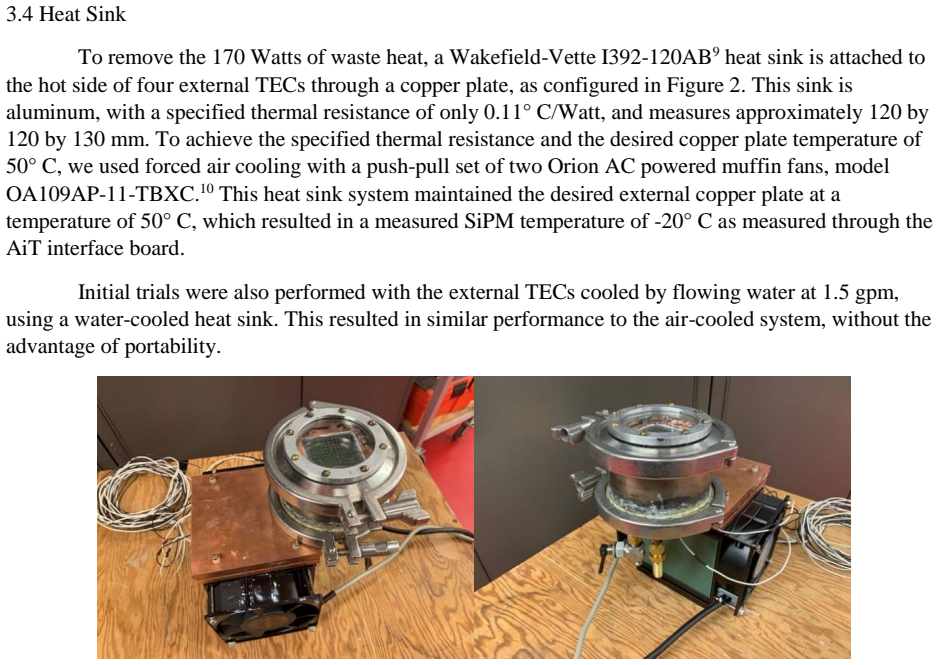
The mechanism that carries the argument is the thermal suppression of thermally generated carriers in silicon: SiPM dark count falls by roughly an order of magnitude for every 30 K of cooling, so reaching -20 °C from room temperature removes most of the noise that otherwise buries few-photon pulses. The engineering realization is a three-stage heat-removal chain: the SiPM is pressed against a sapphire window inside a rough vacuum and thermally coupled to an inner thermoelectric cooler; four parallel thermoelectric coolers outside the vacuum pull heat from the inner cooler's hot side; and a large aluminum heat sink with two AC fans vents the total 170 W of waste heat to room air. This chain makes the -20 °C operating point reachable without water cooling, which is what converts the detector from a bench device into a self-contained portable instrument.
What would settle it
Install an independently calibrated temperature sensor directly on the SiPM package and repeat the dark-count and Cs-137/Ba-133 measurements while logging that temperature; if the true silicon temperature is significantly warmer than -20 °C, or if the measured dark-count drop from room temperature to -20 °C does not follow the roughly order-of-magnitude-per-30-K trend, then the cooling explanation for the improved spectra is not supported.
Extended reading notes
Core claim
The central claim is that active cooling is sufficient, not just helpful, for SiPM-based scintillation spectroscopy. With the array at -20 °C, the dark count measured through the spectroscopy amplifier fell from 6630 kHz to 190 kHz at a 25 mV threshold and from 360 kHz to 0.01 kHz at a 125 mV threshold, so the highest-threshold background dropped by roughly four orders of magnitude. In pulse-height spectra, the Cs-137 photopeak resolution improved from 20% FWHM at room temperature to 16% when cold, and the cold spectrum showed the Compton edge, Compton plateau, and backscatter peak that were barely visible at room temperature; for Ba-133, the 356 and 303 keV peaks became distinguishable and the 81 and 31 keV peaks appeared. The authors conclude that, even with non-optimized air coupling to the NaI crystal, the cooled SiPM performs nearly identically to a PMT for energies above 25 keV in NaI.
Load-bearing premise
The load-bearing premise is that the board-reported -20 °C is the actual SiPM temperature during the spectra, and that the device is self-contained in practice — the prototype still needs an external roughing pump, so the portability claim assumes a sealed gas-filled enclosure can replace it without changing the thermal behavior.
Editorial extensions
If this is right
- A fan-cooled, thermoelectrically cooled SiPM package can be made portable and self-contained, because the air-cooled version performed like the water-cooled version in the same setup.
- Above roughly 25 keV in NaI, such a detector reproduces the photopeak, Compton edge, and backscatter features that nuclide identification relies on, despite the loss of low-energy sensitivity.
- The remaining low-energy limit is set by dark noise rather than by the SiPM itself, so improving cooling and light collection should push the threshold to lower energies.
- The design improvements the paper lists — a sealed gas-filled or getter-pumped enclosure, fewer thermal junctions, and multi-stage coolers — should reach -30 °C or below and widen the useful window.
Reading between the lines
- If the same dark-count scaling holds below -20 °C, reaching -30 °C should reduce the working dark rate by roughly another factor of two, likely turning the 31 keV Ba-133 shoulder into a distinct peak and lowering the spectral floor below 25 keV.
- The strong threshold dependence of the cooled dark count implies that the remaining noise is concentrated at small pulse heights; a pulse-shape or timing cut that rejects fast dark pulses might recover spectroscopy below 25 keV even before deeper cooling is engineered.
- Because the cooled array already matches a PMT with an ungreased air gap, adding optical coupling compound should increase light collection and could make the SiPM's photopeak resolution better than the PMT's rather than equal to it.
Signed reviews
Editorial analysis
A structured set of objections, weighed in public.
Referee Report
Summary. The paper describes a thermoelectrically cooled silicon photomultiplier (SiPM) array enclosed in a rough vacuum chamber and coupled through a glass window to a 2"x2" NaI scintillator. The authors report that cooling the SiPM array to -20 C reduces its dark count rate by factors ranging from about 36 to 10^5 depending on discriminator threshold (Table 2), and they show pulse-height spectra for Cs-137 and Ba-133 at room temperature and at -20 C, alongside spectra taken with a photomultiplier tube (PMT) in the same setup. The central claim, stated in Section 5, is that with non-optimized optical coupling the cooled SiPM performance is 'nearly identical' to that of a PMT for energies above 25 keV in NaI, making the system adequate for field gamma-ray spectroscopy. The paper also describes the thermal design, including an air-cooled heat sink replacing an earlier water-cooled version, and discusses straightforward improvements for lower temperatures.
Significance. If the central claim is quantitatively established, the work is a useful instrumentation contribution: it demonstrates that a compact, TEC-cooled SiPM array can resolve gamma-ray photopeaks and low-energy features (including the 31 keV Ba-133 line as a shoulder) that are invisible at room temperature, and it provides a practical thermal design with estimated heat loads. The strengths of the paper are its direct experimental approach, the use of standard calibration sources with a linear energy scale, and the honest discussion of limitations in Section 5 (vacuum pump requirement, proof-of-principle mechanics). However, the paper's headline comparative claim against a PMT rests entirely on qualitative visual comparisons; no PMT resolution or valley-to-peak metrics are reported, and no uncertainties are given for any rate, resolution, or dark-count value. These are missing-support issues rather than internal inconsistencies, and they are addressable with additional analysis of the already-recorded data.
major comments (3)
- [Section 4.2, 4.3, and 5] The central conclusion that the cooled SiPM performance is 'nearly identical to that of a PMT for energies above 25 keV' is unsupported because no PMT performance metric is reported anywhere. Section 4.2 gives the SiPM photopeak FWHM (20% at 25 C, 16% at -20 C) and valley-to-peak ratio (18% to 9.6%), and Section 4.3 says the SiPM shows the same peaks as the PMT with 'slightly worse' valley-to-peak ratios, but the corresponding PMT FWHM and valley-to-peak values from the same air-coupled geometry are never given. Please add a table with the PMT FWHM and valley-to-peak values (and ideally the same quantities for both SiPM temperatures) so that 'nearly identical' can be quantitatively evaluated.
- [Section 4.1, Table 2] The dark-count reduction factors are presented without uncertainties or replicate measurements. Table 2 lists single dark-count values at each threshold and temperature, and the text quotes reductions such as 'a factor of about 1000' and 'factors ranging up to 100,000' without statistical errors. The temperature readout from the AiT interface board is also quoted as -20 C with no stated accuracy. Since the dark-count reduction is the physical basis for the spectroscopic improvement, please provide uncertainties (or at least multiple runs) and state the accuracy of the temperature measurement.
- [Abstract and Section 5] The abstract calls the system 'self-contained,' but Section 3.1 explicitly states that 'A rotary vacuum pump connected to its base maintained the rough vacuum,' and Section 5 concedes that 'The need for a vacuum pump would be eliminated by use of a sealed, gas filled system.' As written, the demonstrated system requires an external vacuum pump and AC mains fans, so the portability/self-contained claim is not yet demonstrated. Please either temper the abstract and conclusion to say the cooling is self-contained while the full detector system remains a proof of principle, or add measurements with a sealed, gas-filled enclosure if one was tested.
minor comments (4)
- [Abstract] There is a typographical error: 'spectrsocopy' should be 'spectroscopy.'
- [Section 4.2 and 4.3, Figures 3 and 4] The spectra are shown as 'Normalized Count' but the text says only that channels were normalized around the 662 keV peak and counts were divided by the peak count. Please state the bin width and whether any smoothing was applied, since the line shapes appear smooth on the log scale.
- [Section 3.3, Table 1] The 'Electric 0.22' heat load for Section I is not explained in the text; clarify whether this is the Joule heating of the SiPM bias/readout electronics and how it was estimated.
- [References] Reference [5] (Moutinho et al.) is cited as a scintillating optical fiber dosimeter paper, but the URL provided points to a different article; please verify and correct the link.
Circularity Check
No circularity: the paper is a direct experimental measurement with an external PMT benchmark; the qualitative PMT comparison is under-supported but not circular.
full rationale
The paper is a direct experimental report, not a derivation. The dark-count reduction in Table 2 is an observed quantity, and the cooled SiPM spectra are measurements using a standard linear energy calibration from known photopeak energies; no fitted parameter is renamed as a prediction. The core comparative claim is benchmarked against a PMT run in the same setup, so the SiPM performance is externally anchored rather than derived from the paper's own assumptions. Statements such as the cooled SiPM being 'nearly identical' to a PMT and the PMT having superior noise below about 25 keV are qualitative and lack quantitative PMT metrics, but that is a missing-support or correctness concern, not circularity. There are no load-bearing self-citations; the cited references are datasheets and external SiPM characterizations that do not incorporate the present result. Therefore no circular step exists.
Assumptions & free parameters
assumptions (5)
- domain assumption Dark count of SiPMs falls by about one order of magnitude per 30 K temperature decrease.
- domain assumption Manufacturer datasheet values for the SiPM, TEC, and heat sink are accurate enough for design.
- standard math Thermal conductivity of gases is nearly independent of pressure down to below 1 mTorr, so 500 mTorr rough vacuum provides adequate insulation.
- domain assumption A linear energy calibration based on Cs-137 and Ba-133 photopeaks is valid across the measured energy range.
- domain assumption The room-temperature PMT measurement is a fair benchmark because the same NaI crystal and readout chain are used.
Cite this review
Pith. "Pith review of Self-Contained, Cooled SiPM Array for Scintillation Spectroscopy." pith.science (2026). https://pith.science/paper/NSZGHS3J
@misc{pith2026190808852,
  author       = {Pith},
  title        = {Pith review of: Self-Contained, Cooled SiPM Array for Scintillation Spectroscopy},
  year         = {2026},
  howpublished = {\url{https://pith.science/paper/NSZGHS3J}},
  note         = {Machine review of arXiv:1908.08852}
}
read the original abstract
A simple, self-contained, thermo-electrically cooled SiPM system is presented which cools a SiPM array to -20 C. The array views a NaI scintillator through a 75 mm diameter glass window. Waste heat is removed with a large heat sink and AC fans. Above 40 keV in an air-coupled 2" x 2" NaI scintillator, the SiPM dark count rate was reduced by a factor of about 1000 when cooled. Spectroscopic performance when cooled was very similar to a PMT tested in the same setup, and adequate for nuclear spectrsocopy above 25 keV. Originally, water cooling was used but it was replaced by air cooling which is more suitable for a self-contained system, giving the advantage of portability without degrading performance. Straightforward improvements would allow cooling the SiPM to -30 C or below, which would further reduce the dark count rate and extend the spectroscopically useful range to even lower energies. Such a system would be rugged and suitable for field use, for instance for inspection of cargo for gamma ray emissions.
Figures

Reference graph
Works this paper leans on
-
[1]
“C Series Datasheet.” Sensl, Apr. 2018. https://www.onsemi.com/PowerSolutions/product.do?id=C- SERIES%20SIPM
work page 2018
-
[2]
ArrayB-300Series-144P Preliminary Datasheet
“ArrayB-300Series-144P Preliminary Datasheet.” Sensl, May 2013. Downloaded Feb. 2013; no longer available, superseded by C-Series
work page 2013
-
[3]
“AB424T-ARRAY144P.” AiT Instruments. N.d. www.aid- instruments.com/AB424T_ARRAY144P_p/ab424tarray144p.htm
-
[4]
B-Series Preliminary Datasheet
“B-Series Preliminary Datasheet.” Sensl, Feb. 2013. Downloaded Feb. 2013; no longer available, superseded by C-Series
work page 2013
-
[5]
Development of a Scintillating Optical Fiber Dosimeter with Silicon Photomultipliers
Moutinho, L.M., et al. “Development of a Scintillating Optical Fiber Dosimeter with Silicon Photomultipliers.” Nuclear Instruments and Methods in Physics Research Section A: Accelerators, Spectrometers, Detectors and Associated Equipment, 2011, doi:10.1016/j.nima.2011.11.069. https://www.sciencedirect.com/science/article/pii/S0168900213013788 - 9 -
-
[6]
Cryogenic Characterization of FBK HD Near-UV Sensitive SiPMs
Acerbi, Fabio, et al. “Cryogenic Characterization of FBK HD Near-UV Sensitive SiPMs.” IEEE Transactions on Electron Devices, vol. 64, no. 2, 2017, pp. 521–526., doi:10.1109/ted.2016.2641586. https://arxiv.org/pdf/1610.01915.pdf
arXiv 2017
-
[7]
Technical Data Sheet for XLT2422
“Technical Data Sheet for XLT2422.” Marlow Industries. N.d. https://www.digikey.com/product- detail/en/marlow-industries-inc/XLT2422-01LS/1681-1081-ND/6159129
-
[8]
Chhabra, R. P. CRC Handbook of Thermal Engineering. 2nd ed., Taylor & Francis, CRC Press, 2017
work page 2017
Show all 10 references
-
[9]
Wakefield-Vette 392 Series
“Wakefield-Vette 392 Series.” Wakefield-Vette. N.d. https://www.digikey.com/product- detail/en/wakefield-vette/392-300AB/345-1174-ND/4864908
-
[10]
Orion Fans OA109 ‘XC Series.’
“Orion Fans OA109 ‘XC Series.’” Knight Electronics, Inc. N.d. https://orionfans.com/series.php?k=21
Reviewed August 14, 2026 · model on record in the stance chip above.
Discussion (0). Continue with ORCID to comment.