REVIEW 4 major objections 6 minor 45 references
Dissent and Rebellion in the House of Commons: A Social Network Analysis of Brexit-Related Divisions in the 57$^{ th}$ Parliament
T0 review · 4 major / 6 minor · reviewed 2026-08-14 · deepseek-v4-flash
Pith's one-line read Voting networks alone can predict which MPs will rebel on a Brexit deal with 94% accuracy, this paper claims.
desk verdict The network-based rebellion score is a reasonable descriptive tool, but the headline 'over 90% accuracy' is essentially a party-line baseline, so the paper should be revised or rejected as is. read the letter →
The pith
A machine-rendered reading of the paper's core claim, the machinery that carries it, and where it could break.
The reading
What carries the argument
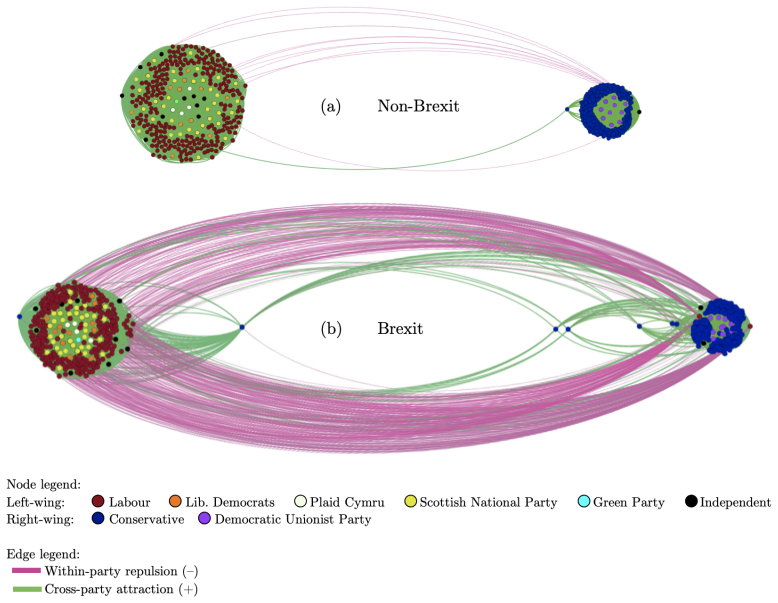
The central object is the rebellion metric: the sum of two eigenvector centralities computed on a signed, party-adjusted voting-similarity network. Each MP is a node; edge weights are the difference between the cosine similarity of two MPs' voting vectors and the similarity expected from their party or ideology, so positive edges mark cross-party alliances and negative edges mark within-party conflicts. Eigenvector centrality is computed separately on the positive-edge subnetwork and on the negative-edge subnetwork (with absolute weights), and the two scores are summed. This single number is then thresholded at an elbow in its distribution to label MPs as rebels or loyalists.
What would settle it
Take the same 639 MPs' centrality scores and apply the same elbow threshold to the next major Brexit-related division in the 57th or 58th Parliament; if the resulting accuracy does not exceed the always-non-rebel baseline (around 93%) by a substantial margin, the claim that the rebellion metric predicts future voting is not supported.
Extended reading notes
Core claim
On the paper's own terms, the central discovery is that the structure of an MP's voting relationships carries predictive signal about future rebellion. Building a signed network from pairwise cosine similarities of voting records, subtracting expected party or ideology coherence, and summing eigenvector centralities on the positive and negative edges yields a scalar rebellion score per MP. Using a threshold at the elbow of this score's distribution, the authors classify all 639 MPs as likely rebels or loyalists on the 22 October 2019 vote on the Brexit bill's expedited timetable, and report a confusion-matrix accuracy of 94% (580 true negatives, 20 true positives, 14 false positives, 25 false negatives).
Load-bearing premise
The claim of over 90% predictive accuracy rests on a single, class-imbalanced future division, with the rebel threshold selected from the same centrality distribution, and no comparison to a trivial always-non-rebel baseline, which would already achieve roughly 93% accuracy on that division.
Editorial extensions
If this is right
- If a parliament's voting record is public, the same pipeline can rank individual MPs by propensity to defect on any upcoming division, without requiring private whip information.
- The metric reveals that rebellion on European integration is not just a party-level phenomenon but is concentrated in identifiable individuals, as the paper's networks show blurred party clusters on Brexit divisions.
- The method can be re-run continuously across a parliament, so predictions can be updated after each division rather than waiting for end-of-term analysis.
- Because the approach uses only recorded votes, it could be extended to other legislatures with digital voting records.
Reading between the lines
- The reported 94% accuracy is computed on a single, class-imbalanced division where only about 7% of MPs actually rebelled; a natural extension is to compare the model's accuracy against a trivial always-non-rebel baseline on the same division, which would already score roughly 93%, to quantify the metric's added predictive value.
- A more stringent out-of-sample test would fix the rebel threshold using only divisions before 22 October 2019 and then apply it to that vote; the current procedure selects the threshold from the same centrality distribution used for the prediction.
- The paper's two-ideology relabeling shows rebellion can be defined at different granularities; an extension would be to let the threshold and ideology labels emerge from clustering the voting network itself, rather than being chosen a priori.
- The method is not limited to Brexit; it could be applied to any legislature where similar divisions exist, potentially producing a real-time dissent index for journalists and political analysts.
Signed reviews
Editorial analysis
A structured set of objections, weighed in public.
Referee Report
Summary. The paper uses Hansard division records from the 57th Parliament (June 2017 to April 2019) to construct cosine-similarity networks among MPs, adjusting the pairwise voting similarities by party and ideological affiliation, and splitting the divisions into Brexit and non-Brexit sets. It visualizes cross-party alliances and within-party conflicts, computes an eigenvector-centrality-based rebellion score for every MP, and reports a top-10 rebel list. The main claims are that Brexit divisions show significantly more dissent than non-Brexit divisions and that the rebellion metric predicted MPs' voting on the October 22, 2019 timetable division with 'over 90% accuracy,' which the supplementary material quantifies as 94%.
Significance. If the predictive claim were supported, the paper would provide an interesting individual-level complement to aggregate party-cohesion metrics, and the use of public parliamentary records with a replication data DOI is a strength. The descriptive network analysis offers a clear way to visualize Brexit-related fragmentation. However, the central result rests on an accuracy calculation that is barely above a trivial always-non-rebel baseline, on a rebellion threshold selected from the full sample, and on a prediction target defined using the same party/ideology labels that enter the construction of the rebellion metric. The authors explicitly acknowledge that the analysis is not causal and that aggregate cohesion measures have their own merits, but they do not address the baseline problem or the limited out-of-sample evidence. As a result, the headline claim of forecasting skill is not supported by the reported analysis.
major comments (4)
- [Validation and Table S1] The reported 94% accuracy does not demonstrate predictive skill because it is measured against a nearly identical trivial baseline. Supplementary Table S1 gives 580 true negatives, 20 true positives, 14 false positives, and 25 false negatives, so the model's accuracy is (580+20)/639 = 93.9%. Since 594 of 639 MPs (93.0%) did not rebel, a classifier that simply labels every MP as a non-rebel also achieves 93.0% accuracy. The model's entire improvement is 6 correct classifications, or 0.94 percentage points, with a recall of only 20/45 = 44.4% for actual rebels and no confidence interval or significance test. The statement in the Validation section that the accuracy score is 94% and that this validates the centrality metric is therefore not supported.
- [Methods and Validation] The rebellion metric is defined as deviation from party- and ideology-adjusted voting similarity, and the validation labels an MP as a rebel if he or she votes against the party/ideology expectation (Table 3). This means the same party and ideology labels are used both to construct the predictor and to define the outcome. The October 2019 division is temporally out-of-sample, which gives some independence, but the outcome is not independent of the labels used to build the model. A stronger test would predict the direction of the vote (Aye/No) directly, or would use a rebellion definition that is not derived from the same party/ideology similarity matrices that generate the eigenvector centralities.
- [Supplementary Material: Accuracy score calculation] The elbow threshold of 0.21 is selected from the full distribution of all 639 eigenvector centralities, and the entire predictive evaluation rests on a single future division in which only 45 of 639 MPs (7.0%) rebelled. No cross-validation, alternative thresholds, or sensitivity analysis is reported. Given the class imbalance and the data-dependent threshold, the claimed accuracy is not a robust measure of forecasting skill; an out-of-sample threshold selection rule or a pre-registered cut-off would be needed to support the 'over 90% accuracy' claim.
- [Results: Party and ideology-adjusted voting similarity matrices] The abstract's claim that the methodology 'was able to detect a significant difference in eurosceptic behaviour' is an overstatement of what is shown. The Kolmogorov-Smirnov test in this section only establishes that the distributions of pairwise similarity scores differ between Brexit and non-Brexit divisions; it does not establish that the difference is specifically eurosceptic in nature, nor does it quantify the effect size or identify which parties or MPs drive the difference. The histogram suggests more within-party conflict on Brexit divisions, but connecting this to euroscepticism requires additional party-specific evidence rather than a single KS test.
minor comments (6)
- [Data and Methods] The data period is stated as '21st June, 2017 until 10th April' without a year; this should be corrected to a complete date range.
- [Results and Figure 4] The phrase 'regardless of arbitrary labeling (false positives)' is confusing: an MP detected as a rebel by visual inspection but not by the centrality score is not a statistical false positive. The terminology should be clarified or rephrased.
- [Table 3] The table and its footnotes do not make clear for each MP whether the recorded vote is on the Brexit bill itself or on the expedited timetable division, even though the validation text says the comparison uses the second debate. A column or footnote specifying the division used for each comparison would remove ambiguity.
- [Supplementary Material: Table S1] The confusion matrix labels should explicitly define rows and columns (e.g., 'Predicted rebellion status' versus 'Actual rebellion status') and state that the accuracy formula uses the table orientation shown; the current presentation makes it easy to misread the orientation.
- [Data and Methods: Ideology labels] The ideology labels for Independent MPs are inferred from prior party affiliation, and for Lady Hermon from a 2010 BBC news report. The sensitivity of the top-10 list and of the accuracy score to these choices is not discussed; a robustness check with alternative ideology assignments would strengthen the analysis.
- [Data Availability] The data availability statement has a missing space before the URL ('found athttps://'); this should be corrected for readability.
Circularity Check
No significant circularity; the out-of-sample validation is genuine, though the reported 94% accuracy is only marginally above the trivial always-non-rebel baseline.
full rationale
The paper's predicted target is rebel status on the 22 October 2019 timetable division, and the rebellion metric is built from party/ideology-adjusted voting similarities and eigenvector centralities over the earlier 414 divisions. The validation division is genuinely out-of-sample: it is not used to compute the centralities, and the elbow threshold of 0.21 is selected from the centrality distribution without reference to the validation outcomes. The confusion matrix is fully reported, allowing the accuracy figure to be checked: 580 of the 639 MPs are true negatives, and a trivial classifier predicting no rebels would achieve 594/639 = 93.0% accuracy, so the model's improvement over the baseline is only 0.94 percentage points. That is a substantive weakness in the strength of the predictive claim, but it is a benchmark/statistical issue rather than circularity. No parameter is fitted to the validation labels, no load-bearing self-citation is used, and no uniqueness theorem is imported from the authors' prior work. The derivation chain is self-contained, and the future vote provides an independent, albeit weak, test. Thus no circular step is exhibited.
Assumptions & free parameters
free parameters (3)
- Elbow cut-off for rebel classification =
0.21 (eigenvector centrality)
- Ideology labels for Independent MPs =
Categorical (e.g., Lady Hermon labelled Left-wing)
- Edge thresholds for network visualization =
>=1 and <= -1
assumptions (3)
- domain assumption Cosine similarity with +1/-1/0 vote encodings is a valid similarity measure for voting pairs.
- domain assumption The manual classification of divisions into Brexit and non-Brexit based on title keywords is accurate and unbiased.
- ad hoc to paper The sum of eigenvector centralities from the positive and negative subnetworks is an appropriate rebellion metric.
Cite this review
Pith. "Pith review of Dissent and Rebellion in the House of Commons: A Social Network Analysis of Brexit-Related Divisions in the 57$^{ th}$ Parliament." pith.science (2026). https://pith.science/paper/ZCRMXYUX
@misc{pith2026190808859,
  author       = {Pith},
  title        = {Pith review of: Dissent and Rebellion in the House of Commons: A Social Network Analysis of Brexit-Related Divisions in the 57$^ th$ Parliament},
  year         = {2026},
  howpublished = {\url{https://pith.science/paper/ZCRMXYUX}},
  note         = {Machine review of arXiv:1908.08859}
}
read the original abstract
The British party system is known for its discipline and cohesion, but it remains wedged on one issue: European integration. We offer a methodology using social network analysis that considers the individual interactions of MPs in the voting process. Using public Parliamentary records, we scraped votes of individual MPs in the 57th parliament (June 2017 to April 2019), computed pairwise similarity scores and calculated rebellion metrics based on eigenvector centralities. Comparing the networks of Brexit- and non-Brexit divisions, our methodology was able to detect a significant difference in eurosceptic behaviour for the former, and using a rebellion metric we predicted how MPs would vote in a forthcoming Brexit deal with over 90% accuracy.
Figures


Figures from the paper (1 more)

Reference graph
Works this paper leans on
-
[1]
Ashford (1980). The European Community . In Z. Layton-Henry (Ed.), Conservative Party Politics . New York: Macmillan
work page 1980
-
[2]
Baker, D., A. S. Ludlam, and D. Seawright (1999). Backbenchers with attitude: A seismic study of the conservative party and dissent on europe. In S. Bowler, D. M. Farrell, and R. S. Katz (Eds.), Party discipline and parliamentary government , Chapter 4, pp.\ 72--98. Ohio State University Press Columbus, OH
work page 1999
-
[3]
MP Hermon quits Ulster Unionists
BBC (2010, March). MP Hermon quits Ulster Unionists . British Broadcasting Corporation\/ . http://news.bbc.co.uk/2/hi/uk_news/northern_ireland/8586845.stm. Last accessed 2019-07-03
-
[4]
Beer, S. H. (1969). British politics in the collectivist age . A Vintage giant ; V -563. New York: Vintage Books
work page 1969
-
[5]
Collie, M. P. (1984). Voting Behavior in Legislatures . Legislative Studies Quarterly\/ 9\/ (1), 3--50
work page 1984
-
[6]
Cowley, P. and P. Norton (1999, April). Rebels and rebellions: Conservative MPs in the 1992 Parliament . The British Journal of Politics & International Relations\/ 1\/ (1), 84--105
work page 1999
- [7]
-
[8]
Dickson, A. (2017, September). 40 Brexit troublemakers: The ranking. https://www.politico.eu/list/brexit-40-troublemakers-ranking/. Last accessed on 2019-07-05
work page 2017
Show all 45 references
-
[9]
Electoral Commission EU referendum results
Electoral Commission (2016). Electoral Commission EU referendum results. https://www.electoralcommission.org.uk/find-information-by-subject/elections-and-referendums/past-elections-and-referendums/eu-referendum/electorate-and-count-information. Last accessed on 2019-06-23
2016
-
[10]
Epstein, L. D. (1956). Cohesion of British Parliamentary Parties . The American Political Science Review\/ 50\/ (2), 360--377
1956
-
[11]
(2019, April)
Forrest, A. (2019, April). Pro- Remain Labour candidate wins by-election in Leave -voting Newport West . Last accessed on 2019-07-05
2019
-
[12]
Forster, A. (2002). Euroscepticism in contemporary British politics: opposition to Europe in the British Conservative and Labour parties since 1945 . London: Routledge
2002
-
[13]
Frei, M. (2019). Remainer MP Admits He 's Prepared To Lose His Seat In Order To Cancel Brexit . LBC: Leading Britain's Conversation\/ . Last accessed on 2019-07-05
2019
-
[14]
Garner, C. and N. Letki (2005). Party Structure and Backbench Dissent in the Canadian and British Parliaments . Canadian Journal of Political Science / Revue canadienne de science politique\/ 38\/ (2), 463--482
2005
-
[15]
(2018, August)
Hanley, L. (2018, August). Why is Frank Field still an MP for the Labour party? Lynsey Hanley . The Guardian\/
2018
-
[16]
(2019, January)
Hanson, D. (2019, January). No Deal Brexit . Last accessed on 2019-07-05
2019
-
[17]
Hazan, R. Y. (2003, December). Does Cohesion Equal Discipline ? Towards a Conceptual Delineation . The Journal of Legislative Studies\/ 9\/ (4), 1--11
2003
-
[18]
Hoey, K. and G. Stringer (2019, January). There is no case for another referendum. Last accessed on 2019-07-05
2019
-
[19]
Jackson, R. J. (1968). Rebels and whips: an analysis of dissension, discipline and cohesion in British political parties . London: Macmillan
1968
-
[20]
Venturini, S
Jacomy, M., T. Venturini, S. Heymann, and M. Bastian (2014, June). ForceAtlas 2, a Continuous Graph Layout Algorithm for Handy Network Visualization Designed for the Gephi Software . PLOS ONE\/ 9\/ (6), e98679
2014
-
[21]
Lazer, H. (1969). Review of Rebels and Whips : An Analysis of Dissension , Discipline and Cohesion in British Political Parties . Comparative Politics\/ 1\/ (4), 548--550
1969
-
[22]
Lynch, P. and R. Whitaker (2018, April). All Brexiteers now? Brexit , the Conservatives and party change. British Politics\/ 13\/ (1), 31--47
2018
-
[23]
Mairs, N. (2019). Opposition parties fail in bid to block no-deal Brexit after Labour rebellion. https://www.politicshome.com/news/uk/foreign-affairs/brexit/news/104538/opposition-parties-fail-bid-block-no-deal-brexit-after. Last accessed on 2019-08-15
2019
-
[24]
(2018, July)
McDonald, K. (2018, July). The Four Labour MPs who voted with the Government to save Jacob Rees - Mogg 's Brexit amendment. https://inews.co.uk/news/brexit/four-labour-mps-rebel-brexit-amendment-put-forward-by-jacob-rees-moggs-group/. Last accessed on 2019-07-05
2018
-
[25]
(2018, January)
Moore, L. (2018, January). Policy, Office and Votes : Conservative MPs and the Brexit Referendum . Parliamentary Affairs\/ 71\/ (1), 1--27
2018
-
[26]
Norton, P. (1980). The Changing Face of the British House of Commons in the 1970s. Legislative Studies Quarterly\/ 5\/ (3), 333--357
1980
-
[27]
Norton, P. (2003). Part 1: Cohesion without discipline: Party voting in the house of lords. The Journal of Legislative Studies\/ 9\/ (4), 57--72
2003
-
[28]
(2018, January)
Orchard, R. (2018, January). Ken Clarke : ' I am very glad I am here. It 's the maddest situation I have seen in my entire political career'. https://www.politicshome.com/news/uk/political-parties/conservative-party/house/house-magazine/91960/ken-clarke-i-am-very-glad-i. Last ...
2018
-
[29]
Johnston, and M
Pattie, C., R. Johnston, and M. Stuart (1998). Voting without party? In P. Cowley (Ed.), Conscience and Parliament , pp.\ 162. Frank Cass, London
1998
-
[30]
Plumb, A. (2013). Research note: a comparison of free vote patterns in westminster-style parliaments. Commonwealth & Comparative Politics\/ 51\/ (2), 254--266
2013
-
[31]
Raymond, C. D. and R. M. Worth (2017, November). Explaining voting behaviour on free votes: Solely a matter of preference? British Politics\/ 12\/ (4), 555--564
2017
-
[32]
Rice, S. A. (1938). Quantitative methods in politics. Journal of the American Statistical Association\/ 33\/ (201), 126--130
1938
-
[33]
(2014, September)
Russell, M. (2014, September). Parliamentary party cohesion: Some explanations from psychology. Party Politics\/ 20\/ (5), 712--723
2014
-
[34]
Samuels, S. (1969). Review of Rebels and Whips : An Analysis of Dissension , Discipline and Cohesion in British Political Parties . The American Historical Review\/ 75\/ (1), 129--130
1969
-
[35]
Searing, D. D. (1978). Measuring Politicians ' Values : Administration and Assessment of a Ranking Technique in the British House of Commons . The American Political Science Review\/ 72\/ (1), 65--79
1978
-
[36]
(2006, June)
Sieberer, U. (2006, June). Party unity in parliamentary democracies: A comparative analysis. The Journal of Legislative Studies\/ 12\/ (2), 150--178
2006
-
[37]
Stokes, B. (2016). Euroskepticism beyond brexit. Pew Research Center\/ 7
2016
-
[38]
Streeter, G. (2019). BREXIT - my position ahead of the vote. https://www.garystreeter.co.uk/news/brexit-my-position-ahead-vote. Last accessed on 2019-07-05
2019
-
[39]
(2018, December)
Surridge, P. (2018, December). Brexit, British Politics , and the Left - Right Divide . Political Insight\/ 9\/ (4), 4--7
2018
-
[40]
The Bruges Speech
Thatcher, M. (1988). Speech to the College of Europe (" The Bruges Speech ") Margaret Thatcher Foundation . https://www.margaretthatcher.org/document/107332. Last accessed on 2019-07-05
1988
-
[41]
(2014, March)
Tzelgov, E. (2014, March). Cross-cutting issues, intraparty dissent and party strategy: The issue of European integration in the House of Commons . European Union Politics\/ 15\/ (1), 3--23
2014
-
[42]
(2019, April)
Umunna, C. (2019, April). This is why our new party will not be forming a 'pro- Remain alliance ' for the European elections. https://www.independent.co.uk/voices/. brexit-european-elections-mep-change-uk-the-independent-group-remain-leave-alliance-a8881306.html. Last accessed...
2019
-
[43]
(2016, April)
Vasilopoulou, S. (2016, April). UK Euroscepticism and the Brexit Referendum . The Political Quarterly\/ 87\/ (2), 219--227
2016
-
[44]
Whiteley, P. F. and P. Seyd (1999). Discipline in the british conservative party: The attitudes of party activists toward the role of their members of parliament. In S. Bowler, D. M. Farrell, and R. S. Katz (Eds.), Party discipline and parliamentary government , Chapter 3, pp....
1999
-
[45]
Wood, D. M. (1982). Comparing Parliamentary Voting on European Issues in France and Britain . Legislative Studies Quarterly\/ 7\/ (1), 101--117
1982
Reviewed August 14, 2026 · model on record in the stance chip above.
Discussion (0). Continue with ORCID to comment.