REVIEW 2 major objections 5 minor 26 references
An Accurate Approximation of Resource Request Distributions in Millimeter Wave 3GPP New Radio Systems
T0 review · 2 major / 5 minor · reviewed 2026-08-14 · deepseek-v4-flash
Pith's one-line read The paper claims that SNR at a random user in 3GPP millimeter-wave New Radio closely follows a Normal mixture, making session resource-request distributions computable with error functions.
desk verdict Useful closed-form approximation for mmWave NR resource pmf, but the validation benchmark mixes blockage with a distance-averaged probability and that needs fixing. read the letter →
The pith
A machine-rendered reading of the paper's core claim, the machinery that carries it, and where it could break.
The reading
What carries the argument
The load-bearing construction is the mixture CDF $W_S(x)=p_B W_{S,B}(x)+(1-p_B)W_{S,\mathrm{nB}}(x)$, where each component CDF comes from Eq. (13): the distance-induced SNR distribution of a uniformly located UE is transformed into a density via the random-variable method, then convolved with a zero-mean Normal shadow-fading term. The weight $p_B$ is the distance-averaged blockage probability from the random-direction-mobility blocker model. This construction matters because the convolution with Gaussian shadow fading yields an expression in error functions, and the final mixture is then replaced by Normal components with matched first two moments, giving a closed-form route to $m_j$ and hence to the resource-request pmf.
What would settle it
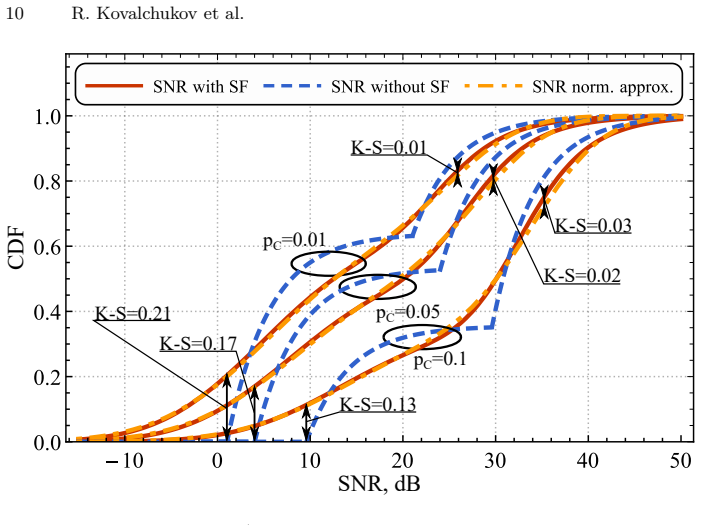
Simulate a millimeter-wave sector with explicit blockers whose positions correlate with user distance, compute the empirical SNR CDF conditioned on blocked and unblocked states, and compare it with the paper's Eq. (16) mixture; if the Kolmogorov-Smirnov distance rises well above the reported 0.01 to 0.03, the independence assumption is the reason.
Extended reading notes
Core claim
The central discovery is that Lognormal shadow fading smooths the distance-induced SNR distribution into a nearly Gaussian shape. In decibels, the SNR at a uniformly located UE is represented as $S_{\mathrm{SF}} = S_{\mathrm{dB}} + \mathrm{Norm}(0,\sigma_{\mathrm{SF}})$, and the paper claims the resulting CDF is well fitted by weighted Normal components for blocked and non-blocked line-of-sight states, with mean $\mathbb{E}[S_{\mathrm{dB}}]$ and standard deviation $\sqrt{\sigma_{\mathrm{SF}}^2+\sigma_{\mathrm{SdB}}^2}$. Substituting this CDF into the MCS selection probabilities $m_j = F_S(s_{j+1}) - F_S(s_j)$ and then into the resource binning formula turns the session resource-request pmf into error functions. In the reported scenarios the fitted mean matches the exact mean SNR to the shown precision, the fitted standard deviation matches to three decimal places, and mean resource requests from the approximation differ from the full model by at most about two percent (e.g., 3.21 vs 3.27 at $p_C=0.1$ and 5 Mbps).
Load-bearing premise
The load-bearing premise is that the blocked and non-blocked SNR states can be mixed with a single blockage probability averaged over all user distances, so the link state and the user's distance from the base station are treated as independent.
Editorial extensions
If this is right
- Queuing and session-level models of 5G NR can evaluate resource-request pmfs in closed form instead of numerical convolution.
- Ignoring shadow fading is not a minor simplification: in the paper's tables the mean resource request without shadow fading is roughly 15 to 35 percent lower than with it.
- The Normal fit gets better as shadow-fading variance increases, so the approximation is most reliable in the channels where direct numerical evaluation is most costly.
- The same error-function machinery extends to random session rates, as the paper notes in its conclusion.
Reading between the lines
- Because the Gaussian shape comes from convolution smoothing rather than from the specific UMi constants, the approximation likely carries over to other standardized deployment scenarios with different path-loss exponents and shadow-fading variances; testing this transfer is a direct next step.
- The fixed interference margin leaves room for an SINR extension: a stochastic interference term could be absorbed into the Normal mixture instead of the constant $M_I$.
- A spatially explicit simulation that conditions user distance on blocked versus unblocked state would test whether the distance-averaged $p_B$ in Eq. (16) is accurate or whether the correlation between blockage and distance shifts the mixture weights.
Signed reviews
Editorial analysis
A structured set of objections, weighed in public.
Referee Report
Summary. The paper develops an analytical approximation to the session resource-request probability mass function (pmf) in a single-sector millimeter-wave 3GPP New Radio deployment. The model assumes uniformly distributed user equipment, 3GPP-like distance-dependent path loss with two link states (blocked/non-blocked), dynamic blockage, and lognormal shadow fading. The authors derive closed-form SNR CDFs for the blocked and non-blocked states, mix them using a distance-averaged blockage probability in Eq. (16), and then approximate the resulting CDF by a mixture of Normal distributions whose mean and standard deviation are moment-matched to the analytical model. This lets the resource-request pmf be evaluated through error functions. Numerical results report Kolmogorov-Smirnov statistics between 0.01 and 0.03 for the Normal fit and mean resource requests within a few percent in Table 4, and the paper highlights that omitting shadow fading changes the pmf substantially.
Significance. If the central claim is correct, the paper provides a useful computational shortcut: replacing a numerical convolution over user location and shadow fading with a closed-form Normal-mixture approximation would speed up queueing and stochastic-geometry analyses of 5G NR sessions. The derivation of the closed-form SNR CDF in Eq. (13) is a genuine technical contribution, and the explicit moment matching makes the approximation transparent. However, the validation benchmark in Eq. (16) is itself questionable because it mixes distance-unconditioned CDFs with a distance-averaged blockage probability even though the blockage probability in Eq. (14) is distance-dependent. The reported K-S statistics and Table 4 errors are therefore measured against a possibly biased reference; the magnitude of this bias is unreported. The issue is addressable, but it is load-bearing for the paper's main claim, so the manuscript requires major revision.
major comments (2)
- [Section 3.2, Eq. (16)] The mixture W_S(x) = p_B W_SB(x) + (1-p_B) W_SnB(x) is not the correct unconditional SNR CDF when the blockage probability depends on distance. Equation (14) gives p_B(x) increasing with 2D distance x, while the path loss in Eq. (2) also depends on distance. The correct unconditional CDF is F_S(s) = ∫ [p_B(x) F_{S|B,x}(s) + (1-p_B(x)) F_{S|nB,x}(s)] f_X(x) dx, whereas Eq. (16) computes p_B ∫ F_{S|B,x}(s) f_X(x) dx + (1-p_B) ∫ F_{S|nB,x}(s) f_X(x) dx. The difference is Cov(p_B(X), F_{S|B,X}(s) - F_{S|nB,X}(s)), which is generally non-zero because both p_B(x) and the conditional SNR CDFs vary with x. Since Eq. (16) is the 'exact' benchmark used in Section 4 to assess the Normal approximation, the reported K-S values and Table 4 errors may not reflect the true accuracy of the approximation. Please replace the benchmark with the correct distance-conditioned mixture, or validate against Monte Carlo simulation, and recompute the reported statistics.
- [Section 4.1, Fig. 2 and Table 4] The Normal approximation is parameterized by the first two moments of the analytical model and then compared with that same analytical model. Agreement in mean and standard deviation is therefore partly by construction; the K-S statistic is informative about shape beyond the first two moments, but it is an in-sample metric. More importantly, the comparison is made against Eq. (16), which, per the comment above, is itself an approximation. Please report the distance-conditioned benchmark (or a simulation-based benchmark) and the resulting K-S statistics and pmf errors, including the maximum absolute error or total variation distance between the approximate and correct resource-request pmfs.
minor comments (5)
- [Section 2, Eq. (9)] The variable d_E is used in Eq. (9) but is not defined; it appears to denote the coverage radius r_A. Please define it explicitly.
- [Section 3.2, Eq. (13)] The symbol gamma appears in the argument of the error functions in Eq. (13) but is not defined; it should be the path-loss exponent zeta introduced in Eq. (5).
- [Table 3] The row labeled 'Noise figure, WP RB 1.44 Mhz' mixes the noise figure with the PRB bandwidth and has incorrect units; it should read 'PRB bandwidth, 1.44 MHz' as a separate parameter.
- [Section 4.1, Fig. 2] The K-S values for the without-shadow-fading case (0.13-0.21) are not discussed in the text; a sentence explaining why the Normal fit degrades in that case would help the reader interpret the role of shadow fading.
- [Section 5] The conclusion refers to the session resource requirements 'pdf', but the object is a probability mass function (pmf) because the number of requested resources is discrete.
Circularity Check
No significant circularity: the Normal approximation is a moment-matched fit tested against an independently derived analytical SNR CDF, and the resource-request pmf is a nonlinear transform of that fitted CDF.
full rationale
The paper's derivation chain is self-contained: 3GPP path loss and shadowing models, uniform UE placement, and a dynamic blockage probability produce the closed-form SNR CDF in Eq. (13), then the blockage mixture in Eq. (16). The claimed prediction is that this SNR CDF can be approximated by a Normal distribution with mean E[S_dB] and standard deviation sqrt(sigma_SF^2 + sigma_SdB^2). The approximating parameters are moment-matched to the analytical model, so the equal mean and standard deviation in Table 4 are set by construction; however, the analytical CDF is not itself a Normal distribution, and the reported K-S statistics (0.01-0.03) measure shape agreement rather than a quantity forced by the fit. The resource-request pmf is then obtained from the Normal CDF through the MCS boundary mapping in Eqs. (3)-(4), a nonlinear transformation that is not equivalent to the fitted moments; Table 4 shows close but non-identical mean resource requirements, confirming that the approximation carries content. The paper does rely on several prior papers co-authored by D. Moltchanov for modeling ingredients, notably the blockage probability in Eq. (14) from [26] and the distance distribution from [24], but these are standard external modeling results with stated assumptions, and they do not assume or entail the Normal approximation. The possible concern that Eq. (16) uses a distance-averaged blockage probability instead of conditioning the distance distribution on link state is a model-accuracy issue about the benchmark, not a circularity: the Normal approximation is compared to the paper's stated analytical benchmark, and any error in that benchmark would weaken validation without making the approximation identical to its inputs by construction.
Assumptions & free parameters
free parameters (3)
- Normal approximation mean mu =
E[S_dB], reported as 27.016, 17.8982 and 12.7958 dB for p_C=0.01, 0.05, 0.1
- Normal approximation standard deviation sigma =
sqrt(sigma_SF^2 + sigma_SdB^2), e.g., 12.0514 dB for p_C=0.01
- Path loss exponent zeta =
not specified in Table 3
assumptions (5)
- domain assumption 3GPP UMi street canyon path loss model of TR 38.901 (Eq. 2) is the true propagation law.
- domain assumption Shadow fading is zero-mean lognormal in the dB scale with parameters from [22].
- domain assumption Blockage probability from the random direction mobility model in Eq. (14) is exact.
- ad hoc to paper The blockage state is independent of UE distance for the purpose of mixing CDFs in Eq. (16).
- domain assumption UE location is uniformly distributed in the sector and independent of fading.
Cite this review
Pith. "Pith review of An Accurate Approximation of Resource Request Distributions in Millimeter Wave 3GPP New Radio Systems." pith.science (2026). https://pith.science/paper/LPW2FAZA
@misc{pith2026190808872,
  author       = {Pith},
  title        = {Pith review of: An Accurate Approximation of Resource Request Distributions in Millimeter Wave 3GPP New Radio Systems},
  year         = {2026},
  howpublished = {\url{https://pith.science/paper/LPW2FAZA}},
  note         = {Machine review of arXiv:1908.08872}
}
read the original abstract
The recently standardized millimeter wave-based 3GPP New Radio technology is expected to become an enabler for both enhanced Mobile Broadband (eMBB) and ultra-reliable low latency communication (URLLC) services specified to future 5G systems. One of the first steps in mathematical modeling of such systems is the characterization of the session resource request probability mass function (pmf) as a function of the channel conditions, cell size, application demands, user location and system parameters including modulation and coding schemes employed at the air interface. Unfortunately, this pmf cannot be expressed via elementary functions. In this paper, we develop an accurate approximation of the sought pmf. First, we show that Normal distribution provides a fairly accurate approximation to the cumulative distribution function (CDF) of the signal-to-noise ratio for communication systems operating in the millimeter frequency band, further allowing evaluating the resource request pmf via error function. We also investigate the impact of shadow fading on the resource request pmf.
Figures


Figures from the paper (1 more)

Reference graph
Works this paper leans on
-
[1]
Packet Level Performance Assessment of mmWave Backhauling Technology for 3GPP NR Systems,
A. Ometov, D. Moltchanov, M. Komarov, S. V. Volvenko, and Y. Koucheryavy, “Packet Level Performance Assessment of mmWave Backhauling Technology for 3GPP NR Systems,” IEEE Access, vol. 7, pp. 9860–9871, 2019
work page 2019
-
[2]
Analysis of Human Body Blockage in Millimeter-Wave Wireless Communications Systems,
M. Gapeyenko, A. Samuylov, M. Gerasimenko, D. Moltchanov, S. Singh, E. Arya- far, S. Yeh, N. Himayat, S. Andreev, and Y. Koucheryavy, “Analysis of Human Body Blockage in Millimeter-Wave Wireless Communications Systems,” in Proc. of IEEE ICC , May 2016
work page 2016
-
[3]
D. Moltchanov, A. Ometov, and Y. Koucharyavy, “Analytical characterization of the blockage process in 3GPP new radio systems with trilateral mobility and multi- connectivity,” Computer Communications, 2019. An Approximation of Resource Distributions in mmWave 3GPP NR Systems 13
work page 2019
-
[4]
On the tem- poral effects of mobile blockers in urban millimeter-wave cellular scenarios,
M. Gapeyenko, A. Samuylov, M. Gerasimenko, D. Moltchanov, S. Singh, M. R. Akdeniz, E. Aryafar, N. Himayat, S. Andreev, and Y. Koucheryavy, “On the tem- poral effects of mobile blockers in urban millimeter-wave cellular scenarios,” IEEE Transactions on Vehicular Technology, vol. 66, no. 11, pp. 10124–10138, 2017
work page 2017
-
[5]
Characterizing Spatial Correlation of Blockage Statistics in Urban mmWave Systems,
A. Samuylov, M. Gapeyenko, D. Moltchanov, M. Gerasimenko, S. Singh, N. Hi- mayat, S. Andreev, and Y. Koucheryavy, “Characterizing Spatial Correlation of Blockage Statistics in Urban mmWave Systems,” in Proc. of the IEEE Globecom Workshops (GC Wkshps) , December 2016
work page 2016
-
[6]
Evaluating SIR in 3D Millimeter-Wave Deployments: Direct Modeling and Feasible Approximations,
R. Kovalchukov, D. Moltchanov, A. Samuylov, A. Ometov, S. Andreev, Y. Kouch- eryavy, and K. Samouylov, “Evaluating SIR in 3D Millimeter-Wave Deployments: Direct Modeling and Feasible Approximations,” IEEE Transactions on Wireless Communications, vol. 18, no. 2, pp. 879–896, 2018
work page 2018
-
[7]
Analyzing effects of directionality and random heights in drone-based mmWave communication,
R. Kovalchukov, D. Moltchanov, A. Samuylov, A. Ometov, S. Andreev, Y. Kouch- eryavy, and K. Samouylov, “Analyzing effects of directionality and random heights in drone-based mmWave communication,” IEEE Transactions on Vehicular Tech- nology, vol. 67, no. 10, pp. 10064–10069, 2018
work page 2018
-
[8]
Flexible and reliable UAV-assisted backhaul operation in 5G mmWave cellular networks,
M. Gapeyenko, V. Petrov, D. Moltchanov, S. Andreev, N. Himayat, and Y. Kouch- eryavy, “Flexible and reliable UAV-assisted backhaul operation in 5G mmWave cellular networks,” IEEE Journal on Selected Areas in Communications , vol. 36, no. 11, pp. 2486–2496, 2018
work page 2018
Show all 26 references
-
[9]
On the degree of multi-connectivity in 5G millimeter-wave cellular urban deployments,
M. Gapeyenko, V. Petrov, D. Moltchanov, M. R. Akdeniz, S. Andreev, N. Himayat, and Y. Koucheryavy, “On the degree of multi-connectivity in 5G millimeter-wave cellular urban deployments,” IEEE Transactions on Vehicular Technology, vol. 68, no. 2, pp. 1973–1978, 2018
1973
-
[10]
Upper bound on capacity of 5G mmWave cellular with multi-connectivity capabilities,
D. Moltchanov, A. Ometov, S. Andreev, and Y. Koucheryavy, “Upper bound on capacity of 5G mmWave cellular with multi-connectivity capabilities,” Electronics Letters, vol. 54, no. 11, pp. 724–726, 2018
2018
-
[11]
Dynamic multi-connectivity performance in ultra-dense urban mmWave deploy- ments,
Petrov, Vitaly and Solomitckii, Dmitrii and Samuylov, Andrey and Lema, Maria A and Gapeyenko, Margarita and Moltchanov, Dmitri and Andreev, Sergey and Naumov, Valeriy and Samouylov, Konstantin and Dohler, Mischa and others, “Dynamic multi-connectivity performance in ultra-dens...
2017
-
[12]
Improving session continuity with bandwidth reservation in mmWave communications,
D. Moltchanov, A. Samuylov, V. Petrov, M. Gapeyenko, N. Himayat, S. Andreev, and Y. Koucheryavy, “Improving session continuity with bandwidth reservation in mmWave communications,” IEEE Wireless Communications Letters , vol. 8, no. 1, pp. 105–108, 2018
2018
-
[13]
Improved Session Continuity in 5G NR with Joint Use of Multi-Connectivity and Guard Bandwidth,
R. Kovalchukov, D. Moltchanov, V. Begishev, A. Samuylov, S. Andreev, Y. Kouch- eryavy, and K. Samouylov, “Improved Session Continuity in 5G NR with Joint Use of Multi-Connectivity and Guard Bandwidth,” in 2018 IEEE Global Communica- tions Conference (GLOBECOM) , pp. 1–7, IEEE, 2018
2018
-
[14]
Achiev- ing end-to-end reliability of mission-critical traffic in softwarized 5G networks,
V. Petrov, M. A. Lema, M. Gapeyenko, K. Antonakoglou, D. Moltchanov, F. Sardis, A. Samuylov, S. Andreev, Y. Koucheryavy, and M. Dohler, “Achiev- ing end-to-end reliability of mission-critical traffic in softwarized 5G networks,” IEEE Journal on Selected Areas in Communications ,...
2018
-
[15]
Connectivity Properties of Vehicles in Street Deployment of 3GPP NR Systems,
V. Begishev, A. Samuylov, D. Moltchanov, E. Machnev, Y. Koucheryavy, and K. Samouylov, “Connectivity Properties of Vehicles in Street Deployment of 3GPP NR Systems,” in 2018 IEEE Globecom Workshops (GC Wkshps) , pp. 1–7, IEEE, 2018. 14 R. Kovalchukov et al
2018
-
[16]
Performance Analysis of Mixture of Unicast and Multicast Ses- sions in 5G NR Systems,
A. Samuylov, D. Moltchanov, A. Krupko, R. Kovalchukov, F. Moskaleva, and Y. Gaidamaka, “Performance Analysis of Mixture of Unicast and Multicast Ses- sions in 5G NR Systems,” in 2018 10th International Congress on Ultra Mod- ern Telecommunications and Control Systems and Works...
2018
-
[17]
Sojourn time analysis for processor sharing loss system with unreliable server,
K. Samouylov, V. Naumov, E. Sopin, I. Gudkova, and S. Shorgin, “Sojourn time analysis for processor sharing loss system with unreliable server,” in International Conference on Analytical and Stochastic Modeling Techniques and Applications , pp. 284–297, Springer, 2016
2016
-
[18]
Analysis of multi-resource loss system with state- dependent arrival and service rates,
V. Naumov and K. Samouylov, “Analysis of multi-resource loss system with state- dependent arrival and service rates,” Probability in the Engineering and Informa- tional Sciences, vol. 31, no. 4, pp. 413–419, 2017
2017
-
[19]
NR; Physical channels and modulation (Release 15),
3GPP, “NR; Physical channels and modulation (Release 15),” 3GPP TR 38.211, Dec 2017
2017
-
[20]
Properties of random direction models,
P. Nain, D. Towsley, B. Liu, and Z. Liu, “Properties of random direction models,” in Proc. of the IEEE 24th Annual Joint Conference of the IEEE Computer and Communications Societies (INFOCOM) , March 2005
2005
-
[21]
Inter- ference and SINR in millimeter wave and terahertz communication systems with blocking and directional antennas,
V. Petrov, M. Komarov, D. Moltchanov, J. M. Jornet, and Y. Koucheryavy, “Inter- ference and SINR in millimeter wave and terahertz communication systems with blocking and directional antennas,” IEEE Transactions on Wireless Communica- tions, vol. 16, no. 3, pp. 1791–1808, 2017
2017
-
[22]
Study on channel model for frequencies from 0.5 to 100 GHz (Release 14),
3GPP, “Study on channel model for frequencies from 0.5 to 100 GHz (Release 14),” 3GPP TR 38.901 version 15.0.0, July 2018
2018
-
[23]
MCS selection for throughput improvement in downlink LTE systems,
J. Fan, Q. Yin, G. Y. Li, B. Peng, and X. Zhu, “MCS selection for throughput improvement in downlink LTE systems,” in 2011 Proceedings of 20th international conference on computer communications and networks (ICCCN) , pp. 1–5, IEEE, 2011
2011
-
[24]
Distance distributions in random networks,
D. Moltchanov, “Distance distributions in random networks,” Elsevier Ad Hoc Networks, vol. 10, pp. 1146–1166, Aug. 2012
2012
-
[25]
Ross, Introduction to probability models
S. Ross, Introduction to probability models . Academic Press, 2010
2010
-
[26]
Capacity of Multiconnectivity mmWave Systems With Dynamic Blockage and Directional Antennas,
M. Gerasimenko, D. Moltchanov, M. Gapeyenko, S. Andreev, and Y. Koucheryavy, “Capacity of Multiconnectivity mmWave Systems With Dynamic Blockage and Directional Antennas,” IEEE Transactions on Vehicular Technology, vol. 68, no. 4, pp. 3534–3549, 2019
2019
Reviewed August 14, 2026 · model on record in the stance chip above.
Discussion (0). Continue with ORCID to comment.