REVIEW 3 major objections 5 minor 7 references
Constraints on cross-section and lifetime of dark matter with HAWC Observations of dwarf Irregular galaxies
T0 review · 3 major / 5 minor · reviewed 2026-08-14 · deepseek-v4-flash
Pith's one-line read 31 dwarf irregular galaxies set new TeV dark matter limits
desk verdict First HAWC dIrr-galaxy dark matter limits, from a clean null search, but the J-factor normalizations are unquantified and the paper admits it. read the letter →
The pith
A machine-rendered reading of the paper's core claim, the machinery that carries it, and where it could break.
The reading
What carries the argument
The load-bearing machinery is the joint likelihood over all 31 galaxies, in which the annihilation cross-section or decay lifetime is a single shared parameter while each galaxy contributes its own expected signal built from its astrophysical factor. The astrophysical factors, $J$ for annihilation and $D$ for decay, are computed from cored Burkert dark-matter profiles whose parameters come from a universal rotation-curve relation for dwarf disc galaxies, integrated with standard halo-model code. At TeV energies the suspected GeV-range emission from star-forming regions is neglected, so each galaxy is modelled as signal plus background counts, with the background taken from off-source data. The 95% limits are obtained by comparing the joint signal model with a null hypothesis.
What would settle it
Measure the actual dark-matter distribution of DDO 154, the galaxy that drives the combined limit, from resolved rotation-curve or stellar-kinematic data and recompute its $J$-factor; if the new $J$-factor is, say, a factor of two below the value used here, the quoted 10 TeV cross-section limit would shift upward by the same factor. Alternatively, a TeV gamma-ray detection from any of the 31 galaxies that follows star-formation tracers rather than the $J$-factor would falsify the background-free assumption that the limits rely on.
Extended reading notes
Core claim
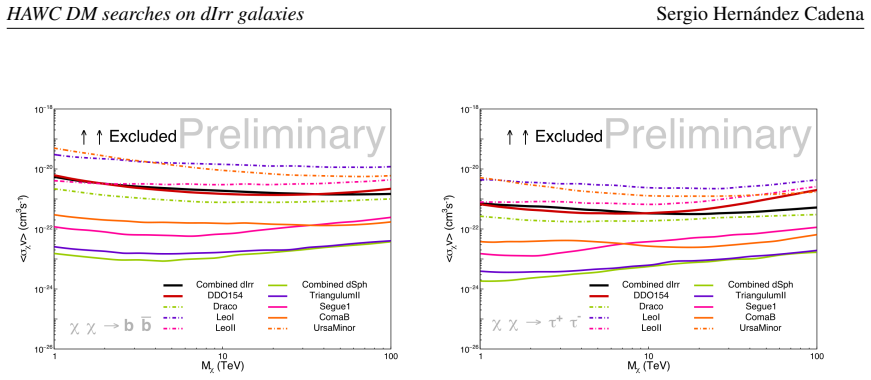
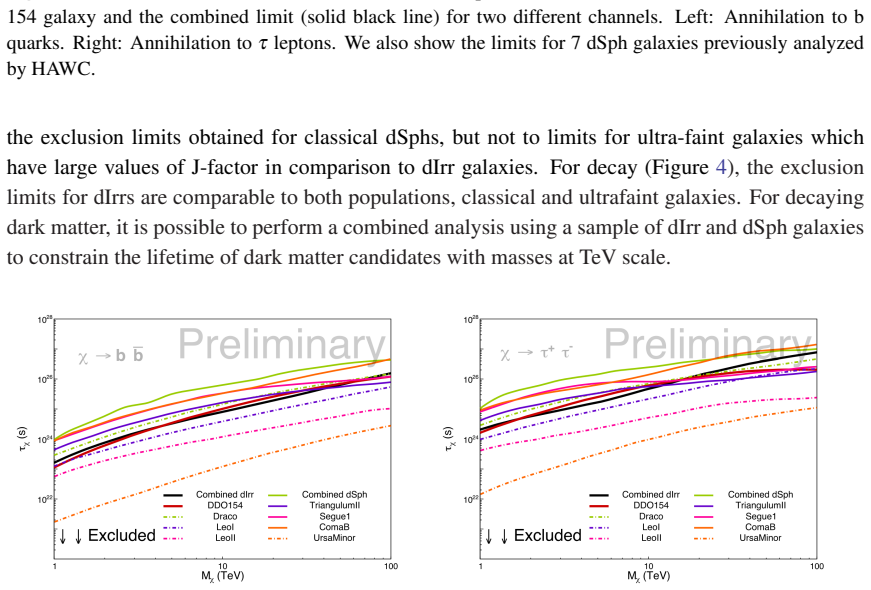
The central claim is that dIrr galaxies, despite their gas and star formation, can be treated as background-free at energies above about 1 TeV, and that a joint-likelihood analysis of 31 such galaxies in a wide-field survey yields meaningful TeV-scale constraints on dark matter. No statistically significant gamma-ray excess is found at any of the 31 positions. For a 10 TeV WIMP annihilating to $\tau^+\tau^-$, the 95% exclusion on the velocity-weighted cross-section is $\langle\sigma v\rangle = 3.31\times10^{-22}\,\mathrm{cm^3\,s^{-1}}$; for decaying dark matter to the same channel, the exclusion on the lifetime is $\tau_\chi = 6.16\times10^{25}\,\mathrm{s}$. The combined limit equals or exceeds the best individual galaxy (DDO 154) below 10 TeV and improves on it above 10 TeV, because the gain from stacking is offset at lower energies by the large spread in signal-to-background among the galaxies.
Load-bearing premise
The analysis assumes that the dark-matter content of each of the 31 galaxies, computed from a standard cored halo profile with parameters taken from a universal rotation-curve relation rather than from each galaxy's own detailed kinematics, is accurate; if these inferred dark-matter amounts are too large, the quoted exclusion limits are too strong.
Editorial extensions
If this is right
- Dwarf irregulars can be added to dwarf spheroidal galaxies as a TeV dark-matter target population, roughly doubling the number of stacked targets available to wide-field observatories.
- For decaying dark matter, the dIrr limits are comparable to those from classical and ultrafaint dwarf spheroidals, so a combined dIrr-plus-dSph lifetime constraint at TeV masses is feasible.
- Because the local volume contains roughly four times more dIrr galaxies than the 31 used here, an enlarged sample should sharpen the combined annihilation and decay limits.
- Above 10 TeV, stacking the full population beats the single best target, so future TeV analyses should prefer population stacking over selecting only the highest-$J$ galaxy.
Reading between the lines
- If the per-galaxy dark-matter content were recalibrated with detailed kinematic data, the $J$-factor systematics now dominating the limits could be reduced, potentially making the 31-galaxy stacking competitive with the best dwarf spheroidal targets for decay channels.
- The background-free assumption above 1 TeV is a testable prediction: a future observation of gamma rays from a dIrr galaxy that tracks star-formation activity rather than dark-matter density would falsify it and force a reanalysis with diffuse emission models.
- The crossover behaviour of the combined limit near 10 TeV suggests an optimization: weighting galaxies by their signal-to-background ratio rather than by $J$-factor alone might extend the stacking gain to lower masses.
- The same joint-likelihood recipe could be transferred to other wide-field TeV instruments, where larger samples of gas-rich dwarfs would yield lifetime constraints complementary to those from dwarf spheroidals.
Editorial analysis
A structured set of objections, weighed in public.
Referee Report
Summary. This manuscript, an ICRC 2019 proceedings contribution from the HAWC Collaboration, reports a search for gamma-ray emission from dark matter annihilation and decay in 31 dwarf irregular (dIrr) galaxies within the HAWC field of view. The authors compute the annihilation J-factors and decay D-factors with CLUMPY, assuming Burkert dark matter profiles with parameters taken from the Karukes and Salucci universal rotation curve, and combine Poisson maximum-likelihood analyses over 1017 HAWC transits to set 95% CL limits on the annihilation cross-section and decay lifetime for WIMP masses between 1 and 100 TeV in the b bbar and tau+tau- channels. No significant excess is found. The headline limits at 10 TeV for the tau+tau- channel are 3.31e-22 cm^3/s for annihilation and 6.16e25 s for decay, and the combined limit is reported to improve on the best single-galaxy limit (DDO 154) above 10 TeV.
Significance. The paper's value is in extending TeV-scale indirect dark matter constraints to a new class of targets, dIrr galaxies, and in showing that a combined analysis of many low-astrophysical-factor objects can reach limits comparable to classical dSph galaxies for annihilation and to both classical and ultrafaint dSphs for decay. The analysis is not circular: the limits come from a null search with astrophysical factors fixed from external kinematic modeling, and the sample and numerical inputs are presented transparently in Table 1. The procedure follows prior HAWC dSph analyses, and the null result is plausible. However, the quantitative claims rest on two unquantified pillars: the absolute normalization of the J/D factors and the statistical significance of the null result. If those are supplied and demonstrated to be robust, the limits would be a useful addition to the HAWC dark matter program.
major comments (3)
- [Section 4 and Table 1] The conclusion explicitly states that "This analysis does not include detailed kinematics to compute J-factors and is therefore limited," yet the paper quotes absolute exclusion limits that are directly proportional to the inverse of the J- and D-factors in Table 1. No uncertainty on these factors is computed or propagated, unlike dSph analyses that typically profile over log-normal J-factor errors with sigma ~0.2-0.5 dex. Because the combined limit is dominated by a few galaxies (WLM, NGC 6822, IC 10, DDO 154), a factor of about two normalization error shifts the headline limits by a comparable factor. The authors should propagate J/D-factor systematics or, at minimum, provide a sensitivity scan showing how the limits change under a range of halo-profile and distance assumptions.
- [Sections 2 and 3] The text repeatedly states that "no significant excess" was found and that the significance was converted into an exclusion limit, but no test-statistic values, p-values, or expected-limit bands are reported, either for individual galaxies or for the combined analysis. Without these numbers the reader cannot determine whether the observed limits are consistent with the background-only expectation or are dominated by statistical fluctuations. The paper should report the observed and expected 95% CL limits with the associated significance (e.g., TS values or p-values) for each channel and for the combined analysis.
- [Equation (2.1)] Equation (2.1) writes LSignal = product over i of ln[ (1/Ni!) (Bi+Si)^Ni exp(-(Bi+Si)) ], which is the product of logarithms and is not a likelihood; if LSignal is intended to be the log-likelihood, it should be a sum over bins. Because the limit-setting procedure and the null-hypothesis comparison both depend on this quantity, the notation must be corrected and the actual test statistic used by Liff should be specified, for example TS = -2 ln(LNull/LSignal).
minor comments (5)
- [Figure 4] The caption of Figure 4 labels the panels as "Annihilation to b quarks" and "Annihilation to tau leptons," but the figure shows decay limits; the captions should say "Decay" instead.
- [Section 4] The conclusions state that the local volume contains "four times bigger than the sample of 30 we used here," but Table 1 lists 31 galaxies; the count should be corrected for consistency.
- [Abstract] The phrase "ultra very high energies" is redundant and should be replaced with a standard energy-band term such as "very high energies."
- [Table 1] The caption of Table 1 does not define the assumed halo model or the angular integration aperture used for the J- and D-factors; a sentence stating the Burkert profile parameters and integration angle should be added.
- [References] References [2] and [3] are cited for the claim that gamma rays from star-forming regions in dIrr galaxies are in the GeV range, but neither reference is about dIrr galaxies specifically; a more directly relevant citation would strengthen the background-free argument.
Circularity Check
No circularity: the HAWC dIrr limits are a null gamma-ray search with fixed astrophysical J/D-factors taken from external kinematic modeling, not fitted to the gamma-ray data.
full rationale
The paper derives 95% CL exclusion limits on dark matter annihilation and decay from the absence of a gamma-ray excess at the positions of 31 dwarf irregular galaxies. The likelihood in Eq. (2.1) contains a signal term S_i that is proportional to the astrophysical J- or D-factor and to the annihilation cross-section or decay lifetime, and the analysis maximizes the likelihood against HAWC data. The J- and D-factors are computed with CLUMPY using Burkert profiles whose parameters come from Karukes & Salucci (2017), a prior kinematic study. Crucially, these astrophysical factors are inputs to the likelihood, not free parameters fitted to the HAWC gamma-ray observations; they are fixed before the null search and are not adjusted to make the limits come out in one direction or another. The resulting limits are therefore conditional on the adopted dark-matter distribution, but they are not equivalent by construction to the astrophysical input. The paper explicitly concedes the limitation: 'This analysis does not include detailed kinematics to compute J-factors and is therefore limited.' That statement identifies a systematic uncertainty about the normalization of the limits, not a circular reduction. The self-citation to Karukes & Salucci (2017), whose authors overlap with the present work, is load-bearing in the sense that the J-factors control the limit normalization, but the cited result is an external, empirically falsifiable kinematic model of dwarf disc galaxies and is not derived from the HAWC gamma-ray data analyzed here. No fitted parameter is renamed as a prediction, no uniqueness theorem is imported, and no ansatz is smuggled in only through a self-citation. The comparison to dSph limits is also an external benchmark rather than a circular reuse of the same data. Overall, the derivation chain is self-contained with respect to the gamma-ray observations, and the only identified concern is a quantified-in-principle but unpropagated J-factor systematic, which is a correctness risk rather than a circularity.
Assumptions & free parameters
free parameters (1)
- J-factors (annihilation) and D-factors (decay) for 31 dIrr galaxies =
log10 J values in Table 1, e.g., DDO 154: 11.800 TeV^2 cm^-5; log10 D values e.g., DDO 154: 15.397 TeV cm^-2
assumptions (3)
- domain assumption The dark matter distribution in each dIrr galaxy follows a Burkert profile with parameters from the universal rotation curve of dwarf disc galaxies (Karukes & Salucci 2017).
- domain assumption Astrophysical gamma-ray emission from dIrr galaxies is negligible above 1 TeV, so the targets are background-free.
- standard math The Poisson likelihood in Eq. 2.1 correctly models counts in each bin, and the Liff software computes the profile likelihood correctly.
Cite this review
Pith. "Pith review of Constraints on cross-section and lifetime of dark matter with HAWC Observations of dwarf Irregular galaxies." pith.science (2026). https://pith.science/paper/L2KCNZ4B
@misc{pith2026190808884,
  author       = {Pith},
  title        = {Pith review of: Constraints on cross-section and lifetime of dark matter with HAWC Observations of dwarf Irregular galaxies},
  year         = {2026},
  howpublished = {\url{https://pith.science/paper/L2KCNZ4B}},
  note         = {Machine review of arXiv:1908.08884}
}
read the original abstract
It has been shown that the dynamics of dwarf Irregular (dIrr) galaxies are dominated by dark matter. It is also observed that these galaxies have low star formation rates and metallicities, and no gamma-ray emission at ultra very high energies is expected. Because of their distance, dark matter content and vast number, dIrr galaxies are good targets to perform indirect dark matter searches by ground-based and wide field of view gamma-ray experiments, like HAWC. We analyzed data at the position of 31 dIrr galaxies within the HAWC field-of-view and no significant excess was found. Here, we present the individual and combined limits on the annihilation cross-section and decay lifetime of weakly interacting massive particles with a mass between 1 and 100 TeV.
Figures


Figures from the paper (1 more)
Reference graph
Works this paper leans on
-
[1]
E. Karukes and P. Salucci, The universal rotation curve of dwarf disc galaxies, MNRAS 465, 4703-4722 (2017) [astro-ph.GA/1609.06903v3]
arXiv 2017
-
[2]
P. Martin, Interstellar gamma-ray emission from cosmic rays in star forming galaxies, A&A 564, A61 (2014) [DOI: 10.1051/004-6361/201323329 ]
-
[3]
S. Ohm, D. Horns, O. Reimer, J. Hinton, G. Rowell, E. de Oña Willhelmi, M. V . Fernandes, F. Acero, A. Marcowith for the H.E.S.S. collaboration, H.E.S.S. observations of massive stellar clusters, [astro-ph.PE/0906.2637v2]
-
[4]
V . Bonnivard, M. Hütten, E. Nezri, A. Charbonnier, C. Combet and D. MaurinJeans analysis,γ-ray and ν fluxes from dark matter (sub-)structures, Computer Physics Communications, 200, p. 336-349 (2016) [arXiv:1506.07628 [astro-ph.CO] ]
arXiv 2016
-
[5]
T. Sjostrand, S. Mrenna and P. Skands, JHEP 05 (2006) 026, Comput. Phys. Comm. 178 (2008) 852
work page 2006
- [6]
-
[7]
P. W. Younk, R. J. Lauer, G. Vianello, J. P. Harding, H. A. A. Solares, H. Zhou, M. Hui, for the HAWC Co- laboration, A high-level analysis framework for HAWC, The 34th International Cosmic Ray Conference, ICRC 2015, edited by PoS (The Hague, The Netherlands, 2015) p. 948. 5
work page 2015
Reviewed August 14, 2026 · model on record in the stance chip above.
Discussion (0). Continue with ORCID to comment.