REVIEW 3 major objections 5 minor 1 cited by
The complete classification of empty lattice $4$-simplices
T0 review · 3 major / 5 minor · reviewed 2026-08-14 · deepseek-v4-flash
Pith's one-line read This paper completes the classification of empty lattice 4-simplices: every such simplex belongs to one 3-parameter family, two 2-parameter families, 46 one-parameter families, or one of 2461 explicitly listed sporadic simplices.
desk verdict Complete classification of empty 4-simplices, credible and important, but the infinite families rest on an unverified computer enumeration in Lemma 4.2 that should be certified. read the letter →
The pith
A machine-rendered reading of the paper's core claim, the machinery that carries it, and where it could break.
The reading
What carries the argument
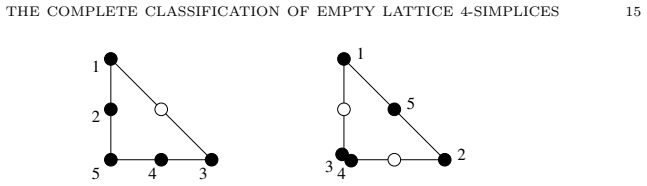
The load-bearing object is the 5-tuple: for a cyclic simplex of volume $V$, take any generator of the quotient lattice $\Lambda/\Lambda_P$ and record $V$ times its barycentric coordinates with respect to the five vertices; two simplices are unimodularly equivalent exactly when their 5-tuples agree up to multiplication by a unit modulo $V$ and permutation of coordinates. The argument then reduces the classification to a parametrization result: a simplex that projects to a hollow configuration $S$ in dimension $k<4$ has 5-tuple $Va+b$, where $a$ encodes a generator of the quotient group $\pi(\Lambda)/\Lambda_S$ and $b$ runs over integer affine dependences among the five projected points. The hard part is the $k=3$ case, where the finite list of twelve maximal hollow 3-polytopes yields, after deleting configurations with no empty lifts, 29 primitive and 17 non-primitive bipyramids. The $k=4$ case is settled by a volume bound of 5184 proved through successive-minima and symmetrization arguments, followed by brute-force enumeration up to that bound.
What would settle it
Run an independent, verifier-equipped enumeration of all empty 4-simplices of volume at most 5184 and confirm that, after removing the $1+2+46$ infinite families, the surviving isomorphism classes are exactly the 2461 sporadic 5-tuples of Table 3; separately regenerate the five-point subconfigurations of the twelve maximal hollow 3-polytopes and confirm the counts in Lemma 4.2, namely 24 pyramids, 29 primitive and 23 non-primitive bipyramids. A single missing or spurious configuration disproves the completeness of the classification.
Extended reading notes
Core claim
The central discovery is that every empty 4-simplex of volume $V$ projects, by an affine lattice map, to a hollow $k$-dimensional polytope with $k\le 4$, and the possible simplices are exactly the following. If $k=1$, the 5-tuple is $(\alpha+\beta,-\alpha,-\beta,-1,1)$ with $\gcd(\alpha,\beta,V)=1$. If $k=2$, either the primitive family $(1,-2,\alpha,-2\alpha,1+\alpha)$ with $V$ odd, or the non-primitive family $\frac{V}{2}(0,1,0,1,0)+(-1,-1,\alpha,-\alpha,2)$ with $V$ a multiple of 4. If $k=3$, apart from finitely many simplices of volume at most 72, it lies in 29 primitive or 17 non-primitive one-parameter families whose 5-tuples are listed in the paper, with modular restrictions on $V$. If $k=4$, there are exactly 2461 sporadic simplices, with volumes from 24 to 419, listed on the authors' website and in an ancillary file. The converse is also proved: every simplex described by these tuples is indeed empty. The classification is stated modulo unimodular equivalence, using a 5-tuple of barycentric coordinates of a generator of the cyclic quotient group, which is a complete invariant for empty 4-simplices because all such simplices are cyclic.
Load-bearing premise
The completeness claims rest on two computer-generated lists: the five-point subconfigurations of the twelve maximal hollow 3-polytopes, which are stated without proof and were produced by another researcher, and the brute-force enumeration of all empty 4-simplices of volume up to 7600, whose details appear in a companion paper rather than in the text; if either list is incomplete, the classification is incomplete.
Editorial extensions
If this is right
- Every empty 4-simplex is now explicitly known: the classification gives a complete list of all isomorphism classes, so any proposed property of empty 4-simplices can be checked against the families and the 2461 sporadic cases.
- The earlier claim that all but finitely many empty 4-simplices have width one or two is corrected: there is a new two-parameter family, 17 additional one-parameter families, and the sporadic list refines the exceptional set.
- Every empty 4-simplex has at least two unimodular facets, and the ones with exactly two are characterized explicitly: the width-one family with three non-unimodular facets, one width-two primitive family when $V$ is a multiple of 30, and three sporadic simplices.
- The $h^*$-vector, and therefore the Ehrhart polynomial, of any empty 4-simplex is determined by its volume and surface area, and the paper tabulates the possible facet-volume configurations across all cases.
- The projection method yields a partial classification of all hollow 4-simplices: they form finitely many fine families, with a volume bound of 5184 for those that do not project to dimension three, leaving explicit enumeration as a computational challenge.
Reading between the lines
- An independent reimplementation of the enumeration would settle residual doubt about the count 2461; the paper distributes the resulting data but not verifier code, so a small standalone verification script is a natural companion artifact.
- The same projection-to-lower-dimensional-configurations scheme, with $n-k-1$ parameters per fine family, suggests that classifications in higher dimensions will be driven by explicit finite lists of maximal hollow polytopes, with the volume bound for sporadic cases as the main bottleneck.
- If the new counts in the paper's comparison table supersede the historical prime-volume enumeration, then the corrected number of sporadic terminal quotient singularities of prime volume below 60 follows; the discrepancies concentrate there, consistent with an earlier redundancy-checking error.
- One could test the machinery in a smaller setting by reproducing the classification of empty tetrahedra through the same fine-family parametrization, validating the pipeline before trusting the four-dimensional results.
Signed reviews
Editorial analysis
A structured set of objections, weighed in public.
Referee Report
Summary. The paper claims a complete classification of empty lattice 4-simplices up to affine unimodular equivalence. The classification is organized by the minimal dimension k of a hollow polytope onto which a simplex projects: k=1 gives one 3-parameter family, k=2 gives two 2-parameter families, k=3 gives 29 primitive and 17 nonprimitive 1-parameter families together with finitely many exceptions of volume at most 72, and k=4 gives 2461 sporadic simplices with volumes between 24 and 419. The proof develops a 5-tuple representation of cyclic simplices, uses the cyclicity theorem of Barile et al., reduces the k=3 case to five-point subconfigurations of the twelve maximal hollow 3-polytopes of Averkov et al., and proves a volume bound of 5184 for the k=4 case via a width-two slicing argument; the sporadic list is then obtained by enumeration up to volume 7600.
Significance. If the classification is correct, it completes a thirty-year program initiated by Mori, Morrison, and Morrison and corrects the claimed classification of Barile et al. The 5-tuple and facet-volume framework is elegant, the families are explicit, and the volume bound of Theorem 5.1 is a substantial result in its own right. The paper also gives concrete consequences for facet volumes, Ehrhart polynomials, and terminal quotient singularities, and it honestly reports discrepancies with the earlier enumeration of Mori et al. However, the completeness of the classification rests on two computational pillars that the manuscript does not make independently verifiable: Lemma 4.2, an exhaustive enumeration of five-point subconfigurations summarized without proof or certificate, and the Section 5 enumeration that produces the 2461 sporadic examples. These are load-bearing for the central claim, so the paper is not yet fully self-contained as a complete classification.
major comments (3)
- [§4, Lemma 4.2] The completeness of the k=3 case of Theorem 1.6 depends on Lemma 4.2, which asserts an exhaustive list of five-point subconfigurations of the twelve maximal hollow 3-polytopes, separated into tetrahedra, 24 quadrilateral pyramids, 29 primitive bipyramids, and 23 nonprimitive bipyramids. The manuscript states only that the computations were done by Mónica Blanco and gives no proof, certificate, or reproduction instructions. A missing or misclassified bipyramid would remove or add an entire one-parameter family, thereby invalidating the completeness statement for infinitely many volumes. Please provide a verifiable certificate, the enumeration code, or an independent derivation of the list.
- [§5, Theorem 1.9] The count of 2461 sporadic empty 4-simplices is a central claim, but it is obtained by discarding from the output of an enumeration whose details appear in the separate paper [IVnS19], and the current manuscript does not include the enumeration code, the pruning code, or a verifier for the ancillary list. A reader can check the statistics in Table 3 but cannot verify completeness. Please make the code and data available and include a machine-checkable verification that each listed 5-tuple represents an empty simplex and that the list is complete under the isomorphism criterion of Corollary 1.4.
- [§4, Proposition 4.3] The bound of 72 for the finite exceptions in the k=3 case is asserted after stating that formula (2) gives that bound 'for the 24 pyramids of Lemma 4.2,' but the individual computations of the ratio |xz|/|yz| for the 24 pyramids are not shown. Since this bound is what separates the infinite families from the finite exceptions in case k=3, please include the table of the 24 cases or an easily checkable script that produces the bound.
minor comments (5)
- [Abstract] The abstract says the sporadic simplices have volumes ranging between 29 and 419, while Theorem 1.9 and Table 3 state that volumes range from 24 to 419; the abstract should be corrected.
- [§1, after Theorem 1.9] The sentence '1+17=46 one-parameter families' should read '29+17=46 one-parameter families'.
- [§4, Table 7] The notation '±k ∈ ∅' and conditions such as '±k ≠ 1' are explained only in the proof of Proposition 4.7; a sentence in the table caption would make the table readable independently.
- [§1, Corollary 1.4] There is a typo, 'mutiplication', and the statement would be clearer if it explicitly said that the tuple entries are integers considered modulo V.
- [§1, Theorem 1.8] Theorem 1.8 is presented as the converse of Theorem 1.6, but Theorem 1.6 includes the k=4 case only by reference to Theorem 1.9; please clarify that the converse concerns the parametric families, not the sporadic list.
Circularity Check
No significant circularity: the classification is derived by case analysis on externally enumerated hollow 3-polytopes and a separate published width/enumeration result.
full rationale
I walked the derivation chain of Theorems 1.6 and 1.9. The infinite families for k=1,2,3 are obtained by Corollary 2.12 from the affine dependence spaces of five-point configurations S. Those configurations come from Lemma 4.2, which is an enumeration of subconfigurations of the twelve maximal hollow 3-polytopes of [AKW17], an external classification; the five-point configurations are not defined from the target 5-tuples. Thus the tuples in Tables 1 and 2 are outputs of a geometric enumeration, not fitted inputs disguised as predictions. The k=4 finiteness and the count 2461 rest on the volume bound of Theorem 5.1, proved in this paper, together with the width-at-least-three bound and enumeration engine taken from [IVnS19]. That is a self-citation, but [IVnS19] is a published, peer-reviewed companion theorem whose assumptions do not include the present classification; its results are parameter-free and independently falsifiable, so under the rules it counts as real evidence rather than circularity. The paper explicitly acknowledges that Lemma 4.2 is a computation summarized without proof and that enumeration details live in [IVnS19]; these are completeness and verification risks, but no equation in the paper defines a family in terms of the very simplices that the theorem then purports to predict. I found no step where the claimed prediction reduces by construction to its own input.
Assumptions & free parameters
assumptions (7)
- standard math Dirichlet's prime number theorem
- domain assumption Nill-Ziegler finiteness theorem (NZ11, Thm. 1.2): finitely many hollow d-polytopes do not project onto a hollow (d-1)-polytope.
- domain assumption Averkov-Krumpelmann-Weltge classification (AKW17, Thm. 4.1): twelve maximal hollow 3-polytopes that do not project to dimension two.
- domain assumption Barile-Bernardi-Borisov-Kantor theorem (BBBK11): every empty 4-simplex is cyclic.
- standard math White's classification of empty tetrahedra (Whi64, Thm. 1.1).
- domain assumption Averkov-Wagner bounds for hollow polygons (AW12, Thm. 2.2).
- domain assumption Results from authors' companion paper [IVnS19]: volume bound for width >= 3 and the enumeration algorithm.
Cite this review
Pith. "Pith review of The complete classification of empty lattice $4$-simplices." pith.science (2026). https://pith.science/paper/D6TWGWVM
@misc{pith2026190808933,
  author       = {Pith},
  title        = {Pith review of: The complete classification of empty lattice $4$-simplices},
  year         = {2026},
  howpublished = {\url{https://pith.science/paper/D6TWGWVM}},
  note         = {Machine review of arXiv:1908.08933}
}
abstract
An empty simplex is a lattice simplex with only its vertices as lattice points. Their classification in dimension three was completed by White in 1964. In dimension four, the same task was started in 1988 by Mori, Morrison, and Morrison, with their motivation coming from the close relationship between empty simplices and terminal quotient singularities. They conjectured a classification of empty simplices of prime volume, modulo finitely many exceptions. Their conjecture was proved by Sankaran (1990) with a simplified proof by Bober (2009). The same classification was claimed by Barile et al. in 2011 for simplices of non-prime volume, but this statement was proved wrong by Blanco et al. (2016+). In this article we complete the classification of $4$-dimensional empty simplices. In doing so we correct and complete the classification claimed by Barile et al., and we also compute all the finitely many exceptions, by first proving an upper bound for their volume. The whole classification has: - One $3$-parameter family, consisting of simplices of width equal to one. - Two $2$-parameter families (the one in Mori et al., plus a second new one). - Forty-six $1$-parameter families (the 29 in Mori et al., plus 17 new ones). - $2461$ individual simplices not belonging to the above families, with volumes ranging between 29 and 419. We characterize the infinite families of empty simplices in terms of lower dimensional point configurations that they project to, with techniques that can be applied to higher dimensions and larger classes of lattice polytopes.
Figures


Forward citations
Cited by 1 Pith paper
-
On a generalization of the Hermite-Hadamard inequality and applications in convex geometry
A sharp generalized Hermite-Hadamard inequality is proved and applied to obtain the optimal volume-to-central-section constant 2^n/n for symmetric projections.
Reference graph
Works this paper leans on
-
[1]
Gennadiy Averkov, Jan Kr\"umpelmann, and Stefan Weltge, Notions of maximality for integral lattice-free polyhedra: the case of dimension three, Math. Oper. Res. 42 (2017), no. 4, 1035-1062
work page 2017
-
[2]
Gennadiy Averkov and Christian Wagner, Inequalities for the lattice width of lattice-free convex sets in the plane, Beitr. Algebra Geom. 53 (2012), no. 1, 1--23
work page 2012
-
[3]
Gennadiy Averkov , Christian Wagner , and Robert Weismantel , Maximal lattice-free polyhedra: finiteness and an explicit description in dimension three. , Math. Oper. Res. 36 (2011), no. 4, 721--742
work page 2011
-
[4]
Margherita Barile , Dominique Bernardi , Alexander Borisov , and Jean-Michel Kantor , On empty lattice simplices in dimension 4 . , Proc. Am. Math. Soc. 139 (2011), no. 12, 4247--4253
work page 2011
-
[5]
Gabriele Balletti and Akihiro Higashitani., Universal inequalities in Ehrhart theory, Israel J. Math. 227 (2018), no. 2, 843--859
work page 2018
-
[6]
M\'onica Blanco, Christian Haase, Jan Hofmann, and Francisco Santos, The finiteness threshold width of lattice polytopes, preprint 2016
work page 2016
-
[7]
Bober, Factorial ratios, hypergeometric series, and a family of step functions, J
Jonathan W. Bober, Factorial ratios, hypergeometric series, and a family of step functions, J. Lond. Math. Soc. (2) 79 (2009), no. 2, 422--444
work page 2009
-
[8]
Alexander Borisov, On classification of toric singularities, J. Math. Sci. 94 (1999), no. 1, 1111--1113
work page 1999
Show all 41 references
-
[9]
Alexander Borisov, Quotient singularities, integer ratios of factorials, and the R iemann hypothesis , Int. Math. Res. Not. IMRN (2008), rnn052
2008
-
[10]
Litvak, Alain Pajor, Stanislaw J
Wojciech Banaszczyk, Alexander E. Litvak, Alain Pajor, Stanislaw J. Szarek, The flatness theorem for nonsymmetric convex bodies via the local theory of Banach spaces. , Math. Oper. Res. 24 (1999), no. 3, 728--750
1999
-
[11]
Integer-point enumeration in polyhedra, Undergraduate Texts in Mathematics, Springer, New York, 2015
Matthias Beck and Sinai Robins, Computing the continuous discretely. Integer-point enumeration in polyhedra, Undergraduate Texts in Mathematics, Springer, New York, 2015
2015
-
[12]
Discrete Math
M\'onica Blanco and Francisco Santos, Lattice 3-polytopes with few lattice points, SIAM J. Discrete Math. 30 (2016), no. 2, 669--686
2016
-
[13]
Giulia Codenotti and Francisco Santos, Unimodular covers of 3-dimensional parallelepipeds and cayley sums, preprint 2019, arXiv:1907.12312
2019 arXiv
-
[14]
Giulia Codenotti, Francisco Santos, Hollow polytopes of large width, Proc. Amer. Math. Soc. 148 (2020), n. 2, 835--850
2020
-
[15]
Dais, Resolving 3-dimensional toric singularities, Geometry of toric varieties, S\' e min
Dimitrios I. Dais, Resolving 3-dimensional toric singularities, Geometry of toric varieties, S\' e min. Congr., vol. 6, Soc. Math. France, Paris, 2002, pp. 155--186
2002
-
[16]
Eug\`ene Ehrhart, Sur les poly\`edres rationnels homoth\' e tiques \`a n dimensions , C. R. Acad. Sci. Paris 254 (1962), 616--618
1962
-
[17]
Bernardo Gonz\'alez Merino, On O rlicz- J ensen- H ermite- H adamard theorem , preprint 2019, arXiv:1908.06426
2019 arXiv
-
[18]
Gruber, Convex and discrete geometry, Grundlehren der Mathematischen Wissenschaften [Fundamental Principles of Mathematical Sciences], vol
Peter M. Gruber, Convex and discrete geometry, Grundlehren der Mathematischen Wissenschaften [Fundamental Principles of Mathematical Sciences], vol. 336, Springer, Berlin, 2007
2007
-
[19]
83 (1990), no
Takayuki Hibi, Some results on E hrhart polynomials of convex polytopes , Discrete Math. 83 (1990), no. 1, 119--121
1990
-
[20]
Johannes Hofscheier, Lukas Katth\"an, and Benjamin Nill, Ehrhart theory of spanning lattice polytopes, Int. Math. Res. Not. IMRN 2018 (2018), no. 19, 5947--5973
2018
-
[21]
Johannes Hofscheier, Benjamin Nill, and Dennis \" O berg, On E hrhart polynomials of lattice triangles , Electron. J. Combin. 25 (2018), no. 1, article number P1.3
2018
-
[22]
Cornelius A. J. Hurkens, Blowing up convex sets in the plane, Linear Algebra Appl. 134 (1990), 121--128
1990
-
[23]
Ziegler , On the maximal width of empty lattice simplices
Christian Haase and G\"unter M. Ziegler , On the maximal width of empty lattice simplices. , Eur. J. Comb. 21 (2000), no. 1, 111--119
2000
-
[24]
\' O scar Iglesias-Vali\ n o and Francisco Santos, Classification of empty lattice 4-simplices of width larger than two, Trans. Amer. Math. Soc. 371 (2019), no. 9, 6605--6625
2019
-
[25]
Jean-Michel Kantor and Karanbir S.\ Sarkaria, On primitive subdivisions of an elementary tetrahedron, Pacific J. Math. 211 (2003), no. 1, 123--155
2003
-
[26]
Discrete Math
Jim Lawrence, Finite unions of closed subgroups of the n -dimensional torus , Applied geometry and discrete mathematics, DIMACS Ser. Discrete Math. Theoret. Comput. Sci., vol. 4, Amer. Math. Soc., Providence, RI, 1991, pp. 433--441
1991
-
[27]
Fu Liu and Liam Solus, On the relationship between E hrhart unimodality and E hrhart positivity , Ann. Comb. 23 (2019), no. 2, 347--365
2019
-
[28]
J., 98 (1985), 43--66
Shigefumi Mori, On 3-dimensional terminal singularities, Nagoya Math. J., 98 (1985), 43--66
1985
-
[29]
Shigefumi Mori, Flip theorem and the existence of minimal models for 3-folds, J. Amer. Math, Soc. 1 (1988), 117--253
1988
-
[30]
Morrison, and Ian Morrison, On four-dimensional terminal quotient singularities, Math
Shigefumi Mori, David R. Morrison, and Ian Morrison, On four-dimensional terminal quotient singularities, Math. Comput. 51 (1988), no. 184, 769--786
1988
-
[31]
Morrison and Glenn Stevens, Terminal quotient singularities in dimensions three and four, Proc
David R. Morrison and Glenn Stevens, Terminal quotient singularities in dimensions three and four, Proc. Amer. Math. Soc. 90 (1984), no. 1, 15--20
1984
-
[32]
Ziegler , Projecting lattice polytopes without interior lattice points., Math
Benjamin Nill and G\"unter M. Ziegler , Projecting lattice polytopes without interior lattice points., Math. Oper. Res. 36 (2011), no. 3, 462--467
2011
-
[33]
Sankaran, Stable quintiples and terminal quotient singularities, Math
Gregory K. Sankaran, Stable quintiples and terminal quotient singularities, Math. Proc. Cambridge Philos. Soc. 107 (1990), no. 1, 91--101
1990
-
[34]
Symbolic Comput
Josef Schicho, Simplification of surface parametrizations---a lattice polygon approach, J. Symbolic Comput. 36 (2003), no. 3-4, 535--554, Special volume for ISSAC'2002 (Lille)
2003
-
[35]
Scott, On convex lattice polygons, Bull
Paul R. Scott, On convex lattice polygons, Bull. Austral. Math. Soc. 15 (1976), no. 3, 395--399
1976
-
[36]
Sci., vol
Andr \'a s Seb o , An introduction to empty lattice simplices, Integer programming and combinatorial optimization ( G raz, 1999), Lecture Notes in Comput. Sci., vol. 1610, Springer, Berlin, 1999, pp. 400--414
1999
-
[37]
Stanley, Decompositions of rational convex polytopes, Ann
Richard P. Stanley, Decompositions of rational convex polytopes, Ann. Discrete Math. 6 (1980), 333--342
1980
-
[38]
Alan Stapledon, Inequalities and Ehrhart -vectors, Trans. Amer. Math. Soc. 361 (2009), no. 10, 5615--5626
2009
-
[39]
Santos and G\"unter
Francisco. Santos and G\"unter. M. Ziegler, Unimodular triangulations of dilated 3-polytopes, Trans. Moscow Math. Soc. (2013), 293--311
2013
-
[40]
atze von White und Mordell \
Uwe Wessel, Die S\"atze von White und Mordell \"uber kritische Gitter von Polytopen in den Dimensionen 4 und 5, Diplomarbeit, Ruhr-Universit\"at Bochum, 1989
1989
-
[41]
White, Lattice tetrahedra, Canadian J
George K. White, Lattice tetrahedra, Canadian J. Math. 16 (1964), 389--396
1964
Reviewed August 14, 2026 · model on record in the stance chip above.
Discussion (0). Continue with ORCID to comment.