REVIEW 3 major objections 5 minor 22 references
Non Cooperative Game Theoretic Approach for Residential Energy Management in Smart Grid
T0 review · 3 major / 5 minor · reviewed 2026-08-14 · deepseek-v4-flash
Pith's one-line read A non-cooperative scheduling game cuts daily residential energy cost about 37 percent while keeping discomfort near 20 percent above baseline.
desk verdict A plausible scheduling heuristic in game-theoretic clothing, but the Nash-equilibrium claim does not survive contact with the price coupling. read the letter →
The pith
A machine-rendered reading of the paper's core claim, the machinery that carries it, and where it could break.
The reading
What carries the argument
The central object is the finite non-cooperative game $G=\{N,S,J\}$, whose players are households, whose strategy space $S$ is the product of each household's feasible appliance schedules, and whose payoff vector $J$ stacks the two objectives: the daily energy cost $C_c^t=c_r^t(l_t)\sum_j P_j^t$ and the quadratic discomfort cost $\sum_j (\alpha \Delta_j^2 + \beta \Delta_j + \delta)$. NSGA-II is the multiobjective genetic algorithm that searches each player's schedule space for the best strategy; Nash's existence theorem for finite games is invoked to guarantee that at least one equilibrium profile exists, and the paper identifies the combination of per-player best strategies as that equilibrium.
What would settle it
Recompute the real-time tariff from the aggregate load of all 30 households' NSGA-II schedules, then let each household re-solve its own two-objective scheduling problem at that same tariff; if even one household would pick a different schedule, the original profile is not a Nash equilibrium.
Extended reading notes
Core claim
In the paper's own terms, the discovery is that a multiobjective demand-response game with consumers and prosumers as non-cooperative players has a Nash equilibrium that can be computed by NSGA-II, and that this equilibrium realizes a concrete trade-off. A consumer who follows the equilibrium schedule spends roughly 37 percent less on electricity per day than a consumer who runs each appliance at its preferred time, while accepting a discomfort increase of about 20 percent; prosumers, who can sell distributed generation back to the grid, reach a similar cost saving with less discomfort. The authors define each player's strategy as a daily appliance schedule, define the price signal as a real-time tariff that depends on total consumption, and measure discomfort as a quadratic function of how far each task is shifted from the consumer's preferred window.
Load-bearing premise
The paper assumes that if each household independently picks its cheapest feasible schedule at the current real-time price, the resulting set of schedules is a Nash equilibrium, even though the price in Eq. (5) depends on the total load of all households and can therefore change when several households shift their appliances at once.
Editorial extensions
If this is right
- Residential consumers could reduce daily electricity bills by roughly 37 percent relative to running every appliance at its preferred time.
- The multiobjective schedule keeps cost within about 3 percent of a cost-only optimizer while lowering consumer discomfort by about 10 percent relative to that optimizer.
- Prosumers with distributed generation can achieve similar cost savings while keeping appliance schedules closer to their preferred windows.
- The game formulation gives the grid operator a way to shape aggregate demand through price signals alone, without directly controlling household appliances.
- The approach extends beyond scheduling: the paper frames it as a tool for analyzing strategic consumer behavior in competitive electricity markets.
Reading between the lines
- Inference: the Nash-equilibrium conclusion as stated would require either that each household's payoff is independent of the other households' schedules or an explicit best-response iteration; neither appears in the paper, so the 37 percent figure is best read as the outcome of simultaneous one-shot optimization until a convergence check is added.
- Inference: a testable extension would repeat the game iteratively, letting each household re-optimize against the latest aggregate price, and compare the converged cost and discomfort with the reported values to see whether the one-shot profile is stable.
- Inference: the same two-objective game could be recast as a potential game with a single scalarized objective; if such a potential function exists, the claim that independent optimization composes to a Nash equilibrium would follow rigorously rather than by assertion.
- Inference: the quadratic discomfort model treats morning and evening shifts as equally costly; weighting $\Delta_j$ by time of day would make the trade-off more realistic and could change which schedules survive at the reported cost savings.
Signed reviews
Editorial analysis
A structured set of objections, weighed in public.
Referee Report
Summary. The paper proposes a residential demand-side management scheme in which each household (modeled as a player in a non-cooperative game) schedules its electric appliances to minimize two objectives: daily energy cost and discomfort from shifting tasks off their preferred time windows. The authors formulate the game, state two existence theorems, and use the NSGA-II multiobjective genetic algorithm to compute a schedule for each player. They claim that the combination of these individually computed schedules is a dominant-strategy Nash equilibrium. Simulation results for a 30-consumer system report about 37% cost reduction relative to an unscheduled reference while keeping the discomfort increase near 20%.
Significance. If the equilibrium claim were sound, the paper would offer a genuinely distributed, game-theoretic mechanism for residential load scheduling that jointly addresses cost and comfort, a problem of practical interest in smart-grid demand response. The authors also deserve credit for explicitly modeling occupant discomfort and for comparing against two reasonable baselines. However, the central theoretical contribution—that the NSGA-II output constitutes a Nash equilibrium—is not established and appears incorrect because the real-time price couples all players' decisions through the aggregate load. The numerical results may be useful as a heuristic demonstration, but they do not support the game-theoretic claims that form the paper's stated contribution.
major comments (3)
- [Nash equilibrium / NSGA-II scheduling (Theorem 2, Eqs. (22)-(23))] The paper claims that each player's NSGA-II solution is a best strategy and that the combination of these best strategies is a dominant-strategy Nash equilibrium (Section 'Nash equilibrium' and 'NSGA-II scheduling'). This assertion is unsupported. The real-time price in Eq. (5) depends on the aggregate load l_t in Eq. (3), which includes all consumers' schedules; hence each player's cost function depends on the other players' strategies. Equations (22)-(23) only describe each player minimizing its own objectives independently; no best-response iteration is performed, no other players' strategies are held fixed, and no fixed-point condition is checked. Theorem 2 is asserted rather than proved, and the citation to Fudenberg and Tirole does not supply such a theorem for games with coupled payoffs. The paper must either provide a rigorous proof that the independently computed schedules form a Nash equilibrium (or a dominant-strategy equilibrium) or reformulate the contribution without the equilibrium claim.
- [Numerical Results and NSGA-II scheduling] The numerical evaluation does not verify the defining condition of Nash equilibrium, Eq. (13), for any player or any schedule. Since NSGA-II returns a set of Pareto-optimal solutions rather than a single strategy, the paper also does not specify how one schedule per player is selected from the Pareto front. Without such a selection rule and without checking Eq. (13), the reported profile cannot be called a Nash equilibrium. The simulation results are therefore only an evaluation of a heuristic scheduling strategy, not a demonstration of the game-theoretic solution concept claimed in the abstract and conclusion.
- [Problem Formulation, constraints (Eq. (21))] The energy balance constraint in Eq. (21) is stated but never enforced or even mentioned in the NSGA-II scheduling description. It is unclear whether the simulated schedules satisfy this constraint, and if they do not, the cost and discomfort figures may be computed for infeasible schedules. The paper should clarify how Eq. (21) is incorporated into the optimization or why it is automatically satisfied by the task scheduling model.
minor comments (5)
- [System model, Eq. (12)] Equation (12) writes J_i(s) = J_i{s*_i, s*_i}, which is a typographical error: the second argument should denote the other players' strategies, typically s*_-i. Also, the superscript stars presuppose an equilibrium that has not yet been defined at that point.
- [System model, Eq. (7)] The discomfort model in Eq. (7) does not cover the case where the scheduled interval [t_j, t_j + D_j] starts before STP_j and ends after FTP_j, i.e., the task spans the entire preferred window. In that situation the time-shift parameter is undefined, which affects the objective in Eqs. (15) and (18).
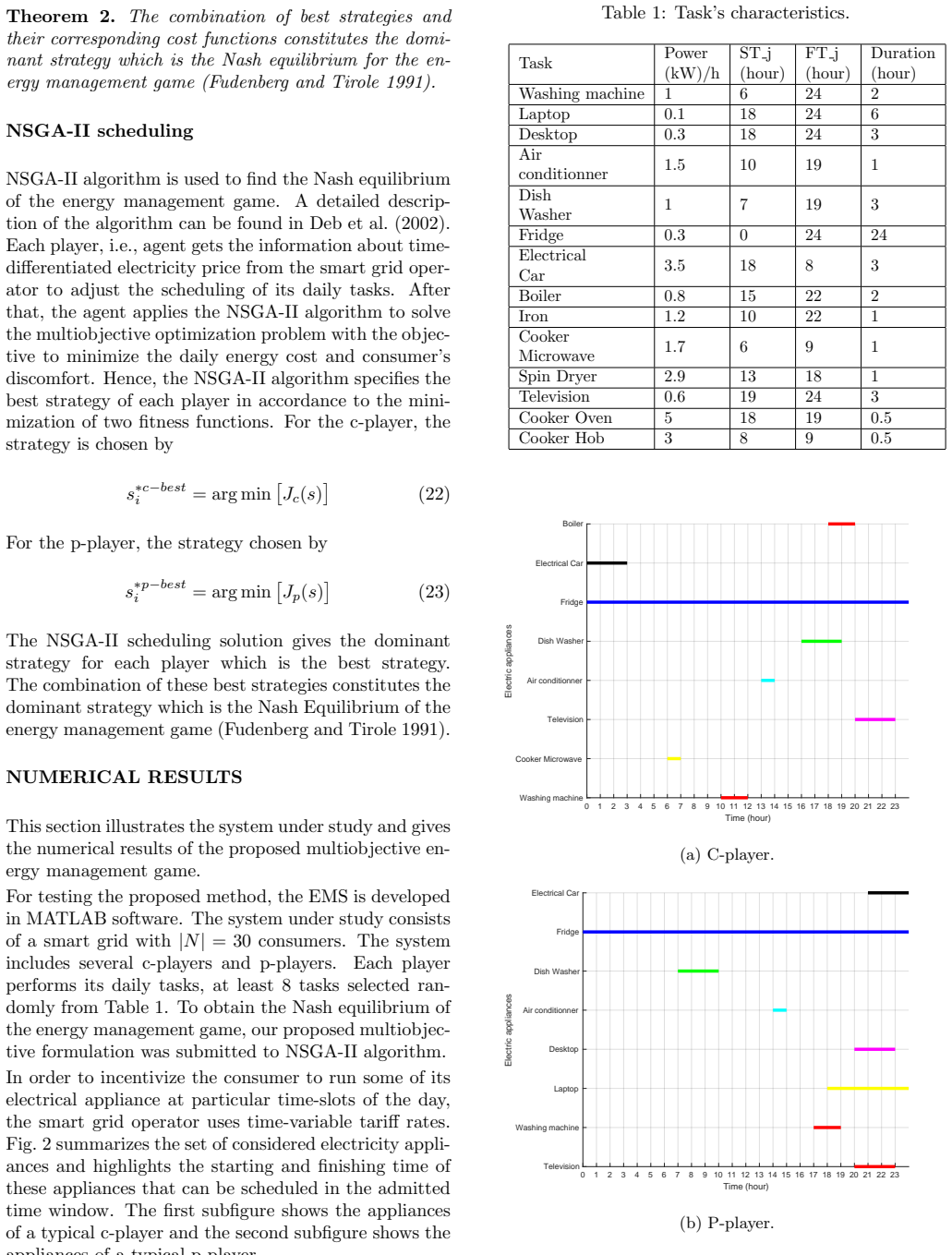
- [Numerical Results] The legend labels in Fig. 4 use 'Ref-discomfort-sce' while Fig. 5 uses 'Cost-discomfort-sce' for what appears to be the same scenario; the text should be consistent.
- [Numerical Results] The paper does not report the NSGA-II parameters (population size, number of generations, crossover and mutation rates) or the number of independent runs, so the numerical results are not reproducible.
- [Nash equilibrium] Theorem 1 cites Nash (1951) for existence of equilibrium in finite games, but the paper does not discuss whether mixed strategies are allowed or relevant; this is a minor gap but worth clarifying because the NSGA-II implementation appears to use pure schedules only.
Circularity Check
The central Nash-equilibrium claim is produced by definition: independent NSGA-II argmins (Eqs. 22-23) are labeled 'best strategies' and their combination is declared the equilibrium without verifying the mutual best-response condition of Eq. (13).
-
self definitional
[Section 'Nash equilibrium' and 'NSGA-II scheduling', Theorem 2 and Eqs. (22)-(23)]
"The NSGA-II scheduling solution gives the dominant strategy for each player which is the best strategy. The combination of these best strategies constitutes the dominant strategy which is the Nash Equilibrium of the energy management game (Fudenberg and Tirole 1991)."
Eqs. (22)-(23) define 'best strategy' as the standalone argmin of each player's own objective Jc(s) or Jp(s). The game is coupled (Eqs. (3), (5), (13)): price depends on aggregate load l_t, so equilibrium requires checking J_i(s*_i, s*_-i) ≤ J_i(s_i, s*_-i) for all feasible s_i. No opponent strategies are held fixed and no best-response iteration is run. The sentence declaring 'the combination of these best strategies constitutes ... the Nash Equilibrium' merely relabels the algorithm output as equilibrium rather than verifying Eq. (13); citing Fudenberg and Tirole does not help because that source defines NE by Eq. (13).
full rationale
The numerical schedule comparison (Ref-sce, Cost-sce, Cost-discomfort-sce) is a self-contained simulation exercise: the reported cost and discomfort reductions follow from running NSGA-II under the stated tariff, and they are not circular. The introduction also contains several self-citations (e.g., Mosbahi and Khalgui 2016; Meskina et al. 2017; Abidi et al. 2017), but these only motivate smart-grid architecture and are not load-bearing for the game-theoretic result. The circularity is concentrated in the paper's central claim: the Nash Equilibrium is not computed from the mutual best-response condition (Eq. (13)); instead, each player's independent NSGA-II argmin (Eqs. (22)-(23)) is called a dominant strategy, and the tuple of these argmins is declared to be the Nash Equilibrium. Since the payoff depends on aggregate demand, that declaration is true only by the definition of the labels assigned to the scheduling outputs. Consequently, the headline contribution 'NSGA-II finds the Nash equilibrium' reduces by construction to 'the algorithm's own output is named the equilibrium,' which is the score-8 pattern of a result forced by definition rather than derived.
Assumptions & free parameters
free parameters (4)
- Quadratic price coefficients a_t, b_t, c_t
- Discomfort cost coefficients alpha, beta, delta
- Revenue coefficient r
- NSGA-II parameters (population size, generations, crossover and mutation rates)
assumptions (4)
- standard math Every finite game with finite strategies has at least one Nash equilibrium, per Nash 1951.
- domain assumption Players are rational and each chooses the strategy that minimizes its own cost function.
- ad hoc to paper The combination of each player's individually optimized strategies constitutes a dominant strategy Nash equilibrium, attributed to Fudenberg and Tirole 1991.
- domain assumption Cost functions are quadratic in load and time shift, following Deng et al. 2014 and Samadi et al. 2012.
Cite this review
Pith. "Pith review of Non Cooperative Game Theoretic Approach for Residential Energy Management in Smart Grid." pith.science (2026). https://pith.science/paper/B7FGTHV4
@misc{pith2026190808982,
  author       = {Pith},
  title        = {Pith review of: Non Cooperative Game Theoretic Approach for Residential Energy Management in Smart Grid},
  year         = {2026},
  howpublished = {\url{https://pith.science/paper/B7FGTHV4}},
  note         = {Machine review of arXiv:1908.08982}
}
read the original abstract
Demand side management (DSM) is one of the main functionalities of the smart grid as it allows the consumer to adjust its energy consumption for an efficient energy management. Most of the existing DSM techniques aim at minimizing the energy cost while not considering the comfort of consumers. Therefore, maintaining a trade-off between these two conflicting objectives is still a challenging task. This paper proposes a novel DSM approach for residential consumers based on a non-cooperative game theoretic approach, where each player is encouraged to reshape its electricity consumption pattern through the dynamic pricing policy applied by the smart grid operator. The players are guided to select the best strategy that consists of scheduling their electric appliances in order to minimize the daily energy cost and their discomfort level. The Nash Equilibrium of the energy management game is achieved using Non-Sorting Genetic Algorithm NSGA-II. Simulation results show the effectiveness of the distributed non cooperative game approach for the residential energy management problem where an appreciable energy cost reduction is reached while maintaining the discomfort in an acceptable level.
Figures


Figures from the paper (1 more)

Reference graph
Works this paper leans on
-
[1]
Abidi M.G.; Smida M.B.; Khalgui M.; Li Z.; and Wu N., 2017. Multi-agent oriented solution for forecasting-based control strategy with load priority of microgrids in an island mode--Case study: Tunisian petroleum platform. Electric Power Systems Research, 152, 411--423
work page 2017
-
[2]
Advanced Demand Response Considering Modular and Deferrable Loads under Time-Variable Rates
Al Zahr S.; Doumith E.A.; and Forestier P., 2017. Advanced Demand Response Considering Modular and Deferrable Loads under Time-Variable Rates. In GLOBECOM 2017-2017 IEEE Global Communications Conference. IEEE, 1--6
work page 2017
-
[3]
A Fast and Elitist Multiobjective Genetic Algorithm: NSGA-II
Deb K.; Pratap A.; Agarwal S.; and Meyarivan T., 2002. A Fast and Elitist Multiobjective Genetic Algorithm: NSGA-II. IEEE transactions on evolutionary computation, 6, no. 2, 182--197
work page 2002
-
[4]
Residential Energy Consumption Scheduling: A Coupled-onstraint Game Approach
Deng R.; Yang Z.; Chen J.; Asr N.R.; and Chow M.Y., 2014. Residential Energy Consumption Scheduling: A Coupled-onstraint Game Approach. IEEE Transactions on Smart Grid, 5, no. 3, 1340--1350
work page 2014
-
[5]
Demand Response Management in Smart Grids with Heterogeneous Consumer Preferences
Eksin C.; Deli c H.; and Ribeiro A., 2015. Demand Response Management in Smart Grids with Heterogeneous Consumer Preferences. IEEE Transactions on Smart Grid, 6, no. 6, 3082--3094
work page 2015
-
[6]
A survey on wireless sensor networks for smart grid
Fadel E.; Gungor V.C.; Nassef L.; Akkari N.; Malik M.A.; Almasri S.; and Akyildiz I.F., 2015. A survey on wireless sensor networks for smart grid. Computer Communications, 71, 22--33
work page 2015
-
[7]
Fudenberg D. and Tirole J., 1991. Game theory, 1991. Cambridge, Massachusetts, 393, no. 12, 80
work page 1991
-
[8]
Advanced Demand Response Solutions Based on Fine-grained Load Control
Kaddah R.; Kofman D.; and Pioro M., 2014. Advanced Demand Response Solutions Based on Fine-grained Load Control. In Intelligent Energy Systems (IWIES), 2014 IEEE International Workshop on. IEEE, 38--45
work page 2014
Show all 22 references
-
[9]
Bidirectional energy trading and residential load scheduling with electric vehicles in the smart grid
Kim B.G.; Ren S.; Van Der Schaar M.; and Lee J.W., 2013. Bidirectional energy trading and residential load scheduling with electric vehicles in the smart grid. IEEE Journal on Selected Areas in Communications, 31, no. 7, 1219--1234
2013
-
[10]
Optimal demand response based on utility maximization in power networks
Li N.; Chen L.; and Low S.H., 2011. Optimal demand response based on utility maximization in power networks. In Power and Energy Society General Meeting, 2011 IEEE. IEEE, 1--8
2011
-
[11]
Demand Response for Ancillary Services
Ma O.; Alkadi N.; Cappers P.; Denholm P.; Dudley J.; Goli S.; Hummon M.; Kiliccote S.; MacDonald J.; Matson N.; et al., 2013. Demand Response for Ancillary Services. IEEE Transactions on Smart Grid, 4, no. 4, 1988--1995
2013
-
[12]
Multiagent framework for smart grids recovery
Meskina S.B.; Doggaz N.; Khalgui M.; and Li Z., 2017. Multiagent framework for smart grids recovery. IEEE Transactions on Systems, Man, and Cybernetics: Systems, 47, no. 7, 1284--1300
2017
-
[13]
and Khalgui M., 2016
Mosbahi O. and Khalgui M., 2016. New solutions for optimal power production, distribution and consumption in smart grids. International Journal of Modelling, Identification and Control, 26, no. 2, 110--129
2016
-
[14]
Non-cooperative games
Nash J., 1951. Non-cooperative games. Annals of mathematics, 286--295
1951
-
[15]
A bi-level coordinated optimization strategy for smart appliances considering online demand response potential
Ning J.; Tang Y.; Chen Q.; Wang J.; Zhou J.; and Gao B., 2017. A bi-level coordinated optimization strategy for smart appliances considering online demand response potential. Energies, 10, no. 4, 525
2017
-
[16]
and Rahimi-Kian A., 2015
Safamehr H. and Rahimi-Kian A., 2015. A cost-efficient and reliable energy management of a micro-grid using intelligent demand-response program. Energy, 91, 283--293
2015
-
[17]
Multi-objective optimal energy consumption scheduling in smart grids
Salinas S.; Li M.; and Li P., 2013. Multi-objective optimal energy consumption scheduling in smart grids. IEEE Transactions on Smart Grid, 4, no. 1, 341--348
2013
-
[18]
Advanced demand side management for the future smart grid using mechanism design
Samadi P.; Mohsenian-Rad H.; Schober R.; and Wong V.W., 2012. Advanced demand side management for the future smart grid using mechanism design. IEEE Transactions on Smart Grid, 3, no. 3, 1170--1180
2012
-
[19]
Demand Response for Residential Appliances Via Customer Reward Scheme
Vivekananthan C.; Mishra Y.; Ledwich G.; and Li F., 2014. Demand Response for Residential Appliances Via Customer Reward Scheme. IEEE transactions on smart grid, 5, no. 2, 809--820
2014
-
[20]
A game-theoretic approach for optimal time-of-use electricity pricing
Yang P.; Tang G.; and Nehorai A., 2013. A game-theoretic approach for optimal time-of-use electricity pricing. IEEE Transactions on Power Systems, 28, no. 2, 884--892
2013
-
[21]
, " * write output.state after.block = add.period write newline
ENTRY address author booktitle chapter doi edition editor eid howpublished institution isbn issn journal key month note number organization pages publisher school series title type url volume year label extra.label sort.label short.list INTEGERS output.state before.all mid.sen...
-
[22]
write newline
" write newline "" before.all 'output.state := FUNCTION n.dashify 't := "" t empty not t #1 #1 substring "-" = t #1 #2 substring "--" = not "--" * t #2 global.max substring 't := t #1 #1 substring "-" = "-" * t #2 global.max substring 't := while if t #1 #1 substring * t #2 gl...
Reviewed August 14, 2026 · model on record in the stance chip above.
Discussion (0). Continue with ORCID to comment.