REVIEW 2 major objections 5 minor 60 references
Single-Frequency Imaging and Material Characterization using Reconfigurable Reflectarrays
T0 review · 2 major / 5 minor · reviewed 2026-08-14 · deepseek-v4-flash
Pith's one-line read A single-frequency reflectarray system reconstructs a concealed object's profile while estimating its complex permittivity and thickness.
desk verdict Useful single-frequency reflectarray imaging plus material ID, with a clean PA66 benchmark; the general material-ID claim needs more than the slab-on-PEC test it ships with. read the letter →
The pith
A machine-rendered reading of the paper's core claim, the machinery that carries it, and where it could break.
The reading
What carries the argument
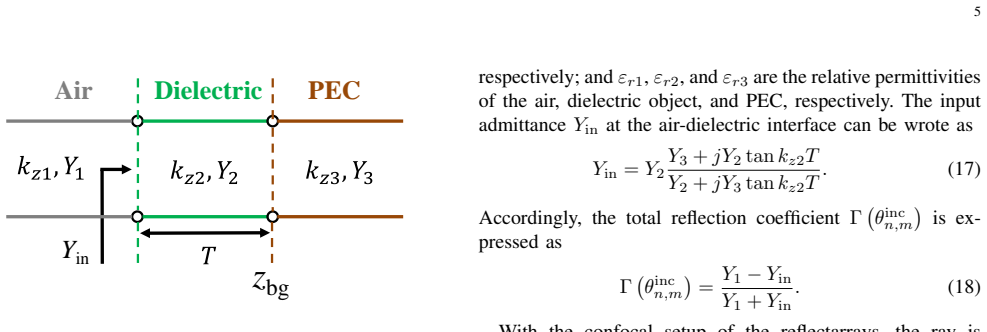
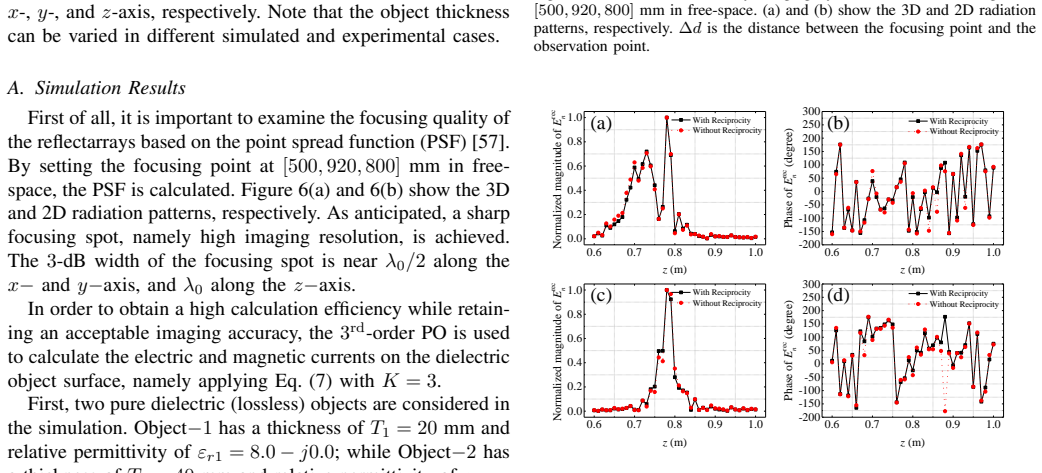
The load-bearing object is the total reflection coefficient $\Gamma(\theta_{\rm inc})$ of the dielectric layer, computed through the transmission-line model of Fig. 4: the air–dielectric–PEC stack is represented by characteristic admittances $Y_i$ and the input admittance $Y_{\rm in}=Y_2\,(Y_3+jY_2\tan(k_{z2}T))/(Y_2+jY_3\tan(k_{z2}T))$, with $\Gamma=(Y_1-Y_{\rm in})/(Y_1+Y_{\rm in})$. This analytic formula makes the forward model fast enough to sweep $\varepsilon'_r$, $\varepsilon''_r$, $T$ exhaustively. The companion ingredient is the range-dependent near-field radiation pattern of the confocally focused reflectarray, which makes the received magnitude and phase vary with the focusing point in a way that carries thickness information, breaking the $T\sqrt{\varepsilon'}$ ambiguity. Throughout, physical optics with the modified equivalent current approximation provides the induced currents on the object and body used for profile reconstruction, and a reciprocity relation avoids computing each receive path directly.
What would settle it
Take the same two-reflectarray setup and measure an object that is deliberately not a flat slab, for instance a curved dielectric shell or a wedge of variable thickness, on the same steel plate; if matching the three focusing points yields a permittivity far from the known material or a thickness that contradicts the geometry, the central inversion claim would be falsified. A more direct test is to use the method on two objects with equal $T\sqrt{\varepsilon'}$ but different shapes and see whether the estimated permittivities remain distinct.
Extended reading notes
Core claim
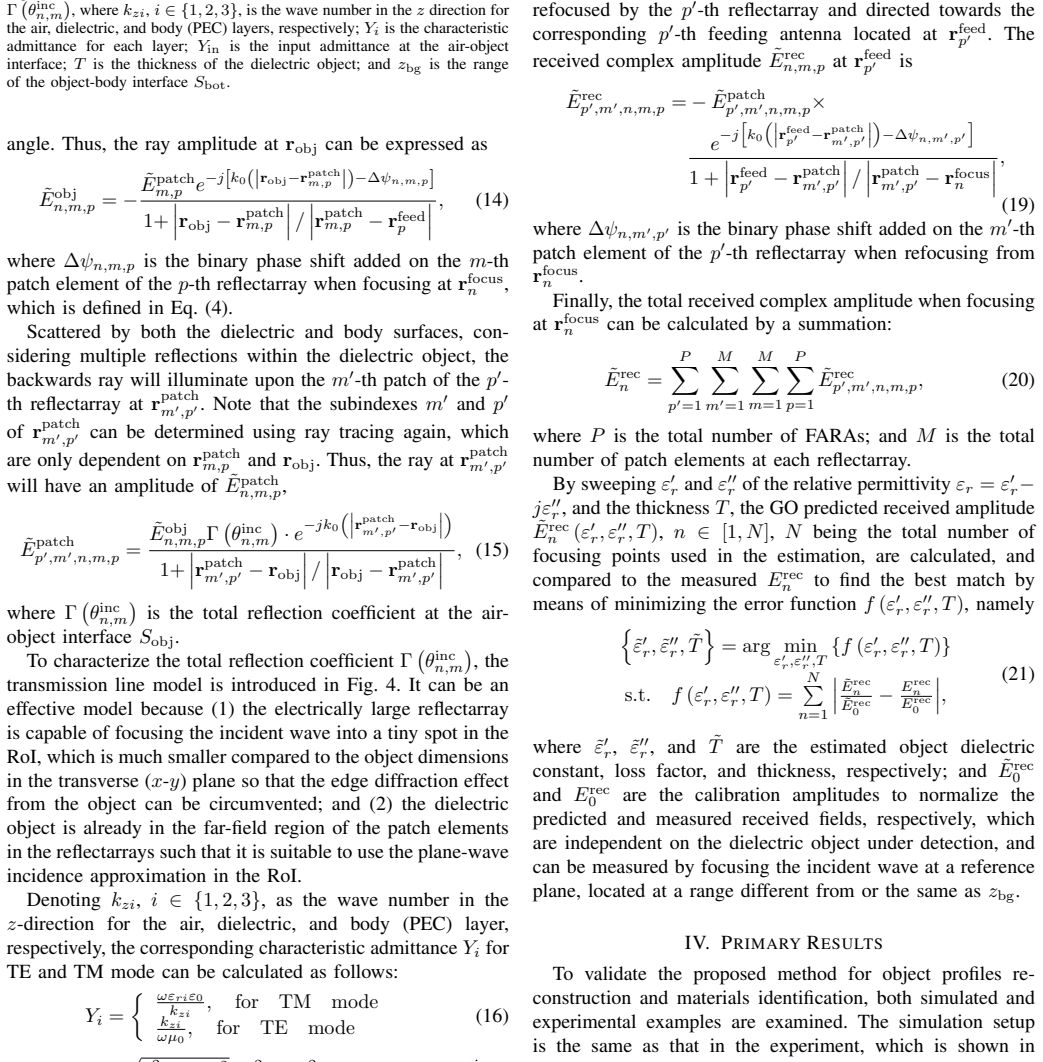
The paper's central claim is that one fixed operating frequency can do what current microwave screening usually needs wide bandwidth or multiple transceivers for: reconstruct the shape of a concealed dielectric object and determine its material. The object profile is found by focusing the reflectarray beam along a line and recording the range of maximum received field; the paper shows that for low-loss thick slabs this maximum sits not at the front surface but below it because of strong internal multiple reflections, so the profile step alone under-estimates thickness. Material identification is carried out separately: a geometrical-optics ray-tracing forward model computes the complex received field from each patch of each reflectarray, using a transmission-line formula for the total reflection coefficient of a homogeneous dielectric slab on a perfect conductor. Sweeping $\varepsilon'_r$, $\varepsilon''_r$, and $T$, the method minimizes the mismatch between the predicted and measured normalized fields at three chosen focusing points, and the paper reports exact recovery for three simulated objects (including two deliberately chosen to satisfy $T_1\sqrt{\varepsilon'_1}=T_2\sqrt{\varepsilon'_2}$, the classic phase-shift ambiguity) and mean estimates $\tilde{\varepsilon}'_r=3.012$, $\tilde{\varepsilon}''_r=0.014$, and $\tilde{T}=37.6$ mm for a PA66 slab whose nominal dielectric constant is 2.8–3.1 and thickness 37 mm.
Load-bearing premise
The material-identification model assumes the concealed object is a homogeneous, planar slab of constant thickness sitting on a flat perfectly conducting surface, so a one-dimensional transmission-line reflection coefficient applies; realistic threats and the human body are neither planar slabs nor ideal conductors.
Editorial extensions
If this is right
- A single-frequency reflectarray scanner can in principle identify a concealed material by its complex permittivity without requiring prior knowledge of its thickness, since thickness is estimated jointly.
- The method inherits the computational speed of an analytic forward model and hardware-based focusing, so image formation and material estimation could run in real time at a checkpoint.
- Because the forward model is analytic, the estimation reduces to a bounded sweep over $\varepsilon'_r$, $\varepsilon''_r$, and $T$; the paper demonstrates unambiguous convergence even for two objects with identical $T\sqrt{\varepsilon'}$.
- The same scheme extends to multiple confocally arranged reflectarrays, covering larger regions of interest while preserving the single-frequency, single-transceiver-per-array hardware simplicity.
Reading between the lines
- A natural stress test for this work is whether the same slab-model inversion holds for curved or inhomogeneous objects, since the transmission-line $\Gamma$ formula assumes a flat, homogeneous layer.
- The analytic forward model is not specific to reflectarrays; other single-frequency configurations with a well-characterized near-field pattern could in principle run the same $\varepsilon'_r$, $\varepsilon''_r$, $T$ sweep.
- A robustness study varying the three selected focusing points, the calibration plane, and the noise level would clarify how the PA66 accuracy degrades in cluttered screening environments.
Signed reviews
Editorial analysis
A structured set of objections, weighed in public.
Referee Report
Summary. The manuscript proposes a single-frequency near-field imaging method for personnel screening using multiple reconfigurable reflectarrays. Profile reconstruction is carried out with a physical-optics model that accounts for multiple reflections inside dielectric objects, while material characterization uses a geometrical-optics ray-tracing forward model that sweeps the dielectric constant, loss factor, and thickness and matches the predicted received field to the measured one. The method is validated in simulation with three dielectric slab objects, including two deliberately chosen to exhibit the T*sqrt(epsilon') phase-shift ambiguity, and in experiment with a PA66 slab on a steel plate, for which the estimated values are epsilon'_r = 3.012 +/- 0.425, epsilon''_r = 0.014 +/- 0.009, and T = 37.6 +/- 0.593 mm against a known epsilon'_r of 2.8-3.1 and a thickness of 37 mm.
Significance. If the results hold, the paper offers a computationally efficient single-frequency alternative to wideband material characterization for reflectarray-based security screening. The GO forward model contains no fitted constants, the unknowns are the estimated permittivity and thickness, and the experimental agreement with the PA66 slab is a genuine external benchmark. The simulated pair of objects satisfying T1*sqrt(epsilon'_1) = T2*sqrt(epsilon'_2) is a good test of the claimed phase-shift-ambiguity resolution. The main caveat is that the material-identification model, and all validation cases, are restricted to homogeneous planar slabs of constant thickness on a metal-backed surface, so the broader claim of identifying threat materials on human bodies is not yet fully supported.
major comments (2)
- [Eq. (15), Section III-B] The denominator in Eq. (15) is degenerate: because |r^{patch}_{m',p'} - r_obj| equals |r_obj - r^{patch}_{m',p'}|, the ratio is identically 1, so the entire denominator reduces to the constant 2 and contains no geometry-dependent spreading factor. This contradicts the structure of the analogous Eq. (14), whose denominator involves two different path lengths. As written, every GO-predicted received field entering the cost function in Eq. (21) uses an incorrect path-loss term, which directly affects the estimated permittivity and thickness. The authors should correct the denominator and re-run the simulations and the PA66 experiment to confirm that the reported estimates remain valid.
- [Section III-B, Eqs. (13)-(18), Fig. 4] The material-characterization forward model assumes a homogeneous, planar, constant-thickness dielectric slab resting on a PEC half-space. Eq. (13) computes the first reflection point using a single thickness T and a flat air-object interface at zbg - T, and the transmission-line model of Eqs. (16)-(18) describes a uniform layer. The abstract and conclusion claim material identification for objects with undetermined profile on the human body, but Section IV validates only rectangular uniform slabs on a steel/PEC plate. For a curved object, a wedge, or a spatially varying thickness, the assumed reflection coefficient is incorrect, so the best-fit (epsilon'_r, epsilon''_r, T) from Eq. (21) will be biased even for noise-free data; the lossy, non-PEC human body introduces a further model mismatch. The authors should either narrow the claim to slab-like objects on a metal-backed surface or provide a quantitative robustness study showing how deviations from the slab-on-PEC geometry and from the PEC-body assumption affect the estimates.
minor comments (5)
- [Fig. 5(b), Section IV] The label '0.150 mm' for the y-dimension of the dielectric slab should presumably read '0.150 m', consistent with the stated 150 mm dimension.
- [Eq. (17), Section III-B] The sentence 'The input admittance Yin at the air-dielectric interface can be wrote as' contains a grammatical error; it should be 'can be written as'.
- [Section IV-B, Table I] The Velcro layer is approximated as a 1.0 mm air layer, but the reported estimated thickness of 37.6 mm is close to the PA66 thickness (37 mm) rather than to the total PA66-plus-Velcro thickness (38 mm). Please clarify whether T in the four-layer model denotes the PA66 thickness only or the combined thickness, and how the four-layer transmission line was implemented.
- [Eq. (21), Section III-B] The calibration amplitudes E^rec_0 and E^rec_0 are only described verbally as being obtained by focusing at a reference plane. Please state explicitly where this reference plane is located in the simulations and experiment and whether the same calibration was used for all focusing points, since any range-dependent amplitude or phase offset in this normalization directly enters the cost function.
- [Figs. 11-13, Section IV-A] The error-distribution figures are labeled 'dB', but the colorbar units and the quantity being plotted in dB are not defined. Please state whether f(epsilon'_r, epsilon''_r, T) is displayed in dB and what reference value is used.
Circularity Check
No circularity: the material-characterization result is an inversion of an independently derived forward model, validated against MLFMA and an external PA66 experiment.
full rationale
The central derivation chain is self-contained. The GO forward model in Eqs. (12)-(20) is constructed from free-space ray tracing, the reflectarray binary-phase focusing formula, and the standard transmission-line reflection coefficient of a dielectric layer on a PEC (Eqs. (16)-(18)); it contains no parameters fitted to the object being characterized. Eq. (21) sweeps the unknowns (epsilon'_r, epsilon''_r, T) and selects the values that minimize the mismatch between the model output and independently obtained fields, either MLFMA-simulated fields or experimental measurements. These unknowns are not inputs to the model, and the comparison is made on data not used to build the model. The PA66 experiment is an external benchmark: the material's permittivity is known from a datasheet, the fields are measured, and the estimates are compared with that independent knowledge. The self-citations [24] and [56] introduce prior frameworks, but the present paper re-derives the GO prediction in Eqs. (12)-(20), and no uniqueness theorem or authority claim is used to force the result. The stated limitations, namely the homogeneous constant-thickness slab model, the PEC-body assumption, and the Velcro-as-air approximation, affect accuracy and generality but do not make the derivation circular. No step reduces to its own inputs by construction.
Assumptions & free parameters
free parameters (3)
- PO order K =
3
- Number of focusing points N =
3
- Range resolution delta_z =
10 mm
assumptions (5)
- domain assumption The human body can be modeled as a PEC plate (Section II and Fig. 2).
- domain assumption MECA/PO equivalent currents in Eq. (2) accurately describe scattering from dielectric interfaces at 24.16 GHz.
- domain assumption The dielectric threat is a homogeneous planar slab of constant thickness T, and the incident field in the RoI is a plane wave, allowing a 1-D transmission-line model (Section III-B, Fig. 4).
- domain assumption GO ray tracing with spherical spreading and no edge diffraction models the near-field reflectarray response (Eqs. 12-19).
- standard math Standard EM reciprocity (Eq. 9) and the free-space near-field integral (Eq. 1) are valid.
Cite this review
Pith. "Pith review of Single-Frequency Imaging and Material Characterization using Reconfigurable Reflectarrays." pith.science (2026). https://pith.science/paper/ZH7KUC4X
@misc{pith2026190809033,
  author       = {Pith},
  title        = {Pith review of: Single-Frequency Imaging and Material Characterization using Reconfigurable Reflectarrays},
  year         = {2026},
  howpublished = {\url{https://pith.science/paper/ZH7KUC4X}},
  note         = {Machine review of arXiv:1908.09033}
}
read the original abstract
In this work, a physical and geometrical optics based single-frequency imaging scheme is proposed for personal screening systems using multiple reconfigurable reflectarrays. This scheme is able to not only reconstruct profiles of potential threat objects on human body, but also identify their materials in terms of their complex relative permittivities. Both simulation and experiment are carried out to detect dielectric objects at a microwave frequency of 24.16 GHz. The object profiles and complex relative permittivities are obtained with both high accuracy and computational efficiency, which show great potentials for security imaging where inspection of human body for threat materials, such as narcotics, explosives, and other types of contraband, is very common.
Figures


Figures from the paper (11 more)




Reference graph
Works this paper leans on
-
[1]
Three-dimensional millimeter-wave imaging for concealed weapon detection,
D. M. Sheen, D. L. McMakin, and T. E. Hall, “Three-dimensional millimeter-wave imaging for concealed weapon detection,” IEEE Trans. Microw. Theory Tech., vol. 49, no. 9, pp. 1581–1592, Sep 2001
work page 2001
-
[2]
A novel fully electronic active real-time imager based on a planar multistatic sparse array,
S. S. Ahmed, A. Schiessl, and L. P. Schmidt, “A novel fully electronic active real-time imager based on a planar multistatic sparse array,” IEEE Trans. Microw. Theory Tech., vol. 59, no. 12, pp. 3567–3576, Dec 2011
work page 2011
-
[3]
S. S. Ahmed, A. Schiessl, F. Gumbmann, M. Tiebout, S. Methfessel, and L. P. Schmidt, “Advanced microwave imaging,” IEEE Microw. Mag. , vol. 13, no. 6, pp. 26–43, Sept 2012
work page 2012
-
[4]
Sar imaging of suicide bombers wearing concealed explosive threats,
J. A. Martinez-Lorenzo, F. Quivira, and C. M. Rappaport, “Sar imaging of suicide bombers wearing concealed explosive threats,” Progress in Electromagnetics Research, vol. 125, pp. 255–272, 2012
work page 2012
-
[5]
Y . Rodrguez-Vaqueiro, Y . lvarez Lpez, B. Gonzlez-Valdes, J. . Martnez, F. Las-Heras, and C. M. Rappaport, “On the use of compressed sensing techniques for improving multistatic millimeter-wave portal-based per- sonnel screening,” IEEE Trans. Antennas Propag. , vol. 62, no. 1, pp. 494–499, Jan 2014
work page 2014
-
[6]
P. M. Meaney, K. D. Paulsen, A. Hartov, and R. K. Crane, “Microwave imaging for tissue assessment: initial evaluation in multitarget tissue- equivalent phantoms,” IEEE Trans. Biomed. Eng. , vol. 43, no. 9, pp. 878–890, Sept. 1996
work page 1996
-
[7]
A clinical prototype for active microwave imaging of the breast,
P. M. Meaney, M. W. Fanning, D. Li, S. P. Poplack, and K. D. Paulsen, “A clinical prototype for active microwave imaging of the breast,” IEEE Trans. Microw. Theory Tech., vol. 48, no. 11, pp. 1841–1853, Nov. 2000
work page 2000
-
[8]
Confocal microwave imaging for breast cancer detection: localization of tumors in three dimensions,
E. C. Fear, X. Li, S. C. Hagness, and M. A. Stuchly, “Confocal microwave imaging for breast cancer detection: localization of tumors in three dimensions,” IEEE Trans. Biomed. Eng. , vol. 49, no. 8, pp. 812–822, Aug 2002
work page 2002
Show all 60 references
-
[9]
Passive millimeter wave imaging,
L. Yujiri, M. Shoucri, and P. Moffa, “Passive millimeter wave imaging,” IEEE Microw. Mag., vol. 4, no. 3, pp. 39–50, Sept 2003
2003
-
[10]
An innovative microwave-imaging technique for nondestruc- tive evaluation: Applications to civil structures monitoring and biological bodies inspection,
M. Benedetti, M. Donelli, A. Martini, M. Pastorino, A. Rosani, and A. Massa, “An innovative microwave-imaging technique for nondestruc- tive evaluation: Applications to civil structures monitoring and biological bodies inspection,”IEEE Trans. Instrum. Meas., vol. 55, no. 6, pp...
2006
-
[11]
Single-frequency microwave imaging with dynamic metasurface apertures,
T. Sleasman, M. Boyarsky, M. F. Imani, T. Fromenteze, J. N. Gollub, and D. R. Smith, “Single-frequency microwave imaging with dynamic metasurface apertures,” J. Opt. Soc. Am. B , vol. 34, no. 8, pp. 1713– 1726, Aug 2017
2017
-
[12]
Recent european developments in active microwave imaging for industrial, scientific, and medical applications,
J. C. Bolomey, “Recent european developments in active microwave imaging for industrial, scientific, and medical applications,” IEEE Trans. Microw. Theory Tech., vol. 37, no. 12, pp. 2109–2117, Dec 1989
1989
-
[13]
B. D. Steinberg and H. M. Subbaram, Microwave imaging techniques . John Wiley & Sons, 1991
1991
-
[14]
A review of target decomposition theorems in radar polarimetry,
S. R. Cloude and E. Pottier, “A review of target decomposition theorems in radar polarimetry,” IEEE Trans. Geosci. Remote Sens. , vol. 34, no. 2, pp. 498–518, Mar 1996
1996
-
[15]
Microwave breast imaging with a monostatic radar-based system: A study of application to patients,
E. C. Fear, J. Bourqui, C. Curtis, D. Mew, B. Docktor, and C. Romano, “Microwave breast imaging with a monostatic radar-based system: A study of application to patients,” IEEE Trans. Microw. Theory Tech. , vol. 61, no. 5, pp. 2119–2128, May 2013
2013
-
[16]
Bistatic sar processing and experiments,
I. Walterscheid, J. H. G. Ender, A. R. Brenner, and O. Loffeld, “Bistatic sar processing and experiments,” IEEE Trans. Geosci. Remote Sens. , vol. 44, no. 10, pp. 2710–2717, Oct 2006
2006
-
[17]
Spaceborne bi- and multistatic sar: potential and challenges,
G. Krieger and A. Moreira, “Spaceborne bi- and multistatic sar: potential and challenges,” IEE Proceedings - Radar, Sonar and Navigation , vol. 153, no. 3, pp. 184–198, June 2006
2006
-
[18]
The evolution to modern phased array architectures,
J. S. Herd and M. D. Conway, “The evolution to modern phased array architectures,” Proc. IEEE, vol. 104, no. 3, pp. 519–529, Mar. 2016
2016
-
[19]
Compressed sensing,
D. L. Donoho, “Compressed sensing,” IEEE Trans. Inf. Theory, vol. 52, no. 4, pp. 1289–1306, Apr. 2006
2006
-
[20]
A novel strategy for radar imaging based on compressive sensing,
M. T. Alonso, P. Lopez-Dekker, and J. J. Mallorqui, “A novel strategy for radar imaging based on compressive sensing,” IEEE Trans. Geosci. Remote Sens., vol. 48, no. 12, pp. 4285–4295, Dec 2010
2010
-
[21]
Soumekh, Synthetic Aperture Radar Signal Processing
M. Soumekh, Synthetic Aperture Radar Signal Processing. Wiley, 1999
1999
-
[22]
Millimeter-wave imaging system for personnel screening: scanning 107 points a second and using no moving parts,
P. Corredoura, Z. Baharav, B. Taber, and G. Lee, “Millimeter-wave imaging system for personnel screening: scanning 107 points a second and using no moving parts,” Proc. SPIE, vol. 6211, pp. 6211 – 6211 – 8, 2006
2006
-
[23]
Reflect-array based mm- wave people screening system,
B. N. Lyons, E. Entchev, and M. K. Crowley, “Reflect-array based mm- wave people screening system,” Proc. SPIE, vol. 8900, pp. 8900 – 8900 – 10, 2013
2013
-
[24]
Modeling and imaging security threats using a single-frequency adaptable reflect-array,
H. Gomez-Sousa and J. A. Martinez-Lorenzo, “Modeling and imaging security threats using a single-frequency adaptable reflect-array,” inProc. 2017 IEEE International Symposium on Technologies for Homeland Security (HST), Apr. 2017, pp. 1–7
2017
-
[25]
Identification of potential threat materials using active electromagnetic waves,
M. B. Abdillah, B. Lyons, and E. Entchev, “Identification of potential threat materials using active electromagnetic waves,” Mar. 5 2013, uS Patent 8,390,504
2013
-
[26]
Microstrip reflectarray,
J. Huang, “Microstrip reflectarray,” in Antennas and Propagation Society Symposium 1991 Digest , June 1991, pp. 612–615 vol.2
1991
-
[27]
Design of millimeter wave microstrip reflectarrays,
D. M. Pozar, S. D. Targonski, and H. D. Syrigos, “Design of millimeter wave microstrip reflectarrays,” IEEE Trans. Antennas Propag. , vol. 45, no. 2, pp. 287–296, Feb 1997
1997
-
[28]
X ray imaging for on-the-body contraband detection,
W. Baukus, “X ray imaging for on-the-body contraband detection,” in Proc. 16th Annual Security Technology Symposium & Exhibition , 2000
2000
-
[29]
Qpass quick personnel automatic safe screening for security enhancement of passengers,
S. Ahmed, F. Gumbmann, A. Schiessl, M. Reiband, S. Methfessel, C. Maire, A. Cenanovic, O. Ostwald, C. Evers, and L. Schmidt, “Qpass quick personnel automatic safe screening for security enhancement of passengers,” in Proc. Future Security Conf. , 2011
2011
-
[30]
Indirect microwave holographic imaging of concealed ordnance for airport security imaging systems,
O. Yurduseven, “Indirect microwave holographic imaging of concealed ordnance for airport security imaging systems,” Progress In Electromag- netics Research, vol. 146, pp. 7–13, 2014
2014
-
[31]
Sar processing for profile reconstruction and characterization of dielectric objects on the human body surface,
B. Gonzalez-Valdes, Y . Alvarez-Lopez, J. A. Martinez-Lorenzo, F. L. H. Andres, and C. M. Rappaport, “Sar processing for profile reconstruction and characterization of dielectric objects on the human body surface,” Progress In Electromagnetics Research, vol. 138, pp. 269–282, 2013
2013
-
[32]
Sar imaging-based techniques for low permittiv- ity lossless dielectric bodies characterization,
Y . Alvarez, B. Gonzalez-Valdes, J. A. Martinez-Lorenzo, C. M. Rappa- port, and F. Las-Heras, “Sar imaging-based techniques for low permittiv- ity lossless dielectric bodies characterization,” IEEE Antennas Propag. Mag., vol. 57, no. 2, pp. 267–276, Apr. 2015
2015
-
[33]
Spectral signatures for identifying explosives with wideband millimeter-wave illumination,
J. C. Weatherall, J. Barber, and B. T. Smith, “Spectral signatures for identifying explosives with wideband millimeter-wave illumination,” IEEE Trans. Microw. Theory Tech. , vol. 64, no. 3, pp. 999–1005, Mar. 2016
2016
-
[34]
Comparison of two optimization techniques for the estimation of complex permittivities of multilayered structures using waveguide measurements,
M. E. Baginski, D. L. Faircloth, and M. D. Deshpande, “Comparison of two optimization techniques for the estimation of complex permittivities of multilayered structures using waveguide measurements,” IEEE Trans. Microw. Theory Tech., vol. 53, no. 10, pp. 3251–3259, Oct 2005
2005
-
[35]
Estimation of frequency dispersive complex permittivity seen by each antenna for enhanced multistatic radar medical imaging,
A. Zamani and A. M. Abbosh, “Estimation of frequency dispersive complex permittivity seen by each antenna for enhanced multistatic radar medical imaging,” IEEE Trans. Antennas Propag. , vol. 65, no. 7, pp. 3702–3711, July 2017
2017
-
[36]
Estimation of the frequency-dependent average dielectric properties of breast tissue using a time-domain inverse scattering technique,
D. W. Winters, E. J. Bond, B. D. V . Veen, and S. C. Hagness, “Estimation of the frequency-dependent average dielectric properties of breast tissue using a time-domain inverse scattering technique,”IEEE Trans. Antennas Propag., vol. 54, no. 11, pp. 3517–3528, Nov 2006
2006
-
[37]
Material characterization of arbitrarily shaped dielectrics based on reflected pulse characteristics,
K. K. M. Chan, A. E. C. Tan, L. Li, and K. Rambabu, “Material characterization of arbitrarily shaped dielectrics based on reflected pulse characteristics,” IEEE Trans. Microw. Theory Tech. , vol. 63, no. 5, pp. 1700–1709, May 2015
2015
-
[38]
System for bulk dielectric permittivity estimation of breast tissues at microwave frequencies,
J. Bourqui and E. C. Fear, “System for bulk dielectric permittivity estimation of breast tissues at microwave frequencies,” IEEE Trans. Microw. Theory Tech., vol. 64, no. 9, pp. 3001–3009, Sept 2016
2016
-
[39]
Radar- based time-domain head imaging using database of effective dielectric constant,
B. J. Mohammed, K. S. Bialkowski, and A. M. Abbosh, “Radar- based time-domain head imaging using database of effective dielectric constant,” Electron. Lett., vol. 51, no. 20, pp. 1574–1576, 2015
2015
-
[40]
Determining the rela- tive permittivity of deep embedded biological tissues,
S. Salman, D. Psychoudakis, and J. L. V olakis, “Determining the rela- tive permittivity of deep embedded biological tissues,” IEEE Antennas Wireless Propag. Lett., vol. 11, pp. 1694–1697, 2012
2012
-
[41]
A novel method of deep tissue biomedical imaging using a wearable sensor,
M. A. Islam, A. Kiourti, and J. L. V olakis, “A novel method of deep tissue biomedical imaging using a wearable sensor,” IEEE Sensors J. , vol. 16, no. 1, pp. 265–270, Jan 2016
2016
-
[42]
Automatic measurement of complex dielectric constant and permeability at microwave frequencies,
W. B. Weir, “Automatic measurement of complex dielectric constant and permeability at microwave frequencies,” Proc. IEEE, vol. 62, no. 1, pp. 33–36, Jan 1974. 11
1974
-
[43]
A comprehensive analysis of free-space and guided-wave techniques for extracting the permeability and permittivity of materials using reflection-only mea- surements,
R. A. Fenner, E. J. Rothwell, and L. L. Frasch, “A comprehensive analysis of free-space and guided-wave techniques for extracting the permeability and permittivity of materials using reflection-only mea- surements,” Radio Sci., vol. 47, no. 01, pp. 1–13, Feb. 2012
2012
-
[44]
Radiation analysis approaches for reflectarray antennas [antenna designer’s notebook],
P. Nayeri, A. Z. Elsherbeni, and F. Yang, “Radiation analysis approaches for reflectarray antennas [antenna designer’s notebook],”IEEE Antennas Propag. Mag., vol. 55, no. 1, pp. 127–134, Feb. 2013
2013
-
[45]
Phase-shift ambiguity in microwave dielectric properties measurements,
S. Trabelsi, A. W. Kraszewski, and S. O. Nelson, “Phase-shift ambiguity in microwave dielectric properties measurements,” IEEE Trans. Instrum. Meas., vol. 49, no. 1, pp. 56–60, Feb. 2000
2000
-
[46]
Measuring the complex permittivity of thin grain samples by the free-space transmission technique,
J. Roelvink and S. Trabelsi, “Measuring the complex permittivity of thin grain samples by the free-space transmission technique,” in 2012 IEEE International Instrumentation and Measurement Technology Conference Proceedings, May 2012, pp. 310–313
2012
-
[47]
Free-space measurement using explicit, reference-plane and thickness-invariant method for permittivity determination of planar materials,
K. Y . You, M. S. Sim, H. Mutadza, F. Esa, and Y . L. Chan, “Free-space measurement using explicit, reference-plane and thickness-invariant method for permittivity determination of planar materials,” in 2017 Progress in Electromagnetics Research Symposium - Fall (PIERS - FALL)...
2017
-
[48]
Realizing an electron- ically tunable reflectarray using varactor diode-tuned elements,
S. V . Hum, M. Okoniewski, and R. J. Davies, “Realizing an electron- ically tunable reflectarray using varactor diode-tuned elements,” IEEE Microw. Wireless Compon. Lett., vol. 15, no. 6, pp. 422–424, June 2005
2005
-
[49]
X-band reflectarray antenna with switching-beam using pin diodes and gathered elements,
E. Carrasco, M. Barba, and J. A. Encinar, “X-band reflectarray antenna with switching-beam using pin diodes and gathered elements,” IEEE Trans. Antennas Propag., vol. 60, no. 12, pp. 5700–5708, Dec 2012
2012
-
[50]
An electronically reconfigurable reflectarray element based on binary phase shifters for k-band applications,
H. Theissen, C. Dahl, I. Rolfes, and T. Musch, “An electronically reconfigurable reflectarray element based on binary phase shifters for k-band applications,” in Proc. 2016 German Microwave Conference (GeMiC), March 2016, pp. 321–324
2016
-
[51]
C. A. Balanis, Advanced Engineering Electromagnetics, 2nd ed. Wiley, 2012
2012
-
[52]
Wave scattering by dielectric and lossy materials using the modi- fied equivalent current approximation (meca),
J. G. Meana, J. . Martinez-Lorenzo, F. Las-Heras, and C. Rappaport, “Wave scattering by dielectric and lossy materials using the modi- fied equivalent current approximation (meca),” IEEE Trans. Antennas Propag., vol. 58, no. 11, pp. 3757–3761, Nov 2010
2010
-
[53]
High frequency techniques: The physical optics approximation and the modi- fied equivalent current approximation (meca),
J. Guti ´errez-Meana, J. ´A. Mart ´ınez-Lorenzo, and F. Las-Heras, “High frequency techniques: The physical optics approximation and the modi- fied equivalent current approximation (meca),” in Electromagnetic waves propagation in complex matter . InTech, 2011
2011
-
[54]
A uniform geometrical theory of diffraction for an edge in a perfectly conducting surface,
R. G. Kouyoumjian and P. H. Pathak, “A uniform geometrical theory of diffraction for an edge in a perfectly conducting surface,” Proc. IEEE, vol. 62, no. 11, pp. 1448–1461, Nov. 1974
1974
-
[55]
An analysis of the radiation from apertures in curved surfaces by the geometrical theory of diffraction,
P. H. Pathak and R. G. Kouyoumjian, “An analysis of the radiation from apertures in curved surfaces by the geometrical theory of diffraction,” Proc. IEEE, vol. 62, no. 11, pp. 1438–1447, Nov 1974
1974
-
[56]
Single-frequency material characterization using a microwave adaptive reflect-array,
W. Zhang and J. A. Martinez-Lorenzo, “Single-frequency material characterization using a microwave adaptive reflect-array,” in2018 IEEE International Symposium on Antennas and Propagation USNC/URSI National Radio Science Meeting , July 2018, pp. 1063–1064
2018
-
[57]
The point-spread function of a confocal microscope: its measurement and use in deconvolution of 3-d data,
P. J. Shaw and D. J. Rawlins, “The point-spread function of a confocal microscope: its measurement and use in deconvolution of 3-d data,” Journal of Microscopy , vol. 163, no. 2, pp. 151–165, 1991. [Online]. Available: http://dx.doi.org/10.1111/j.1365-2818.1991.tb03168.x
1991
-
[58]
Microwave inspection of luggage for contraband materials using imaging and inverse-scattering algorithms,
D. G. Watters, D. G. Falconer, K. J. Harker, R. Ueberschaer, and A. J. Bahr, “Microwave inspection of luggage for contraband materials using imaging and inverse-scattering algorithms,” Research in Nondestructive Evaluation, vol. 7, no. 2, pp. 153–168, Jun 1995
1995
-
[59]
Review of one-side approaches to radiographic imaging for detection of explosives and narcotics,
E. M. Hussein and E. J. Waller, “Review of one-side approaches to radiographic imaging for detection of explosives and narcotics,” Radiation Measurements, vol. 29, no. 6, pp. 581 – 591, 1998
1998
-
[60]
A. R. V on Hippel, Dielectric materials and applications . New York: Wiley, 1954
1954
Reviewed August 14, 2026 · model on record in the stance chip above.
Discussion (0). Continue with ORCID to comment.