REVIEW 4 major objections 6 minor 22 references
SIDLE: Semantically Intelligent Distributed Leader Election Algorithm for Wireless Sensor Networks
T0 review · 4 major / 6 minor · reviewed 2026-08-14 · deepseek-v4-flash
Pith's one-line read The paper claims that a two-level hexagonal wireless sensor/actuator network using its Premiership scoring function elects leaders faster and more safely, and keeps more residual energy in the network, than LEACH and FCA.
desk verdict The paper's residual-energy superiority claim is supported only by a missing figure, so the empirical core is absent; the hardware sketch is concrete but the research contribution is unsubstantiated. read the letter →
The pith
A machine-rendered reading of the paper's core claim, the machinery that carries it, and where it could break.
The reading
What carries the argument
The load-bearing object is the Premiership scoring function PS = $Re^{3}$ + 2 $Ss^{2}$ + 3 Pl + Ng, with Re residual energy, Ss radio signal strength, Pl path length to the head cluster, and Ng neighbor grade. The leader at each cell is selected by computing this value and choosing the highest, so the paper's battery-life claim stands or falls on whether that choice actually minimizes total network energy use. Around the score sits the two-level hierarchy: primitive nodes collect and preprocess data, leaders merge cell data, head clusters merge cluster data, and the master sends the final encrypted, compressed record to the base station or drone.
What would settle it
Run the reported two-cluster hardware setup through repeated election rounds, logging the residual energy of every node under identical traffic for SIDLE, LEACH, and FCA; if SIDLE's residual energy does not remain above both baselines until first node death, or if the plotted comparison in Figure 5 cannot be reproduced, the central claim fails.
Extended reading notes
Core claim
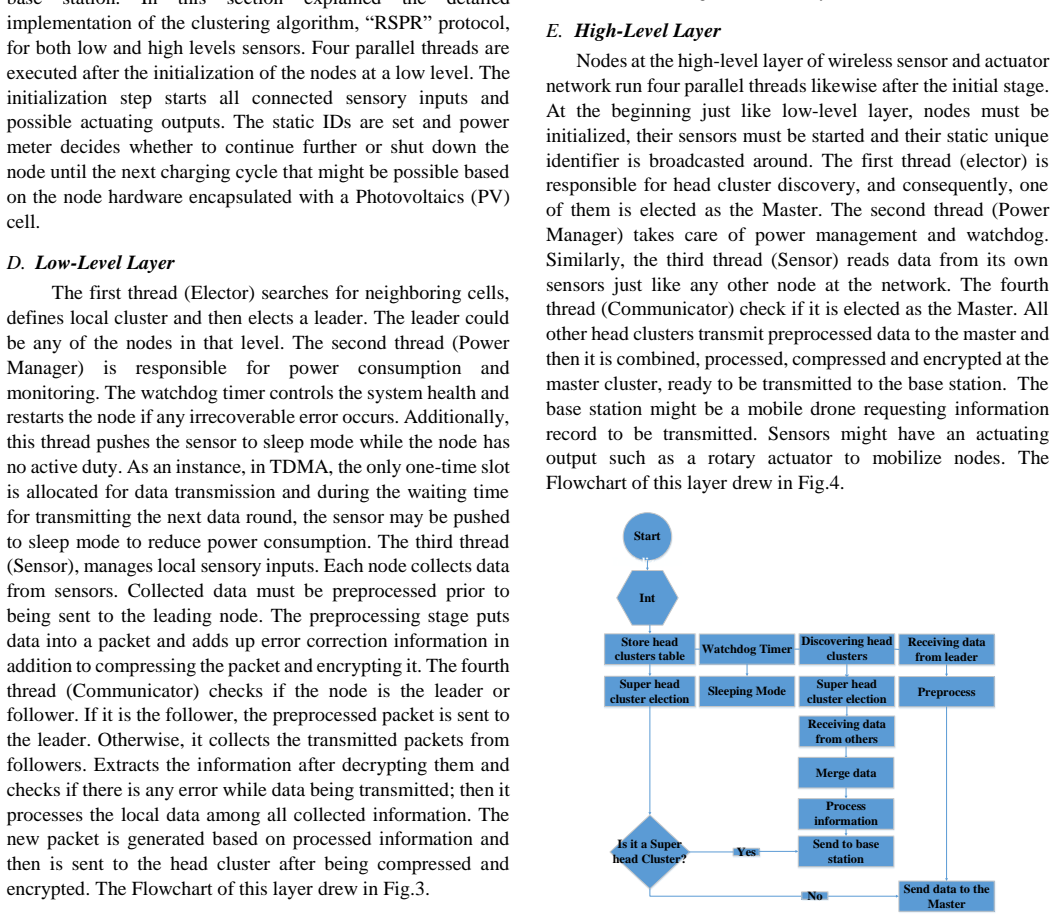
The central claim is that the distributed leader-election algorithm SIDLE, named RSPR in the protocol description, improves on LEACH and FCA on the decisive metric of residual energy. The mechanism is the Premiership function, which evaluates every candidate leader by the expression PS = $Re^{3}$ + 2 $Ss^{2}$ + 3 Pl + Ng, using residual energy, signal strength, path length to the head cluster, and neighbor grade; the node with the highest PS becomes leader. In the proposed two-level hierarchy, each hexagonal cell elects a leader, the central cell of a seven-cell FDMA cluster acts as head cluster, and head clusters elect a master that communicates with the base station or a mobile drone. The authors report that this scheme elects leaders more quickly, tolerates leader crashes, and, because of Semantic Intelligence in the scoring, keeps the network's residual energy above LEACH and FCA.
Load-bearing premise
The energy-saving claim holds only if choosing the highest Premiership score PS = $Re^{3}$ + 2 $Ss^{2}$ + 3 Pl + Ng actually picks the leader that minimizes total network battery use, an assumption the paper states without calibration, normalization, or an energy-consumption model.
Editorial extensions
If this is right
- If the central claim is right, a leader election that uses one arithmetic score can replace randomized rotation and fuzzy inference while improving residual energy, so constrained sensor nodes need no fuzzy engine.
- The two-level preprocessing hierarchy means each node sends small records rather than raw sensor streams, so network lifetime gains come from both leader choice and data-volume reduction.
- Because the Premiership rule is deterministic and simple, the same hardware setup can be reproduced and its weights tuned by other groups without protocol licensing barriers.
- The dead-head-cluster recovery mechanism, where refugee nodes switch to a neighboring leader and daisy-chain data, gives the protocol a fault-tolerance property that the described random-rotation baseline does not explicitly provide.
Reading between the lines
- A natural extension the paper does not pursue is to calibrate the Premiership weights (the cubic energy term, the quadratic signal term, and the linear path term) against measured per-round energy draw; one would expect the optimal weights to depend on cell density and traffic rather than being universal constants.
- The Semantic Intelligence label is applied in the text to what is a deterministic weighted sum; a testable extension is to replace the fixed weights with a fuzzy or learned mapping from the same four inputs and compare residual-energy curves on the same testbed.
- The hexagonal seven-cell cluster geometry makes testable predictions: path length and neighbor grade vary with cell size and drone drop accuracy, so the protocol's advantage over LEACH should grow with cell density and shrink in sparse deployments where every node hears the base station.
- The refugee and daisy-chain recovery after a head-cluster death invites a benchmark against a single power-boosted hop on the same topology, to find the crossover where each strategy saves more energy.
Signed reviews
Editorial analysis
A structured set of objections, weighed in public.
Referee Report
Summary. The manuscript proposes SIDLE, also called RSPR, a distributed leader-election protocol for heterogeneous wireless sensor and actuator networks deployed by drone in a hexagonal grid. Cells elect a local leader using a "Premiership" score PS = Re^3 + 2 Ss^2 + 3 Pl + Ng (Eq. 2), where Re is residual energy, Ss is signal strength, Pl is path length, and Ng is neighbor grade. The elected leader aggregates and compresses cell data and forwards it to a head cluster, which forwards processed information to a base station or mobile drone. The paper describes a multi-threaded low-level/high-level architecture and a hardware implementation using Arduino, nRF24L01, and ESP8266 modules. It claims that the proposed algorithm provides faster and safer election and reduces battery consumption compared with LEACH and FCA, with Figure 5 cited as the residual-energy comparison plot. However, Figure 5 is absent from the manuscript, and no simulation or measurement data are provided to support the central claim.
Significance. The potential contribution, if established, would be a simple deterministic weighted leader-election rule for heterogeneous WSANs that is cheap to compute on resource-constrained nodes; the drone-deployed hexagonal two-level hierarchy is a relevant scenario for IoT monitoring in rural areas. The submission does contain a concrete score formula, an explicit architecture description, and a stated comparison against LEACH and FCA. However, it supplies no machine-checked proofs, reproducible code, simulation data, or falsifiable measurements. Its central empirical claim rests on a missing figure, and the hand-weighted Premiership function is neither derived nor calibrated, so the mechanism underlying the claimed benefit is not established.
major comments (4)
- [IV.C, V, Fig.5] The central claim that SIDLE/RSPR outperforms LEACH and FCA in residual energy is not evidenced. Figure 5, which is said to plot this comparison, is absent from the manuscript, and no numerical table, simulation setup, initial energy values, traffic model, number of rounds, or variance statistics are provided. The Conclusion repeats the claim without adding evidence. As submitted, the superiority conclusion does not follow from the presented material.
- [II.F, III.B, Eq. (2)] The mechanism by which the score is supposed to improve energy efficiency is not established. PS = Re^3 + 2 Ss^2 + 3 Pl + Ng is a hand-weighted sum with no normalization, calibration, or derivation from an energy-consumption or network-lifetime model. Section III.B states that Ng is set to 1 and Pl is the same for all nodes, so the effective score is Re^3 + 2 Ss^2 + 3. Without an energy model linking these terms to residual energy, the claimed advantage does not follow even if Figure 5 were supplied.
- [II.F, III] The "Semantic Intelligence" decision-making system invoked in Section II.F is not implemented or evaluated. Section III.B and Box.4 describe only a direct linear weighted sum in C++, with no fuzzy inference rules, membership functions, defuzzification, or semantic reasoning. Consequently, the stated contribution of "SI employment" to reduced battery consumption is unsupported.
- [IV.A-C] The comparative evaluation is not described at a level that permits reproduction. The FCA baseline is described qualitatively, the LEACH threshold equation (3) is garbled in the typeset formula, and there is no statement of common simulation conditions, node counts, energy model, or performance metrics other than the missing Figure 5.
minor comments (6)
- [Title/abstract] The algorithm is called SIDLE in the title and abstract but RSPR in Sections II.C and II.F; please use one name consistently throughout the manuscript.
- [II.F] The sentence beginning "A sophisticated decision making Semantic Intelligent algoFailure on whether to accept or reject a given query" is incomplete and contains a typo; it should be rewritten for coherence.
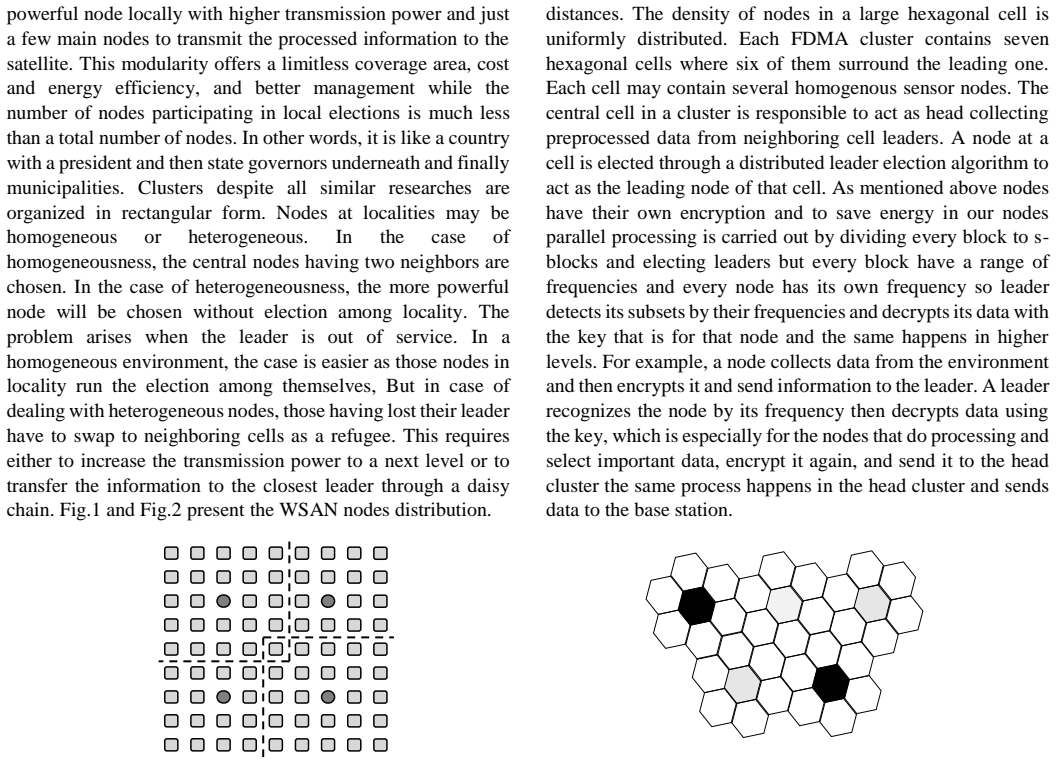
- [Figs. 1-2] The caption of Fig. 2 duplicates the caption of Fig. 1, and the two figures appear identical in the text, making the intended distinction unclear.
- [References] References [13] and [22] are the same paper, and reference [20] appears to be uncited in the text; please consolidate and verify all citations.
- [Eq. (3)] Equation (3), the LEACH threshold formula, is not rendered correctly and is unreadable as typeset; it must be reformatted.
- [Box.4] The premiership function in Box.4 uses int arguments for Re, Ss, Pl, and Ng, which truncates real-valued measurements; if real values are intended, the type should be changed and the normalization of inputs should be stated.
Circularity Check
No circular derivation: the uncalibrated Premiership function and the missing Fig. 5 create an evidence gap, not a self-referential reduction.
full rationale
The paper's only quantitative election rule is Eq. (2), PS = Re^3 + 2Ss^2 + 3Pl + Ng, which Section III.B reduces to Re^3 + 2Ss^2 + 3. This is an algorithmic scoring rule, not a derived prediction: it does not claim to compute residual energy from itself, and no fitted parameter is later renamed as a prediction. The residual-energy superiority over LEACH and FCA is asserted in Section IV.C and the Conclusion as being 'plotted in Fig.5', but the figure and simulation methodology are absent from the manuscript; that is an absence of evidence, not a circular step. The self-citations ([1], [4]) and the label 'Semantic Intelligence' are contextual and are not load-bearing in any equation or theorem; no uniqueness result is imported from the authors' prior work. Since no derivation chain reduces to its own inputs, the appropriate circularity finding is no significant circularity.
Assumptions & free parameters
free parameters (1)
- PS weighting coefficients (exponent and weights in Eq. 2) =
Re^3, 2 Ss^2, 3 Pl, 1 Ng
assumptions (3)
- ad hoc to paper The Premiership function PS = Re^3 + 2 Ss^2 + 3 Pl + Ng is a valid measure of leader quality.
- domain assumption Nodes within a cell can all communicate on the same frequency with unique codes, and a leader can cover up to 24 surrounding nodes.
- domain assumption The network is deployed as a regular hexagonal mesh by drone with uniform node density.
invented entities (1)
-
Semantic Intelligent (SI) decision-making system
Cite this review
Pith. "Pith review of SIDLE: Semantically Intelligent Distributed Leader Election Algorithm for Wireless Sensor Networks." pith.science (2026). https://pith.science/paper/J4XMWKBJ
@misc{pith2026190809042,
  author       = {Pith},
  title        = {Pith review of: SIDLE: Semantically Intelligent Distributed Leader Election Algorithm for Wireless Sensor Networks},
  year         = {2026},
  howpublished = {\url{https://pith.science/paper/J4XMWKBJ}},
  note         = {Machine review of arXiv:1908.09042}
}
read the original abstract
This paper introduces the deployment of a group of Wireless Sensor and Actuator Network (WSAN) for Internet of Thing (IoT) systems in rural regions deployed by a drone dropping sensors and actuators at a certain position as a mesh of a hexagonal form. Nodes are heterogeneous in hardware and functionality thus not all nodes are able to transfer data directly to the base station. Primitive ones are only capable of collecting local data. However, ones that are more sophisticated are equipped with long-range radio telemetry and more computational power. Power optimization is one of the crucial factors in designing WSANs. Total power consumption must be minimized, as sensors are self-managed. It is not feasible to collect sensors on time bases and recharge the batteries. Therefore, energy consumption optimization and harvesting green energy are other factors that are considered. In this regard, protocols are designed in a way to support such requirements. The preprocessed data are first collected and combined by the leaders at each hexagonal cell. Then, the information packets are sent to the head clusters. Consequently, head clusters reprocess the received information and depict a better global view of the zone, using a variety of the received information. Finally, the processed information is sent to the nearest base station or a mobile drone.
Figures

Reference graph
Works this paper leans on
-
[13]
A clustering routing protocol for energy balance of WSN based on Genetic Clustering Algorithm
S. He and Y. Dai, “A clustering routing protocol for energy balance of WSN based on Genetic Clustering Algorithm”, Procedia Computer Science IERI, vol. 2, pp. 788-793, 2012
work page 2012
-
[22]
Design, Implementation, and Evaluation of SemHD: A New Semantic Hierarchical Sensor Data Storage
Mehdi Gheisari. Design, Implementation, and Evaluation of SemHD: A New Semantic Hierarchical Sensor Data Storage. Indian J. Innovations Dev., Vol. 1, No. 3 (Mar 2012) ISSN 2277 – 5390
work page 2012
-
[1]
A Novel IoT Architecture based on 5G -IoT and Next Generation Technologies,
H. Rahimi, A. Zibaeenejad, and A. A. Safavi, “A Novel IoT Architecture based on 5G -IoT and Next Generation Technologies,” IEEE IEMCON conference, Vancouver, BC, Canada, Nov. 2018
work page 2018
-
[2]
Al-Anbagi, Irfan, Melike Erol-Kantarci, and Hussein T. Mouftah. "A survey on cross -layer quality -of-service appro aches in WSNs for delay and reliability-aware applications." IEEE Communications Surveys & Tutorials 18.1 (2016): 525-552
work page 2016
-
[3]
Application of thermal energy harvesting from low -level heat sources in powering up WSN node
Abdal-Kadhim, Ali Mohammed, and Kok Swee Leong. "Application of thermal energy harvesting from low -level heat sources in powering up WSN node." Frontiers of Sensors Technologies (ICFST), 2017 2nd International Conference on. IEEE, 2017
work page 2017
-
[4]
on the Security of the 5G -IoT Architecture
H. Rahimi, A. Zibaeenejad, P. Rajabzadeh, A. A. Safavi, "on the Security of the 5G -IoT Architecture", In Proceedings of the International Conference on Smart Cities & Internet of Things (SCIOT2018), September 26–27, 2018, Mashhad, Iran. ACM, New York, NY, USA, 2018
work page 2018
-
[5]
EhsanGhadakSaz, Mohammad Reza Amini, PayamPorkar, and Mehdi Gheisari. A Design- Implement and Compare two proposed sensor data’s storages Named SemHD and SSW, International Geoinformatics Research and Development Journal, Vol. 3, Issue2 , June 2012
work page 2012
-
[6]
uses a similar selection of the cluster heads to LEACH. Additionally, this algorithm uses the fuzzy logic to select the supercluster head (SCH). By the way, the collected data from the cluster heads are merged and then send to the base station by the SCH. Two different cluster levels have been defined in TSFL-LEACH on the basis of a node’s distance from t...
Show all 22 references
-
[7]
A Fuzzy Logic-Based Clustering Algorithm for WSN to Extend the Network Lifetime
P. Nayak and A. Devulapalli, “A Fuzzy Logic-Based Clustering Algorithm for WSN to Extend the Network Lifetime”, IEEE Sensor Journal, vol. 16, no. 1, pp. 137-144, 2016
2016
-
[8]
Two Stage Fuzzy Logic Based Clustering Approach wireless Sensor Network LEACH Protocol
M. Kamal and S. A. Shawkat, “ Two Stage Fuzzy Logic Based Clustering Approach wireless Sensor Network LEACH Protocol” , in Proceedings of the IEEE international conference on computer and information technology,pp. 154-159, 2014
2014
-
[9]
Sensor, Mesh and Ad Hoc Communications and Networks, 2009
Qi Dong and Donggang Liu., (2009),” Resilient Cluster Leader Election for Wireless Sensor Networks”. Sensor, Mesh and Ad Hoc Communications and Networks, 2009. SECON '09. 6th Annual IEEE Communications Society Conference on
2009
-
[10]
Chanak, P., Banerjee, I., Sherratt, R.S.: Mobile sink based fault diagnosis scheme for wireless sensor networks. J. Syst. Softw. 119, 45–57 (2016)
2016
-
[11]
Energy efficient Fuzzy logic Cluster Head selection in Wireless sensor networks
H. AL. Alami, A.Najid, “ Energy efficient Fuzzy logic Cluster Head selection in Wireless sensor networks”, in proc IEEE international conference on Information Technology for organizations development, pp. 1-7, 2016
2016
-
[12]
Cluster head selection in wireless sensor networks under fuzzy environment
Puneet Azad, Vidushi Sharma (2013), “Cluster head selection in wireless sensor networks under fuzzy environment” ISRN Sensor Networks 2013, Hindawi Publishing Corporation
2013
-
[15]
Energy efficient protocol for mobile Wireless Sensor Networks
M. K. Chourasia, M. Panchal and A. Shrivastav, “Energy efficient protocol for mobile Wireless Sensor Networks”, in Proceedings of the IEEE International Confer ence on Communication, Control and Intelligent Systems(CCIS), pp. 79-84, 2015
2015
-
[16]
Multilayer cluster designing algorithm for lifetime improvement of wireless sensor networks
Sohail Jabbar, Abid Ali Minhas, Anand Paul, Seungmin Rho, (2014), “Multilayer cluster designing algorithm for lifetime improvement of wireless sensor networks”, The Journal of Supercomputing October 2014, Volume 70, Issue 1, pp 104–132
2014
-
[17]
and Mittal V., (2004), “FLOC: A fast local clustering service for wireless sensor networks, in Proc
Demirbas M., Arora A. and Mittal V., (2004), “FLOC: A fast local clustering service for wireless sensor networks, in Proc. of Workshop on Dependability Issues in Wireless AdHoc Networks and Sensor Networks (DIWANS04), Florence, Italy
2004
-
[18]
Fuzzy-Logic-Based Energy Optimized Routing for Wireless Sensor Networks
Jiang H., Sun Y., Sun R., and Xu H., (2013), “Fuzzy-Logic-Based Energy Optimized Routing for Wireless Sensor Networks”, International Journal of Distributed Sensor Networks Volume 6, pp 1-9
2013
-
[19]
Godbolev, (2012),” Perfor mance Analysis of Clustering Protocol Using Fuzzy Logic for Wireless Sensor Network”, IAES International Journal of Artificial Intelligence (IJ-AI) Vol. 1, No. 3, ISSN: 2252-8938, pp. 103-111
2012
-
[20]
A bank failure early warning system based on a novel localized pattern learning and semantically associative fuzzy neural network,
G.S.Ng, C.Quek, H.Jiang, (2008), “A bank failure early warning system based on a novel localized pattern learning and semantically associative fuzzy neural network,” Expert Systems with Applications, Volume 34, Issue 2, February 2008, Pages 989-1003
2008
-
[21]
Hani Moghaddam, MeysamGharghi ,MehdiJafari, and Mehdi Gheisari, comparison semantic sensor network storages, IPCSIT Journal, 2010 - 460X, 2012
2010
-
[23]
Aydın, I., Karaköse, M., Akın, E.: Combined intelligent methods based on wireless sensor networks for condition monitoring and fault diagnosis. J. Intell. Manuf. 26(4), 717–729 (2015)
2015
Reviewed August 14, 2026 · model on record in the stance chip above.
Discussion (0). Continue with ORCID to comment.