REVIEW 3 major objections 6 minor 26 references
Photon Reconstruction Performance at the CEPC baseline detector
T0 review · 3 major / 6 minor · reviewed 2026-08-14 · deepseek-v4-flash
Pith's one-line read For the CEPC baseline detector, full simulation shows isolated photons above 1 GeV are identified with over 99% efficiency and less than 1% misidentification, and the Higgs boson mass in H→γγ is reconstructed to 2.2% after a…
desk verdict Useful first full-simulation photon performance study for CEPC, but the headline 2.2% H→γγ resolution and the 97% pi0 claim are both softer than they look. read the letter →
The pith
A machine-rendered reading of the paper's core claim, the machinery that carries it, and where it could break.
The reading
What carries the argument
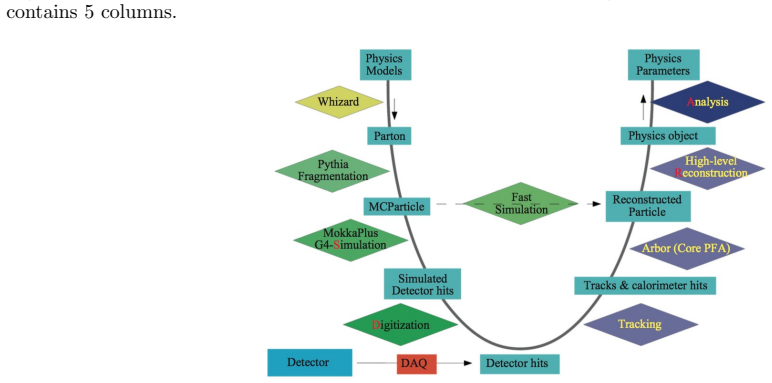
The analysis rests on three linked mechanisms: the particle-flow reconstruction that builds calorimeter clusters and separates nearby showers; a photon identifier that combines shower-shape variables with a 50 ps time-of-flight cut to reject neutral hadrons; and a geometry-based energy correction that scales each electromagnetic cluster by a position-dependent factor measured from simulated 50 GeV photons, compensating for energy lost in module and stave cracks and in the barrel–endcap dead zone. The H→γγ invariant mass then serves as the test bench for both energy resolution and two-shower separation.
What would settle it
Train the correction algorithm on 10 GeV and 100 GeV photon samples instead of 50 GeV and recompute the H→γγ invariant-mass resolution; if the 2.2% changes by more than the fit uncertainty, the single-energy calibration does not transfer and the quoted resolution depends on the training choice.
Extended reading notes
Core claim
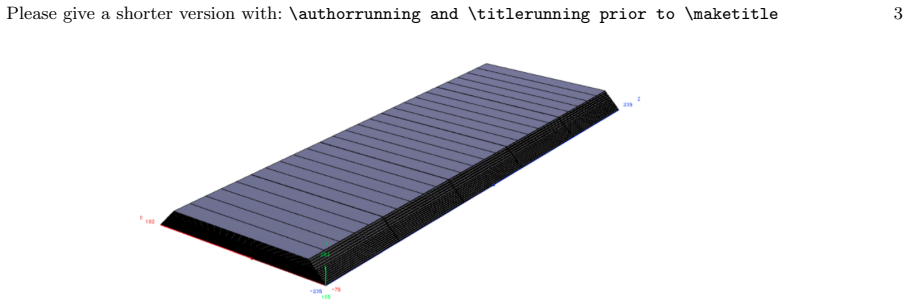
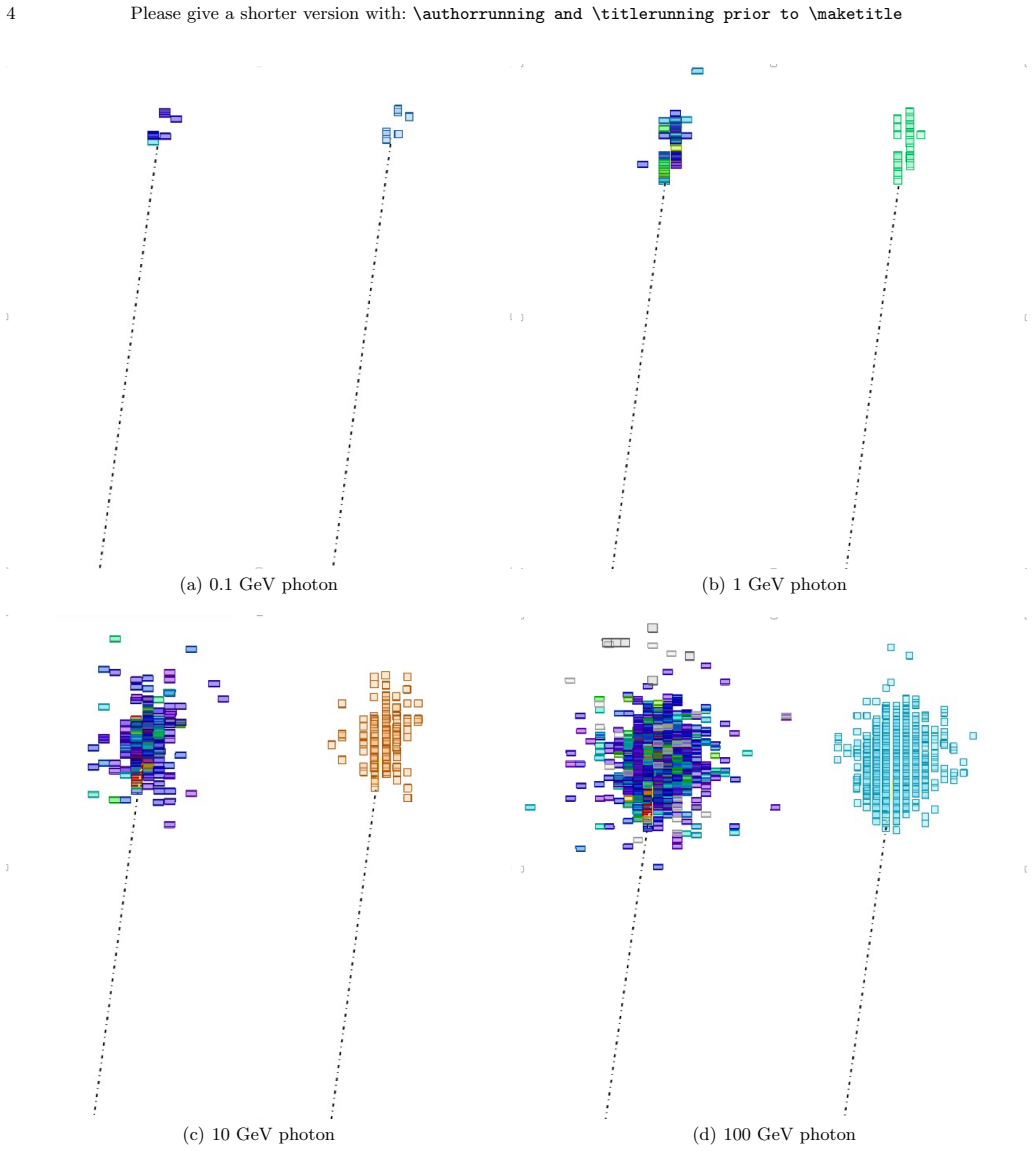
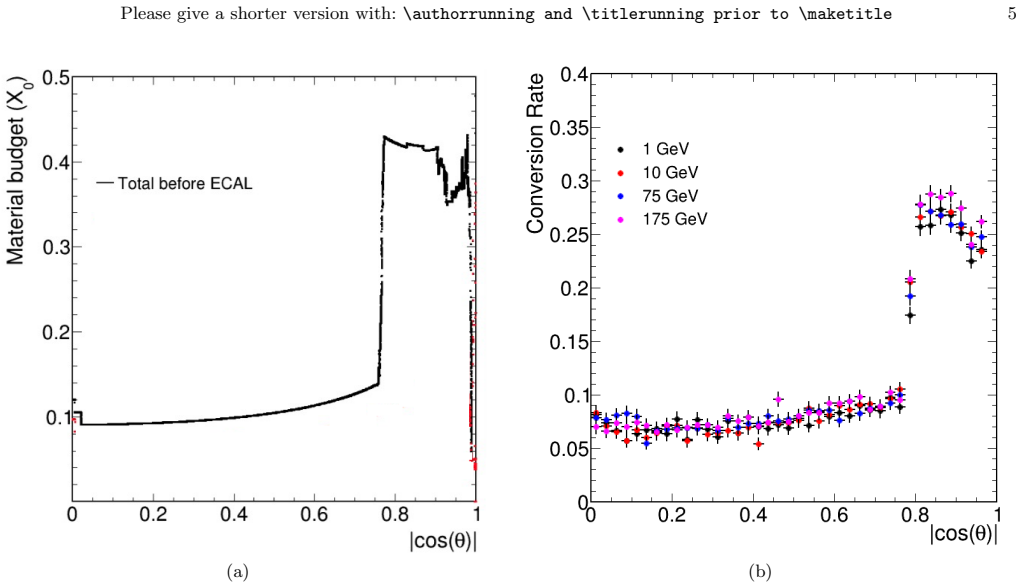
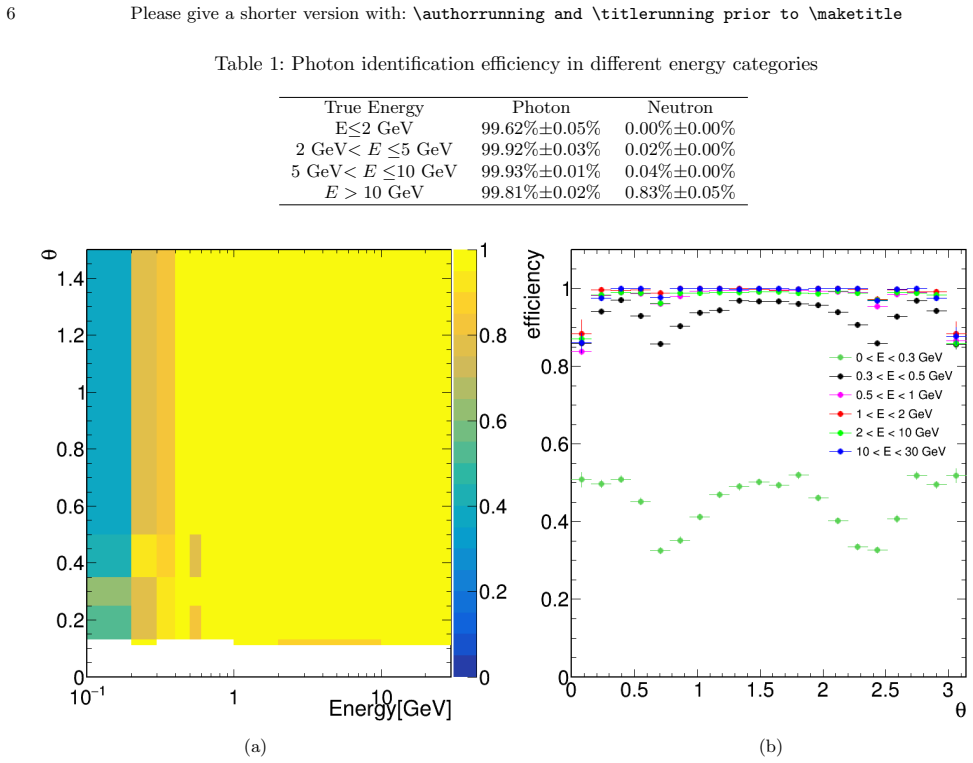
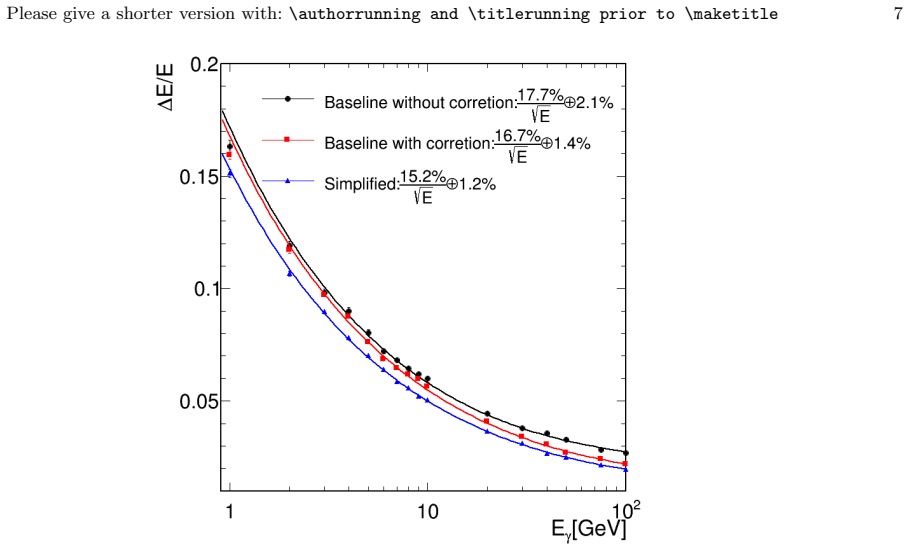
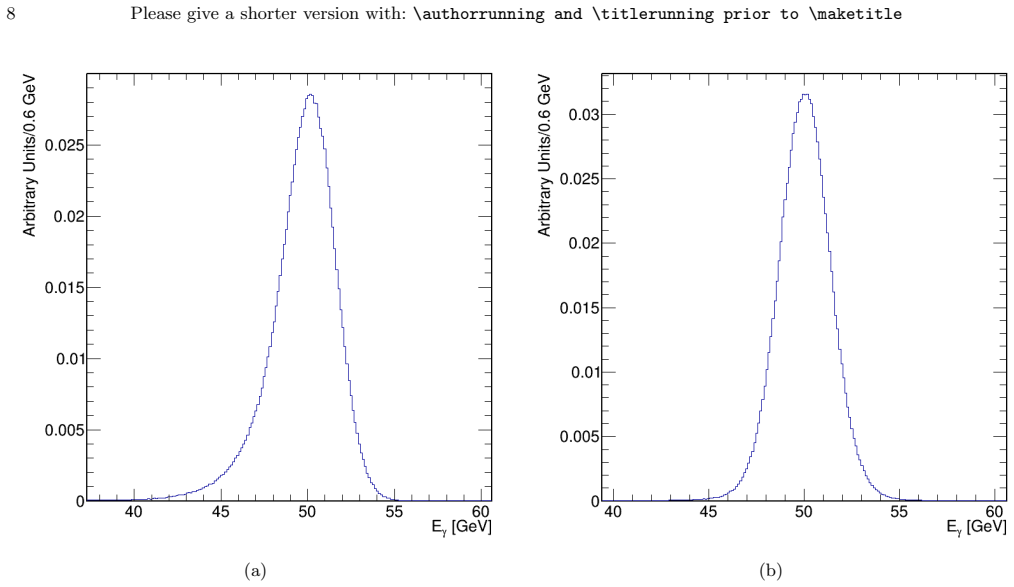
On its own terms, the paper claims that the CEPC baseline detector—a particle-flow oriented design with a silicon-tungsten sampling calorimeter split into staves, modules, and columns—reconstructs photons well enough for a Higgs factory. Unconverted, isolated photons above 1 GeV are identified with >99% efficiency and <1% misidentification; cluster reconstruction is near 100% for photons above 200 MeV and about 85% at 100 MeV; and roughly 6–10% of central-region photons and 25% of forward photons convert to e+e− before reaching the calorimeter. The energy resolution is about 17.7%/√E ⊕ 2.1% at the baseline detector versus 15.2%/√E ⊕ 1.2% at a simplified defect-free geometry, and a correction calibrated on 50 GeV photons removes the low-energy tail in H→γγ events so the Higgs mass resolution reaches 2.2% (1.7% ideal). The same clustering separates π0→γγ up to critical energies of 22 GeV in the barrel and 34 GeV in the endcap, so about 97% of π0s from Z→ττ are reconstructed.
Load-bearing premise
The position-based energy correction is calibrated on 50 GeV photons and is assumed to hold for the much wider energy spectrum of photons in H→γγ events.
Editorial extensions
If this is right
- Isolated unconverted photons above 1 GeV can be tagged at >99% efficiency with <1% neutron contamination, making the CEPC photon sample clean enough for precision Higgs and electroweak measurements.
- With the geometry correction, the Higgs mass from H→γγ is reconstructed at 2.2% relative resolution, establishing the baseline configuration as a viable starting point for the physics program.
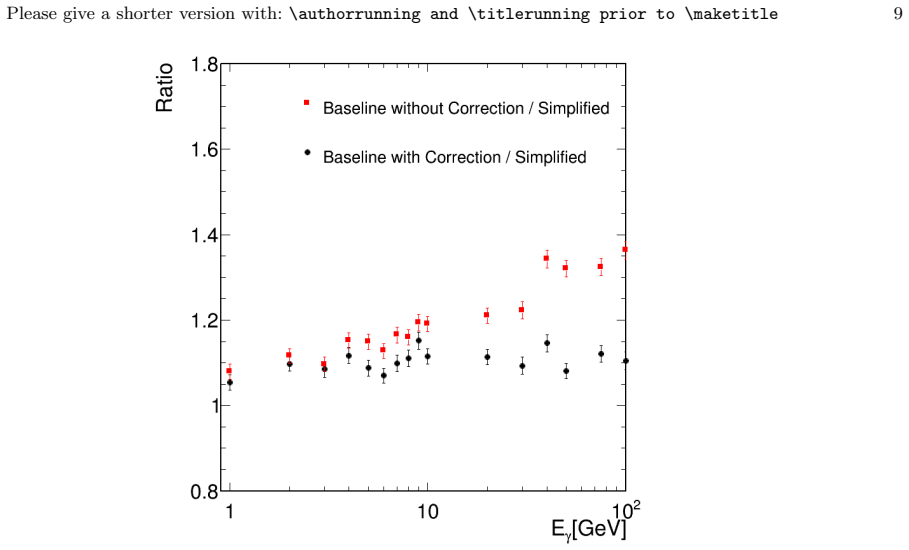
- The correction reduces the energy-resolution degradation from geometry defects from about 35% to about 10% for 40–100 GeV photons, so the main cost of a segmented calorimeter is largely recoverable.
- About 97% of π0s produced in Z→ττ are reconstructed, so tau identification via decay photons is not blocked by photon merging.
- Roughly 15% of π0s in inclusive Higgs events lie above the 30 GeV frontier, motivating a dedicated π0 finder beyond the generic particle-flow reconstruction.
Reading between the lines
- An energy-dependent calibration is the obvious next step: training the correction on several photon energies and iterating would probably push the baseline H→γγ resolution from 2.2% toward the 1.7% defect-free value.
- The same position-based crack correction could be transferred to any modular sampling calorimeter, not just the specific CEPC stave geometry, so the method has general value for future detectors.
- The 99%/1% identification numbers apply to isolated unconverted photons; counting merged-π0 backgrounds inside jets would test where the practical purity ceiling sits for CEPC's Higgs measurements.
Signed reviews
Editorial analysis
A structured set of objections, weighed in public.
Referee Report
Summary. This paper characterizes photon reconstruction performance at the CEPC baseline detector using full Geant4 simulation and the Arbor particle-flow reconstruction. The authors report conversion rates, reconstruction and identification efficiencies for single photons, an energy-resolution comparison between the baseline detector and a simplified defect-free geometry, a position-dependent energy correction tested on 50 GeV photons, the H→γγ invariant-mass resolution, and π0 reconstruction efficiency as a function of π0 energy. They conclude that isolated unconverted photons above 1 GeV are identified with efficiency above 99% and misidentification below 1%, that the H→γγ mass resolution is 2.2% at the baseline detector (1.7% at the simplified geometry), and that about 97% of π0 from Z→ττ events can be reconstructed.
Significance. If the headline results hold, the paper provides useful quantitative benchmarks for the CEPC detector design: it gives a full-simulation estimate of the photon identification performance, quantifies the effect of ECAL geometry cracks and dead zones on the energy resolution, and demonstrates a position-based correction as a proof of principle. The separation of the simplified-geometry resolution from the baseline-detector resolution, and the comparison with CALICE test-beam results, are helpful for detector optimization. The 1.7% simplified-geometry H→γγ mass resolution is a clean, directly simulated result, and the single-photon efficiency and misidentification tables are internally consistent and reproducible in structure.
major comments (3)
- [§3.3 and §4.1, Eq. (1), Fig. 10] The quoted 2.2% H→γγ mass resolution rests on a geometry-correction scale factor calibrated exclusively on 50 GeV single photons and then applied to the broad photon energy spectrum of Higgs decays. The paper itself states in §3.3 and Fig. 10 that the correction is energy-dependent and that an iterative correction algorithm is deferred to future work. Because the transfer of the 50 GeV calibration to the H→γγ sample is not validated, the 2.2% number is not an established property of the baseline detector; the uncorrected 2.6% and the simplified-geometry 1.7% values are the directly demonstrated results. The abstract and conclusion should either report the 2.2% explicitly as a test-of-principle result, or the authors should add a transfer check, for example by comparing the corrected mass resolution when the calibration map is derived in several energy bins.
- [§4.2 and Abstract] The claim that about 97% of π0 generated in Z→ττ events can be reconstructed successfully is an inference from the energy spectrum and a single 30 GeV 'critical energy' threshold, not a direct measurement of π0 reconstruction efficiency on Z→ττ events. Figure 12 shows a smooth, energy-dependent reconstruction efficiency, so the assumption that all π0 below the critical energy are reconstructed and none above are reconstructed is not justified, and no uncertainty is propagated to the 97% figure. The abstract and conclusions should be rephrased to state that only about 3% of Z→ττ π0 have energy above the 30 GeV critical energy, which is a threshold-based estimate rather than a direct reconstruction efficiency.
- [§3.2, Table 1] The identification-efficiency statement in the conclusion, namely 'efficiency higher than 99% and misidentification rate smaller than 1% for unconverted, isolated photons with energies larger than 1 GeV', is only demonstrated when the ToF-based separation is assumed and the cluster-level photon selection is applied. Table 1 itself shows that for E > 10 GeV the neutron misidentification rate is 0.83%, which is below 1%, but the systematic uncertainties from the assumed 50 ps time resolution and from the simplified L=2.4 m flight-distance assumption are not quantified. The authors should state these assumptions in the conclusion or add a systematic study of the ToF parameters.
minor comments (6)
- [§3.2] There are several typographical and grammatical issues: 'Of cause' should be 'Of course', and 'is consist with' should be 'is consistent with'.
- [§3.3, Eq. (1)] In the correction equation, the scale factor E'_true/E'_deposited is written as a scalar, but it is actually a position-dependent map defined from 50 GeV photons; please state explicitly that the scale factor is a function of the reconstructed hit position and define how the map is binned and interpolated.
- [§5, Conclusion] The energy-resolution parameterization is garbled: '17.7%√E ⊕ 2.1%/ 15.2%√E ⊕1.2%' should be written with explicit denominators, for example '17.7%/sqrt(E) ⊕ 2.1%' and '15.2%/sqrt(E) ⊕ 1.2%', and the applicable energy range and fit uncertainties should be given.
- [§4.2 and Abstract] The abstract reports '1.7 - 2.2%' for the Higgs mass resolution and '97%' for π0 reconstruction without mentioning that the mass resolution is evaluated in the central region and that the π0 figure is a threshold-based estimate; adding these qualifications would improve accuracy.
- [§2.1 and Fig. 6] The caption of Fig. 6 says 'Between 200 MeV and 500 GeV', which should be '500 MeV'; also, please define the coordinate ranges used for 'central region' and 'forward region' consistently in §3.1 and §4.1.
- [§3.2, references] Reference [22] appears as '[21][22]][23]' with a stray bracket; please correct the citation formatting.
Circularity Check
No significant circularity: the photon performance numbers come from independent full simulation, and the 50 GeV calibration is a standard transfer explicitly flagged as energy-dependent.
full rationale
The paper's central results are obtained from Geant4-based full simulation and reconstruction, not from a self-referential derivation. The photon identification efficiency is evaluated on simulated single-photon and single-neutron samples using cluster-shape and ToF variables; the quoted numbers are direct simulation outputs. The energy correction for geometry defects uses a scale factor E'_true/E'_deposited determined from simulated 50 GeV photons and is then applied to H to gamma gamma events. This is a standard calibration transfer rather than a construction that forces the H to gamma gamma mass resolution: the 2.2% resolution is an independent simulation result, and the paper explicitly acknowledges the limitation by stating 'Because the input sample is chosen at 50 GeV, correction at high energy is more significant' and that 'an iterative correction algorithm shall be developed in the future.' The simplified-geometry comparison and consistency checks with CALICE test-beam results provide external anchors. Self-citations to the Arbor software and to earlier CEPC ECAL studies describe the tools and geometry used, but the main performance claims do not reduce to those citations as mathematical premises. No equation in the paper defines a target result in terms of itself or renames a fitted parameter as a prediction. Accordingly, the analysis is self-contained with respect to its claimed predictions, and the circularity score is 0.
Assumptions & free parameters
free parameters (3)
- Geometry correction scale factor =
E'_true/E'_deposited derived from 50 GeV photon simulation
- Critical energy 30 GeV =
30 GeV
- Average flight distance L for ToF =
2.4 m
assumptions (5)
- domain assumption Geant4/MokkaPlus simulation accurately models the CEPC baseline detector geometry and material response
- domain assumption Arbor PFA correctly reconstructs calorimeter showers with its default configuration
- domain assumption A 50 ps time-of-flight resolution is achievable
- domain assumption The simplified geometry from Ref [25] represents an ideal, defect-free ECAL
- ad hoc to paper All pi0 with energy below the critical energy are successfully reconstructed
Cite this review
Pith. "Pith review of Photon Reconstruction Performance at the CEPC baseline detector." pith.science (2026). https://pith.science/paper/2Q2VH5R5
@misc{pith2026190809062,
  author       = {Pith},
  title        = {Pith review of: Photon Reconstruction Performance at the CEPC baseline detector},
  year         = {2026},
  howpublished = {\url{https://pith.science/paper/2Q2VH5R5}},
  note         = {Machine review of arXiv:1908.09062}
}
abstract
The Circular Electron Positron Collider (CEPC) is a proposed Higgs/Z factory. The photon reconstruction is critical to its physics program. We study the photon reconstruction at the CEPC baseline detector, a Particle Flow oriented detector. We characterized the objective performance at both single-photon and di-photon samples. At the single-photon sample, we quantify the photon conversion rate, the differential reconstruction efficiency and energy resolution, and the identification performance. Using di-photon samples, our analysis shows that the CEPC baseline detector reaches a relative mass resolution of 1.7 - 2.2% of the Higgs boson at the $H\to\gamma\gamma$ sample, and can reconstruct the $\pi^0$ with energy as high as 20 - 30 GeV. We also investigate the impact of geometry defects on photon energy resolution and discuss the possible corrections according to the reconstructed photon position.
Figures

Figures from the paper (11 more)




Reference graph
Works this paper leans on
-
[1]
ATLAS Collaboration, Observation of a new particle in the search for the Standard Model Higgs boson with the ATLAS detector at the LHC , Physics Letters B, 716: 1-29 (2012), arxiv: 1207.7214 [hep-ex]
arXiv 2012
-
[2]
CMS Collaboration, S. Chatrchyan et al., Observation of a new boson at a mass of 125 GeV with the CMS experiment at the LHC, Physics Letters B, 716: 30-61 (2012), arXiv: 1207.7235 [hep-ex] Please give a shorter version with: \authorrunning and \titlerunning prior to \maketitle 13
arXiv 2012
-
[3]
C. D. Froggatt and H. B. Nielsen, Hierarchy of Quark Masses, Cabibbo Angles and CP Violation , Nucl. Phys. B, 147: 277-298 (1979)
work page 1979
-
[4]
P. A. M. Dirac, New basis for cosmology , Proc. Roy. Soc. Lond. A165 (1938)
work page 1938
-
[5]
′ t Hooft, Naturalness, chiral symmetry, and spontaneous chiral symmetry breaking , NATO Sci
G. ′ t Hooft, Naturalness, chiral symmetry, and spontaneous chiral symmetry breaking , NATO Sci. Ser. B, 59: 135-157 (1980)
work page 1980
-
[6]
Higgs-Precision Constraints on Colored Naturalness
R. Essig, P. Meade, H. Ramani, and Y.-M. Zhong, Higgs-Precision Constraints on Colored Naturalness , JHEP, 09: 085 (2017), arXiv:1707.03399 [hep-ph]
work page Pith review arXiv 2017
-
[7]
C. Cai, Z.-H. Yu, and H.-H. Zhang, CEPC Precision of Electroweak Oblique Parameters and Weakly Interacting Dark Matter: the Fermionic Case, Nucl. Phys. B, 921: 181-210 (2017), arXiv:1611.02186 [hep-ph]
work page Pith review arXiv 2017
-
[8]
Q.-F. Xiang, X.-J. Bi, P.-F. Yin, and Z.-H. Yu, Exploring Fermionic Dark Matter via Higgs Boson Precision Measurements at the Circular Electron Positron Collider , Phys. Rev. D, 97: 055004 (2018), arXiv:1707.03094 [hep-ph]
work page Pith review arXiv 2018
Show all 26 references
-
[9]
The CEPC-SPPC Study Group, CEPC Conceptual Design Report: Volume 2 - Physics & Detector, arXiv: 1811.10545 [hep-ex]
-
[10]
Liu, L.-T
Z. Liu, L.-T. Wang, and H. Zhang, Exotic decays of the 125 GeV Higgs boson at future e+e− lepton colliders, Chin. Phys. C, 41 063102 (2017), arXiv:1612.09284 [hep-ph]
2017 arXiv
-
[11]
CEPC software website , http://cepcsoft.ihep.ac.cn/
-
[12]
Kilian, T
W. Kilian, T. Ohl, and J. Reuter, WHIZARD: Simulating Multi-Particle Processes at LHC and ILC , Eur. Phys. J. C, 71: 1742 (2011), arXiv:0708.4233 [hep-ph]
2011 arXiv
-
[13]
The Pythia Group, An Introduction to PYTHIA 8.2 , Comput. Phys. Commun., 191: 159-177 (2015), arXiv:1410.3012 [hep-ph]
2015 arXiv
-
[14]
Mora de Freitas and H
P. Mora de Freitas and H. Videau, Detector simulation with MOKKA/GEANT4: Present and future , LC-TOOL-2003-010
2003
-
[15]
Source code of MokkaPlus, http://cepcgit.ihep.ac.cn/cepcsoft/MokkaC
-
[16]
GEANT4 software website , http://geant4.web.cern.ch/
-
[17]
Ruan and H
M. Ruan and H. Videau, Arbor, a new approach of the Particle Flow Algorithm , arxiv: 1403.4784[physics.ins-det]
-
[18]
Thomson, Particle Flow Calorimetry and the PandoraPFA Algorithm , Nucl.Instrum
M. Thomson, Particle Flow Calorimetry and the PandoraPFA Algorithm , Nucl.Instrum. Meth. A, 611: 25-40 (2009), arxiv: 0907.3577 [physics.ins-det]
2009 arXiv
-
[19]
CMS collaboration, Performance of photon reconstruction and identification with the CMS detector in proton-proton colli- sions at√s = 8TeV , JINT, 10: P08010 (2015), arXiv: 1502.02702
2015 arXiv
-
[20]
ATLAS collaboration, Measurement of the photon identification efficiencies with the ATLAS detector using LHC Run-1 data, Eur. Phys. J. C, 76 666 (2016)
2016
-
[21]
CMS Collaboration, The CMS HGCAL detector for HL-LHC upgrade , arxiv: 1708.08234[physics.ins-det]
-
[22]
Lucia, A High-granularity Timing Detector for the Phase-II upgrade of the ATLAS Detector system, ATL-LARG-SLIDE- 2017-008
M. Lucia, A High-granularity Timing Detector for the Phase-II upgrade of the ATLAS Detector system, ATL-LARG-SLIDE- 2017-008
2017
-
[23]
F. An, S. Prell, C. Chen, J. Cochran, X. Lou, M. Ruan, Monte Carlo study of particle identification at the CEPC using TPC dE/dx information, Eur. Phys. J. C, 78: 464 (2018)
2018
-
[24]
Sefkow et al., Experimental Tests of Particle Flow Calorimetry
F. Sefkow et al., Experimental Tests of Particle Flow Calorimetry. DESY 14-032, KYUSHU-RCAPP 2015-01, LAL 15-235 (2015), ArXiv: 1507.05893 [physics.ins-det]
2015 arXiv
-
[25]
H. Zhao, C. Fu, D.Yu, Z. Wang, T. Hu and M.Ran, Particle flow oriented electromagnetic calorimeter optimization for the circular electron positron collider, JINST, 13: P03010 (2018), arxiv: 1712.09625v3 [physics.ins-det]
2018 arXiv
-
[26]
Zhao, Di-photon separation Study and the Higgs Signal at CEPC , presentation at the Workshop on CEPC 2018
H. Zhao, Di-photon separation Study and the Higgs Signal at CEPC , presentation at the Workshop on CEPC 2018
2018
Reviewed August 14, 2026 · model on record in the stance chip above.
Discussion (0). Continue with ORCID to comment.