REVIEW 3 minor 20 references
Graphs without two vertex-disjoint $S$-cycles
T0 review · 0 major / 3 minor · reviewed 2026-08-14 · deepseek-v4-flash
Pith's one-line read For rooted graphs with no two disjoint S-cycles, four vertices always hit every S-cycle, and three are not enough in general.
desk verdict Tight bound of 4 for S-cycle hitting sets is plausible and the counterexample is solid, but Proposition 6.9 has a load-bearing gap: Claim 6.11 cites Claim 5.4 in a different subdivided graph where the notation and the separation argument do not carry over as written. read the letter →
The pith
A machine-rendered reading of the paper's core claim, the machinery that carries it, and where it could break.
The reading
What carries the argument
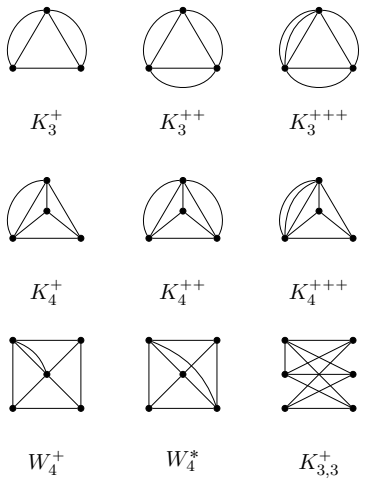
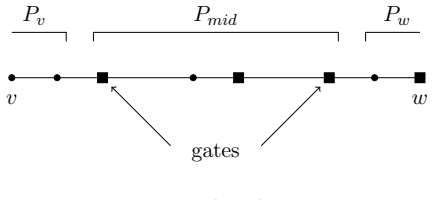
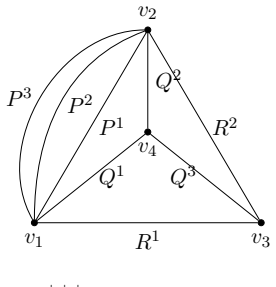
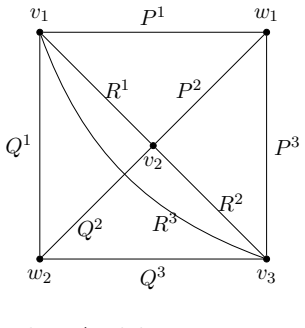
The proof rests on the notion of an $S$-cycle subgraph, a subgraph whose every cycle is an $S$-cycle, and on $W$-extensions: paths that start and end in $W$, have no internal vertices in $W$, and whose addition to $W$ preserves the property that every cycle is an $S$-cycle. Lemma 4.3 says that if $W$ is an $S$-cycle subgraph and $T\subseteq S\cap V(W)$ hits all $S$-cycles of $W$, then any $S$-cycle of $G-T$ either meets $W$ in exactly one vertex or contains a $W$-extension. Repeated application of this lemma, together with a bound from Lemma 4.5 on the size of small hitting sets in subdivisions, forces the existence of larger and larger $S$-cycle subdivisions. The analysis in Sections 5$-$8 shows that only certain unavoidable configurations can stop this growth, and each yields a four-vertex hitting set.
What would settle it
A single rooted graph with no two vertex-disjoint S-cycles but with $\tau(G,S)\ge 5$ would disprove the upper bound; such a graph could be sought by exhaustive search on small graphs with an exact packing-hitting computation. As a sanity check, the paper's own 21-vertex example should have $\tau(G,S)=4$.
Extended reading notes
Core claim
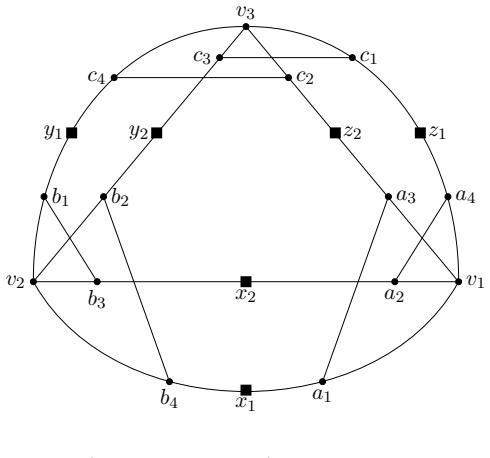
The central discovery is that the $S$-cycle analogue of the classical three-vertex theorem for ordinary cycles fails by exactly one vertex. For every rooted graph $(G,S)$, if $\mu(G,S)\le 1$, then $\tau(G,S)\le 4$. Moreover, there is a rooted graph on 21 vertices with $\mu(G,S)=1$ and $\tau(G,S)\ge 4$, so the constant 4 is best possible. The upper bound is proved by a structural case analysis. Assuming $\tau>4$, the proof grows an $S$-cycle subdivision by repeatedly adding paths that preserve the property that all cycles are $S$-cycles, eventually forcing one of a finite list of special subdivisions. Each such terminal subgraph is then shown to admit an $S$-cycle hitting set of size at most four, contradicting $\tau>4$.
Load-bearing premise
The proof requires that the recursive case analysis in Sections 5 through 8 is exhaustive: every S-cycle subdivision that cannot be extended must be one of the listed special structures, and each such structure must admit a hitting set of size at most four. If a structural case is missed, the contradiction argument for $\tau(G,S)>4$ does not go through.
Editorial extensions
If this is right
- Every rooted graph with no two vertex-disjoint S-cycles has a set of at most four vertices meeting all S-cycles; this yields a constant-size deletion set in such graphs.
- The 21-vertex example proves that three vertices are insufficient, so the theorem cannot be improved to a smaller constant.
- The result confirms that the classical three-vertex theorem for ordinary cycles does not extend unchanged to S-cycles; the correct constant is exactly one larger.
- For the next open case, rooted graphs with no three vertex-disjoint S-cycles, the proof structure suggests a finite case analysis but does not determine the constant.
Reading between the lines
- Editorial inference: the 21-vertex example may not be vertex-minimal; a computer search could reveal a smaller counterexample.
- Editorial inference: the subdivision-enlargement scheme might generalize to the case $\mu(G,S)\le 2$, but it is unclear whether the list of terminal configurations remains finite.
- Editorial inference: the proof's explicit finite terminal shapes suggest that $\tau\le 4$ can be certified in polynomial time by either finding a forbidden structure or exhibiting a four-vertex hitting set.
- Editorial inference: comparing ordinary cycles and S-cycles, the off-by-one gap may be a sign that other constrained-cycle classes require their own exact small-packing analyses.
Signed reviews
Editorial analysis
A structured set of objections, weighed in public.
Referee Report
Summary. The paper studies the Erdős–Pósa-type parameter for S-cycles in rooted graphs (G,S), where an S-cycle is a cycle meeting a prescribed vertex set S. It proves Theorem 1.2: if μ(G,S) ≤ 1, then there is an S-cycle hitting set of size at most 4. It also constructs, in Theorem 1.1, a 21-vertex rooted graph with μ(G,S)=1 and τ(G,S) ≥ 4, showing that the bound 4 is tight. The proof of Theorem 1.2 proceeds by contradiction: assuming τ(G,S) > 4, the authors start from an S-cycle subgraph and repeatedly use Lemma 4.3 to force larger S-cycle subdivisions, eventually reducing to the cases K4, W4, and K'_3,3. Sections 5–8 contain a long case analysis showing that each structural branch either produces an S-cycle K'_3,3-subdivision or yields an S-cycle hitting set of size at most 4.
Significance. If correct, the paper resolves the k=2 case for S-cycles by determining the tight bound τ ≤ 4, in contrast to the bound 3 for ordinary cycles. This is a natural and nontrivial result with direct connections to the Subset Feedback Vertex Set problem. The paper’s main strengths are the explicit 21-vertex extremal example with a fully worked verification, the parameter-free derivation of the upper bound, and a self-contained proof that does not rely on circular arguments or unstated numerical inputs. The proof is long and mostly hand-verified rather than machine-checked, but the overall strategy is transparent and the individual lemmas are carefully organized.
minor comments (3)
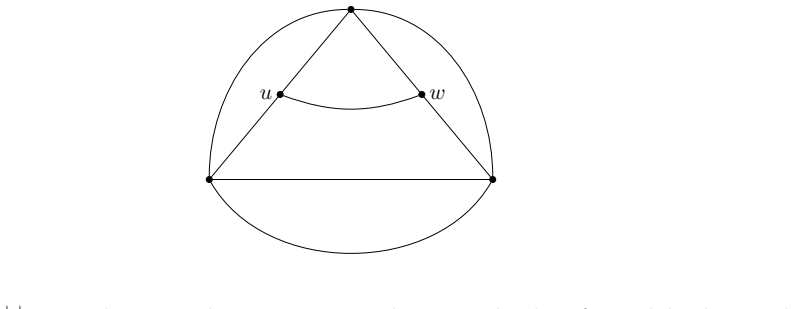
- [§6.9, Claim 6.11] The sentence “By Claim 5.4, z separates (∪_{j∈I}P^j) ∪ Q^1_{v1} and the rest of W in G−T” is formally unjustified, because Claim 5.4 is proved inside Proposition 5.2 for a K'''_3-subdivision in which Q^1 runs from v2 to v3 and refers to Q^1_{v2}, whereas in Proposition 6.9 Q^1 runs from v4 to v1 and the relevant side is Q^1_{v1}. The needed separation does follow from the immediately preceding no-path assertion, the earlier observation that there is no (P^i,P^j)-path in G−T, and the fact that z is the boundary of the segment Q^1_{v1}; the authors should replace the incorrect citation with this short self-contained argument.
- [§6.5, Claim 6.8] In the definition of the auxiliary graph F, the displayed vertex set appears to contain a duplicated entry and to omit R^1_1; it should be {R^1_1, R^1_2, R^2_1, R^2_2, A1, A2, Q^1_{v1}, Q^1_{v2}}.
- [§3, proof of Theorem 1.1] The first paragraph of the proof says “In each case, we can observe that C2 contains neither y2 nor z2” without explicitly enumerating the cases; adding a sentence describing the two symmetric choices for C1 would make the verification easier for the reader.
Circularity Check
No circularity: the proof is a forward structural case analysis from the definitions; cited prior work is background, and the claimed bound is not assumed.
full rationale
Running the derivation chain from Definitions 2.1–2.2 through Lemmas 4.1–4.7 and the case analyses in Sections 5–8, I find no step in which a claimed conclusion is identical to an input by construction. The main theorem is proved by contradiction: having assumed μ(G,S) ≤ 1 and τ(G,S) > 4, the proof uses the definition of τ > 4 to obtain an S-cycle in each G − T for small candidate T; this is definitional but not circular, since the same definition is what a hitting-set statement means. The candidate sets T are constructed from the current S-cycle subdivision W (e.g., branching vertices plus chosen S-vertices or gates), and the work in each proposition is to show G − T has no S-cycle, which is a genuinely independent separation/case-analysis argument. The 21-vertex example of Theorem 1.1 is explicitly checked by enumerating possible T, not fitted to Theorem 1.2. Citations to Lovász, Erdős–Pósa variations, and the subset-feedback-vertex-set literature are background/context; the only self-citation (ref. [11]) appears in an introductory list and is not load-bearing. I note two correctness concerns that are not circularity: Lemma 4.6 invokes Lemma 4.3 without restating its T ⊆ S ∩ V(W) hypothesis, and Claim 6.11 applies Claim 5.4 (proved for a K'''_3-subdivision) to a K''''_4-subdivision without a replacement argument. These concern proof completeness, not equivalence of inputs and outputs.
Assumptions & free parameters
assumptions (1)
- standard math Elementary finite graph theory: paths, cycles, subdivisions, connectivity, and feedback edge sets behave as in standard references.
Cite this review
Pith. "Pith review of Graphs without two vertex-disjoint $S$-cycles." pith.science (2026). https://pith.science/paper/5HWRHLZZ
@misc{pith2026190809065,
  author       = {Pith},
  title        = {Pith review of: Graphs without two vertex-disjoint $S$-cycles},
  year         = {2026},
  howpublished = {\url{https://pith.science/paper/5HWRHLZZ}},
  note         = {Machine review of arXiv:1908.09065}
}
abstract
Lov\'asz (1965) characterized graphs without two vertex-disjoint cycles, which implies that such graphs have at most three vertices hitting all cycles. In this paper, we ask whether such a small hitting set exists for $S$-cycles, when a graph has no two vertex-disjoint $S$-cycles. For a graph $G$ and a vertex set $S$ of $G$, an $S$-cycle is a cycle containing a vertex of $S$. We provide an example $G$ on $21$ vertices where $G$ has no two vertex-disjoint $S$-cycles, but three vertices are not sufficient to hit all $S$-cycles. On the other hand, we show that four vertices are enough to hit all $S$-cycles whenever a graph has no two vertex-disjoint $S$-cycles.
Figures
Figures from the paper (6 more)



Reference graph
Works this paper leans on
-
[1]
Birmel´ e, Ph.D Thesis, Universt´ e Lyon 1 (2003)
work page 2003
-
[2]
Etienne Birmel´ e, J. Adrian Bondy, and Bruce A. Reed, The Erd˝ os-P´ osa property for long circuits, Combinatorica 27 (2007), no. 2, 135–145. MR 2321919
work page 2007
-
[3]
Henning Bruhn, Felix Joos, and Oliver Schaudt, Long cycles through prescribed vertices have the Erd˝ os-P´ osa property, J. Graph Theory 87 (2018), no. 3, 275–284. MR 3755249
work page 2018
-
[4]
Marek Cygan, Marcin Pilipczuk, Micha/suppress l Pilipczuk, and Jakub Onufry Wojtaszczyk, Subset feedback vertex set is fixed-parameter tractable , SIAM J. Discrete Math. 27 (2013), no. 1, 290–309. MR 3032920
work page 2013
-
[5]
Paul Erd˝ os and Louis P´ osa,On the maximal number of disjoint circuits of a graph , Publ. Math. Debrecen 9 (1962), 3–12
work page 1962
-
[6]
Guy Even, Joseph Naor, and Leonid Zosin, An 8-approximation algorithm for the subset feed- back vertex set problem , SIAM J. Comput. 30 (2000), no. 4, 1231–1252. MR 1786759
work page 2000
-
[7]
Samuel Fiorini and Audrey Herinckx, A tighter Erd˝ os-P´ osa function for long cycles, J. Graph Theory 77 (2014), no. 2, 111–116. MR 3246170
work page 2014
- [8]
Show all 20 references
-
[9]
Discrete Math.26 (2012), no
Naonori Kakimura and Ken-ichi Kawarabayashi, Packing directed circuits through prescribed vertices bounded fractionally, SIAM J. Discrete Math.26 (2012), no. 3, 1121–1133. MR 3022130
2012
-
[10]
Naonori Kakimura, Ken-ichi Kawarabayashi, and D´ aniel Marx, Packing cycles through pre- scribed vertices, J. Combin. Theory Ser. B 101 (2011), no. 5, 378–381. MR 2802885
2011
-
[11]
1665–1684
Eun Jung Kim and O-joung Kwon, Erd˝ os-P´ osa property of chordless cycles and its applications, Proceedings of the Twenty-Ninth Annual ACM-SIAM Symposium on Discrete Algorithms, SIAM, Philadelphia, PA, 2018, pp. 1665–1684. MR 3775897
2018
-
[12]
Lapok 16 (1965), 289–299
L´ aszl´ o Lov´ asz,On graphs not containing independent circuits , Mat. Lapok 16 (1965), 289–299. MR 0211902
1965
-
[13]
Mousset, A
F. Mousset, A. Noever, N. ˇSkori´ c, and F. Weissenberger,A tight Erd˝ os-P´ osa function for long cycles, J. Combin. Theory Ser. B 125 (2017), 21–32. MR 3641798
2017
-
[14]
Pontecorvi and P
M. Pontecorvi and P. Wollan, Disjoint cycles intersecting a set of vertices , J. Combin. Theory Ser. B 102 (2012), no. 5, 1134–1141. MR 2959394
2012
-
[15]
Thilikos, Recent techniques and results on the Erd˝ os- P´ osa property, Discrete Appl
Jean-Florent Raymond and Dimitrios M. Thilikos, Recent techniques and results on the Erd˝ os- P´ osa property, Discrete Appl. Math. 231 (2017), 25–43. MR 3695268
2017
-
[16]
2, 267–296
Bruce Reed, Mangoes and blueberries , Combinatorica 19 (1999), no. 2, 267–296. MR 1723044
1999
-
[17]
4, 535–554
Bruce Reed, Neil Robertson, Paul Seymour, and Robin Tho mas, Packing directed circuits , Combinatorica 16 (1996), no. 4, 535–554. MR 1433641
1996
-
[18]
Neil Robertson and P. D. Seymour, Graph minors. V. Excluding a planar graph , J. Combin. Theory Ser. B 41 (1986), no. 1, 92–114. MR 854606
1986
-
[19]
Graph Theory 12 (1988), no
Carsten Thomassen, On the presence of disjoint subgraphs of a specified type , J. Graph Theory 12 (1988), no. 1, 101–111. MR 928740
1988
-
[20]
Voss, Eigenschaften von Graphen, die keine k ` 1 knotenfremde Kreise enthalten , Math
H.-J. Voss, Eigenschaften von Graphen, die keine k ` 1 knotenfremde Kreise enthalten , Math. Nachr. 40 (1969), 19–25. MR 284381 25
1969
Reviewed August 14, 2026 · model on record in the stance chip above.
Discussion (0). Continue with ORCID to comment.