REVIEW 3 major objections 5 minor 46 references
Emergent critical phenomenon in spin-1/2 ferromagnetic-leg ladders: Quasi-one-dimensional Bose--Einstein condensate
T0 review · 3 major / 5 minor · reviewed 2026-08-14 · deepseek-v4-flash
Pith's one-line read The paper shows that the spin-1/2 ferromagnetic-leg ladder 3-Cl-4-F-V has a linear phase boundary near saturation, $T \propto (H_c - H)$, corresponding to critical exponent $\varphi = 1$ and to quasi-one-dimensional Bose–Einstein…
desk verdict A careful data paper whose φ=1 quasi-1D BEC conclusion is undermined by circular fitting: Hc comes from the same linear fits that force the log-log slope to 1. read the letter →
The pith
A machine-rendered reading of the paper's core claim, the machinery that carries it, and where it could break.
The reading
What carries the argument
The central object is the critical exponent $\varphi$ of the saturation-field phase boundary, defined by $T \sim |H_c(T) - H_c(0)|^{1/\varphi}$; in three-dimensional BEC universality $\varphi = 3/2$, whereas the theory cited as Ref. 22 predicts $\varphi \simeq 1$ for quasi-1D or quasi-2D magnets with predominant ferromagnetic interactions. The argument runs through an effective mapping of the spin-1/2 ferromagnetic-leg ladder onto a spin-1/2 ferromagnetic chain with easy-plane anisotropy, which strengthens the saturation field and makes the $\varphi = 1$ region observable. The mechanism that keeps three-dimensional behavior from dominating is the weakness and frustration of the interladder couplings, which suppresses the effective interladder magnon interactions and lets the one-dimensional physics control the phase boundary over a wide field range.
What would settle it
Directly measure the interladder exchange couplings, for example by inelastic neutron scattering on a large single crystal, or tune them with pressure: if they prove comparable to the ferromagnetic leg coupling instead of weak and frustrated, the quasi-1D BEC explanation would be refuted. Alternatively, extend thermodynamic measurements below 0.1 K, because the quasi-1D BEC theory predicts a crossover from $\varphi = 1$ to the three-dimensional $\varphi = 3/2$ behavior sufficiently close to $H_c$; finding or ruling out that crossover would settle the interpretation.
Extended reading notes
Core claim
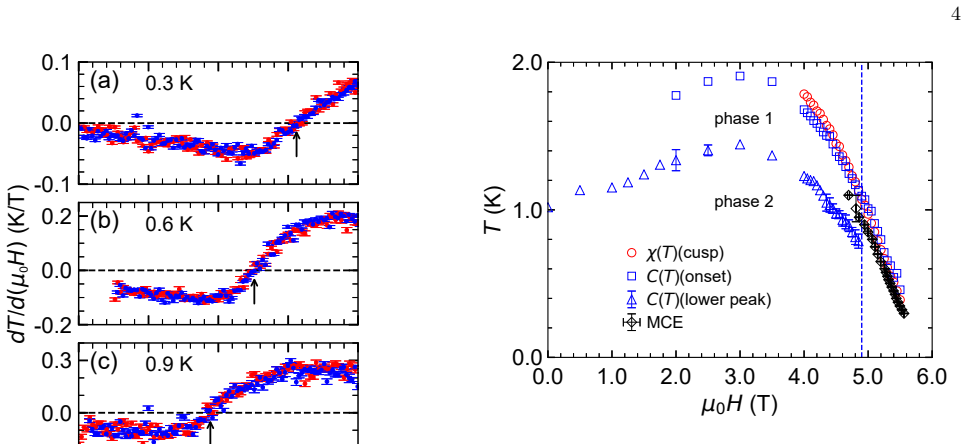
The paper's central claim is the experimental determination that the upper phase boundary of 3-Cl-4-F-V obeys $T \propto (H_c - H)^{1/\varphi}$ with $\varphi = 1$ over a wide temperature range below about 0.8 K, in the single phase-boundary region between roughly 4.9 T and the saturation field $\mu_0 H_c \sim 5.9$ T. The linear boundary is extracted from three independent thermodynamic probes—dc magnetization, specific heat, and magnetocaloric-effect measurements—whose critical temperatures fall on the same line. Because the same linear law appears in another strong-leg-type ferromagnetic-leg ladder, 3-I-V, the authors interpret the shared behavior as the theoretically predicted quasi-one-dimensional BEC of magnons, realized in materials whose dominant interactions are ferromagnetic chains with weak, frustrated interladder couplings. The paper also maps the double phase transition that survives below about 4.9 T and argues that it can coexist with the quasi-1D criticality near saturation.
Load-bearing premise
The interpretation rests on the interladder magnetic couplings being weak and frustrated enough that 3-Cl-4-F-V behaves as nearly independent spin-1/2 ferromagnetic chains; if those couplings are actually strong, the observed linear boundary could have a different origin even though the measurements themselves are sound.
Editorial extensions
If this is right
- If the $\varphi = 1$ criticality is universal among strong-leg-type ferromagnetic-leg ladders, every member of that family should show a linear phase boundary near saturation, and the double transitions seen at lower fields can be understood as a separate feature caused by frustrated interladder couplings.
- The linear boundary provides a clean extrapolation to the zero-temperature saturation field $\mu_0 H_c$, enabling high-precision comparisons with theoretical predictions for these molecular magnets.
- Because magnetization, specific heat, and magnetocaloric-effect measurements all fall on the same line, the $\varphi = 1$ exponent is robust against the choice of how the critical temperature is defined.
- The observed exponent distinguishes quasi-1D BEC from competing mechanisms such as disorder-induced Bose glass, since the impurity level in these crystals is below one percent and the exponent matches the clean quasi-1D prediction.
Reading between the lines
- If the paper's interpretation is right, the field at which the double transition merges into a single boundary, about 4.9 T, could serve as a quantitative measure of the frustrated interladder couplings, since stronger frustration should push that merger closer to saturation.
- The same linear-boundary diagnostic could be applied to existing and future phase-boundary data on other quasi-1D ferromagnets, especially other verdazyl-radical compounds, to identify additional quasi-1D BEC candidates without requiring a full microscopic theory.
- The paper's mention of a low-temperature deviation in the magnetocaloric data suggests a testable extension: higher-resolution measurements at lower temperatures might reveal a crossover from the $\varphi = 1$ line to the three-dimensional $\varphi = 3/2$ law, which would be a sharper confirmation of the quasi-1D scenario.
- A natural next step would be to probe the spin dynamics in the single phase-boundary region, since quasi-1D BEC should leave Tomonaga–Luttinger-liquid-like correlations along the legs coexisting with three-dimensional order, a signature distinguishable from a conventional condensate.
Signed reviews
Editorial analysis
A structured set of objections, weighed in public.
Referee Report
Summary. The manuscript reports a detailed thermodynamic study of the spin-1/2 ferromagnetic-leg ladder 3-Cl-4-F-V near its saturation field. Using dc magnetization, specific heat, and magnetocaloric effect measurements, the authors construct the H–T phase diagram, identify a double phase transition below about 4.9 T, and find a single phase boundary from that field up to a saturation field near 5.9 T. The central claim is that this single boundary is linear in T versus (Hc − H), giving a critical exponent φ = 1, which they interpret as quasi-one-dimensional Bose–Einstein condensation on the basis of a theoretical crossover predicted in Ref. 22. The same φ = 1 behavior is reported for the previously studied compound 3-I-V, and the authors argue that both materials show universal quasi-1D BEC criticality.
Significance. If the reported φ = 1 exponent is correct, this would be a valuable experimental realization of the quasi-1D BEC scenario in ferromagnetic-leg ladders, and the comparison between 3-Cl-4-F-V and 3-I-V would provide a persuasive universality argument. The paper has notable strengths: critical temperatures are determined with three independent thermodynamic probes, the appendix examines alternative definitions of the specific-heat critical temperature, and the discussion explicitly considers competing interpretations such as quasi-2D BEC and disorder-induced Bose glass. However, the central exponent determination suffers from a circularity problem: the saturation field Hc is extracted from the same linear fits that are then used to assert φ = 1, so the log-log analysis does not constitute an independent measurement of the exponent. No free-exponent fit, information-criterion comparison, or robustness analysis is reported, and no data/code availability statement is provided. These issues are fixable and do not invalidate the underlying measurements, but they must be addressed before the empirical claim can be accepted.
major comments (3)
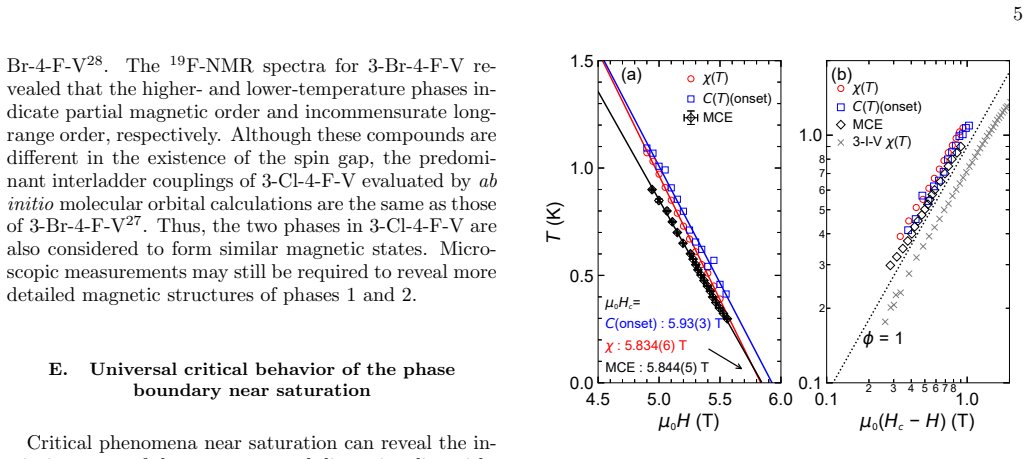
- [§III E, Fig. 7] The claim that the phase boundary is characterized by φ = 1 is not independently established. In Fig. 7(a), Hc is obtained by extrapolating linear fits to T(H), and in Fig. 7(b) the same Hc values are used to construct log T versus log(Hc − H). Since Hc is defined by the linear fit, the transformed plot is essentially a restatement of the assumed linear form and cannot distinguish φ = 1 from other exponents over the fitted window. The manuscript should report an unconstrained power-law fit T = A(Hc − H)^β with both β and Hc treated as free parameters, including uncertainties, and should compare β = 1 against β = 3/2 quantitatively (for example with an F-test or AIC). Without such a test, the claimed distinction from the 3D BEC universality class is not supported by the data analysis.
- [Appendix, Figs. 8 and 10] The same circularity applies to the appendix's alternative definitions of the critical temperature. For the peak-temperature and midpoint-temperature definitions, Hc is re-extracted from linear fits before the log-log plots are made, so the statement that φ = 1 is also seen in Figs. 8(b) and 10(b) is again a restatement of the linear fits rather than an independent check. The appendix should either present free-exponent fits for these alternative definitions or explicitly note that the alternative definitions reproduce the same linear boundary before applying the same transformation.
- [§III E, Hc values] The saturation fields obtained from the three probes differ noticeably: μ0Hc = 5.834(6) T for χ(T), 5.844(5) T for MCE, and 5.93(3) T for C(T) onset. The spread of about 0.1 T, particularly the larger value from specific heat, is not discussed. Because the apparent log-log slope is highly sensitive to the choice of Hc, the authors should demonstrate that the φ = 1 conclusion is robust to the uncertainty in Hc, for example by reporting the slope obtained when Hc is varied within its uncertainty for each dataset.
minor comments (5)
- [Fig. 7(b)] The dotted line labeled φ = 1 is drawn using the fitted Hc values; the caption should state explicitly that this line is a guide based on the linear fits, not an independent fit to the transformed data.
- [§III E, last paragraph] The statement that the MCE data deviate slightly from the φ = 1 line near the lowest temperature is not quantified; including residuals or an error band would make the claim more transparent.
- [Introduction, third paragraph] The phrase 'few experimental tests for the theoretical proposal have been reported for this theoretical proposal' is redundant; consider rewording to 'few experimental tests of this theoretical proposal have been reported'.
- [References] Reference 1 should read 'Plancksches Gesetz' rather than 'Plancks Gesetz', and some non-ASCII names (e.g., Rüegg, Horvatić) are inconsistently rendered; a final proofreading pass for diacritics is recommended.
- [Fig. 7(a) and Fig. 5] In Fig. 5 the error bars are defined as fitting errors of the initial slope, but Fig. 7(a) shows no error bars for the extracted critical temperatures; the authors should clarify whether the plotted points in Fig. 7 have uncertainties smaller than the symbol size or whether error bars were omitted for clarity.
Circularity Check
φ=1 is imposed by extracting Hc from the same linear fits; log-log slope is unity by construction, so the critical exponent is not independently measured.
-
fitted input called prediction
[Section III E, Fig. 7]
"We extracted the critical field at zero temperature, Hc, from the linear fit for each dataset below 1 K, as plotted in Fig. 7(a), ... The criticality can be characterized by the φ = 1 behavior at phase boundary T ∝ (Hc−H)^{1/φ} for a wide temperature range below∼ 0.8 K, which is distinguished from the φ = 3/2 critical exponent for the 3D BEC universality class."
Hc is not measured independently; it is the zero-temperature intercept of a linear T-versus-H fit to the same data. A linear boundary T = A(Hc − H) implies log T = log A + log(Hc − H), whose slope is identically 1. Therefore the log-log plot and the claimed φ = 1 are a restatement of the fitted functional form, not an independent determination of the critical exponent. The paper reports no unconstrained power-law fit T = A(Hc − H)^β with both β and Hc free, and no quantitative comparison of β = 1 against β = 3/2, so the purported distinction from the 3D BEC universality class is not statistically tested.
-
fitted input called prediction
[Appendix, Figs. 8 and 10]
"We also checked the critical behavior for these definitions in the specific heat. Figures. 8(b) and 10(b) are log-log plots of the critical temperature vs. µ0(Hc−H) for the peak and midpoint temperatures, respectively, in the same format as Fig. 7(b). The φ = 1 behavior can also be seen in these plots in the wide temperature range."
The same construction is repeated for the alternative specific-heat definitions. The Hc values used in Figs. 8(b) and 10(b) are read off as intercepts of linear fits in Figs. 8(a) and 10(a), respectively (µ0Hc = 6.13(3) T for peak and 6.13(2) T for midpoint). Hence those log-log plots also have slope 1 by construction. The claim that φ = 1 is independent of the critical-temperature definition is therefore another restatement of the linear fits rather than a test of the exponent.
full rationale
The central empirical observation—that the phase boundary in the single-boundary region is approximately linear in (Hc−H)—is genuine and not circular: it comes from direct measurements of magnetization, specific heat, and MCE. The circularity enters specifically when the linear fit is used twice: first to define Hc as the zero-temperature intercept, and then to exhibit φ=1 by plotting the same points against Hc−H. Because a line T = A(Hc−H) has log-log slope 1 identically, the claimed exponent is a restatement of the fitted functional form rather than an independent critical-exponent measurement. The appendix repeats this construction for alternative specific-heat definitions. No unconstrained power-law fit with Hc and φ as free parameters, and no model comparison against φ=3/2, is reported; without such a test the data cannot distinguish φ=1 from φ=3/2 or establish the quasi-1D BEC interpretation. The comparison with 3-I-V (Ref. 25) is a self-citation, but it is prior data rather than an argument by authority; I do not count it as a separate circular step, although if the same fitting procedure was used there the universality claim inherits the same limitation. Overall, one load-bearing derived quantity (φ=1) reduces by construction, so the score is 6.
Assumptions & free parameters
free parameters (1)
- Hc, zero-temperature saturation field =
5.834(6) T from chi(T), 5.844(5) T from MCE, 5.93(3) T from C(T) onset
assumptions (4)
- domain assumption The spin Hamiltonian is a two-leg ladder with ferromagnetic legs J_parallel < 0 and antiferromagnetic rung J_perp > 0 (Eq. 1).
- domain assumption A spin-1/2 ferromagnetic-leg ladder can be mapped to a spin-1/2 ferromagnetic chain with easy-plane anisotropy, matching the model in Ref. 22.
- domain assumption Interladder interactions are sufficiently weak or frustrated to preserve quasi-1D BEC critical behavior.
- domain assumption The cusp, specific-heat onset, and MCE sign-change anomalies mark true thermodynamic phase transitions.
Cite this review
Pith. "Pith review of Emergent critical phenomenon in spin-1/2 ferromagnetic-leg ladders: Quasi-one-dimensional Bose--Einstein condensate." pith.science (2026). https://pith.science/paper/EI3UVHSQ
@misc{pith2026190809076,
  author       = {Pith},
  title        = {Pith review of: Emergent critical phenomenon in spin-1/2 ferromagnetic-leg ladders: Quasi-one-dimensional Bose--Einstein condensate},
  year         = {2026},
  howpublished = {\url{https://pith.science/paper/EI3UVHSQ}},
  note         = {Machine review of arXiv:1908.09076}
}
abstract
We examine the magnetic-field-induced criticality of phase boundary near saturation field $H_{\mathrm{c}}$ in the spin-1/2 ferromagnetic (FM)-leg ladder 3-Cl-4-F-V [=3-(3-chloro-4-fluorophenyl)-1,5-diphenylverdazyl], the predominant interactions of which arise from FM chains (strong-leg type). Critical temperatures were precisely determined through dc magnetization, specific heat, and magnetocaloric effect measurements. The criticality of 3-Cl-4-F-V is characterized by a linear phase boundary with respect to $H_{\mathrm{c}}-H$ near $H\,=\,H_{\mathrm{c}}$. This behavior is similar to that of another strong-leg-type FM-leg ladder. The universal critical behavior in these strong-leg-type FM-leg ladders is expected to demonstrate the theoretically predicted quasi-one-dimensional Bose--Einstein condensation.
Figures


Figures from the paper (4 more)


Reference graph
Works this paper leans on
-
[1]
author author S. N. \ Bose ,\ title title Plancks Gesetz und Lichtquantenhypothese ,\ https://doi.org/10.1007/BF01327326 journal journal Z. Physik \ volume 26 ,\ pages 178 ( year 1924 ) NoStop
-
[2]
author author A. Einstein ,\ title title Quantentheorie Des Einatomigen Idealen Gases ,\ @noop journal journal Sitzber. Kgl. Preuss. Akad. Wiss. \ volume 3 \ ( year 1925 ) NoStop
work page 1925
-
[3]
author author E. A. \ Cornell \ and\ author C. E. \ Wieman ,\ title title Nobel Lecture : Bose - Einstein Condensation in a Dilute Gas , the First 70 Years and Some Recent Experiments ,\ https://doi.org/10.1103/RevModPhys.74.875 journal journal Rev. Mod. Phys. \ volume 74 ,\ pages 875 ( year 2002 ) NoStop
-
[4]
author author W. Ketterle ,\ title title Nobel Lecture : When Atoms Behave as Waves : Bose - Einstein Condensation and the Atom Laser ,\ https://doi.org/10.1103/RevModPhys.74.1131 journal journal Rev. Mod. Phys. \ volume 74 ,\ pages 1131 ( year 2002 ) NoStop
-
[5]
author author V. S. \ Bagnato , author D. J. \ Frantzeskakis , author P. G. \ Kevrekidis , author B. A. \ Malomed ,\ and\ author D. Mihalache ,\ title title BOSE - EINSTEIN CONDENSATION : TWENTY YEARS AFTER ,\ @noop journal journal Rom. Rep. Phys. \ volume 67 ,\ pages 5 ( year 2015 ) NoStop
work page 2015
-
[6]
author author T. Giamarchi , author C. R \"u egg ,\ and\ author O. Tchernyshyov ,\ title title Bose - Einstein condensation in magnetic insulators ,\ https://doi.org/10.1038/nphys893 journal journal Nat. Phys. \ volume 4 ,\ pages 198 ( year 2008 ) NoStop
-
[7]
author author V. Zapf , author M. Jaime ,\ and\ author C. D. \ Batista ,\ title title Bose - Einstein condensation in quantum magnets ,\ https://doi.org/10.1103/RevModPhys.86.563 journal journal Rev. Mod. Phys. \ volume 86 ,\ pages 563 ( year 2014 ) NoStop
-
[8]
author author T. Giamarchi \ and\ author A. M. \ Tsvelik ,\ title title Coupled ladders in a magnetic field ,\ https://doi.org/10.1103/PhysRevB.59.11398 journal journal Phys. Rev. B \ volume 59 ,\ pages 11398 ( year 1999 ) NoStop
Show all 46 references
-
[9]
Nikuni , author M
author author T. Nikuni , author M. Oshikawa , author A. Oosawa ,\ and\ author H. Tanaka ,\ title title Bose - Einstein condensation of dilute magnons in TlCuCl _ 3 ,\ https://doi.org/10.1103/PhysRevLett.84.5868 journal journal Phys. Rev. Lett. \ volume 84 ,\ pages 5868 ( year...
-
[10]
Yamada , author T
author author F. Yamada , author T. Ono , author H. Tanaka , author G. Misguich , author M. Oshikawa ,\ and\ author T. Sakakibara ,\ title title Magnetic-field induced Bose - Einstein condensation of magnons and critical behavior in interacting spin dimer system TlCuCl _ 3 ,\ ...
-
[11]
author author S. E. \ Sebastian , author P. A. \ Sharma , author M. Jaime , author N. Harrison , author V. Correa , author L. Balicas , author N. Kawashima , author C. D. \ Batista ,\ and\ author I. R. \ Fisher ,\ title title Characteristic Bose - Einstein condensation scaling...
-
[12]
author author S. E. \ Sebastian , author N. Harrison , author C. D. \ Batista , author L. Balicas , author M. Jaime , author P. A. \ Sharma , author N. Kawashima ,\ and\ author I. R. \ Fisher ,\ title title Dimensional reduction at a quantum critical point ,\ http://dx.doi.org...
-
[13]
author author C. D. \ Batista , author J. Schmalian , author N. Kawashima , author P. Sengupta , author S. E. \ Sebastian , author N. Harrison , author M. Jaime ,\ and\ author I. R. \ Fisher ,\ title title Geometric Frustration and Dimensional Reduction at a Quantum Critical P...
-
[14]
R\"osch \ and\ author M
author author O. R\"osch \ and\ author M. Vojta ,\ title title Quantum phase transitions and dimensional reduction in antiferromagnets with interlayer frustration ,\ https://doi.org/10.1103/PhysRevB.76.180401 journal journal Phys. Rev. B \ volume 76 ,\ pages 180401(R) ( year 2...
-
[15]
Schmalian \ and\ author C
author author J. Schmalian \ and\ author C. D. \ Batista ,\ title title Emergent symmetry and dimensional reduction at a quantum critical point ,\ https://doi.org/10.1103/PhysRevB.77.094406 journal journal Phys. Rev. B \ volume 77 ,\ pages 094406 ( year 2008 ) NoStop
-
[16]
Laflorencie \ and\ author F
author author N. Laflorencie \ and\ author F. Mila ,\ title title Theory of the Field - Induced BEC in the Frustrated Spin - 1 2 Dimer Compound BaCuSi _2 O _6 ,\ https://doi.org/10.1103/PhysRevLett.102.060602 journal journal Phys. Rev. Lett. \ volume 102 ,\ pages 060602 ( year...
-
[17]
Ninios , author T
author author K. Ninios , author T. Hong , author T. Manabe , author C. Hotta , author S. N. \ Herringer , author M. M. \ Turnbull , author C. P. \ Landee , author Y. Takano ,\ and\ author H. B. \ Chan ,\ title title Wilson ratio of a Tomonaga - Luttinger liquid in a spin- 1/2...
-
[18]
Jeong , author H
author author M. Jeong , author H. Mayaffre , author C. Berthier , author D. Schmidiger , author A. Zheludev ,\ and\ author M. Horvati c \' c ,\ title title Attractive Tomonaga - Luttinger liquid in a quantum spin ladder ,\ https://doi.org/10.1103/PhysRevLett.111.106404 journa...
-
[19]
R\"uegg , author K
author author C. R\"uegg , author K. Kiefer , author B. Thielemann , author D. F. \ McMorrow , author V. Zapf , author B. Normand , author M. B. \ Zvonarev , author P. Bouillot , author C. Kollath , author T. Giamarchi , author S. Capponi , author D. Poilblanc , author D. Bine...
-
[20]
auchli , author M. Zvonarev , author B. Thielemann , author C. R\
author author P. Bouillot , author C. Kollath , author A. M. \ L\"auchli , author M. Zvonarev , author B. Thielemann , author C. R\"uegg , author E. Orignac , author R. Citro , author M. Klanj s s ek , author C. Berthier , author M. Horvati c \' c ,\ and\ author T. Giamarchi ,...
-
[21]
Matsushita , author N
author author T. Matsushita , author N. Hori , author S. Takata , author N. Wada , author N. Amaya ,\ and\ author Y. Hosokoshi ,\ title title Direct three-dimensional ordering of quasi-one-dimensional quantum dimer system near critical fields ,\ https://doi.org/10.1103/PhysRev...
-
[22]
author author A. V. \ Syromyatnikov ,\ title title Bose - Einstein condensation of magnons in magnets with predominant ferromagnetic interactions ,\ https://doi.org/10.1103/PhysRevB.75.134421 journal journal Phys. Rev. B \ volume 75 ,\ pages 134421 ( year 2007 ) NoStop
-
[23]
Hirata , author N
author author S. Hirata , author N. Kurita , author M. Yamada ,\ and\ author H. Tanaka ,\ title title Quasi-two-dimensional Bose - Einstein condensation of lattice bosons in the spin- 1 2 XXZ ferromagnet K _ 2 CuF _ 4 ,\ https://doi.org/10.1103/PhysRevB.95.174406 journal journ...
-
[24]
Kono , author H
author author Y. Kono , author H. Yamaguchi , author Y. Hosokoshi ,\ and\ author T. Sakakibara ,\ title title Three-dimensional Bose - Einstein condensation in the spin- 1 2 ferromagnetic-leg ladder 3-Br-4-F-V ,\ https://doi.org/10.1103/PhysRevB.96.104439 journal journal Phys....
-
[25]
Kono , author S
author author Y. Kono , author S. Kittaka , author H. Yamaguchi , author Y. Hosokoshi ,\ and\ author T. Sakakibara ,\ title title Quasi-one-dimensional Bose - Einstein condensation in the spin-1/2 ferromagnetic-leg ladder 3- I - V ,\ https://doi.org/10.1103/PhysRevB.97.100406 ...
-
[26]
Yamaguchi , author K
author author H. Yamaguchi , author K. Iwase , author T. Ono , author T. Shimokawa , author H. Nakano , author Y. Shimura , author N. Kase , author S. Kittaka , author T. Sakakibara , author T. Kawakami ,\ and\ author Y. Hosokoshi ,\ title title Unconventional Magnetic and The...
-
[28]
Yamaguchi , author H
author author H. Yamaguchi , author H. Miyagai , author M. Yoshida , author M. Takigawa , author K. Iwase , author T. Ono , author N. Kase , author K. Araki , author S. Kittaka , author T. Sakakibara , author T. Shimokawa , author T. Okubo , author K. Okunishi , author A. Mats...
-
[29]
Yamaguchi , author H
author author H. Yamaguchi , author H. Miyagai , author Y. Kono , author S. Kittaka , author T. Sakakibara , author K. Iwase , author T. Ono , author T. Shimokawa ,\ and\ author Y. Hosokoshi ,\ title title Quantum phase near the saturation field in the S = 1 2 frustrated spin ...
-
[30]
author author A. K. \ Kolezhuk \ and\ author H. J. \ Mikeska ,\ title title Phase transitions in the Heisenberg spin ladder with ferromagnetic legs ,\ https://doi.org/10.1103/PhysRevB.53.R8848 journal journal Phys. Rev. B \ volume 53 ,\ pages R8848 ( year 1996 ) NoStop
-
[31]
Vekua , author G
author author T. Vekua , author G. I. \ Japaridze ,\ and\ author H.-J. \ Mikeska ,\ title title Phase diagrams of spin ladders with ferromagnetic legs ,\ https://doi.org/10.1103/PhysRevB.67.064419 journal journal Phys. Rev. B \ volume 67 ,\ pages 064419 ( year 2003 ) NoStop
-
[32]
Hijii , author A
author author K. Hijii , author A. Kitazawa ,\ and\ author K. Nomura ,\ title title Phase diagram of S = 1 2 two-leg XXZ spin-ladder systems ,\ https://doi.org/10.1103/PhysRevB.72.014449 journal journal Phys. Rev. B \ volume 72 ,\ pages 014449 ( year 2005 ) NoStop
-
[33]
Vekua , author G
author author T. Vekua , author G. I. \ Japaridze ,\ and\ author H.-J. \ Mikeska ,\ title title Magnetic-field-induced phase transitions in spin ladders with ferromagnetic legs ,\ https://doi.org/10.1103/PhysRevB.70.014425 journal journal Phys. Rev. B \ volume 70 ,\ pages 0144...
-
[34]
Sakakibara , author H
author author T. Sakakibara , author H. Mitamura , author T. Tayama ,\ and\ author H. Amitsuka ,\ title title Faraday Force Magnetometer for High - Sensitivity Magnetization Measurements at Very Low Temperatures and High Fields ,\ https://doi.org/10.1143/JJAP.33.5067 journal j...
-
[35]
note The upturn near the lowest temperature, which is enhanced above 4.8 + .1667em T, is attributed to nuclear Schottky contributions primarily arising from ^ 1 H, ^ 14 N, and, ^ 35 Cl. Stop
-
[36]
author author A. W. \ Rost , author R. S. \ Perry , author J.-F. \ Mercure , author A. P. \ Mackenzie ,\ and\ author S. A. \ Grigera ,\ title title Entropy Landscape of Phase Formation Associated with Quantum Criticality in Sr _3 Ru _2 O _7 ,\ https://doi.org/10.1126/science.1...
-
[37]
author author U. M. \ Scheven , author S. T. \ Hannahs , author C. Immer ,\ and\ author P. M. \ Chaikin ,\ title title Thermodynamics in the High - Field Phases of ( TMTSF ) _2 ClO _4 ,\ https://doi.org/10.1103/PhysRevB.56.7804 journal journal Phys. Rev. B \ volume 56 ,\ pages...
-
[38]
Kittaka , author S
author author S. Kittaka , author S. Nakamura , author H. Kadowaki , author H. Takatsu ,\ and\ author T. Sakakibara ,\ title title Field- Rotational Magnetocaloric Effect : A New Experimental Technique for Accurate Measurement of the Anisotropic Magnetic Entropy ,\ https://doi...
-
[39]
note For the upper critical temperature of C(T) , the onset temperature of the upper peak, instead of the peak itself, is plotted for the discussion of the criticality in Sec. cl . On the other hand, for the lower critical temperature for C(T) , the lower peak temperature belo...
-
[40]
auchli , author D. Biner , author K. W. \ Kr\
author author B. Thielemann , author C. R\"uegg , author K. Kiefer , author H. M. \ R nnow , author B. Normand , author P. Bouillot , author C. Kollath , author E. Orignac , author R. Citro , author T. Giamarchi , author A. M. \ L\"auchli , author D. Biner , author K. W. \ Kr\...
-
[41]
Willenberg , author H
author author B. Willenberg , author H. Ryll , author K. Kiefer , author D. A. \ Tennant , author F. Groitl , author K. Rolfs , author P. Manuel , author D. Khalyavin , author K. C. \ Rule , author A. U. B. \ Wolter ,\ and\ author S. S\"ullow ,\ title title Luttinger liquid be...
-
[42]
Zhang \ and\ author X.-Q
author author L. Zhang \ and\ author X.-Q. \ Wang ,\ title title Critical Exponents for the Three - Dimensional Superfluid Bose - Glass Phase Transition ,\ https://doi.org/10.1103/PhysRevB.47.11518 journal journal Phys. Rev. B \ volume 47 ,\ pages 11518 ( year 1993 ) NoStop
-
[43]
Yamada , author H
author author F. Yamada , author H. Tanaka , author T. Ono ,\ and\ author H. Nojiri ,\ title title Transition from Bose Glass to a Condensate of Triplons in Tl _ 1 - x K _x CuCl _3 ,\ https://doi.org/10.1103/PhysRevB.83.020409 journal journal Phys. Rev. B \ volume 83 ,\ pages ...
-
[44]
Yu , author L
author author R. Yu , author L. Yin , author N. S. \ Sullivan , author J. S. \ Xia , author C. Huan , author A. Paduan-Filho , author N. F. \ Oliveira Jr , author S. Haas , author A. Steppke , author C. F. \ Miclea , author F. Weickert , author R. Movshovich , author E.-D. \ M...
-
[45]
Yao , author K
author author Z. Yao , author K. P. C. \ da Costa , author M. Kiselev ,\ and\ author N. Prokof'ev ,\ title title Critical Exponents of the Superfluid Bose - Glass Transition in Three Dimensions ,\ https://doi.org/10.1103/PhysRevLett.112.225301 journal journal Phys. Rev. Lett. ...
-
[46]
Moreover, we can estimate the degree of bond disorder in other verdazyl-radical-based materials with bond randomness Yamaguchi_ScientificReports2017
note Another possibility is bond disorder, but we did not find any indications of bond disorder in single-crystal x-ray diffraction measurements of this material series doi:10.7566/JPSJ.83.033707 . Moreover, we can estimate the degree of bond disorder in other verdazyl-radical...
-
[47]
Yamaguchi , author M
author author H. Yamaguchi , author M. Okada , author Y. Kono , author S. Kittaka , author T. Sakakibara , author T. Okabe , author Y. Iwasaki ,\ and\ author Y. Hosokoshi ,\ title title Randomness-induced Quantum Spin Liquid on Honeycomb Lattice ,\ https://doi.org/10.1038/s415...
Reviewed August 14, 2026 · model on record in the stance chip above.
Discussion (0). Continue with ORCID to comment.