REVIEW 3 major objections 5 minor 3 references
Kinesthetic Learning -- Haptic User Interfaces for Gyroscopic Precession Simulation
T0 review · 3 major / 5 minor · reviewed 2026-08-14 · deepseek-v4-flash
Pith's one-line read The paper claims that a force-feedback bicycle-wheel simulator measurably improves students' understanding of gyroscopic precession, reporting a post-test gain from 78.5 to 87.4 out of 100 in a 64-student experiment.
desk verdict A plausible but under-validated first haptic simulator for gyroscopic precession; the learning gain is real but the force-fidelity and assignment issues keep the central claim from landing. read the letter →
The pith
A machine-rendered reading of the paper's core claim, the machinery that carries it, and where it could break.
The reading
What carries the argument
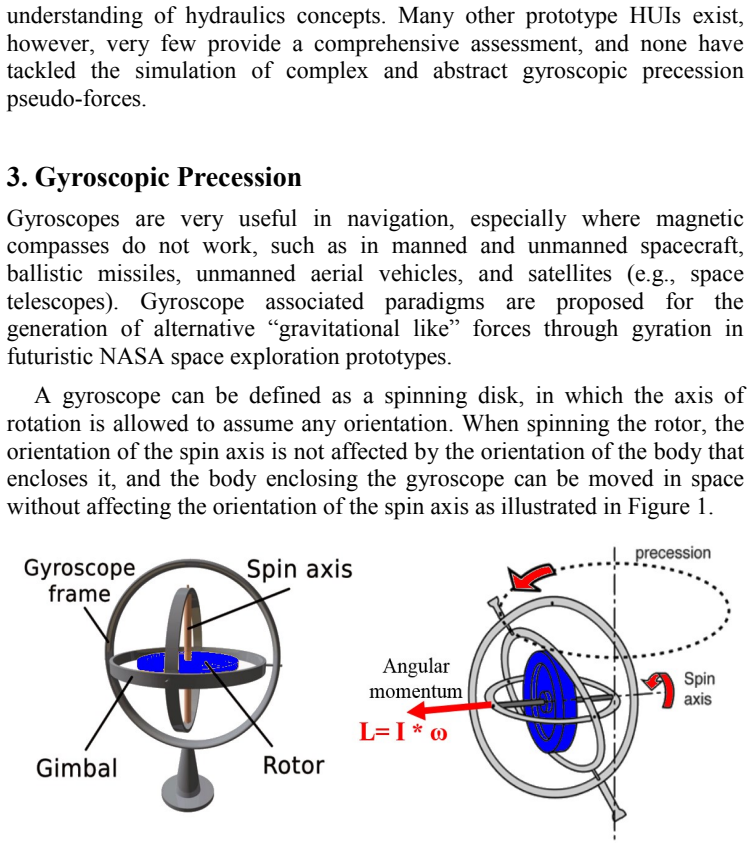
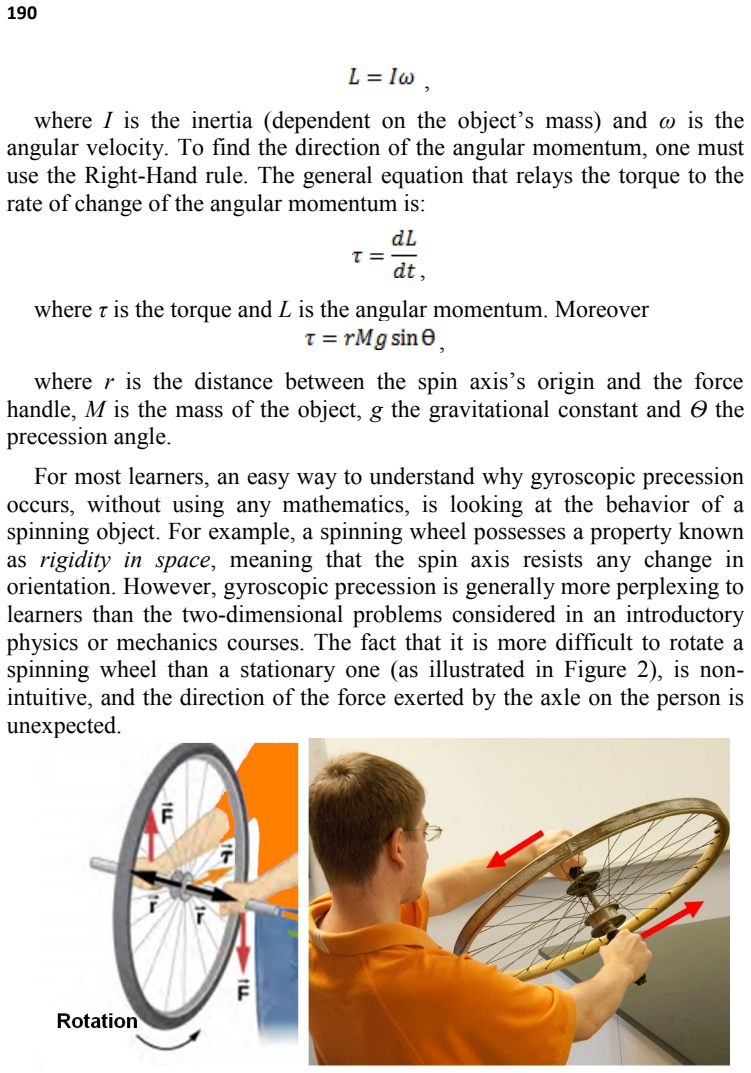
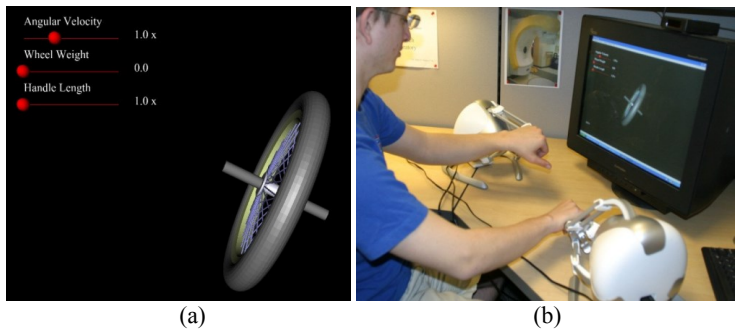
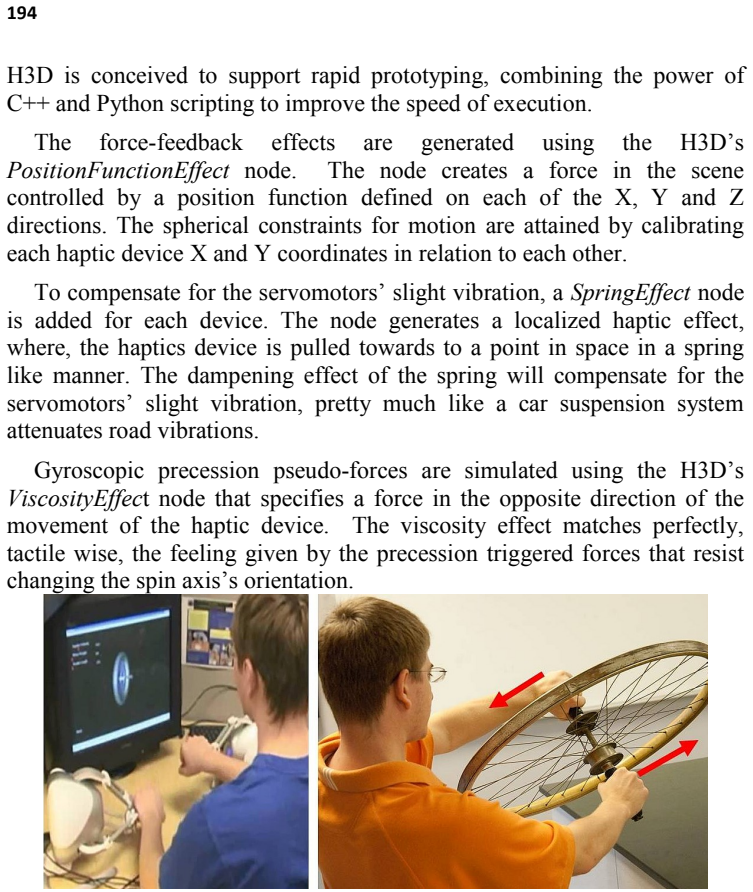
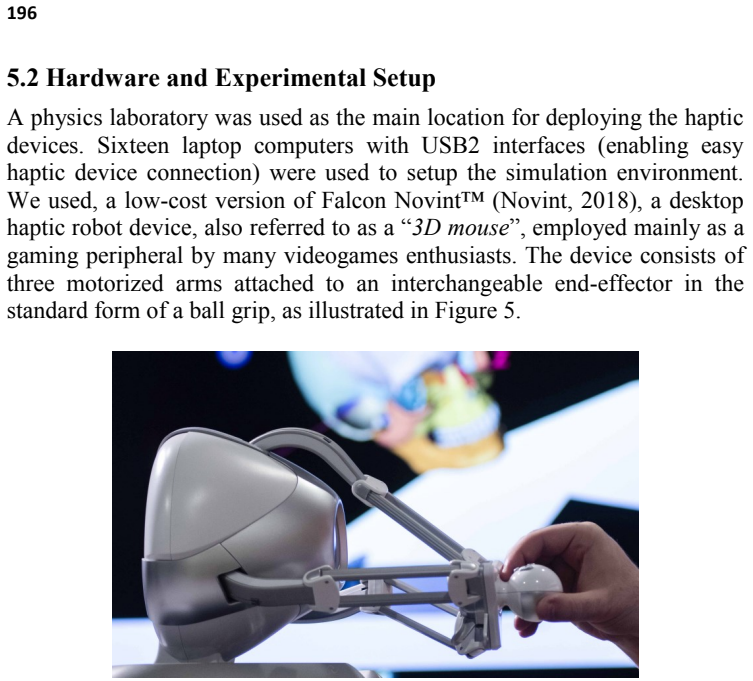
The mechanism that carries the argument is a paired arrangement of two Novint Falcon force-feedback devices acting as a virtual axle for a 3D bicycle wheel. The haptic scene uses H3D's ViscosityEffect node to generate a force opposite to the user's hand movement, which is the tactile analog of the pseudo-forces that resist changing a spinning wheel's axis; a SpringEffect node damps motor vibration, and a PositionFunctionEffect keeps the handles on a spherical path so the two devices feel like one rigid bar. The X3D interface lets the learner change wheel mass, radius, and angular velocity, so the felt force varies with the parameters. The touch channel is the novelty that distinguishes this simulator from earlier purely visual gyroscope simulations.
What would settle it
Run a third group through the same interactive simulator with the force-feedback motors turned off; if their post-test score matches the haptic group's 87.44, the gain comes from interactivity rather than touch, and if it matches the control group's 78.5, the touch channel is the active ingredient.
Extended reading notes
Core claim
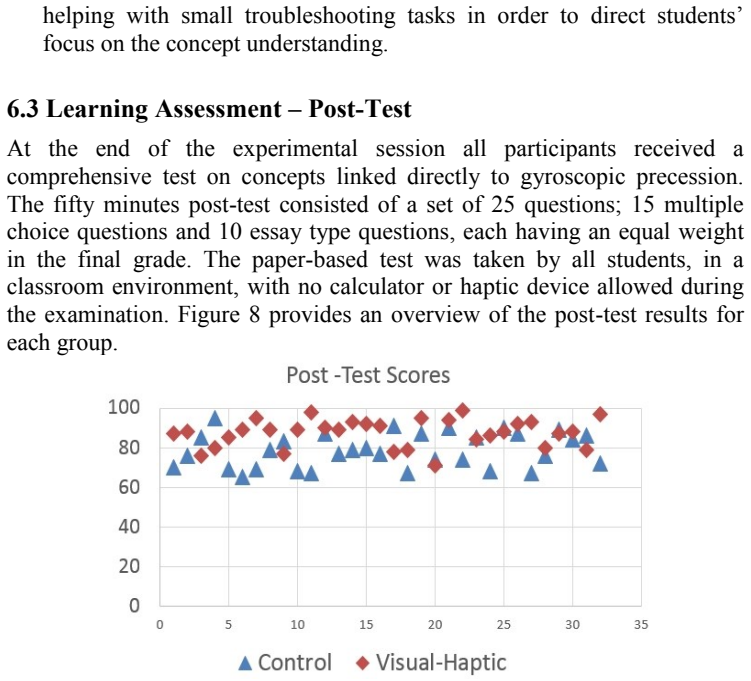
The paper's central claim is that a visual-haptic simulation of a spinning bicycle wheel produces a measurably better understanding of gyroscopic precession than the traditional lab activity. After a common 50-minute lecture, the visual-haptic group spent 50 minutes adjusting the wheel's mass, radius, and angular velocity while feeling counter-forces through two Novint Falcon devices; the control group spent the same time in an instructor-led problem-solving lab. On a 25-question written post-test the visual-haptic group averaged 87.44/100 (SD 6.96) while the control group averaged about 78.52 (the overall mean is reported as 82.98), and the paper reports a t-test of t=4.09 with p<0.001. The conclusion is that the force-feedback interface helps learners internalize the direction and magnitude of precession force vectors, and that this kind of multimodal simulator is a viable addition to physics and engineering instruction.
Load-bearing premise
The result rests on the assumption that the force felt at the haptic handle is a faithful rendering of gyroscopic precession pseudo-forces, since the paper tuned the force by feel to match a real 23-inch wheel rather than measuring it against the torque equations.
Editorial extensions
If this is right
- A haptic lab can give every student hands-on experience with precession forces, replacing a single shared demonstration wheel that only one person can feel at a time.
- Because the simulation parameters can be changed continuously, learners can feel how force magnitude scales with wheel mass, radius, and spin rate, which a fixed physical wheel cannot show.
- The higher post-test average suggests the tactile experience transfers to written, non-haptic exam performance rather than only to immediate intuition.
- The smaller standard deviation in the haptic group (6.96 vs 8.74) suggests the simulator may reduce the gap between stronger and weaker students, not just raise the mean.
Reading between the lines
- The experiment compares the visual-haptic system against a teacher-led traditional lab, so the gain could come from the 3D interactivity, the individual hands-on time, or the novelty of the devices; a visual-only interactive condition would isolate the touch contribution.
- If force fidelity is what matters, then calibrating the rendered force against the analytic torque equations and testing multiple force levels would show whether more accurate forces produce larger learning gains.
- A replication with a larger sample and a delayed post-test would show whether the reported gain persists beyond the immediate session and generalizes beyond one instructor and one institution.
Signed reviews
Editorial analysis
A structured set of objections, weighed in public.
Referee Report
Summary. The paper presents a haptic-enabled 3D simulation of a spinning bicycle wheel for teaching gyroscopic precession. The system combines an X3D graphical display with two Novint Falcon haptic devices, driven by the H3D API, and is intended to let students feel the pseudo-forces that resist changing a spinning wheel's axis. The evaluation involved 64 undergraduate volunteers divided into a control group (C, traditional lecture and laboratory) and a visual-haptic group (VH, using the simulator), with pre- and post-tests of 25 questions. The authors report a significant post-test advantage for the VH group over the C group (t=4.09, p<0.001) and interpret this as evidence that haptic feedback supports kinesthetic learning of gyroscopic precession.
Significance. If the central claim is accepted, the paper offers a concrete, low-cost way to teach an abstract and non-intuitive physics concept, with a deployed system, a sizable participant sample (n=64), a pre/post test protocol, and anonymized grading. The significant post-test difference is a useful empirical result. However, the significance is currently limited by two load-bearing gaps: the haptic force rendering is not shown to match the physics of precession, and the experimental design does not isolate haptic feedback from other factors such as interactivity and engagement. The work is a promising prototype evaluation, but the specific claim of kinesthetic learning from precession pseudo-forces requires additional evidence.
major comments (3)
- [4.3] The haptic rendering of precession pseudo-forces is not supported by any force-fidelity evidence. Section 4.3 states that the forces are simulated using the H3D ViscosityEffect node, which 'specifies a force in the opposite direction of the movement of the haptic device,' and that the magnitude was 'experimentally adjusted' to feel like a real bicycle wheel. A viscosity/damping force is collinear with handle velocity, whereas the precession reaction described by the equations in Section 3 (τ = dL/dt; Ω_p = τ/L) is a direction-dependent torque perpendicular to both the spin axis and the applied tilt. No force measurements, H3D node parameter values, or comparisons between the commanded force and the Section 3 equations are reported. Without this evidence, the post-test gain cannot be attributed specifically to kinesthetic learning of precession forces; it may arise from the interactive simulation, visual feedback, or increased engagement.
- [5.1 and 6.2] The experimental design confounds haptic feedback with other factors. The VH group's fifty-minute session consisted of individual, interactive use of a computer simulation with haptic devices, while the C group's session was a teacher-led traditional problem-solving laboratory. These conditions differ simultaneously in haptic feedback, interactivity, individual versus group activity, and novelty/engagement. Section 5.1 describes balancing groups by grade point average but does not report random assignment to conditions. Consequently, the significant post-test difference in Section 6.4 cannot be attributed specifically to the haptic modality; a visual-only simulator control group, or a non-haptic interactive simulation, would be needed to support the paper's haptic-specific claim.
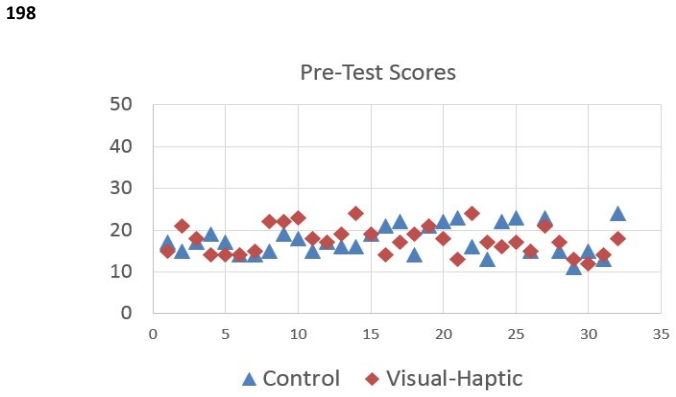
- [6.1] The pre-test group-equivalence statistic is internally inconsistent. The paper reports a two-tailed t-test on pre-test scores with 't = 0.04 with p-value = 0.83.' With 62 degrees of freedom, t = 0.04 corresponds to a two-tailed p of approximately 0.97, not 0.83; conversely, p = 0.83 corresponds to t ≈ 0.22. The reported t and p values cannot both be correct. Because the claim that the two groups had equivalent prior knowledge is essential to the post-test comparison, this inconsistency must be corrected and the one-tailed/two-tailed choice made explicit.
minor comments (5)
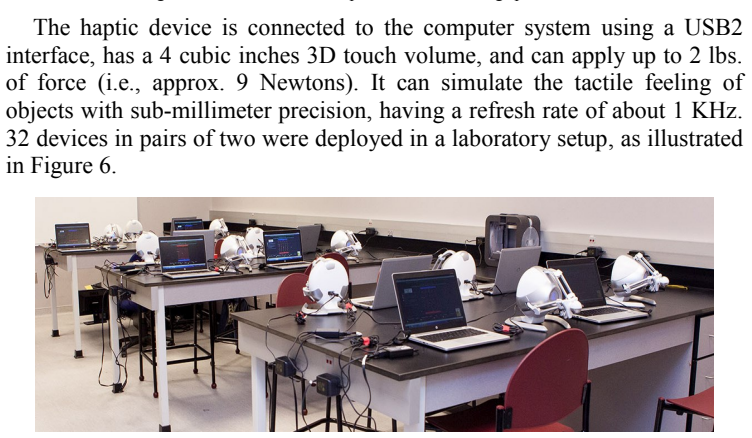
- [5.2] The hardware description states that '32 devices in pairs of two were deployed in a laboratory setup,' but the VH group has 32 participants. Please clarify the number of simultaneous workstations and the number of experimental sessions, since each station seems to require two Falcon devices.
- [6.3] The post-test is described as comprising 15 multiple-choice questions and 10 essay questions, but the pre-test composition is not specified. Please state whether the pre-test also had 25 questions and how it was structured.
- [6.1] The statement that 'a random chance trial would yield a score of 16%' implies each multiple-choice item has five options; this should be stated explicitly so the reader can interpret the pre-test baseline.
- [Conclusion] The limitations paragraph mentions 'co-depended variables' but does not name the specific confound between haptic feedback and interactivity/engagement; the discussion would be strengthened by acknowledging the need for a visual-only control condition.
- [6] The grading procedure relies on three independent graders, but no inter-rater reliability statistic (e.g., intraclass correlation or Cohen's kappa) is reported. A short reliability statement would strengthen confidence in the outcome measure.
Circularity Check
No significant circularity: the learning assessment uses an external control group and independent pre/post tests; the haptically rendered force is a calibration detail, not a predicted output.
full rationale
The paper's central claim is empirical: students who used the visual-haptic simulator (VH group) performed better on a post-test than students in a traditional control group (C group). The evidence is a between-group comparison with a reported t-test (t=4.09, p<0.001). This evaluation is self-contained and externally grounded: the post-test is a separate measurement of concept understanding, not a quantity derived from the simulator parameters. The physics equations in Section 3 (torque, angular momentum, precession) are standard textbook background and are not fitted to the experimental results. The haptic implementation in Section 4.3 is described as an 'experimentally adjusted' ViscosityEffect that opposes handle movement; this is a system calibration detail, and the paper does not claim to mathematically derive the post-test improvement from the haptic force equations. Concerns about haptic force fidelity are validity or correctness risks, not circularity. Self-citations (e.g., Hamza-Lup and Page 2012, Newton et al. 2019) motivate the work and provide survey context, but they are not load-bearing for the central result and no uniqueness claim or derived prediction depends on them. No equation is shown to reduce to another by construction, no fitted parameter is renamed as a prediction, and the study's outcome is not an input to its own derivation. The paper is therefore free of circular reasoning.
Assumptions & free parameters
free parameters (3)
- Haptic counter-force magnitude =
unknown (manually tuned)
- Spherical calibration mapping for paired haptic devices =
unknown
- SpringEffect damping and stiffness parameters =
unknown
assumptions (4)
- standard math Standard gyroscope equations: L = I * omega, tau = dL/dt, tau = r * M * g * sin(theta)
- domain assumption Hands-on kinesthetic interaction improves concept understanding
- ad hoc to paper H3D ViscosityEffect creates a force perceptually equivalent to precession pseudo-forces
- domain assumption Pre-test and post-test scores measure understanding of gyroscopic precession
Cite this review
Pith. "Pith review of Kinesthetic Learning -- Haptic User Interfaces for Gyroscopic Precession Simulation." pith.science (2026). https://pith.science/paper/NOTJGBLD
@misc{pith2026190809082,
  author       = {Pith},
  title        = {Pith review of: Kinesthetic Learning -- Haptic User Interfaces for Gyroscopic Precession Simulation},
  year         = {2026},
  howpublished = {\url{https://pith.science/paper/NOTJGBLD}},
  note         = {Machine review of arXiv:1908.09082}
}
read the original abstract
Some forces in nature are difficult to comprehend due to their non-intuitive and abstract nature. Forces driving gyroscopic precession are invisible, yet their effect is very important in a variety of applications, from space navigation to motion tracking. Current technological advancements in haptic interfaces, enables development of revolutionary user interfaces, combining multiple modalities: tactile, visual and auditory. Tactile augmented user interfaces have been deployed in a variety of areas, from surgical training to elementary education. This research provides an overview of haptic user interfaces in higher education, and presents the development and assessment of a haptic-user interface that supports the learner's understanding of gyroscopic precession forces. The visual-haptic simulator proposed, is one module from a series of simulators targeted at complex concept representation, using multi-modal user interfaces. Various higher education domains, from classical physics to mechanical engineering, will benefit from the mainstream adoption of multi-modal interfaces for hands-on training and content delivery. Experimental results are promising, and underline the valuable impact that haptic user interfaces have on enabling abstract concepts understanding, through kinesthetic learning and hands-on practice.
Figures
Figures from the paper (7 more)


Reference graph
Works this paper leans on
-
[1]
Bortone, I., Leonardis, D., Mastronicola, N., Crecchi, A., Bonfiglio, L., Procopio, C., Solazzi, M., and Frisoli, A. (2018). Wearable Haptics and Immersive Virtual Reality Rehabilitation Training in Children With Neuromotor Impairments , IEEE Transactions on Neural Systems and Rehabilitation Engineering, 26(7), 1469-1478. Butikov, E. (2006) . Precession a...
-
[597]
Neri, L., Noguez, J., Robledo -Rella, V., Escobar-Castillejos, D., and Gonzalez-Nucamendi, A. (2018) . Teaching Classical Mechanics Concepts using Visuo -haptic Simulators, Journal of Educational Technology & Society, 21(2), pp. 85-97. Newton, D., Bergeron K. and Hamza -Lup, F.G. (2019) Haptic Systems in User Interfaces – State-of-Art Survey, Proceedings ...
-
[2284]
doi:10.3390/s17102284. Popovici, D. M., Hamza -Lup, F. G., Se itan, A., and Bogdan, C. M. (2012). Comparative Study of APIs and Frameworks for Haptic Application Development. 2012 International Conference on Cyberworlds. doi:10.1109/cw.2012.13. Rose, C. G., McDonald, C. G., Clark, J. P. , and O’Malley, M. K. (2018). Reflection on System Dynamics Principle...
arXiv 2012
Reviewed August 14, 2026 · model on record in the stance chip above.
Discussion (0). Continue with ORCID to comment.