REVIEW 3 minor 5 references
Constraint Qualifications in Partial Identification
T0 review · 0 major / 3 minor · reviewed 2026-08-14 · deepseek-v4-flash
Pith's one-line read For pure moment-inequality models, several leading regularity assumptions in partial identification are all equivalent to one classical constraint qualification.
desk verdict A clean, carefully proven map showing that the main high-level regularity assumptions in CHT, PPHI, and BCS essentially reduce to classical constraint qualifications, with the disclosed caveat that the equivalences are localized versions. read the letter →
The pith
A machine-rendered reading of the paper's core claim, the machinery that carries it, and where it could break.
The reading
What carries the argument
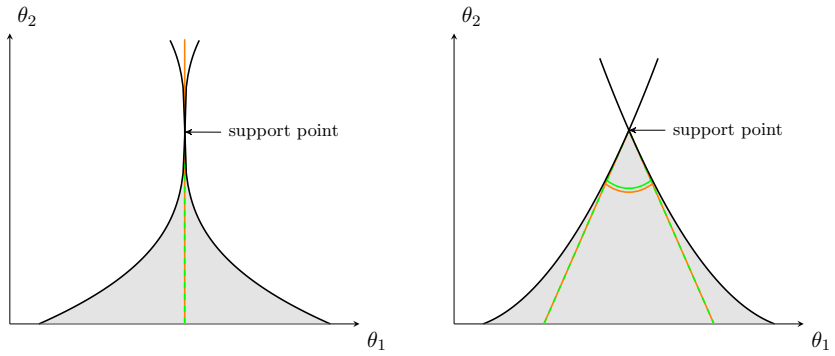
The load-bearing objects are the tangent cone $T(\theta)$ and linearized cone $L(\theta)$ at a support point $\theta^*$, together with the classical Mangasarian–Fromowitz constraint qualification (MFCQ): the gradients of equality constraints are linearly independent and there exists a direction $t$ with $D_j(\theta^*)t<0$ for active inequalities and $D_j(\theta^*)t=0$ for equalities. Lemma 3.1 rewrites each econometric assumption in cone language, for example Assumption 5 becomes $\max\{p't/\|t\|: t\in T(\theta^*)\setminus\{0\}\}<0$, and Assumption 7 becomes the same expression on $L(\theta^*)$. The proof of Theorem 3.1 transfers these geometric statements into each other, using continuous differentiability and the fact that $T(\theta^*)\subseteq L(\theta^*)$.
What would settle it
Construct a pure moment-inequality model with continuously differentiable moments, no equality constraints, and an identified set contained in the interior of the parameter space, whose support point satisfies MFCQ (a direction strictly decreases every active constraint) but where the localized degeneracy condition, Assumption 2, fails; Theorem 3.1 predicts no such model exists.
Extended reading notes
Core claim
The paper's main theorem (Theorem 3.1) states that, under a background assumption of compact convex parameter space with the identified set in its interior and continuously differentiable normalized moments, the following hold for pure moment-inequality models: Assumption 2 (a localized degeneracy condition) and Assumption 6 (a condition requiring, at each support point, a direction in which every active constraint strictly decreases) are equivalent, and both are equivalent to excluding equality constraints and imposing the Mangasarian–Fromowitz constraint qualification at every support point. Assumption 3 (a polynomial minorant) is implied by any of these and in turn implies the Abadie constraint qualification. Assumptions 5 and 7, which concern the tangent and linearized cones at support points, relate through further implications: Assumption 7 is stronger than Assumptions 5 and 4, and, when exactly $d$ constraints are active, implies the linear independence constraint qualification. The paper also shows the result is tight, with counterexamples demonstrating that none of the nontrivial implications can be reversed, and it applies the conditions to linear regression with interval outcome data and to a two-player entry game.
Load-bearing premise
The equivalences are established only for assumptions that have been localized to a neighborhood of each support point and stated pointwise rather than uniformly over data-generating processes; the original versions often include uniform or global components that are not covered, and the identified set is assumed to be strictly inside the parameter space.
Editorial extensions
If this is right
- For pure moment-inequality models, a researcher who verifies MFCQ at support points has automatically verified the localized content of degeneracy and common projection-inference assumptions; no separate verification is needed.
- The linear independence constraint qualification is stronger than MFCQ-based assumptions only by excluding support points with more than $d$ active constraints; when exactly $d$ constraints are active, the projection-inference assumptions already imply LICQ.
- The polynomial minorant condition splits into a local constraint-qualification part and a global identification part; the local part is implied by MFCQ, and the global part is what makes the identified set a well-separated minimum of the criterion.
- The minorant on the supporting hyperplane (the assumption used by profiling methods) does not require MFCQ, which helps explain why profile inference can work under weaker geometry than full-set estimation.
- In interval-outcome linear regression and entry-game examples, checking these assumptions reduces to determining whether the support set is a vertex, facet, or relative interior point and whether active gradients admit a common descent direction.
Reading between the lines
- Because the equivalence holds only for localized, pointwise versions, a natural extension would be to determine exactly how much uniformity is lost; uniform-over-dgp versions of these assumptions may be strictly stronger than MFCQ, so practitioners needing uniform inference should check whether the localization applies.
- The equivalence suggests a practical diagnostic: compute the gradients of active constraints at estimated support points and test for a common descent direction, a finite-dimensional linear program; rejection of such a direction indicates MFCQ fails.
- Separating the global from the local component of polynomial minorants implies that convergence-rate results could be re-proven by combining MFCQ with a separately verifiable global identification condition, potentially simplifying existing proofs.
- The direction-dependence seen in the entry-game example (assumptions hold for $p=(0,1)$ but fail for $p=(1,-1)$) hints that inference on projections may need to be tailored to the chosen direction rather than treated uniformly.
Signed reviews
Editorial analysis
A structured set of objections, weighed in public.
Referee Report
Summary. This paper connects high-level geometric assumptions used in the partial-identification literature—CHT's degeneracy and polynomial minorant, PPHI's assumptions, and BCS's minorant—with classical constraint qualifications from stochastic programming. After fixing a common maintained assumption (Assumption 1: compact convex parameter space, identified set interior to the parameter space, nonzero variances, and continuous differentiability of normalized moments), the authors state pointwise and localized versions of the econometric assumptions. Lemma 3.1 rewrites several of them in terms of tangent and linearized cones, and Theorem 3.1 establishes that Assumptions 2 and 6 are equivalent to imposing no equality constraints plus the Mangasarian-Fromowitz constraint qualification, with a further chain of implications (MFCQ and no equalities implies Assumption 3; Assumption 3 implies ACQ; Assumptions 5 and ACQ jointly imply Assumption 7; Assumption 7 implies Assumptions 5 and 4, and also implies spanning of active gradients and LICQ when exactly d constraints are active). Section 3.3 provides counterexamples showing that no additional implications in the flow chart hold, and Section 4 applies the conditions to two leading examples: linear regression with interval outcome data and discrete regressors, and a two-player entry game.
Significance. If the results hold, they provide a useful unification of a fragmented set of high-level assumptions, showing that many of them are not independent objects but a family of geometric regularity conditions centered on MFCQ and ACQ. The paper's strengths are the detailed proofs of the main equivalences, the explicit counterexamples in Section 3.3 that demonstrate tightness, and the candid treatment of the scope of the results: Assumptions 2–7 are deliberately stated pointwise and localized, and Remark 3.1 separates the local, CQ-related part of the polynomial minorant from its global identification part. The two worked examples in Section 4 are also valuable because they show when the assumptions hold and fail in empirically relevant models. The main caveat—that the equivalences are not literal equivalences of the original uniform/global assumptions—is disclosed in the text, so it does not constitute a correctness error, but it deserves slightly more prominence in the abstract and conclusion.
minor comments (3)
- [Abstract and Section 5] The phrase 'essentially coincide with MFCQ' is somewhat stronger than what the theorems establish. Theorem 3.1 applies to the pointwise, localized versions of Assumptions 2 and 6 defined in Section 2, with PPHI's uniformity over d.g.p.s removed (footnote 5) and with CHT's global polynomial-minorant component (3.3) excluded in Remark 3.1. Since the original CHT rate results and PPHI's uniform inference use the uniform/global parts, I recommend adding an explicit sentence in the abstract and conclusion stating that the equivalences do not justify replacing the original assumptions by MFCQ in applications requiring uniform validity or the global separation condition.
- [Section 4.1, Lemma 4.1, Case 2] The proof's claim that the KKT necessary condition yields λ_j>0 for every j in an arbitrary d-element subset J~ of active constraints is not justified; multipliers can be zero on some active constraints, especially when the support set is not a singleton. The claim #J*(θ*)<d at a point in the relative interior of a non-singleton face follows more directly from condition (iii): all active gradients at an ℓ-face (ℓ≥1) lie in a subspace of dimension at most d−1, so a subset of size d would be linearly dependent, contradicting (iii).
- [Assumption 6' and Eq. (3.4)] The minimum over t∈R^d includes t=0, where the ratio Dj(θ*)t/||t|| is undefined; the minimization should be restricted to ||t||=1 (or t≠0).
Circularity Check
No circularity: the equivalence theorems are proved from explicit assumptions, and all weakenings are disclosed.
full rationale
I found no circular step in the paper. The central contribution is a chain of mathematical equivalence results (Lemma 3.1 and Theorem 3.1) proved directly from Assumption 1 and standard first-order/cone arguments; no parameter is fitted to data and no central claim is assumed by construction. The paper explicitly states that it localizes CHT's and PPHI's assumptions and removes uniform-over-d.g.p. components (Section 2, before Assumption 2, and footnote 5), and Remark 3.1 expressly separates the local polynomial-minorant condition (3.2) from the global identification condition (3.3), noting that only (3.2) is related to constraint qualifications. This is a disclosed scope restriction, not a circular reduction. The equivalence of Assumption 2 and Assumption 6 with MFCQ-plus-no-equalities is established by explicit proof, including construction of the relevant directions and constants; neither assumption is defined in terms of MFCQ. Self-citations appear only as auxiliary support, e.g., Kaido and Santos (2014) for a geometric fact in Lemma 4.1, and those are published, externally checkable results that do not carry the main argument. The paper is self-contained in its derivation and does not rename a known result as a new prediction.
Assumptions & free parameters
assumptions (3)
- domain assumption Correctly specified moment inequality model: identified set defined by finite moment inequalities and equalities as in Eq. (2.1).
- domain assumption Assumption 1(a)-(d): compact convex parameter space with nonempty interior; nonempty identified set interior to the parameter space; finite positive variances; continuous gradients of normalized moment functions.
- standard math Tangent cone subset of linearized cone and related facts from nonlinear programming (Bazaraa, Sherali, Shetty 2006, ch.5).
Cite this review
Pith. "Pith review of Constraint Qualifications in Partial Identification." pith.science (2026). https://pith.science/paper/T2EWBDLE
@misc{pith2026190809103,
  author       = {Pith},
  title        = {Pith review of: Constraint Qualifications in Partial Identification},
  year         = {2026},
  howpublished = {\url{https://pith.science/paper/T2EWBDLE}},
  note         = {Machine review of arXiv:1908.09103}
}
read the original abstract
The literature on stochastic programming typically restricts attention to problems that fulfill constraint qualifications. The literature on estimation and inference under partial identification frequently restricts the geometry of identified sets with diverse high-level assumptions. These superficially appear to be different approaches to closely related problems. We extensively analyze their relation. Among other things, we show that for partial identification through pure moment inequalities, numerous assumptions from the literature essentially coincide with the Mangasarian-Fromowitz constraint qualification. This clarifies the relation between well-known contributions, including within econometrics, and elucidates stringency, as well as ease of verification, of some high-level assumptions in seminal papers.
Figures


Figures from the paper (1 more)

Reference graph
Works this paper leans on
-
[1]
Inference for Parameters Defined by Moment Inequalities Using Generalized Moment Selection,
Andrews, D. W. K., and G. Soares (2010): “Inference for Parameters Defined by Moment Inequalities Using Generalized Moment Selection,” Econometrica, 78(1), 119–157. Andrews, I., J. Roth, and A. Pakes (2019): “Inference for Linear Conditional Moment Inequalities,” Working Paper 26374, National Bureau of Eco nomic Research. Bazaraa, M. S., H. D. Sherali, and...
work page 2010
-
[24]
Simple Inference on Functionals of Set-Identified Parameters Defined by Linear Moments
Bonnans, J., and A. Shapiro (2000): Perturbation Analysis of Optimization Problems . Springer. Bugni, F. A. (2009): “Bootstrap Inference in Partially Identified Model s Defined by Moment Inequalities: Coverage of the Identified Set,” Econometrica, 78(2), 735–753. Bugni, F. A., I. A. Canay, and X. Shi (2017): “Inference for subvectors and other functions of p...
work page Pith review arXiv 2000
-
[25]
Microeconometrics with partial identification,
Molinari, F. (2020): “Microeconometrics with partial identification,” in Handbook of Econometrics, Volume 7A , ed. by S. N. Durlauf, L. P. Hansen, J. J. Heckman, and R. L. Matzkin, pp. 355–486. Elsevier. Newey, W. K., and D. McF adden (1994): “Large Sample Estimation and Hypothesis Testing,” in Handbook of Econometrics , ed. by R. F. Engle, and D. L. McFad...
work page 2020
-
[36]
Moment Inequalities and Their Application,
New York: Elsevier. Pakes, A., J. Porter, K. Ho, and J. Ishii (2011): “Moment Inequalities and Their Application,” Discussion Paper, Harvard University. (2015): “Moment Inequalities and Their Application,” Econometrica, 83, 315–334. Shapiro, A. (1990): “On Differential Stability in Stochastic Programmin g.,” Math. Pro- gram., 47, 107–116. (1991): “Asymptot...
work page 2011
-
[80]
Consistency of plug-in estimators of upper contou r and level sets,
Yildiz, N. (2012): “Consistency of plug-in estimators of upper contou r and level sets,” Econometric Theory, 28(2), 309–327. [26]
work page 2012
Reviewed August 14, 2026 · model on record in the stance chip above.
Discussion (0). Continue with ORCID to comment.