REVIEW 4 major objections 4 minor 38 references
Magnetic order and anisotropic interactions induced by mixing between the $J=1/2$ and $3/2$ sectors in spin-orbit coupled honeycomb-lattice compounds
T0 review · 4 major / 4 minor · reviewed 2026-08-14 · deepseek-v4-flash
Pith's one-line read Mixing between the $J=1/2$ and $J=3/2$ sectors can order a honeycomb lattice even with Hund's coupling set to zero.
desk verdict New mixing mechanism worth a look, but the ground-state evidence is weaker than the claims. read the letter →
The pith
A machine-rendered reading of the paper's core claim, the machinery that carries it, and where it could break.
The reading
What carries the argument
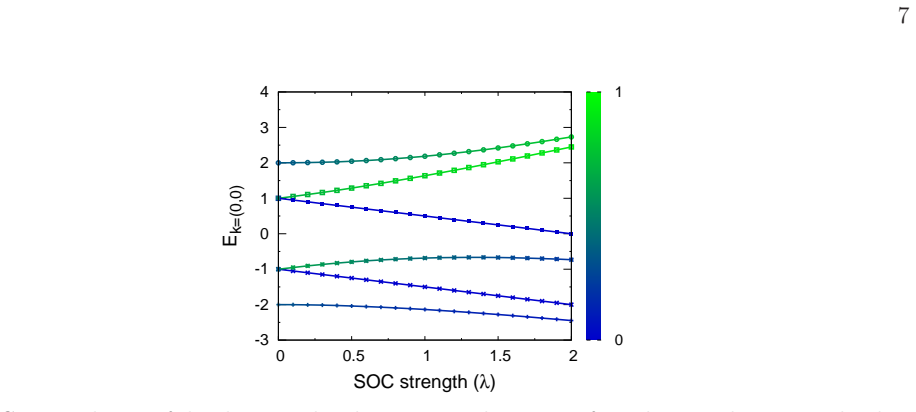
The load-bearing object is the transformation from the $t_{2g}$ orbital basis to the spin-orbit eigenstates: three Kramers pairs labeled 1, 2, and 3, where pair 1 is the $J=1/2$ doublet and pairs 2 and 3 form the $J=3/2$ quartet. In this pseudo-orbital basis, the inter-orbital hopping $t_2$ appears as spin-dependent hopping only between sectors, not within the $J=1/2$ sector. The authors use these spin-dependent terms as the seed of a self-consistent mean-field loop in a three-orbital by four-sublattice by two-spin basis; the induced moments in the $J=3/2$ sectors feed back into the $J=1/2$ sector, and magnon excitations are computed in the random phase approximation to check stability and extract the energy scales.
What would settle it
Run the same three-orbital model without restricting the self-consistent ansatz to collinear four-sublattice order, or solve the finite-cluster exact problem, and check whether cubic Néel and planar or axial zigzag orders survive for the Table I parameter sets; if a different state appears, the claimed stabilization fails. Alternatively, measure the spin-orbit-coupling dependence of the magnon anisotropy gap in RuCl$_3$: the paper predicts enhanced anisotropy effects for smaller spin-orbit coupling, so a flat or opposite trend would contradict the mechanism.
Extended reading notes
Core claim
The central claim is that mixing between the $J=1/2$ and $J=3/2$ sectors in a three-orbital interacting model, with no Hund's coupling, generates weak emergent anisotropic magnetic interactions that determine the magnetic order. In the ideal cubic edge-sharing geometry, the leading spin-dependent hoppings within the $J=1/2$ sector cancel, so the usual bond-directional anisotropic exchange is quenched; what remains are spin-dependent hoppings between $J=1/2$ and $J=3/2$. Self-consistent mean-field solutions yield anisotropic Néel and zigzag orders locked to the crystal axes, with tiny induced moments in the $J=3/2$ sector that feed back into the active sector. The authors extract the resulting spin interactions and find only next-nearest-neighbor $J=1/2$ couplings, combining symmetric off-diagonal and antisymmetric off-diagonal exchange, plus nearest-neighbor $J=1/2$ to $J=3/2$ couplings that frustrate the order. They conclude that effective spin models keeping only $J=1/2$ degrees of freedom miss an essential part of the physics.
Load-bearing premise
The results rest on the assumption that the self-consistent mean-field loop, started only from a collinear zigzag ansatz on four sublattices, finds the true ground state of the three-orbital model; non-collinear, spiral, and spin-liquid states are never tested, so the reported Néel and zigzag orders could be mean-field artifacts.
Editorial extensions
If this is right
- If the mechanism is correct, anisotropic exchange does not require Hund's coupling, so the usual reasoning that ties Kitaev-type interactions to the intra-atomic exchange needs revision.
- The emergent single-ion anisotropy locks the ordered moments to the crystal axes, explaining the observed ordered-moment directions and the magnon gaps in Na$_2$IrO$_3$ and RuCl$_3$.
- The extremely small magnon energy scale compared with the hopping scale follows naturally from the weakness of the mixing-induced interactions, matching the low magnon energies measured in these compounds.
- Because nearest-neighbor $J=1/2$ to $J=3/2$ interactions frustrate the order, low-energy properties cannot be captured by effective spin models that keep only $J=1/2$ spins.
- Smaller spin-orbit coupling strengthens the mixing and enhances anisotropy effects, making RuCl$_3$ a sharper test of the scenario.
Reading between the lines
- Beyond the paper, the same mixing mechanism should be active in other $d^5$ honeycomb materials with edge-sharing octahedra, so their ordered-moment directions and magnon gaps are likely controlled by $J=1/2$ to $J=3/2$ mixing rather than by Hund's-coupling-generated exchanges.
- Beyond the paper, the predicted frustration from nearest-neighbor $J=1/2$ to $J=3/2$ couplings suggests that tuning spin-orbit coupling or strain in RuCl$_3$ could move the system closer to a proximate spin-liquid regime without changing the leading exchange itself.
- Beyond the paper, a direct numerical test would be to compute the same interaction matrices from an unbiased method such as exact diagonalization on finite clusters and compare them with the random-phase-approximation-derived couplings reported here.
Signed reviews
Editorial analysis
A structured set of objections, weighed in public.
Referee Report
Summary. The paper studies a three-orbital t2g model with spin-orbit coupling and no Hund's coupling on the honeycomb lattice, and argues that mixing between the J=1/2 sector and the nominally filled J=3/2 sector generates weak anisotropic exchange interactions that stabilize cubic Néel and planar/axial zigzag orders. Sections II–III set up a Hartree-Fock calculation on a four-sublattice ansatz and report self-consistent staggered fields for four hopping parameter sets (Table I). Section IV presents RPA magnon spectra with positive energies and a very small energy scale, which the authors interpret as evidence of stability. Section V extracts exchange tensors from a particle-hole propagator via Eq. (16), identifies single-ion anisotropy, Kitaev, symmetric off-diagonal, and Dzyaloshinskii-Moriya terms, and uses these to interpret the ordering. The conclusions connect the results to Na2IrO3 and RuCl3.
Significance. If correct, the mechanism is significant: it offers a route to anisotropic magnetic interactions in honeycomb iridates and ruthenates without Hund's coupling, in a regime where the conventional J=1/2 Kitaev-Heisenberg expansion is suppressed, and it naturally explains the small magnon scale and the locking of moment directions. The paper is constructive: it provides explicit parameter sets, detailed band structures, RPA magnon dispersions, and explicit exchange matrices in Appendix B, and it makes falsifiable predictions for the dependence of anisotropy on the spin-orbit coupling strength. The main limitation is that the central numerical statements rely on a restricted mean-field ansatz and on an unproven, self-referential extraction of exchange interactions, so the strength of the conclusions currently exceeds what the calculations establish.
major comments (4)
- [Secs. II C, III, IV, and Fig. 2] The self-consistent search is restricted to a four-sublattice ansatz and is initialized only from a zigzag configuration, so the positive RPA magnon energies in Fig. 5 establish at most local stability of the converged state at the RPA level, not that it is the ground state of the three-orbital model. The NNN interaction tensors reported in Sec. V and Appendix B contain Kitaev, symmetric off-diagonal, and DM terms, which are the kinds of frustrated interactions that favor spiral or multi-q ground states in classical spin models; those states are not represented by the four-sublattice ansatz. Please perform an unrestricted search over non-collinear, spiral, and larger-unit-cell states, or benchmark the HF ground state against exact diagonalization or DMRG on finite clusters; at minimum, the statement in Sec. IV that self-consistency 'indeed yields the ground state' should be replaced by a qualified local-stability statement.
- [Sec. V, Eq. (16)] The central formula J^{alpha beta}_{ij} = -2 U^2 [chi0]^{alpha beta}_{ij} is stated without derivation, and the assertion that this approach 'is well known to interpolate properly to the strong coupling limit' is neither derived nor supported by a specific reference or benchmark. All of the exchange constants and minimal spin models in Sec. V and Appendix B are computed from this formula, so the paper's central mechanism rests on an unproven step. Please derive Eq. (16), for example from the RPA/ladder resummation of the Hubbard interaction, and validate it in a controlled limit such as a two-site Hubbard model or the one-band honeycomb model with spin-dependent hopping, where the strong-coupling exchange is known analytically.
- [Sec. V, Eqs. (14) and (16), and Table I] The interaction tensor J is computed from the self-consistently ordered state: the HF eigenstates and eigenvalues of that state enter chi0 in Eq. (14), and the resulting J matrices are then used to argue that the same order is stabilized. This is partly circular and does not provide an independent stability test, because the extracted interactions already contain the feedback of the ordered moments. An independent test would compute J in a paramagnetic or weakly polarized reference state, or compare the total HF energies of competing states directly; the manuscript should at least acknowledge the state dependence of the extracted J and demonstrate that the stability conclusion is not an artifact of the self-consistency loop.
- [Table I and Sec. III] The comparison of parameter sets A and D does not isolate the effect of the orbital-mixing hopping t4 because the two sets differ in t1 and t3 as well (t1=-0.15 vs -0.2; t3=0.3 vs 0.4). The conclusion that structural distortion, represented by t4, 'significantly stabilizes the zigzag order' is therefore not supported by the presented data; a controlled sweep in which only t4 is varied is required.
minor comments (4)
- [Introduction] The phrase 'withn a three-orbital interacting electron model' appears to contain a typo; it should read 'within'.
- [Sec. III] The statement 'the iteration process converges significantly faster for t2=-0.7 in parameter set B' is inconsistent with Table I, where set B has t2=-0.5; please correct or clarify.
- [Sec. V and Appendix B] The bond labels AA, AD, and Z, X, Y are not all defined in the text, making the interaction matrices in Appendix B difficult to verify; a figure or explicit sublattice indexing would help.
- [Sec. V] The approximate minimal spin models are presented as 'found' from the J matrices, but the reduction from the full matrices in Eq. (B1) to the simplified forms is not shown; please state which matrix elements are dropped and justify the truncation.
Circularity Check
The stability argument for the emergent anisotropic interactions reduces, via Eq. (16), to the very self-consistent magnetic order from which the interaction tensor is extracted.
-
self definitional
[Sec. V, Eq. (16) and the following minimal-spin-model discussion; Sec. IV, Eq. (14)]
"J αβ ij = −2U 2[χ 0]αβ ij = −2U 2 ∑ q [χ 0(q)]αβeiq. (ri−rj) ... in terms of the bare particle-hole propagator given in Eq. (14) evaluated for ω = 0. ... For the planar zigzag case, only one intra-site OD interaction + DSixSiy was obtained, which stabilizes the local (1, −1, 0) magnetic order."
The propagator [χ0] in Eq. (16) is, by Eq. (14), evaluated 'by integrating out the fermions in the self-consistently determined state'. Hence J is defined from the already established magnetic order whose stability it is then used to prove. Saying the extracted single-ion/anisotropic terms 'stabilize' the same Néel or zigzag order is therefore a restatement of the self-consistency condition in spin-model language, not an independent derivation from the bare Hamiltonian. The causal claim that mixing-induced anisotropic interactions produce the order is not independently tested: order and stabilizing interactions are the same self-consistent solution.
full rationale
The self-consistent HF calculation itself is not circular: the magnetic orders in Table I are outputs of the microscopic parameters (t_i, λ, U, JH=0), and starting from a zigzag initial state nevertheless yields cubic Néel for set A, so the order is not merely copied from the initial ansatz. The four-sublattice restriction and zigzag-only initialization are a search-space limitation (a possible correctness risk), not a circularity. The main circular step is in Sec. V: Eq. (16) defines the effective interaction J using the static particle-hole propagator of the self-consistently ordered state, and the paper then presents the fact that this same J favors that same order as evidence that the emergent interactions stabilize the order. This is a state-dependent consistency check rather than an independent prediction. The citation of the authors' prior work (ref 35) for the J-extraction method is a self-citation, but the formula is written out, so it is not the main load-bearing circularity. Ref 33 is used only for a side remark about Hund's coupling. Because the central self-consistent determination of the magnetic orders has independent content, but the 'due to anisotropic interactions' stability argument reduces by construction to the ordered state from which it is derived, the circularity score is 6.
Assumptions & free parameters
free parameters (9)
- Hopping parameter t1 =
-0.15 (A), -0.5 (B), -0.15 (C), -0.2 (D)
- Hopping parameter t2 =
-1.0 (A,C,D), -0.5 (B)
- Hopping parameter t3 =
0.3 (A,C), 1.0 (B), 0.4 (D)
- Hopping parameter t4 =
0 (A,B,C), 0.15 (D)
- Hopping parameter t5 =
0 (A,B,D), 0.3 (C)
- Spin-orbit coupling lambda =
1.5 (all sets); 0.75 in the RuCl3 case
- On-site Coulomb interaction U =
3.33 (all sets); ~6 in the RuCl3 case
- Hund's coupling JH =
0
- Heisenberg suppression condition 2t1+t3 =
0 (enforced in all sets)
assumptions (5)
- ad hoc to paper Effective spin interactions are given by J = -2U^2 chi0 (Eq. 16).
- domain assumption Hartree-Fock mean-field captures the ground state.
- domain assumption A four-sublattice collinear ansatz covers the relevant orders.
- domain assumption The t2g three-orbital model with the hopping matrices (6) describes Na2IrO3 and RuCl3.
- standard math The spin-orbit eigenstates (3) form a valid basis.
Cite this review
Pith. "Pith review of Magnetic order and anisotropic interactions induced by mixing between the $J=1/2$ and $3/2$ sectors in spin-orbit coupled honeycomb-lattice compounds." pith.science (2026). https://pith.science/paper/3KFXOITZ
@misc{pith2026190809130,
  author       = {Pith},
  title        = {Pith review of: Magnetic order and anisotropic interactions induced by mixing between the $J=1/2$ and $3/2$ sectors in spin-orbit coupled honeycomb-lattice compounds},
  year         = {2026},
  howpublished = {\url{https://pith.science/paper/3KFXOITZ}},
  note         = {Machine review of arXiv:1908.09130}
}
abstract
Novel magnetic ordering on the honeycomb lattice due to emergent weak anisotropic interactions generated by the mixing between the $J=1/2$ sector and the magnetically inactive 3/2 sector is investigated in a three-orbital interacting electron model in the absence of Hund's coupling. Self-consistent determination of magnetic order yields anisotropic N\'{e}el and zigzag orders for different parameter regimes, highlighting the effect of the emergent single-ion anisotropy. Study of magnon excitations shows extremely small magnon energy scale compared to the hopping energy scale, and enhancement of anisotropy effects for smaller spin-orbit coupling. These results account for several features of the honeycomb lattice compounds such as $\rm Na_2 Ir O_3$ and $\rm Ru Cl_3$, where the leading order anisotropic interactions within the magnetically active $J=1/2$ sector are completely quenched due to the edge-sharing octahedra.
Figures


Figures from the paper (3 more)


Reference graph
Works this paper leans on
-
[1]
A. Banerjee, J. Yan, J. Knolle, C. A. Bridges, M. B. Stone, M. D. Lumsden, D. G. Mandrus, D. A. Tennant, R. Moessner, and S. E. Nagler, Science 356 , 1055–1059 (2017)
work page 2017
-
[2]
A. Revelli, M. Moretti Sala, G. Monaco, C. Hickey, P. Becker, F. Freund, A. Jesche, P. Gegenwart, T. Eschmann, F. L. Buessen, S. Trebst, P. H. M. van Loosdrecht, J. van den Brink, and M. Gr\" u ninger, arXiv:1905.1359 (2019)
-
[3]
X. Liu, T. Berlijn, W.-G. Yin, W. Ku, A. Tsvelik, Y.-J. Kim, H. Gretarsson, Y. Singh, P. Gegenwart, and J. P. Hill, Phys. Rev. B 83 , 220403 (2011)
work page 2011
-
[4]
F. Ye, S. Chi, H. Cao, B. C. Chakoumakos, J. A. F-Baca, R. Custelcean, T. F. Qi, O. B. Korneta, and G. Cao, Phys. Rev. B 85 , 180403(R) (2012)
work page 2012
-
[5]
S. K. Choi, R. Coldea, A. N. Kolmogorov, T. Lancaster, I. I. Mazin, S. J. Blundell, P. G. Radaelli, Y. Singh, P. Gegenwart, K. R. Choi, S.-W. Cheong, P. J. Baker, C. Stock, and J. Taylor, Phys. Rev. Lett. 108 , 127204 (2012)
work page 2012
- [6]
-
[7]
J. A. Sears, M. Songvilay, K. W. Plumb, J. P. Clancy, Y. Qiu, Y. Zhao, D. Parshall, and Y.-J. Kim, Phys. Rev. B 91 , 144420 (2015)
work page 2015
-
[8]
R. D. Johnson, S. C. Williams, A. A. Haghighirad, J. Singleton, V. Zapf, P. Manuel, I. I. Mazin, Y. Li, H. O. Jeschke, R. Valent\' , and R. Coldea, Phys. Rev. B 92 , 235119 (2015)
work page 2015
Show all 38 references
-
[9]
K. Ran, J. Wang, W. Wang, Z-Y. Dong, X. Ren, S. Bao, S. Li, Z. Ma, Y. Gan, Y.n Zhang, J. T. Park, G. Deng, S. Danilkin, S-L Yu, J-X Li, and J. Wen, Phys. Rev. Lett. 118 , 107203 (2017)
2017
-
[10]
Gretarsson, J
H. Gretarsson, J. P. Clancy, Y. Singh, P. Gegenwart, J. P. Hill, J. Kim, M. H. Upton, A. H. Said, D. Casa, T. Gog, and Y-J Kim, Phys. Rev. B 87 , 220407(R) (2013)
2013
-
[11]
Chaloupka, G
J. Chaloupka, G. Jackeli, and G. Khaliullin, Phys. Rev. Lett. 105 , 027204 (2010); 110 , 097204 (2013)
2010
-
[12]
Kimchi and Y.-Z
I. Kimchi and Y.-Z. You, Phys. Rev. B 84 , 180407(R) (2011)
2011
-
[13]
C. H. Kim, H. S. Kim, H. Jeong, H. Jin, and J. Yu, Phys. Rev. Lett. 108 , 106401 (2012)
2012
-
[14]
Yamaji, Y
Y. Yamaji, Y. Nomura, M. Kurita, R. Arita, and M. Imada, Phys. Rev. Lett. 113 , 107201 (2014)
2014
-
[15]
V. M. Katukuri, S. Nishimoto, V. Yushankhai, A. Stoyanova, H. Kandpal, S. Choi, R. Coldea, I. Rousochatzakis, L. Hozoi, and J. van den Brink, New J. Phys. 16 , 013056 (2014)
2014
-
[16]
J. G. Rau, E. Kin-Ho Lee, and H.-Y. Kee, Phys. Rev. Lett. 112 , 077204 (2014)
2014
-
[17]
Sizyuk, C
L. Sizyuk, C. Price, P. W\"olfle, and N. B. Perkins, Phys. Rev. B 90 , 155126 (2014)
2014
-
[18]
H.-S. Kim, V. V. Shankar, A. Catuneanu, and H.-Y. Kee, Phys. Rev. B 91 , 241110(R) (2015)
2015
-
[19]
Wang, Z.-Y
W. Wang, Z.-Y. Dong, S.-L. Yu, and J.-X. Li, Phys. Rev. B 96 , 115103 (2017)
2017
-
[20]
Foyevtsova, H
K. Foyevtsova, H. O. Jeschke, I. I. Mazin, D. I. Khomskii, and R. Valent\' , Phys. Rev. B 88 , 035107 (2013)
2013
-
[21]
S. M. Winter, Y. Li, H. O. Jeschke, and Roser Valent\' , Phys. Rev. B 93 , 214431 (2016)
2016
-
[22]
Kim and H.-Y
H.-S. Kim and H.-Y. Kee, Phys. Rev. B 93 , 155143 (2016)
2016
-
[23]
S. H. Chun, J.-W. Kim, J. Kim, H. Zheng, C. C. Stoumpos, C. D. Malliakas, J. F. Mitchell, K. Mehlawat, Y. Singh, Y. Choi, T. Gog, A. Al-Zein, M. M. Sala, M. Krisch, J. Chaloupka, G. Jackeli, G. Khaliullin, and B. J. Kim, Nature Phys. 11 , 462 (2015)
2015
-
[24]
K. Hu, F. Wang, and J. Feng, Phys. Rev. Lett. 115 , 167204 (2015)
2015
-
[25]
Singh and P
Y. Singh and P. Gegenwart, Phys. Rev. B 82 , 064412 (2010)
2010
-
[26]
E. E. Gordon, H. Xiang, J. K\" o hler, and M.-H. Whangbo, J. Chem. Phys. 144 , 114706 (2016)
2016
-
[27]
Igarashi and T
J.-I. Igarashi and T. Nagao, J. Phys.: Condens. Matter 28 , 026006 (2016)
2016
-
[28]
Mohapatra, and A
S. Mohapatra, and A. Singh, J. Magn. Magn. Mater 479 , 229 (2019)
2019
-
[29]
J. G. Rau and H.-Y. Kee, arXiv:1408.4811 (2014)
2014 arXiv
-
[30]
I. I. Mazin, H. O. Jeschke, K. Foyevtsova, R. Valent\' , and D. I. Khomskii, Phys. Rev. Lett. 109 , 197201 (2012)
2012
-
[31]
C. H. Sohn, H.- S. Kim, T. F. Qi, D. W. Jeong, H. J. Park, H. K. Yoo, H. H. Kim, J.-Y. Kim, T. D. Kang, D.-Y. Cho, G. Cao, J. Yu, S. J. Moon, and T. W. Noh, Phys. Rev. B 88 , 085125 (2013)
2013
-
[32]
Y. Li, K. Foyevtsova, H. O. Jeschke, and R. Valent\' , Phys. Rev. B 91 , 161101 (2015)
2015
-
[33]
B. H. Kim, T. Shirakawa, and S. Yunoki, Phys. Rev. Lett. 117 , 187201 (2016)
2016
- [34]
-
[35]
uller, M. Knupfer, B. B\
A. Koitzsch, C. Habenicht, E. M\"uller, M. Knupfer, B. B\"uchner, H. C. Kandpal, J. van den Brink, D. Nowak, A. Isaeva, and Th. Doert, Phys. Rev. Lett. 117 , 126403 (2016)
2016
-
[36]
Ghosh, N
S. Ghosh, N. Raghuvanshi, S. Mohapatra, A. Kumar, and A. Singh, J. Phys.: Condens. Matter 28 , 366002 (2016)
2016
-
[37]
Neese and E
F. Neese and E. I. Solomon, Inorg. Chem. 37 , 6568 (1998)
1998
-
[38]
Maurice, R
R. Maurice, R. Bastardis, C. de Graff, N. Suaud, T. Mallah, and N. Guih\' e ry, J. Chem. Theory Comput. 5 , 11 (2009)
2009
Reviewed August 14, 2026 · model on record in the stance chip above.
Discussion (0). Continue with ORCID to comment.