REVIEW 4 major objections 4 minor 9 references
The Bracket in the Bar Spectral Sequence for an Iterated Loop Space
T0 review · 4 major / 4 minor · reviewed 2026-08-14 · deepseek-v4-flash
Pith's one-line read The bar spectral sequence is a spectral sequence of Poisson Hopf algebras, and on the $E^1$ page its bracket is the bracket in the bar construction.
desk verdict Plausible and useful extension of Browder's bracket comparison to the bar spectral sequence, but the n≥3 proof has load-bearing gaps that need real work before publication. read the letter →
The pith
A machine-rendered reading of the paper's core claim, the machinery that carries it, and where it could break.
The reading
What carries the argument
The load-bearing object is the bar construction $B_{*,*}(A)$ of a commutative differential graded Poisson algebra $A$, equipped with the shuffle product and a bracket defined by inserting a single bracket $[a_i,a_j]$ at a lower-right corner of a shuffle path (Theorem 3.1). For $A=H_*(\Omega^n X)$, the $E^1$ page is exactly this bar construction, and the chain-level bracket on the total bar complex is produced by the delooping maps $h_n$ that implement the pointwise multiplication on loop spaces. The exterior degree $s$ of the bar filtration is what makes the bracket have bidegree $(-1,n-1)$, so the total degree $n-2$ matches the bracket on the target $H_*(\Omega^{n-1}X)$.
What would settle it
Compute the $E^1$ bracket for a small concrete case, for example $\Omega^3 S^3$ or $\Omega^4 S^4$, in the lowest filtration degrees where an $h_1$ shuffle term not touching $1\otimes\xi\otimes1$ can occur; if any such term is nonzero, the $E^1$ bracket differs from Theorem 3.1, and if all vanish, the key vanishing assertion in Section 4.3 is verified in that case.
Extended reading notes
Core claim
On the author's own terms, the discovery is the theorem stated in the introduction: for $n\ge 2$, the bar spectral sequence $$$E^{2}$_{*,*}\cong \operatorname{Tor}^{H_*(\$\Omega$^n X)}_{*,*}(k,k)\Rightarrow H_*(\$\Omega$^{n-1}X)$$ is a spectral sequence of Poisson Hopf algebras. The bracket shifts bidegree by $(-1,n-1)$ and the differentials act as graded derivations with the stated sign. On the $E^1$ page the bracket is the one in the bar construction of $H_*(\Omega^n X)$, described combinatorially in Theorem 3.1; passing to the edge homomorphism recovers the classical comparison between the degree $n-1$ bracket and the degree $n-2$ bracket under the homology suspension.
Load-bearing premise
The proof relies on the claim that every shuffle term whose inserted chain map $h_1$ does not touch the distinguished factor $1\otimes\xi\otimes1$, or touches it only once, is degenerate and therefore vanishes; the paper asserts this by analogy with the $n=2$ case rather than demonstrating it, and if it failed the $E^1$ bracket would not reduce to the formula of Theorem 3.1.
Editorial extensions
If this is right
- On every page $E^r$, the bracket makes $E^r_{*,*}$ into a bigraded Poisson Hopf algebra, so the filtration of $H_*(\Omega^{n-1}X)$ is compatible with the degree $n-2$ bracket.
- The identity $d^r[x,y]=[d^r x,y]+(-1)^{n+|x|}[x,d^r y]$ turns bracket computations on $E^1$ into constraints on which higher differentials can be nonzero.
- The $E^1$ computation $[[x],[y]]=[[x,y]]$ recovers the classical suspension comparison: the homology suspension sends the degree $n-1$ bracket to the degree $n-2$ bracket.
- In examples where the homology of the delooping is known, such as $H_*(\Omega^n S^k;\mathbb{Q})$, the spectral sequence can determine the degree $n-1$ bracket completely.
Reading between the lines
- Read as a homology-suspension calculus, the theorem implies that the spectral sequence can be run purely algebraically whenever $H_*(\Omega^n X)$ is known as a Poisson Hopf algebra; this is a route to new bracket computations the paper mentions only by example.
- If the vanishing assertion in Section 4.3 is correct, the same $h_2$-only mechanism should yield a closed formula for the $E^1$ bracket for every $n\ge 3$, including the sign $\sigma'(\phi,i)$ when $n$ is odd; checking it on small shuffle paths would isolate the combinatorial heart of the proof.
- The author's remark about topological Hochschild homology of $\mathbb{E}_n$ ring spectra suggests a testable extension: the bar-construction bracket should appear as the $E^1$ bracket there, and the Leibniz formula for differentials would constrain THH differentials.
Signed reviews
Editorial analysis
A structured set of objections, weighed in public.
Referee Report
Summary. The paper studies the bar (Rothenberg–Steenrod) spectral sequence for an n-fold loop space Ω^n X, with target H_*(Ω^{n-1}X). The central claim is that this spectral sequence is a spectral sequence of Poisson Hopf algebras: the bracket has bidegree (−1,n−1), satisfies the Leibniz rule d^r[x,y] = [d^r x,y] + (−1)^{n+|x|}[x,d^r y], and on the E_1 page agrees with the algebraic bracket defined in §3 on the bar construction of H_*(Ω^n X). The paper first defines a bracket on the bar construction of a commutative differential graded Poisson algebra and proves (or sketches) its algebraic properties. It then treats the geometric bar spectral sequence, working out the case n=2 explicitly via the commutator and the map φ: Ω^2X×S^1×Ω^2X→Ω^2X. For n≥3, the argument uses Sugawara's and Clark's delooping machinery to construct chain-level maps h_n and asserts that the h_1-inserted terms vanish and that the surviving h_2 terms assemble to the Browder bracket. The paper concludes that Browder's Theorem 2-1 follows as a special case of the edge homomorphism.
Significance. If the main theorem is correct, it gives a useful generalization of Browder's classical comparison between the bracket on H_*(Ω^n X) and the bracket on H_*(Ω^{n-1}X), placing that comparison inside the bar spectral sequence and providing a computational tool. The paper is clearly written and contains a detailed and credible treatment of the case n=2, including an explicit chain-level identification of the surviving terms with the Browder bracket. The algebraic bracket on the bar construction in §3, with its explicit shuffle formula, is a useful contribution even independently of the geometric comparison. However, the n≥3 proof is substantially incomplete: several load-bearing vanishing and identification steps are asserted rather than proved, and the algebraic proof of Theorem 3.1 leaves essential cases to the reader. The significance is therefore conditional on filling these gaps.
major comments (4)
- [§4.3, Proposition 4.2] The proof that the bracket lowers filtration from F_{p+q+1} to F_{p+q-1} is not complete. After disposing of the F_{p+q+1} part via degeneracy of h_0(1⊗ξ⊗1), the proof must rule out the F_{p+q} part, which consists of shuffles with one inserted h_1. The manuscript asserts that if the h_1 does not touch 1⊗ξ⊗1 the term vanishes, and that if it does touch it, the result is still degenerate because 'the role of ΩS^{n−2} is to control the multiplication.' No chain-level formula for h_1 involving ξ is written, and no explicit argument is given to show that h_1(x⊗1⊗1, 1⊗ξ⊗1) is degenerate. This is a load-bearing step: if any such h_1 term were nonzero in the normalized complex, the bracket would not land in F_{p+q−1}, and no induced bracket would exist on the pages E^r for r≥1.
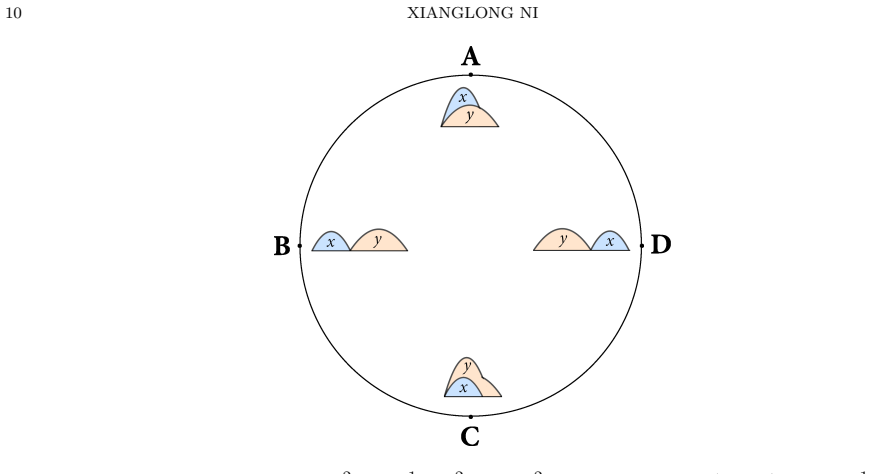
- [§4.3, Theorem 4.2] The identification of the E_1 bracket with the algebraic bracket of Theorem 3.1 is not established for n≥3. The proof asserts that the six surviving h_2 terms assemble into a map F, that a homotopy H_t untwists F into the Browder map φ, and that consequently ˜F_*(x,γ,y) equals φ_*(x,γ,y). However, the maps Rhat h_2, F, and H_t are described only pictorially (Figures 4.5 and 4.6) and no chain-level formulas or explicit homotopies are provided. Since this comparison is the core content of the theorem, the proof is incomplete as it stands.
- [§3, Theorem 3.1] The proof of Theorem 3.1 explicitly leaves to the reader the verification of antisymmetry, the Jacobi identity, and the Leibniz rule with respect to the internal differential, as well as the entire case of n odd. These are not merely routine details: the internal Leibniz rule is later used to obtain the formula (4.4) for the spectral-sequence differential, and the odd-n sign case is essential for the explicit bracket formula (3.1). The paper should either provide these checks or indicate a precise reference where they are proved.
- [§4.2, Proposition 4.1] The proof of Proposition 4.1 leaves to the reader the check that bracketing an element of Z^r_{p+1,q-1} + B^r_{p,q} with y lands in the appropriate submodule Z^r_{p+s,q+t} + B^r_{p+s-1,q+t+1}. This is a standard well-definedness argument for operations on spectral-sequence pages, but it is part of the proof that the bracket exists on every page. The paper should spell out this check or cite a fully worked reference; as written, the proof is incomplete.
minor comments (4)
- [§4.2, Proposition 4.2 (at end of proof)] The sentence 'The Poisson Hopf algebra axioms will follow from 4.2 and 3.1' appears to refer to the proposition currently being proved, which would be circular; presumably Proposition 4.1 is meant. This should be corrected to remove the ambiguity.
- [§3, Theorem 3.1] There is a typo: 'Liebniz' should be 'Leibniz'.
- [§4.3, after (4.5)] The notation h_0 is used in the proof of Proposition 4.2 ("h_0(1⊗ξ⊗1)") but h_0 is not explicitly defined in the text; the reader must infer from the earlier definition of h_n that h_0 is the chain-level multiplication map. A sentence defining h_0 would improve clarity.
- [§4.1, equation (4.1)] The displayed map in (4.1) is written for a two-factor input, but in §4.3 it is used for a three-factor shuffle with the ΩS^{n-2} factor inserted. The notation is understandable, but a brief comment that the formula extends to three factors would prevent confusion.
Circularity Check
No circularity: the derivation compares independent algebraic and topological bracket constructions and does not reduce to its own conclusion.
full rationale
The paper's central claim is a comparison of two independently defined brackets: the algebraic bracket on B_{*,*}(H_*(Ω^n X)) supplied by Theorem 3.1 and the bracket induced on the bar spectral sequence by the topological Browder bracket via Sugawara–Clark delooping maps. Theorem 3.1 is proved combinatorially from the Poisson algebra structure of H_*(Ω^n X) due to Cohen, and Theorem 4.2 identifies the E1-page bracket with that formula by explicit chain-level computations involving h1, h2, and the maps F and H_t. Neither step defines its conclusion into its hypotheses. The external inputs—Browder's bracket, Cohen's Poisson Hopf theorem, Sugawara's delooping criterion, and Clark's verification of the delooping conditions—come from non-overlapping authors and do not presuppose the theorem being proved. The sentence 'the Poisson Hopf algebra axioms will follow from 4.2 and 3.1' is most naturally read as a forward reference to Theorem 4.2 and Theorem 3.1; even on a stricter reading, it is a self-referential locution rather than the load-bearing reduction, since the filtration argument and the chain-map derivation of (4.4) are stated independently. Some assertions, such as the vanishing of h1 terms in Proposition 4.2 and the construction of the untwisting homotopy H_t in Theorem 4.2, are sketched rather than fully demonstrated, but these are omitted details in a geometric comparison and do not make the argument circular.
Assumptions & free parameters
assumptions (6)
- standard math The bar spectral sequence E2_{*,*} ≅ Tor^{H_*(A)}_{*,*}(k,k) ⇒ Tor^A_{*,*}(k,k), and for G an associative H-space Tor^{C_*(G)} ≅ H_*(BG).
- domain assumption H_*(Ω^n X) is a Poisson Hopf algebra with bracket of degree n-1 satisfying Poisson, Jacobi, and coproduct identities.
- domain assumption Sugawara's theorem that maps between associative H-spaces satisfying his homotopy conditions deloop, and Clark's theorem that the pointwise product map ζ satisfies those conditions.
- standard math The Künneth isomorphism H_*(X×Y) ≅ H_*(X)⊗H_*(Y) holds over a field, and degenerate chains vanish in normalized chains.
- standard math The loop-suspension unit η: S^{n-3}→ΩS^{n-2} sends a homology generator to a generator, so ξ=η_*(β) represents the generator of H_{n-3}(ΩS^{n-2}).
- standard math The shuffle product signs and normalized bar complex satisfy the standard commutation, associativity, and coproduct formulas stated in §2 and §3.
Cite this review
Pith. "Pith review of The Bracket in the Bar Spectral Sequence for an Iterated Loop Space." pith.science (2026). https://pith.science/paper/F6K6G5K6
@misc{pith2026190809233,
  author       = {Pith},
  title        = {Pith review of: The Bracket in the Bar Spectral Sequence for an Iterated Loop Space},
  year         = {2026},
  howpublished = {\url{https://pith.science/paper/F6K6G5K6}},
  note         = {Machine review of arXiv:1908.09233}
}
abstract
When $X$ is an associative H-space, the bar spectral sequence computes the homology of the delooping, $H_{*}(BX)$. If $X$ is an $n$-fold loop space for $n\geq2$ this is a spectral sequence of Hopf algebras. Using machinery by Sugawara and Clark, we show that the spectral sequence filtration respects the Browder bracket structure on $H_{*}(BX)$, and so it is moreover a spectral sequence of Poisson algebras. Through the bracket on the spectral sequence, we establish a connection between the degree $n-1$ bracket on $H_{*}(X)$ and the degree $n-2$ bracket on $H_{*}(BX)$. This generalizes a result of Browder and puts it in a computational context.
Figures


Figures from the paper (7 more)




Reference graph
Works this paper leans on
-
[1]
Homology operations and loop spaces
Browder, William. Homology operations and loop spaces. Illinois J. Math. 4 (1960), 347–357
work page 1960
-
[2]
Homotopy commutativity and the Moore spectral sequence
Clark, Allan. Homotopy commutativity and the Moore spectral sequence . Pacific J. Math. 15 (1965), 65-74
work page 1965
-
[3]
The homology of iterated loop spaces
Cohen, Frederick R.; Lada, Thomas J.; May, Peter J. The homology of iterated loop spaces . Berlin: Springer (1976)
work page 1976
-
[4]
Eilenberg, Samuel; Mac Lane, Saunders. On the groupsH(Π,n ). Annals of Mathematics, Second Series, 58 (1953), 55-106
work page 1953
-
[5]
Homology operations in the Eilenberg-Moore spectral sequence
Ligaard, Hans; Madsen, Ib. Homology operations in the Eilenberg-Moore spectral sequence. Math. Z. 143 (1975), 45–54
work page 1975
-
[6]
A User’s Guide to Spectral Sequences
McCleary, John. A User’s Guide to Spectral Sequences . Cambridge: Cambridge U, (2008)
work page 2008
-
[7]
Alg` ebre homologique et homologie des espaces classifiants
Moore, John C. Alg` ebre homologique et homologie des espaces classifiants. S´ eminaire Henri Cartan 12.1 (1959/60)
work page 1959
- [8]
Show all 9 references
-
[9]
On the homotopy-commutativity of groups and loop spaces
Sugawara, Masahiro. On the homotopy-commutativity of groups and loop spaces. Memoirs of the College of Science, University of Kyoto, Series A, Math. 33 (1960/61), 251-259
1960
Reviewed August 14, 2026 · model on record in the stance chip above.
Discussion (0). Continue with ORCID to comment.