REVIEW 3 major objections 5 minor 16 references
Peripheral convex expansions of resonance graphs
T0 review · 3 major / 5 minor · reviewed 2026-08-14 · deepseek-v4-flash
Pith's one-line read Resonance graphs of plane elementary bipartite graphs grow from a single edge by peripheral convex expansions exactly when the infinite face is forcing.
desk verdict A clean characterization of resonance graphs that genuinely generalizes known results, but the proof carries a citation-scope gap that a referee should pin down before the theorem is trusted. read the letter →
The pith
A machine-rendered reading of the paper's core claim, the machinery that carries it, and where it could break.
The reading
What carries the argument
The load-bearing object is the resonance graph $Z(G)$ and the expansion operation that builds it. A peripheral convex expansion is a convex expansion in which one of the two isometric subgraphs is the whole starting graph and the other is a convex subgraph; the new graph is formed by taking disjoint copies of the two subgraphs and adding an edge between corresponding vertices of their intersection. A reducible face decomposition builds $G$ face by face, each step adding one finite face by an odd-length boundary path. The proof's central mechanism is Lemma 3.2, which converts the expansion into a one-step lattice-height statement: $Z(G)$ is a peripheral convex expansion of $Z(H)$ if and only if $\operatorname{height}(M(G)) = \operatorname{height}(M(H)) + 1$. The height formula (1), summing the face contributions $\varphi_{\hat M_1}(f)$, ties this lattice height back to the geometry of alternating cycles and forces the all-contributions-equal-one condition.
What would settle it
Compute a plane elementary bipartite graph with a non-hexagonal finite face and test whether $d_{Z(G)}(\hat M_1,\hat M_0) = \sum_{f\in F} \varphi_{\hat M_1}(f)$; any inequality would falsify the imported height formula and therefore the necessity proof. More directly, find a graph whose infinite face is forcing but whose resonance graph cannot be assembled from an edge by peripheral convex expansions along any reducible face decomposition, which would disprove Theorem 3.3.
Extended reading notes
Core claim
The central claim is Theorem 3.3: $Z(G)$ is constructible from an edge by peripheral convex expansions with respect to a reducible face decomposition of $G$ exactly when the infinite face of $G$ is forcing. The proof works through the distributive lattice of perfect matchings. It uses the height formula $\operatorname{height}(M(G)) = \sum_{f\in F} \varphi_{\hat M_1}(f)$, where $\varphi_{\hat M_1}(f)$ counts the $(\hat M_1,\hat M_0)$-alternating cycles whose interior contains the finite face $f$, and shows via Lemma 3.2 that each peripheral convex expansion over a reducible face raises the lattice height by exactly one. Hence a graph built from an edge in $n$ steps has height $n$, and the forcing condition is exactly what makes every finite face contribute one to the height; a non-forcing infinite face forces some face to contribute at least two, which blocks the construction.
Load-bearing premise
The necessity proof assumes that the height formula and Lemmas 2.4 and 2.5 from reference [13], originally proved for benzenoid systems, hold for every plane elementary bipartite graph; if those results are limited to hexagonal systems, the contradiction argument that every finite face contributes exactly one to the height collapses.
Editorial extensions
If this is right
- If the infinite face of $G$ is forcing, Theorem 3.3 supplies an explicit inductive construction of the entire resonance graph $Z(G)$ starting from a single edge.
- For a plane elementary bipartite graph with $n$ finite faces, constructibility is equivalent to $\operatorname{height}(M(G)) = n$ and to $\varphi_{\hat M_1}(f) = 1$ for every finite face $f$.
- The paper's Corollary 3.4 says that if every finite face of $G$ has a vertex on the outer boundary, then $Z(G)$ is constructible from an edge.
- The constructibility condition does not by itself force the graph $\Theta(Z(G))$ to be isomorphic to the inner dual of $G$; the paper gives two examples and leaves that stronger characterization as Question 3.1.
Reading between the lines
- Inference: The imported height formula (1) is the true bottleneck of the proof; verifying it on a non-benzenoid plane elementary bipartite graph would show whether the characterization extends, needs a different proof, or fails outside the hexagonal setting.
- Inference: Because forcing of the infinite face is equivalent to $\hat M_0 \oplus \hat M_1 = \partial G$, the theorem yields a polynomial-time certificate for constructibility: check that the symmetric difference of the two extremal perfect matchings is exactly the outer boundary.
- Inference: Since resonance graphs are median graphs, the expansion description suggests that constructible resonance graphs are exactly those median graphs whose $\Theta$-classes can be ordered level by level to match a reducible face decomposition; this is a testable structural conjecture, not a claim of the paper.
Signed reviews
Editorial analysis
A structured set of objections, weighed in public.
Referee Report
Summary. The paper characterizes, for a plane elementary bipartite graph G, when the resonance graph Z(G) can be obtained from a single edge by a sequence of peripheral convex expansions with respect to a reducible face decomposition. The main result (Theorem 3.3) states that this happens exactly when the infinite face of G is forcing. The proof works with the distributive lattice of perfect matchings of G, uses a height formula expressing the lattice height as a sum over finite faces of a function φ, and then relates equality in that height formula to the forcing-face condition and to the possibility of building Z(G) by peripheral convex expansions.
Significance. If the proof is made fully rigorous, the result is a clean and natural characterization that generalizes earlier work on outerplane bipartite graphs and catacondensed hexagonal systems. The connection between forcing faces and convex expansion structure is elegant, and the paper gives useful examples showing that the associated Θ-graph need not be a tree. The main proof strategy, reducing the problem to a height computation in the perfect-matching lattice, is well chosen. However, the correctness of the central implication depends on the applicability of several results from a cited paper whose title targets benzenoid systems, and on a few terse steps in the proof that need to be spelled out.
major comments (3)
- [Section 3, Theorem 3.3, formula (1) and necessity direction] The proof relies on Theorem 3.2 and Lemmas 2.4 and 2.5 of [13] to establish the height formula (1) and the inequalities φ_{M'_1}(s) − φ_{M'_2}(s) = ψ_{M'_1M'_2}(s) and φ_{M̂1}(s) ≥ φ_{M'_1}(s). The cited paper is titled "Resonance graphs and a binary coding for the 1-factors of benzenoid systems," and the present manuscript gives no argument that its statements, or their proofs, apply to the strictly larger class of all plane elementary bipartite graphs. Since this class includes non-hexagonal examples such as rectangular grids, the "only if" direction of Theorem 3.3 collapses if those results are in fact restricted to benzenoid systems. Please either quote the exact theorems from [13] confirming that they hold for all plane elementary bipartite graphs, or provide self-contained proofs of the needed statements.
- [Lemma 3.2 and sufficiency direction of Theorem 3.3] The statement of Lemma 3.2 gives an equivalence with the equality height(M(G)) = height(M(H)) + 1, but the proof of Theorem 3.3 uses the stronger assertion that height(M(G_i)) ≥ height(M(G_{i-1})) + 1 for every reducible face decomposition, with equality exactly in the peripheral-expansion case. This inequality is not part of the lemma as stated, even though the proof of Lemma 3.2 suggests it. In addition, in the sufficiency proof of Lemma 3.2 the sentence "In particular, we can choose x as the minimum element of the sublattice (M(G;P^−), ≤)" is not justified as written: an arbitrary directed path's crossing edge need not have the minimum element as an endpoint, and one must show that a directed path can be chosen whose F-edge starts at that minimum and that the partner vertex in M(G;P^+,∂s) is not M̂0. Please state the inequality explicitly and supply the missing argument.
- [Theorem 3.3, necessity direction, extension of M1 and M2] The proof says "It is clear that M1 (resp., M2) can be extended to a perfect matching M'_1 (resp., M'_2) of G such that both C and ∂G are proper M'_1-alternating and improper M'_2-alternating, and C is not contained in any (M'_1,M'_2)-alternating cycles other than ∂G." This extension step is load-bearing because it is used to produce a face s with ψ_{M'_1M'_2}(s) ≥ 2 and hence φ_{M'_1}(s) ≥ 2. The existence of such an extension is not immediate from the hypotheses, especially for an arbitrary perfect matching M1 of G − V(∂G), and the orientation compatibility with ∂G needs a proof. Please either prove this extension lemma or give a precise reference.
minor comments (5)
- [Introduction, first paragraph] There is a typo: "The we obtain a graph" should read "Then we obtain a graph."
- [Abstract and Introduction] The abstract contains a spacing typo in "elem entary"; the same word is also broken across lines in the introduction. Please fix the formatting.
- [Section 2, notation for M(G;P^−,∂s)] The notation M(G;P^-, \overline{\partial s}) is introduced without defining the overline notation. Please define it explicitly as the complement of the set M(G;P^-,∂s).
- [Proof of Theorem 3.3] The sentence "By Theorem 3.2 in [13] states that ..." is grammatically awkward and should be rewritten as "By Theorem 3.2 of [13], ... ."
- [Lemma 3.2] Since the proof of Theorem 3.3 uses the strict inequality height(M(G_i)) > height(M(G_{i-1})) + 1 in the non-peripheral case, it would be clearer to incorporate this inequality into the statement of Lemma 3.2 or to state it as a separate corollary.
Circularity Check
No circularity: the characterization in Theorem 3.3 is derived from independent lattice, median-graph, and external results, with no step reducing to its own input.
full rationale
Theorem 3.3 characterizes when Z(G) is obtained from an edge by peripheral convex expansions with respect to a reducible face decomposition in terms of the infinite face being forcing. The two notions are not defined in terms of each other: forcing faces are defined by unique perfect matchings after removing boundary vertices, while peripheral convex expansions are defined via isometric/convex subgraphs and Θ-classes. The proof's height formula (1), height(M(G)) = Σ φ_{M̂1}(f), is imported from Theorem 3.2 of [13], an external published result on resonance graphs, and the φ_M(f) quantities count alternating cycles containing faces in their interiors; they are not defined by the expansion structure or by the forcing-face property. The necessity direction then uses the assumed expansion sequence via Lemma 3.2 to obtain height = |F|, deduces φ_{M̂1}(f)=1, and reaches a contradiction if the infinite face is not forcing; the contradiction uses Lemmas 2.4 and 2.5 of [13] about differences of φ-values and cover relations in the distributive lattice of perfect matchings. None of these steps is equivalent to the statement being proved. The author's earlier Theorem 2.2 from [2] is used structurally in Lemmas 3.1 and 3.2, but it is a separate published result about reducible face decompositions of plane elementary bipartite graphs and is not a restatement of the forcing-face characterization. The only substantive concern is whether the lemmas and height formula from [13], whose title addresses benzenoid systems, extend without modification to all plane elementary bipartite graphs; if they do not, the proof has a completeness gap, but that is a correctness risk, not a circularity. No fitted parameters are renamed as predictions, no uniqueness theorem is imported from the present authors to force a choice, and no ansatz is smuggled in via citation. The derivation chain is self-contained relative to its cited external results, and no circular reduction is exhibited.
Assumptions & free parameters
assumptions (4)
- domain assumption height(M(G)) = Σ_{f∈F} φ_{M̂1}(f) for every plane elementary bipartite graph G.
- domain assumption Lemmas 2.4 and 2.5 of [13] hold for all plane elementary bipartite graphs.
- ad hoc to paper Any two perfect matchings of G - V(∂G) extend to perfect matchings of G making C and ∂G proper/improper alternating as claimed.
- ad hoc to paper For every reducible face decomposition, height(M(G_i)) ≥ height(M(G_{i-1})) + 1.
Cite this review
Pith. "Pith review of Peripheral convex expansions of resonance graphs." pith.science (2026). https://pith.science/paper/IAKR42Q7
@misc{pith2026190809342,
  author       = {Pith},
  title        = {Pith review of: Peripheral convex expansions of resonance graphs},
  year         = {2026},
  howpublished = {\url{https://pith.science/paper/IAKR42Q7}},
  note         = {Machine review of arXiv:1908.09342}
}
abstract
In this paper, we show that the resonance graph of a plane elementary bipartite graph $G$ can be obtained from an edge by a sequence of peripheral convex expansions with respect to a reducible face decomposition of $G$ if and only if the infinite face of $G$ is forcing.
Figures

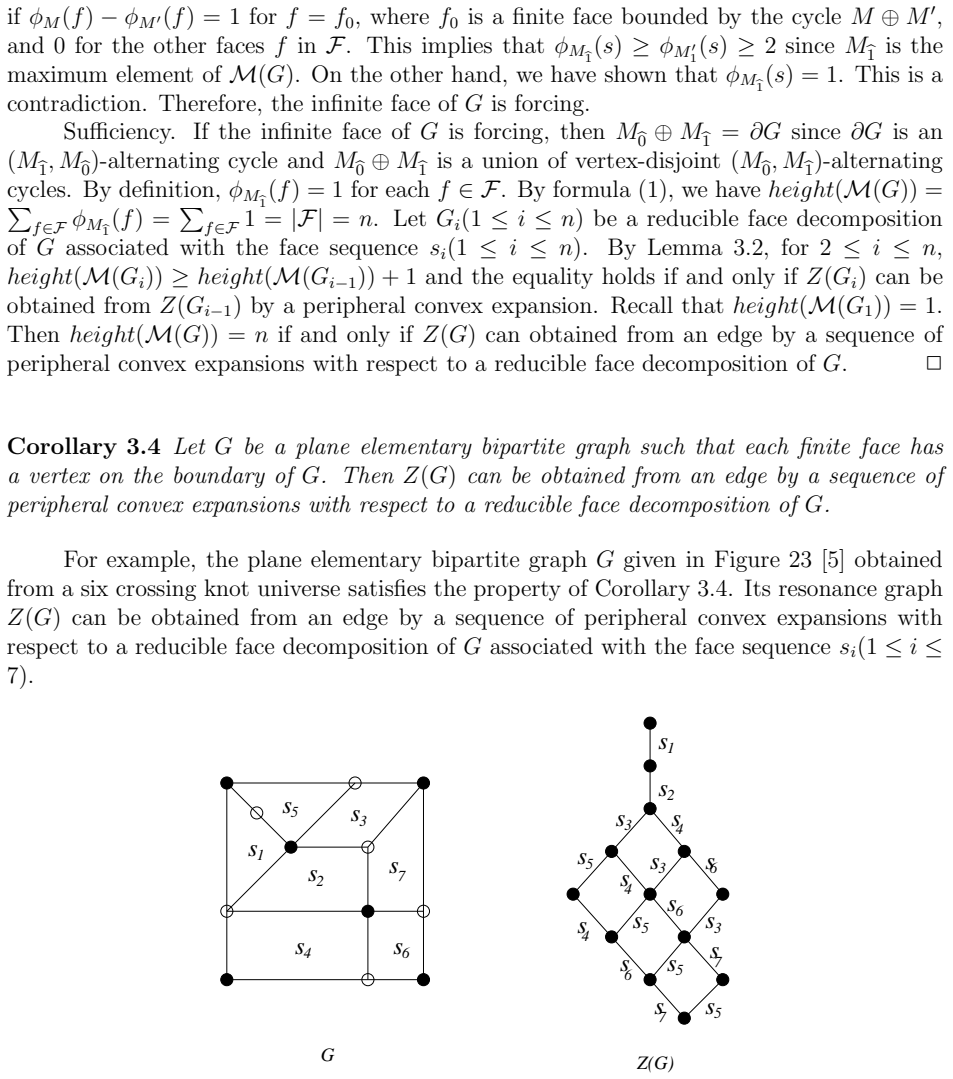
Reference graph
Works this paper leans on
- [13]
-
[3]
Che, Characterizations of the resonance graph of an outer plane bipartite graph, Discrete Appl
Z. Che, Characterizations of the resonance graph of an outer plane bipartite graph, Discrete Appl. Math. 258 (2019), 264–268
work page 2019
-
[11]
Vesel, Characterization of resonance graphs of catacond ensed hexagonal graphs, MATCH Commun
A. Vesel, Characterization of resonance graphs of catacond ensed hexagonal graphs, MATCH Commun. Math. Comput. Chem. 53 (2005), 195–208
work page 2005
-
[1]
Birkhoff, Lattice Theory, 3rd ed., Amer
G. Birkhoff, Lattice Theory, 3rd ed., Amer. Math. Soc. Colloq. Publ., vol. 25, 1973
work page 1973
-
[2]
Che, Structural properties of resonance graphs of plane e lementary bipartite graphs, Discrete Appl
Z. Che, Structural properties of resonance graphs of plane e lementary bipartite graphs, Discrete Appl. Math. 247 (2018), 102–110
work page 2018
- [4]
-
[5]
M. Cohen and M. Teicher, Kauffman’s clock lattice as a graph of per fect matchings: a formula for its height, Electron. J. Combin. 21 (2014), Paper 4.31, pp. 39
work page 2014
-
[6]
J. C. Fournier, Combinatorics of perfect matchings in plane bipar tite graphs and appli- cation to tilings, Theoret. Comput. Sci. 303 (2003), 333–351
work page 2003
Show all 16 references
-
[7]
Hammack, W
R. Hammack, W. Imrich, S. Klavˇ zar, Handbook of product graphs. Second edition. Dis- crete Mathematics and its Applications (Boca Raton). CRC Press, B oca Raton, FL, 2011
2011
-
[8]
Lov´ asz and M
L. Lov´ asz and M. D. Plummer, Matching theory , North-Holland Publishing Co., Ams- terdam, 1986
1986
-
[9]
P. C. B. Lam and H. Zhang, A distributive lattice on the set of perf ect matchings of a plane bipartite graph, Order 20 (2003), 13–29
2003
-
[10]
Taranenko and A
A. Taranenko and A. Vesel, 1-Factors and characterization o f reducible faces of plane elementary bipartite graphs, Discuss. Math. Graph Theory 32 (2012), 289–297
2012
-
[12]
Zhang, Z-transformation graphs of perfect matchings of plane bipartite g raphs: a survey, MATCH Commun
H. Zhang, Z-transformation graphs of perfect matchings of plane bipartite g raphs: a survey, MATCH Commun. Math. Comput. Chem. 56 (2006), 457–476. 9
2006
-
[14]
Zhang and F
H. Zhang and F. Zhang, The rotation graphs of perfect match ings of plane bipartite graphs, Discrete Appl. Math. 73 (1997), 5–12
1997
-
[15]
Zhang and F
H. Zhang and F. Zhang, Plane elementary bipartite graphs, Discrete Appl. Math. 105 (2000), 291–311
2000
-
[16]
Zhang, F
H. Zhang, F. Zhang, H. Yao, Z-transformation graphs of perfect matchings of plane bipartite graphs, Discrete Math. 276 (2004), 393–404. 10
2004
Reviewed August 14, 2026 · model on record in the stance chip above.
Discussion (0). Continue with ORCID to comment.