REVIEW 3 major objections 5 minor 45 references
Equilibria of an aggregation model with linear diffusion in domains with boundaries
T0 review · 3 major / 5 minor · reviewed 2026-08-14 · deepseek-v4-flash
Pith's one-line read This paper claims that in domains with boundaries, the existence of swarm equilibria is controlled by an effective volume dimension and by whether the domain is symmetric enough to prevent mass from escaping to infinity.
desk verdict The effective-volume-dimension idea is good and the escaping-mass phenomenon is real, but Theorem 5.1 as stated is false for fD=0, and the sharp-threshold claim needs a corrected assumption. read the letter →
The pith
A machine-rendered reading of the paper's core claim, the machinery that carries it, and where it could break.
The reading
What carries the argument
The key object is the effective volume dimension f_D, defined through V_D(r)=sup_{x∈D}|D∩B_r(x)| and f_D=sup{s: V_D(r)≳r^s}; it measures the number of directions in which the domain extends to infinity and appears in place of d in the logarithmic threshold for K. The other load-bearing tool is the Euler-Lagrange equation K∗ρ+ν log ρ+V=λ together with the fixed-point map T(µ)=Z(µ)^{-1}exp(−(K∗µ+V)/ν), whose fixed points are exactly the critical points with full support. From the Euler-Lagrange equation, the paper derives the boundary condition (5.5) by taking gradients, using that ∇K's antisymmetry cancels the interaction term, and applying the divergence theorem; this condition is what exposes the escaping-mass phenomenon.
What would settle it
Take the half-line D=[0,∞), K(x)=$x^{2}$/2, V=0, and compute the energy E_ν on the family ρ_c of truncated Gaussians (as in the proof of Theorem 5.2). The proof claims c↦E_ν[ρ_c] is strictly decreasing with no critical point; numerically finding a stationary c would refute the non-existence claim in that example.
Extended reading notes
Core claim
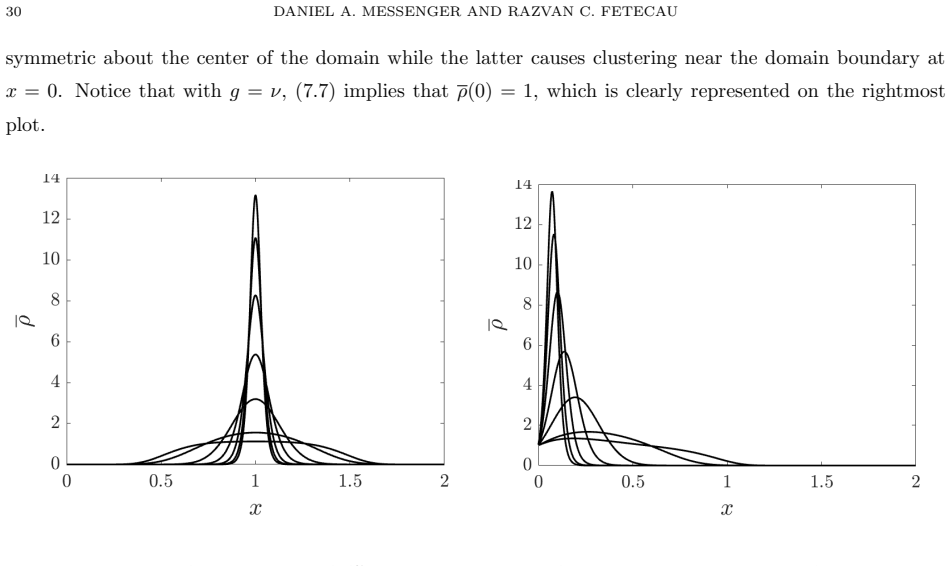
The central claim is that in domains with boundaries, the condition for existence of global minimizers of the energy E_ν = 1/2∫∫K(x−y)dµdµ + ν∫ρ log ρ + ∫V dµ no longer reduces to boundedness from below, as it does in free space. Instead, two geometry-dependent obstructions appear. First, diffusion-dominated spreading is controlled by the effective volume dimension f_D: if K(x) grows no faster than 2(1−δ)f_Dν log|x| at infinity, the energy is unbounded below, while for domains D=F×$R^{{d−m}}$, growth above 2(1+δ)f_Dν log|x| forces existence. Second, asymmetric unbounded domains exhibit an escaping-mass phenomenon: the necessary condition ν∫_{∂D}nρ dS = −∫_D ρ∇V dx, obtained by differentiating the Euler-Lagrange equation and using antisymmetry of ∇K, cannot be satisfied for V=0 because the density is strictly positive on the boundary, so critical points—and hence minimizers—do not exist. Thus external forces are necessary to confine the swarm in general domains, in contrast to free space.
Load-bearing premise
The proof of the necessary boundary condition assumes the classical trace theorem applies to the possibly unbounded domain, so if the boundary is too irregular for that theorem, the conclusion that external forces are required to confine a swarm is not established.
Editorial extensions
If this is right
- If the sharp threshold holds, then in a cylinder-like domain D=F×R^{d−m}, attraction growing exactly as 2f_Dν log|x| is the borderline: slightly weaker attraction blows the energy to −∞, slightly stronger yields a global minimizer.
- For any unbounded domain without translation symmetry (half-space, wedge, paraboloid), zero external force means no global minimizer exists, no matter how strong the short-range attraction is—only an external potential can confine the swarm.
- The boundary condition (5.5) gives a precise stationary-state test: an equilibrium requires the boundary flux ν∫∂D nρ dS to exactly cancel the force ∫_D ρ∇V dx; in simulations, this can be checked pointwise.
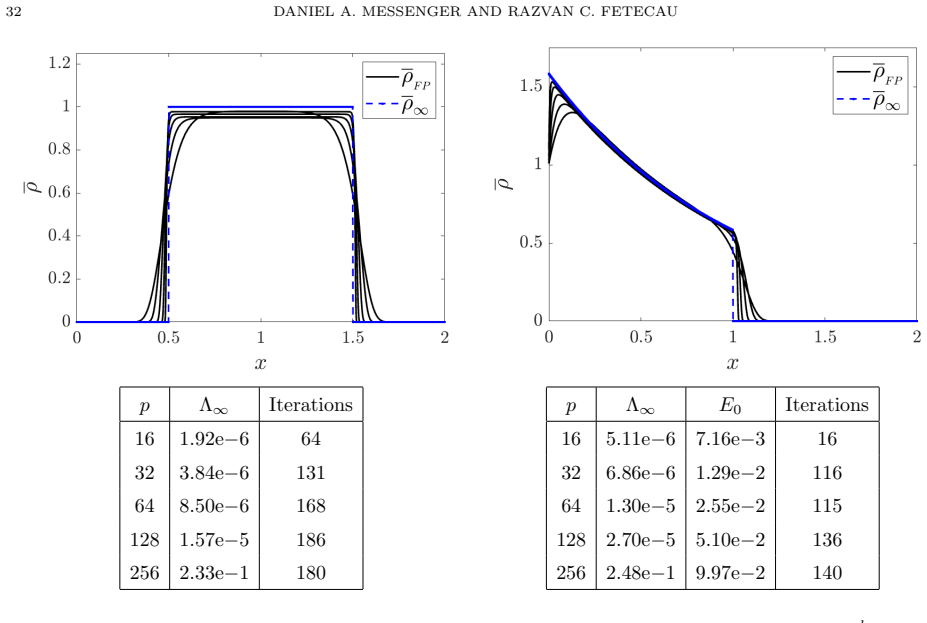
- Since every minimizer must have full support D (Theorem 3.1), linear diffusion prevents compactly supported equilibria even when attraction is very strong; compact support emerges only in the p→∞ singular limit.
- Adding a coercive confining potential V (growing to +∞ at infinity), or a periodic/translation-invariant domain structure, restores existence for general domains (Theorems 6.3 and 6.4).
Reading between the lines
- The effective volume dimension may be computable for more general domains than F×R^{d−m} (e.g., parabolic or spiral regions), giving a concrete way to predict when a swarm in an obstacle field must be confined externally; measuring V_D(r) numerically would provide a test.
- The escaping-mass mechanism suggests a design principle for experimental or engineered swarm confinement: a domain whose boundary has zero average outward normal along the region where the swarm sits (e.g., a periodic channel) can equilibrate without external forcing, while any symmetry-breaking defect will pump the swarm toward the boundary.
- One could test whether the necessary boundary condition (5.5) survives the addition of nonlinear diffusion; if it does, the conclusion that boundaries alone cannot confine a swarm may extend to degenerate-diffusion models, where compactly supported equilibria are otherwise expected.
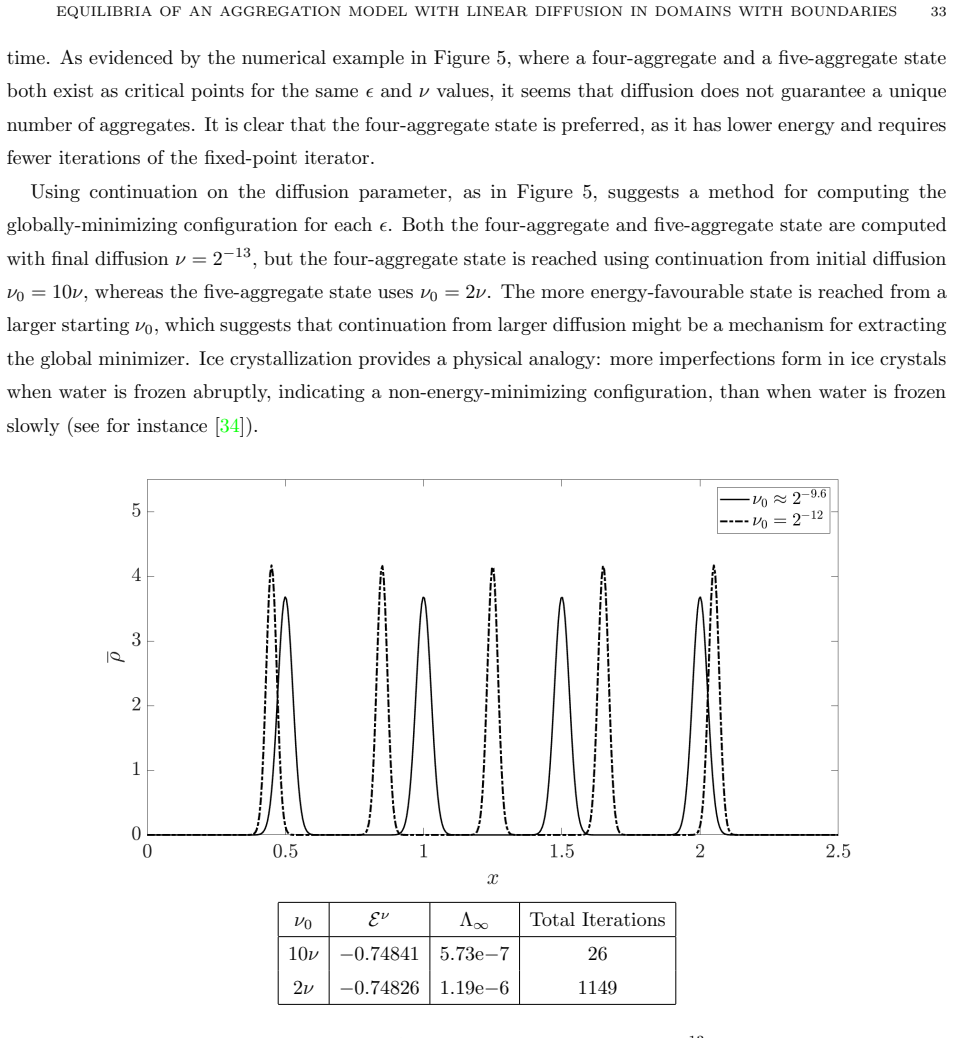
- The numerical continuation-from-large-ν heuristic, which found the lower-energy four-aggregate state, suggests a general annealing procedure for non-convex interaction energies on bounded domains; whether it always lands on a global minimizer is not proved here and is a natural next question.
Signed reviews
Editorial analysis
A structured set of objections, weighed in public.
Referee Report
Summary. The paper studies the energy functional (1.1) for an aggregation model with linear diffusion in domains with boundaries, and asks when global minimizers exist. The main theoretical contributions are (i) a non-existence theorem, Theorem 5.1, relating diffusion-dominated spreading to an 'effective volume dimension' f_D of the domain; (ii) a new 'escaping mass' phenomenon illustrated by the half-line example in Theorem 5.2 and encoded in the boundary necessary condition (5.5) of Theorem 5.3; and (iii) existence results, Theorems 6.1, 6.3, and 6.4, under growth conditions on K and confining conditions on V. The paper also proposes a fixed-point iteration for computing critical points and reports several numerical experiments, including examples with multiple critical points. The authors claim that the domain geometry, through f_D, determines the sharp threshold for existence versus non-existence, and that external potentials are necessary to confine swarms in general domains.
Significance. If the main results were valid as stated, the paper would extend the free-space sharp conditions of Carrillo, Delgadino, and Patacchini [13] to bounded and unbounded domains with boundaries, and would identify a genuinely new domain-dependent mechanism for non-existence. The paper is careful in several places: it gives a self-contained proof that minimizers have full support, it provides explicit benchmark computations for the half-line, and the numerical method is described in reproducible detail. However, the central sharp-threshold claim is not valid as stated for f_D=0, and the boundary-trace argument in Theorem 5.3 requires stronger domain regularity than Assumption 2 provides. These are load-bearing issues, so the current version cannot be accepted without substantial revision.
major comments (3)
- [Section 5.1, Theorem 5.1] The statement of Theorem 5.1 is false when f_D=0, because condition (5.1) then reduces to a mere upper bound on K and the proof's estimate |D_n| >= C n^{f_D} degenerates to a constant lower bound; the logarithmic divergence -delta0 f_D nu log(n) disappears. A concrete counterexample is D = {(x,y) : x>=0, 0<=y<=e^{-x}} subset R^2, with K=0 and V=0. This domain is closed, connected, has |D|=1, and satisfies Assumption 2; moreover f_D=0 since VD(r) <= 1 for all r. Condition (5.1) holds with C0=0 because 0 <= 0 for all |x|. Yet by Jensen's inequality, E_nu[rho] = nu integral rho log rho >= -nu log|D| = 0 for every probability density rho on D, and the uniform density rho=1_D attains equality, so a global minimizer exists. Thus the claimed sharp dependence on f_D is incomplete: f_D=0 does not distinguish finite-volume unbounded domains, where spreading cannot drive the energy to -infinity, from domains with slower-than-polynomial volume growth where it can. The theorem and the associated discussion in the abstract should either assume f_D>0 or replace f_D by a more refined volume-growth exponent.
- [Section 5.2, Theorem 5.3] The proof of Theorem 5.3 applies the divergence theorem and classical trace theorems [21, Ch. 5] to the possibly unbounded domain D under Assumption 2(ii), which only requires the outward normal to exist almost everywhere on the boundary. Classical trace theorems require Lipschitz or more regular boundaries, and for unbounded domains one also needs uniform control of the exhaustion sets A_n used in the proof. In addition, the validity of the step 'integral over D of grad rho = boundary integral' requires grad rho in L^1(D), which is not established from the Euler-Lagrange equation under the stated assumptions. Consequently the necessary condition (5.5), and with it the claim in Remark 5.2 that external forces are necessary to confine the swarm in general domains, is not proved for the full class of domains admitted by Assumption 2. The authors should either strengthen Assumption 2 (for instance, assume D is Lipschitz and impose the integrability needed for the trace theorem) or give a proof that the trace of rho exists and is integrable on the boundary under their weaker assumptions.
- [Section 3, Corollary 3.1] Corollary 3.1 states an 'if and only if' relationship between the Euler-Lagrange equation (3.3) and fixed points of the map T in (3.8) without proof and without specifying conditions under which Z(mu) is finite and the convolution K*mu is sufficiently regular to justify the exponential representation. This result is used in Theorem 5.2 and Theorem 6.2, so it is not purely cosmetic. A short argument or a precise citation should be supplied, including integrability assumptions on K*mu and V.
minor comments (5)
- [Section 2, Eq. (2.12)] The definition of f_D as a supremum does not automatically imply the stated consequence (2.13) at s=f_D; for example, a supremum of an open set of exponents need not be attained. Please either define f_D as the largest exponent for which (2.13) holds, or add an assumption that the supremum is attained, or alter (2.13) to hold for every s<f_D.
- [Abstract and Assumption 2] The abstract states that D has 'smooth boundary', while Assumption 2 only assumes a unique outward normal almost everywhere; Theorem 5.3 then relies on stronger regularity. Please make the domain hypotheses consistent throughout.
- [Proof of Theorem 3.1] The proof asserts that if supp(rho) is a proper closed subset of D, then D\supp(rho) has positive Lebesgue measure; this requires D to have nonempty interior. Assumption 2 allows closed Borel sets with |D|>0 that might have empty interior, so either the domain should be assumed open with nonempty interior (or otherwise regular) or the statement should be adjusted.
- [Section 5.3, Examples] The wedge and paraboloid examples are only sketched; the sign computations of the boundary integrals should be written out explicitly, since the claim that N_d 'cannot be zero' is central to the illustration of Remark 5.2.
- [Section 7, Eq. (7.5)] The L1-Lipschitz bound (7.5) is cited to the first author's master's thesis; if this bound is used to justify the choice tau_c=O(nu), it would help to state the exact hypotheses under which it holds or to label the choice as heuristic.
Circularity Check
No significant circularity: the sharp threshold and non-existence results are derived in-paper from definitions and external benchmarks, not from fitted inputs or self-citations.
full rationale
The paper's central claims about diffusion-dominated spreading and the sharp condition for existence are proved directly from the definitions and lemmas stated in the paper, not imported from the authors' own prior work. The effective volume dimension fD is defined in (2.12), and Theorem 5.1 constructs an explicit minimizing sequence whose entropy diverges logarithmically using only that definition; Theorem 6.1 proves boundedness below and existence via the log-HLS inequality and convexity estimates. The external results used as anchors (free-space existence conditions from Carrillo et al. [13], Prokhorov's theorem, and the logarithmic Hardy-Littlewood-Sobolev inequality) are authored by others and established independently of this paper's fitted values; no constants are fitted to data. The necessary boundary condition (5.5) is derived from the Euler-Lagrange equation (3.3) and the divergence theorem, not from a self-citation. The self-citations that appear ([26], [25], [37]) are contextual: [26] is cited to note a previously identified degeneracy of the zero-diffusion model, [25] to note numerical flexibility, and [37] only to supply a Lipschitz bound used for choosing a numerical relaxation parameter. The skeptical concern about fD = 0 and boundary regularity in Theorem 5.3 is a correctness or assumption-scope issue, not a circularity issue, because the proof does not assume the conclusion it derives. Therefore no step in the derivation reduces to its own inputs by construction.
Assumptions & free parameters
assumptions (6)
- standard math The energy E_nu is weakly-* lower semicontinuous (Lemma 4.1), and Prokhorov's theorem characterizes tightness of measure sequences.
- standard math The logarithmic Hardy-Littlewood-Sobolev inequality (Lemma 4.2) holds for marginals of probability measures on R^(d-m).
- domain assumption Potentials K and V satisfy Assumption 1: local integrability, lower semicontinuity, and symmetry of K.
- domain assumption The domain D is closed, connected, |D|>0, and has a unique outward normal a.e. (Assumption 2).
- ad hoc to paper The divergence theorem and classical trace theorems apply to D, implicitly requiring Lipschitz-type boundary regularity.
- ad hoc to paper The effective volume dimension f_D, defined as the largest exponent with V_D(r) >= C r^s, is finite and lies in [0,d].
invented entities (1)
-
Effective volume dimension f_D
Cite this review
Pith. "Pith review of Equilibria of an aggregation model with linear diffusion in domains with boundaries." pith.science (2026). https://pith.science/paper/NVEGHLXV
@misc{pith2026190809373,
  author       = {Pith},
  title        = {Pith review of: Equilibria of an aggregation model with linear diffusion in domains with boundaries},
  year         = {2026},
  howpublished = {\url{https://pith.science/paper/NVEGHLXV}},
  note         = {Machine review of arXiv:1908.09373}
}
read the original abstract
We investigate the effect of linear diffusion and interactions with the domain boundary on swarm equilibria by analyzing critical points of the associated energy functional. Through this process we uncover two properties of energy minimization that depend explicitly on the spatial domain: (i) unboundedness from below of the energy due to an imbalance between diffusive and aggregative forces depends explicitly on a certain volume filling property of the domain, and (ii) metastable mass translation occurs in domains without sufficient symmetry. From the first property, we present a sharp condition for existence (resp. non-existence) of global minimizers in a large class of domains, analogous to results in free space, and from the second property, we identify that external forces are necessary to confine the swarm and grant existence of global minimizers in general domains. We also introduce a numerical method for computing critical points of the energy and give examples to motivate further research.
Figures


Figures from the paper (2 more)
Reference graph
Works this paper leans on
-
[13]
J. A. Carrillo, M.G. Delgadino, and F. S. Patacchini. Existence of ground states for aggregation-diffusion equations.Analysis and Applications, 17(3):393–423, 2019
work page 2019
-
[1]
L. Ambrosio, N. Gigli, and G. Savar´ e. Gradient Flows: in Metric Spaces and in the Space of Probability Measures. Birkh¨ auser, Basel, 2008
work page 2008
-
[2]
D. Balagu´ e, J. A. Carrillo, T. Laurent, and G. Raoul. Dimensionality of local minimizers of the interaction energy. Archive for Rational Mechanics and Analysis, 209(3):1055–1088, 2013
work page 2013
-
[3]
D. Balagu´ e, J. A. Carrillo, T. Laurent, and G. Raoul. Nonlocal interactions by repulsive-attractive potentials: radial ins/stability. Phys. D, 260:5–25, 2013
work page 2013
- [4]
-
[5]
S. Benachour, B. Roynette, D. Talay, and P. Vallois. Nonlinear self-stabilizing processes–I existence, invariant probability, propagation of chaos. Stochastic Processes and their Applications, 75(2):173–201, 1998
work page 1998
-
[6]
A. J. Bernoff and C. M. Topaz. A primer of swarm equilibria. SIAM Journal on Applied Dynamical Systems, 10(1):212–250, 2011
work page 2011
-
[7]
Blow-up in multidimensional aggregation equations with mildly singular interaction kernels
Andrea L Bertozzi, Jos´ e A Carrillo, and Thomas Laurent. Blow-up in multidimensional aggregation equations with mildly singular interaction kernels. Nonlinearity, 22(3):683, 2009
work page 2009
Show all 45 references
-
[8]
Finite-time blow-up of solutions of an aggregation equation inRn
Andrea L Bertozzi and Thomas Laurent. Finite-time blow-up of solutions of an aggregation equation inRn. Communications in Mathematical Physics, 274(3):717–735, 2007
2007
-
[9]
Billingsley
P. Billingsley. Convergence of Probability Measures. John Wiley & Sons, Chicago, 2013
2013
-
[10]
Burger, R
M. Burger, R. C. Fetecau, and Y. Huang. Stationary states and asymptotic behavior of aggregation models with nonlinear local repulsion. SIAM J. Appl. Dyn. Syst., 13(1):397–424, 2014
2014
-
[11]
Stationary states of quadratic diffusion equations with long-range attraction
Martin Burger, Marco Di Francesco, and M Franek. Stationary states of quadratic diffusion equations with long-range attraction. Comm. Math. Sci., 11(3):709–738, 2013
2013
-
[12]
J. A. Ca˜ nizo, J. A. Carrillo, and F. S. Patacchini. Existence of compactly supported global minimisers for the interaction energy. Arch. Ration. Mech. Anal., 217(3):1197–1217, 2015
2015
-
[14]
J. A. Carrillo, M. DiFrancesco, A. Figalli, T. Laurent, and D. Slepˇ cev. Global-in-time weak measure solutions and finite-time aggregation for nonlocal interaction equations. Duke Mathematical Journal, 156(2):229–271, 2011
2011
-
[15]
J. A. Carrillo, S Hittmeir, B Volzone, and Y Yao. Nonlinear aggregation-diffusion equations: radial symmetry and long time asymptotics. Submitted, preprint arXiv:1603.07767 [[math.AP]], 2019
2019 arXiv
-
[16]
J. A. Carrillo, D. Slepˇ cev, and L. Wu. Nonlocal-interaction equations on uniformly prox-regular sets. Discrete and Continuous Dynamical Systems Series A, 36(3):1209–1247, 2014
2014
-
[17]
Kinetic equilibration rates for granular media and related equations: entropy dissipation and mass transportation estimates
Jos´ e A Carrillo, Robert J McCann, and C´ edric Villani. Kinetic equilibration rates for granular media and related equations: entropy dissipation and mass transportation estimates. Revista Matematica Iberoamericana, 19(3):971–1018, 2003
2003
-
[18]
Carrillo, Robert J
Jos´ e A. Carrillo, Robert J. McCann, and C´ edric Villani. Contractions in the 2-Wasserstein length space and thermalization of granular media. Arch. Ration. Mech. Anal., 179(2):217–263, 2006
2006
-
[19]
On global minimizers of repulsive-attractive power-law inter- action energies
Jos´ e Antonio Carrillo, Michel Chipot, and Yanghong Huang. On global minimizers of repulsive-attractive power-law inter- action energies. Philos. Trans. R. Soc. Lond. Ser. A Math. Phys. Eng. Sci., 372(2028):20130399, 13, 2014. EQUILIBRIA OF AN AGGREGATION MODEL WITH LINEAR DI...
2014
-
[20]
Choksi, R
R. Choksi, R. C. Fetecau, and I. Topaloglu. On minimizers of interaction functionals with competing attractive and repulsive potentials. Ann. Inst. H. Poincar´ eAnal. Non Lin´ eaire, 32(6):1283–1305, 2015
2015
-
[21]
L.C. Evans. Partial Differential Equations. American Mathematical Society, Providence, R.I., 2010
2010
-
[22]
Evers and T
J. Evers and T. Kolokolnikov. Metastable states for an aggregation model with noise. SIAM Journal on Applied Dynamical Systems, 15(4):2213–2226, 2016
2016
-
[23]
Fellner and G
K. Fellner and G. Raoul. Stable stationary states of non-local interaction equations. Mathematical Models and Methods in Applied Sciences, 20(12):2267–2291, 2010
2010
-
[24]
Stable stationary states of non-local interaction equations
Klemens Fellner and Gael Raoul. Stable stationary states of non-local interaction equations. Math. Models Methods Appl. Sci., 20(12):2267–2291, 2010
2010
-
[25]
R. C. Fetecau, H. Huang, D. A. Messenger, and W. Sun. Zero-diffusion limit for aggregation equations over bounded domains. Submitted, preprint arXiv:1809.01763 [math.AP], 2018
2018 arXiv
-
[26]
R. C. Fetecau and M. Kovacic. Swarm equilibria in domains with boundaries.SIAM Journal on Applied Dynamical Systems, 16(3):1260–1308, 2017
2017
-
[27]
R. C. Fetecau, M. Kovacic, and I. Topaloglu. Swarming in domains with boundaries: approximation and regularization by nonlinear diffusion. Discrete and Continuous Dynamical Systems Series B, 24(4):1815–1842, 2019
2019
-
[28]
Fetecau and Yanghong Huang
Razvan C. Fetecau and Yanghong Huang. Equilibria of biological aggregations with nonlocal repulsive-attractive interac- tions. Phys. D, 260:49–64, 2013
2013
-
[29]
Fetecau, Yanghong Huang, and Theodore Kolokolnikov
Razvan C. Fetecau, Yanghong Huang, and Theodore Kolokolnikov. Swarm dynamics and equilibria for a nonlocal aggrega- tion model. Nonlinearity, 24(10):2681–2716, 2011
2011
-
[30]
Holm and Vakhtang Putkaradze
Darryl D. Holm and Vakhtang Putkaradze. Formation of clumps and patches in self-aggregation of finite-size particles. Physica D., 220(2):183–196, 2006
2006
-
[31]
Bertozzi
Yanghong Huang and Andrea L. Bertozzi. Self-similar blowup solutions to an aggregation equation in Rn. SIAM J. Appl. Math., 70(7):2582–2603, 2010
2010
-
[32]
B. D. Hughes and K. Fellner. Continuum models of cohesive stochastic swarms: the effect of motility on aggregation patterns. Phys. D, 260:26–48, 2013
2013
-
[33]
Bertozzi
Theodore Kolokolnikov, Hui Sun, David Uminsky, and Andrea L. Bertozzi. A theory of complex patterns arising from 2D particle interactions. Phys. Rev. E, Rapid Communications, 84:015203(R), 2011
2011
-
[34]
Effects of relationships among freezing rate, ice crystal size and color on surface color of frozen salmon fillet
Shinji Kono, Madoka Kon, Tetsuya Araki, and Yasuyuki Sagara. Effects of relationships among freezing rate, ice crystal size and color on surface color of frozen salmon fillet. Journal of Food Engineering, 214:158–165, 2017
2017
-
[35]
Leverentz, Chad M
Andrew J. Leverentz, Chad M. Topaz, and Andrew J. Bernoff. Asymptotic dynamics of attractive-repulsive swarms. SIAM J. Appl. Dyn. Syst., 8(3):880–908, 2009
2009
-
[36]
A convexity principle for interacting gases
Robert J McCann. A convexity principle for interacting gases. Advances in Mathematics, 128(1):153–179, 1997
1997
-
[37]
D. A. Messenger. Aggregation-diffusion phenomena in domains with boundaries. Master’s thesis, Simon Fraser University, 2019
2019
-
[38]
Mogilner and L
A. Mogilner and L. Edelstein-Keshet. A non-local model for a swarm. J. Math. Biol., 38:534–570, 1999
1999
-
[39]
Mogilner, L
A. Mogilner, L. Edelstein-Keshet, L. Bent, and A. Spiros. Mutual interactions, potentials, and individual distance in a social aggregation. Journal of Mathematical Biology, 47(4):353–389, 2003
2003
-
[40]
Heterophilious dynamics enhances consensus
Sebastien Motsch and Eitan Tadmor. Heterophilious dynamics enhances consensus. SIAM Review, 56:577–621, 2014
2014
-
[41]
Simione, D
R. Simione, D. Slepˇ cev, and I. Topaloglu. Existence of ground states of nonlocal-interaction energies. J. Stat. Phys., 159(4):972–986, 2015
2015
-
[42]
Topaz, Maria R
Chad M. Topaz, Maria R. D’Orsogna, Leah Edelstein-Keshet, and Andrew J. Bernoff. Locust dynamics: behavioral phase change and swarming. PLoS Comput. Biol., 8(8):e1002642, 11, 2012
2012
-
[43]
C. Villani. Optimal Transport: Old and New. Springer Science & Business Media, Berlin, 2008
2008
-
[44]
Wu and D
L. Wu and D. Slepˇ cev. Nonlocal interaction equations in environments with heterogeneities and boundaries.Communications in Partial Differential Equations, 40(7):1241–1281, 2015. 36 DANIEL A. MESSENGER AND RAZVAN C. FETECAU
2015
-
[45]
Y. Zhang. On continuity equations in space-time domains. Discrete and Continuous Dynamical Systems Series A, 38(10):4837–4873, 2018. Department of Mathematics, Simon Fraser University, 8888 University Dr., Burnaby, BC V5A 1S6, Canada. E-mail address : daniel.messenger@colorado...
2018
Reviewed August 14, 2026 · model on record in the stance chip above.
Discussion (0). Continue with ORCID to comment.