REVIEW 3 major objections 4 minor 38 references
Multidimensional Phase Recovery and Interpolative Decomposition Butterfly Factorization
T0 review · 3 major / 4 minor · reviewed 2026-08-14 · deepseek-v4-flash
Pith's one-line read When the matrix can be applied but not inspected, the phase function behind a 2D or 3D oscillatory transform can be recovered and factorized in O(N log N) work.
desk verdict The MIDBF half is a solid extension of existing butterfly machinery; the phase-recovery half is genuinely new but its main lemma is unproved and the O(N log N) claim needs a sampling condition that isn't there. read the letter →
The pith
A machine-rendered reading of the paper's core claim, the machinery that carries it, and where it could break.
The reading
What carries the argument
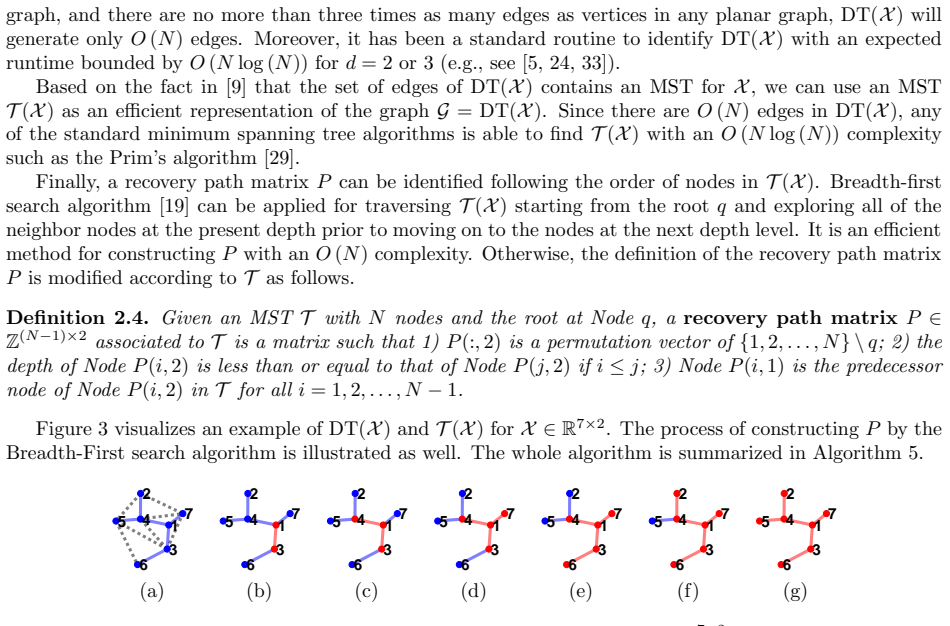
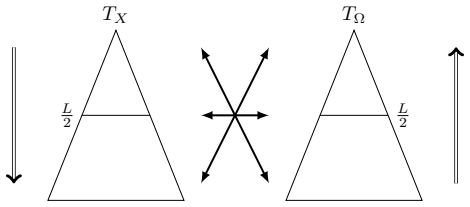
The machinery has two load-bearing pieces. The first is the recovery path matrix $P$, built by computing the Delaunay triangulation of the grid points, extracting a minimum spanning tree, and ordering its nodes breadth-first; $P$ tells the unwrapping algorithm which phase values are physically adjacent and should be unwrapped together, replacing the one-dimensional ordering that fails on nonuniform multidimensional grids. The second is the MIDBF, a recursive factorization $K\approx U_L U_{L-1}\cdots U_h S_h V_h\cdots V_L$ built from alternating leaf-root complementary skeletonization and matrix splitting with complementary skeletonization, which exploits the complementary low-rank property of oscillatory kernel blocks to keep every factor sparse.
What would settle it
Take a 2D nonuniform grid and a smooth phase function with a steep gradient such that two MST-adjacent points have true phase difference 0.6; run the recovery with $\tau=1/4$ and check whether the recovered row and column phases at their intersection agree: if the rounding picks a lift off by one, the intersection will fail and the kernel reconstruction error will jump to $O(1)$.
Extended reading notes
Core claim
The central claim is that indirect access to the phase function is enough to build a nearly linear fast matvec for oscillatory kernels in $d=2,3$. Because only $e^{2\pi i\Phi}$ is observable, the phase is known modulo $1$; the paper shows that unwrapping along an MST-based recovery path, with threshold $\tau=1/4$ separating genuine discontinuities from artificial ones, recovers smooth rows and columns of $\Phi$ up to a numerically low-rank error. These recovered low-rank factors provide an $O(1)$-cost entry oracle for the kernel, which the MIDBF turns into a product of sparse interpolative-decomposition factors. The paper claims end-to-end $O(N\log N)$ complexity for recovery, factorization, and application, and presents numerical experiments for a 2D generalized Radon transform, a 3D nonuniform Fourier transform, and the oscillatory Green's function of the Helmholtz equation.
Load-bearing premise
The recovery succeeds only when every pair of adjacent points on the minimum-spanning-tree path has true phase difference below the threshold $\tau=1/4$ (except at genuine discontinuities), because only then does the rounding step in the unwrapping choose the correct integer lift; the paper states no sampling condition guaranteeing this for nonuniform 2D and 3D grids, and the lemma asserting consistency of recovered row/column intersections is left unproved.
Editorial extensions
If this is right
- The framework removes the need for explicit phase formulas: any kernel matvec available in Scenario 2 becomes compressible in $O(N\log N)$ time.
- Phase recovery itself becomes a nearly linear precomputation, so the total cost of setting up and applying the butterfly factorization stays nearly linear rather than quadratic.
- The recovery-path construction and MIDBF extend naturally from uniform to nonuniform grids and from 2D to 3D, covering problems like nonuniform Fourier transforms and surface Green's functions.
- For PDE-driven phases (Scenario 3), the recovery step can be skipped, so the same factorization machinery applies directly to rows and columns obtained from PDE solves.
Reading between the lines
- Because the unwrapping only uses physical adjacency, the same MST path construction could serve other phase-unwrapping problems—interferometry, MRI, or wavefield reconstruction—on irregular sampling sets, a direction the paper does not explore.
- The correctness of the recovery depends on the threshold $\tau=1/4$ and on the MST path not crossing two discontinuities in one step; a testable extension would be an adaptive or higher-order finite-difference version that relaxes this requirement, which the paper flags as future work.
- A natural next step is to characterize phase families where the numerical rank of recovered phase matrices provably stays constant, since the $O(N\log N)$ complexity relies on that.
Signed reviews
Editorial analysis
A structured set of objections, weighed in public.
Referee Report
Summary. The paper proposes a two-stage framework for evaluating multidimensional oscillatory transforms g=Kf when only indirect access to the kernel K(x,ξ)=exp(2πiΦ(x,ξ)) is available. Stage one recovers a low-rank factorization of the phase matrix Φ from O(1) rows and columns obtained through black-box matvecs, using Delaunay triangulation and minimum spanning trees to build a recovery path and a first-order phase-unwrapping procedure. Stage two adapts the interpolative decomposition butterfly factorization (IDBF) to multidimensional and nonuniform settings, yielding an O(N log N) matvec once the phase is available. Numerical experiments for 2D Fourier integral operators, 3D nonuniform FFTs, and a Helmholtz Green's function example are reported, with complexity and accuracy tables.
Significance. If the claims hold, this is a substantial contribution: it would provide the first nearly linear framework for multidimensional oscillatory transforms with indirect kernel access and nonuniform grids, and the MIDBF generalization of IDBF is a natural and useful extension. The manuscript is also commendable for shipping reproducible code in ButterflyLab and for reporting wall-clock scaling against direct evaluation. The central weakness is that the phase-recovery step, which is the genuinely new component, rests on an unproved consistency lemma and an empirically chosen discontinuity threshold, with no stated sampling condition that would make the recovery provably correct.
major comments (3)
- [§2.3.2, Algorithm 4] The recovery of v(ed) = u(ed) - round(u(ed)-v(bg)) in Line 5 is correct only when the true unwrapped phase increment across the MST edge lies in (-1/2, 1/2]; otherwise the wrong integer lift is selected and the error propagates along the recovery path. The discontinuity test in Line 6 flags every edge with |v(ed)-v(bg)| >= τ, with τ = 1/4 in the reported experiments, so a perfectly smooth phase on a nonuniform grid can produce many false discontinuities whenever an MST edge connects points separated by a large gap. No sampling condition on the point sets or smoothness condition on Φ is stated that would ensure MST phase increments stay below 1/2, or below 1/4 for the consistency lemma. This missing hypothesis is load-bearing because false discontinuities can create many submatrices in Partition2 and invalidate the O(N log N) recovery complexity as well as the accuracy of the recovered phase.
- [§2.3.4, Lemma 2.5] Lemma 2.5 is the only stated guarantee that rows and columns recovered independently in Algorithm 6 agree at their intersections, and it is left unproved with the sentence 'we leave the proof to the reader.' The lemma assumes all rows and columns belong to C_{τ,P} with τ ≤ 1/4, but no argument is given that this class condition is satisfied by the actual rows and columns of a piecewise smooth phase matrix on a nonuniform grid, nor that the MST-based recovery path respects the class. Without this lemma, the input rows and columns fed to randomizedSVD in Algorithm 7 need not be consistent at shared entries, so the recovered Ψ need not equal Φ plus a numerically low-rank integer-valued perturbation, and the subsequent low-rank factorization feeding MIDBF has no rigorous accuracy guarantee.
- [§4.1, Tables 3-5 and parameter settings] The numerical validation does not exercise the failure mode identified above: all reported examples are well resolved, with nearest-neighbor phase increments far below the threshold τ = 1/4, and Table 3 only varies τ on the 3D nonuniform FFT, showing that smaller thresholds create many detected discontinuities at small n. No experiment with deliberately coarse or highly nonuniform grids, large phase gradients, or constructed counterexamples is reported, so the statement that 'τ = 1/4 is good enough for all numerical examples' cannot support the general O(N log N) recovery claim. The authors should either prove a sampling condition under which the algorithm succeeds, or demonstrate numerically that the failure mode is benign for the target class of problems.
minor comments (4)
- [Abstract] The phrase 'O(N log(N)) time and memories complexity' should read 'memory complexity'.
- [Table 3] The column header 'N Dr NDc' appears to be a typographical corruption of 'NDr' and 'NDc'; this makes the table harder to read.
- [§2.3.4] The sentence 'When τ increases to 1/2, no more discontinuous point will be detected' is imprecise: with the test |v(ed)-v(bg)| ≥ τ, increments strictly exceeding 1/2 would still be flagged, though the rounding step would already be unreliable in that regime.
- [§3.5, Eq. (22)] The formulas for the middle-factor entries S^L_{ij} use unwieldy index arithmetic; a short definition of the skeleton index blocks would improve readability.
Circularity Check
No circularity: the recovery and factorization pipelines are self-contained constructions; the unproved sampling threshold in Lemma 2.5 is a soundness gap, not an input relabeled as a prediction.
full rationale
The paper's phase-recovery step (Algorithms 4 and 6) takes K = e^{2πiΦ}, unwraps mod-1 observations along an MST-based recovery path, and forms Ψ; the property e^{2πiΨ} = e^{2πiΦ} on the sampled rows and columns holds by construction, but the subsequent low-rank factorization UV^T and the MIDBF are validated against independently sampled entries of the same kernel, which is standard reconstruction testing rather than a fitted parameter renamed as a prediction. The 1D recovery algorithm of [38] and the IDBF of [28] are prior-work citations by overlapping authors, but the multidimensional extensions (DT/MST recovery path construction, Algorithm 6, recursive MSCS, and the nonuniform/3D extensions in Section 3.6) are derived and specified in the paper itself, so the central claim of a first multidimensional indirect-access framework does not reduce to those citations. The main weakness of the paper is not circularity: Lemma 2.5, which would justify the τ = 1/4 row-column intersection consistency, is asserted with its proof omitted ('we leave the proof to the reader'), and no sampling or smoothness condition is stated to ensure that MST edge phase increments lie in (-1/2, 1/2] so that the rounding in Algorithm 4 selects the correct integer lift. These are correctness and rigor gaps, not self-referential derivations, so no specific circular step can be exhibited.
Assumptions & free parameters
free parameters (5)
- Discontinuity threshold tau =
1/4, with epsilon increment 1/40 if needed
- Phase matrix rank r =
5 to 50 depending on example
- MIDBF local rank k =
20 to 80 in experiments
- Leaf size n0 =
8d
- Oversampling parameters q and t =
q = 2, t = 5
assumptions (5)
- domain assumption After unwrapping, the phase matrix admits a global low-rank factorization with rank O(1).
- ad hoc to paper The phase variation along each MST edge is below tau = 1/4 except at detected discontinuities.
- standard math Delaunay triangulation contains a minimum spanning tree and can be built in O(N log N) for d = 2 or 3.
- domain assumption The kernel satisfies the complementary low-rank property.
- ad hoc to paper Lemma 2.5: intersections of recovered rows and columns are consistent.
Cite this review
Pith. "Pith review of Multidimensional Phase Recovery and Interpolative Decomposition Butterfly Factorization." pith.science (2026). https://pith.science/paper/KQ66FVHZ
@misc{pith2026190809376,
  author       = {Pith},
  title        = {Pith review of: Multidimensional Phase Recovery and Interpolative Decomposition Butterfly Factorization},
  year         = {2026},
  howpublished = {\url{https://pith.science/paper/KQ66FVHZ}},
  note         = {Machine review of arXiv:1908.09376}
}
abstract
This paper focuses on the fast evaluation of the matvec $g=Kf$ for $K\in \mathbb{C}^{N\times N}$, which is the discretization of a multidimensional oscillatory integral transform $g(x) = \int K(x,\xi) f(\xi)d\xi$ with a kernel function $K(x,\xi)=e^{2\pi\i \Phi(x,\xi)}$, where $\Phi(x,\xi)$ is a piecewise smooth phase function with $x$ and $\xi$ in $\mathbb{R}^d$ for $d=2$ or $3$. A new framework is introduced to compute $Kf$ with $O(N\log N)$ time and memory complexity in the case that only indirect access to the phase function $\Phi$ is available. This framework consists of two main steps: 1) an $O(N\log N)$ algorithm for recovering the multidimensional phase function $\Phi$ from indirect access is proposed; 2) a multidimensional interpolative decomposition butterfly factorization (MIDBF) is designed to evaluate the matvec $Kf$ with an $O(N\log N)$ complexity once $\Phi$ is available. Numerical results are provided to demonstrate the effectiveness of the proposed framework.
Figures

Figures from the paper (9 more)




Reference graph
Works this paper leans on
- [1]
-
[2]
J. P. Boyd and F. Xu. Divergence (Runge Phenomenon) for least-squares polynomial approximation on an equispaced grid and Mock Chebyshev subset interpolation. Applied Mathematics and Computation , 210(1):158 – 168, 2009
work page 2009
-
[3]
J. Bremer. An algorithm for the rapid numerical evaluation of Bessel functions of real orders and arguments. arXiv:1705.07820 [math.NA], 2017
work page Pith review arXiv 2017
-
[4]
J. Bremer. An algorithm for the numerical evaluation of the associated Legendre functions that runs in time independent of degree and order. Journal of Computational Physics , 360:15 – 38, 2018
work page 2018
-
[5]
K. Buchin and W. Mulzer. Delaunay Triangulations in O(sort(n)) Time and More. In 2009 50th Annual IEEE Symposium on Foundations of Computer Science , pages 139–148, Oct 2009
work page 2009
-
[6]
E. J. Cand` es, L. Demanet, and L. Ying. A Fast Butterfly Algorithm for the Computation of Fourier Integral Operators. Multiscale Modeling and Simulation , 7(4):1727–1750, 2009
work page 2009
-
[7]
M. Costantin, A. Farina, and F. Zirilli. A Fast Phase Unwrapping Algorithm for SAR Interferometry. IEEE TRANSACTIONS ON GEOSCIENCE AND REMOTE SENSING , 37(1), 1999
work page 1999
-
[8]
B. Davies. Green’s Functions, pages 163–179. Springer New York, New York, NY, 2002
work page 2002
Show all 38 references
-
[9]
de Berg, O
M. de Berg, O. Cheong, M. van Kreveld, and M. Overmars. Delaunay Triangulations, pages 191–218. Springer Berlin Heidelberg, Berlin, Heidelberg, 2008. 23
2008
-
[10]
Demanet and L
L. Demanet and L. Ying. Fast wave computation via Fourier integral operators. Math. Comput. , 81(279), 2012
2012
-
[11]
M. T. Dickerson and R. Drysdale. Fixed-radius near neighbors search algorithms for points and segments. Information Processing Letters, 35(5):269–273, 1990
1990
-
[12]
Engquist and L
B. Engquist and L. Ying. A fast directional algorithm for high frequency acoustic scattering in two dimensions. Communications in Mathematical Sciences , 7(2):327–345, 06 2009
2009
-
[13]
Greengard and J.-Y
L. Greengard and J.-Y. Lee. Accelerating the Nonuniform Fast Fourier Transform. SIAM Review , 46(3):443–454, 2004
2004
-
[14]
H. Guo, Y. Liu, J. Hu, and E. Michielssen. A Butterfly-Based Direct Integral-Equation Solver Using Hierarchical LU Factorization for Analyzing Scattering From Electrically Large Conducting Objects. IEEE Transactions on Antennas and Propagation , 65(9):4742–4750, Sept 2017
2017
-
[15]
Halko, P.-G
N. Halko, P.-G. Martinsson, and J. A. Tropp. Finding structure with randomness: Probabilistic algo- rithms for constructing approximate matrix decompositions. SIAM review, 53(2):217–288, 2011
2011
-
[16]
Hoffman and K
P. Hoffman and K. Reddy. Numerical Differentiation by High Order Interpolation. SIAM Journal on Scientific and Statistical Computing , 8(6):979–987, 1987
1987
-
[17]
Isozaki and J
H. Isozaki and J. L. Rousseau. Pseudodifferential Multi-Product Representation of the Solution Operator of a Parabolic Equation. Communications in Partial Differential Equations , 34(7):625–655, 2009
2009
-
[18]
Jianchun, G
L. Jianchun, G. A. Pope, and K. Sepehrnoori. A high-resolution finite-difference scheme for nonuniform grids. Applied Mathematical Modelling, 19(3):162 – 172, 1995
1995
-
[19]
C. Y. Lee. An Algorithm for Path Connections and Its Applications. IRE Transactions on Electronic Computers, EC-10(3):346–365, Sep. 1961
1961
-
[20]
Li and H
Y. Li and H. Yang. Interpolative Butterfly Factorization. SIAM Journal on Scientific Computing , 39(2):A503–A531, 2017
2017
-
[21]
Y. Li, H. Yang, E. R. Martin, K. L. Ho, and L. Ying. Butterfly Factorization. Multiscale Modeling & Simulation, 13(2):714–732, 2015
2015
-
[22]
Y. Li, H. Yang, and L. Ying. Multidimensional butterfly factorization. Applied and Computational Harmonic Analysis, 2017
2017
-
[23]
Y. Liu, H. Guo, and E. Michielssen. An HSS Matrix-Inspired Butterfly-Based Direct Solver for Analyzing Scattering From Two-Dimensional Objects. IEEE Antennas and Wireless Propagation Letters, 16:1179– 1183, 2017
2017
-
[24]
S. Lo. Parallel Delaunay triangulation in three dimensions. Computer Methods in Applied Mechanics and Engineering, 237-240:88 – 106, 2012
2012
-
[25]
Michielssen and A
E. Michielssen and A. Boag. A multilevel matrix decomposition algorithm for analyzing scattering from large structures. Antennas and Propagation, IEEE Transactions on , 44(8):1086–1093, Aug 1996
1996
-
[26]
G. Nico, G. Palubinskas, and M. Datcu. Bayesian Approaches to Phase Unwrapping: Theoretical Study. IEEE TRANSACTIONS ON SIGNAL PROCESSING , 48(9), 2000
2000
-
[27]
O’Neil, F
M. O’Neil, F. Woolfe, and V. Rokhlin. An algorithm for the rapid evaluation of special function transforms. Appl. Comput. Harmon. Anal. , 28(2):203–226, 2010
2010
-
[28]
Q. Pang, K. L. Ho, and H. Yang. Interpolative Decomposition Butterfly Factorization.arXiv:1809.10573 [math.NA], 2018
2018 arXiv
-
[29]
R. Prim. Shortest Connection Networks And Some Generalizations. Bell System Technical Journal , 36:1389–1401, 11 1957. 24
1957
-
[30]
J. L. Rousseau. Fourier-Integral-Operator Approximation of Solutions to First-Order Hyperbolic Pseu- dodifferential Equations I: Convergence in Sobolev Spaces. Communications in Partial Differential Equations, 31(6):867–906, 2006
2006
-
[31]
J. L. Rousseau and G. H¨ ormann. Fourier-integral-operator approximation of solutions to first-order hyperbolic pseudodifferential equations II: Microlocal analysis. Journal de Mathmatiques Pures et Ap- pliqu´ ees, 86(5):403 – 426, 2006
2006
-
[32]
Ruiz-Antoln and A
D. Ruiz-Antoln and A. Townsend. A Nonuniform Fast Fourier Transform Based on Low Rank Approx- imation. SIAM Journal on Scientific Computing , 40(1):A529–A547, 2018
2018
-
[33]
M. Smid. The Well-Separated Pair Decomposition and Its Applications. In Handbook of Approximation Algorithms and Metaheuristics , 2007
2007
-
[34]
Trouv´ e, J.-M
E. Trouv´ e, J.-M. Nicolas, and H. Maˆitre. Improving Phase Unwrapping Techniques by the Use of Local Frequency Estimates. IEEE TRANSACTIONS ON GEOSCIENCE AND REMOTE SENSING , 36(6), 1998
1998
-
[35]
P. Vaidya. An O(n logn) Algorithm for the All-Nearest-Neighbors Problem. Discrete and computational geometry, 4(2):101–116, 1989
1989
-
[36]
Van Loan
C. Van Loan. Computational Frameworks for the Fast Fourier Transform . Society for Industrial and Applied Mathematics, 1992
1992
-
[37]
O. V. Vasilyev. High Order Finite Difference Schemes on Non-uniform Meshes with Good Conservation Properties. Journal of Computational Physics , 157(2):746 – 761, 2000
2000
-
[38]
H. Yang. A unified framework for oscillatory integral transforms: When to use NUFFT or butterfly factorization? Journal of Computational Physics , 388:103–122, Jul 2019. 25
2019
Reviewed August 14, 2026 · model on record in the stance chip above.
Discussion (0). Continue with ORCID to comment.