REVIEW 3 major objections 6 minor 43 references
Error Analysis for Quadtree-Type Mesh-Coarsening Algorithms Adapted to Pixelized Heterogeneous Microstructures
T0 review · 3 major / 6 minor · reviewed 2026-08-14 · deepseek-v4-flash
Pith's one-line read Quadtree coarsening of pixelized microstructures cuts degrees of freedom by about 90 percent after two steps while raising discretization error by only about 15 percent.
desk verdict A solid, honest numerical study of quadtree coarsening for image-based FE homogenization; the central efficiency/error trade-off is plausible but rests on an estimator whose transfer beyond the calibration example is asserted, not demonstrated. read the letter →
The pith
A machine-rendered reading of the paper's core claim, the machinery that carries it, and where it could break.
The reading
What carries the argument
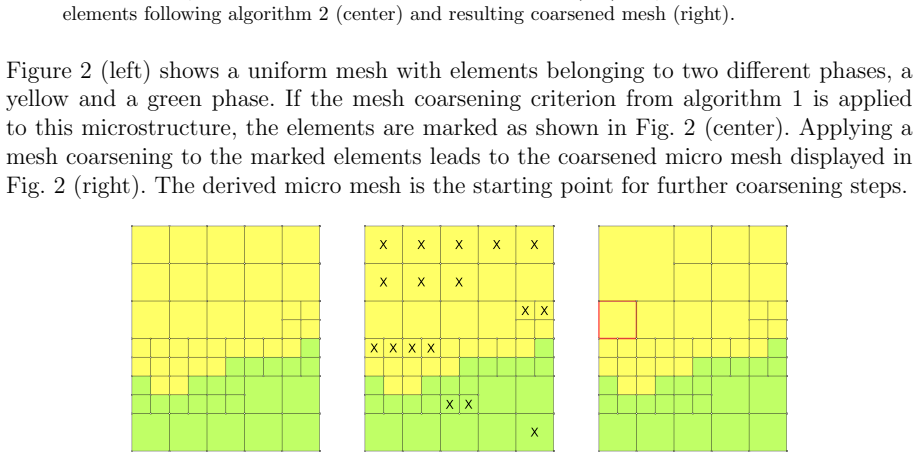
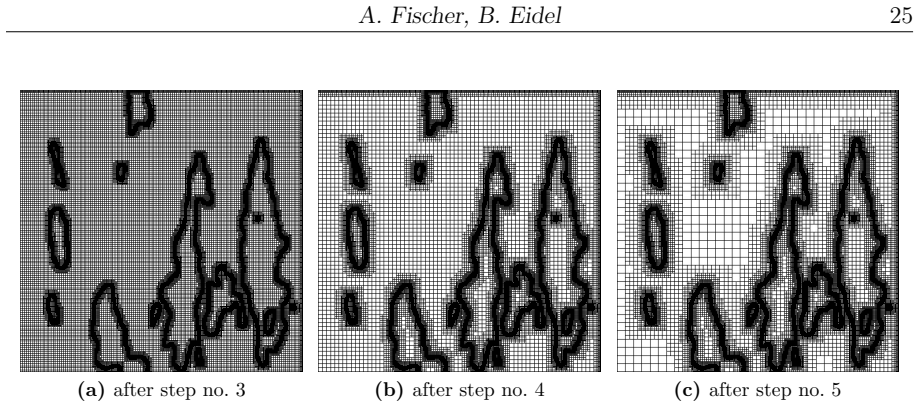
The central mechanism is quadtree coarsening: four square elements that share a node and lie inside one phase are merged into one element of side length 2h, and the nodes on the new element's edges become hanging nodes constrained to the midpoints of master-node edges, so they carry no degrees of freedom. Two marking rules decide what can be coarsened: hard coarsening forbids only phase-boundary elements, while soft coarsening also forbids elements touching constraint nodes or boundary-adjacent elements, giving gentler size gradients. The companion machinery is the modified superconvergent patch recovery, which reconstructs nodal stresses by least-squares fitting over patches lying entirely inside one material phase; nodes on interfaces are treated like boundary nodes by expanding the patch into the phase interior. A still cheaper variant averages elementwise nodal stresses obtained by inverting the shape-function interpolation at standard quadrature points, and the paper shows that this averaging estimator is almost as accurate as the modified patch recovery.
What would settle it
Recompute the reported error increases and effectivity indices with a reference mesh at least twice as fine as the eight-times rule, for example 2048 by 2048 or 4096 by 4096 on the cross example; if the true errors shift beyond the claimed fifteen percent or the effectivity indices move clearly outside 0.95 to 1.07, the central trade-off is miscalibrated.
Extended reading notes
Core claim
The paper establishes a quantitative accuracy-efficiency trade-off for quadtree coarsening of pixelized microstructures: after two coarsening steps the degrees of freedom fall by roughly 90 percent while the micro discretization error increases by only about 15 percent, and a few more steps buy little while degrading accuracy. To make that measurement without expensive reference solutions, it introduces two error estimators for multiphase meshes—a modified superconvergent patch recovery and a simpler elementwise-averaging scheme—both of which reproduce reference-computed energy-norm errors with effectivity indices close to one (0.95 to 1.07), whereas the standard recovery scheme overestimates the error by more than 50 percent on a uniform mesh. The paper also shows that the effective stiffness of the composite and the macroscopic displacements change by under one percent even when the micro mesh keeps less than ten percent of its original unknowns.
Load-bearing premise
The overkill reference solution taken as the true error must itself be converged, and the paper's rule that it be at least eight times finer per spatial dimension is a heuristic based on one convergence study, not a proven criterion.
Editorial extensions
If this is right
- Two coarsening steps are enough to capture most of the efficiency gain; with the meshes studied, later steps cut few additional unknowns while the error climbs faster.
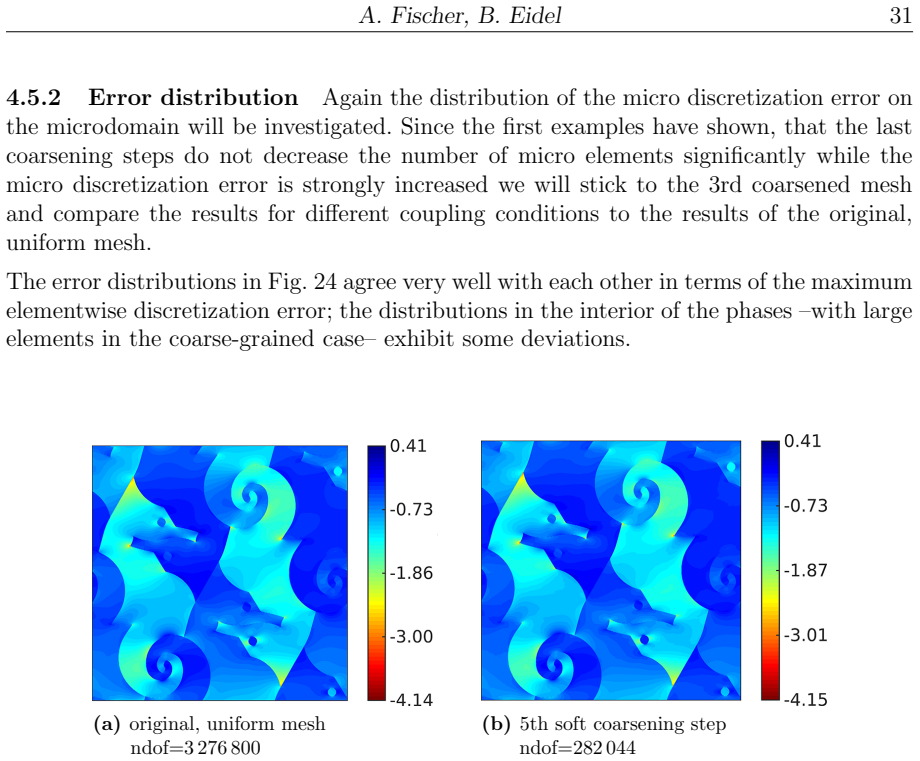
- Soft coarsening should be preferred over hard coarsening: with comparable degrees of freedom it reproduces the uniform mesh's error and strain distributions, whereas hard coarsening shows deviations from hanging-node constraints.
- Reference-solution error computation can be replaced by the modified SPR or the averaging estimator, both of which keep effectivity indices near one on multiphase meshes.
- Coarsened micro meshes with under ten percent of the original unknowns change macroscopic quantities by less than one percent, so the preprocessing step is nearly invisible at the macroscale.
- The more regular the phase geometry, the better the trade-off: a circular inclusion keeps accuracy with the mesh reduced to eight percent of its original degrees of freedom.
Reading between the lines
- A natural extension the paper leaves implicit is to use the averaging estimator as an in-loop error indicator that stops coarsening locally where elementwise error is high, rather than fixing the number of global coarsening steps.
- The eight-times-finer reference rule is a heuristic; at higher stiffness contrasts or with sharp corners the 'true error' itself may not be converged, so the 15 percent figure deserves a recheck before being used as a general budget.
- In three dimensions, octree coarsening of voxel data should amplify the efficiency gain because volume grows as the cube of element size, but the reference-mesh requirement becomes harder to satisfy and the same error analysis would need to be repeated.
- The reported elementwise error maps suggest a concrete testable criterion: threshold coarsening by relative elementwise error per phase interior, and the optimal stopping step should emerge from the error map itself rather than from the uniform step count.
Signed reviews
Editorial analysis
A structured set of objections, weighed in public.
Referee Report
Summary. The paper proposes two quadtree-based mesh-coarsening algorithms (a "hard" and a "soft" variant) for pixelized heterogeneous microstructures, applied as a preprocessing step for subsequent finite-element homogenization computations. It introduces a modified superconvergent patch recovery (SPR) scheme that respects phase boundaries with stiffness jumps, alongside a cheaper averaging-based estimator. The error estimators are validated against overkill reference solutions on a simple Cross benchmark (Tables 2-3), and then used to quantify the trade-off between degree-of-freedom reduction and discretization-error increase for several microstructures: a Heisenberg portrait, a circular inclusion, a Diamond/SiC composite, and a three-phase seahorse tessellation. The main reported conclusions are that (i) soft coarsening outperforms hard coarsening, (ii) two coarsening steps reduce the number of degrees of freedom by about 90% with an error increase of at most about 15%, and (iii) the homogenized macroscopic response is largely insensitive to the micro coarsening.
Significance. If the findings hold, the paper provides a quantitative and practical basis for choosing coarsening levels in image-based finite-element analysis, which is a common bottleneck in computational materials science. The proposed phase-aware SPR modification and the averaging estimator are simple, parameter-free, and achieve effectivity indices close to unity on the validation benchmark (Table 3: theta between 0.95 and 1.07). The systematic comparison of coarsening algorithms and the extensive numerical documentation (Tables 1-13 and figures) are strengths. However, the transferability of the estimator to the more complex microstructures is not established, which currently limits the generality of the central trade-off claim.
major comments (3)
- [4.1.4, Tables 3-5, 8, 13] The error estimators are validated only against true errors on the Cross benchmark (Table 3), after which Sec. 4.1.4 explicitly discontinues error computation and all subsequent error-increase factors (Tables 4, 5, 8, 13) are produced with the same estimators without further validation. The Cross microstructure has straight interfaces and, by the paper's own assessment in Sec. 4.1.3, its phase-boundary error is not dominant; it is therefore a weak basis for assuming that the effectivity indices remain near unity on the irregular pixelized interfaces, hanging-node neighborhoods, and different coupling conditions of Secs. 4.2-4.5. If the effectivity index drifts on those meshes, the reported error-increase factors and the "not more than about 15%" conclusion (Sec. 5(iv)) would be miscalibrated. Please validate the estimator against an overkill reference solution on at least one additional microstructure (e.g., the Diamond/SiC example), or provide a quantitative argument bounding the expected drift of theta.
- [3.2.3] The treatment of patches with fewer than four elements is underspecified. Sec. 3.2.3 states that for patches with one, two, or three superconvergent points "the number of terms in vector P in equation (5) may have to be reduced," but it does not state the exact rule (e.g., minimal-degree polynomial, constrained least squares, or use of neighboring patches). Since such degenerate patches arise precisely at hanging nodes and at scattered pixelized interfaces (Fig. 8), which are abundant in the coarsened meshes of the later examples, the implementation is not reproducible and the estimator's accuracy on these patches is unclear. Please provide the exact reduction rule and, ideally, a small numerical test for a degenerate-patch configuration.
- [4.1.2, Table 2] The criterion that the reference discretization be "at least eight times finer per dimension" is justified by a single convergence study (Table 2), in which the error changes between the 1024x1024 and 1536x1536 references are still about 1% for the uniform mesh. Because all effectivity indices are computed against this reference, any residual lack of convergence in the reference solution would directly bias the validation. Please quantify the sensitivity of theta to the reference resolution, for example by recomputing the effectivity indices of Table 3 with the two finest reference discretizations.
minor comments (6)
- [Abstract] The word "discretitization" should be "discretization".
- [2.2] In Algorithm 3, the terms "boundary element nodes" and "constraint element nodes" are not precisely defined; please add a short definition of these sets in the text or in the pseudocode.
- [4.5, Table 13 caption] The caption of Table 13 mentions "Dirichlet, Neumann, PBC" but only periodic boundary condition results are shown in the table; please correct the caption.
- [4.2.3, Figure 16 caption] The caption for Fig. 16(c) reports ndof=175 424, whereas Table 4 gives ndof=75 424 for the second hard-coarsening step; this appears to be a typo.
- [4.4.1] The sentence about the prime factorization of 1098 is cryptic; please clarify why this property of the initial discretization is relevant to the coarsening procedure.
- [3.2.4, Eq. (12)] In Eq. (12), the inverse of the shape-function matrix N_i(x_qn) is taken; please explicitly state that this inverse is well-defined for the 4-node quadrilateral with the standard 2x2 Gauss-point arrangement.
Circularity Check
No circularity: the paper validates error estimators against an independent overkill solution and applies parameter-free coarsening algorithms; later use of the estimators is inductive validation, not construction.
full rationale
The paper's central quantitative claims are not equivalent to their inputs by construction. The coarsening algorithms (Algorithms 1-3) mark elements using only phase-boundary and hanging-node information; they contain no fitted parameters and no reference to the error quantities later reported. The modified SPR and averaging estimators are defined from FE stresses/strains alone and are then assessed against a true error based on an overkill reference solution (Sec. 4.1, Tables 2-3), which is an independent benchmark rather than a calibration target. The effectivity index near one on the Cross example is used to justify discarding further true-error computations (Sec. 4.1.4), so the error-increase factors in Tables 4, 5, 8, 13 are estimates whose accuracy is assumed to transfer, not values forced by the validation data. That transferability concern is a soundness or external-validity issue, not a circularity issue: the later error estimates are still computed from the actual FE solutions on each coarsened mesh, not read off from the Cross benchmark. Self-citations to the authors' FE-HMM work are contextual background for the homogenization framework and material parameters, and no load-bearing uniqueness or ansatz claim is imported solely through those citations. The paper is therefore self-contained for the purpose of circularity analysis, and no specific reduction of a prediction to an input can be exhibited.
Assumptions & free parameters
free parameters (1)
- reference refinement factor =
8x per spatial dimension (at least)
assumptions (4)
- domain assumption The overkill reference solution is sufficiently converged to represent the exact solution for error computation.
- standard math Superconvergence of stress and strain at element centers (Barlow points) for rectangular bilinear elements.
- domain assumption Hanging node constraints (Eq. 1) enforce C0 continuity exactly and contribute negligible error.
- domain assumption The fixed macro displacement field from the original mesh provides a representative loading for comparing micro meshes.
Cite this review
Pith. "Pith review of Error Analysis for Quadtree-Type Mesh-Coarsening Algorithms Adapted to Pixelized Heterogeneous Microstructures." pith.science (2026). https://pith.science/paper/CG7GXNKJ
@misc{pith2026190809380,
  author       = {Pith},
  title        = {Pith review of: Error Analysis for Quadtree-Type Mesh-Coarsening Algorithms Adapted to Pixelized Heterogeneous Microstructures},
  year         = {2026},
  howpublished = {\url{https://pith.science/paper/CG7GXNKJ}},
  note         = {Machine review of arXiv:1908.09380}
}
read the original abstract
Pixel- and voxel-based representations of microstructures obtained from tomographic imaging methods is an established standard in computational materials science. The corresponding highly resolved, uniform discretitization in numerical analysis is adequate to accurately describe the geometry of interfaces and defects in microstructures and, therefore, to capture the physical processes in these regions of interest. For the defect-free interior of phases and grains however, the high resolution is in view of only weakly varying field properties not necessary such that mesh-coarsening in these regions can improve efficiency without severe losses of accuracy in simulations. The present work proposes two different variants of adaptive, quadtree-based mesh-coarsening algorithms applied to pixelized images that serves the purpose of a preprocessor for consecutive finite element analyses, here, in the context of numerical homogenization. Error analysis is carried out on the microscale by error estimation which itself is assessed by true error computation. A modified stress recovery scheme for a superconvergent error estimator is proposed which overcomes the deficits of the standard recovery scheme for nodal stress computation in cases of interfaces with stiffness jump. By virtue of error analysis the improved efficiency by the reduction of unknowns is put into relation to the increase of the discretization error. This quantitative analysis sets a rational basis for decisions on favorable meshes having the best trade-off between accuracy and efficiency as will be underpinned by various examples.
Figures


Figures from the paper (23 more)




Reference graph
Works this paper leans on
-
[1]
Abdulle, Analysis of the heterogeneous multiscale FEM for problems in elasticity, Math
A. Abdulle, Analysis of the heterogeneous multiscale FEM for problems in elasticity, Math. Models Methods Appl. Sci. 16(4) (2006) 615--635
work page 2006
-
[2]
A. Abdulle, The finite element heterogeneous multiscale method: a computational strategy for multiscale PDEs, Math. Sci. Appl., Vol. 31 31 (2009) 133--181
work page 2009
-
[3]
A. Abdulle, W. E., B. Engquist, E. Vanden-Eijnden, The heterogeneous multiscale method, Acta Numer. 466 (2012) 1--87
work page 2012
-
[4]
M.V. d'Agostino, G. Barbagallo, I.-D. Ghiba, B. Eidel, P. Neff, A. Madeo, Effective description of anisotropic wave dispersion in mechanical band-gap metamaterials via the relaxed micromorphic model, submitted, arXiv preprint 1709.07054 (2018)
work page Pith review arXiv 2018
-
[5]
Allaire, Homogenization and two-scale convergence, SIAM J
G. Allaire, Homogenization and two-scale convergence, SIAM J. Math. Anal 23 (1992) 1482--1518
work page 1992
-
[6]
I. Babu s ka, W.C. Rheinboldt, A-posteriori error estimates for the finite element method, Int. J. Numer. Methods Eng. 12 (1978) 1597--1615
work page 1978
-
[7]
Barlow, Optimal stress locations in finite element models, Int
J. Barlow, Optimal stress locations in finite element models, Int. J. Numer. Methods Eng. 10 (1976) 243--251
work page 1976
-
[8]
D. Cioranescu, P. Donato, An Introduction to Homogenization, Oxford University Press, New York (1999)
work page 1999
Show all 43 references
-
[9]
W. E, B. Engquist, The heterogeneous multi-scale methods, Commun. Math. Sci. 1 (2003) 87--132
2003
-
[10]
W. E, B. Engquist, X. Li, W. Ren, E. Vanden-Eijnden, Heterogeneous multiscale methods: a review, Commun. Comput. Phys 2 (2007) 367--450
2007
-
[11]
Eidel, A
B. Eidel, A. Fischer, The heterogeneous multiscale finite element method FE-HMM for the homogenization of linear elastic solids, PAMM 16 (2016) 521--522
2016
-
[12]
Eidel, A
B. Eidel, A. Fischer, The heterogeneous multiscale finite element method FE-HMM for the homogenization of linear elastic solids and a comparison with the FE ^2 method, Comput. Methods Appl. Mech. Engrg. 329 (2018) 332--368
2018
-
[13]
Eidel, A
B. Eidel, A. Fischer, A. Gote, A nonlinear FE-HMM formulation along with a novel algorithmic structure for finite deformation elasticity, PAMM 18 (2018) 1--2
2018
-
[14]
Eidel, A
B. Eidel, A. Gote, M. Ruby, L. Holzer, L. Keller, X. Jiang, Estimating the effective elasticity properties of a diamond-SiC composite thin film by 3D reconstruction and numerical homogenization, Diam. Relat. Mater. 97 (2019) 107406
2019
-
[15]
Eidel, A
B. Eidel, A. Fischer, A. Gote, A nonlinear finite element heterogeneous multiscale method for the homogenization of hyperelastic solids and a novel staggered two-scale solution algorithm, submitted, arXiv preprint black 1908.08292 (2019)
2019 arXiv
-
[16]
Feyel, J.L
F. Feyel, J.L. Chaboche, FE2 multiscale approach for modelling the elastoviscoplastic behaviour of long fibre SiC/Ti composite materials, Comput. Methods Appl. Mech. Engrg. 183 (2000) 309--330
2000
-
[17]
Fischer, B
A. Fischer, B. Eidel, Convergence and error analysis of FE-HMM/FE2 for energetically consistent micro-coupling conditions in linear elastic solids, Eur. J. Mech. A Solid. 77 (2019) 103735
2019
-
[18]
Geers, V.G
M.G.D. Geers, V.G. Kouznetsova, W.A.M. Brekelmans, Computational homogenization, in: R. Pippan, P. Gumbsch (Eds.), Multiscale Modelling of Plasticity and Fracture by Means of Dislocation Mechanics, CISM International Centre for Mechanical Sciences, (2010) 327--394
2010
-
[19]
Hill, Elastic properties of reinforced solids: some theoretical principles, J
R. Hill, Elastic properties of reinforced solids: some theoretical principles, J. Mech. Phys. Solids 11 (1963) 357--372
1963
-
[20]
Hill, On constitutive macro-variables for heterogeneous solids at finite strain, Proc
R. Hill, On constitutive macro-variables for heterogeneous solids at finite strain, Proc. R. Soc. London, Ser. A 326 (1972) 131--147
1972
-
[21]
Holzer, M
L. Holzer, M. Cantoni, Review of FIB-tomography. In: Ivo Utke, Stanislav Moshkalev, and Phillip Russell (Eds.), Nanofabrication Using Focused Ion and Electron Beams: Principles and Applications Oxford University Press, New York (2012) 410--435
2012
-
[22]
Ketcham, W.D
R.A. Ketcham, W.D. Carlson, Acquisition, optimization and interpretation of X-ray computed tomographic imagery: applications to the geosciences, Comput. Geosci. 27 (2001) 381--400
2001
-
[23]
Kouznetsova, W.A.M
V. Kouznetsova, W.A.M. Brekelmans, F.P.T. Baaijens, An approach to micro-macro modeling of heterogeneous materials, Comput. Mech. 27 (2002) 37--48
2002
-
[24]
Kouznetsova, M.G.D
V. Kouznetsova, M.G.D. Geers, W.A.M. Brekelmans, Multi-scale constitutive modelling of heterogeneous materials with a gradient-enhanced computational homogenization scheme, Int. J. Numer. Meth. Eng. 54 (2002) 1235--1260
2002
-
[25]
Legrain, P
G. Legrain, P. Cartraud, I. Perreard, N. Mo\" e s, An X-FEM and level set computational approach for image-based modelling: application to homogenization, Int. J. Numer. Methods Eng. 86 (2011) 915--934
2011
-
[26]
W.D. Lian, G. Legrain, P. Cartraud, Image-based computational homogenization and localization: comparison between X-FEM/levelset and voxel-based approaches, Comput. Mech. 51 (2013) 279--293
2013
-
[27]
Michel, H
J.C. Michel, H. Moulinec, P. Suquet, Effective properties of composite materials with periodic microstructure: a computational approach, Comput. Methods Appl. Mech. Engrg. 172 (1999) 109--143
1999
-
[28]
Miehe, J
C. Miehe, J. Schr\" o der, J. Schotte, Computational homogenization analysis in finite plasticity simulation of texture development in polycrystalline materials, Comput. Methods Appl. Mech. Engrg. 171 (1999) 387--418
1999
-
[29]
Miehe, J
C. Miehe, J. Schotte, J. Schr\" o der, Computational homogenization analysis in finite plasticity simulation of texture development in polycrystalline materials, Comput. Mat. Sci. 16 (1-4) (1999) 372--382
1999
-
[30]
Miska, D
N. Miska, D. Balzani, Quantification of uncertain macroscopicmaterial properties resulting from variations of microstructure morphology based on statistically similar volume elements: application to dual-phase steel microstructures, Comput. Mech. (2019) https://doi.org/10.1007...
2019 doi
-
[31]
Nambiar, K
R.V. Nambiar, K. Lawrence, The Zienkiewciz-Zhu error estimator for multiple material problems, Commun. Appl. Numer. M. 8 (1992) 273--277
1992
-
[32]
Nguyen, A
T. Nguyen, A. Ghazlan, A. Kashani, S. Bordas, T. Ngo, 3D meso-scale modelling of foamed concrete based on X-ray computed tomography, Constr. Build. Mater. 188 (2018) 583--598
2018
-
[33]
Pennycook, P.D
S.J. Pennycook, P.D. Nellist (Eds.), Scanning Transmission Electron Microscopy, Imaging and Analysis, Springer, New York (2011)
2011
-
[34]
Peri\' c , E.A
D. Peri\' c , E.A. de Souza Neto, R.A.Feij\' o o, M. Partovi, A.J. Carneiro Molina, On micro-to-macro transitions for multi-scale analysis of non-linear heterogeneous materials: unified variational basis and finite element implementation. Int. J. Numer. Methods Eng. 87 (2010) 149--170
2010
-
[35]
S. Saeb, P. Steinmann, A. Javili, Aspects of computational homogenization at finite deformations: a unifying review from Reuss' to Voigt's bound, Appl. Mech. Rev. 68 (2016) 050801
2016
-
[36]
Saputra, H
A. Saputra, H. Talebi, D. Tran, C. Birk and C. Song, Automatic image-based stress analysis by the scaled boundary finite element method, Int. J. Numer. Methods Eng. 109 (2017) 697--738
2017
-
[37]
Saputra, V
A.A. Saputra, V. Sladek, J. Sladek, and C. Song, Micromechanics determination of effective material coefficients of cement-based piezoelectric ceramic composites, J. Intel. Mat. Syst. Str. 29(5) (2018) 845--862
2018
-
[38]
Saxena, R
N. Saxena, R. Hofmann, F.O. Alpak, J. Dietderich, S. Hunter, R.J. Day-Stirrat, Effect of image segmentation & voxel size on micro-CT computed effective transport & elastic properties, Mar. Petrol. Geol. 86 (2017) 972--990
2017
-
[39]
o der, A numerical two-scale homogenization scheme: the FE ^2 -method, in: J. Schr\
J. Schr\" o der, A numerical two-scale homogenization scheme: the FE ^2 -method, in: J. Schr\" o der, K. Hackl (Eds.), Plasticity and Beyond, CISM International Centre for Mechanical Sciences, (2014) 1--64
2014
-
[40]
Suquet, Elements of homogenization for inelastic solid mechanics, in: E
P. Suquet, Elements of homogenization for inelastic solid mechanics, in: E. Sanchez-Palencia, A. Zaoui (Eds.), Homogenization Techniques for Composite Media, Springer-Verlag, Berlin (1987) 193--287
1987
-
[41]
Zienkiewicz, J.Z
O.C. Zienkiewicz, J.Z. Zhu, A simple error estimator and adaptive procedure for practical engineerng analysis, Int. J. Numer. Methods Eng. 24 (1987) 337--357
1987
-
[42]
Zienkiewicz, J.Z
O.C. Zienkiewicz, J.Z. Zhu, The superconvergent patch recovery and a posteriori error estimates. part 1: the recovery technique, Int. J. Numer. Methods Eng. 33 (1992) 1331--1364
1992
-
[43]
Zienkiewicz, J.Z
O.C. Zienkiewicz, J.Z. Zhu, The superconvergent patch recovery and a posteriori error estimates. part 2: error estimates and adaptivity, Int. J. Numer. Methods Eng. 33 (1992) 1365--1382
1992
Reviewed August 14, 2026 · model on record in the stance chip above.
Discussion (0). Continue with ORCID to comment.