REVIEW 4 major objections 5 minor 23 references
Geometric anomaly detection in data
T0 review · 4 major / 5 minor · reviewed 2026-08-14 · deepseek-v4-flash
Pith's one-line read This paper proposes an unsupervised criterion—counting long-lived cohomology intervals in a thin annulus around each point—that partitions a dataset into manifold, boundary, and singular points, and it demonstrates the criterion on two…
desk verdict Local persistence rule for detecting intersections is a clean new idea; the gap between theory and algorithm needs work. read the letter →
The pith
A machine-rendered reading of the paper's core claim, the machinery that carries it, and where it could break.
The reading
What carries the argument
The load-bearing object is the annular neighbourhood $A_y$ of a data point $y$: the subset of points whose distance from $y$ lies between two fixed radii $r$ and $s$. The paper treats $A_y$ as a discrete proxy for the boundary $\partial U_y$ of a small neighborhood of $y$ in the underlying stratified space. The criterion is the number of intervals in the $(k-1)$-dimensional Vietoris-Rips persistent cohomology barcode of $A_y$ whose length exceeds $s-r$; this count is interpreted as the number of local branches of the space around $y$. Stratification theory supplies the reason: by equisingularity, the homeomorphism type of $\partial U_y$ is constant along each stratum, so points in the same stratum share the same branch count.
What would settle it
Sample two transversely intersecting disks in $\mathbb{R}^3$ at several densities with known labels for interior, boundary, and intersection points; run Procedure 1 with the paper's rule. Any interior point whose degree-1 annulus barcode has 0 or more than 1 long intervals, or any intersection point whose count is exactly 1, would contradict the claim.
Extended reading notes
Core claim
The paper's central discovery is that singular regions of a stratified dataset can be found by counting, for each point $y$, the number of intervals in the $(k-1)$-dimensional persistent cohomology barcode of the annulus $A_y=\{x : r\leq \|x-y\|\leq s\}$ whose persistence exceeds $s-r$. If the count is $0$, $y$ is a boundary point; if $1$, a manifold point; and if more than $1$, an intersection point. Procedure 1 turns this into a partition of the dataset into $P_{\mathrm{man}}$, $P_{\mathrm{bnd}}$, and $P_{\mathrm{int}}$. The annulus is a discrete proxy for the boundary of a small neighbourhood in the underlying space, and by equisingularity the cohomology of that boundary is constant along each stratum, so the count reflects the number of local branches meeting at $y$. The method recovers the singular circles of cyclo-octane's conformation space and the self-intersections of the Henneberg minimal surface even though no sampled points lie exactly on those singularities.
Load-bearing premise
The method assumes that the persistent cohomology of the sampled annulus $A_y$ faithfully reproduces the cohomology of the boundary of a true small neighbourhood of $y$, and that one fixed global pair of radii $r,s$ and the fixed threshold $s-r$ work for every point in the dataset.
Editorial extensions
If this is right
- The same criterion can be iterated: rerun the procedure on the detected intersection points to uncover lower-dimensional singularities contained inside them.
- The per-point computations are independent, so the method scales by parallelising across a cluster.
- The stability theorem for persistent homology means the partition is stable under bounded perturbations of the input points.
- The method separates points near the singular set even when no data point lies exactly on the singularity, so it applies to sampled data from singular spaces.
- It provides an unsupervised first step toward relaxing the manifold hypothesis in data analysis.
Reading between the lines
- A direct stress test would sweep sampling density and curvature for a synthetic pair of intersecting manifolds and record how the three-way partition degrades; the paper does not provide such a phase portrait.
- Because the annulus barcode is a per-point object, one could replace the hard 0/1/more-than-1 rule with a clustering of barcode signatures, potentially exposing strata that are not captured by a single cohomological degree.
- An adaptive choice of $r$ and $s$ per point (for instance, derived from local nearest-neighbour distances) is a natural extension that could remove the paper's reliance on one global radius pair.
Signed reviews
Editorial analysis
A structured set of objections, weighed in public.
Referee Report
Summary. The paper proposes a method for detecting singular (non-manifold) regions in point cloud data using local persistent cohomology. For each data point y, the algorithm forms an annular neighborhood A_y of points at distance between parameters r and s, computes the (k-1)-dimensional Vietoris-Rips barcode of A_y, and counts bars longer than s-r. Based on this count (0, 1, or >1), the point is classified as boundary, manifold, or intersection. The method is demonstrated on two datasets: the 24-dimensional cyclo-octane conformation space (union of a Klein bottle and sphere along two circles) and the Henneberg minimal surface immersed in R^3 (with four self-intersections). The authors report that all non-manifold regions are successfully identified in both cases. The paper frames the approach via stratified spaces and links, and claims the local annulus barcode approximates the cohomology of the boundary of a small neighborhood.
Significance. If the central claim were rigorously established, this would be a valuable contribution to topological data analysis: a simple, parallelizable, unsupervised procedure for detecting intersections of manifolds directly from point cloud data, without requiring points to be sampled from the singularities themselves. The two case studies are well chosen and the visual results are suggestive. The paper also gives credit for a concrete algorithmic procedure, use of existing software (Ripser), and a stability-based argument for robustness to bounded noise. However, the theoretical bridge between the discrete annulus barcode and the continuous link cohomology is asserted rather than proven, and the evaluation is entirely qualitative. The potential utility is high, but the current evidence is not sufficient to establish the method's reliability beyond the two hand-picked examples.
major comments (4)
- [Methods, Stratified Spaces] The central assumption, stated as 'we are able to approximate its cohomology via the persistent cohomology of all the data points lying within an annular neighbourhood Ay', is not supported by any theorem or quantitative condition. No sampling density, curvature bound, feature-size condition, or relation between r, s and the normal-triviality radius is given under which the (k-1)-dimensional Vietoris-Rips barcode of the finite annulus reproduces the cohomology of the link. The stability theorem cited (ref. 17) only bounds the movement of barcode intervals under bounded perturbation of points; it does not connect the continuous boundary ∂U_y to the discrete Rips annulus. This is a load-bearing gap because the decision rule in Procedure 1 depends entirely on this approximation.
- [Procedure 1 and Datasets] The reported annulus parameters violate the condition 0 < r < s stated in Procedure 1 and in the introduction. The paper lists (r, s) = (0.4, 0.25) for cyclo-octane and (2, 1.5) for the Henneberg surface, both with r > s. If these values are taken literally, the annular neighborhoods are empty, making the method undefined. This inconsistency must be corrected and the actual parameter ordering clarified; as written, the experimental configuration is not reproducible.
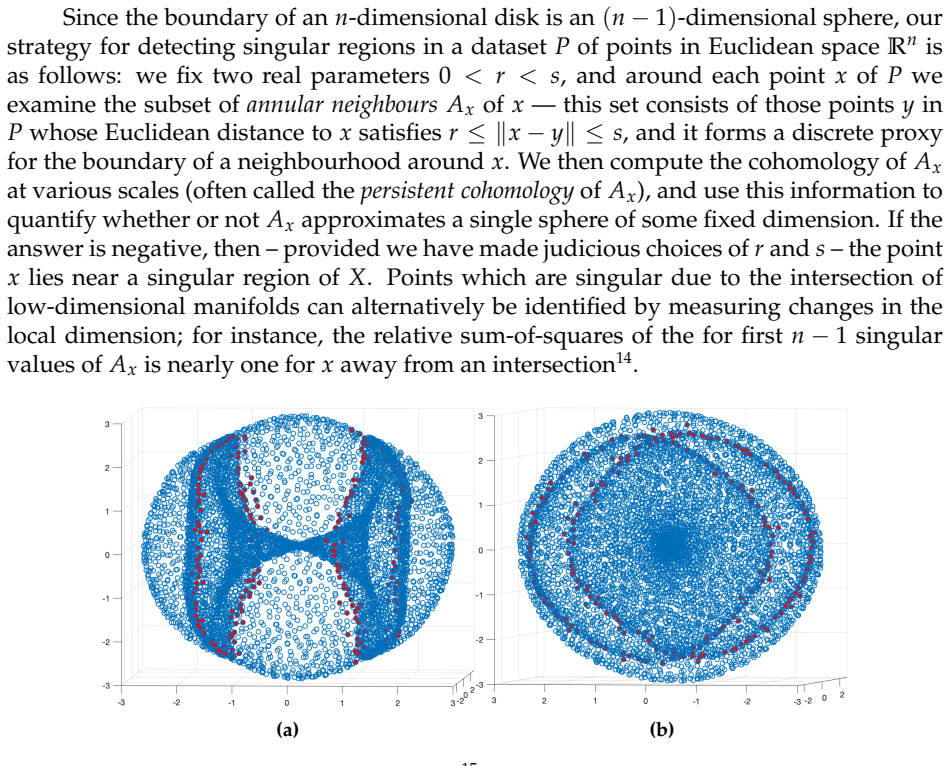
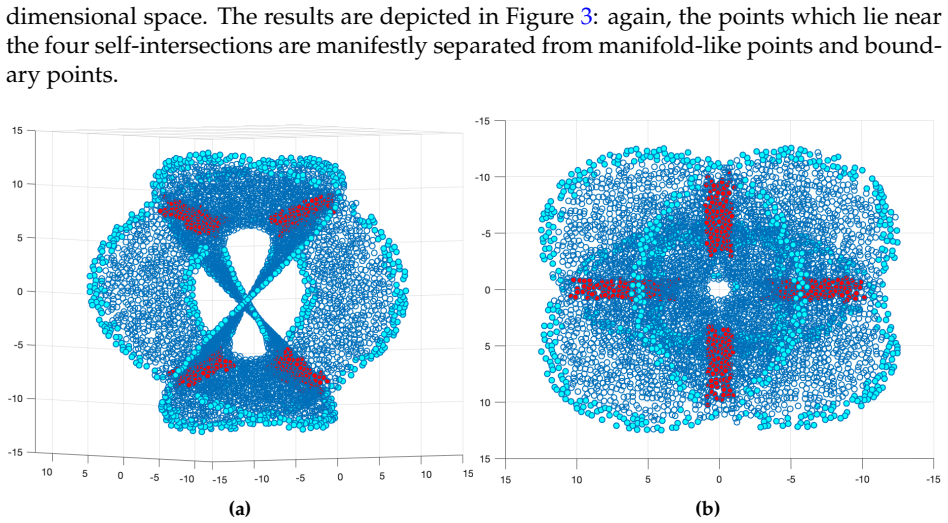
- [Empirical evaluation (Figures 2 and 3)] The central claim that the method 'successfully identifies all the non-manifold regions in two completely different data sets' is supported only by visual inspection of two-dimensional ISOMAP projections. There is no quantitative comparison with known ground truth (e.g., distance to the true intersection curves), no precision/recall or confusion-matrix analysis, no sensitivity study of the classification with respect to the hand-picked radii, and no assessment of how the red/cyan coloring changes if (r, s) are varied. Without such evaluation, the two examples remain anecdotal, and the reported success could be an artifact of the specific parameter choices.
- [Procedure 1, threshold choice] The decision rule counts intervals in the (k-1)-dimensional barcode whose length exceeds s-r. The threshold s-r is asserted without derivation or justification. It is not explained why this particular persistence threshold should separate boundary, manifold, and intersection points, nor how it relates to the scale of the underlying geometry. Since this threshold directly determines the classification, it requires either a theoretical justification or an empirical sensitivity analysis.
minor comments (5)
- [Methods, Persistent cohomology] The phrase 'we obtain not only a one-parameter family of cohomology vector spaces' is fine, but the following sentence says 'for all pairs of real numbers t≤u' while the map direction should be clarified: in cohomology the induced map goes V(u) → V(t), which is correctly stated later; consider aligning the notation to avoid confusion.
- [References] Reference 18 contains a typo: 'Algebriac Topology' should be 'Algebraic Topology'.
- [Introduction] The sentence 'for instance, the relative sum-of-squares of the for first n−1 singular values of Ax is nearly one for x away from an intersection' contains a grammatical error ('of the for') and the alternative method is not described or cited; please revise.
- [Datasets] The parametrization of the Henneberg surface is given with β ∈ [0.4, 0.6]; it would be helpful to state the number of sample points per parameter direction and whether the sampling is uniform in β and φ, as this affects the interpretation of the annulus radii.
- [Figure 1 caption] The caption states 'the dimensions of H1(Ax) from left to right are 1, 0 and 3 respectively' — please double-check the dimension for the boundary case (middle panel), as a thickened half-circle should have H1 dimension 0, which is consistent, but the text could be clearer.
Circularity Check
No circularity: the local-cohomology classifier is self-contained and benchmarked on external data; the noted approximation gap is a correctness risk, not a circular reduction.
full rationale
The paper's derivation chain is: (i) standard stratified-space theory (Kirwan–Woolf, ref. [8]) implies that for an interior point of a k-stratum the boundary of a small neighbourhood is a (k-1)-sphere, for a boundary point a (k-1)-disk, and for a codimension-one intersection a link with H^{k-1}-dimension > 1; (ii) Procedure 1 replaces the unavailable boundary ∂U_y by the finite annular sample A_y and reads H^{k-1} from the Vietoris-Rips barcode via the number of bars longer than s-r; (iii) the resulting three-way partition is compared with independently known singular loci in the cyclo-octane and Henneberg datasets. No quantity used to produce the output -- annulus membership, barcode intervals, or bar-length threshold -- is fitted to the output labels, and no equation in the paper defines singular regions in terms of the classifier's counts. The only self-citations are contextual: [7] (Nanda, local cohomology) is cited as background and for generalizations, and [20] (Otter et al.) is cited for software/tooling; neither carries the weight of the classification rule, which is fully specified in Procedure 1. The paper does assert without proof that persistent cohomology of A_y approximates the cohomology of ∂U_y; this is a sampling-density/radius-condition gap and a potential correctness risk, but it is not a circular reduction -- the approximation is neither defined nor fitted in terms of the output. Thus the central claim has independent content and no self-definitional or fit-by-construction step is present.
Assumptions & free parameters
free parameters (2)
- Annulus radii for cyclo-octane dataset =
reported as (r,s) = (0.4,0.25); inconsistent with r<s, likely (0.25,0.4)
- Annulus radii for Henneberg surface dataset =
reported as (r,s) = (2,1.5); inconsistent with r<s, likely (1.5,2)
assumptions (4)
- standard math Equisingularity and normal triviality hold for the underlying stratified spaces, so the homeomorphism type and cohomology of the boundary of a small neighborhood are constant on each stratum.
- ad hoc to paper A discrete annular neighborhood A_y, together with its Vietoris-Rips persistent cohomology, faithfully approximates the cohomology of the boundary of a small neighborhood in the underlying space.
- ad hoc to paper The number of intervals in H^{k-1}(A_y) with length greater than s-r equals the number of incident strata.
- domain assumption The known ground-truth structures of the two test spaces: cyclo-octane conformations form a Klein bottle glued to a sphere along two circles, and the Henneberg immersion in the stated beta-range has exactly four self-intersections and no triple intersections.
Cite this review
Pith. "Pith review of Geometric anomaly detection in data." pith.science (2026). https://pith.science/paper/Y6A7A2T3
@misc{pith2026190809397,
  author       = {Pith},
  title        = {Pith review of: Geometric anomaly detection in data},
  year         = {2026},
  howpublished = {\url{https://pith.science/paper/Y6A7A2T3}},
  note         = {Machine review of arXiv:1908.09397}
}
read the original abstract
This paper describes the systematic application of local topological methods for detecting interfaces and related anomalies in complicated high-dimensional data. By examining the topology of small regions around each point, one can optimally stratify a given dataset into clusters, each of which is in turn well-approximable by a suitable submanifold of the ambient space. Since these approximating submanifolds might have different dimensions, we are able to detect non-manifold like singular regions in data even when none of the data points have been sampled from those singularities. We showcase this method by identifying the intersection of two surfaces in the 24-dimensional space of cyclo-octane conformations, and by locating all the self-intersections of a Henneberg minimal surface immersed in 3-dimensional space. Due to the local nature of the required topological computations, the algorithmic burden of performing such data stratification is readily distributable across several processors.
Figures

Reference graph
Works this paper leans on
-
[1]
It can be suitably generalised in order to find lower-dimensional singularities 7
from points sampled on k-dimensional submanifolds of Rn for n > k. It can be suitably generalised in order to find lower-dimensional singularities 7. The partition produced by Procedure 1 decomposes the original dataset P into the k-manifold points Pman, the boundary points Pbnd and the desired intersection points Pint. We have implemented Pro- cedure 1 in...
-
[2]
Fefferman, C., Mitter, S. & Narayanan, H. Testing the manifold hypothesis. J. Amer. Math. Soc. 29, 983–1049 (2016). URL https://doi.org/10.1090/jams/852
doi:10.1090/jams/852 2016
-
[3]
What is principal component analysis? Nature biotechnology 26, 303–4 (2008)
Ringner, M. What is principal component analysis? Nature biotechnology 26, 303–4 (2008)
work page 2008
-
[4]
Seung, H. S. & Lee, D. D. The manifold ways of perception. Science 290, 2268–2269 (2000). URL https://science.sciencemag.org/content/290/5500/2268
work page 2000
-
[5]
Vidal, R. Subspace clustering. IEEE Signal Processing Magazine 28, 52–68 (2011)
work page 2011
-
[6]
Che, T., Li, Y., Jacob, A. P ., Bengio, Y. & Li, W. Mode regularized generative ad- versarial networks. In 5th International Conference on Learning Representations, ICLR 2017, Toulon, France, April 24-26, 2017, Conference Track Proceedings (2017). URL https://openreview.net/forum?id=HJKkY35le
work page 2017
-
[7]
Sabour, S., Frosst, N. & Hinton, G. E. Dynamic routing between capsules. In Guyon, I. et al. (eds.) Advances in Neural Information Processing Systems 30 , 3856– 3866 (Curran Associates, Inc., 2017). URL http://papers.nips.cc/paper/ 6975-dynamic-routing-between-capsules.pdf
work page 2017
-
[8]
Local cohomology and stratification
Nanda, V . Local cohomology and stratification. Foundations of Computational Mathe- matics (2019)
work page 2019
Show all 23 references
-
[9]
& Woolf, J
Kirwan, F. & Woolf, J. An introduction to intersection homology theory (Chapman and Hall/CRC, 2006)
2006
-
[10]
& MacPherson, R
Goresky, M. & MacPherson, R. Intersection homology II. Inventiones Mathematicae 71, 77–129 (1983)
1983
-
[11]
Intersection Theory (Springer-Verlag, 1998)
Fulton, W. Intersection Theory (Springer-Verlag, 1998)
1998
-
[12]
& Nanda, V
Mischaikow, K. & Nanda, V . Morse theory for filtrations and efficient computation of persistent homology. Discrete and Computational Geometry 50, 330–353 (2013)
2013
-
[13]
& Ghrist, R
Henselman, G. & Ghrist, R. Matroid filtrations and computational persistent homol- ogy. arXiv:1606.00199 [math.AT] (2016)
2016 arXiv
-
[14]
Markov, A. A. O konstruktivnykh funkciyakh. Trudy Mat. Instituta im. Steklova 52, 315–348 (1958)
1958
-
[15]
& Watson, J.-P
Martin, S. & Watson, J.-P . Non-manifold surface reconstruction from high- dimensional point cloud data. Computational Geometry 44, 427–441 (2011)
2011
-
[16]
B., De Silva, V
Tenenbaum, J. B., De Silva, V . & Langford, J. C. A global geometric framework for nonlinear dimensionality reduction. science 290, 2319–2323 (2000)
2000
-
[17]
Martin, S., Thompson, A., Coutsias, E. A. & Watson, J.-P . Topology of cyclo-octane energy landscape. The Journal of Chemical Physics 132, 234115 (2010). 8
2010
-
[18]
& Harer, J
Cohen-Steiner, D., Edelsbrunner, H. & Harer, J. Stability of persistence diagrams. Discrete and Computational Geometry 37, 107–120 (2007)
2007
-
[19]
Algebriac Topology (Cambridge University Press, 2002)
Hatcher, A. Algebriac Topology (Cambridge University Press, 2002)
2002
-
[20]
Persistence Theory: from Quiver Representations to Data Analysis (American Mathematical Society, 2015)
Oudot, S. Persistence Theory: from Quiver Representations to Data Analysis (American Mathematical Society, 2015)
2015
-
[21]
A., Tillmann, U., Grindrod, P
Otter, N., Porter, M. A., Tillmann, U., Grindrod, P . & Harrington, H. A. A roadmap for the computation of persistent homology. EPJ Data Science 6 (2017). URL https: //doi.org/10.1140/epjds/s13688-017-0109-5
2017 doi
-
[22]
& Adams, H
Tausz, A., Vejdemo-Johansson, M. & Adams, H. JavaPlex: A research software pack- age for persistent (co)homology. In Hong, H. & Yap, C. (eds.) Proceedings of ICMS 2014, Lecture Notes in Computer Science 8592, 129–136 (2014). Software available at http://appliedtopology.github....
2014
-
[23]
Ripser: a lean C++ code for the computation of vietoris–rips persistence barcodes
Bauer, U. Ripser: a lean C++ code for the computation of vietoris–rips persistence barcodes. Software available at https://github.com/Ripser/ripser (software retrieved in 2017). Acknowledgements We thank Barbara Mahler for performing the isomap projection of the cyclo- octane ...
2017
Reviewed August 14, 2026 · model on record in the stance chip above.
Discussion (0). Continue with ORCID to comment.