REVIEW 3 major objections 5 minor 48 references
Novel Stealthy Attack and Defense Strategies for Networked Control Systems
T0 review · 3 major / 5 minor · reviewed 2026-08-14 · deepseek-v4-flash
Pith's one-line read One or two monitored agents detect both zero-dynamics attack variants when switching graphs have distinct eigenvalues, with no attack-timing knowledge and privacy preserved.
desk verdict Solid extension of topology-switching ZDA defenses, but the headline detection guarantee for velocity-only monitoring misses a no-pause position-shift attack that an informed attacker can run after learning the periodic schedule. read the letter →
The pith
A machine-rendered reading of the paper's core claim, the machinery that carries it, and where it could break.
The reading
What carries the argument
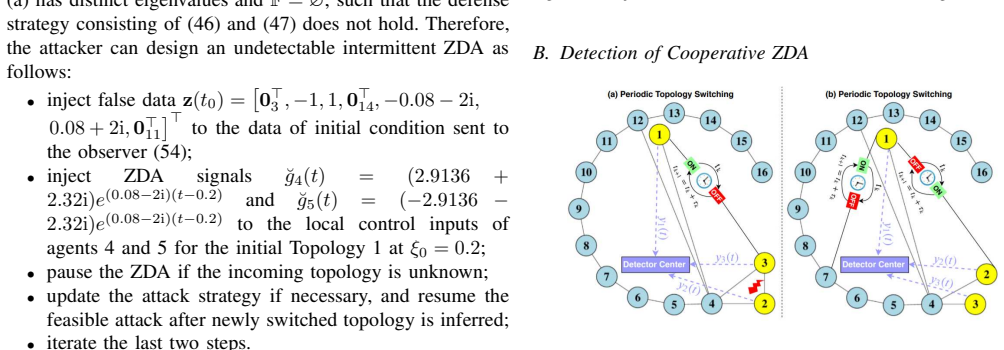
The central object is the zero-dynamics attack signal, a nonzero input $g(t) = g e^{\eta t}$ chosen so that $(z_0, -g)$ lies in the kernel of the matrix pencil $[\eta I - A, B;\, -C, D]$, making the monitored output of the attacked system identical to the attack-free output. The paper's counter-mechanism is periodic topology switching: a preprogrammed sequence of connected undirected graphs whose Laplacians have distinct eigenvalues (46), together with monitored agents located so that their rows in the modal matrix $Q_r$ are informative (47), (53), feeding a Luenberger observer (54). The observer residuals $r_i(t)$ are the detection signals, and the proofs use the Vandermonde structure of the powers of the diagonalized Laplacian to show that an undetected attack would force $x_1 = \cdots = x_{|V|}$ and $v_1 = \cdots = v_{|V|}$ at some time, contradicting the attack's existence unless the initial conditions are already identical.
What would settle it
Equip the attacker with a real-time topology oracle that infers each new graph and recomputes the ZDA signal within an arbitrarily short time after every switch (eliminating Assumption 1.3's pause), then run Algorithm 1 under conditions (46), (47), (52), (53): if the Luenberger residual stays identically zero while consensus is broken, the central detectability claim fails; if the residual becomes nonzero, the pause assumption is doing the work the proof assigns it.
Extended reading notes
Core claim
The paper's central claim is Theorem 3: under the defense strategy (46), (47), (52), (53), the Luenberger observer (54) detects both intermittent and cooperative ZDAs without knowledge of the misbehaving agents or of the attack start, pause, and resume times; in the absence of attacks the same scheme achieves asymptotic consensus and asymptotic tracking. One monitored agent suffices for the intermittent ZDA and two for the cooperative ZDA. The mechanism behind the proof is that any attack that keeps the detection residual identically zero would force the states of all agents to coincide at a switching time—an impossibility for a genuine attack on non-identical initial conditions—and the distinct-eigenvalue condition (46) makes the Vandermonde matrices that enforce this conclusion full rank.
Load-bearing premise
For the intermittent ZDA result, the load-bearing premise is that the attacker needs a non-negligible time to infer each newly activated topology, which is what creates the pause intervals the detection proof uses; an attacker who could infer and re-target instantly would leave no pauses, and the claimed detectability argument would not cover it.
Editorial extensions
If this is right
- A defender can detect both attack variants without knowing the attack schedule or the number of corrupted agents; one monitored agent suffices for intermittent ZDA and two for cooperative ZDA.
- Privacy is preserved: the conditions on monitored outputs keep non-monitored agents' full states unobservable, so an attacker cannot infer the global state or initial condition to choose target links.
- The detectability conditions give explicit design rules: pick topologies with distinct Laplacian eigenvalues, place monitored agents per (47)/(53), and use velocity or matched position-velocity outputs.
- In attack-free operation the same scheme reaches consensus and tracking with no restriction on coupling-weight magnitudes, so security adds no nominal-performance constraint.
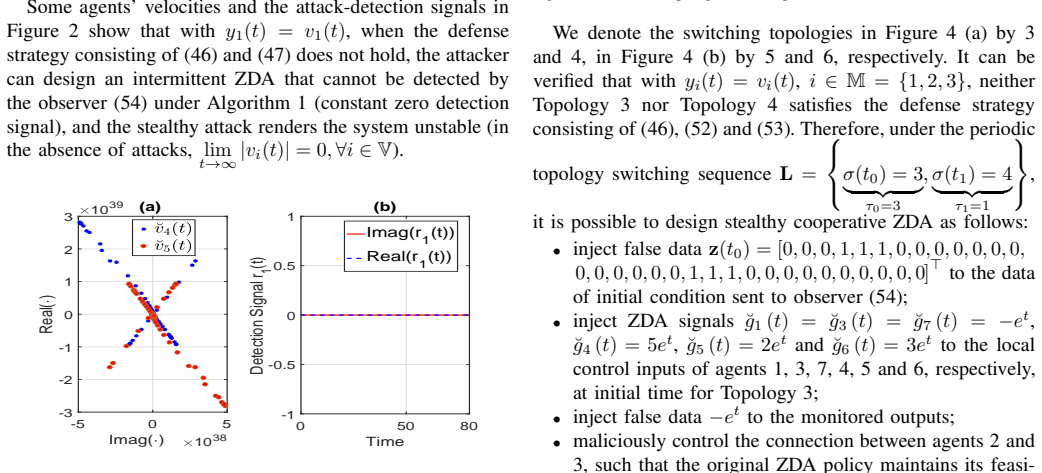
- Simulations demonstrate the boundary: when the conditions fail, both attack variants drive the system unstable with identically zero detection signal; when they hold, the residual becomes nonzero.
Reading between the lines
- If an attacker could infer each new topology and recompute the ZDA signal instantaneously, the intermittent attack would become continuous and the pause-interval argument would not apply; extending the detectability theorem to zero-length pauses is an open test.
- The distinct-eigenvalue requirement is a graph-design constraint worth quantifying: Lemma 2 only guarantees diameter+1 distinct eigenvalues, so characterizing which graphs qualify and how many switching topologies are needed is a natural next question.
- The paper's privacy result suggests a broader trade-off: monitored-output coefficients could tune detection speed against the amount of state information revealed, rather than the binary observable/unobservable choice.
- The cooperative-ZDA analysis restricts topology corruption to links among monitored agents ($D\subseteq M$); an attack that corrupts links wholly inside the unmonitored subgraph without using their states sits outside the theorem and is worth probing.
Signed reviews
Editorial analysis
A structured set of objections, weighed in public.
Referee Report
Summary. The paper studies zero-dynamics attacks (ZDAs) against a second-order multi-agent consensus system that uses periodic topology switching as a defense. It introduces two attack variations in which the attacker is aware of the switching strategy: an intermittent ZDA that pauses, updates, and resumes across topology changes, and a cooperative ZDA that combines the control-input attack with a topology attack. The main results are detectability conditions (Theorems 1 and 2) and a Luenberger-observer-based detection algorithm (Theorem 3) claimed to detect both variations without knowledge of the attack start/pause/resume times or the set of misbehaving agents, while also achieving consensus and tracking in the absence of attacks and preserving the privacy of non-monitored agents. Detailed proofs are provided in appendices, and simulations illustrate the claims.
Significance. If the main theorem were correct, the paper would be a meaningful advance over prior ZDA defenses that assume a naive attacker or known attack start times: it gives explicit, checkable conditions on the topology spectrum, the monitored-agent set, and the output structure, and its detection algorithm is decentralized and privacy-aware. The manuscript contains detailed proofs and reproducible simulations, which are strengths. However, the central detection claim is not correct as stated: there is a natural no-pause attack that lies inside the paper's own attack model but is not covered by the proofs and defeats the proposed detector. The significance is therefore conditional on a substantial revision of either the attack model or the defense.
major comments (3)
- [Section V-A, Theorem 1; Appendix E; Theorem 3] The detectability proof for intermittent ZDA assumes that the attacker actually pauses for a positive duration inside each dwell interval. Appendix E begins with "we let ζ_k < t_{k+1}", and the argument uses the pause dynamics (75) over [ζ_k, ξ_{k+1}). However, the attack model (23) permits ζ_k = t_{k+1}, i.e., a continuous no-pause attack, and Remark 9 explicitly states that after recording one period the attacker knows all future topologies and can compute synchronous policies offline. For velocity-only monitoring (c_i1=0, d_i=0), take e(0)=[x;0] for nonzero x and inject g_r = -L_r x on every interval. Then in the observer-error dynamics (115), \dot{e}_v = -e_v - L_r e_x - g_r = 0 and r_i = c_i2 e_{vi} = 0, so the residual is identically zero while the physical trajectory is driven away from the attack-free consensus trajectory. This is a valid zero-dynamics attack on the observer-error system with η=0, and none of the hypotheses (46),(47),(52),(53) exclude it. Theorem 3's first statement is therefore false as written.
- [Section IV-A, Eq. (23); Assumption 1; Remark 9] The paper's 'intermittent' attack model does not formally require a positive-duration pause. The theorems should either add an explicit hypothesis that ζ_k < t_{k+1} and ξ_{k+1} > ζ_k (with a positive lower bound) or the defense must handle the boundary case. As it stands, the proof of Theorem 1 in Appendix E relies essentially on the pause interval, and the no-pause case is not analyzed. Because Remark 9 acknowledges that the attacker can learn the full periodic schedule, the no-pause case is not a pathological corner case but a realistic attack policy within the stated threat model.
- [Section V-B, Theorem 2; Appendix F] The proof of Theorem 2 uses the fact that the null space of the Laplacian of the attacked subgraph is spanned by the all-ones vector on a connected component, which requires that the difference subgraph has at least one edge (so that two agents lie in a common connected component). This assumption is not stated in Theorem 2 or in Section IV-B. If the topology attack changes no edges (or affects only an edgeless subgraph), equation (107) does not imply the equality of two entries of χ, and the detectability conclusion is not established for that degenerate case. The theorem needs an explicit non-degeneracy assumption or a separate treatment of the empty-attack case.
minor comments (5)
- [Eq. (16d), Section III-B] The block structure of C_j assumes the monitored agents are the first |M| entries of the state vector. Since M is an arbitrary increasing subset of V, the indexing should be made explicit (e.g., by defining a permutation or by writing the nonzero columns at the positions given by M).
- [Appendix G, Eq. (115b)] The summation in (115b) is written as ∑_{i∈V} a_{σ(t)}^{ij}(e_{xj}(t)-e_{xi}(t)); the index i is used both as the running agent and the summation index. It should be ∑_{j∈V} a_{σ(t)}^{ij}(e_{xj}(t)-e_{xi}(t)).
- [Algorithm 1, Step 2] The notation τ_{σ(t_k)} ← τ_{σ(t mod (k,L+1))} is unclear and likely should be τ_{σ(t_k)} ← τ_{mod(k,l)} (or similar), using the length l of the periodic sequence L defined in (10).
- [Section VII, Figures 2-3] The axis labels in Figures 2 and 3 contain stray '1038' and '1039' artifacts, and Figure 2(b) would be clearer if it plotted |r_1(t)| as a single curve instead of separate real and imaginary parts.
- [Lemma 1] The letter m is overloaded: it denotes the graph diameter in Section II-A but is also used as the recursion superscript in N^m_0. This makes conditions such as (19) hard to parse; a different symbol for the recursion depth would improve readability.
Circularity Check
No significant circularity: the detectability conditions are derived from first principles and are not equivalent to their inputs.
full rationale
The paper's derivation chain is self-contained. The detectability conditions (46)-(47) for intermittent ZDA and (46),(52),(53) for cooperative ZDA are stated as design constraints on topologies, monitored-agent locations, and output coefficients; they are not fitted from attack data and they do not presuppose the attack-detection conclusion. Theorem 1 is proved in Appendix E by a contradiction argument that starts from the definition of an undetected attack over the pause interval and derives, using the distinct-eigenvalue Vandermonde argument and the F nonempty condition, that the attack signal must vanish; Theorem 2 is proved similarly in Appendix F from the topology-attack equations; Theorem 3 then reduces the Luenberger-observer error dynamics to the same system form and invokes Theorems 1-2 plus standard matrix-measure and Hurwitz lemmas (Lemmas 3-4). The consensus and tracking part uses Proposition 1 and standard switched-system stability arguments. Self-citations [1], [24], and [40] supply motivation (the topology-switching idea, the feasibility of topology inference, and an earlier conference version), but no theorem needed for the main result is imported solely from those citations; the substantive detectability proofs are in the appendices. The possible gap concerning a no-pause ZDA (the skeptic's eta=0 position-shift attack) concerns the scope of the intermittent attack model rather than a circular reduction: the theorem is conditional on attack signals of form (23) with pause intervals, and a continuously-running attack is not an intermittent ZDA as defined. That is a correctness or robustness question, not an equivalence of inputs and outputs. Therefore no self-definitional, fitted-input, or self-citation-load-bearing circularity is present.
Assumptions & free parameters
assumptions (7)
- standard math Laplacian of a connected undirected graph has a one-dimensional null space spanned by the all-ones vector and can be orthogonally diagonalized as in (11).
- standard math For a periodic switched linear system, uniform asymptotic stability follows from a negative convex combination of matrix measures (Lemma 4).
- standard math Observability characterization of switched linear systems via recursive unobservable subspaces (Theorem 1 in [44]).
- domain assumption The attacker knows the initial topology, output matrix, and switching times, and needs non-negligible time to infer each newly activated topology (Assumption 1).
- domain assumption The defender designs switching times and topologies, selects monitored agents, but has no knowledge of attack starting, pausing, resuming times or the misbehaving agents (Assumption 2).
- domain assumption The periodic switching sequence is preprogrammed into controlled links and is therefore immune to cyber topology attacks (Section III-A).
- ad hoc to paper The attacked subgraph in Theorem 2 has at least one edge, so a pair of agents in the same connected component exists.
Cite this review
Pith. "Pith review of Novel Stealthy Attack and Defense Strategies for Networked Control Systems." pith.science (2026). https://pith.science/paper/6JZMGDVW
@misc{pith2026190809466,
  author       = {Pith},
  title        = {Pith review of: Novel Stealthy Attack and Defense Strategies for Networked Control Systems},
  year         = {2026},
  howpublished = {\url{https://pith.science/paper/6JZMGDVW}},
  note         = {Machine review of arXiv:1908.09466}
}
read the original abstract
This paper studies novel attack and defense strategies, based on a class of stealthy attacks, namely the zero-dynamics attack (ZDA), for multi-agent control systems. ZDA poses a formidable security challenge since its attack signal is hidden in the null-space of the state-space representation of the control system and hence it can evade conventional detection methods. An intuitive defense strategy builds on changing the aforementioned representation via switching through a set of carefully crafted topologies. In this paper, we propose realistic ZDA variations where the attacker is aware of this topology-switching strategy, and hence employs the following policies to avoid detection: (i) pause, update and resume ZDA according to the knowledge of switching topologies; (ii) cooperate with a concurrent stealthy topology attack that alters network topology at switching times, such that the original ZDA is feasible under the corrupted topology. We first systematically study the proposed ZDA variations, and then develop defense strategies against them under the realistic assumption that the defender has no knowledge of attack starting, pausing, and resuming times and the number of misbehaving agents. Particularly, we characterize conditions for detectability of the proposed ZDA variations, in terms of the network topologies to be maintained, the set of agents to be monitored, and the measurements of the monitored agents that should be extracted, while simultaneously preserving the privacy of the states of the non-monitored agents. We then propose an attack detection algorithm based on the Luenberger observer, using the characterized detectability conditions. We provide numerical simulation results to demonstrate our theoretical findings.
Figures

Figures from the paper (2 more)


Reference graph
Works this paper leans on
-
[1]
Detectability of intermittent zero-dynamics attack in ne tworked control systems,
Y . Mao, H. Jafarnejadsani, P . Zhao, E. Akyol, and N. Hovak imyan, “Detectability of intermittent zero-dynamics attack in ne tworked control systems,” in Proceedings of the 58th IEEE Conference on Decision and Control, pp. 5605–5610, 2019
work page 2019
-
[2]
Coordination of gr oups of mobile autonomous agents using nearest neighbor rules,
A. Jadbabaie, J. Lin, and A. S. Morse, “Coordination of gr oups of mobile autonomous agents using nearest neighbor rules,” IEEE Transactions on Automatic Control, vol. 48, no. 6, pp. 988–1001, 2003
2003
-
[3]
Information flow and cooperati ve control of vehicle formations,
J. A. Fax and R. M. Murray, “Information flow and cooperati ve control of vehicle formations,” IEEE Transactions on Automatic Control, vol. 49, no. 9, pp. 1465–1476, 2004
work page 2004
-
[4]
Distributed subgradient methods for mul ti- agent optimization,
A. Nedi ´c and A. Ozdaglar, “Distributed subgradient methods for mul ti- agent optimization,” IEEE Transactions on Automatic Control , vol. 54, no. 1, pp. 48–61, 2009
work page 2009
-
[5]
Consensus-based droop control s ynthesis for multiple dics in isolated micro-grids,
L.-Y . Lu and C.-C. Chu, “Consensus-based droop control s ynthesis for multiple dics in isolated micro-grids,” IEEE Transactions on Power Systems, vol. 30, no. 5, pp. 2243–2256, 2015
work page 2015
-
[6]
Global clock synchronization in sensor networks,
Q. Li and D. Rus, “Global clock synchronization in sensor networks,” IEEE Transactions on Computers , vol. 55, no. 2, pp. 214–226, 2006
work page 2006
-
[7]
Distributed multi-vehicle coordi nated control via local information exchange,
W. Ren and E. Atkins, “Distributed multi-vehicle coordi nated control via local information exchange,” International Journal of Robust and Nonlinear Control, vol. 17, no. 10-11, pp. 1002–1033, 2007
work page 2007
-
[8]
Attitude synchronizatio n of a group of spacecraft without velocity measurements,
A. Abdessameud and A. Tayebi, “Attitude synchronizatio n of a group of spacecraft without velocity measurements,” IEEE Transactions on Automatic Control, vol. 54, no. 11, pp. 2642–2648, 2009
work page 2009
Show all 48 references
-
[9]
Synchronization of nonlinear oscillators in an LTI electr ical power network,
B. B. Johnson, S. V . Dhople, A. O. Hamadeh, and P . T. Krein, “Synchronization of nonlinear oscillators in an LTI electr ical power network,” IEEE Transactions on Circuits and Systems I: Regular Papers , vol. 61, no. 3, pp. 834–844, 2014
2014
-
[10]
Politically motivated denial of service a ttacks,
J. Nazario, “Politically motivated denial of service a ttacks,” The Virtual Battlefield: Perspectives on Cyber W arfare , pp. 163–181, 2009
2009
-
[11]
Lessons learned from the marooch y water breach,
J. Slay and M. Miller, “Lessons learned from the marooch y water breach,” in International Conference on Critical Infrastructure Prot ec- tion, pp. 73–82, 2007
2007
-
[12]
Attack detec tion and identi- fication in cyber-physical systems,
F. Pasqualetti, F. D¨ orfler, and F. Bullo, “Attack detec tion and identi- fication in cyber-physical systems,” IEEE Transactions on Automatic Control, vol. 58, no. 11, pp. 2715–2729, 2013
2013
-
[13]
Dura l rate control for security in cyber-physical systems,
M. Naghnaeian, N. Hirzallah, and P . G. V oulgaris, “Dura l rate control for security in cyber-physical systems,” in Proceedings of the 54th IEEE Conference on Decision and Control , pp. 1415–1420, 2015
2015
-
[14]
A multirate adaptive control for MIMO systems with application to cyber -physical security,
H. Jafarnejadsani, H. Lee, N. Hovakimyan, and P . V oulgaris, “A multirate adaptive control for MIMO systems with application to cyber -physical security,” in Proceedings of the 57th IEEE Conference on Decision and Control, pp. 6620–6625, 2018
2018
-
[15]
On the computation of worst attacks: a LP framework,
N. H. Hirzallah and P . G. V oulgaris, “On the computation of worst attacks: a LP framework,” in Annual American Control Conference , pp. 4527–4532, 2018
2018
-
[16]
Whe n adversary encounters uncertain cyber-physical systems: R obust zero- dynamics attack with disclosure resources,
G. Park, H. Shim, C. Lee, Y . Eun, and K. H. Johansson, “Whe n adversary encounters uncertain cyber-physical systems: R obust zero- dynamics attack with disclosure resources,” in Proceedings of the 55th IEEE Conference on Decision and Control , pp. 5085–5090, 2016
2016
-
[17]
Zero-stealthy atta ck for sampled- data control systems: The case of faster actuation than sens ing,
J. Kim, G. Park, H. Shim, and Y . Eun, “Zero-stealthy atta ck for sampled- data control systems: The case of faster actuation than sens ing,” in Proceedings of the 55th IEEE Conference on Decision and Cont rol, pp. 5956–5961, 2016
2016
-
[18]
Distributed functi on calculation via linear iterative strategies in the presence of maliciou s agents,
S. Sundaram and C. N. Hadjicostis, “Distributed functi on calculation via linear iterative strategies in the presence of maliciou s agents,” IEEE Transactions on Automatic Control, vol. 56, no. 7, pp. 1495–1508, 2011
2011
-
[19]
Consensus com putation in unreliable networks: A system theoretic approach,
F. Pasqualetti, A. Bicchi, and F. Bullo, “Consensus com putation in unreliable networks: A system theoretic approach,” IEEE Transactions on Automatic Control , vol. 57, no. 1, pp. 90–104, 2012
2012
-
[20]
Robust structu ral analysis and design of distributed control systems to prevent zero dynam ics attacks,
S. Weerakkody, X. Liu, and B. Sinopoli, “Robust structu ral analysis and design of distributed control systems to prevent zero dynam ics attacks,” in Proceedings of the 56th IEEE Conference on Decision and Cont rol, pp. 1356–1361, 2017
2017
-
[21]
Protecting positive and second-order systems against und etectable attacks,
J. Chen, J. Wei, W. Chen, H. Sandberg, K. H. Johansson, an d J. Chen, “Protecting positive and second-order systems against und etectable attacks,” IF AC-PapersOnLine, vol. 50, no. 1, pp. 8373–8378, 2017
2017
-
[22]
Enhancemen t of security against zero dynamics attack via generalized hold,
J. Back, J. Kim, C. Lee, G. Park, and H. Shim, “Enhancemen t of security against zero dynamics attack via generalized hold,” in Proceedings of the 56th IEEE Conference on Decision and Control , pp. 1350–1355, 2017
2017
-
[23]
Revealing stealthy attacks in control systems,
A. Teixeira, I. Shames, H. Sandberg, and K. H. Johansson , “Revealing stealthy attacks in control systems,” in 50th Allerton Conference on Communication, Control, and Computing , pp. 1806–1813, 2012
2012
-
[24]
Novel defense strategy a gainst zero- dynamics attack in multi-agent systems,
Y . Mao, E. Akyol, and Z. Zhang, “Novel defense strategy a gainst zero- dynamics attack in multi-agent systems,” in Proceedings of the 58th IEEE Conference on Decision and Control , pp. 3563–3568, 2019
2019
-
[25]
A tutorial survey on vehicular ad hoc networks,
H. Hartenstein, K. P . Laberteaux et al. , “A tutorial survey on vehicular ad hoc networks,” IEEE Communications Magazine , vol. 46, no. 6, pp. 164–171, 2008
2008
-
[26]
S. K. Mazumder, Wireless networking based control . Springer, 2011
2011
-
[27]
Security concepts for the dy namics of autonomous vehicle networks,
M. Xue, W. Wang, and S. Roy, “Security concepts for the dy namics of autonomous vehicle networks,” Automatica, vol. 50, no. 3, pp. 852–857, 2014
2014
-
[28]
On topology attack of a smart grid: Un detectable attacks and countermeasures,
J. Kim and L. Tong, “On topology attack of a smart grid: Un detectable attacks and countermeasures,” IEEE Journal on Selected Areas in Communications, vol. 31, no. 7, pp. 1294–1305, 2013
2013
-
[29]
Effective topology tampering attacks and de fenses in software-defined networks,
R. Skowyra, L. Xu, G. Gu, V . Dedhia, T. Hobson, H. Okhravi , and J. Landry, “Effective topology tampering attacks and de fenses in software-defined networks,” in 48th IEEE/IFIP International Conference on Dependable Systems and Networks , pp. 374–385, 2018
2018
-
[30]
Flocking i n fixed and switching networks,
H. G. Tanner, A. Jadbabaie, and G. J. Pappas, “Flocking i n fixed and switching networks,” IEEE Transactions on Automatic control , vol. 52, no. 5, pp. 863–868, 2007
2007
-
[31]
Distributed continuous-time con vex optimization with time-varying cost functions,
S. Rahili and W. Ren, “Distributed continuous-time con vex optimization with time-varying cost functions,” IEEE Transactions on Automatic Control, vol. 62, no. 4, pp. 1590–1605, 2017. 16
2017
-
[32]
Flocking for multi-agent dynamic sy stems: Algorithms and theory,
R. Olfati-Saber, “Flocking for multi-agent dynamic sy stems: Algorithms and theory,” IEEE Transactions on Automatic Control , vol. 51, no. 3, pp. 401–420, 2006
2006
-
[33]
A decentraliz ed approach to formation maneuvers,
J. R. Lawton, R. W. Beard, and B. J. Y oung, “A decentraliz ed approach to formation maneuvers,” IEEE Transactions on Robotics and Automa- tion, vol. 19, no. 6, pp. 933–941, 2003
2003
-
[34]
Distributed consensus of se cond-order multi-agent systems with heterogeneous unknown inertias a nd control gains under a directed graph,
J. Mei, W. Ren, and J. Chen, “Distributed consensus of se cond-order multi-agent systems with heterogeneous unknown inertias a nd control gains under a directed graph,” IEEE Transactions on Automatic Control , vol. 61, no. 8, pp. 2019–2034, 2016
2019
-
[35]
Attack models and scenarios for networked control systems,
A. Teixeira, D. P´ erez, H. Sandberg, and K. H. Johansson , “Attack models and scenarios for networked control systems,” in Proceedings of the 1st international conference on High Confidence Networked Syst ems, pp. 55–64, 2012
2012
-
[36]
Consensus control for a class of netw orks of dynamic agents: switching topology,
G. Xie and L. Wang, “Consensus control for a class of netw orks of dynamic agents: switching topology,” in Annual American Control Conference, pp. 1382–1387, 2006
2006
-
[37]
Hacker jailed for revenge sewage attacks,
T. Smith, “Hacker jailed for revenge sewage attacks,” https://www.theregister.co.uk/2001/10/31/hacker jailed for revenge sewage/, accessed 2001-10-31
2001
-
[38]
Security of smart distribution grids: Data inte grity attacks on integrated volt/var control and countermeasures,
A. Teixeira, G. D´ an, H. Sandberg, R. Berthier, R. B. Bob ba, and A. V aldes, “Security of smart distribution grids: Data inte grity attacks on integrated volt/var control and countermeasures,” in Annual American Control Conference, pp. 4372–4378, 2014
2014
-
[39]
Topology r econstruction of dynamical networks via constrained Lyapunov equations,
H. J. van Waarde, P . Tesi, and M. K. Camlibel, “Topology r econstruction of dynamical networks via constrained Lyapunov equations, ” IEEE Transactions on Automatic Control , vol. 64, no. 10, pp. 4300–4306, 2019
2019
-
[40]
On inference of network topology an d confir- mation bias in cyber-social networks,
Y . Mao and E. Akyol, “On inference of network topology an d confir- mation bias in cyber-social networks,” to appear in IEEE Transactions on Signal and Information Processing over Networks (Specia l Issue on Network Topology Inference), arXiv:1908.09472
1908 arXiv
-
[41]
Characterization of Zeno beha vior in hybrid systems using homological methods,
A. D. Ames and S. Sastry, “Characterization of Zeno beha vior in hybrid systems using homological methods,” in Annual American Control Conference, pp. 1160–1165, 2005
2005
-
[42]
Distributed det ection and isolation of topology attacks in power networks,
J. Weimer, S. Kar, and K. H. Johansson, “Distributed det ection and isolation of topology attacks in power networks,” in Proceedings of the 1st international conference on High Confidence Networked S ystems, pp. 65–72, 2012
2012
-
[43]
A. E. Brouwer and W. H. Haemers, Spectra of graphs. Springer Science & Business Media, 2011
2011
-
[44]
Observability fo r switched linear systems: characterization and observer design,
A. Tanwani, H. Shim, and D. Liberzon, “Observability fo r switched linear systems: characterization and observer design,” IEEE Transactions on Automatic Control , vol. 58, no. 4, pp. 891–904, 2013
2013
-
[45]
Implementation of unobservabl e state- preserving topology attacks,
J. Zhang and L. Sankar, “Implementation of unobservabl e state- preserving topology attacks,” in North American Power Symposium , pp. 1–6, 2015
2015
-
[46]
Observing the state of a linear syste m,
D. G. Luenberger, “Observing the state of a linear syste m,” IEEE Transactions on Military Electronics , vol. 8, no. 2, pp. 74–80, 1964
1964
-
[47]
Fast swit ching analysis of linear switched systems using exponential splitting,
M. Porfiri, D. G. Roberson, and D. J. Stilwell, “Fast swit ching analysis of linear switched systems using exponential splitting,” SIAM Journal on Control and Optimization , vol. 47, no. 5, pp. 2582–2597, 2008
2008
-
[48]
Topics in matrix analysis,
R. A. Horn and C. R. Johnson, “Topics in matrix analysis, ” Cambridge UP , New York, 1991
1991
Reviewed August 14, 2026 · model on record in the stance chip above.
Discussion (0). Continue with ORCID to comment.