REVIEW 3 major objections 4 minor 30 references
Local Graph Stability in Exponential Family Random Graph Models
T0 review · 3 major / 4 minor · reviewed 2026-08-14 · deepseek-v4-flash
Pith's one-line read For exponential random graph models, the set of parameters that makes a target graph locally stable is always the interior of a convex cone through the origin.
desk verdict The core stable-cone theorem is correct but elementary; the paper's value is in the framework and applications, with the algorithm's correctness being the main unresolved issue. read the letter →
The pith
A machine-rendered reading of the paper's core claim, the machinery that carries it, and where it could break.
The reading
What carries the argument
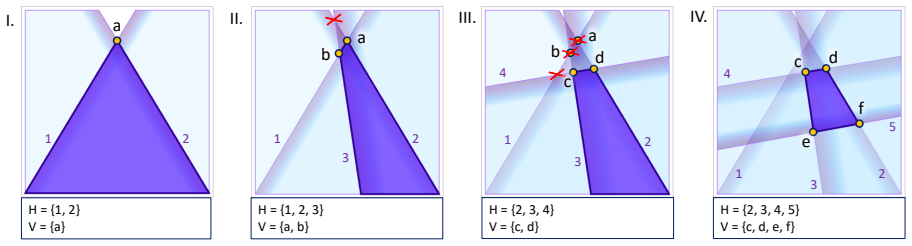
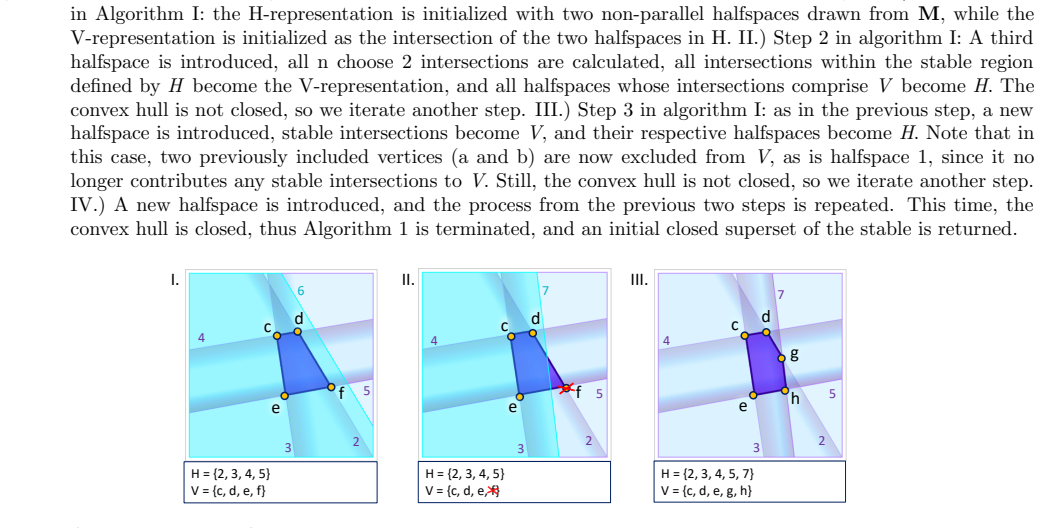
The central object is the change-score matrix $M$, whose $i$-th row is the vector $t(G'_i)-t(G)$ for an alternative graph $G'_i$, together with the stable cone $\Phi=\{\theta: M\theta<0\}$ that it defines. The paper proves that $\Phi$ is the interior of a convex polyhedral cone with apex at the origin, and computes it with the double description method, alternating between an H-representation (the halfspaces from the rows of $M$) and a V-representation (the cone's vertices, normalized onto a sphere), testing the closure of the hull with a convex hull algorithm.
What would settle it
Build a change-score matrix M whose stable region is empty, for example two rows that are exact negatives of each other such as (1,1) and (-1,-1), and run Algorithm 1; if the algorithm does not terminate, or if it returns a nonempty closed cone, the closure test is unsound and the practical method fails on this input.
Extended reading notes
Core claim
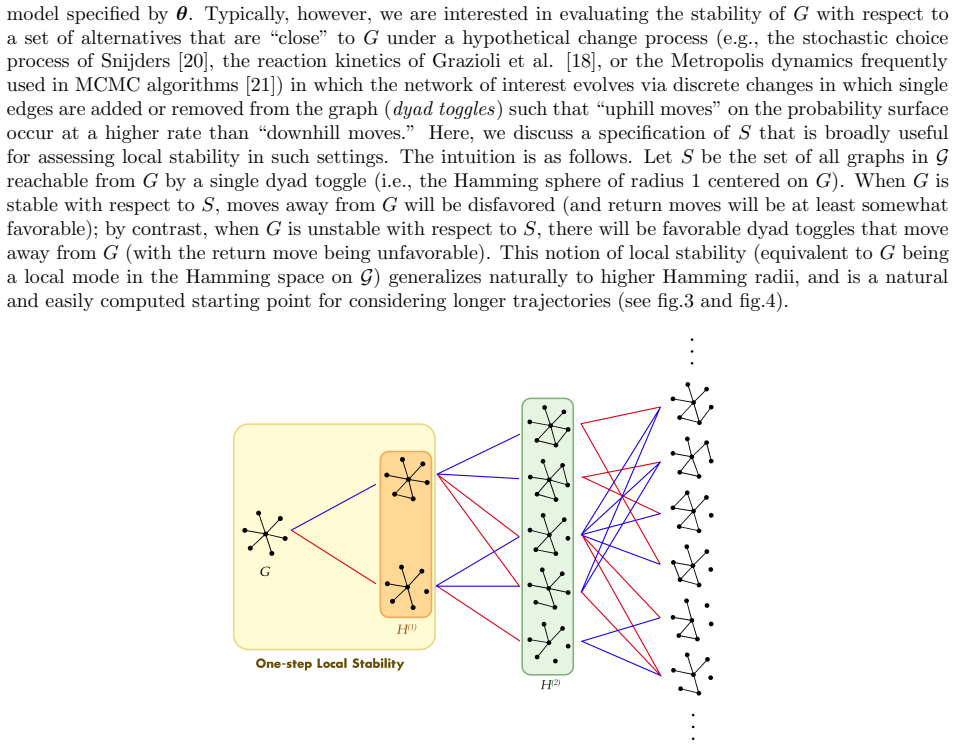
Under an ERGM with probability mass function $\Pr(G=g|\theta)=\exp(\theta \cdot t(g))/K(\theta)$, the condition that a target graph $G$ be more probable than each alternative $G'\in S$ reduces to the linear inequalities $\theta^T(t(G')-t(G))<0$. Collecting the change-score vectors into the $|S|\times K$ matrix $M$, the stabilizing subset is $\Phi=\{\theta: M\theta<0\}$, which is the interior of a convex cone through the origin; the paper proves convexity by showing that any positive linear combination of two stabilizing vectors is again stabilizing. Each row of $M$ defines an open halfspace bounded by a hyperplane through the origin, and the faces of the cone are a subset of these hyperplanes. Local stability against the Hamming sphere of radius 1 makes the target graph a local mode of the model, and the paper shows that membership in the stable cone is necessary but not sufficient for dynamic stability under random-walk Monte Carlo dynamics, with escape times growing exponentially as one moves away from the cone's faces. The paper also shows how to use the stable cone to separate stabilization by social forces from entropic effects, and how to score individual dyads by their signed distance to the cone faces to predict which ties are most likely to change.
Load-bearing premise
The practical algorithm assumes that its convex-hull closure test reliably detects when the current halfspace-and-vertex description is the fully reduced stable cone; the paper offers no proof or edge-case analysis for degenerate or empty stable cones, so the method could fail to terminate or return an incorrect region in those cases.
Editorial extensions
If this is right
- Checking whether a fitted model stabilizes a given graph becomes an exact matrix-inequality test, with no simulation required.
- The cone's facets locate the parameter values at which some alternative graph becomes as probable as the target, giving a geometric picture of how changes in social forces flip the most likely network structure.
- Because local stability is necessary but not sufficient for dynamic stability, the cone can be used to focus simulation effort on the thin band near the faces where dynamic persistence may fail.
- Signed distances from the fitted parameter vector to the cone's faces produce closed-form dyad-vulnerability predictions, identifying which ties or null ties are most likely to be toggled first.
Reading between the lines
- The solid angle of the stable cone gives a quantitative measure of a model family's 'capacity' to stabilize a given structure, allowing different families (e.g. with different sufficient statistics) to be compared by how much parameter space they devote to a structure.
- The dyad-vulnerability scores could be adapted into a fast anomaly-detection tool for longitudinal networks: in a fitted ERGM, edges whose change-score row pushes the parameter vector outside the stable halfspace are precisely the ones a stochastic process would sever first, a prediction testable on panel data without simulation.
- Because the ERGM form matches a Boltzmann distribution, the stable cone also characterizes parameter regions where the target graph is a local free-energy minimum; a natural extension is to compute, for a given energy function, which microstates can be stabilized at all by inspecting the union of feasible cones.
Signed reviews
Editorial analysis
A structured set of objections, weighed in public.
Referee Report
Summary. The paper defines local stability of a target graph relative to a set of alternative graphs under an exponential family random graph model (ERGM). It shows that the stabilizing region of the parameter space, Φ = {θ : Mθ < 0}, where M is the matrix of change scores t(G')−t(G), is the interior of a convex polyhedral cone through the origin. The authors propose two algorithms (Algorithm 1 and Algorithm 2) based on the double description method to compute a non-redundant H- and V-representation of this stable cone, and they demonstrate the method on a star graph and on the Lazega law-firm network, including a dyad-vulnerability analysis.
Significance. If the computational claims are made rigorous, the paper offers a useful and elegant tool: the cone characterization is a direct, parameter-free consequence of the ERGM likelihood ratio, and the local-stability notion gives a fast proxy for dynamic stability under Metropolis dynamics. The paper's strengths include the explicit derivation in Section 2.1.1, the transparent one-step transition probability formulas in Section 3.2, and the reproducible simulation checks in Sections 3 and 4. However, the central computational contribution is not fully established, which limits the significance of the practical method and the reported applications.
major comments (3)
- [Section 2.3, Algorithm 1, lines 3–6] The initialization loop requires sampling two non-parallel rows of M, but for degenerate M with only one distinct row direction (e.g., M = [1 0] in K=2) the loop never terminates even though the stable cone is well-defined as the open halfspace θ1 < 0. This is a concrete failure mode that should be handled explicitly or excluded by an assumption on M; as written, the algorithm is not a general procedure for the stated problem.
- [Section 2.3, Algorithm 1, lines 15–18 (closure test)] The closure test—'if the convex hull is closed, terminate'—is asserted without proof or edge-case analysis. For an empty stable cone, a cone with a non-trivial lineality space, or redundant constraints, the test based on counting vertices and halfspaces from Quickhull may either never succeed (so the loop exhausts M and returns a malformed representation) or may return prematurely before all non-redundant constraints are identified. Since Algorithm 2 explicitly assumes a closed superset from Algorithm 1, this gap undermines the claimed practical algorithm and the correctness of the reported computations in Section 4.
- [Sections 2.3 and 4] The empirical analysis of the Lazega network (stable/unstable edges and nulls, dyad distances di) depends on the unproven correctness of the cone-computation procedure. Please either provide a formal correctness proof for the double-description implementation (including termination and the closure test) or replace it with a certified convex hull / vertex enumeration routine; otherwise the load-bearing computational claims are unsupported.
minor comments (4)
- [Section 2.1.1, Eq. (4)] The notation R^{|S|}_− is nonstandard and should be defined; also the surrounding text has '1 < i < |S|' where '1 ≤ i ≤ |S|' is intended.
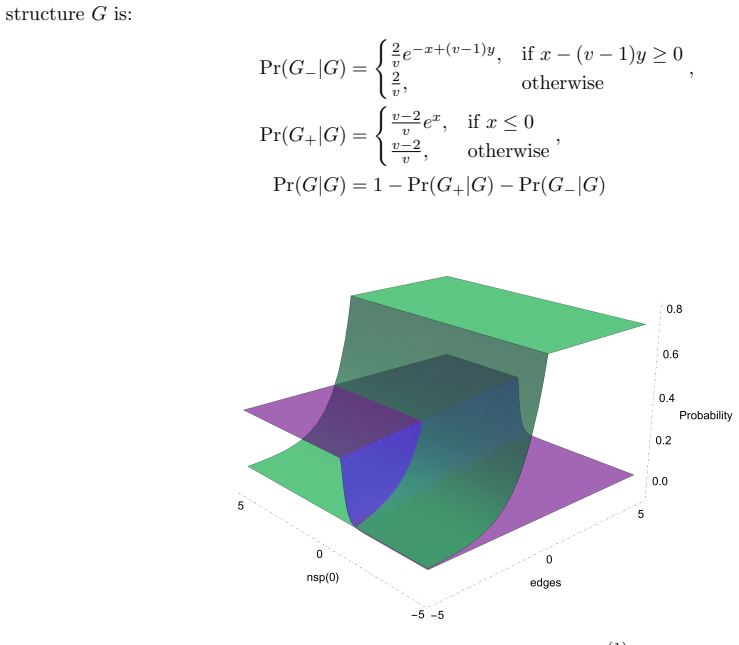
- [Section 3.2] In the formula for Pr(accept|d−,G), the exponent should be written as θ^T(t(G−)−t(G)) with the transpose explicit; the current expression omits the transpose and the dependence on the parameter vector.
- [Table 1] The table is visually garbled: the row for G lists statistic values but no clear separator from the change-score columns. Reformatting would improve readability.
- [Section 4] The quantity di ('distance from the model to stabilization of graph G'_i') is used prominently but never formally defined; please define the distance metric and its sign convention precisely.
Circularity Check
No significant circularity: the stable-cone characterization is a direct algebraic consequence of the ERGM likelihood definition, and the paper does not present any fitted parameter as an independent prediction.
full rationale
The paper's central result, that the stabilizing region is the interior of the convex cone Phi = {theta : M theta < 0}, is a direct algebraic rewriting of the stability inequality Pr(G|theta) > Pr(G'|theta) using the ERGM form Pr(G=g|theta) = exp(theta . t(g)) / K(theta). Equation (3) follows by canceling the common normalizing constant K(theta), and Equation (4) is just the row-wise statement of the resulting linear inequalities. The convexity proof is likewise an immediate verification from M(alpha theta1 + beta theta2) = alpha M theta1 + beta M theta2 with positive coefficients. No parameter is fitted to obtain this characterization, and no input statistic is renamed as a prediction. The Lazega application uses a previously published model re-fit to the data, then assesses stability relative to that fitted model; this is diagnostic rather than circular. The Metropolis simulations in Sections 3 and 4 are consistency checks using the same model, not independent confirmations, but they are not presented as deriving a prediction from a fitted value in a way that reduces to the model's inputs. The paper's references to the authors' prior work, e.g. the amyloid fibril application, are motivational and not load-bearing for the stability theorem. Algorithm 1's closure test is asserted without a full proof and may fail for degenerate cases, but that is a correctness or robustness concern about the computational procedure, not a circularity in the derivation of the stable cone. Overall, the derivation chain is self-contained and does not rely on self-citation or fitted-input-as-prediction maneuvers.
Assumptions & free parameters
assumptions (4)
- domain assumption ERGM probability model with sufficient statistics t(g) and parameter vector θ
- standard math The graph space G is finite and the normalization constant K(θ) is finite
- domain assumption Network evolution proceeds by single dyad toggles under random-walk Metropolis dynamics
- ad hoc to paper The convex hull closure test in Algorithm 1 correctly identifies a closed non-redundant cone
Cite this review
Pith. "Pith review of Local Graph Stability in Exponential Family Random Graph Models." pith.science (2026). https://pith.science/paper/THG3P2VU
@misc{pith2026190809470,
  author       = {Pith},
  title        = {Pith review of: Local Graph Stability in Exponential Family Random Graph Models},
  year         = {2026},
  howpublished = {\url{https://pith.science/paper/THG3P2VU}},
  note         = {Machine review of arXiv:1908.09470}
}
read the original abstract
Exponential family Random Graph Models (ERGMs) can be viewed as expressing a probability distribution on graphs arising from the action of competing social forces that make ties more or less likely, depending on the state of the rest of the graph. Such forces often lead to a complex pattern of dependence among edges, with non-trivial large-scale structures emerging from relatively simple local mechanisms. While this provides a powerful tool for probing macro-micro connections, much remains to be understood about how local forces shape global outcomes. One simple question of this type is that of the conditions needed for social forces to stabilize a particular structure. We refer to this property as local stability and seek a general means of identifying the set of parameters under which a target graph is locally stable with respect to a set of alternatives. Here, we provide a complete characterization of the region of the parameter space inducing local stability, showing it to be the interior of a convex cone whose faces can be derived from the change-scores of the sufficient statistics vis-a-vis the alternative structures. As we show, local stability is a necessary but not sufficient condition for more general notions of stability, the latter of which can be explored more efficiently by using the ``stable cone'' within the parameter space as a starting point. In addition, we show how local stability can be used to determine whether a fitted model implies that an observed structure would be expected to arise primarily from the action of social forces, versus by merit of the model permitting a large number of high probability structures, of which the observed structure is one. We also use our approach to identify the dyads within a given structure that are the least stable, and hence predicted to have the highest probability of changing over time.
Figures


Figures from the paper (13 more)






Reference graph
Works this paper leans on
-
[1]
Statistics of Social Con gurations
Jacob L. Moreno and Helen H. Jennings. “Statistics of Social Con gurations”. In: Sociometry 1.3/4 (1938), pp. 342-374
work page 1938
- [2]
-
[3]
A Combinatorial Optimization Model for Transmission of Job Information through Contact Networks
Scott A. Boorman. “A Combinatorial Optimization Model for Transmission of Job Information through Contact Networks”. In: Bell journal of Economics 6.1 (1975), pp. 216-249
work page 1975
-
[4]
Information Exchange and the Robust- ness of Organizational Networks
Peter Sheridan Dodds, Duncan J.Watts, and Charles F. Sabel. “Information Exchange and the Robust- ness of Organizational Networks”. In: Proceedings of the National Academy of Sciences 100.21 (2003), pp. 12516-12521
work page 2003
-
[5]
Network Structure and the Diffusion of Knowledge
Robin Cowan and Nicolas Jonard. “Network Structure and the Diffusion of Knowledge”. In: Journal of Economic Dynamics and Control 28.8 (2004), pp. 1557-1575
work page 2004
-
[6]
Informal Networks and Organizational Crises: An Experimental Simulation
David Krackhardt and R. N. Stern. “Informal Networks and Organizational Crises: An Experimental Simulation”. In: Social Psychology Quarterly 51 (1988), pp. 123-140
work page 1988
-
[7]
Network Ro- bustness and Fragility : Percolation on random graphs
Duncan S. Callaway, Mark E. J. Newman, Steven H. Strogatz, and Duncan J.Watts. “Network Ro- bustness and Fragility : Percolation on random graphs”. In: Physical review letters 85.25 (2000), p. 5468
work page 2000
-
[8]
Gunnar W. Klau and Ren´ e Weiskircher. “Robustness and Resilience”. In: Network Analysis: Method- ological Foundations. Ed. by Ulrik Brandes and Thomas Erlebach. Berlin: Springer-Verlag, 2005. Chap. 15, pp. 417-437
work page 2005
Show all 30 references
-
[9]
Systemic Risk and Stability in Finan- cial Networks
Daron Acemoglu, Asuman Ozdaglar, and Alireza Tahbaz-Salehi. “Systemic Risk and Stability in Finan- cial Networks”. In: American Economic Review 105.2 (2015), pp. 564-608
2015
-
[10]
Concurrent Partnerships and the Spread of HIV
Martina Morris and Mirjam Kretzschmar. “Concurrent Partnerships and the Spread of HIV”. In: Aids 11.5 (1997), pp. 641-648
1997
-
[11]
Concurrent Partnerships and HIV Prevalence Disparities by Race: Linking Science and Public Health Practice
Martina Morris, Ann E. Kurth, Deven T. Hamilton, James Moody, and Steve Wake eld. “Concurrent Partnerships and HIV Prevalence Disparities by Race: Linking Science and Public Health Practice”. In: American Journal of Public Health 99.6 (2009), pp. 1023-1031
2009
-
[12]
Transitivity in Structural Models of Small Groups
Paul W. Holland and Samuel Leinhardt. “Transitivity in Structural Models of Small Groups”. In: Com- parative Group Studies 2 (1971), pp. 107-124
1971
-
[13]
Markov Graphs
Ove Frank and David Strauss. “Markov Graphs”. In: Journal of the American Statistical Association 81 (1986), pp. 832-842
1986
-
[14]
Neighborhood-Based Models for Social Networks
Philippa E. Pattison and Garry L. Robins. “Neighborhood-Based Models for Social Networks”. In: Sociological Methodology 32 (2002), pp. 301-337
2002
-
[15]
New Speci cations for Exponential Random Graph Models
Tom A. B. Snijders, Philippa E. Pattison, Garry L. Robins, and Mark S. Handcock. “New Speci cations for Exponential Random Graph Models”. In: Sociological Methodology 36 (2006), 99-154
2006
-
[16]
Small and Other Worlds: Network Struc- tures from Local Processes
Garry L. Robins, Philippa E. Pattison, and Jodie Woolcock. “Small and Other Worlds: Network Struc- tures from Local Processes”. In: American Journal of Sociology 110.4 (2005), pp. 894-936
2005
-
[17]
Robins, eds
Dean Lusher, Johan Koskinen, and Garry L. Robins, eds. Exponential Random Graph Models for Social Networks: Theory, Methods, and Applications. Structural Analysis in the Social Sciences. Cambridge: Cambridge University Press, 2012. doi: 10.1017/CBO9780511894701
2012 doi
-
[18]
Network- based Classi cation and Modeling of Amyloid Fibrils
Gianmarc Grazioli, Yue Yu, Megha H. Unhelkar, Rachel W. Martin, and Carter T. Butts. “Network- based Classi cation and Modeling of Amyloid Fibrils”. In: Journal of Physical Chemistry , B 123.26 (2019), pp. 5452-5462. doi: 10.1021/acs.jpcb.9b03494. 19
2019 doi
-
[19]
Comparative Exploratory Analysis of Intrinsically Disordered Protein Dynamics using Machine Learning and Network Analytic Meth- ods
Gianmarc Grazioli, Rachel W. Martin, and Carter T. Butts. “Comparative Exploratory Analysis of Intrinsically Disordered Protein Dynamics using Machine Learning and Network Analytic Meth- ods”. In: Frontiers in Molecular Biosciences, Biological Modeling and Simulation 6.42 (201...
2019
-
[20]
The Statistical Evaluation of Social Network Dynamics
Tom A. B. Snijders. “The Statistical Evaluation of Social Network Dynamics”. In: Sociological Method- ology 31 (2001), pp. 361-395
2001
-
[21]
Computational Statistical Methods for Social Network Analysis
David R. Hunter, Pavel N. Krivitsky, and Michael Schweinberger. “Computational Statistical Methods for Social Network Analysis”. In: Journal of Computational and Graphical Statistics 21 (4 2012), pp. 856-882
2012
-
[22]
A Pivoting Algorithm for Convex Hulls and Vertex Enumeration of Arrangements and Polyhedra
David Avis and Komei Fukuda. “A Pivoting Algorithm for Convex Hulls and Vertex Enumeration of Arrangements and Polyhedra”. In: Discrete & Computational Geometry 8.3 (1992), pp. 295-313
1992
-
[23]
The Quick-hull Algorithm for Convex Hulls
C. Bradford Barber, David P. Dobkin, David P. Dobkin, and Hannu Huhdanpaa. “The Quick-hull Algorithm for Convex Hulls”. In: ACM Transactions on Mathematical Software (TOMS) 22.4 (1996), pp. 469-483
1996
-
[24]
Dilemmas of Charismatic Leadership: The Case of the People’s Temple
Doyle P. Johnson. “Dilemmas of Charismatic Leadership: The Case of the People’s Temple”. In: Socio- logical Analysis 40.4 (1979), pp. 315-323
1979
-
[25]
Heaven’s Gate: A Study of Religious Obedience
Winston Davis. “Heaven’s Gate: A Study of Religious Obedience”. In: Nova Religio: The Journal of Alternative and Emergent Religions 3.2 (2000), pp. 241-267
2000
-
[26]
ergm: A Package to Fit, Simulate and Diagnose Exponential-Family Models for Networks
David R. Hunter, Mark S. Handcock, Carter T. Butts, Steven M. Goodreau, and Martina Morris. “ergm: A Package to Fit, Simulate and Diagnose Exponential-Family Models for Networks”. In: Journal of Statistical Software 24.3 (2008)
2008
-
[27]
statnet: Software Tools for the Representation, Visualization, Analysis and Simulation of Network Data
Mark S. Handcock, David R. Hunter, Carter T. Butts, Steven M. Goodreau, and Martina Morris. “statnet: Software Tools for the Representation, Visualization, Analysis and Simulation of Network Data”. In: Journal of Statistical Software 24.1 (2008), pp. 1-11
2008
-
[28]
The Collegial Phenomenon: The Social Mechanisms of Cooperation Among Peers in a Corporate Law Partnership
Emmanuel Lazega. The Collegial Phenomenon: The Social Mechanisms of Cooperation Among Peers in a Corporate Law Partnership. Oxford University Press on Demand, 2001
2001
-
[29]
Curved Exponential Family Models for Social Networks
David R. Hunter. “Curved Exponential Family Models for Social Networks”. In: Social Networks 29.2 (2007), pp. 216-230
2007
-
[30]
ergm: Fit, Simulate and Diagnose Exponential-Family Models for Networks
Mark S. Handcock, David R. Hunter, Carter T. Butts, Steven M. Goodreau, Pavel N. Krivitsky, and Martina Morris. “ergm: Fit, Simulate and Diagnose Exponential-Family Models for Networks”. R package version 3.8.0. The Statnet Project (https://statnet.org). 2019. url: https://CRA...
2019
Reviewed August 14, 2026 · model on record in the stance chip above.
Discussion (0). Continue with ORCID to comment.