REVIEW 3 major objections 5 minor 33 references
Low-Congestion Shortcut and Graph Parameters
T0 review · 3 major / 5 minor · reviewed 2026-08-14 · deepseek-v4-flash
Pith's one-line read The paper establishes O(kD)-quality shortcuts in O(1) rounds for k-chordal graphs, closes the small-diameter MST gaps at D=3 and D=4, and shows bounded clique-width does not help.
desk verdict Strong k-chordal and D=3 shortcut results, but D=4 proof has a real gap and clique-width parameters are inconsistent; worth serious peer review. read the letter →
The pith
A machine-rendered reading of the paper's core claim, the machinery that carries it, and where it could break.
The reading
What carries the argument
The load-bearing object is the low-congestion shortcut: for each part $P_i$ of a partition, a set $H_i$ of extra edges such that $P_i + H_i$ has diameter at most $d$ and every edge of $G$ appears in at most $c$ of the augmented parts; the quality is $d+c$. The main construction scheme is one-hop extension: each node in a part adds each incident edge to its part's shortcut, which costs one round and already gives $O(kD)$ quality on $k$-chordal graphs through a chord argument on shortest paths. For diameter $3$ and $4$, random sampling is layered on top of one-hop extension: diameter $3$ samples incident edges with probability $n^{-1/2}$, while diameter $4$ uses an $(n^{1/3}\log^3 n)$-wise independent hash function $h$—a hash family in which any fixed collection of inputs behaves like independent uniform values—to sample edges with probability $1/h(u,i)$. The dilation analysis uses ruling sets and terminal sets inside each part to show that two far-apart nodes become connected by a short sampled path. The clique-width lower bound is carried by a recursively constructed graph that fits the same hard-instance framework used for general lower bounds.
What would settle it
Inspect the diameter-4 proof at Lemma 6: compute the probability that a fixed two-hop path $(a,b,c)$, with $a$ adjacent to one terminal set and $c$ adjacent to the other, is fully contained in $H_i$ under the stated sampling rule; if the correct value is $1/h(b,i)^2$ rather than $1/h(b,i)$, the union bound loses a factor and the claimed $\tilde{O}(n^{1/3})$ dilation needs a repaired argument.
Extended reading notes
Core claim
The central discovery is a tight connection between shortcut quality and three graph parameters. Theorem 3 shows that a one-round construction—each node contributes all its incident edges to its part's shortcut—produces a shortcut of quality $O(kD)$ for any $k$-chordal graph (a graph with no induced cycle longer than $k$), and Theorem 4 gives a matching lower bound up to polylogarithmic factors for $k\le D$ and $kD\le \sqrt{n}$. Theorem 5 gives two randomized constructions: for diameter $3$, quality and construction time $\tilde{O}(n^{1/4})$; for diameter $4$, quality and construction time $\tilde{O}(n^{1/3})$, matching the known lower bounds and immediately yielding MST algorithms at those speeds. Theorem 6 builds a clique-width-$6$ graph on which MST requires $\tilde{\Omega}(\sqrt{n}+D)$ rounds, so bounded clique-width does not make good shortcuts possible. The proofs identify one-hop extension plus selective random sampling of length-one or length-two paths as the mechanism that carries these upper bounds.
Load-bearing premise
The load-bearing premise is that the diameter-4 randomized sampling makes, for every far-apart pair of representative nodes, a two-hop path between their surrounding terminal sets appear in the shortcut with high probability; if that event fails, the $\tilde{O}(n^{1/3})$ result does not follow.
Editorial extensions
If this is right
- In any $k$-chordal network with constant $k$, MST, approximate minimum cut, and approximate shortest paths become solvable in $\tilde{O}(D)$ rounds, matching the universal $\Omega(D)$ diameter lower bound up to polylogarithmic factors.
- For diameter-$3$ networks, MST runs in $\tilde{O}(n^{1/4})$ rounds, and for diameter-$4$ networks in $\tilde{O}(n^{1/3})$ rounds, closing the small-diameter MST gaps.
- The $k$-chordal construction is nearly optimal: for $k \le D$ and $kD \le \sqrt{n}$, no shortcut-based MST algorithm can do asymptotically better.
- Bounded clique-width is not a viable route to fast MST: a clique-width-$6$ network can be as hard as the general $\tilde{\Omega}(\sqrt{n}+D)$ case.
Reading between the lines
- One consequence left implicit in the paper is that chordal graphs, the $k=3$ case, already receive a $\tilde{O}(D)$-round MST algorithm, placing them in the same fast category as planar and bounded-treewidth networks.
- The ruling-set and terminal-set technique is a natural template for diameter $5$ and above, but the paper leaves that extension open; the obvious next step would be sampling paths of length $D-2$ to match the known lower-bound curve.
- The clique-width result suggests that a graph parameter helps shortcuts only if it constrains diameter or chordality; construction complexity alone, such as clique-width, is orthogonal to the distributed bottleneck.
Signed reviews
Editorial analysis
A structured set of objections, weighed in public.
Referee Report
Summary. The paper studies low-congestion shortcuts in the CONGEST model and their relation to three graph parameters. It claims (1) an O(1)-round algorithm constructing a shortcut of quality O(kD) for every k-chordal graph, together with a near-matching lower bound; (2) shortcut algorithms of quality and round complexity O~(n^{1/4}) for diameter-3 graphs and O~(n^{1/3}) for diameter-4 graphs, yielding MST algorithms that match known lower bounds; and (3) a negative result that clique-width six does not help, exhibited by an n-vertex graph on which MST requires Ω~(√n+D) rounds. The technical core is a 1-hop extension scheme for chordal graphs and two probabilistic edge-sampling constructions for small diameter.
Significance. If the results were fully established, the paper would close the MST complexity gap for diameters 3 and 4 and show that chordality is a parameter admitting optimal shortcuts; the clique-width lower bound would also rule out a natural candidate parameter. The paper is self-contained, uses the established Das Sarma et al. lower-bound framework, and the k-chordal upper bound is elegant and appears sound. The D=3 analysis is also coherent. The significance is high, but two load-bearing proofs, the D=4 dilation bound and the clique-width lower bound, are not valid as written.
major comments (3)
- [Section 4.1, Lemma 6] The D=4 dilation proof does not match the stated edge-sampling algorithm. For a length-two path (a,b,c), the shortcut must contain both edges (a,b) and (b,c). In the algorithm, node b selects each incident edge independently with probability 1/h(b,i), so conditioning only on Y_b = h(b,i) gives Pr[X_b=1 | Y_b=y] >= 1 - (1 - 1/y^2)^{Δ(b)}, not the printed 1 - (1 - 1/y)^{Δ(b)}. With the weaker bound, the subsequent threshold event Y_b <= Δ(b)/log^2 n no longer yields the claimed failure probability e^{-Ω(log^2 n)}. Additionally, the proof asserts that Y_b for all b in B are independent because the hash is (n^{1/3} log^3 n)-wise independent; this requires |B| <= n^{1/3} log^3 n, and no such bound on the set of centers of the edge-disjoint path packing is given. Since Lemma 6 is the only support for the D=4 part of Theorem 5, the claimed O~(n^{1/3}) shortcut for diameter 4 is not established.
- [Section 5, Lemma 7 and Theorem 6] The parameters in the clique-width lower bound do not produce the claimed Ω~(√n) bound. Lemma 7 places G(Γ,p) in G(O(Γ(2p+2)), Γ, 2p+2, 3p), so Theorem 2 gives a lower bound of Ω~(min{Γ/(3p), p}) up to constants. If the intended instance is G(√n, log n/2), then p = O(log n) and the bound is O(log n); if instead one takes 2p = Θ(√n) as the last sentence of the proof suggests, then Γ/(3p) = Θ(1). In neither case is Ω~(√n+D) obtained, and the stated n-vertex instance is not matched to the claim. Consequently Theorem 6 is unsupported as written.
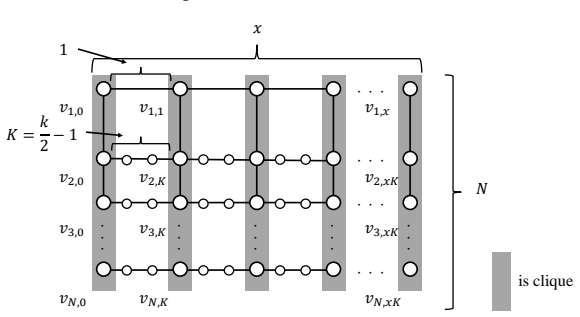
- [Section 3.3, Theorem 4 and Lemma 2] The lower-bound construction uses K = k/2 - 1, which is an integer only for even k, yet Theorem 4 is stated for all k with k <= D and kD <= √n. The definition of G(k,x,N) and the chordality proof in Lemma 2 depend on K being integral; for odd k the construction is not well-defined. The upper bound in Theorem 3 is unaffected, but the claimed near-optimal lower bound for all k needs either an explicit even-k restriction or a separate treatment of odd k.
minor comments (5)
- [Section 5 heading] The heading contains a typo: 'Low-Congstion' should be 'Low-Congestion'.
- [Section 5, Lemma 7] The formal vertex set T = {u_i^j | 0 <= i <= 2p-1, 0 <= j <= p} is inconsistent with the binary-tree structure and with the recursive definition G(Γ,p) = G(Γ,p-1) ⊕ G(Γ,p-1); the index range should presumably be 0 <= i <= 2^j - 1. This also affects the vertex count and the relation between p and n.
- [Section 4.1, Lemma 6] The last displayed inequality in the lemma reads Pr[X=1] >= Pr[X=1 ∧ Y=1] Pr[Y=1]; it should be Pr[X=1] >= Pr[X=1 ∧ Y=1] = Pr[X=1 | Y=1] Pr[Y=1].
- [Section 4.2, Preprocessing] The preprocessing identifies parts of diameter Θ(κ_D) arbitrarily, whereas the analysis assumes large parts have diameter larger than 12κ_D log^3 n. The logarithmic slack between these thresholds should be stated explicitly so that the congestion and dilation bounds remain valid.
- [Section 3.3, Lemma 3] The definition of X_i uses cases 'i mod K = 2' and 'i mod K ≠ 2'; when K = 1 the partition becomes degenerate. The range of k for which the construction is non-degenerate should be clarified.
Circularity Check
No significant circularity: the shortcut constructions are self-contained and checked against external lower-bound frameworks.
full rationale
The paper's central contributions are constructive upper bounds (Theorems 3 and 5) and a lower bound (Theorem 6), none of which reduces to its own inputs. The k-chordal shortcut construction is the 1-hop extension scheme: every node adds all incident edges, and Lemma 1 proves the dilation bound O(kD) directly from the definition of k-chordality. No parameter is fitted to data, and no output quantity is defined in terms of the claimed result. The small-diameter algorithms combine the 1-hop extension with randomized edge sampling; the congestion and dilation analyses are self-contained probabilistic arguments based on ruling sets, terminal sets, and hash functions. Although the D=4 dilation proof in Lemma 6 contains a cited probabilistic concern (it conditions only on the center's hash value while requiring both edges of a length-two path to be sampled), that is a potential correctness gap, not circularity: the claimed shortcut quality is not assumed, fitted, or defined into existence. The lower bounds for k-chordal graphs and clique-width-six graphs are obtained by embedding the constructed instances into the externally established Das Sarma et al. framework (Theorem 2), and the MST consequences use the external meta-theorem of Ghaffari-Haeupler and Haeupler-Li (Theorem 1). The authors cite prior work by one of the authors (Haeupler, Izumi, and Zuzic), but those citations are used as background or as existing shortcut results for other graph classes, not as the load-bearing justification for the new theorems. No self-citation supplies a uniqueness theorem, no ansatz is smuggled in by citation, and no known result is merely renamed. The derivation chain is therefore not circular, despite any correctness questions in Lemma 6.
Assumptions & free parameters
assumptions (4)
- domain assumption Theorem 1 of Ghaffari-Haeupler and Haeupler-Li: a shortcut of quality q constructible in f rounds yields O~(f+q)-round MST, min-cut, and SSSP algorithms.
- domain assumption Theorem 2 of Das Sarma et al.: on graph class G(n,b,l,c), every MST algorithm requires Omega~(min{b/c, l/2-1}) rounds.
- standard math Existence of an (alpha, alpha+1)-ruling set in every graph.
- standard math Wegman-Carter k-wise independent hash families with small seeds exist.
Cite this review
Pith. "Pith review of Low-Congestion Shortcut and Graph Parameters." pith.science (2026). https://pith.science/paper/HT7D62K7
@misc{pith2026190809473,
  author       = {Pith},
  title        = {Pith review of: Low-Congestion Shortcut and Graph Parameters},
  year         = {2026},
  howpublished = {\url{https://pith.science/paper/HT7D62K7}},
  note         = {Machine review of arXiv:1908.09473}
}
abstract
The concept of low-congestion shortcuts is initiated by Ghaffari and Haeupler [SODA2016] for addressing the design of CONGEST algorithms running fast in restricted network topologies. Specifically, given a specific graph class $X$, an $f$-round algorithm of constructing shortcuts of quality $q$ for any instance in $X$ results in $\tilde{O}(q + f)$-round algorithms of solving several fundamental graph problems such as minimum spanning tree and minimum cut, for $X$. In this paper, we consider the relationship between the quality of low-congestion shortcuts and three major graph parameters, chordality, diameter, and clique-width. The main contribution of the paper is threefold: (1) We show an $O(1)$-round algorithm which constructs a low-congestion shortcut with quality $O(kD)$ for any $k$-chordal graph, and prove that the quality and running time of this construction is nearly optimal up to polylogarithmic factors. (2) We present two algorithms, each of which constructs a low-congestion shortcut with quality $\tilde{O}(n^{1/4})$ in $\tilde{O}(n^{1/4})$ rounds for graphs of $D=3$, and that with quality $\tilde{O}(n^{1/3})$ in $\tilde{O}(n^{1/3})$ rounds for graphs of $D=4$ respectively. These results obviously deduce two MST algorithms running in $\tilde{O}(n^{1/4})$ and $\tilde{O}(n^{1/3})$ rounds for $D=3$ and $4$ respectively, which almost close the long-standing complexity gap of the MST construction in small-diameter graphs originally posed by Lotker et al. [Distributed Computing 2006]. (3) We show that bounding clique-width does not help the construction of good shortcuts by presenting a network topology of clique-width six where the construction of MST is as expensive as the general case.
Figures


Figures from the paper (3 more)


Reference graph
Works this paper leans on
-
[1]
AmirAbboud,KerenCensor-Hillel,andSeriKhoury. Near-linearlowerboundsfordistributeddistance computations,eveninsparsenetworks.In Proceedingsof30ndInternationalSymposiumonDistributed Computing (DISC), pages 29–42, 2016.doi:10.1007/978-3-662-53426-7_3
-
[2]
Networkdecomposition and locality in distributed computation
BaruchAwerbuch,AndrewV.Goldberg,MichaelLuby,andSergeA.Plotkin. Networkdecomposition and locality in distributed computation. InProceedings of 30th Annual Symposium on Foundations of Computer Science (FOCS), pages 364–369, 1989.doi:10.1109/SFCS.1989.63504
arXiv 1989
-
[3]
Derek G. Corneil and Udi Rotics. On the relationship between clique-width and treewidth.SIAM Journal on Computing, pages 825–847, 2005.doi:10.1137/S0097539701385351
-
[4]
Bruno Courcelle and Stephan Olariu. Upper bounds to the clique width of graphs.Discrete Applied Mathematics, pages 77–114, 2000.doi:10.1016/S0166-218X(99)00184-5
-
[5]
Distributed approximation: a survey
Michael Elkin. Distributed approximation: a survey. ACM SIGACT News, pages 40–57, 2004. doi:10.1145/1054916.1054931
-
[6]
Michael Elkin. An unconditional lower bound on the time-approximation trade-off for the distributed minimumspanningtreeproblem. SIAMJournalonComputing ,pages433–456,2006. doi:10.1137/ S0097539704441058
work page 2006
-
[7]
Robert G. Gallager, Pierre A. Humblet, and Philip M. Spira. A distributed algorithm for minimum- weight spanning trees.ACM Transactions on Programming Languages and Systems (TOPLAS), pages 66–77, 1983.doi:10.1145/357195.357200. 17
arXiv 1983
-
[8]
Garay, Shay Kutten, and David Peleg
Juan A. Garay, Shay Kutten, and David Peleg. A sublinear time distributed algorithm for minimum- weight spanning trees. SIAM Journal on Computing, pages 302–316, 1998. doi:10.1137/ S0097539794261118
work page 1998
Show all 33 references
-
[9]
The intersection graphs of subtrees in trees are exactly the chordal graphs.Journal of Combinatorial Theory, Series B, pages 47–56, 1974.doi:10.1016/0095-8956(74)90094-X
Fˇanicˇa Gavril. The intersection graphs of subtrees in trees are exactly the chordal graphs.Journal of Combinatorial Theory, Series B, pages 47–56, 1974.doi:10.1016/0095-8956(74)90094-X
1974 doi
-
[10]
Near-optimal scheduling of distributed algorithms
Mohsen Ghaffari. Near-optimal scheduling of distributed algorithms. InProceedings of the 2015 ACMSymposiumonPrinciplesofDistributedComputing(PODC) ,pages3–12,2015. doi:10.1145/ 2767386.2767417
2015
-
[11]
DistributedalgorithmsforplanarnetworksII:low-congestion shortcuts, mst, and min-cut
MohsenGhaffariandBernhardHaeupler. DistributedalgorithmsforplanarnetworksII:low-congestion shortcuts, mst, and min-cut. InProceedings of the twenty-seventh annual ACM-SIAM symposium on Discrete algorithms (SODA), pages 202–219, 2016.doi:10.1137/1.9781611974331.ch16
2016 doi
-
[12]
Distributed MST and broadcast with fewer messages, and faster gossiping
Mohsen Ghaffari and Fabian Kuhn. Distributed MST and broadcast with fewer messages, and faster gossiping. InProceedings of 32nd International Symposium on Distributed Computing (DISC), pages 30:1–30:12, 2018.doi:10.4230/LIPIcs.DISC.2018.30
2018 doi
-
[13]
DistributedMSTandroutinginalmostmixingtime
MohsenGhaffari,FabianKuhn,andHsin-HaoSu. DistributedMSTandroutinginalmostmixingtime. In Proceedings of 31nd International Symposium on Distributed Computing (DISC), pages 131–140,
-
[14]
New distributed algorithms in almost mixing time via transformations from parallel algorithms
Mohsen Ghaffari and Jason Li. New distributed algorithms in almost mixing time via transformations from parallel algorithms. InProceedings of 32nd International Symposium on Distributed Computing (DISC), pages 31:1–31:16, 2018.doi:10.4230/LIPIcs.DISC.2018.31
2018 doi
-
[15]
Time-messagetrade-offsindistributedalgorithms
RobertGmyrandGopalPandurangan. Time-messagetrade-offsindistributedalgorithms. In Proceed- ings of 32nd International Symposium on Distributed Computing (DISC), pages 32:1–32:18, 2018. doi:10.4230/LIPIcs.DISC.2018.32
2018 doi
-
[17]
Low-congestion shortcuts without embedding
Bernhard Haeupler, Taisuke Izumi, and Goran Zuzic. Low-congestion shortcuts without embedding. In Proceedings of the 2016 ACM Symposium on Principles of Distributed Computing (PODC), pages 451–460, 2016.doi:10.1145/2933057.2933112
2016
-
[18]
Bernhard Haeupler, Taisuke Izumi, and Goran Zuzic. Near-optimal low-congestion shortcuts on boundedparametergraphs.In Proceedingsof30ndInternationalSymposiumonDistributedComputing (DISC), pages 158–172, 2016.doi:10.1007/978-3-662-53426-7_12
2016 doi
-
[19]
Faster distributed shortest path approximations via shortcuts
Bernhard Haeupler and Jason Li. Faster distributed shortest path approximations via shortcuts. In Proceedings of 32nd International Symposium on Distributed Computing (DISC), pages 33:1–33:14,
-
[20]
Minorexcludednetworkfamiliesadmitfastdistributed algorithms
BernhardHaeupler,JasonLi,andGoranZuzic. Minorexcludednetworkfamiliesadmitfastdistributed algorithms. In Proceedings of the 2018 ACM Symposium on Principles of Distributed Computing (PODC), pages 465–474, 2018.doi:10.1145/3212734.3212776. 18
2018
-
[21]
MSTin O(1)roundsofcongestedclique
TomaszJurdzinskiandKrzysztofNowicki. MSTin O(1)roundsofcongestedclique. In Proceedingsof the Twenty-Ninth Annual ACM-SIAM Symposium on Discrete Algorithms (SODA), pages 2620–2632,
-
[22]
Fastdistributedconstructionofsmall k-dominatingsetsandapplications
ShayKuttenandDavidPeleg. Fastdistributedconstructionofsmall k-dominatingsetsandapplications. Journal of Algorithms, pages 40–66, 1998.doi:10.1006/jagm.1998.0929
1998
-
[23]
Distributed treewidth computation.arXiv, 2018
Jason Li. Distributed treewidth computation.arXiv, 2018. arXiv:1805.10708
2018 arXiv
-
[24]
doi:10.1137/1.9781611975031.167
-
[25]
Filling logarithmic gaps in distributed complexity for global problems
Hiroaki Ookawa and Taisuke Izumi. Filling logarithmic gaps in distributed complexity for global problems. InProccedings of 41st International Conference on Current Trends in Theory and Practice of Informatics (SOFSEM), pages 377–388, 2015.doi:10.1007/978-3-662-46078-8_31
2015 doi
-
[26]
Intersection graphs: An introduction.arXiv, 2014
Madhumangal Pal. Intersection graphs: An introduction.arXiv, 2014. arXiv:1404.5468
2014 arXiv
-
[27]
Distributed MST for constant diameter graphs
Zvi Lotker, Boaz Patt-Shamir, and David Peleg. Distributed MST for constant diameter graphs. Distributed Computing, pages 453–460, 2006.doi:10.1007/s00446-005-0127-6
2006 doi
-
[28]
The distributed minimum spanning tree problem.Bulletin of the European Association for Theoretical Computer Science (EATCS), 2018
Gopal Pandurangan, Peter Robinson, and Michele Scquizzato. The distributed minimum spanning tree problem.Bulletin of the European Association for Theoretical Computer Science (EATCS), 2018. URL: http://eatcs.org/beatcs/index.php/beatcs/article/view/538
2018
-
[29]
A near-tight lower bound on the time complexity of distributed minimum-weight spanning tree construction.SIAM Journal on Computing, pages 1427–1442, 2000
David Peleg and Vitaly Rubinovich. A near-tight lower bound on the time complexity of distributed minimum-weight spanning tree construction.SIAM Journal on Computing, pages 1427–1442, 2000. doi:10.1137/S0097539700369740
-
[30]
Atime-andmessage-optimaldistributed algorithm for minimum spanning trees
GopalPandurangan,PeterRobinson,andMicheleScquizzato. Atime-andmessage-optimaldistributed algorithm for minimum spanning trees. InProceedings of the 49th Annual ACM SIGACT Symposium on Theory of Computing (STOC), pages 743–756, 2017.doi:10.1145/3055399.3055449
2017
-
[31]
Newhashfunctionsandtheiruseinauthenticationandsetequality
MarkN.WegmanandLarryCarter. Newhashfunctionsandtheiruseinauthenticationandsetequality. Journal of Computer and System Sciences, pages 265–279, 1981.doi:10.1016/0022-0000(81) 90033-7. 19
1981 doi
-
[33]
In Proceedings of the 43th Annual ACM SIGACT Symposium on Theory of Computing (STOC), pages 363–372, 2011.doi:10.1145/1993636.1993686
AtishDasSarma,StephanHolzer,LiahKor,AmosKorman,DanuponNanongkai,GopalPandurangan, DavidPeleg,andRogerWattenhofer.Distributedverificationandhardnessofdistributedapproximation. In Proceedings of the 43th Annual ACM SIGACT Symposium on Theory of Computing (STOC), pages 363–372, 20...
2011
-
[2017]
doi:10.1145/3087801.3087827
-
[2018]
doi:10.4230/LIPIcs.DISC.2018.33
2018 doi
Reviewed August 14, 2026 · model on record in the stance chip above.
Discussion (0). Continue with ORCID to comment.