REVIEW 4 major objections 5 minor 11 references
Converting ALC Connection Proofs into ALC Sequents
T0 review · 4 major / 5 minor · reviewed 2026-08-14 · deepseek-v4-flash
Pith's one-line read The paper claims that non-clausal ALC connection proofs can be converted into ALC sequent proofs, preserving the original formula structure and making the proofs readable.
desk verdict A plausible conversion method from ALC connection proofs to sequent proofs, but the central correctness claim is not proved and the key admissibility condition is under-specified. read the letter →
The pith
A machine-rendered reading of the paper's core claim, the machinery that carries it, and where it could break.
The reading
What carries the argument
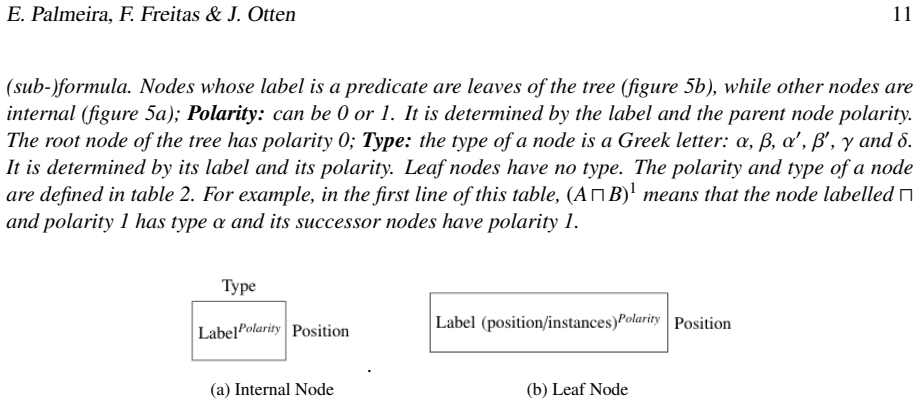
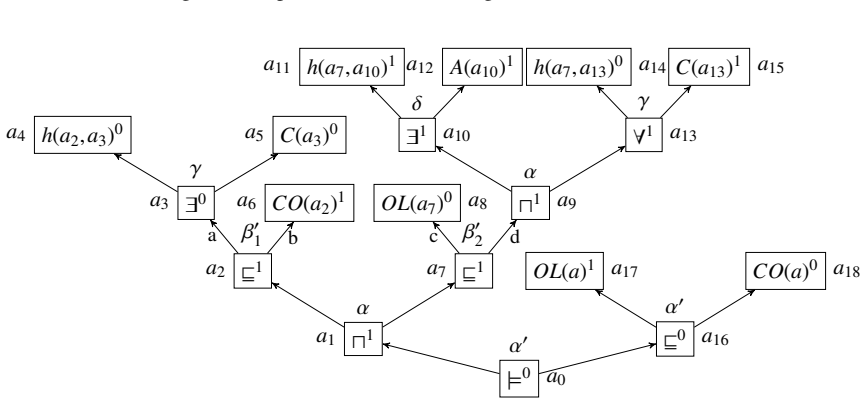
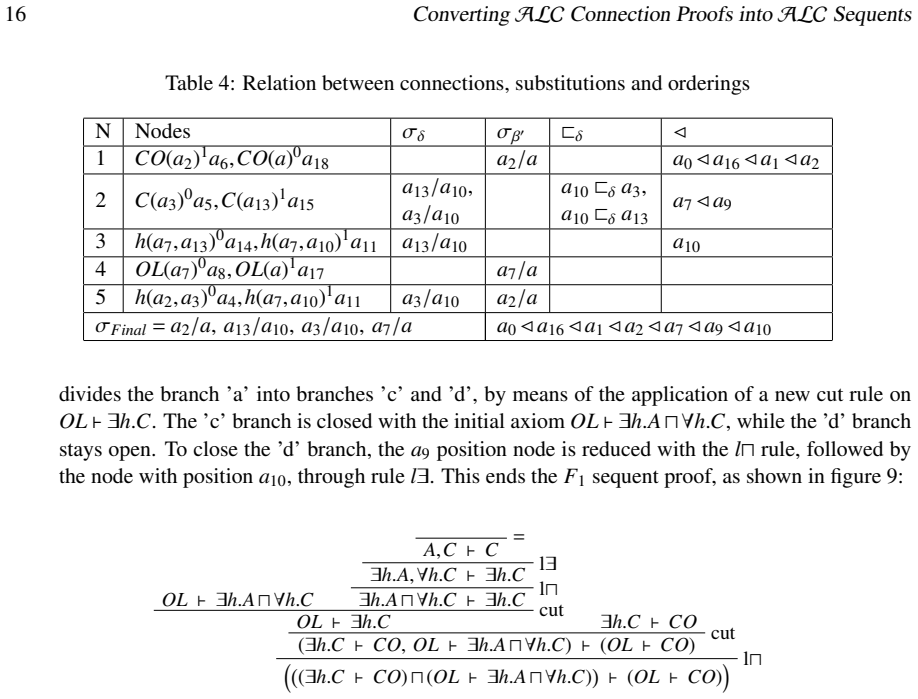
The central object is the formula tree, a syntactic tree of the input ALC formula whose nodes are labelled with positions, polarities, and types $\alpha$, $\alpha'$, $\beta$, $\beta'$, $\gamma$, and $\delta$; the type of a node determines which sequent rule applies, for example an $\sqcap$-node with polarity 1 becomes $l\sqcap$ and a $\beta'$-node is reduced by the cut rule. The argument runs on the reduction order $\triangleleft$, defined as the transitive closure of $(\prec \cup \sqsubset_\delta \cup \sqsubset_{\beta'})^+$: $\prec$ is the tree ordering, $\sqsubset_\delta$ records that a type-$\delta$ node must be reduced before a type-$\gamma$ node whose position it replaces, and $\sqsubset_{\beta'}$ records instantiations of $\beta'$/ $\gamma$/ $\delta$ positions. The machinery works because the reduction order turns the spatial, path-checking information of a matrix proof into a linear schedule of sequent inferences, and the $\sigma_{\mathrm{Final}}$ substitution keeps track of which universal and existential positions are identified and which variables are instantiated. Admissibility of $\sigma_{\mathrm{Final}}$---non-reflexivity of $\triangleleft$---is the condition that the schedule is acyclic and hence executable as a sequent proof.
What would settle it
Exhibit one non-clausal ALC connection proof whose $\sigma_{\mathrm{Final}}$ substitution induces a reflexive reduction order, or run the conversion procedure on proofs emitted by a connection-based ALC reasoner and find any proof that terminates without an admissible substitution; either observation would refute the claim that all such proofs can be converted.
Extended reading notes
Core claim
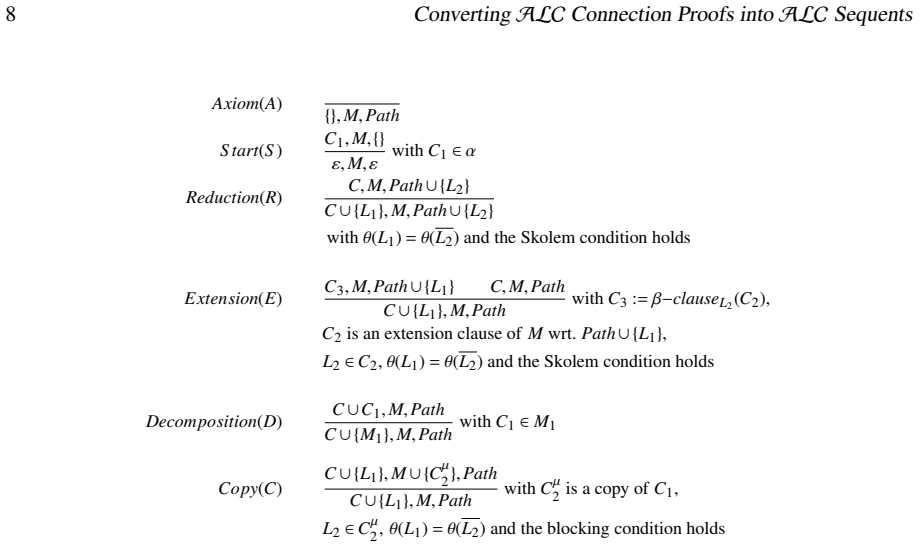
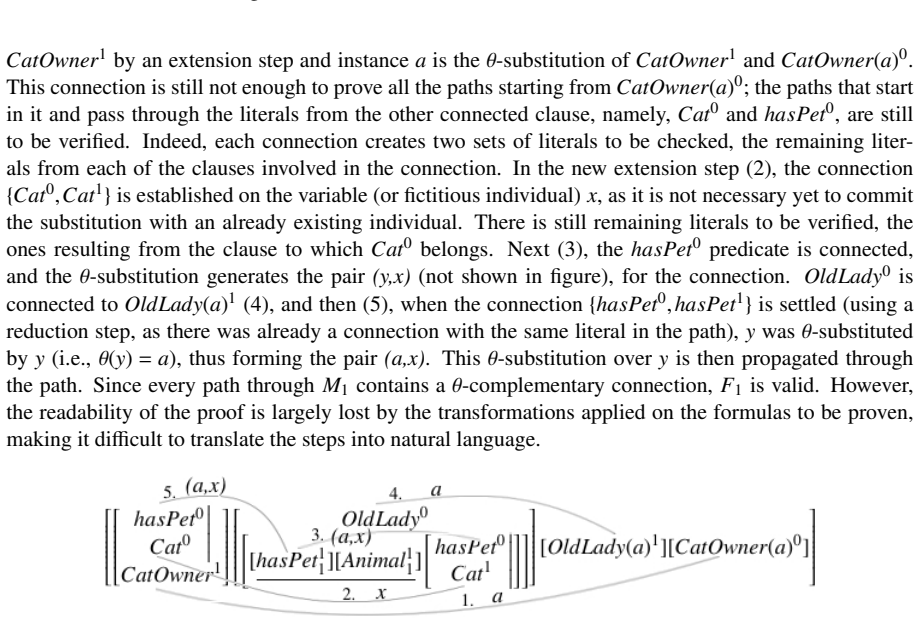
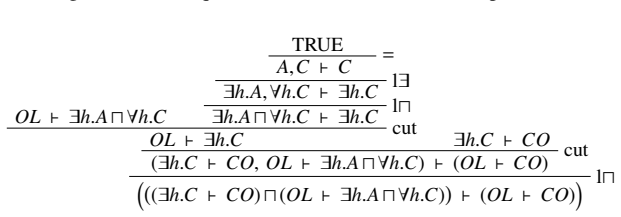
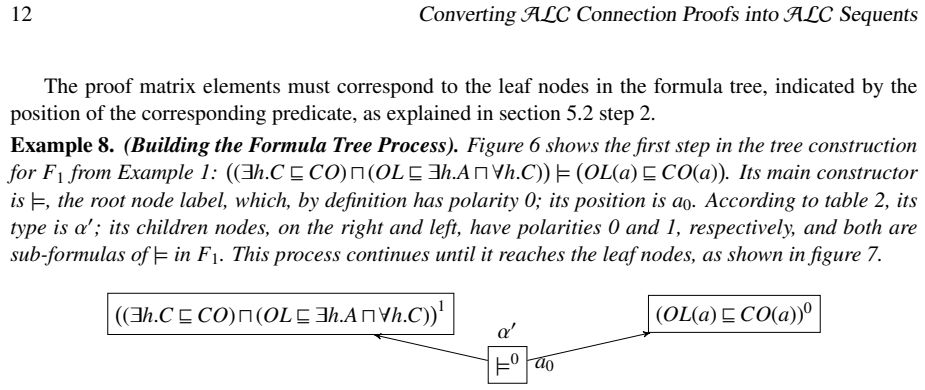
On the paper's own terms, the central claim is a constructive translation theorem: given an ALC query and a non-clausal $\theta$-connection proof of it, the procedure of Section 5.2 produces a proof in the ALC sequent calculus. The bridge is the $\sigma_{\mathrm{Final}}$ substitution, made of a position substitution $\sigma_\delta$ that maps type-$\gamma$ universal positions to type-$\delta$ existential positions and a second substitution $\sigma_{\beta'}$ that maps $\beta'$, $\gamma$, and $\delta$ positions to instances or $\beta'$ positions. Connections in the matrix proof become $\sigma_{\mathrm{Final}}$-complementary pairs of leaf nodes, and the transitive closure of the tree ordering with the relations induced by $\sigma_\delta$ and $\sigma_{\beta'}$ yields a reduction order $\triangleleft$ that schedules sequent rule applications. Definition 21 states that when $\triangleleft$ is not reflexive, $\sigma_{\mathrm{Final}}$ is admissible and a sequent proof can be constructed; the worked example of an ontology query about old ladies, cats, and cat owners shows each connection closing a branch of the sequent proof, with $\beta'$ nodes triggering cut rules. The conversion therefore gives a way to view the entire connection proof as a readable sequent derivation rather than a set of complementary pairs.
Load-bearing premise
The load-bearing premise is that every non-clausal ALC connection proof yields an admissible $\sigma_{\mathrm{Final}}$ substitution---that is, one whose reduction order is not reflexive---because the paper asserts but does not prove this for all connection proofs.
Editorial extensions
If this is right
- A connection-method proof for an ALC query no longer has to be read through the lens of clause-form transformations; the converted sequent proof operates on the original formula structure.
- Each connection in the matrix proof corresponds to closing a branch of the sequent proof, with the reduction order $\triangleleft$ fixing the order of rule applications, so the translation is deterministic once the formula tree and substitutions are fixed.
- Because the main algorithms run in polynomial time, with the most expensive step at $O(n^4)$ for connection search, the conversion is practically feasible for proofs produced by connection-based ALC reasoners.
- The resulting sequent proofs are better suited to automatic translation into natural-language justifications, as the paper demonstrates on the old-lady/cat-owner example.
- The correspondence table between node types and sequent rules gives a direct recipe for assigning a sequent inference to every reduction step in the connection proof.
Reading between the lines
- This suggests a practical test: instrument a connection-method prover for ALC to output $\sigma_{\mathrm{Final}}$ together with each proof, then check how often the reduction order is non-reflexive; if reflexive orders occur in real ontologies, the conversion would need a fallback for those cases.
- One could formalize Definition 21 in a proof assistant and prove that admissibility of $\sigma_{\mathrm{Final}}$ is not only sufficient but also necessary for the existence of a sequent proof respecting the eigenvariable conditions, which the paper states but does not fully demonstrate.
- Because the converted proofs use the cut rule for $\beta'$ nodes, a natural next step is to study whether cut elimination applied after conversion yields a cut-free ALC sequent proof, which would connect this work to standard proof normalization.
- The same tree-ordering-and-substitution recipe may extend to other non-clausal connection calculi or other description logics, since the position machinery is not specific to ALC connectives.
Signed reviews
Editorial analysis
A structured set of objections, weighed in public.
Referee Report
Summary. The paper proposes a method for converting proofs produced by the non-clausal ALCθ-connection calculus [5,8] into proofs in the ALC sequent calculus of Borgida et al. [4]. The conversion proceeds in four steps: (1) building a formula tree with positions, polarities, and node types; (2) assigning matrix elements to leaf positions; (3) constructing a partial sequent proof structure from connections and a reduction order; (4) completing the sequent proof. The central claim is that if the final substitution σFinal is admissible in the sense that the induced reduction order ◁ is non-reflexive, then a sequent proof can be constructed (Definition 21). The paper illustrates the method on a single nontrivial ontology query and gives a brief complexity overview.
Significance. If the conversion were fully established, it would provide a useful bridge between efficient connection-method reasoning for ALC and readable sequent-style proofs, with potential applications to explanation generation and user interaction with description logic reasoners. The paper has clear strengths: it targets a concrete and relevant proof calculus, it includes a detailed worked example, it explicitly defines the target sequent calculus, and it states a concrete polynomial complexity claim (O(n^4) for the search-connections algorithm). The idea of using σδ and σβ′ substitutions to manage the order of quantifier reductions is promising. However, as submitted, the central correctness claim is not established: Definition 21 is stated without proof, the reduction order is not fully defined (⊏β′ is missing), and the crucial Steps 3 and 4 of Section 5.2 are described only informally via the example. The paper also defers the actual algorithms to the author's thesis [10], so the complexity claims cannot be checked from the text.
major comments (4)
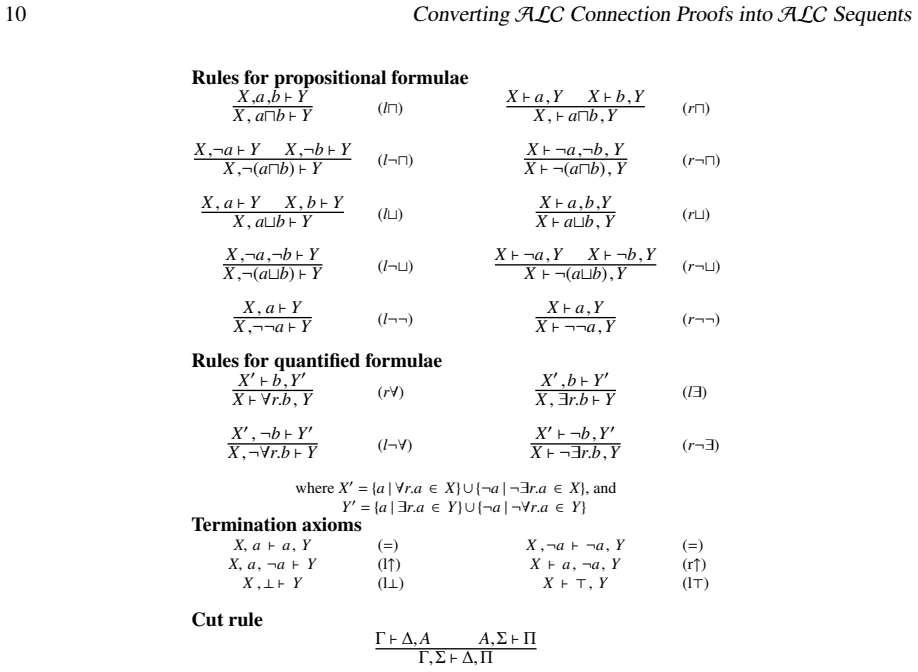
- [Section 5, Definition 21] The admissibility criterion for σFinal—non-reflexivity of the reduction order ◁—is stated to be sufficient for constructing a sequent proof, but no proof or lemma is provided that (a) every connection proof produced by the calculus of Figure 1 yields an admissible σFinal, or (b) the resulting reduction order respects the eigenvariable condition of the δ-rules (r∀, l∃, l¬∀, r¬∃) of Section 4. Non-reflexivity merely rules out cycles in ◁; it does not prevent a δ-rule from being applied when its eigenvariable already occurs elsewhere in the lower sequent, which is the actual side condition of the target sequent calculus. This is the central correctness gate of the paper, and it is not demonstrated.
- [Section 5, Definitions 16 and 20] The ordering ⊏β′ is used in Definition 20 to define the reduction order ◁ as the transitive closure of ≺, ⊏δ, and ⊏β′, but Definition 16 defines only the substitution σβ′ and never defines an induced ordering ⊏β′. Without this ordering, the expression (≺∪⊏δ∪⊏β′)+ is not well-defined, and the admissibility predicate of Definition 21 cannot be checked from the text. This under-specification affects the main claim and the running example, where reduction orders involving β′ nodes are asserted without the missing definition.
- [Section 5.2, Steps 3 and 4] The construction of the partial sequent proof structure is described only informally through the example. In Step 3, connections are 'analyzed' and the text states, for instance, that 'the second connection was only reached in the tree after the third connection,' but no algorithm or invariant specifies the order in which connections are processed or how paths between leaf nodes are combined into a reduction order. Step 4 is similarly informal: it says the partial structure is 'traversed,' but gives no rule for how the traversal yields the final sequent proof. Without a formal description, the conversion cannot be checked, implemented, or verified from the paper alone.
- [Section 6] The complexity claims are made about algorithms that are only named, with the statement 'All the algorithms are demonstrated in [10]'. Since the conversion procedure is not fully specified in this paper—particularly Steps 3 and 4 of Section 5.2—the polynomial complexity claim cannot be verified from the manuscript, and the correctness of the method remains dependent on an external thesis that is not available to the reader.
minor comments (5)
- [Section 4, Figure 3] The axiom rule labelled (l⊤) has ⊤ on the right of the sequent, so the label should be (r⊤).
- [Section 2 and Section 5.1] There are several typos: 'th following formulae' in Section 2, 'eingevariable' in Section 5.1, and 'sequent poof' in Definition 20; these should be corrected.
- [Example 6] The sentence 'y was θ-substituted by y (i.e., θ(y) = a)' is confusing and appears to contain a typo; it should state which variable is substituted by a. Also, in Example 1 the FOL rendering of the second axiom contains a free variable z in the conjunct ∀k(hasPet(z,k)→Cat(k)).
- [Table 3] Several entries in Table 3 are empty (e.g., for ∃0, ∀1, ⊑0 under 'Typeδ'/'Typeγ'), which could be interpreted as missing rules; a brief note explaining that some node polarities/types have no directly corresponding rule in the target calculus would improve clarity.
- [Section 5.2, Step 3 example] The running example is difficult to follow because branch names a, b, c, d are introduced without a figure showing their positions in the formula tree; a version of Figure 7 with branch annotations would substantially improve readability.
Circularity Check
No circularity: the conversion is a constructive translation from connection proofs to sequent proofs; the unproved admissibility criterion is a correctness gap, not a circular reduction.
full rationale
Step-by-step, Section 5.2's conversion takes an existing non-clausal ALC theta-connection proof as input and constructs a formula tree (Step 1), assigns matrix positions (Step 2), builds a partial sequent structure from the connection paths (Step 3), and then emits the complete sequent proof using Table 3's rule correspondence (Step 4). The output is not contained in the input: the input is a matrix/connection proof and the output is a sequent derivation in the external calculus of [4]. Definition 21 states that if the reduction order is non-reflexive then a sequent proof can be constructed, but this is asserted rather than proved; together with the undefined ordering, this is an under-specification and proof gap, not a circularity. The self-citations ([5], [8], [9], [10]) support the background connection calculus, the RACCOON reasoner, and the thesis containing implementation details; none of them defines the sequent consequence relation in terms of the conclusion or turns a fitted parameter into a predicted output. There is no equation in which a derived quantity equals its input by construction, and no fitted input is renamed as a prediction.
Assumptions & free parameters
assumptions (4)
- domain assumption Matrix characterization (Lemma 1): a matrix M is valid iff there are theta-substitutions and connections such that every path through M contains a theta-complementary connection.
- domain assumption The ALC sequent calculus of Borgida et al. is sound and complete for ALC subsumption, with cut elimination.
- ad hoc to paper Definition 21: if the reduction order is not reflexive, a sequent proof can be constructed.
- ad hoc to paper The reduction order respects the eigenvariable conditions of the gamma/delta sequent rules.
Cite this review
Pith. "Pith review of Converting ALC Connection Proofs into ALC Sequents." pith.science (2026). https://pith.science/paper/3OYEZDTN
@misc{pith2026190809477,
  author       = {Pith},
  title        = {Pith review of: Converting ALC Connection Proofs into ALC Sequents},
  year         = {2026},
  howpublished = {\url{https://pith.science/paper/3OYEZDTN}},
  note         = {Machine review of arXiv:1908.09477}
}
read the original abstract
The connection method has earned good reputation in the area of automated theorem proving, due to its simplicity, efficiency and rational use of memory. This method has been applied recently in automatic provers that reason over ontologies written in the description logic ALC. However, proofs generated by connection calculi are difficult to understand. Proof readability is largely lost by the transformations to disjunctive normal form applied over the formulae to be proven. Such a proof model, albeit efficient, prevents inference systems based on it from effectively providing justifications and/or descriptions of the steps used in inferences. To address this problem, in this paper we propose a method for converting matricial proofs generated by the ALC connection method to ALC sequent proofs, which are much easier to understand, and whose translation to natural language is more straightforward. We also describe a calculus that accepts the input formula in a non-clausal ALC format, what simplifies the translation.
Figures
Figures from the paper (7 more)


Reference graph
Works this paper leans on
-
[10]
E. Palmeira (2017): Conversion of Proof in Description LogicALC Generated by Connection Method into Sequents. Ph.D. thesis, Federal University of Pernambuco
work page 2017
-
[4]
A. Borgida, E. Franconi & I. Horrocks (2000): ExplainingALC Subsumption. In: ECAI 2000, Proceedings of the 14th European Conference on Artificial Intelligence, Berlin, Germany, 2000, pp. 209–213
work page 2000
- [1]
-
[2]
F. Baader, I. Horrocks & U. Sattler (2008): Description Logics. In: Handbook of Knowledge Representation, Foundations of Artificial Intelligence 3, Elsevier, pp. 135–179, doi:10.1016/S1574-6526(07)03003-9
-
[3]
Bibel (1993): Deduction - automated logic
W. Bibel (1993): Deduction - automated logic. Academic Press
work page 1993
-
[5]
F. Freitas & J. Otten (2016): A Connection Calculus for the Description Logic ALC. In: Advances in Artificial Intelligence - 29th Canadian Conference on Artificial Intelligence, Canadian AI 2016, Victoria, BC, Canada, May 31 - June 3, 2016. Proceedings, pp. 243–256, doi:10.1007/978-3-319-34111-8 30
-
[6]
Jean-Yves Girard, Paul Taylor & Yves Lafont (1989): Proofs and Types. Cambridge University Press
work page 1989
-
[7]
Horrocks (2008): Ontologies and the semantic web
I. Horrocks (2008): Ontologies and the semantic web . Commun. ACM 51(12), pp. 58–67, doi:10.1145/1409360.1409377
Show all 11 references
-
[8]
D. Melo, F. Freitas & J. Otten (2017):RACCOON: A Connection Reasoner for the Description Logic ALC. In: LPAR-21, 21st International Conference on Logic for Programming, Artificial Intelligence and Reasoning, Maun, Botswana, May 7-12, 2017, pp. 200–211
2017
-
[9]
Otten (2011): A Non-clausal Connection Calculus
J. Otten (2011): A Non-clausal Connection Calculus . In: Automated Reasoning with Analytic Tableaux and Related Methods - 20th International Conference, TABLEAUX 2011, Bern, Switzerland, July 4-8, 2011. Proceedings, pp. 226–241, doi:10.1007/978-3-642-22119-4 18
2011 doi
-
[11]
D. A. Plaisted & S. Greenbaum (1986): A Structure-Preserving Clause Form Translation. J. Symb. Comput. 2(3), pp. 293–304, doi:10.1016/S0747-7171(86)80028-1
1986 doi
Reviewed August 14, 2026 · model on record in the stance chip above.
Discussion (0). Continue with ORCID to comment.