REVIEW 2 major objections 5 minor 158 references
CubeSat Communications: Recent Advances and Future Challenges
T0 review · 2 major / 5 minor · reviewed 2026-08-14 · deepseek-v4-flash
Pith's one-line read This paper claims to be the first consolidated survey of CubeSat communications, covering constellation design, channel modeling, modulation and coding, and networking in one place.
desk verdict A useful entry-point survey of CubeSat communications, but its 'first consolidated survey' claim collapses against its own Table II, and a few factual slips need fixing. read the letter →
The pith
A machine-rendered reading of the paper's core claim, the machinery that carries it, and where it could break.
The reading
What carries the argument
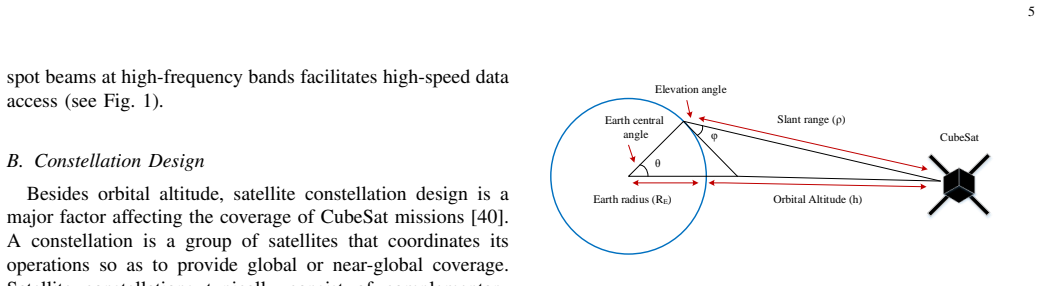
The working machinery is the division of CubeSat links into CubeSat-to-ground and CubeSat-to-CubeSat links, carried through the paper by the link-budget expression $E_b/N_0 = P_t G_t G_r/(L k T R_b)$ and by a set of statistical channel models whose parameters include elevation angle, shadowing, multipath, and Doppler. These pieces do the work of connecting orbital geometry to signal reliability: the coverage formulas convert altitude and elevation angle into the required number of satellites and orbital planes, the link budget converts geometry into energy per bit, and the recommended modulation tables from the space-data-systems standards body convert the result into concrete waveform choices.
What would settle it
Take received-power time series from a CubeSat downlink over elevation angles from about 5 to 30 degrees in a rural area and compare the empirical envelope distribution to the log-normal line-of-sight/Rayleigh multipath model and the Rician/log-normal model; if the fits degrade badly at low elevations or deviate systematically from CubeSat-specific parameters, the paper's adoption of land-mobile-satellite models for CubeSats is not supported.
Extended reading notes
Core claim
On its own terms, the paper's central claim is that no existing review covers the CubeSat communication system as a whole, and that the missing piece is an account of how technical choices interact. It argues that the number of satellites and orbital planes needed for coverage follows from altitude and elevation angle; that channel models for CubeSat-to-ground links can be drawn from land-mobile-satellite statistics, with dynamic Markov-chain models best suited to the satellite's motion; that the link budget equation $E_b/N_0 = P_t G_t G_r/(L k T R_b)$ ties orbit geometry to achievable data rates; and that modulation, coding, medium access, and routing must be selected jointly with these constraints. The survey closes by identifying open problems in integration with next-generation wireless systems, scheduling, software-defined networking, and the Internet of space things.
Load-bearing premise
The survey's channel-model guidance assumes that statistical land-mobile-satellite channel models, built for full-size satellites, still describe CubeSat-to-ground links even though CubeSats transmit at about one watt and have small antennas and different link geometry.
Editorial extensions
If this is right
- A CubeSat mission can be planned end-to-end from altitude and elevation angle to modulation and coding using the survey's linked formulas and tables.
- Dynamic multi-state Markov channel models are more appropriate than static single-state models for CubeSat-to-ground links because the satellite's motion exposes the link to changing shadowing and multipath conditions.
- Higher frequency bands such as X-band and Ka-band enable higher data rates but demand more accurate pointing and incur greater atmospheric losses, so the choice of band must be balanced against the mission's power and pass duration.
- CubeSat-to-CubeSat optical links can provide very high data rates with low bit error rates but require precise tracking and acquisition, making radio-frequency links the practical default for many near-term missions.
- Future CubeSat networks will likely integrate with terrestrial IoT-style systems and software-defined networking, with machine learning used to allocate power and spectrum across multiple bands.
Reading between the lines
- Editorial inference: the land-mobile-satellite-to-CubeSat transfer is testable with public telemetry; if empirical envelope fits at elevations below about 10 degrees are poor, the survey's channel-modeling recommendations would need a CubeSat-specific replacement.
- Editorial inference: the coverage formulas could be packaged into a quick constellation-sizing rule, but the paper itself stops at presenting the equations rather than a closed-form optimization.
- Editorial inference: the survey's emphasis on dynamic Markov models implies that a standardized CubeSat channel-model benchmark could emerge, though the paper does not specify the parameters such a benchmark would need.
Signed reviews
Editorial analysis
A structured set of objections, weighed in public.
Referee Report
Summary. This paper is a survey of CubeSat communications, covering constellation design and coverage, communication links and channel modeling, link budget analysis, modulation and coding, MAC protocols, networking, application-layer protocols, and future research directions such as IoST, LoRa, and machine learning. The authors claim that it is the first consolidated survey of CubeSat communication systems, connecting technical choices (e.g., altitude, modulation, MAC) to mission goals, and they support this with a broad review of academic and industrial works, tables of missions and protocols, and illustrative evaluations of standard link-budget and constellation formulas.
Significance. If the novelty claim were fully supported, this survey would be a valuable entry point for researchers and practitioners, since it spans the full communication stack and includes tables that organize mission and protocol data. The paper assembles a representative set of citations and standard formulas, and its discussion of future directions (e.g., LoRa, SDN, machine learning) is timely. The strengths are the breadth of coverage and the explicit connection between satellite altitude/elevation and link metrics. However, the central novelty claim is overstated relative to the paper's own Table II, and the channel-modeling section adopts LMS models for CubeSats without adequate validation; these issues need to be addressed before the survey can be considered a definitive reference.
major comments (2)
- [Section I-B and Table II] The claim that 'there is no consolidated article that provides a comprehensive survey of CubeSat communication system' is not supported by the paper's own comparison in Table II. The table lists [4] (Davoli et al., 2018) as covering small satellite missions, antennas design, and networking, and [30] (Radhakrishnan et al., 2016) as a survey of inter-satellite communication from the physical layer to the network layer. Both are consolidated communication-focused surveys that overlap with the present paper's Sections III-VII. The authors should either provide a topic-by-topic gap analysis showing which of their sections are absent from [4] and [30], or qualify the claim (e.g., 'first survey to also cover channel modeling and future research directions'). As written, the uniqueness claim is the manuscript's stated raison d'être, and this counter-evidence from its own table makes the claim load-bearing and currently unsupported.
- [Section III] The channel-modeling section presents Loo's model, Corazza-Vatalaro's model, Patzold's model, and other land-mobile-satellite (LMS) models as applicable to CubeSat communications, despite the paper's own acknowledgment that CubeSats have limited transmit power (1 W), lower antenna gains, and a different link geometry. No measurements or simulation results are provided to show that these LMS models, developed for full-size LEO satellites, remain valid for CubeSat links at low elevation angles. Since channel modeling is one of the paper's four stated technical contributions (as listed in Section I-B), the authors should either present CubeSat-specific validation data or explicitly state that the transferability of LMS models to CubeSat links is an open research question. Without such a caveat or evidence, the survey's recommendations on channel models could mislead readers.
minor comments (5)
- [Section I, paragraph 2] The classification of CubeSats as 'pico-satellites' contradicts the paper's own weight scheme, which defines pico-satellites as 0.1-1 kg; a 1U CubeSat has a mass of 1.33 kg and therefore falls in the nano-satellite category (1-10 kg). Please correct this internal inconsistency.
- [Section IX-D] The statement that 'NASA aims to establish a human colony on Mars by 2025' is factually incorrect; NASA's publicly stated plans target the 2030s and do not use the term 'colony.' The cited source [149] is a marketing blog and not an authoritative reference. Please replace this with a correct and properly sourced statement.
- [Throughout] The manuscript contains numerous typos and grammatical errors, including 'develoment' (Section I), 'propsoed' (Section VII), 'becasue' (Section III-B), 'donwlink' (reference [102] title), and 'to the best of ours knowledge' (Section I-B). The paper would benefit from a careful proofreading pass.
- [Section IV, Fig. 12] The caption of Fig. 12 states that the energy-per-bit to noise spectral density is shown 'for various frequency bands and elevation angles,' but the legend appears to include only two frequency bands (L-band and VHF-band) and no explicit elevation-angle variations. Please clarify the curves or update the caption.
- [Section III-B] The sentence about LED-based VLC links states that a 4 W transmit power achieves 2 Mbps at 500 meters, but earlier the paper notes CubeSats are limited to 1 W (30 dBm) for downlink; please clarify whether the 4 W transmitter would be aboard the CubeSat or at the ground station, and if aboard, how this complies with the stated power constraint.
Circularity Check
No circularity: a self-contained survey whose illustrative plots evaluate standard formulas with stated parameters.
full rationale
No circular step is present. The paper is a survey; its load-bearing quantitative content consists of evaluations of standard closed-form expressions, not fitted predictions. Equations (1)-(4) are classical coverage geometry, and Eqs. (21)-(25) are the textbook link-budget equations; the plots in Figs. 4, 5, 10-12 evaluate those formulas at parameter values listed in Table IV and the text, with no fitted coefficient and no output that is also an input. The channel-model section (Section III) catalogs independently published LMS models (Loo, Corazza-Vatalaro, Hwang, Patzold, etc.); the claim that these models are usable for CubeSats is a stated assumption, explicitly qualified by the 'limited power' and 'differing geometry' caveats, and is not manufactured by this paper's own equations. The only self-citations ([53], [141], [153]) support a generic architecture figure and future-direction remarks; none is used as the basis of a claimed result. The 'first consolidated survey' statement in Section I-B is an assertion of novelty that is debatable (Table II lists prior communication-focused surveys), but a novelty claim is not a derivation and nothing in the paper is forced by it. Hence the appropriate finding is no significant circularity, with a score reflecting only the presence of minor, non-load-bearing self-citations.
Assumptions & free parameters
free parameters (3)
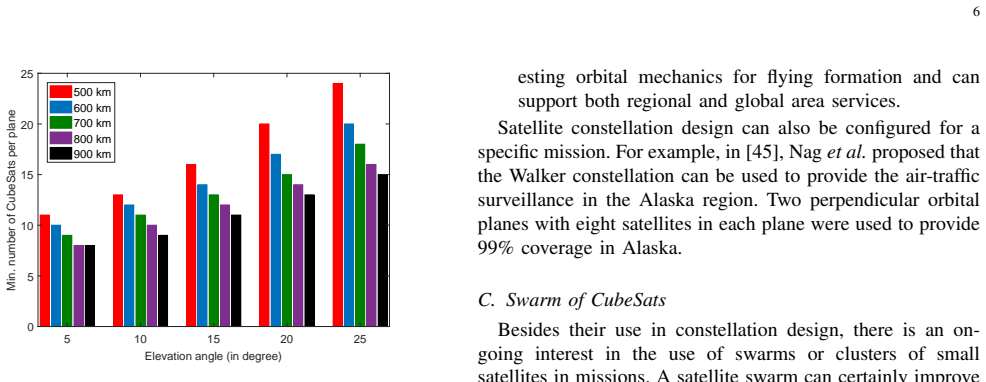
- Orbital altitude and elevation angle ranges for constellation coverage plots =
h: 500-900 km; elevation: 5-25 degrees
- Link budget parameter set for Eb/N0 curves =
Pt=15 dBm, Gt=0 dBi, Gr=12 dBi, T=1160 K, Rb=2.4 kbps, losses as listed
- Frequency bands for path loss and Eb/N0 plots =
L-band 1.2 GHz; VHF 144 MHz
assumptions (3)
- domain assumption LMS channel models developed for full-size LEO satellites are applicable to CubeSat-to-ground links.
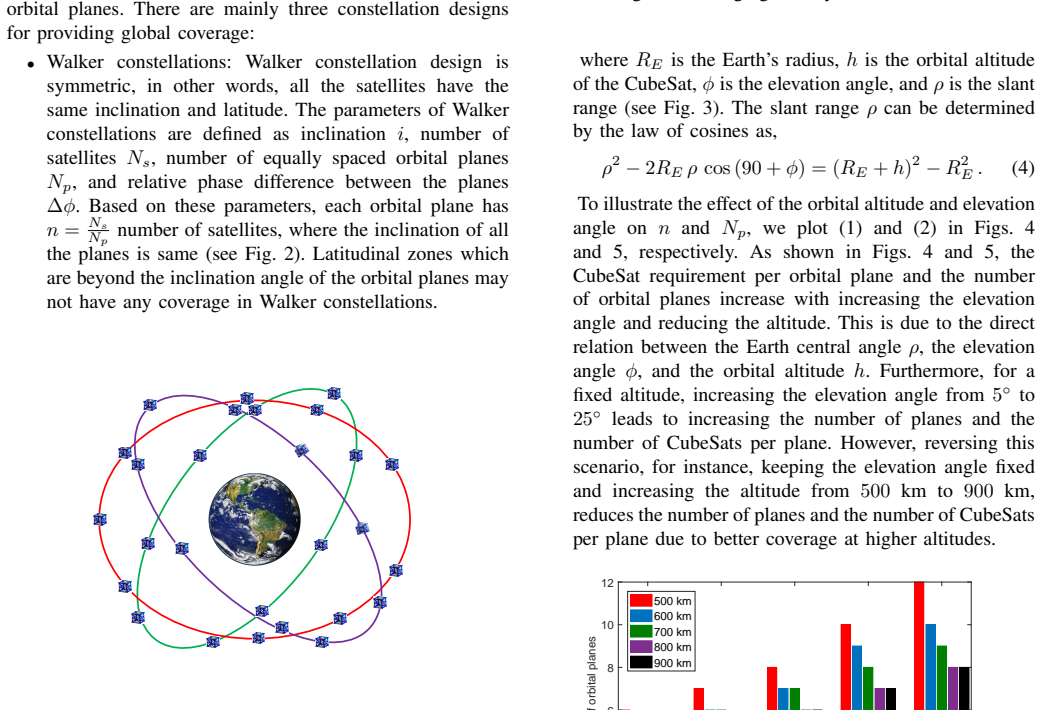
- domain assumption Conventional constellation design formulas (Walker, street-of-coverage, flower) apply to CubeSats without CubeSat-specific propulsion or pointing constraints.
- standard math Link budget equations for satellite downlinks (Friis transmission equation and loss terms) hold for CubeSat links.
Cite this review
Pith. "Pith review of CubeSat Communications: Recent Advances and Future Challenges." pith.science (2026). https://pith.science/paper/NGWX7ORA
@misc{pith2026190809501,
  author       = {Pith},
  title        = {Pith review of: CubeSat Communications: Recent Advances and Future Challenges},
  year         = {2026},
  howpublished = {\url{https://pith.science/paper/NGWX7ORA}},
  note         = {Machine review of arXiv:1908.09501}
}
read the original abstract
Given the increasing number of space-related applications, research in the emerging space industry is becoming more and more attractive. One compelling area of current space research is the design of miniaturized satellites, known as CubeSats, which are enticing because of their numerous applications and low design-and-deployment cost. The new paradigm of connected space through CubeSats makes possible a wide range of applications, such as Earth remote sensing, space exploration, and rural connectivity. CubeSats further provide a complementary connectivity solution to the pervasive Internet of Things (IoT) networks, leading to a globally connected cyber-physical system. This paper presents a holistic overview of various aspects of CubeSat missions and provides a thorough review of the topic from both academic and industrial perspectives. We further present recent advances in the area of CubeSat communications, with an emphasis on constellation-and-coverage issues, channel modeling, modulation and coding, and networking. Finally, we identify several future research directions for CubeSat communications, including Internet of space things, low-power long-range networks, and machine learning for CubeSat resource allocation.
Figures

Figures from the paper (10 more)



Reference graph
Works this paper leans on
-
[4]
Small satellites and CubeSats: Survey of structures, ar- chitectures, and protocols,
F. Davoli, C. Kourogiorgas, M. Marchese, A. Panagopoulos, and F. Patrone, “Small satellites and CubeSats: Survey of structures, ar- chitectures, and protocols,” Int. J. of Satellite Commun. and Network. , vol. 1, no. 17, pp. 1–17, 2018
2018
-
[30]
Survey of inter-satellite com- munication for small satellite systems: Physical layer to network layer view,
R. Radhakrishnan, W. W. Edmonson, F. Afghah, R. M. Rodriguez- Osorio, F. Pinto, and S. C. Burleigh, “Survey of inter-satellite com- munication for small satellite systems: Physical layer to network layer view,” IEEE Commun. Surveys Tuts. , vol. 18, no. 4, pp. 2442–2473, Oct. 2016
2016
-
[1]
Why Facebook, SpaceX and dozens of others are battling over Internet access from space,
“Why Facebook, SpaceX and dozens of others are battling over Internet access from space,” http://fortune.com/2019/01/25/ facebook-spacex-internet-access-space, accessed: 2019-06-20
2019
-
[2]
Cubesats: Cost-effective science and technology platforms for emerging and developing nations,
K. Woellert, P. Ehrenfreund, A. J. Ricco, and H. Hertzfeld, “Cubesats: Cost-effective science and technology platforms for emerging and developing nations,” Adv. in Space Research, vol. 47, no. 4, pp. 663 – 684, 2011
2011
-
[3]
CubeSats in brief,
“CubeSats in brief,” https://www.isispace.nl/cubesats/, accessed: 2019- 11-21
2019
-
[5]
Link budget analysis for a proposed Cubesat earth observation mission,
D. Barbaric, J. Vukovic, and D. Babic, “Link budget analysis for a proposed Cubesat earth observation mission,” in Int. Convention on Info. and Commun. Techno., Electronics and Microelectronics (MIPRO), May 2018, pp. 133–138
2018
-
[6]
World’s only connectivity solution designed for the poles,
“World’s only connectivity solution designed for the poles,” https:// www.keplercommunications.com/, accessed: 2019-06-20
2019
-
[7]
“Radix,” https://space.skyrocket.de/doc sdat/radix.htm, accessed: 2019-06-20
2019
Show all 158 references
-
[8]
“Gomx-3,” https://gomspace.com/gomx-3.aspx, accessed: 2019-06-25
2019
-
[9]
Lemur-2,
“Lemur-2,” https://space.skyrocket.de/doc sdat/lemur-2.htm, note = Accessed: 2019-06-25
2019
-
[10]
“Dice,” https://earth.esa.int/web/eoportal/satellite-missions/content/ article/dice, accessed: 2019-06-25
2019
-
[11]
Quakesat,
“Quakesat,” https://space.skyrocket.de/doc sdat/quakesat-1.htm, ac- cessed: 2019-06-25
2019
-
[12]
Swarm-to-earth commu- nication in OLFAR,
A. Budianu, A. Meijerink, and M. Bentum, “Swarm-to-earth commu- nication in OLFAR,” Acta Astronautica, vol. 107, pp. 14 – 19, 2015
2015
-
[13]
Cubesat evolution: Analyzing cubesat capabilities for conducting science missions,
A. Poghosyan and A. Golkar, “Cubesat evolution: Analyzing cubesat capabilities for conducting science missions,” Progress in Aerospace Sciences, vol. 88, pp. 59 – 83, 2017
2017
-
[14]
Mars Cube One (MarCO),
“Mars Cube One (MarCO),” https://www.jpl.nasa.gov/cubesat/ missions/marco.php, accessed: 2019-06-25
2019
-
[15]
Integrated solar array & reflectarray antenna (ISARA),
“Integrated solar array & reflectarray antenna (ISARA),” https://www. jpl.nasa.gov/cubesat/missions/isara.php, accessed: 2019-06-25
2019
-
[16]
AeroCube-OCSD,
“AeroCube-OCSD,” https://directory.eoportal.org/web/eoportal/ satellite-missions/a/aerocube-ocsd, accessed: 2019-06-25
2019
-
[17]
Arcsecond space telescope enabling research in astrophysics (AS- TERIA),
“Arcsecond space telescope enabling research in astrophysics (AS- TERIA),” https://www.jpl.nasa.gov/cubesat/missions/asteria.php, ac- cessed: 2019-06-25
2019
-
[18]
SpaceX submits paperwork for 30,000 more starlink satellites,
“SpaceX submits paperwork for 30,000 more starlink satellites,” https://spacenews.com/ spacex-submits-paperwork-for-30000-more-starlink-satellites/, accessed: 2019-10-11
2019
-
[19]
Whereever you are, we will cover you,
“Whereever you are, we will cover you,” https://oneweb.world, ac- cessed: 2019-10-11
2019
-
[20]
Telesat LEO: Why LEO?
“Telesat LEO: Why LEO?” https://www.telesat.com/services/leo/ why-leo, accessed: 2019-12-02
2019
-
[21]
Amazon’s Kuiper Systems Joins SIA
“Amazon’s Kuiper Systems Joins SIA.”
-
[22]
Applications of nano-satellites and cube-satellites in microwave and RF domain,
R. N. Simons and K. Goverdhanam, “Applications of nano-satellites and cube-satellites in microwave and RF domain,” in 2015 IEEE MTT- S International Microwave Symposium , May 2015, pp. 1–4
2015
-
[23]
Nanosatellite and cubesat database,
E. Kulu, “Nanosatellite and cubesat database,” 2019. [Online]. Available: https://www.nanosats.eu/
2019
-
[24]
A review of impending small satellite formation flying missions,
S. Bandyopadhyay, G. P. Subramanian, R. Foust, D. Morgan, S.- J. Chung, and F. Hadaegh, “A review of impending small satellite formation flying missions,” in 53rd AIAA Aerospace Sciences Meeting, 2015, pp. 1–17
2015
-
[25]
Survey, statistical analysis and classification of launched cubesat missions with emphasis on the attitude control method,
H. Polat, J. Virgili-Llop, and M. Romano, “Survey, statistical analysis and classification of launched cubesat missions with emphasis on the attitude control method,” J. of Small Satellites , vol. 5, pp. 513–530, Jan. 2016
2016
-
[26]
Survey of worldwide pico- and nanosatel- lite missions, distributions and subsystem technology,
J. Bouwmeester and J. Guo, “Survey of worldwide pico- and nanosatel- lite missions, distributions and subsystem technology,” Acta Astronau- tica, vol. 67, no. 7, pp. 854 – 862, 2010
2010
-
[27]
The first one hundred CubeSats: A statistical look,
M. Swartwout, “The first one hundred CubeSats: A statistical look,” J. of Small Satellites , vol. 2, no. 2, pp. 213–233, Mar. 2013
2013
-
[28]
Communication technologies and architectures for space network and interplanetary Internet,
J. Mukherjee and B. Ramamurthy, “Communication technologies and architectures for space network and interplanetary Internet,” IEEE Commun. Surveys Tuts., vol. 15, no. 2, pp. 881–897, Jul. 2013
2013
-
[29]
Towards the thousandth CubeSat: A statistical overview,
T. Villela, C. A. Costa, A. M. Brando, F. T. Bueno, and R. Leonardi, “Towards the thousandth CubeSat: A statistical overview,” Int. J. of Aerospace Engineering, vol. 5063145, no. 1, pp. 1–13, Jan. 2017
2017
-
[31]
NASA near earth network (NEN) and 21 space network (SN) CubeSat communications,
S. Schaire, B. Horne, J. Schier, H. Shaw, G. Bussey, P. Celeste, Y . F. Wong, O. Kegege, Y . Zhang, C. Patel, D. Pierce, S. Altunc, D. Raphael, J. Burke, and L. V . Cooper, “NASA near earth network (NEN) and 21 space network (SN) CubeSat communications,” in SpaceOps Conf. , 20...
2016
-
[32]
For satellites, think small, dream big: A review of recent antenna developments for CubeSats
Y . Rahmat-Samii, V . Manohar, and J. M. Kovitz, “For satellites, think small, dream big: A review of recent antenna developments for CubeSats.”IEEE Antennas and Propag. Mag., vol. 59, no. 2, pp. 22–30, Apr. 2017
2017
-
[33]
Modern small satellites-changing the economics of space,
M. N. Sweeting, “Modern small satellites-changing the economics of space,” Proc. of the IEEE , vol. 106, no. 3, pp. 343–361, Mar. 2018
2018
-
[34]
Cubesats for future science and Internet of space: Challenges and opportunities,
A. Gregorio and F. Alimenti, “Cubesats for future science and Internet of space: Challenges and opportunities,” in IEEE Int. Conf. on Elec- tronics, Circuits and Sys., (ICECS) , Dec. 2018, pp. 169–172
2018
-
[35]
Design and architecture of pico-satellites network for earth coverage,
N. Lazreg and K. Besbes, “Design and architecture of pico-satellites network for earth coverage,” in Int. Conf. on Adv. Techno. for Signal and Image Process., (ATSIP) , Mar. 2016, pp. 601–605
2016
-
[36]
“Sstl,” https://www.sstl.co.uk, accessed: 2019-10-11
2019
-
[37]
Wideband circularly polarized fabry-perot antenna,
F. Qin, S. Gao, G. Wei, Q. Luo, C. Mao, C. Gu, J. Xu, and J. Li, “Wideband circularly polarized fabry-perot antenna,” IEEE Antennas and Propag. Mag., vol. 57, no. 5, pp. 127–135, Oct. 2015
2015
-
[38]
Advanced antennas for small satellites,
S. Gao, Y . Rahmat-Samii, R. E. Hodges, and X. Yang, “Advanced antennas for small satellites,” Proc. of the IEEE , vol. 106, no. 3, pp. 391–403, Mar. 2018
2018
-
[39]
Broadband LEO satellite communications: Architectures and key technologies,
Y . Su, Y . Liu, Y . Zhou, J. Yuan, H. Cao, and J. Shi, “Broadband LEO satellite communications: Architectures and key technologies,” IEEE Wireless Commun., vol. 26, no. 2, pp. 55–61, Apr. 2019
2019
-
[40]
Ad hoc CubeSat constella- tions: Secondary launch coverage and distribution,
A. Marinan, A. Nicholas, and K. Cahoy, “Ad hoc CubeSat constella- tions: Secondary launch coverage and distribution,” in IEEE Aerospace Conf., Mar. 2013, pp. 1–15
2013
-
[41]
A new CubeSat design with reconfigurable multi-band radios for dynamic spectrum satellite communication networks,
I. F. Akyildiz, J. M. Jornet, and S. Nie, “A new CubeSat design with reconfigurable multi-band radios for dynamic spectrum satellite communication networks,” Ad Hoc Networks , vol. 86, pp. 166 – 178, 2019
2019
-
[42]
Global communication coverage using cubesats,
Weilian Su, Jianwen Lin, and T. Ha, “Global communication coverage using cubesats,” in IEEE 7th Annual Computing and Commun. Works. and Conf., (CCWC) , Jan 2017, pp. 1–7
2017
-
[43]
Establishing a formation of small satellites in a lunar flower constellation,
L. McManus and H. Schaub, “Establishing a formation of small satellites in a lunar flower constellation,” The J. of the Astronautical Sci., vol. 63, no. 4, pp. 263–286, Dec 2016
2016
-
[44]
New insights on flower constellations theory,
M. E. Avendano and D. Mortari, “New insights on flower constellations theory,”IEEE Trans. Aerospace and Electronic Sys., vol. 48, no. 2, pp. 1018–1030, Apr. 2012
2012
-
[45]
CubeSat constellation design for air traffic monitoring,
S. Nag, J. L. Rios, D. Gerhardt, and C. Pham, “CubeSat constellation design for air traffic monitoring,” Acta Astronautica, vol. 128, pp. 180– 193, 2016
2016
-
[46]
DARPA moves ahead with fractionated-satellite system F6 program with solicitation for affordable satellite bus,
“DARPA moves ahead with fractionated-satellite system F6 program with solicitation for affordable satellite bus,” https://www.militaryaerospace.com/communications/article/16720493, accessed: 2019-07-03
2019
-
[47]
DARPA cancels formation-flying satellite demo,
“DARPA cancels formation-flying satellite demo,” https://spacenews. com/35375darpa-cancels-formation-flying-satellite-demo/, accessed: 2019-07-03
2019
-
[48]
Constellations, clusters, and communica- tion technology: Expanding small satellite access to space,
J. Alvarez and B. Walls, “Constellations, clusters, and communica- tion technology: Expanding small satellite access to space,” in IEEE Aerospace Conf., Mar. 2016, pp. 1–11
2016
-
[49]
Satellite-to-satellite coverage optimization approach for opportunistic inter-satellite links,
I. Lluch and A. Golkar, “Satellite-to-satellite coverage optimization approach for opportunistic inter-satellite links,” in IEEE Aerospace Conf., 2014, pp. 1–13
2014
-
[50]
Nanosatellites swarm deployment using decentralized differential drag-based control with communicational constraints,
D. Ivanov, U. Monakhova, and M. Ovchinnikov, “Nanosatellites swarm deployment using decentralized differential drag-based control with communicational constraints,” Acta Astronautica, vol. 159, pp. 646 – 657, 2019
2019
-
[51]
Swarm of 105 tiny sprite chipsats successfully deployed,
“Swarm of 105 tiny sprite chipsats successfully deployed,” https: //newatlas.com/sprite-chipsat-swarm-deployed/59994/, accessed: 2019- 07-04
2019
-
[52]
Enabling the Internet of arctic things with freely-drifting small-satellite swarms,
D. Palma and R. Birkeland, “Enabling the Internet of arctic things with freely-drifting small-satellite swarms,” IEEE Access , vol. 6, pp. 71 435–71 443, Nov. 2018
2018
-
[53]
To boldly go where no sensor has gone before: The movement to place IoT in radical new spaces,
N. Saeed, M.-S. Alouini, and T. Y . Al-Naffouri, “To boldly go where no sensor has gone before: The movement to place IoT in radical new spaces,” arXiv preprint arXiv:1903.11996 , 2019
1903 arXiv
-
[54]
ShindaiSat : A visible light communica- tion experimental micro-satellite,
A. Nakajima, N. Sako, M. Kamemura, Y . Wakayama, A. Fukuzawa, H. Sugiyama, and N. Okada, “ShindaiSat : A visible light communica- tion experimental micro-satellite,” in Proc. Int. Conf. on Space Optical Sys. and App., (ICSOS) , Oct. 2012, pp. 1–5
2012
-
[55]
Opti- cal communication on CubeSats enabling the next era in space science,
A. Carrasco-Casado, A. Biswas, R. Fields, and B. Grefenstette, “Opti- cal communication on CubeSats enabling the next era in space science,” in IEEE Int. Conf. on Space Optical Sys. and Apps., (ICSOS) , Mar. 2017, pp. 1–7
2017
-
[56]
CubeSat-scale high- speed laser downlinks,
R. Welle, S. Janson, D. Rowen, and T. Rose, “CubeSat-scale high- speed laser downlinks,” in Proc. of the 13th Reinventing Space Conf. , S. Hatton, Ed., 2018, pp. 7–17
2018
-
[57]
Optical communications downlink from a 1.5U Cubesat: OCSD program,
T. S. Rose, D. W. Rowen, S. LaLumondiere, N. I. Werner, R. Linares, A. Faler, J. Wicker, C. M. Coffman, G. A. Maul, D. H. Chien, A. Utter, R. P. Welle, and S. W. Janson, “Optical communications downlink from a 1.5U Cubesat: OCSD program,” inInt. Conf. on Space Optics (ICSO), 2...
2019
-
[58]
A CubeSat-based optical communication network for low earth orbit,
R. Welle, A. Utter, T. Rose, J. Fuller, K. Gates, B. Oakes, and S. Janson, “A CubeSat-based optical communication network for low earth orbit,” in AIAA/USU Conf. on Small Satellite , Mar. 2017, pp. 1–9
2017
-
[59]
Satellite laser communication activities in NICT,
D. R. Kolev, A. Carrasco-Casado, H. Takenaka, Y . Munemasa, P. V . Trinh, Y . Saito, H. Kunimori, Y . Koyama, K. Suzuki, T. Kubooka, and M. Toyoshima, “Satellite laser communication activities in NICT,” in Progress in Electromagnetics Research Symp. (PIERS), Aug. 2018, pp. 1680–1685
2018
-
[60]
The HITRAN database,
L. S. Rothman, R. R. Gamache, A. Goldman, L. R. Brown et al., “The HITRAN database,” Applied optics , vol. 26, no. 19, pp. 4058–4097, 1987
1987
-
[61]
Atmospheric transmittance/radiance: Computer code LOWTRAN 5,
F. X. Kneizys, E. P. Shettle, W. Gallery, J. Chetwynd Jr, and L. Abreu, “Atmospheric transmittance/radiance: Computer code LOWTRAN 5,” Air force geophysics lab Hanscom AFB MA, Tech. Rep., 1980
1980
-
[62]
The infrared & electro- optical systems handbook: Atmospheric propagation of radiation, vol- ume 2
F. G. Smith, J. S. Accetta, and D. L. Shumaker, “The infrared & electro- optical systems handbook: Atmospheric propagation of radiation, vol- ume 2.” Infrared information and analysis center, Tech. Rep., 1993
1993
-
[63]
Optical communication in space: Challenges and mitigation techniques,
H. Kaushal and G. Kaddoum, “Optical communication in space: Challenges and mitigation techniques,” IEEE Commun. Surveys Tuts. , vol. 19, no. 1, pp. 57–96, Aug. 2017
2017
-
[64]
CubeSat networks: Balancing power with satellite-to-ground data throughput,
S. Ennis and J. Dukes, “CubeSat networks: Balancing power with satellite-to-ground data throughput,” in IEEE Aerospace Conf. , Mar. 2018, pp. 1–18
2018
-
[65]
The land mobile earth-space channel,
P. Arapoglou, E. T. Michailidis, A. D. Panagopoulos, A. G. Kanatas, and R. Prieto-Cerdeira, “The land mobile earth-space channel,” IEEE Veh. Techno. Mag., vol. 6, no. 2, pp. 44–53, Jun. 2011
2011
-
[66]
A statistical model for a land mobile satellite link,
Chun Loo, “A statistical model for a land mobile satellite link,” IEEE Trans. on Veh. Techno., vol. 34, no. 3, pp. 122–127, Aug. 1985
1985
-
[67]
A statistical model for land mobile satellite channels and its application to nongeostationary orbit systems,
G. E. Corazza and F. Vatalaro, “A statistical model for land mobile satellite channels and its application to nongeostationary orbit systems,” IEEE Trans. on Veh. Techno., vol. 43, no. 3, pp. 738–742, Aug 1994
1994
-
[68]
Practical chan- nel simulation model for the non-GEO land mobile satellite (lms) communications,
Sung-Chan Ko, Junghwan Kim, and Chen-Ying Yang, “Practical chan- nel simulation model for the non-GEO land mobile satellite (lms) communications,” in IEEE 47th Veh. Techno. Conf., vol. 1, May 1997, pp. 411–415 vol.1
1997
-
[69]
A channel model for nongeostationary orbiting satellite system,
S.-H. Hwang, K.-J. Kim, J.-Y . Ahn, and K.-C. Whang, “A channel model for nongeostationary orbiting satellite system,” in IEEE 47th Veh. Techno. Conf., vol. 1, May 1997, pp. 41–45 vol.1
1997
-
[70]
Physical model of shadowing probability for land mobile satellite propagation,
S. R. Saunders and B. G. Evans, “Physical model of shadowing probability for land mobile satellite propagation,” Electronics Lett. , vol. 32, no. 17, pp. 1548–1549, Aug. 1996
1996
-
[71]
A study of a land mobile satellite channel model with asymmetrical doppler power spectrum and lognormally distributed line-of-sight component,
M. Patzold, Yingchun Li, and F. Laue, “A study of a land mobile satellite channel model with asymmetrical doppler power spectrum and lognormally distributed line-of-sight component,”IEEE Trans. Veh. Techno., vol. 47, no. 1, pp. 297–310, Feb. 1998
1998
-
[72]
Statistical modeling of the LMS channel,
F. P. Fontan, M. Vazquez-Castro, C. E. Cabado, J. P. Garcia, and E. Kubista, “Statistical modeling of the LMS channel,” IEEE Trans. Veh. Techno., vol. 50, no. 6, pp. 1549–1567, Nov. 2001
2001
-
[73]
A new simple model for land mobile satellite channels: first- and second-order statistics,
A. Abdi, W. C. Lau, M. . Alouini, and M. Kaveh, “A new simple model for land mobile satellite channels: first- and second-order statistics,” IEEE Trans. Wireless Commun., vol. 2, no. 3, pp. 519–528, May 2003
2003
-
[74]
SAT04-2: Accurate and novel modeling of the land mobile satellite channel using reversible jump Markov chain monte carlo technique,
S. Scalise, C. Alasseur, L. Husson, and H. Ernst, “SAT04-2: Accurate and novel modeling of the land mobile satellite channel using reversible jump Markov chain monte carlo technique,” in IEEE Globecom, Nov. 2006, pp. 1–6
2006
-
[75]
Modeling of first-order statistics of the MIMO dual polarized channel at 2 GHz for land mobile satellite systems under tree shadowing,
C. Kourogiorgas, M. Kvicera, D. Skraparlis, T. Korinek, V . K. Sakarel- los, A. D. Panagopoulos, and P. Pechac, “Modeling of first-order statistics of the MIMO dual polarized channel at 2 GHz for land mobile satellite systems under tree shadowing,” IEEE Trans. Antennas and Prop...
2014
-
[76]
Finite-state markov chains channel model for cubesats communication uplink,
J. Lopez-Salamanca, L. O. Seman, M. D. Berejuck, and E. A. Bezerra, “Finite-state markov chains channel model for cubesats communication uplink,” IEEE Trans. Aerosp. Electron. Syst. , pp. 1–13, May 2019
2019
-
[77]
Designing the communi- cation sub-system for nanosatellite CubeSat missions: Operational and implementation perspectives,
O. Popescu, J. S. Harris, and D. C. Popescu, “Designing the communi- cation sub-system for nanosatellite CubeSat missions: Operational and implementation perspectives,” in SoutheastCon, Mar. 2016, pp. 1–5
2016
-
[78]
Doppler characterization for LEO satellites,
I. Ali, N. Al-Dhahir, and J. E. Hershey, “Doppler characterization for LEO satellites,” IEEE Trans. on Comm. , vol. 46, no. 3, pp. 309–313, Mar. 1998. 22
1998
-
[79]
Inverse Gaussian-based composite channel model and time series generator for land mobile satellite systems under tree shadowing,
C. Kourogiorgas, M. Kvicera, A. D. Panagopoulos, and P. Pechac, “Inverse Gaussian-based composite channel model and time series generator for land mobile satellite systems under tree shadowing,” IET Microwaves, Antennas Propagation, vol. 10, no. 6, pp. 612–616, Apr. 2016
2016
-
[80]
Handbook of math- ematical functions with formulas, graphs, and mathematical tables,
M. Abramowitz, I. A. Stegun, and R. H. Romer, “Handbook of math- ematical functions with formulas, graphs, and mathematical tables,” 1988
1988
-
[81]
Dual-polarized nar- rowband MIMO LMS channel measurements in urban environments,
V . Nikolaidis, N. Moraitis, and A. G. Kanatas, “Dual-polarized nar- rowband MIMO LMS channel measurements in urban environments,” IEEE Trans. Antennas and Propag. , vol. 65, no. 2, pp. 763–774, Feb. 2017
2017
-
[82]
Preliminary internetworking simulation of the QB50 cubesat constel- lation,
H. Bedon, C. Negron, J. Llantoy, C. Miguel Nieto, and C. O. Asma, “Preliminary internetworking simulation of the QB50 cubesat constel- lation,” in IEEE Latin-American Conf. on Commun. , Sep. 2010, pp. 1–6
2010
-
[83]
Feasibility of intersatellite communication for CubeSats,
D. Bulanova, Y . Wang, and Q. bin Chen, “Feasibility of intersatellite communication for CubeSats,” in Int. Conf. on Electronic and Info. Techno., (ICEIT), 2017, pp. 1–10
2017
-
[84]
Inter- satellite links for cubesats,
A. Budianu, T. J. W. Castro, A. Meijerink, and M. J. Bentum, “Inter- satellite links for cubesats,” in IEEE Aerospace Conf. , Mar. 2013, pp. 1–10
2013
-
[85]
Inter-satellite communication for LEO CubeSat network: QoS parameters and fea- sibility of massive MIMO,
D. Bulanov, K. Ocheretyanyy, Y . Wang, and Q.-B. Chen, “Inter-satellite communication for LEO CubeSat network: QoS parameters and fea- sibility of massive MIMO,” J. of Commun. Techno. and Electronics , vol. 63, no. 10, pp. 1174–1182, Oct 2018
2018
-
[86]
System design of an s-band network of distributed nanosatellites,
Z. Yoon, W. Frese, A. Bukmaier, and K. Bries, “System design of an s-band network of distributed nanosatellites,” CEAS Space J. , vol. 6, no. 1, pp. 61–71, Mar 2014
2014
-
[87]
5.6 Gbps optical intersatellite communication link,
B. Smutny, H. Kaempfner, G. Muehlnikel, U. Sterr, B. Wandernoth et al. , “5.6 Gbps optical intersatellite communication link,” in Free- Space Laser Commun. Techno. , 2009, pp. 38 – 45
2009
-
[88]
Using light-emitting diodes for intersatellite links,
L. Wood, W. Ivancic, and K. Dorpelkus, “Using light-emitting diodes for intersatellite links,” in IEEE Aerospace Conf., Mar. 2010, pp. 1–6
2010
-
[89]
Intersatellite communication system based on visible light,
D. N. Amanor, W. W. Edmonson, and F. Afghah, “Intersatellite communication system based on visible light,” IEEE Trans. Aerosp. Electron. Syst., vol. 54, no. 6, pp. 2888–2899, Dec. 2018
2018
-
[90]
Link performance improvement via design variables optimiza- tion in LED-based VLC system for inter-satellite communication,
——, “Link performance improvement via design variables optimiza- tion in LED-based VLC system for inter-satellite communication,” in IEEE Int. Conf. on Wireless for Space and Extreme Environments (WiSEE), Oct. 2017, pp. 7–12
2017
-
[91]
Design options for small satellite communications,
C. Benson, “Design options for small satellite communications,” in IEEE Aerospace Conf. , Mar. 2017, pp. 1–7
2017
-
[92]
Link budget analysis for a LEO cubesat communication subsystem,
I. Latachi, M. Karim, A. Hanafi, T. Rachidi, A. Khalayoun, N. Assem, S. Dahbi, and S. Zouggar, “Link budget analysis for a LEO cubesat communication subsystem,” in Int. Conf. on Adv. Techno. for Signal and Image Process., (ATSIP) , May 2017, pp. 1–6
2017
-
[93]
Extending the coverage of the internet of things with low-cost nanosatellite networks,
V . Almonacid and L. Franck, “Extending the coverage of the internet of things with low-cost nanosatellite networks,” Acta Astronautica, vol. 138, pp. 95 – 101, 2017
2017
-
[94]
A prediction model that combines rain attenuation and other propagation impairments along earth-satellite paths,
A. Dissanayake, J. Allnutt, and F. Haidara, “A prediction model that combines rain attenuation and other propagation impairments along earth-satellite paths,” IEEE Trans. Antennas Propag. , vol. 45, no. 10, pp. 1546–1558, Oct. 1997
1997
-
[95]
Attenuation by atmospheric gases,
“Attenuation by atmospheric gases,” International Telecommunication Union- Radiocommunication sector (ITU-R), Tech. Rep., Fen. 2012
2012
-
[96]
Polarization loss in a link budget when using measured circular-polarization gains of antennas,
T. Milligan, “Polarization loss in a link budget when using measured circular-polarization gains of antennas,” IEEE Antennas Propag. Mag., vol. 38, no. 1, pp. 56–58, Feb. 1996
1996
-
[97]
Circular polarization and polarization losses,
R. Galuscak and P. Hazdra, “Circular polarization and polarization losses,” DuBuS, pp. 8–23, 2006
2006
-
[98]
R. M. Gagliardi, Satellite communications . Springer Science & Business Media, 2012
2012
-
[99]
Gimbal for steering propelled CubeSats (NP-2017-06- 2403-HQ),
S. Nabors, “Gimbal for steering propelled CubeSats (NP-2017-06- 2403-HQ),” Marshall Space Flight Center, NASA, Huntsville, Tech. Rep., 2017
2017
-
[100]
Signal quality evaluation for picosatellite communication systems,
I. Vertat, M. Pokorny, R. Linhart, and T. Kavalir, “Signal quality evaluation for picosatellite communication systems,” in Int. Conf. on Applied Electronics, Sep. 2012, pp. 331–334
2012
-
[101]
Kegege, Y
O. Kegege, Y . F. Wong, and S. Altunc, Advances in Ka-Band Commu- nication System for CubeSats and SmallSats . NASA Goddard Space Flight Center; Greenbelt, MD United States, 2016
2016
-
[102]
Peragin, F
E. Peragin, F. Darnon, D. Belot, J.-P. Millerioux, J.-L. Issler, T. De- haene, Y . Richard, G. Guillois, F. Sepot, and D. Simon, X band donwlink for cubesat . Utah State University, 2012
2012
-
[103]
High rate communications systems for CubeSats,
S. E. Palo, “High rate communications systems for CubeSats,” in IEEE MTT-S Int. Microwave Symp. , May 2015, pp. 1–4
2015
-
[104]
Low cost S band communication system design for nano satellites,
O. Ceylan, Y . Kurt, F. A. Tunc, H. B. Yagci, and A. R. Aslan, “Low cost S band communication system design for nano satellites,” in Proc. of 5th Int. Conf. on Recent Adv. in Space Techno., (RAST) , Jun. 2011, pp. 767–770
2011
-
[105]
An optimum space-to-ground communication concept for CubeSat platform utilizing NASA space network and near earth network,
Y . F. Wong, O. Kegege, S. H. Schaire, G. Bussey, S. Altunc, Y . Zhang, and P. Chitra, “An optimum space-to-ground communication concept for CubeSat platform utilizing NASA space network and near earth network,” in AIAA/USU Conf. on Small Satellite , 2016, pp. 1–19
2016
-
[106]
The radar-in-a-cubesat (RAINCUBE) and measurement results,
E. Peral, S. Statham, E. Im, S. Tanelli, T. Imken, D. Price, J. Sauder, N. Chahat, and A. Williams, “The radar-in-a-cubesat (RAINCUBE) and measurement results,” in IEEE Int. Geosci. and Remote Sens. Symp. , Jul. 2018, pp. 6297–6300
2018
-
[107]
Signal analysis of GMSK modulation-based cubesat automatic identification system receiver,
A. Munir, N. Febrian, A. Daneraici Setiawan, and Chairunnisa, “Signal analysis of GMSK modulation-based cubesat automatic identification system receiver,” in Int.l Conf. on Info. Techno., Computer, and Electrical Engineering (ICITACEE), Oct. 2016, pp. 439–442
2016
-
[108]
BIRDS-2: Multi-nation Cubesat constellation project for learning and capacity building,
K. Pradhan, F. Pauline, G. Maeda, S. Kim, H. Masui, and M. Cho, “BIRDS-2: Multi-nation Cubesat constellation project for learning and capacity building,” in Proc. 32nd Annual AIAA/USU Conf. on Small Satellites, 2018
2018
-
[109]
Survey of modulation and coding schemes for application in CubeSat systems,
A. Gaysin, V . Fadeev, and M. Hennhofer, “Survey of modulation and coding schemes for application in CubeSat systems,” in Systems of Sig- nal Synchro., Gener. and Process. in Telecommun., (SINKHROINFO) , Jul. 2017, pp. 1–7
2017
-
[110]
Draft recommendation for space data system stan- dards: Radio frequency and modulation systems-part 1,
S. L. Identifiers, “Draft recommendation for space data system stan- dards: Radio frequency and modulation systems-part 1,” The Consul- tative Committee for Space Data Systems (CCSDS), Tech. Rep., Jul. 2018
2018
-
[111]
CDMA communi- cation system performance for a constellation of CubeSats around the Moon,
A. Babuscia, D. Divsalar, K. Cheung, and C. Lee, “CDMA communi- cation system performance for a constellation of CubeSats around the Moon,” in IEEE Aerospace Conf. , Mar. 2016, pp. 1–15
2016
-
[112]
Hybrid modulation as beacon replacement in CubeSat picosatellites,
I. Vertat, R. Linhart, L. Dudacek, and J. Mejzr, “Hybrid modulation as beacon replacement in CubeSat picosatellites,” in Int. Conf. Radioelek- tronika (RADIOELEKTRONIKA), Apr. 2013, pp. 297–301
2013
-
[113]
Trellis-coded modulation with redundant signal sets part I: Introduction,
G. Ungerboeck, “Trellis-coded modulation with redundant signal sets part I: Introduction,” IEEE Commun. Mag. , vol. 25, no. 2, pp. 5–11, 1987
1987
-
[114]
Bandwidth-efficient modulations: Summary of definition, implementa- tion, and performance,
“Bandwidth-efficient modulations: Summary of definition, implementa- tion, and performance,” CCSDS 413.0-G-3: Green Book, Washington, DC, USA, Int. Rep., Issue 3, Feb. 2018
2018
-
[115]
Performance of turbo and trellis coded OFDM for LEO satellite channels in global mobile communications,
W. Fernando and R. Rajatheva, “Performance of turbo and trellis coded OFDM for LEO satellite channels in global mobile communications,” in IEEE Int. Conf. on Commun. , 1998, pp. 412–416
1998
-
[116]
Estimation of capabilities of cooperative cubesat sys- tems based on Alamouti transmission scheme,
Z. S. Gibalina, V . A. Fadeev, K. A. Korsukova, M. Hennhfer, and M. Haardt, “Estimation of capabilities of cooperative cubesat sys- tems based on Alamouti transmission scheme,” in Systems of Signal Synchronization, Generating and Processing in Telecommun. (SYN- CHROINFO), Jul....
2018
-
[117]
CDMA communications systems with constant envelope modulation for CubeSats,
A. Babuscia, D. Divsalar, and K. Cheung, “CDMA communications systems with constant envelope modulation for CubeSats,” in IEEE Aerospace Conf., Mar. 2015, pp. 1–8
2015
-
[118]
Cooperative earth observation through complex space information networks,
J. Du, C. Jiang, Q. Guo, M. Guizani, and Y . Ren, “Cooperative earth observation through complex space information networks,” IEEE Wireless Commun., vol. 23, no. 2, pp. 136–144, Apr. 2016
2016
-
[119]
The performance evaluation of distributed inter-satellite communication protocols for cube satellite systems,
R. Radhakishnan, W. Edmonson, and Q. Zeng, “The performance evaluation of distributed inter-satellite communication protocols for cube satellite systems,” in Proc. 4th Design Develop. Res. Conf. , 2014, pp. 238–256
2014
-
[120]
Optimal multiple access protocol for inter-satellite communication in small satellite systems,
R. Radhakrishnan, W. W. Edmonson, F. Afghah, J. Chenou, R. M. Rodriguez-Osorio, and Q.-A. Zeng, “Optimal multiple access protocol for inter-satellite communication in small satellite systems,” in4S Small Satellite Systems and Services Symp. , 2014, pp. 1–15
2014
-
[121]
Software defined radio implementation of DS-CDMA in inter-satellite commu- nications for small satellites,
F. Pinto, F. Afghah, R. Radhakrishnan, and W. Edmonson, “Software defined radio implementation of DS-CDMA in inter-satellite commu- nications for small satellites,” in IEEE Int. Conf. on Wireless for Space and Extreme Env., (WiSEE), Dec. 2015, pp. 1–6
2015
-
[122]
Non-orthogonal multiple access (NOMA) for LED-based visible light inter-satellite communications,
A. Anzagira and W. Edmonson, “Non-orthogonal multiple access (NOMA) for LED-based visible light inter-satellite communications,” in IEEE Int. Conf. on Wireless for Space and Extreme Env., (WiSEE) , Dec. 2018, pp. 24–29
2018
-
[123]
Inter-satellite communications for small satellite systems,
R. Radhakrishnan, Q.-A. Zeng, and W. W. Edmonson, “Inter-satellite communications for small satellite systems,” Int. J. Interdiscipl. Telecommun. Netw., vol. 5, no. 3, pp. 11–22, 2013
2013
-
[124]
High-throughput distributed spacecraft network: architecture and multiple access technologies,
M. A. Bergamo, “High-throughput distributed spacecraft network: architecture and multiple access technologies,” Comput. Netw., vol. 47, no. 5, pp. 725 – 749, 2005. 23
2005
-
[125]
A satellite routing algorithm based on optimization of both delay and bandwidth,
D. Zhang, S. Liu, and M. Yin, “A satellite routing algorithm based on optimization of both delay and bandwidth,” in Int. Conf. on Wireless Commun., Netw. and Mobile Comput. , Sep. 2011, pp. 1–4
2011
-
[126]
On multicast routing using rectilinear steiner trees for leo satellite networks,
D. Yang and W. Liao, “On multicast routing using rectilinear steiner trees for leo satellite networks,” IEEE Trans. on Veh. Techno., vol. 57, no. 4, pp. 2560–2569, Jul. 2008
2008
-
[127]
A new routing algorithm of two-tier LEO/MEO mobile satellite communication systems,
Wu Di and Li Qing, “A new routing algorithm of two-tier LEO/MEO mobile satellite communication systems,” in Asia-Pacific Conf. on Commun., Oct. 2005, pp. 111–115
2005
-
[128]
Energy-aware routing algorithm for DTN-nanosatellite networks,
M. Marchese and F. Patrone, “Energy-aware routing algorithm for DTN-nanosatellite networks,” in IEEE Global Commun. Conf., (GLOBECOM), Dec 2018, pp. 206–212
2018
-
[129]
CubeSat Torrent: Torrent like distributed communications for CubeSat satellite clusters,
O. N. Challa and J. McNair, “CubeSat Torrent: Torrent like distributed communications for CubeSat satellite clusters,” in IEEE Military Com- mun. Conf., Oct. 2012, pp. 1–6
2012
-
[130]
An analytical framework for resource-limited small satellite networks,
R. Liu, M. Sheng, K. Lui, X. Wang, Y . Wang, and D. Zhou, “An analytical framework for resource-limited small satellite networks,” IEEE Commun. Lett. , vol. 20, no. 2, pp. 388–391, Feb. 2016
2016
-
[131]
Toward a flexible and reconfigurable broadband satellite network: Resource management architecture and strategies,
M. Sheng, Y . Wang, J. Li, R. Liu, D. Zhou, and L. He, “Toward a flexible and reconfigurable broadband satellite network: Resource management architecture and strategies,” IEEE Wireless Commun. , vol. 24, no. 4, pp. 127–133, Aug. 2017
2017
-
[132]
SDN/NFV-enabled satellite communications networks: Opportunities, scenarios and chal- lenges,
R. Ferrus, H. Koumaras, O. Sallent, G. Agapiou, T. Rasheed, M.-A. Kourtis, C. Boustie, P. Gelard, and T. Ahmed, “SDN/NFV-enabled satellite communications networks: Opportunities, scenarios and chal- lenges,” Physical Commun., vol. 18, pp. 95 – 112, 2016
2016
-
[133]
The Internet of space things/CubeSats: A ubiquitous cyber-physical system for the connected world,
I. F. Akyildiz and A. Kak, “The Internet of space things/CubeSats: A ubiquitous cyber-physical system for the connected world,” Computer Networks, vol. 150, pp. 134 – 149, 2019
2019
-
[134]
Software-defined next-generation satellite networks: Architecture, challenges, and solutions,
S. Xu, X. Wang, and M. Huang, “Software-defined next-generation satellite networks: Architecture, challenges, and solutions,” IEEE Ac- cess, vol. 6, pp. 4027–4041, Jan. 2018
2018
-
[135]
Performance evaluation of SDN-based Internet of space things,
A. Kak, E. Guven, U. E. Ergin, and I. F. Akyildiz, “Performance evaluation of SDN-based Internet of space things,” in IEEE Globecom Workshops (GC Wkshps), Dec 2018, pp. 1–6
2018
-
[136]
SERvICE: A software defined framework for integrated space-terrestrial satellite communication,
T. Li, H. Zhou, H. Luo, and S. Yu, “SERvICE: A software defined framework for integrated space-terrestrial satellite communication,” IEEE Trans. on Mobile Comput. , vol. 17, no. 3, pp. 703–716, Mar. 2018
2018
-
[137]
Controller placement in software-defined satellite networks,
S. Xu, X. Wang, B. Gao, M. Zhang, and M. Huang, “Controller placement in software-defined satellite networks,” in 14th Int. Conf. on Mobile Ad-Hoc and Sensor Networks (MSN) , Dec. 2018, pp. 146– 151
2018
-
[138]
IoT applications and services in space information networks,
M. Bacco, L. Boero, P. Cassara, M. Colucci, A. Gotta, M. Marchese, and F. Patrone, “IoT applications and services in space information networks,” IEEE Wireless Commun. , vol. 26, no. 2, pp. 31–37, Apr. 2019
2019
-
[139]
Modeling reliable M2M/IoT traffic over random access satellite links in non-saturated conditions,
M. Bacco, P. Cassara, M. Colucci, and A. Gotta, “Modeling reliable M2M/IoT traffic over random access satellite links in non-saturated conditions,” IEEE J. Sel. Areas Commun. , vol. 36, no. 5, pp. 1042– 1051, May 2018
2018
-
[140]
A speculative study on 6G,
F. Tariq, M. Khandaker, K.-K. Wong, M. Imran, M. Bennis, and M. Debbah, “A speculative study on 6G,” arXiv preprint arXiv:1902.06700, 2019
1902 arXiv
-
[141]
Next generation terahertz communications: A rendezvous of sensing, imag- ing and localization,
H. Sarieddeen, N. Saeed, T. Y . Al-Naffouri, and M.-S. Alouini, “Next generation terahertz communications: A rendezvous of sensing, imag- ing and localization,” arXiv preprint arXiv:1909.10462 , 2019
1909 arXiv
-
[142]
Nanosatellite-5G integration in the millimeter wave domain: A full top-down approach,
F. Babich, M. Comisso, A. Cuttin, M. Marchese, and F. Patrone, “Nanosatellite-5G integration in the millimeter wave domain: A full top-down approach,” IEEE Trans. Mobile Comput. , vol. 19, no. 2, pp. 390–404, Feb. 2019
2019
-
[143]
Collaborative data scheduling with joint forward and backward induction in small satellite networks,
D. Zhou, M. Sheng, J. Luo, R. Liu, J. Li, and Z. Han, “Collaborative data scheduling with joint forward and backward induction in small satellite networks,” IEEE Trans. Commun. , vol. 67, no. 5, pp. 3443– 3456, May 2019
2019
-
[144]
Scheduling algorithms for rapid imaging using agile Cubesat constellations,
S. Nag, A. S. Li, and J. H. Merrick, “Scheduling algorithms for rapid imaging using agile Cubesat constellations,” Advances in Space Research, vol. 61, no. 3, pp. 891 – 913, 2018
2018
-
[145]
Energy-driven scheduling algorithm for nanosatellite energy harvest- ing maximization,
L. Slongo, S. Martnez, B. Eiterer, T. Pereira, E. Bezerra, and K. Paiva, “Energy-driven scheduling algorithm for nanosatellite energy harvest- ing maximization,” Acta Astronautica, vol. 147, pp. 141 – 151, 2018
2018
-
[146]
Future space-based communications infrastructures based on high throughput satellites and software defined networking,
T. Rossi, M. De Sanctis, E. Cianca, C. Fragale, M. Ruggieri, and H. Fenech, “Future space-based communications infrastructures based on high throughput satellites and software defined networking,” inIEEE Int. Symp. on Sys. Engineering (ISSE) , Sep. 2015, pp. 332–337
2015
-
[147]
Softwarization and virtual- ization as enablers for future EHF/FSO high throughput satellites,
E. Cianca, T. Rossi, M. Ruggieri, M. Presi, E. Ciaramella, L. Luini, C. Sacchi, G. Parca, and G. Codispoti, “Softwarization and virtual- ization as enablers for future EHF/FSO high throughput satellites,” in IEEE Global Commun. Conf., (GLOBECOM) , Dec. 2018, pp. 1–6
2018
-
[148]
VITAL PROJECT H2020,
“VITAL PROJECT H2020,” http://www.ict-vital.eu/, accessed: 2019- 07-14
2019
-
[149]
Blast off: The Internet of things is headed to Mars,
“Blast off: The Internet of things is headed to Mars,” https://www.skyword.com/contentstandard/marketing/ blast-off-the-internet-of-things-is-headed-to-mars/, accessed: 2019- 07-27
2019
-
[150]
Iridium NEXT SensorPODs: Global access for your scientific payloads,
O. P. Gupta, “Iridium NEXT SensorPODs: Global access for your scientific payloads,” in Proc. of the 25th Annual AIAA/USU Conf. on Small Satellites, Aug. 2011, pp. 1–10
2011
-
[151]
Low power long range transmitter,
O. B. Seller and N. Sornin, “Low power long range transmitter,” Feb. 2016, U.S. Patent 9,252,834
2016
-
[152]
A technical overview of LoRa and LoRaW AN,
L. Alliance, “A technical overview of LoRa and LoRaW AN,” White Paper, Nov., 2015
2015
-
[153]
On the LoRa modulation for IoT: Waveform properties and spectral analysis,
M. Chiani and A. Elzanaty, “On the LoRa modulation for IoT: Waveform properties and spectral analysis,” IEEE Internet of Things J., vol. 6, no. 5, pp. 8463–8470, May 2019
2019
-
[154]
LEO satellite constellation for Internet of things,
Z. Qu, G. Zhang, H. Cao, and J. Xie, “LEO satellite constellation for Internet of things,” IEEE Access, vol. 5, pp. 18 391–18 401, Aug. 2017
2017
-
[155]
Experimental study of LoRa modulation immunity to doppler effect in CubeSat radio communications,
A. Doroshkin, A. Zadorozhny, O. Kus, V . Prokopyev, and Y . Prokopyev, “Experimental study of LoRa modulation immunity to doppler effect in CubeSat radio communications,” IEEE Access , pp. 1–10, May 2019
2019
-
[156]
The performance of chirp signal used in LEO satellite Internet of Things,
Y . Qian, L. Ma, and X. Liang, “The performance of chirp signal used in LEO satellite Internet of Things,” IEEE Commun. Lett. , pp. 1–1, 2019
2019
-
[157]
Deep-Learning-Based resource allocation for multi-band communications in CubeSat networks,
S. Nie, J. M. Jornet, and I. F. Akyildiz, “Deep-Learning-Based resource allocation for multi-band communications in CubeSat networks,” in IEEE Int. Conf. on Commun. Works., (ICC Workshops), May 2019, pp. 1–6. Nasir Saeed (S’14-M’16) received his Bachelors of Telecommunication ...
2019
-
[2004]
He is currently a Professor at the Electrical Engineering Department, King Abdullah University of Science and Technology (KAUST). His research interests lie in the areas of sparse, adaptive, and statistical signal processing and their applications, localization, machine learni...
2008
Reviewed August 14, 2026 · model on record in the stance chip above.
Discussion (0). Continue with ORCID to comment.