REVIEW 3 major objections 5 minor 41 references
Bluetooth Mesh under the Microscope: How much ICN is Inside?
T0 review · 3 major / 5 minor · reviewed 2026-08-14 · deepseek-v4-flash
Pith's one-line read Bluetooth mesh is not ICN, and the paper's measurements show the architectural difference in multi-hop performance.
desk verdict The paper's conceptual case that Bluetooth mesh is not ICN is solid and useful; its empirical NDN-vs-BT-mesh comparison is real but confounded by unmatched radio hardware, so treat the performance numbers as indicative, not conclusive. read the letter →
The pith
A machine-rendered reading of the paper's core claim, the machinery that carries it, and where it could break.
The reading
What carries the argument
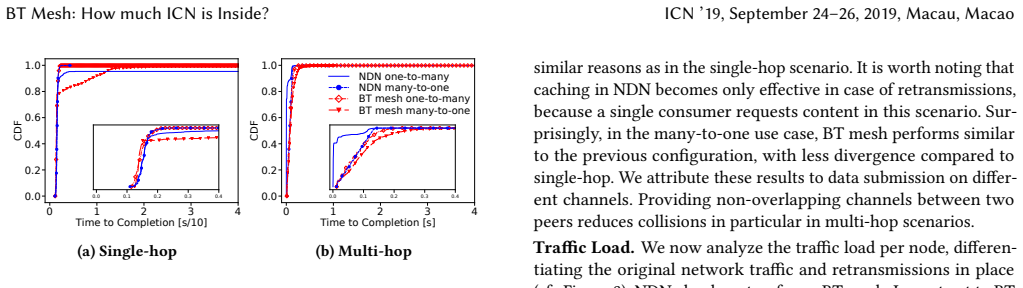
The argument is carried by two mechanisms placed side by side. BT mesh uses managed flooding: every packet is broadcast on advertising channels, a hop limit bounds its reach, and a network message cache drops duplicates after first sight, but no node stores data for later reuse. NDN uses a Pending Interest Table (PIT), which records and aggregates unanswered requests for a name so that one data packet can satisfy many waiters, and a Content Store (CS), which keeps data in-network for later requests. The PIT plus CS, together with Interest retransmission on timeout, is what produces NDN's lower traffic load and faster multi-hop delivery in the paper's measurements.
What would settle it
Repeat the multi-hop traffic-load measurements with both stacks on the same radio and the same link-layer behavior, for example NDN over BLE advertising without CSMA/ARQ and Bluetooth mesh with CSMA/ARQ enabled. If the packet-count gap largely disappears, the reported performance difference is a radio and MAC artifact; if the gap survives, the architecture is the cause.
Extended reading notes
Core claim
The paper's central claim is that Bluetooth mesh is not information-centric in the sense that matters for performance and scalability. Although it supports group-based publish-subscribe, addresses data rather than endpoints, and includes a network message cache, it lacks the load-bearing ICN mechanisms: name-based request matching, aggregation of pending requests, and general in-network content caching. The experiments show that in a multi-hop line topology NDN delivers content to all consumers almost immediately when caches are populated, while BT mesh's managed flooding and fixed link-layer retransmissions multiply packets on every node. The paper concludes that the statement that BT mesh 'implements all of the major paradigms of information-centric networking' is unsupported, and that a genuinely information-centric Bluetooth network would need to add ICN principles.
Load-bearing premise
The comparison assumes that the different radios and link layers on the two sides (BLE advertising without carrier sensing or retransmission at 1 Mbit/s versus 802.15.4 with both at 250 kbit/s) still reveal architectural differences rather than merely hardware differences, a confound the paper acknowledges but does not remove.
Editorial extensions
If this is right
- If the central claim is right, Bluetooth mesh's flooding-without-content-caching is a scaling limit for installations beyond small local groups, as the paper itself concludes.
- NDN's advantage should grow with network size and with request duplication, because interest aggregation and caching become more valuable as more consumers ask for the same content.
- Static link-layer retransmissions in Bluetooth mesh amplify traffic in every measured scenario, so any future BT-ICN should replace blind retransmission with NDN's on-demand Interest retransmission.
- A BLE-based ICN using connection-oriented links could deliver BT-mesh-like services with better resource efficiency, making the paper's 'BT-ICN' sketch a concrete next step.
Reading between the lines
- A testable extension the paper leaves implicit: run BT mesh with a real content store on relay nodes (caching payloads, not just packet identifiers) while keeping its flooding; if the multi-hop traffic load drops substantially, the missing cache, not flooding itself, is the main handicap.
- The paper's conceptual checklist suggests a broader lesson for other 'ICN-like' IoT technologies: what matters is whether requests are aggregated and data is cached by name, not whether data is addressed rather than endpoints.
- The single-hop parity and multi-hop divergence imply the sweet spot may be a hybrid: local flooding for discovery with ICN-style aggregation and caching at relays, which the paper's design only partially explores.
- If the results generalize, claims that a radio technology 'is ICN' can be checked by two measurements: how duplicate requests are handled and whether a second consumer can retrieve data without a new end-to-end exchange.
Signed reviews
Editorial analysis
A structured set of objections, weighed in public.
Referee Report
Summary. The manuscript investigates the claim, attributed to industry source [32], that Bluetooth mesh implements all major ICN paradigms. It first provides an architectural comparison between BT mesh and ICN/NDN (Sections 2 and 3), then reports a testbed study on RIOT that compares NDN/CCN-lite over IEEE 802.15.4 with BT mesh over BLE advertising (Section 4). The experiments cover single-hop and multi-hop topologies with many-to-one and one-to-many traffic, measuring content arrival time and per-node traffic load. The paper finds comparable latency in simple scenarios but substantially lower traffic load and better multi-hop performance for NDN, and concludes that BT mesh is not ICN and that ICN principles still need to be added in future work. A BT-ICN design sketch is given in Section 5.
Significance. If the conceptual analysis is accepted, the paper makes a valuable contribution by correcting a widely repeated industry claim and by articulating precisely where BT mesh and ICN differ: addressing and naming, caching semantics, request aggregation, and MAC adaptation. The experimental part is partly reproducible and uses open-source code and an open testbed, which is a strength. However, the empirical claim that NDN 'easily outperforms' BT mesh due to ICN mechanisms is not fully established because the comparison is confounded by simultaneous differences in radio, bit rate, and MAC behavior. The conceptual comparison alone already supports the main conclusion that BT mesh is not ICN; the performance comparison should be treated as indicative, not conclusive.
major comments (3)
- [Section 4.1 and Figures 2-3] The central empirical claim that NDN outperforms BT mesh is not fully established because the two systems differ simultaneously in radio technology, bit rate, and MAC behavior: NDN runs on 802.15.4 at 250 kbit/s with CSMA/ARQ, while BT mesh runs on BLE advertising at 1 Mbit/s without CSMA/ARQ. The paper acknowledges this and reports a consistency check of NDN on the Nordic platform, but only states that traffic-load results are equal and arrival times vary roughly with radio bit rate; the full curves are not shown. Since the claimed causal mechanisms are ICN-specific (interest aggregation, selective retransmission, in-network caching), a reader cannot attribute the observed performance gap to architecture rather than to radio/MAC. I request either full presentation of the NDN-on-Nordic results, a same-radio control experiment, or a revised conclusion that presents the performance comparison as conditional on the platform choice.
- [Section 4.2, Figure 3] The traffic-load comparison is reported in packet counts, but the two stacks differ in packet sizes and header compression (ICNLoWPAN vs. uncompressed BT mesh headers) and the radios operate at different bit rates. The conclusion that 'NDN clearly outperforms BT mesh' in traffic load would be more robust if the load were also reported in bytes, airtime, or energy per delivered content item. In addition, the multi-hop topology is enforced by MAC address filtering on nodes that are all physically in range, so the physical interference pattern does not match the logical line topology; this may systematically disadvantage the broadcast-oriented BT mesh. The paper should either provide a control that separates logical topology from physical interference or explicitly discuss this limitation as a threat to the empirical claim.
- [Section 7, Conclusions] The conclusion states that 'BT mesh performs flooding without content caching,' which is too strong given the paper's own detailed discussion in Sections 2.1 and 3.4. BT mesh does maintain a network message cache for duplicate suppression and friend nodes do cache messages for sleepy nodes; what BT mesh lacks is ICN-style in-network caching that serves arbitrary subsequent requests. The wording should be qualified, e.g., 'without ICN-style content caching,' to avoid a claim that contradicts the body of the paper.
minor comments (5)
- [Figure 2a] The x-axis label 'Time to Completion [s/10]' is confusing; it should be made explicit that the axis is in tenths of seconds or the axis should be relabeled consistently with the text (e.g., 'Time to Completion [s]').
- [Section 4.2] The paper reports that the average content delivery rate is 100% but does not state the number of experimental repetitions or show any variance/confidence information; please add the number of runs and, if possible, error bars.
- [Section 4.1] The word 'neglectable' should be 'negligible'.
- [Section 3.4] The distinction between the friend-node cache and the relay-node network message cache is important and should be carried into the concluding section; consider introducing the term 'forwarding cache' vs. 'content cache' to avoid ambiguity.
- [References] Reference [32] is a web resource; please include an access date or a stable URL form.
Circularity Check
No significant circularity: this paper is an empirical and architectural comparison, not a derivation from fitted inputs or self-referential premises.
full rationale
The paper's central claims are (i) an architectural analysis showing that Bluetooth mesh lacks ICN-style content caching and request aggregation, and (ii) an experimental comparison in which NDN outperforms BT mesh in multi-hop traffic load and content delivery. Neither claim reduces to its own input. The architectural comparison is grounded in the BT mesh standard and the NDN/CCNx protocol designs, not in the authors' prior results. The experiments report direct measurements of CDFs of content arrival time and per-node packet counts; no parameter is fitted from a subset of data and then presented as a prediction. The authors do cite their own prior work (e.g., RIOT, ICNLoWPAN, HoPP, and a previous NDN/CoAP/MQTT measurement study), but these citations provide tools, implementation context, and corroborating background, and the load-bearing conclusions are independently measured in this paper. The acknowledged radio/MAC mismatch between the 802.15.4 platform and the BLE advertising platform is a validity threat to the empirical comparison, but that is a correctness or confound concern, not circular reasoning: the paper does not define its conclusions in terms of the experimental configuration. Similarly, the paper's rejection of the Silvair claim that BT mesh implements all major ICN paradigms is supported by protocol analysis and measurements, not by assuming the conclusion. No self-definitional steps, fitted-input-as-prediction steps, or load-bearing self-citation chains are present. Accordingly, the appropriate circularity score is 0.
Assumptions & free parameters
assumptions (4)
- domain assumption The NimBLE implementation is a faithful realization of the Bluetooth mesh standard.
- domain assumption The 802.15.4 radio with CSMA/ARQ is an acceptable production-like baseline for NDN and is comparable to the BLE advertising bearer.
- domain assumption Virtual multi-hop topology enforced by MAC address filtering preserves the intended network-layer behavior despite physical interference.
- domain assumption The ICN stack used here, CCN-lite over ICNLoWPAN with unicast MAC faces, represents NDN/ICN sufficiently for comparison.
Cite this review
Pith. "Pith review of Bluetooth Mesh under the Microscope: How much ICN is Inside?." pith.science (2026). https://pith.science/paper/WY7W55YU
@misc{pith2026190809505,
  author       = {Pith},
  title        = {Pith review of: Bluetooth Mesh under the Microscope: How much ICN is Inside?},
  year         = {2026},
  howpublished = {\url{https://pith.science/paper/WY7W55YU}},
  note         = {Machine review of arXiv:1908.09505}
}
read the original abstract
Bluetooth (BT) mesh is a new mode of BT operation for low-energy devices that offers group-based publish-subscribe as a network service with additional caching capabilities. These features resemble concepts of information-centric networking (ICN), and the analogy to ICN has been repeatedly drawn in the BT community. In this paper, we compare BT mesh with ICN both conceptually and in real-world experiments. We contrast both architectures and their design decisions in detail. Experiments are performed on an IoT testbed using NDN/CCNx and BT mesh on constrained RIOT nodes. Our findings indicate significant differences both in concepts and in real-world performance. Supported by new insights, we identify synergies and sketch a design of a BT-ICN that benefits from both worlds.
Figures


Reference graph
Works this paper leans on
-
[32]
SILVAIR. 2018. Information-centric networking – a rev- olutionary approach to wireless lighting control. http: //silvair.com/resources/information-centric-networking/
work page 2018
-
[1]
B. Ahlgren et al. 2010. Second NetInf Architecture Description. Tech.report D-6.2 v2.0. 4Ward EU FP7 Project
work page 2010
- [2]
-
[3]
Marica Amadeo, Claudia Campolo, and Antonella Molinaro. 2014. Multi-source Data Retrieval in IoT via Named Data Networking. In Proc. of ACM ICN. ACM, New York, NY, USA, 67–76
work page 2014
-
[4]
Schmidt, and Matthias Wählisch
Emmanuel Baccelli, Cenk Gündogan, Oliver Hahm, Peter Kietzmann, Martine Lenders, Hauke Petersen, Kaspar Schleiser, Thomas C. Schmidt, and Matthias Wählisch. 2018. RIOT: an Open Source Operating System for Low-end Embedded Devices in the IoT. IEEE Internet of Things Journal 5, 6 (December 2018), 4428–
work page 2018
-
[5]
Emmanuel Baccelli, Oliver Hahm, Mesut Günes, Matthias Wählisch, and Thomas C. Schmidt. 2013. RIOT OS: Towards an OS for the Internet of Things. In Proc. of the 32nd IEEE INFOCOM. Poster . IEEE Press, Piscataway, NJ, USA, 79–80
work page 2013
-
[6]
Schmidt, and Matthias Wählisch
Emmanuel Baccelli, Christian Mehlis, Oliver Hahm, Thomas C. Schmidt, and Matthias Wählisch. 2014. Information Centric Networking in the IoT: Experiments with NDN in the Wild. In Proc. of 1st ACM Conf. on BT Mesh: How much ICN is Inside? ICN ’19, September 24–26, 2019, Macau, Macao Information-Centric Networking (ICN-2014) . ACM, New York, 77–86. http: //d...
-
[7]
Mathias Baert, Jen Rossey, Adnan Shahid, and Jeroen Hoebeke. 2018. The Blue- tooth Mesh Standard: An Overview and Experimental Evaluation. Sensors 18, 8 (2018), 2409
work page 2018
Show all 41 references
-
[8]
Vaibhav Bajpai, Anna Brunstrom, Anja Feldmann, Wolfgang Kellerer, Aiko Pras, Henning Schulzrinne, Georgios Smaragdakis, Matthias Wählisch, and Klaus Wehrle. 2019. The Dagstuhl Beginners Guide to Reproducibility for Experimental Networking Research. ACM SIGCOMM Computer Communi...
2019
-
[9]
András Balogh, Sándor Imre, Károly Lendvai, and Sándor Szabó. 2015. Service Mediation in multihop Bluetooth Low Energy networks based on NDN approach. In SoftCOM. IEEE, 285–289
2015
-
[10]
Antonio Carzaniga, Michele Papalini, and Alexander L. Wolf. 2011. Content-based Publish/Subscribe Networking and Information-centric Networking. In Proc. of the ACM SIGCOMM WS on Information-centric Networking (ICN ’11) . ACM, New York, NY, USA, 56–61
2011
-
[11]
Jiachen Chen, Mayutan Arumaithurai, Lei Jiao, Xiaoming Fu, and Kadangode Ramakrishnan. 2011. COPSS: An Efficient Content Oriented Publish/Subscribe System. In ACM/IEEE Symposium on Architectures for Networking and Commu- nications Systems (ANCS’11). IEEE Computer Society, Los ...
2011
-
[12]
Seyed Mahdi Darroudi, Raül Caldera-S ànchez, and Carles Gomez. 2019. Bluetooth Mesh Energy Consumption: A Model. Sensors 19, 5 (2019), 1238
2019
-
[13]
Seyed Mahdi Darroudi and Carles Gomez. 2017. Bluetooth Low Energy Mesh Networks: A Survey. Sensors 17, 7 (2017), 1467
2017
-
[14]
Asmir Gogic, Aljo Mujcic, Sandra Ibric, and Nermin Suljanovic. 2016. Performance Analysis of Bluetooth Low Energy Mesh Routing Algorithm in Case of Disaster Prediction. Journal of Information, Control and Computer Sciences 10, 6 (2016), 1075 – 1081
2016
-
[15]
Carles Gomez, Seyed Darroudi, Teemu Savolainen, and Michael Spoerk. 2019. IPv6 Mesh over BLUETOOTH(R) Low Energy using IPSP . Internet-Draft – work in progress 05. IETF
2019
-
[16]
Bluetooth Special Interest Group. 2019. Bluetooth Core Specification Version 5.1 . Technical Report. https: //www.bluetooth.com/specifications/bluetooth-core-specification
2019
-
[17]
Bluetooth Special Interest Group. 2019. Bluetooth Mesh Pro- file Specification Version 1.0.1 . Technical Report. https: //www.bluetooth.com/specifications/mesh-specifications/
2019
-
[18]
Schmidt, and Matthias Wählisch
Cenk Gündogan, Peter Kietzmann, Martine Lenders, Hauke Petersen, Thomas C. Schmidt, and Matthias Wählisch. 2018. NDN, CoAP, and MQTT: A Com- parative Measurement Study in the IoT. In Proc. of 5th ACM Conference on Information-Centric Networking (ICN) . ACM, New York, NY, USA, ...
2018
-
[19]
Schmidt, and Matthias Wäh- lisch
Cenk Gündogan, Peter Kietzmann, Thomas C. Schmidt, and Matthias Wäh- lisch. 2018. HoPP: Robust and Resilient Publish-Subscribe for an Information- Centric Internet of Things. In Proc. of the 43rd IEEE Conference on Local Computer Networks (LCN) . IEEE Press, Piscataway, NJ, US...
2018
-
[20]
Schmidt, and Matthias Wählisch
Cenk Gündogan, Peter Kietzmann, Thomas C. Schmidt, and Matthias Wählisch
-
[21]
Smetters, James D
Van Jacobson, Diana K. Smetters, James D. Thornton, and Michael F. Plass. 2009. Networking Named Content. In5th Int. Conf. on emerging Networking Experiments and Technologies (ACM CoNEXT’09). ACM, New York, NY, USA, 1–12
2009
-
[22]
Schmidt, Oliver Hahm, and Matthias Wählisch
Peter Kietzmann, Cenk Gündogan, Thomas C. Schmidt, Oliver Hahm, and Matthias Wählisch. 2017. The Need for a Name to MAC Address Mapping in NDN: Towards Quantifying the Resource Gain. In Proc. of 4th ACM Conference on Information-Centric Networking (ICN) . ACM, New York, NY, USA, 36–42
2017
-
[23]
Dmitrij Lagutin, Kari Visala, and Sasu Tarkoma. 2010. Publish/Subscribe for Internet: PSIRP Perspective. Future Internet Assembly 84 (2010), 75–84
2010
-
[24]
Taeseop Lee, Myung-Sup Lee, Hyung-Sin Kim, and Saewoong Bahk. 2016. A Synergistic Architecture for RPL over BLE. In SECON. IEEE, 1–9
2016
-
[25]
Tianxiang Li, Wentao Shang, Alex Afanasyev, Lan Wang, and Lixia Zhang. 2018. A Brief Introduction to NDN Dataset Synchronization (NDN Sync). In MILCOM 2018 - 2018 IEEE Military Communications Conference (MILCOM) . 612–618
2018
-
[26]
Pourya Moradinia and Imal Sakhi. 2014. Mobile Opportunistic Services for Expe- rience Sharing : Via a NetInf Android Application . Master’s thesis. KTH, Radio Systems Laboratory (RS Lab)
2014
-
[27]
Kathleen Nichols. 2019. Lessons Learned Building a Secure, Network Measure- ment Framework using Basic NDN. In Proc. of ACM ICN. ACM, New York, NY, USA
2019
-
[28]
Nieminen, T
J. Nieminen, T. Savolainen, M. Isomaki, B. Patil, Z. Shelby, and C. Gomez. 2015. IPv6 over BLUETOOTH(R) Low Energy . RFC 7668. IETF
2015
-
[29]
Giuseppe Rossini and D. Rossi. 2012. A dive into the caching performance of Content Centric Networking. In IEEE 17th International Workshop on Computer Aided Modeling and Design of Communication Links and Networks (CAMAD’12) . Barcelone, Spain, 105–109
2012
-
[30]
Schmidt, and Georg Carle
Quirin Scheitle, Matthias Wählisch, Oliver Gasser, Thomas C. Schmidt, and Georg Carle. 2017. Towards an Ecosystem for Reproducible Research in Computer Networking. In Proc. of ACM SIGCOMM Reproducibility Workshop . ACM, New York, NY, USA, 5–8
2017
-
[31]
Wentao Shang, Minsheng Zhang, Alexander Afanasyev, Jeff Burke, Lan Wang, and Lixia Zhang. 2018. Publish-Subscribe Commu- nication in Building Management Systems over Named Data Net- working. Technical Report NDN-0066,. NDN-Project. https: //named-data.net/wp-content/uploads/20...
2018
-
[33]
Hyun soo Kim, JungYub Lee, and Ju Wook Jang. 2015. BLEmesh: A Wireless Mesh Network Protocol for Bluetooth Low Energy Devices. In International Conference on Future Internet of Things and Cloud . 558–563
2015
-
[34]
Michael Spörk, Carlo Alberto Boano, Marco Zimmerling, and Kay Römer. 2017. BLEach: Exploiting the Full Potential of IPv6 over BLE in Constrained Embedded IoT Devices. In SenSys. ACM, 2:1–2:14
2017
-
[35]
Linus Sunde. 2013. NetInf Node for Bluetooth Enabled Android Devices . Master’s thesis. Uppsala University, Department of Information Technology
2013
-
[36]
Christian Tschudin, Christopher Scherb, et al . 2018. CCN Lite: Lightweight implementation of the Content Centric Networking protocol. http://ccn-lite.net
2018
-
[37]
X. Xu, H. Zhang, T. Li, and L. Zhang. 2018. Achieving Resilient Data Avail- ability in Wireless Sensor Networks. In 2018 IEEE International Conference on Communications Workshops (ICC Workshops). IEEE, 1–6
2018
-
[38]
Ververidis, Vasilios A
George Xylomenos, Christopher N. Ververidis, Vasilios A. Siris, Nikos Fotiou, Christos Tsilopoulos, Xenofon Vasilakos, Konstantinos V. Katsaros, and George C. Polyzos. 2014. A Survey of Information-Centric Networking Research. IEEE Communications Surveys and Tutorials 16, 2 (2...
2014
-
[39]
Lixia Zhang, Alexander Afanasyev, Jeffrey Burke, Van Jacobson, kc claffy, Patrick Crowley, Christos Papadopoulos, Lan Wang, and Beichuan Zhang. 2014. Named Data Networking. SIGCOMM Comput. Commun. Rev. 44, 3 (2014), 66–73
2014
-
[2019]
ICNLoWPAN – Named-Data Networking in Low Power IoT Networks. In Proc. of 18th IFIP Networking Conference
-
[4440]
http://dx.doi.org/10.1109/JIOT.2018.2815038
2018
Reviewed August 14, 2026 · model on record in the stance chip above.
Discussion (0). Continue with ORCID to comment.