REVIEW 4 major objections 6 minor 36 references
Constraint Learning for Control Tasks with Limited Duration Barrier Functions
T0 review · 4 major / 6 minor · reviewed 2026-08-14 · deepseek-v4-flash
Pith's one-line read The paper shows that the discounted value function of any policy, or a conservative approximation of it, is a limited-duration control barrier function that certifies safety up to a finite horizon.
desk verdict A genuinely new theoretical idea—value functions as finite-horizon barrier functions—with clean proofs, but experiments that never actually verify the safety certificate and a baseline set up to fail. read the letter →
The pith
A machine-rendered reading of the paper's core claim, the machinery that carries it, and where it could break.
The reading
What carries the argument
The limited-duration control barrier function is a scalar function $B_{LD}: D \to \mathbb{R}_{\ge 0}$ together with two nested sublevel sets: the safe set $O = \{x : B_{LD}(x) < L/\beta\}$ and the set of certified initial states $C^T_{LD} = \{x : B_{LD}(x) \le L e^{-\beta T}/\beta\}$. The defining inequality bounds the Lie derivative of $B_{LD}$ along the controlled dynamics, so the comparison lemma implies $B_{LD}(x(t)) \le B_{LD}(x(0)) e^{\beta t}$; starting in $C^T_{LD}$ keeps $B_{LD}$ below $L/\beta$ for all $t < T$. The key move is to obtain $B_{LD}$ from value function learning: the continuous-time Bellman equation $\beta V = L_f V + L_g V \varphi + \ell$ yields exactly this inequality with a nonnegative correction term added to make the learned approximation conservative. The admissible control set $S^T_{LD}(x)$ is then enforced through a quadratic program at each time step.
What would settle it
Train the cart-pole limited-duration barrier function as described in Section 5.2, sample a fine grid of initial states inside the certified set, and simulate the QP-constrained policy with $T = 5.0$; any trajectory leaving the safe set before 5 seconds would show that the learned certificate fails for that trained network. A sharper falsifier would be a case satisfying all assumptions of Theorem 2 whose QP-constrained trajectory exits the safe set before $T$, which would contradict the theorem's guarantee.
Extended reading notes
Core claim
Finite-time safety is guaranteed whenever a smooth function $B_{LD}$ satisfies the differential inequality $\inf_u \{L_f B_{LD}(x) + L_g B_{LD}(x) u\} \le \alpha(L e^{-\beta T}/\beta - B_{LD}(x)) + \beta B_{LD}(x)$ on the safe set, with the admissible control set defined by the same inequality. Theorem 2 then says that for any policy, its discounted value function, or a shifted, conservative approximation of it, is a limited-duration control barrier function for the sublevel set it defines. Consequently, constraint learning reduces to value function learning: once the approximate value function is trained, a quadratic program selects control inputs inside the admissible set, and the agent is safe for the duration $T$ on every initial state in the certified set. The paper treats this as the basis for reusing good-enough policies across tasks.
Load-bearing premise
The learned approximation of the value function must be close enough to the true value function that the conservatively defined initial set is nonempty and contains the states the agent actually starts from; the paper gives no bound on approximation error for a trained network, so the safety guarantee is conditional on that fit.
Editorial extensions
If this is right
- Any policy whose discounted value function can be estimated yields a finite-horizon safety certificate, so safety constraints do not require an optimal or stabilizing policy.
- Because limited-duration barrier functions are enforced by local input constraints, they compose with task-level objectives such as coverage control without changing the nominal controller.
- Long-duration autonomy can be built from a sequence of finite-horizon guarantees: in the battery example, agents that would run out of energy are driven to charging stations before the finite horizon expires.
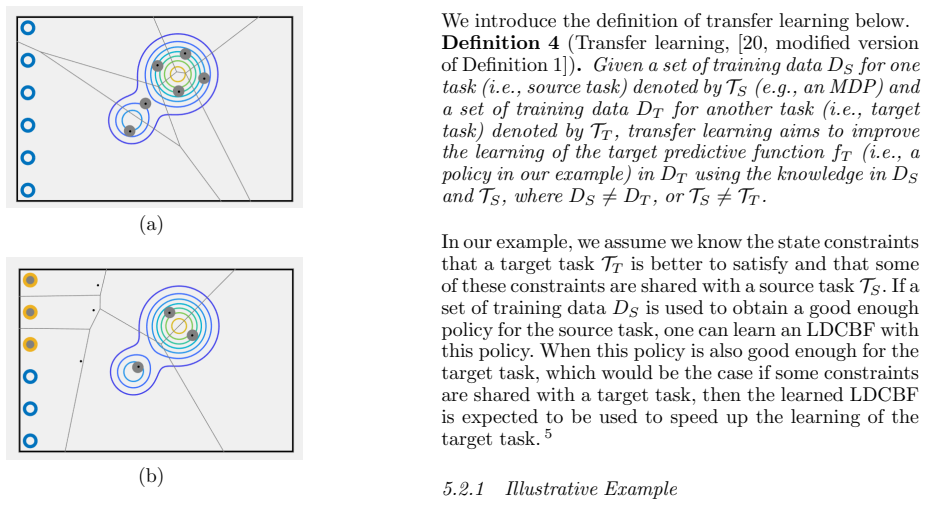
- A policy that is good enough for one task can be reused as a warm start or a constraint for a second task, as demonstrated by the balancing policy accelerating the move-the-pole task.
Reading between the lines
- If a sample-complexity bound were added to the conservative construction in Theorem 2, the framework would become a finite-sample safety certificate for reinforcement learning; the paper explicitly leaves such an analysis beyond its scope.
- Because the admissible control set is affine in the control input, the same certificate could be embedded in model predictive control or mixed-integer planning, potentially enlarging the set of initial states certified safe.
- The framework suggests a protocol for multi-robot fleets: share learned value functions as safety certificates across agents with similar dynamics, so each agent inherits a certified safe policy without retraining.
Signed reviews
Editorial analysis
A structured set of objections, weighed in public.
Referee Report
Summary. This paper introduces limited-duration control barrier functions (LDCBFs) as finite-horizon relaxations of control barrier functions. The authors define LDCBFs via a differential inequality on an open safe set, prove that the discounted value function of any policy can be converted into an LDCBF after shifting the value by c/β and taking conservative sublevel sets (Theorem 2), and propose enforcing the resulting constraints through a quadratic program. The framework is applied to two simulated problems: persistent coverage with battery charging and transfer of a cart-pole balancing policy to a move-the-cart task. The proofs of Theorems 1 and 2 are standard comparison-argument proofs and appear correct.
Significance. The conceptual link between value functions and finite-horizon safety certificates is attractive and, if made operational, would be a useful tool for safety-constrained reinforcement learning. The conservative-set construction in Section 4.2 is a reasonable way to absorb approximation error in principle, and the comparison-argument proofs are clean. However, the paper's actual claims about learned certificates are not supported: the learned neural-network LDCBF is never certified to satisfy the conditions of Theorem 2, and the reported Step-3 result (average exit time 4.73 s < T = 5.0 s) contradicts the safety guarantee. The transfer-learning experiment uses a baseline that is explicitly tuned to fail. The theoretical core is sound, but the experimental and practical validation needs substantial revision.
major comments (4)
- [Section 5.2.2, Step 3] The paper reports an average first-exit time of 4.73 s for the fixed policy φ(x)=1.0 with T=5.0, and calls this "sufficiently close." Under Theorem 1, every trajectory starting in C_T_LD that respects the LDCBF constraint must remain in O for at least T=5.0 s; an average below 5.0 therefore violates the stated safety guarantee. The most plausible explanation given in the text is that the QP uses a control-affine model with friction parameters set to zero, so the premises of the theorem are not satisfied for the actual MuJoCo simulation. This experiment should be corrected by using the true model in the QP, verifying initial states and residual conditions, or by reporting the result as an unguaranteed heuristic rather than as evidence that the LDCBF worked.
- [Section 4.2 and Theorem 2] Theorem 2 turns a learned approximation V̂ into an LDCBF only if V̂ is C1, the shifted Bellman residual l̂_c(x) is nonnegative on all of O, and Ĉ_T_LD is nonempty. The training procedure in Section 5.2.2 does not verify any of these conditions: the network uses ReLU activations, the residual is not evaluated on a continuum, and no bound on the approximation error is given. Consequently the manuscript does not establish that the learned network deployed in the experiments is a valid LDCBF. I suggest either providing a data-based certificate (e.g., a Lipschitz bound on the residual plus dense evaluation) or explicitly reframing the learned object as an approximate LDCBF whose safety is not formally guaranteed.
- [Section 5.2.2, Table 2] The transfer-learning comparison is not statistically meaningful as presented. The baseline "DDPG without LDCBF" has success rate exactly 0.0 for all 15 episodes, and the text states that parameters were chosen so that this baseline cannot succeed within 15 episodes; no standard errors or multiple-seed results are reported for either method. A fair comparison would require a reasonably tuned baseline, error bars over seeds, and a statement of the selection procedure. As written, the table supports only the claim that the chosen baseline fails, not that the LDCBF enables transfer.
- [Definition 2, Eq. (4)] The LDCBF condition is stated as an infimum inequality, inf_{u∈U} {L_fB+L_gBu} ≤ α(...)+βB. Since U is only assumed to be a polyhedron and not compact, the infimum need not be attained, and the admissible set S_T_LD(x) can be empty even when the inf-condition holds. The definition should require nonemptiness of S_T_LD(x) (or equivalently existence of u∈U satisfying the inequality) for every x∈O, since Theorem 1 and Proposition 1 both rely on feasibility of the QP.
minor comments (6)
- [Section 5.2.2, Step 2] The conversion of the discrete-time learned LDCBF to continuous time by multiplying by Δt=0.01 should be explained; it is not clear that the resulting function is C1 or satisfies the continuous-time Lie-derivative conditions of Theorem 2.
- [Section 5.2] The notation 𝒯 for a task and T for the time horizon are easily confused; consider renaming one of them.
- [Definition 3] The phrase "a task T" should read "a task 𝒯" to match Definition 4.
- [Table 1] The LDCBF network training hyperparameters (learning rate, optimizer, replay buffer size) are not fully specified; adding them would improve reproducibility.
- [Section 5.1.2] The coverage experiment uses a single random seed and one run; adding more seeds or explicitly labeling the result as an illustrative demo would be appropriate.
- [Appendix A] In the proof of Theorem 1, the sentence "because O∈ int(X)" should read "because O⊂int(X)."
Circularity Check
No significant circularity: the LDCBF result is derived from the Bellman equation and explicit nonnegativity/nonemptiness premises, not from fitted outputs or self-citations.
full rationale
Theorem 2 is not circular. Starting from a policy value function, the paper defines the estimated Bellman residual and chooses c so that the corrected residual is nonnegative. This directly yields L_f V_hat_c + L_g V_hat_c phi <= beta V_hat_c, which, together with the monotone class-K-like function alpha set to zero on nonpositive arguments, implies the LDCBF inequality. The conclusion is a genuine mathematical implication of the Bellman equation, not an assumption equivalent to the conclusion. The nonemptiness of C_hat_T_LD and nonnegativity of the residual are explicit premises, not hidden restatements of the target safety claim. There is no fitted parameter later renamed as a prediction, and no result is forced by the authors' prior theorems. The main limitation is a correctness/validation gap rather than circularity: the learned neural-network LDCBF is never certified to satisfy Theorem 2's preconditions, and the fixed-policy experiment in Section 5.2.2 reports an average duration of 4.73 s for T = 5.0 s, which the paper calls 'sufficiently close' but which actually violates the claimed safety guarantee. This is an empirical invalidation of the unverified approximation, not a circular derivation. Self-citations such as [17] are used for problem setup rather than as load-bearing mathematical premises; Proposition 1 rests on an external theorem [16]. The derivation chain is therefore self-contained, and no circularity score above zero is warranted.
Assumptions & free parameters
free parameters (6)
- Discount factor β =
0.005 (coverage), -log(0.999)/0.01 ≈ 1.0005 (cart-pole LDCBF learning)
- Time horizon T =
50.0 (coverage), 5.0 (cart-pole random policy test)
- Safety margin L =
β·ΔE = 0.00225 (coverage), 1.0 (cart-pole)
- Offset c =
Not given; chosen in practice to make estimated cost nonnegative
- Energy model constants E_max, E_min, K_d =
1.0, 0.55, 0.01
- Neural network hyperparameters for DDPG and LDCBF =
Learning rates 10^-3 to 10^-4, network sizes 300/200, minibatch 64
assumptions (5)
- domain assumption Assumption 1: f + gφ is locally Lipschitz for any locally Lipschitz policy φ.
- domain assumption Assumption 2: The control space U is a polyhedron.
- domain assumption Assumption 3: The battery dynamics satisfies dE/dt ≥ -K_d and dE/dt ≤ 0 when at a charging station.
- domain assumption The value function V_{φ,β} restricted to O is C^1.
- standard math Standard ODE theory: solution existence, uniqueness, comparison lemma (Khalil 2002, Lakshmikantham 1969).
Cite this review
Pith. "Pith review of Constraint Learning for Control Tasks with Limited Duration Barrier Functions." pith.science (2026). https://pith.science/paper/6M3RNW2D
@misc{pith2026190809506,
  author       = {Pith},
  title        = {Pith review of: Constraint Learning for Control Tasks with Limited Duration Barrier Functions},
  year         = {2026},
  howpublished = {\url{https://pith.science/paper/6M3RNW2D}},
  note         = {Machine review of arXiv:1908.09506}
}
read the original abstract
When deploying autonomous agents in unstructured environments over sustained periods of time, adaptability and robustness oftentimes outweigh optimality as a primary consideration. In other words, safety and survivability constraints play a key role and in this paper, we present a novel, constraint-learning framework for control tasks built on the idea of constraints-driven control. However, since control policies that keep a dynamical agent within state constraints over infinite horizons are not always available, this work instead considers constraints that can be satisfied over some finite time horizon T > 0, which we refer to as limited-duration safety. Consequently, value function learning can be used as a tool to help us find limited-duration safe policies. We show that, in some applications, the existence of limited-duration safe policies is actually sufficient for long-duration autonomy. This idea is illustrated on a swarm of simulated robots that are tasked with covering a given area, but that sporadically need to abandon this task to charge batteries. We show how the battery-charging behavior naturally emerges as a result of the constraints. Additionally, using a cart-pole simulation environment, we show how a control policy can be efficiently transferred from the source task, balancing the pole, to the target task, moving the cart to one direction without letting the pole fall down.
Figures


Figures from the paper (1 more)

Reference graph
Works this paper leans on
-
[1]
A. D. Ames, X. Xu, J. W. Grizzle, and P. Tabuada. Control barrier function based quadratic programs for safety critical systems. IEEE Trans. Automatic Control, 62(8):3861–3876, 2017
work page 2017
-
[2]
A. G. Barto, R. S. Sutton, and C. W. Anderson. Neuronlike adaptive elements that can solve difficult learning control problems. IEEE Trans. Systems, Man, and Cybernetics , (5):834–846, 1983. 10
work page 1983
-
[3]
J. Cort´ es and M. Egerstedt. Coordinated control of multi-robot systems: A survey. SICE Journal of Control, Measurement, and System Integration, 10(6):495–503, 2017
work page 2017
- [4]
-
[5]
M. Egerstedt, J. N. Pauli, G. Notomista, and S. Hutchinson. Robot ecology: Constraint-based control design for long duration autonomy. Elsevier Annual Reviews in Control , 46:1–7, 2018
work page 2018
-
[6]
R. A. Freeman and P. V. Kokotovic. Inverse optimality in robust stabilization. SIAM Journal on Control and Optimization, 34(4):1365–1391, 1996
work page 1996
-
[7]
P. Glotfelter, J. Cort´ es, and M. Egerstedt. Nonsmooth barrier functions with applications to multi-robot systems. IEEE Control Systems Letters, 1(2):310–315, 2017
work page 2017
-
[8]
Constrained Deep Networks: Lagrangian Optimization via Log-Barrier Extensions
H. Kervadec, J. Dolz, J. Yuan, C. Desrosiers, E. Granger, and I. B. Ayed. Log-barrier constrained CNNs. arXiv preprint arXiv:1904.04205, 2019
work page Pith review arXiv 1904
Show all 36 references
-
[9]
H. K. Khalil. Nonlinear systems. Prentice-Hall, 3, 2002
2002
-
[10]
S. M. Khansari-Zadeh and A. Billard. Learning control Lyapunov function to ensure stability of dynamical system- based robot reaching motions. Robotics and Autonomous Systems, 62(6):752–765, 2014
2014
-
[11]
Lakshmikantham and S
V. Lakshmikantham and S. Leela. Differential and Integral Inequalities: Theory and Applications: Volume I: Ordinary Differential Equations. Academic press, 1969
1969
-
[12]
F. L. Lewis and D. Vrabie. Reinforcement learning and adaptive dynamic programming for feedback control. IEEE Circuits and Systems Magazine , 9(3):32–50, 2009
2009
-
[13]
Liberzon
D. Liberzon. Calculus of variations and optimal control theory: a concise introduction . Princeton University Press, 2011
2011
-
[14]
T. P. Lillicrap, J. Hunt, Jonathan, A. Pritzel, N. Heess, T. Erez, Y. Tassa, D. Silver, and D. Wierstra. Continuous control with deep reinforcement learning. arXiv preprint arXiv:1509.02971, 2015
2015 arXiv
-
[15]
Lozano-P´ erez and L
T. Lozano-P´ erez and L. P. Kaelbling. A constraint- based method for solving sequential manipulation planning problems. In IEEE Proc. IROS, pages 3684–3691, 2014
2014
-
[16]
Morris, M
B. Morris, M. J. Powell, and A. D. Ames. Sufficient conditions for the Lipschitz continuity of QP-based multi-objective control of humanoid robots. In Proc. CDC, pages 2920–2926, 2013
2013
-
[17]
Notomista, S
G. Notomista, S. F. Ruf, and M. Egerstedt. Persistification of robotic tasks using control barrier functions. IEEE Robotics and Automation Letters, 3(2):758–763, 2018
2018
-
[18]
Ohnishi, L
M. Ohnishi, L. Wang, G. Notomista, and M. Egerstedt. Barrier-certified adaptive reinforcement learning with applications to brushbot navigation. IEEE Trans. Robotics, 35(5):1186–1205, 2019
2019
-
[19]
Ohnishi, M
M. Ohnishi, M. Yukawa, M. Johansson, and M. Sugiyama. Continuous-time value function approximation in reproducing kernel Hilbert spaces. Proc. NeurIPS, pages 2813–2824, 2018
2018
-
[20]
S. J. Pan, Q. Yang, et al. A survey on transfer learning.IEEE Trans. Knowledge and Data Engineering , 22(10):1345–1359, 2010
2010
-
[21]
Paszke, S
A. Paszke, S. Gross, S. Chintala, G. Chanan, E. Yang, Z. DeVito, Z. Lin, A. Desmaison, L. Antiga, and A. Lerer. Automatic differentiation in PyTorch. 2017
2017
-
[22]
Pickem, P
D. Pickem, P. Glotfelter, L. Wang, M. Mote, A. Ames, E. Feron, and M. Egerstedt. The Robotarium: A remotely accessible swarm robotics research testbed. In IEEE Proc. ICRA, pages 1699–1706, 2017
2017
-
[23]
Ratschan
S. Ratschan. Converse theorems for safety and barrier certificates. IEEE Trans. Automatic Control , 63(8):2628– 2632, 2018
2018
-
[24]
Rimon and D
E. Rimon and D. E. Koditschek. Exact robot navigation using artificial potential functions. IEEE Trans. Robotics and Automation, 8(5):501–518, 1992
1992
-
[25]
B. F. Skinner. Science and human behavior. Number 92904. Simon and Schuster, 1953
1953
-
[26]
E. D. Sontag. A ”universal” construction of Artstein’s theorem on nonlinear stabilization. Systems & control letters, 13(2):117–123, 1989
1989
-
[27]
R. S. Sutton and A. G. Barto. Reinforcement learning: An introduction. MIT Press, 1998
1998
-
[28]
R. S. Sutton, D. A. McAllester, S. P. Singh, and Y. Mansour. Policy gradient methods for reinforcement learning with function approximation. In Proc. NeurIPS, pages 1057–1063, 2000
2000
-
[29]
Tassa, Y
Y. Tassa, Y. Doron, A. Muldal, T. Erez, Y. Li, D. de L. Casas, D. Budden, A. Abdolmaleki, J. Merel, A. Lefrancq, T. L. Lillicrap, and M. Riedmiller. DeepMind Control Suite. arXiv preprint arXiv:1801.00690 , 2018
2018 arXiv
-
[30]
P. S. Thomas, W. C. Dabney, S. Giguere, and S. Mahadevan. Projected natural actor-critic. In Proc. NeurIPS, pages 2337– 2345, 2013
2013
-
[31]
Thrun and T
S. Thrun and T. M. Mitchell. Lifelong robot learning. In The Biology and Technology of Intelligent Autonomous Agents , pages 165–196. Springer, 1995
1995
-
[32]
Todorov, T
E. Todorov, T. Erez, and Y. Tassa. Mujoco: A physics engine for model-based control. In IEEE/RSJ International Conference on Intelligent Robots and Systems , pages 5026– 5033, 2012
2012
-
[33]
L. Wang, D. Han, and M. Egerstedt. Permissive barrier certificates for safe stabilization using sum-of-squares. Proc. ACC, pages 585–590
-
[34]
Wieland and F
P. Wieland and F. Allg¨ ower. Constructive safety using control barrier functions. Proc. IFAC, 40(12):462–467, 2007
2007
-
[35]
Wisniewski and C
R. Wisniewski and C. Sloth. Converse barrier certificate theorems. IEEE Trans. Automatic Control, 61(5):1356–1361, 2016
2016
-
[36]
X. Xu, P. Tabuada, J. W. Grizzle, and A. D. Ames. Robustness of control barrier functions for safety critical control. Proc. IFAC, 48(27):54–61, 2015. 11
2015
Reviewed August 14, 2026 · model on record in the stance chip above.
Discussion (0). Continue with ORCID to comment.