REVIEW 4 major objections 6 minor 22 references
NETR-Tree: An Eifficient Framework for Social-Based Time-Aware Spatial Keyword Query
T0 review · 4 major / 6 minor · reviewed 2026-08-14 · deepseek-v4-flash
Pith's one-line read NETR-Tree claims that a two-layer index combining social embeddings and a time-aware R-tree returns exact top-k places while visiting only a fraction of the data.
desk verdict The NETR-tree paper has a reasonable new problem and index design, but its exactness proof is false for the time and social score components, so the current version should not be accepted. read the letter →
The pith
A machine-rendered reading of the paper's core claim, the machinery that carries it, and where it could break.
The reading
What carries the argument
The load-bearing object is the NETR-Tree itself, specifically its Time-aware R-tree (TR-tree) layer. Each non-leaf node stores a minimum bounding rectangle, a TF-IDF keyword summary, the maximum per-hour check-in probability among its descendants, and category entropy (how mixed the venue categories are inside the rectangle). The user layer stores network-embedding vectors and per-user check-in counts per node in user-inverted blocks. The argument runs through the composite score of Eq. (9): if every component of a node's score is at least the corresponding component of any descendant object, then the weighted sum is also an upper bound, and Algorithm 2 can safely prune by that bound.
What would settle it
On either real dataset used in the paper, compute Eq. (5) for every internal node and every descendant object and list any pair with $F_s(u,N) < F_s(u,o)$; if one exists, Theorem 1's premise fails and Algorithm 2 can return a wrong top-k. As an end-to-end check, run Algorithm 2 and a brute-force scan over all objects on the same queries and compare the result sets.
Extended reading notes
Core claim
The paper's central claim is that STSKQ—returning the $k$ places best matching a user's location, keywords, query time, and social circle—can be solved exactly by a best-first traversal of a two-layer hybrid index. The NETR-Tree combines a user layer, where each user has an embedding vector and per-node check-in counts, with a location layer, a Time-aware R-tree whose nodes store an MBR, a TF-IDF keyword summary, a maximum check-in time distribution, and category entropy. The score of any node is $F(u,q,\eta)=\alpha F_g(q,\eta)+\beta F_k(q,\eta)+\gamma F_s(u,\eta)+(1-\alpha-\beta-\gamma)F_t(\eta,q.t)$. Theorem 1 asserts that for any user $u$, query $q$, internal node $N$, and descendant object $o$, $F(u,q,N)\ge F(u,q,o)$, which makes the heap-based search exact: the first $k$ objects popped are the true top-k, and subtrees whose node score cannot beat the current k-th best are pruned.
Load-bearing premise
The argument collapses if an internal node can score lower than one of its own descendant objects on any of the four components, especially the social score, whose normalization compares a node against its siblings but an object against its siblings; if that inequality fails, best-first pruning can throw away the subtree containing the true answer.
Editorial extensions
If this is right
- Under Theorem 1, Algorithm 2 can stop as soon as $k$ objects are popped from the heap, so the cost of a query is determined by how many nodes have upper-bound scores above the k-th best object, not by the total number of objects.
- The same index answers queries under different balances of location, keyword, time, and social influence by reweighting $\alpha$, $\beta$, and $\gamma$, since the dominance argument applies component-wise before the weighted sum.
- Any node whose check-in probability is zero at the query time can be discarded immediately, which lets the search skip entire subtrees of venues that are closed.
- On a dataset with richer social connections, the social score contributes more pruning power, which is consistent with the paper's reported performance gap between its two datasets.
Reading between the lines
- A direct way to stress-test the exactness claim is to compute Eq. (5) for every internal-node/descendant pair on the same datasets and look for a pair with $F_s(u,N) < F_s(u,o)$; finding one would localize the exact fix needed in the pruning bound.
- The two-layer design transfers to other graph-regularized top-k searches, such as trust-aware or expertise-aware recommendation, by replacing the check-in counts with any per-node user activity signal while keeping the same upper-bound structure.
- The fixed weight setting in the experiments leaves open a per-user learned weighting of the four scores; if the monotonicity bound holds component-wise, any learned weights within the same convex family preserve exactness.
Signed reviews
Editorial analysis
A structured set of objections, weighed in public.
Referee Report
Summary. The paper formulates the Social-based Time-aware Spatial Keyword Query (STSKQ), which ranks spatial objects by a weighted combination of geo-spatial, keyword, visiting-time, and social-relationship scores. To process STSKQ, it proposes the NETR-tree, a two-layer index that combines user network embeddings with a Time-aware R-tree (TR-tree). The central correctness claim is Theorem 1, which asserts that the composite score of an internal TR-tree node is an upper bound on the score of every descendant object, thereby justifying a best-first traversal (Algorithm 2) that is claimed to return the exact top-k results. The experimental section compares NETR-tree with three baselines on Yelp and Weeplaces, reporting processing time and disk I/O.
Significance. If the exactness guarantee were valid, the paper would make a useful contribution by integrating social and temporal dimensions into spatial keyword query processing and by providing an index with an intuitive best-first pruning strategy. The problem formulation is timely, the index design is coherent, and the authors evaluate on two real-world datasets. However, the central theorem is demonstrably false as stated, and the experiments measure only efficiency, never the quality of the returned results. Because the load-bearing theoretical guarantee and the claimed effectiveness are both unsupported, the contribution cannot be accepted in its present form.
major comments (4)
- [§5, Theorem 1 and Eq. (3)] The proof of Theorem 1 asserts that Ft(N,t) >= Ft(o,t) for an internal node N and descendant object o because N.T(t) is the maximum of descendant T-values. This is false because Eq. (3) normalizes by each node's own maximum over time intervals. For example, with two time slots and descendants o1.T=(0.5, 0.5) and o2.T=(0, 1), the parent has N.T(t1)=0.5 and max_tau N.T(tau)=1, so Ft(N,t1)=0.5, while Ft(o1,t1)=0.5/0.5=1. Thus the component score decreases with containment, and since the composite score in Eq. (9) is a weighted sum, F(u,q,N) >= F(u,q,o) can fail. Algorithm 2 therefore may prune a subtree containing true top-k answers, so the exactness guarantee is not established.
- [§5, Theorem 1 and Eqs. (4)-(5)] The same component-wise monotonicity is assumed for the social score Fs, but Eq. (4) normalizes C(ui,o) by the maximum over o's brothers, while Eq. (5) normalizes C(ui,N) by the maximum over N's brothers. Since these brother sets differ, the ratio can decrease with containment even though C(ui,N) is maximal. Concretely, let N have C(ui,N)=5 and a brother M with C(ui,M)=100, so the parent-level denominator is 100; let descendant object o have C(ui,o)=5 and a sibling o' with C(ui,o')=10, so the object-level denominator is 10. Then Fs(u,o)=0.5 while Fs(u,N)=0.05, contradicting the asserted inequality. The proof's statement that 'user check-in number is maximal' does not imply monotonicity of the normalized score.
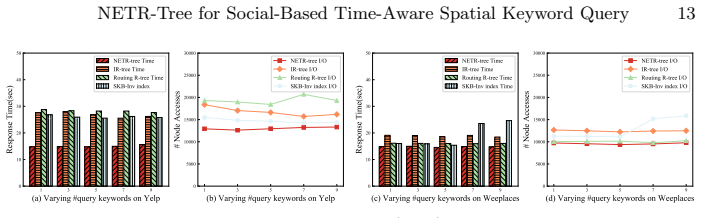
- [§6, experimental evaluation] The experiments report only average processing time and disk I/O. They do not compare NETR-tree's output against a brute-force exact computation or any quality metric such as precision, recall, or NDCG. Consequently, the abstract's and conclusion's claims of 'effectiveness' are not demonstrated; the efficiency measurements could be for result sets that do not match the true top-k ranking, especially given the failure of Theorem 1.
- [§6.2, Table 2] The score function in Eq. (9) contains user-set weights alpha, beta, gamma, and theta, and the index construction depends on LINE embedding dimension d and ST-DBSCAN parameters. Only gamma is swept (Fig. 6), on the same evaluation datasets; alpha, beta, theta, d, Eps, and MinPts are fixed without sensitivity analysis or a principled selection. Since the composite score is defined by the authors, the reported efficiency gains may be sensitive to these arbitrary choices, and the lack of a held-out evaluation of the scoring model weakens the empirical contribution.
minor comments (6)
- [Title] The word 'Eifficient' in the title is a typo and should be 'Efficient'.
- [Definition 4 and Fig. 1] The term 'cEntroy' is used instead of 'cEntropy'; the typo appears in the definition and in the overview figure.
- [Eq. (4)] The summation in Eq. (4) is over 'u.Fds', but the text and Eq. (5) use 'u.Nrs'; this notation should be made consistent.
- [§6.2] The values of the LINE embedding dimension d and the ST-DBSCAN parameters Eps and MinPts are not reported, which makes the experiments difficult to reproduce.
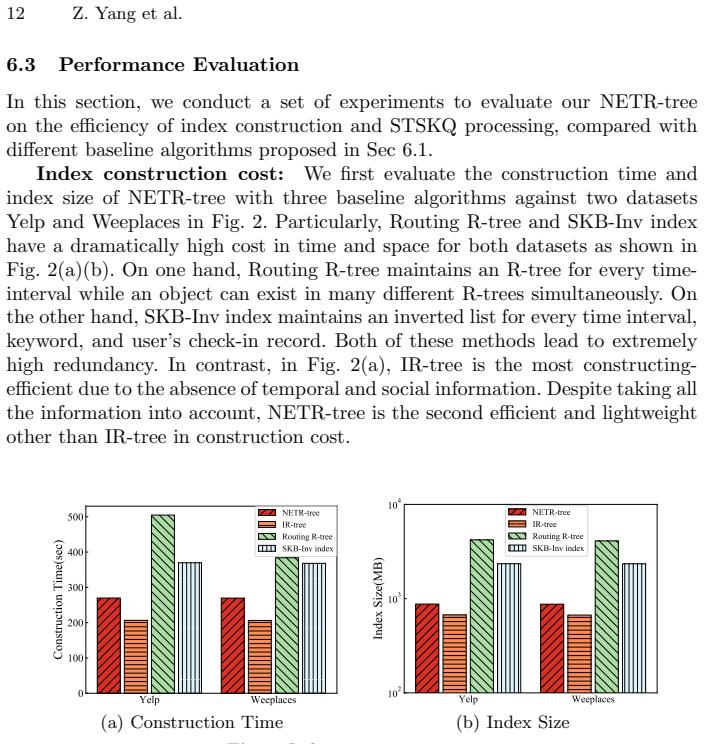
- [Fig. 2] The axis labels in Fig. 2 are garbled in the submitted version; the figure should be regenerated with clear labels.
- [§7] The conclusion claims 'extensive experiments using two real datasets verify the efficiency and effectiveness of NETR-tree,' but effectiveness is not measured anywhere in Section 6.
Circularity Check
No circularity: the STSKQ score is defined from explicit components with user-set weights, and the efficiency claims are tested against independent baselines; the unsound monotonicity step in Theorem 1 is a correctness issue, not a circular derivation.
full rationale
The paper's derivation chain is not circular. The composite score F in Eq. (9) is assembled from explicitly defined components: geo-spatial score Fg (Eq. 7), keyword similarity Fk (Eq. 8), social effect Fs (Eq. 5), and visiting time score Ft (Eq. 3), with user-supplied weights alpha, beta, gamma, and theta. None of these parameters is fitted to reproduce a known top-k result, and the top-k answer is not encoded in the score definition. Theorem 1 is presented as a proof of a monotonicity property of this score over tree containment; even if the proof is unsound because Ft and Fs normalize by node-specific denominators (so the claimed inequalities Ft(N,t) >= Ft(o,t) and Fs(u,N) >= Fs(u,o) do not follow from maximal raw check-in values), that is a mathematical gap or correctness risk, not a reduction of the claim to its inputs by construction. The experimental section evaluates processing time and I/O against independent baselines (IR-tree, Routing R-tree, SKB-Inv index), and the gamma sweep in Fig. 6 is internal parameter tuning rather than a manufactured comparison. The cited prior work by the same authors is not load-bearing for the central claim, and no uniqueness theorem or fitted input is invoked as a substitute for derivation. Accordingly, there is no significant circularity, so the score is 0.
Assumptions & free parameters
free parameters (6)
- alpha, beta in Eq. (9) =
0.25, 0.25
- theta in Eq. (7) =
0.5
- gamma in Eq. (9) =
0.3 default, swept 0.1 to 0.5
- delta_max in Eq. (6) =
12 km default, swept 4 to 20 km
- LINE embedding dimension d =
not reported
- ST-DBSCAN parameters (Eps, MinPts) =
not reported
assumptions (5)
- ad hoc to paper Composite score monotonicity: F(u,q,N) >= F(u,q,o) for every internal node N and descendant object o.
- ad hoc to paper Category entropy of a TR-tree node is not less than that of its descendants.
- domain assumption Check-in frequency distribution over hourly slots is a valid proxy for visiting suitability.
- domain assumption LINE embedding cosine similarity between users captures social influence on venue choice.
- ad hoc to paper Skyline non-dominated users plus friends are the only neighbors affecting the target user.
Cite this review
Pith. "Pith review of NETR-Tree: An Eifficient Framework for Social-Based Time-Aware Spatial Keyword Query." pith.science (2026). https://pith.science/paper/SERJUTM7
@misc{pith2026190809520,
  author       = {Pith},
  title        = {Pith review of: NETR-Tree: An Eifficient Framework for Social-Based Time-Aware Spatial Keyword Query},
  year         = {2026},
  howpublished = {\url{https://pith.science/paper/SERJUTM7}},
  note         = {Machine review of arXiv:1908.09520}
}
read the original abstract
The development of global positioning system stimulates the popularity of location-based social network (LBSN) services. With a large volume of data containing locations, texts, check-in information, and social relationships, spatial keyword queries in LBSNs have become increasingly complex. In this paper, we identify and solve the Social-based Time-aware Spatial Keyword Query (STSKQ) that returns the top-k objects by considering geo-spatial score, keywords similarity, visiting time score, and social relationship effect. To tackle STSKQ, we propose a two-layer hybrid index structure called Network Embedding Time-aware R-tree (NETR-Tree). In the user layer, we exploit the network embedding strategy to measure the relationship effect in users' relationship network. In the location layer, we build a Time-aware R-tree (TR-tree) considered spatial objects' spatiotemporal check-in information, and present a corresponding query processing algorithm. Finally, extensive experiments on two different real-life LBSNs demonstrate the effectiveness and efficiency of our methods, compared with existing state-of-the-art methods.
Figures

Figures from the paper (2 more)


Reference graph
Works this paper leans on
-
[1]
Data Knowledge Engineering (DKE) 60(1), 208–221 (2007)
Birant, D., Kut, A.: St-dbscan: An algorithm for clustering spatial–temporal data. Data Knowledge Engineering (DKE) 60(1), 208–221 (2007)
work page 2007
-
[2]
ACM Computing Surveys (CSUR) 47(2), 15 (2015)
Campos, R., Dias, G., Jorge, A.M., Jatowt, A.: Survey of temporal information retrieval and related applications. ACM Computing Surveys (CSUR) 47(2), 15 (2015)
work page 2015
-
[3]
In: International Conference on Conceptual Mod- eling (ER)
Cao, X., Chen, L., Cong, G., Jensen, C.S., Qu, Q., Skovsgaard, A., Wu, D., Yiu, M.L.: Spatial keyword querying. In: International Conference on Conceptual Mod- eling (ER). pp. 16–29. Springer (2012)
work page 2012
-
[4]
IEEE Transactions on Knowledge and Data Engineering (TKDE) 29(11), 2601–2614 (2017)
Chen, G., Zhao, J., Gao, Y., Chen, L., Chen, R.: Time-aware boolean spatial keyword queries. IEEE Transactions on Knowledge and Data Engineering (TKDE) 29(11), 2601–2614 (2017)
work page 2017
-
[5]
In: IEEE International Conference on Data Engineering (ICDE)
Chen, L., Cong, G., Cao, X., Tan, K.L.: Temporal spatial-keyword top-k pub- lish/subscribe. In: IEEE International Conference on Data Engineering (ICDE). pp. 255–266 (2015)
work page 2015
-
[6]
Chen, L., Cong, G., Jensen, C.S., Wu, D.: Spatial keyword query processing: an experimental evaluation. The Proceedings of the Very Large Database Endowment Endowment (PVLDB) 6(3), 217–228 (2013) NETR-Tree for Social-Based Time-Aware Spatial Keyword Query 15
work page 2013
-
[7]
In: ACM Knowledge discovery and data mining (KDD)
Cho, E., Myers, S.A., Leskovec, J.: Friendship and mobility: user movement in location-based social networks. In: ACM Knowledge discovery and data mining (KDD). pp. 1082–1090 (2011)
work page 2011
-
[8]
IEEE Transactions on Intelligent Transportation Sys- tems(ITS) 17(2), 469–480 (2016)
Gao, Y., Zhao, J., Zheng, B., Chen, G.: Efficient collective spatial keyword query processing on road networks. IEEE Transactions on Intelligent Transportation Sys- tems(ITS) 17(2), 469–480 (2016)
work page 2016
Show all 22 references
-
[9]
In: International Conference on Service- Oriented Computing (ICSOC)
Khani, M., Wang, Y., Orgun, M.A., Zhu, F.: Context-aware trustworthy service evaluation in social internet of things. In: International Conference on Service- Oriented Computing (ICSOC). pp. 129–145. Springer (2018)
2018
-
[10]
The International Journal on Very Large Data Bases(The VLDB Journal) 23(1), 129–145 (2014)
Lee, J., Hwang, S.W.: Toward efficient multidimensional subspace skyline compu- tation. The International Journal on Very Large Data Bases(The VLDB Journal) 23(1), 129–145 (2014)
2014
-
[11]
IEEE Transactions on Knowledge and Data Engineering (ICDE) 23(4), 585–599 (2011)
Li, Z., Lee, K.C., Zheng, B., Lee, W.C., Lee, D., Wang, X.: Ir-tree: An efficient index for geographic document search. IEEE Transactions on Knowledge and Data Engineering (ICDE) 23(4), 585–599 (2011)
2011
-
[12]
IEEE Transactions on Knowledge and Data Engineering (TKDE) 27(5), 1288–1300 (2015)
Liu, X., Chen, L., Wan, C.: Linq: A framework for location-aware indexing and query processing. IEEE Transactions on Knowledge and Data Engineering (TKDE) 27(5), 1288–1300 (2015)
2015
-
[13]
Information Sciences (Inf
Liu, X., Wan, C., Xiong, N.N., Liu, D., Liao, G., Deng, S.: What happened then and there: Top-k spatio-temporal keyword query. Information Sciences (Inf. Sci.) 453, 281–301 (2018)
2018
-
[14]
In: ACM International Conference on Con- ference on Information and Knowledge Management (CIKM)
Liu, Y., Wei, W., Sun, A., Miao, C.: Exploiting geographical neighborhood charac- teristics for location recommendation. In: ACM International Conference on Con- ference on Information and Knowledge Management (CIKM). pp. 739–748 (2014)
2014
-
[15]
In: International Conference of Learning Representation Workshop (ICLR Workshop)
Mikolov, T., Chen, K., Corrado, G., Dean, J.: Efficient estimation of word repre- sentations in vector space. In: International Conference of Learning Representation Workshop (ICLR Workshop). pp. 114–125 (2013)
2013
-
[16]
In: ACM Knowledge discovery and data mining (KDD)
Perozzi, B., Al-Rfou, R., Skiena, S.: Deepwalk: Online learning of social repre- sentations. In: ACM Knowledge discovery and data mining (KDD). pp. 701–710 (2014)
2014
-
[17]
The Computer Journal 61(11), 1620–1638 (2018)
Sohail, A., Cheema, M.A., Taniar, D.: Social-aware spatial top-k and skyline queries. The Computer Journal 61(11), 1620–1638 (2018)
2018
-
[18]
In: ACM International Conference on World Wide Web (WWW)
Tang, J., Qu, M., Wang, M., Zhang, M., Yan, J., Mei, Q.: Line: Large-scale in- formation network embedding. In: ACM International Conference on World Wide Web (WWW). pp. 1067–1077 (2015)
2015
-
[19]
The International Journal on Very Large Data Bases(The VLDB Journal) 26(3), 301–326 (2017)
Wang, X., Zhang, W., Zhang, Y., Lin, X., Huang, Z.: Top-k spatial-keyword pub- lish/subscribe over sliding window. The International Journal on Very Large Data Bases(The VLDB Journal) 26(3), 301–326 (2017)
2017
-
[20]
In: IEEE International Conference on Data Mining (ICDM)
Wen, Y.T., Cho, K.J., Peng, W.C., Yeo, J., Hwang, S.W.: Kstr: Keyword-aware skyline travel route recommendation. In: IEEE International Conference on Data Mining (ICDM). pp. 449–458 (2015)
2015
-
[21]
The International Journal on Very Large Data Bases (The VLDB Journal) 21(6), 797–822 (2012)
Wu, D., Cong, G., Jensen, C.S.: A framework for efficient spatial web object re- trieval. The International Journal on Very Large Data Bases (The VLDB Journal) 21(6), 797–822 (2012)
2012
-
[22]
The International Journal on Very Large Data Bases (The VLDB Journal) 27(2), 225–244 (2018)
Zhang, D., Li, Y., Cao, X., Shao, J., Shen, H.T.: Augmented keyword search on spatial entity databases. The International Journal on Very Large Data Bases (The VLDB Journal) 27(2), 225–244 (2018)
2018
Reviewed August 14, 2026 · model on record in the stance chip above.
Discussion (0). Continue with ORCID to comment.