REVIEW 3 major objections 5 minor 4 references
Annals of Library and Information Studies. A bibliometric analysis of the journal and a comparison with the top library and information studies journals in Asia and worldwide (2011_2017)
T0 review · 3 major / 5 minor · reviewed 2026-08-14 · deepseek-v4-flash
Pith's one-line read A bibliometric study of an Indian library science journal finds its research topics track global trends, but its collaboration rates lag.
desk verdict A useful descriptive update on ALIS whose headline comparison with Asia is undercut by a compromised journal set; the collaboration finding holds up but the topical-similarity claim needs rework. read the letter →
The pith
A machine-rendered reading of the paper's core claim, the machinery that carries it, and where it could break.
The reading
What carries the argument
The analytic engine is the three-level comparison design. The paper defines three units—ALIS itself, the ten highest-rated Asia-based LIS journals, and the ten highest-rated LIS journals worldwide—and runs the same indicators across all three: yearly output, authorship pattern, most frequent author keywords, corresponding authors' countries, single- versus multiple-country publication counts, and citations per country. The mechanism that carries the topic comparison is the ranked list of author keywords in each unit; those lists are treated as a fingerprint of each region's research agenda. The collaboration comparison is carried by the split between single-country and multi-country publications, with the global level serving as the benchmark.
What would settle it
Remove from the Asian top-ten list any journal whose top keywords (genetic algorithm, wireless sensor networks, face recognition) fall outside LIS, then recompute the 20 most frequent Asian author keywords; if 'bibliometrics' and related LIS terms no longer appear in the top few positions, the paper's claim that Asian and global LIS research topics are similar would fail.
Extended reading notes
Core claim
This paper establishes that Annals of Library and Information Studies, an India-based quarterly, grew its output from roughly 20 to 35 articles per year between 2002 and 2017, and that over 2011–2017 it published 239 articles dominated by two-author papers (43.45%) and domestic authors (about 98% of contributions from India). The broadest claim is that ALIS's research lines, determined from the twenty most frequently used author keywords, are similar to those of the ten highest-rated LIS journals in Asia and worldwide; 'bibliometrics' is the one keyword common to all three lists, and ALIS's focus on scientometrics, e-resources, citation analysis, and web/social topics mirrors global emphases. The paper further claims that collaboration among Asia-based journals is lower than among top global LIS journals: single-country publications account for roughly 90% of Asian output and 98% of ALIS output, while about 30% of contributions to the top global journals involve multiple countries. It reads this as the main weakness of the regional journal landscape and notes that multi-country publications tend to receive more citations.
Load-bearing premise
The comparison assumes that every journal grouped under the database category 'library and information science' actually belongs to that field; if the large Asian contributor that publishes genetic-algorithm and face-recognition papers is not an LIS journal, the regional topic comparison loses its foundation.
Editorial extensions
If this is right
- Because ALIS's keyword profile already resembles the top global journals, the journal can use keyword rankings as a low-cost early-warning system for emerging topics.
- The collaboration gap—about 90% single-country papers in Asia versus 30% multi-country in top global journals—implies that Asian LIS output would gain citation visibility from more international co-authorship, since multi-country papers average more citations.
- The same three-level methodology can be applied to other journals or disciplines to map local, regional, and global research agendas from publicly available bibliographic data.
- The high average citations per article for Indian contributions in top global journals suggests Indian LIS research competes well internationally when it reaches global venues.
Reading between the lines
- If the Asian top-ten list were restricted to journals whose stated scope is library and information science, the Asia-level keyword ranking would lose its current heavy top weight from one journal that publishes mostly algorithm, sensor-network, and face-recognition papers; the claimed similarity between Asian and global LIS topics may depend on how that journal is classified.
- A topic-level lag hypothesis: ALIS's keywords (scientometrics, e-resources) resemble the global list of an earlier period, so what the paper presents as 'following global trends' might be better described as following them with a delay; this is testable by comparing keyword ranks across years.
- The same keyword method could be used to track whether ALIS adopts emerging social-media themes such as Twitter or Facebook, which appear in the global top-20 but not in ALIS's top-20, as a concrete test of whether its agenda is converging or diverging.
Signed reviews
Editorial analysis
A structured set of objections, weighed in public.
Referee Report
Summary. The manuscript reports a bibliometric analysis of the Indian journal Annals of Library and Information Studies (ALIS) for 2011–2017, comparing its output, authorship patterns, author keywords, corresponding-author countries, single- vs multi-country collaboration, and citation counts with two comparator sets: the ten highest-rated Asian LIS journals and the ten highest-rated LIS journals worldwide, both defined by Scopus/SJR. The authors find that ALIS's keyword profile overlaps with global LIS trends (scientometrics, bibliometrics, social media) and that Asian-region journals show lower international collaboration than top worldwide journals. The paper also compares current production with an earlier 2002–2010 bibliometric study of ALIS.
Significance. If the comparator sets were valid, this paper would provide a useful descriptive benchmark for an India-based LIS journal and a regional comparison of research trends and collaboration. The study's strengths include its systematic use of Scopus data, transparent tabulation of year-wise output, and a clear longitudinal extension of a previous ALIS study. The collaboration analysis (single- vs multi-country publications) is straightforward and, for the worldwide set, produces a credible contrast with regional norms. However, the central comparative claim about Asia is compromised by the inclusion of a non-LIS journal (JICS) that dominates the Asian corpus, so the significance of the Asian-level results is currently unestablished.
major comments (3)
- [Outstanding research topics, Table 4] Table 4 lists, as the top-rated Asian LIS journal, the Journal of Information and Computational Science (JICS), which contributed 3,090 of the 5,139 articles (60.1%) in the Asian corpus; this venue is not a library and information science journal, as confirmed by the most frequent keywords it contributes to Table 5 (e.g., genetic algorithm, wireless sensor networks, support vector machine, face recognition). Because this single non-LIS journal dominates the Asian keyword and country statistics, the paper's claim that ALIS research lines are similar to those of top LIS journals in Asia is not supported by the reported data. I request the authors to either recompute the Asian comparison with a validated set of LIS journals (excluding JICS and similar venues) or to report a sensitivity analysis that demonstrates the Asian keyword ranking and collaboration rates are robust to the exclusion of JICS.
- [Results, Table 6] The text preceding Table 6 states that the table "shows, for 2017, the 10 most-productive countries," but every entry in the table (e.g., India 154 for ALIS, China 2,473 for Asia) is a cumulative total for the 2011–2017 period, not a single-year count. This mislabeling is not a mere typographical issue: it makes it impossible for the reader to verify whether the single-country publication (SCP) and multi-country publication (MCP) comparisons are based on the intended multi-year window, and the collaboration conclusions in the Discussion depend on these numbers. Please correct the label and confirm that all Table 6 values are period totals.
- [Outstanding research topics, journal selection] The authors selected the ten highest-rated journals at each level "following the SJR for 2017," but the analysis covers 2011–2017; using a single-year ranking to define the comparator journals over a seven-year window can bias the comparison because journal rankings change over time. The manuscript should either use a journal set that is stable over the whole period (e.g., journals ranked in the top ten for a majority of years) or justify why the 2017 snapshot is representative; this concern applies to both the Asian and worldwide lists, though the worldwide list is less affected.
minor comments (5)
- [Table 2] The "Rank" column lists "2" for Single and "1" for Two, which is the reverse of the numerical order implied by the contribution counts; either renumber the rows or relabel the authorship-pattern categories.
- [Outstanding research topics, paragraph after Table 5] The sentence "the Asia region is dominated by Chinese researchers who are largely interested in technology related to health aspects" is not reflected in the keyword data in Table 5, which shows computer-science terms such as wireless sensor networks, face recognition, and image segmentation; the claim about health aspects appears to be an unsupported assertion.
- [Results, collaboration paragraph] The text states that "the co-authors per document index was 1.9, meaning that the collaboration index was 1.84," but earlier in the same paragraph it says "authors per document 1.37"; this inconsistency should be corrected, as the 1.37 figure appears to be a typographical error for 454/239 ≈ 1.9.
- [Table 3] The last row "Four authors 5 each" is ambiguous; it should state the names and the exact number of contributions for each of the four authors.
- [Methodology] The manuscript does not report the full Scopus search query used to retrieve the corpus (e.g., whether the category was the Scopus subject area "Library and Information Sciences" and how journals were assigned to that category); adding this detail would improve reproducibility.
Circularity Check
No circularity: the study is a descriptive bibliometric comparison whose categories and counts come from external Scopus/SJR data, not from the conclusions it draws.
full rationale
The paper's derivation chain is entirely descriptive: it retrieves Scopus records for a journal, for a set of Asia-based journals, and for a set of worldwide journals, then counts authorship patterns, keywords, and citations. The comparison sets are defined externally by the Scopus/SJR category and the 2017 SJR rankings, not by the paper's own conclusions. No parameter is fitted to a subset and then renamed a prediction, and no conclusion is assumed in the selection of data or the indicator definitions. The only self-citation, reference 1, is a methodological citation to a science mapping study co-authored by one of the present authors and is not load-bearing for the central comparison. The concern that the Journal of Information and Computational Science dominates the Asian keyword list and may not be a genuine LIS venue is a question about the validity of the external SJR/Scopus category filter, not a circularity: the paper's stated method openly relies on that external filter. Under the hard rules, an invalid or contested benchmark is a correctness risk, not a circular step, so the circularity score is 0.
Assumptions & free parameters
free parameters (3)
- Number of top journals compared at each level =
10
- Number of top keywords reported =
20
- SJR ranking year =
2017
assumptions (3)
- domain assumption Scopus database accurately and completely indexes LIS journal articles, author affiliations, and citations for 2011-2017.
- domain assumption SJR subject category 'library and information science' and its 2017 ranks correctly identify the top LIS journals.
- domain assumption Author-supplied keywords are a valid proxy for research topics.
Cite this review
Pith. "Pith review of Annals of Library and Information Studies. A bibliometric analysis of the journal and a comparison with the top library and information studies journals in Asia and worldwide (2011_2017)." pith.science (2026). https://pith.science/paper/ZZ2LTQYX
@misc{pith2026190809541,
  author       = {Pith},
  title        = {Pith review of: Annals of Library and Information Studies. A bibliometric analysis of the journal and a comparison with the top library and information studies journals in Asia and worldwide (2011_2017)},
  year         = {2026},
  howpublished = {\url{https://pith.science/paper/ZZ2LTQYX}},
  note         = {Machine review of arXiv:1908.09541}
}
read the original abstract
This paper presents a thorough bibliometric analysis of research published in Annals of Library and Information Studies (ALIS), an India-based journal, for the period 2011_2017. Specifically, it compares this journal's trends with those of other library and information science (LIS) journals from the same geographical area (India, and Asia as a whole) and with the 10 highest-rated LIS journals worldwide. The source of the data used was the multidisciplinary database Scopus. To perform this comparison, ALIS' production was analyzed in order to identify authorship patterns; for example, authors' countries of residence, co-authorship trends, and collaboration networks. Research topics were identified through keyword analysis, while performance was measured by examining the number of citations articles received. This study provides substantial information. The research lines detected through examining the keywords in ALIS articles were determined to be similar to those for the top LIS journals in both Asia and worldwide. Specifically, ALIS authors are focusing on metrics, bibliometrics, and social networking, which follows global trends. Notably, however, collaboration among Asia-based journals was found to be lower than that in the top-indexed journals in the LIS field. The results obtained present a roadmap for expanding the research in this field.
Figures
Reference graph
Works this paper leans on
-
[13]
A Science Mapping Analysis of'Communication'WoS Subject Category (1980-2013)
India 1,480 26.91 TC/C: Total citations per country AAC: Average number of article citations. 13 The total citations per country (TC/C) and average number of article citations 22 are shown in Table 7. Both represent means of measuring geographical areas of research. Table 7 shows the number of citations per country for the three levels across the study pe...
work page 2018
-
[17]
Table 6 shows, for 2017, the 10 most-productive countries for each level of our analysis
India 55 40 15 TP: Total number of publications SCP: Single-country publications MCP: Multiple-country publications Next, information regarding geographic distribution was retrieved by examining corresponding authors’ affiliations. Table 6 shows, for 2017, the 10 most-productive countries for each level of our analysis. The three lists of countries are ra...
work page 2017
-
[27]
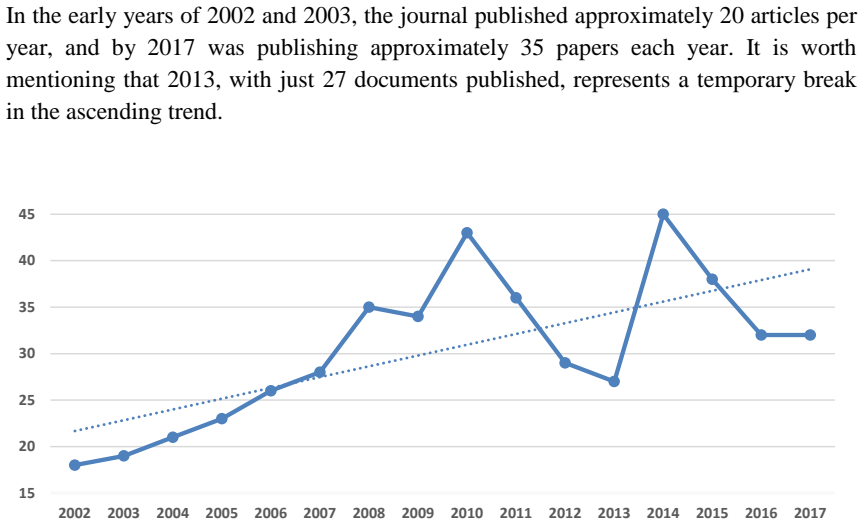
Over the entire period, the annual percentage growth rate was −1.94%. Comparing Table 1 with a table created by Jena, Swain, and Sahoo (2012) shows a huge rise in the number of articles published during the second period (2011–2017). Over the 15 years in question, the journal published 454 documents. Figure 1 provides a graphical description of the upward...
work page 2012
-
[2017]
Specifically, it compares this journal’s trends with those of other library and information science (LIS) journals from the same geographical area (India, and Asia as a whole) and with the 10 highest-rated LIS journals worldwide. The source of the data used was the multidisciplinary database Scopus. To perform this comparison, ALIS’ production was analyze...
Reviewed August 14, 2026 · model on record in the stance chip above.
Discussion (0). Continue with ORCID to comment.